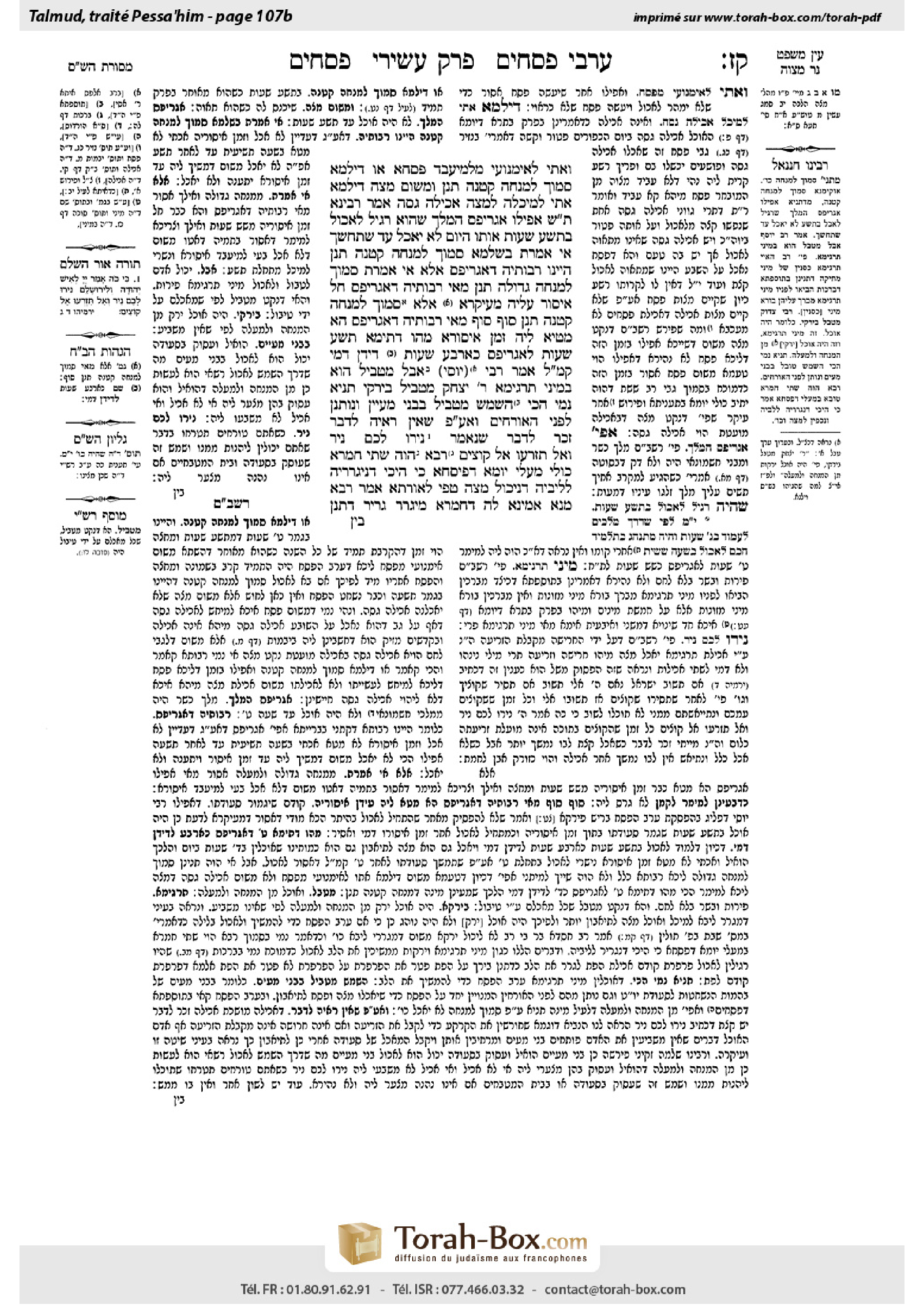
Pesachim 107b: Talmud study for Daf Yomi
Daf Yomi is the daily study of one Talmud folio. Explore 37 tractates with scans, Hebrew text, Sefaria English and AI-generated French translations where annotated.
Passage selection and English or AI-generated French translation are available where the scan has annotations. Daf Study is independent of Torah-Box and Sefaria.
Browse Pesachim · פסחים · All tractatesPesachim 107b text and translations
This page of Pesachim includes the Aramaic text, an English translation and an AI-generated French translation, alongside the scan above.
פסחים ק״ז ב · Aramaic and Hebrew text
וְאָתֵי לְאִימְּנוֹעֵי מִלְּמִיעְבַּד פִּסְחָא. אוֹ דִילְמָא, סָמוּךְ לְמִנְחָה קְטַנָּה תְּנַן — וּמִשּׁוּם מַצָּה, דִּילְמָא אָתֵי לְמֵיכְלַהּ לְמַצָּה אֲכִילָה גַּסָּה.
אָמַר רָבִינָא, תָּא שְׁמַע: אֲפִילּוּ אַגְרִיפַּס הַמֶּלֶךְ שֶׁהוּא רָגִיל לֶאֱכוֹל בְּתֵשַׁע שָׁעוֹת — אוֹתוֹ הַיּוֹם לֹא יֹאכַל עַד שֶׁתֶּחְשַׁךְ. אִי אָמְרַתְּ בִּשְׁלָמָא סָמוּךְ לְמִנְחָה קְטַנָּה תְּנַן, הַיְינוּ רְבוּתֵיהּ דְּאַגְרִיפַּס.
אֶלָּא אִי אָמְרַתְּ סָמוּךְ לְמִנְחָה גְּדוֹלָה תְּנַן, מַאי רְבוּתֵיהּ דְּאַגְרִיפַּס? חָל אִיסּוּר עֲלֵיהּ מֵעִיקָּרָא! אֶלָּא סָמוּךְ לְמִנְחָה קְטַנָּה תְּנַן.
סוֹף סוֹף מַאי רְבוּתֵיהּ דְּאַגְרִיפַּס, הָא מָטְיָא לֵיהּ זְמַן אִיסּוּרָא! מַהוּ דְּתֵימָא תֵּשַׁע שָׁעוֹת לְאַגְרִיפַּס כְּאַרְבַּע שָׁעוֹת דִּידַן דָּמֵי, קָא מַשְׁמַע לַן.
אָמַר רַבִּי (יוֹסֵי): אֲבָל מְטַבֵּיל הוּא בְּמִינֵי תַּרְגִּימָא. רַבִּי יִצְחָק מְטַבֵּיל בְּיַרְקֵי. תַּנְיָא נָמֵי הָכִי: הַשַּׁמָּשׁ מְטַבֵּיל בִּבְנֵי מֵעַיִין וְנוֹתְנָן לִפְנֵי הָאוֹרְחִים.
וְאַף עַל פִּי שֶׁאֵין רְאָיָה לַדָּבָר, זֵכֶר לַדָּבָר, שֶׁנֶּאֱמַר: ״נִירוּ לָכֶם נִיר וְאַל תִּזְרְעוּ אֶל קוֹצִים״.
רָבָא הֲוָה שָׁתֵי חַמְרָא כּוּלֵּי מַעֲלֵי יוֹמָא דְפִיסְחָא, כִּי הֵיכִי דְּנִיגְרְרֵיהּ לְלִיבֵּיהּ דְּנֵיכוֹל מַצָּה טְפֵי לְאוּרְתָּא. אָמַר רָבָא: מְנָא אָמֵינָא לַהּ דְּחַמְרָא מִיגְרָר גָּרֵיר, דִּתְנַן:
Pesachim 107b · English translation
and he will end up refraining from performing the Paschal lamb? Or perhaps we learned this halakha in the mishna as pertaining to the time adjacent to the lesser minḥa, and the reason for the prohibition is due to matza. If one eats shortly before nightfall, perhaps he will come to eat the matza as an act of excessive eating, when one forces himself to eat despite the fact that he has no desire to do so.
Ravina said: Come and hear a solution from a baraita: Even King Agrippa, who regularly eats every day at nine hours, i.e., three hours before sunset, on that day of Passover eve, he may not eat until dark. Ravina infers from this baraita: Granted, if you say that we learned in the mishna that it is prohibited to eat adjacent to the lesser minḥa, this is why his actions are accounted to the greatness of Agrippa, as he refrained from eating despite the fact that the prohibition had not yet gone into effect.
However, if you say that we learned in the mishna that one may not eat adjacent to the greater minḥa, what is the greatness of Agrippa? The prohibition against eating had already taken effect at the outset, right after midday. Rather, it must be that we learned in the mishna that it is prohibited to eat adjacent to the lesser minḥa, and Agrippa was praised for changing his regular routine, despite the fact that he was not obligated to do so.
However, the question still remains: Ultimately, what is the greatness of Agrippa? The time of the prohibition had arrived. Although the ninth hour begins shortly before the prohibition goes into effect, Agrippa’s meal would presumably extend into the time when it is prohibited to eat, and therefore it was indeed prohibited for him to start his meal at the regular time. The Gemara answers: Since Agrippa was accustomed to eating in the afternoon, it might have been thought that he should be permitted to eat at this hour on Passover eve as well. Lest you say that since Agrippa would not eat during the morning like most people, nine hours for Agrippa is considered like four hours for us, the baraita therefore teaches us that we do not distinguish between Agrippa and anyone else in this regard.
Rabbi Yosei said: It is prohibited to eat a proper meal from minḥa time onward; however, one may dip and eat types of refreshments, e.g., fruit or meat that do not constitute a full meal and will not fill one’s stomach. The Gemara relates that Rabbi Yitzḥak would dip and eat vegetables. That opinion, that it is permitted to snack after minḥa time on Passover eve, was also taught in a baraita: During the afternoon of Passover eve, the waiter may dip in the intestines of the animals that had been slaughtered in preparation for the Festival meals and place them before the guests who had registered for the Paschal lamb. This was done to whet their appetites, so they would eat the Paschal lamb and matza that evening with greater relish.
The baraita continues: And although there is no absolute proof for this matter, there is an allusion to this matter, as it is stated: “Break up for yourselves a fallow ground, and do not sow among thorns” (Jeremiah 4:3). This verse teaches that one must undertake preparations to achieve positive results. Similarly, one should eat a small amount in the afternoon to enable him to consume more in the evening.
The Gemara relates that Rava would drink wine the entire day of Passover eve, so as to whet his appetite to enable him to eat more matza at night. Rava said: From where do I say it, that wine whets the appetite? As we learned in a mishna:
Pesachim 107b · Traduction française (IA)
et il finira par s’abstenir d’accomplir le sacrifice pascal ? Ou peut-être avons-nous appris cette halakha dans la Michna à propos du moment qui précède de peu la petite minḥa, et l’interdiction est due à la matsa. S’il mange peu avant la tombée de la nuit, peut-être en viendra-t-il à manger la matsa par excès, en se forçant à manger alors qu’il n’en a pas envie.
Ravina dit : « Viens et entends une solution tirée d’une baraïta : même le roi Agrippa, qui avait l’habitude de manger chaque jour à la neuvième heure, c’est-à-dire trois heures avant le coucher du soleil, ne peut pas manger ce jour-là, la veille de Pessa’h, avant la nuit. » Ravina déduit de cette baraïta : il est logique que, si tu dis que nous avons appris dans la Michna qu’il est interdit de manger à l’approche de la petite minḥa, les actes d’Agrippa soient considérés comme remarquables, puisqu’il s’est abstenu de manger alors même que l’interdiction n’était pas encore entrée en vigueur.
Cependant, si tu dis que nous avons appris dans la Michna qu’il est interdit de manger à l’approche de la grande minḥa, en quoi Agrippa se montre-t-il remarquable ? L’interdiction de manger était déjà entrée en vigueur dès le début, juste après la mi-journée. Il faut donc conclure que nous avons appris dans la Michna qu’il est interdit de manger à l’approche de la petite minḥa, et qu’Agrippa a été loué pour avoir modifié ses habitudes, bien qu’il n’y fût pas obligé.
Cependant, la question demeure : au fond, en quoi Agrippa se montre-t-il remarquable ? Le moment où l’interdiction entrait en vigueur était arrivé. Bien que la neuvième heure commence peu avant l’entrée en vigueur de l’interdiction, le repas d’Agrippa se serait vraisemblablement prolongé jusqu’au moment où il est interdit de manger ; il lui était donc bel et bien interdit de commencer son repas à l’heure habituelle. La Guemara répond : puisque Agrippa avait l’habitude de manger l’après-midi, on aurait pu penser qu’il lui était également permis de manger à cette heure-là la veille de Pessa’h. De peur que tu ne dises que, puisque Agrippa ne mangeait pas le matin, contrairement à la plupart des gens, sa neuvième heure équivalait pour lui à notre quatrième heure, la baraïta nous enseigne donc que, sur ce point, nous ne faisons aucune distinction entre Agrippa et les autres.
Rabbi Yosei dit : il est interdit de prendre un véritable repas à partir de l’heure de la minḥa ; cependant, on peut tremper et manger des aliments légers, par exemple des fruits ou de la viande, qui ne constituent pas un repas complet et ne remplissent pas l’estomac. La Guemara rapporte que Rabbi Yitzḥak trempait et mangeait des légumes. Cette opinion, selon laquelle il est permis de grignoter après l’heure de la minḥa la veille de Pessa’h, est également enseignée dans une baraïta : l’après-midi de la veille de Pessa’h, le serveur peut tremper dans les intestins des animaux abattus en vue des repas de la fête, puis en présenter aux convives inscrits pour le sacrifice pascal. Cela avait pour but de leur ouvrir l’appétit, afin qu’ils mangent le sacrifice pascal et la matsa ce soir-là avec davantage de plaisir.
La baraïta poursuit : bien qu’il n’y ait pas de preuve absolue à ce sujet, il existe une allusion à cette idée, comme il est dit : « Défrichez pour vous un champ en friche, et ne semez pas parmi les épines » (Jérémie 4:3). Ce verset enseigne qu’il faut entreprendre des préparatifs pour obtenir des résultats positifs. De même, on devrait manger une petite quantité l’après-midi afin de pouvoir consommer davantage le soir.
La Guemara rapporte que Rava buvait du vin toute la journée de la veille de Pessa’h afin de s’ouvrir l’appétit et de pouvoir manger davantage de matsa le soir. Rava dit : « D’où est-ce que je tire cette idée, selon laquelle le vin ouvre l’appétit ? » Comme nous l’avons appris dans une Michna :
Traduction française générée par IA à partir de l’édition anglaise de Sefaria. Vérifie toujours un passage avec le texte source.
Text from Sefaria: William Davidson Edition - Vocalized Aramaic (CC BY NC); William Davidson Edition - English (CC BY NC).