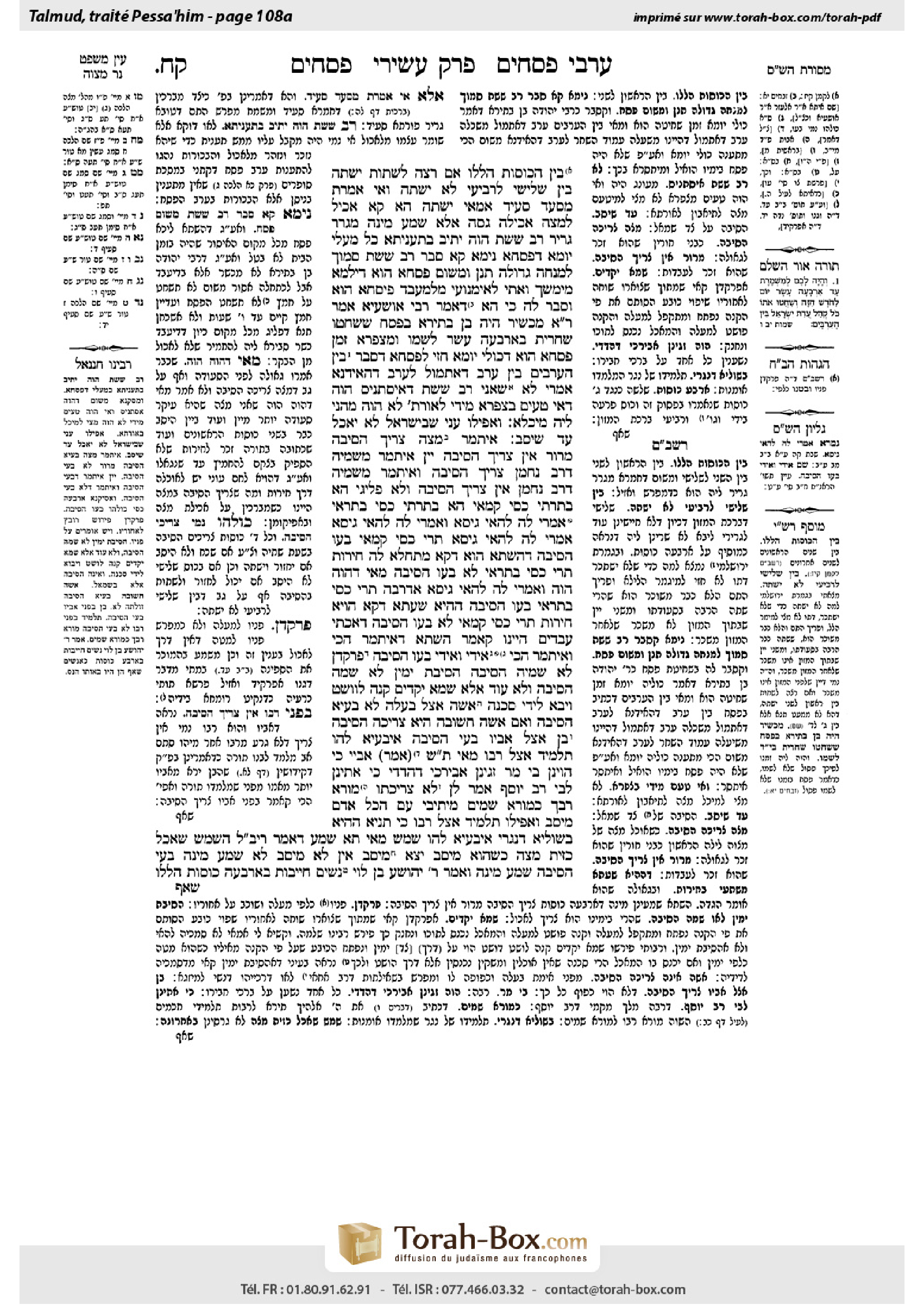
Pesachim 108a: Talmud study for Daf Yomi
Daf Yomi is the daily study of one Talmud folio. Explore 37 tractates with scans, Hebrew text, Sefaria English and AI-generated French translations where annotated.
Passage selection and English or AI-generated French translation are available where the scan has annotations. Daf Study is independent of Torah-Box and Sefaria.
Browse Pesachim · פסחים · All tractatesPesachim 108a text and translations
This page of Pesachim includes the Aramaic text, an English translation and an AI-generated French translation, alongside the scan above.
פסחים ק״ח א · Aramaic and Hebrew text
בֵּין הַכּוֹסוֹת הַלָּלוּ אִם רָצָה לִשְׁתּוֹת — יִשְׁתֶּה, בֵּין שְׁלִישִׁי לִרְבִיעִי — לֹא יִשְׁתֶּה. וְאִי אָמְרַתְּ מִסְעָד סָעֵיד, אַמַּאי יִשְׁתֶּה? הָא קָא אָכֵיל לְמַצָּה אֲכִילָה גַּסָּה. אֶלָּא שְׁמַע מִינַּהּ: מִגְרָר גָּרֵיר.
רַב שֵׁשֶׁת הֲוָה יָתֵיב בְּתַעֲנִיתָא כׇּל מַעֲלֵי יוֹמָא דְפִסְחָא. נֵימָא קָא סָבַר רַב שֵׁשֶׁת: סָמוּךְ לְמִנְחָה גְּדוֹלָה תְּנַן — וּמִשּׁוּם פִּסְחָא הוּא, דִּילְמָא מִימְּשַׁךְ וְאָתֵי לְאִימְּנוֹעֵי מִלְּמֶעְבַּד פִּיסְחָא הוּא,
וְסָבַר לַהּ כִּי הָא דְּאָמַר רַבִּי אוֹשַׁעְיָא אָמַר רַבִּי אֶלְעָזָר: מַכְשִׁיר הָיָה בֶּן בְּתֵירָא בְּפֶסַח שֶׁשְּׁחָטוֹ שַׁחֲרִית בְּאַרְבָּעָה עָשָׂר לִשְׁמוֹ, וּמִצַּפְרָא זְמַן פִּסְחָא הוּא, דְּכוּלֵּי יוֹמָא חֲזֵי לְפִסְחָא,
דְּסָבַר ״בֵּין הָעַרְבַּיִם״ — בֵּין עֶרֶב דְּאֶתְמוֹל לְעֶרֶב דְּהָאִידָּנָא.
אָמְרִי: לָא, שָׁאנֵי רַב שֵׁשֶׁת דְּאִיסְתְּנִיס הֲוָה, דְּאִי טָעֵים בְּצַפְרָא מִידֵּי, לְאוּרְתָּא לָא הֲוָה מַהְנֵי לֵיהּ מֵיכְלָא.
וַאֲפִילּוּ עָנִי שֶׁבְּיִשְׂרָאֵל לֹא יֹאכַל עַד שֶׁיָּסֵב. אִיתְּמַר: מַצָּה צָרִיךְ הֲסִיבָּה, מָרוֹר אֵין צָרִיךְ הֲסִיבָּה. יַיִן, אִיתְּמַר מִשְּׁמֵיהּ דְּרַב נַחְמָן: צָרִיךְ הֲסִיבָּה. וְאִיתְּמַר מִשְּׁמֵיהּ דְּרַב נַחְמָן: אֵין צָרִיךְ הֲסִיבָּה.
וְלָא פְּלִיגִי: הָא בְּתַרְתֵּי כָּסֵי קַמָּאֵי, הָא בְּתַרְתֵּי כָּסֵי בָּתְרָאֵי. אָמְרִי לַהּ לְהַאי גִּיסָא וְאָמְרִי לַהּ לְהַאי גִּיסָא. אָמְרִי לַהּ לְהַאי גִּיסָא: תְּרֵי כָּסֵי קַמָּאֵי — בָּעוּ הֲסִיבָּה, דְּהַשְׁתָּא הוּא דְּקָא מַתְחֲלָא לַהּ חֵירוּת. תְּרֵי כָּסֵי בָּתְרָאֵי — לָא בָּעוּ הֲסִיבָּה, מַאי דַּהֲוָה הֲוָה.
וְאָמְרִי לַהּ לְהַאי גִּיסָא: אַדְּרַבָּה, תְּרֵי כָּסֵי בָּתְרָאֵי — בָּעוּ הֲסִיבָּה, הָהִיא שַׁעְתָּא דְּקָא הָוְיָא חֵירוּת. תְּרֵי כָּסֵי קַמָּאֵי — לָא בָּעוּ הֲסִיבָּה, דְּאַכַּתִּי ״עֲבָדִים הָיִינוּ״ קָאָמַר. הַשְׁתָּא דְּאִיתְּמַר הָכִי וְאִיתְּמַר הָכִי, אִידֵּי וְאִידֵּי בָּעוּ הֲסִיבָּה.
פְּרַקְדָּן לָא שְׁמֵיהּ הֲסִיבָּה. הֲסִיבַּת יָמִין לָא שְׁמַהּ הֲסִיבָּה. וְלֹא עוֹד, אֶלָּא שֶׁמָּא יַקְדִּים קָנֶה לְוֶושֶׁט, וְיָבֹא לִידֵי סַכָּנָה.
אִשָּׁה אֵצֶל בַּעְלָהּ לָא בָּעֲיָא הֲסִיבָּה, וְאִם אִשָּׁה חֲשׁוּבָה הִיא — צְרִיכָה הֲסִיבָּה. בֵּן אֵצֶל אָבִיו בָּעֵי הֲסִיבָּה. אִיבַּעְיָא לְהוּ: תַּלְמִיד אֵצֶל רַבּוֹ מַאי?
תָּא שְׁמַע, (אֲמַר) אַבָּיֵי: כִּי הֲוֵינַן בֵּי מָר זְגֵינַן אַבִּירְכֵי דַהֲדָדֵי, כִּי אָתֵינַן לְבֵי רַב יוֹסֵף, אָמַר לַן: לָא צְרִיכִתוּ, מוֹרָא רַבָּךְ כְּמוֹרָא שָׁמַיִם.
מֵיתִיבִי: עִם הַכֹּל אָדָם מֵיסֵב, וַאֲפִילּוּ תַּלְמִיד אֵצֶל רַבּוֹ! כִּי תַּנְיָא הָהִיא — בִּשְׁוַלְיָא דְנַגָּרֵי.
אִיבַּעְיָא לְהוּ: שַׁמָּשׁ מַאי? תָּא שְׁמַע, דְּאָמַר רַבִּי יְהוֹשֻׁעַ בֶּן לֵוִי: הַשַּׁמָּשׁ שֶׁאָכַל כְּזַיִת מַצָּה כְּשֶׁהוּא מֵיסֵב — יָצָא. מֵיסֵב — אִין, לֹא מֵיסֵב — לָא. שְׁמַע מִינַּהּ: בָּעֵי הֲסִיבָּה. שְׁמַע מִינַּהּ.
וְאָמַר רַבִּי יְהוֹשֻׁעַ בֶּן לֵוִי: נָשִׁים חַיָּיבוֹת בְּאַרְבָּעָה כּוֹסוֹת הַלָּלוּ,
Pesachim 108a · English translation
During the Passover seder, between these cups that one is obligated to drink, e.g., between the first two of the four cups of wine, if one wants to drink he may drink. However, between the third and fourth cups, which are consumed after the meal, one may not drink. And if you say that wine satisfies a person, why may one drink extra cups? He will later eat matza when he is already satiated, which will constitute an excessive eating. Rather, learn from this that wine whets the appetite.
The Gemara relates that Rav Sheshet would fast the entire eve of Passover. The Gemara asks: Shall we say that Rav Sheshet maintains that this practice was necessary because of two factors? First, when the mishna states that one may not eat adjacent to minḥa time, we learned this ruling with regard to the period of time adjacent to the greater minḥa, and the reason for the prohibition is due to the Paschal lamb, lest one be drawn after one’s meal and come to refrain from performing the sacrifice of the Paschal lamb.
And second, Rav Sheshet maintains in accordance with that statement that Rabbi Oshaya said that Rabbi Elazar said: Ben Beteira would deem valid a Paschal lamb that was slaughtered in the morning on the fourteenth of Nisan for its own purpose, as from the morning it is already the time during which a Paschal lamb may be sacrificed, as the whole day is fit for the Paschal lamb.
As ben Beteira maintained that when the Torah says the Paschal lamb must be sacrificed “bein ha’arbayim” (Exodus 12:6), which literally means: Between the evenings, but is often rendered: In the afternoon, the term refers to any time between the evening of yesterday and the current evening of the fourteenth. In other words, as Rav Sheshet maintained that the reason one may not eat on Passover eve is to prevent him from being distracted from preparing the Paschal lamb, and he also maintained that the Paschal offering may be sacrificed during the entire day of the fourteenth of Nisan, therefore, he would not eat that entire day.
They say in response to this suggested interpretation of Rav Sheshet’s practice: No, it is by no means clear that this was his reasoning. Rav Sheshet was different, as he was delicate [istenis], for if he would taste some food in the morning, the food he ate at night would not be effective for him. He would therefore fast the whole day so that he could eat matza at night with a hearty appetite.
We learned in the mishna that even the poorest of Jews should not eat until he reclines. It was stated that amora’im discussed the requirement to recline. Everyone agrees that matza requires reclining, i.e., one must recline when eating matza, and bitter herbs do not require reclining. With regard to wine, it was stated in the name of Rav Naḥman that wine requires reclining, and it was also stated in the name of Rav Naḥman that wine does not require reclining.
The Gemara explains: And these two statements do not disagree with each other: This statement is referring to the first two cups, and that statement is referring to the last two cups. However, it was not clear which two cups require reclining according to Rav Naḥman. Some say the explanation in this manner and some say it in that manner. The Gemara elaborates: Some say it in this manner, that the first two cups require reclining, as it is now that freedom begins. Since reclining is a sign of freedom, while discussing the exodus from Egypt it is appropriate to drink while reclining. By contrast, the last two cups do not require reclining, because what was already was. In other words, by this point one has completed the discussion of the Exodus and has reached the latter stages of the seder.
And some say it in that manner and claim that on the contrary, the last two cups require reclining, as it is at that time that there is freedom. However, the first two cups do not require reclining, as one still says: We were slaves. The Gemara concludes: Now that it was stated so, and it was stated so, i.e., there are two conflicting opinions and it cannot be proven which two cups require reclining, both these sets of cups and those require reclining.
The Gemara continues to discuss the halakha of reclining. Lying on one’s back is not called reclining. Reclining to the right is not called reclining, as free men do not recline in this manner. People prefer to recline on their left and use their right hand to eat, whereas they find it more difficult to eat the other way. And not only that, but if one reclines to the right, perhaps the windpipe will precede the esophagus. The food will enter the windpipe, and one will come into danger of choking.
A woman who is with her husband is not required to recline, but if she is an important woman, she is required to recline. A son who is with his father is required to recline. A dilemma was raised before the Sages: What is the halakha with regard to a student who is with his teacher? Perhaps he is not obligated to recline, as he is in awe of his rabbi, and reclining is a sign of complete freedom and independence.
Come and hear a proof that Abaye said: When we were in the house of my Master, Rabba, there was not enough room for everyone to recline on Passover, so we reclined on each other’s knees, to fulfill the obligation to recline. When we came to the house of Rav Yosef, he said to us: You need not recline, as the fear of your teacher is like the fear of Heaven. A student is subject to the authority of his teacher and may not display freedom in his presence.
The Gemara raises an objection: A person must recline in the presence of anyone, and even a student who is with his teacher must do so. This baraita directly contradicts the statement of Rav Yosef. The Gemara answers: When that baraita was taught, it was with regard to a craftsman’s apprentice, not a student of Torah in the company of his rabbi. One who is in the presence of a person teaching him a trade is not in awe of his instructor, and he is therefore obligated to recline.
A dilemma was raised before the Sages: What is the halakha with regard to a waiter? Is a waiter obligated to recline? The Gemara answers: Come and hear a solution, as Rabbi Yehoshua ben Levi said: A waiter who ate an olive-bulk of matza while reclining has fulfilled his obligation. The Gemara infers: If he ate matza while reclining, yes, he has fulfilled his obligation; if he was not reclining, no, he has not fulfilled the obligation. Learn from this that a waiter requires reclining. The Gemara concludes: Indeed, learn from it that this is the case.
And Rabbi Yehoshua ben Levi said: Women are obligated in these four cups of wine at the Passover seder.
Pesachim 108a · Traduction française (IA)
Pendant le séder de Pessa'h, entre les coupes que l’on est tenu de boire — par exemple, entre les deux premières des quatre coupes de vin —, on peut boire si on le souhaite. En revanche, entre la troisième et la quatrième coupe, qui sont consommées après le repas, il est interdit de boire. Or, si l’on prétend que le vin rassasie, pourquoi peut-on boire des coupes supplémentaires ? On mangerait ensuite la matsa alors qu’on serait déjà rassasié, ce qui constituerait une consommation excessive. Il faut plutôt en déduire que le vin ouvre l’appétit.
La Guemara rapporte que Rav Sheshet jeûnait toute la veille de Pessa'h. La Guemara demande : Faut-il en conclure que Rav Sheshet estimait que cette pratique était nécessaire pour deux raisons ? Premièrement, lorsque la Michna enseigne qu’il ne faut pas manger à l’approche de l’heure de min’ha, nous avons appris cette règle au sujet de la période qui précède la grande min’ha ; l’interdiction s’explique par le sacrifice pascal, car on craint que l’on ne se laisse entraîner par le repas et que l’on finisse par renoncer à offrir le sacrifice pascal.
Deuxièmement, Rav Sheshet suivait l’opinion exprimée par Rabbi Oshaya au nom de Rabbi Elazar : Ben Beteira déclarait valide un sacrifice pascal abattu le matin du quatorze nissan dans l’intention requise, car dès le matin, c’est déjà le moment où le sacrifice pascal peut être offert, puisque toute la journée convient à son offrande.
Ben Beteira estimait en effet que, lorsque la Torah dit que le sacrifice pascal doit être offert « bein ha’arbayim » (Exode 12,6), expression qui signifie littéralement « entre les soirs », mais que l’on rend souvent par « dans l’après-midi », cela désigne n’importe quel moment entre le soir de la veille et le soir du quatorze. Autrement dit, Rav Sheshet estimait que l’on ne doit pas manger la veille de Pessa'h afin d’éviter d’être détourné de la préparation du sacrifice pascal, et il estimait également que celui-ci pouvait être offert pendant toute la journée du quatorze nissan ; c’est pourquoi il ne mangeait pas de toute cette journée.
On répond à cette interprétation proposée de la conduite de Rav Sheshet : Non, rien ne permet d’affirmer que telle était sa raison. Rav Sheshet était un cas particulier, car il était délicat [istenis] : s’il goûtait à un aliment le matin, la nourriture qu’il mangerait le soir ne lui profiterait pas. Il jeûnait donc toute la journée afin de pouvoir manger la matsa le soir avec un bon appétit.
Nous avons appris dans la Michna que même le plus pauvre des Juifs ne doit pas manger avant de s’accouder. Des amoraïm ont discuté de l’obligation de s’accouder. Tous conviennent qu’il faut s’accouder pour manger la matsa, tandis que les herbes amères ne requièrent pas que l’on s’accoude. À propos du vin, une opinion a été rapportée au nom de Rav Naḥman selon laquelle il faut s’accouder pour le boire, et une autre opinion a également été rapportée en son nom, selon laquelle il n’est pas nécessaire de s’accouder pour le boire.
La Guemara explique que ces deux déclarations ne se contredisent pas : l’une concerne les deux premières coupes, l’autre les deux dernières. Cependant, on ne savait pas clairement lesquelles des deux séries de coupes, selon Rav Naḥman, requièrent que l’on s’accoude. Certains l’expliquent d’une manière, d’autres de l’autre. La Guemara précise : certains disent que les deux premières coupes requièrent que l’on s’accoude, car c’est alors que commence la liberté. Puisque s’accouder est un signe de liberté, il convient de boire ainsi lorsqu’on évoque la sortie d’Égypte. En revanche, les deux dernières coupes ne requièrent pas que l’on s’accoude, car ce qui est passé est passé. Autrement dit, à ce stade, on a terminé le récit de la sortie d’Égypte et l’on est parvenu aux dernières étapes du séder.
D’autres l’expliquent de l’autre manière et soutiennent qu’au contraire, les deux dernières coupes requièrent que l’on s’accoude, car c’est alors que l’on est libre. En revanche, les deux premières coupes ne requièrent pas que l’on s’accoude, puisque l’on dit encore : « Nous étions esclaves. » La Guemara conclut : Puisque les deux opinions ont été rapportées et qu’on ne peut établir laquelle des deux séries de coupes requiert que l’on s’accoude, il faut s’accouder pour les deux séries, les premières comme les dernières.
La Guemara poursuit sa discussion sur la halakha de l’accoudement. Être allongé sur le dos ne s’appelle pas s’accouder. S’accouder sur le côté droit ne s’appelle pas non plus s’accouder, car les hommes libres ne s’accoudent pas ainsi. On préfère s’accouder sur le côté gauche et manger de la main droite, tandis qu’il est plus difficile de manger dans l’autre position. De plus, si l’on s’accoude sur le côté droit, la trachée pourrait se trouver au-dessus de l’œsophage. La nourriture entrerait dans la trachée et l’on risquerait de s’étouffer.
Une femme qui est avec son mari n’est pas tenue de s’accouder, mais une femme importante est tenue de le faire. Un fils qui est avec son père est tenu de s’accouder. Les Sages ont soulevé un dilemme : quelle est la halakha concernant un élève qui est avec son maître ? Peut-être n’est-il pas tenu de s’accouder, car il éprouve de la crainte envers son maître, et s’accouder est un signe de liberté et d’indépendance totales.
Venez et entendez une preuve tirée de ce qu’a dit Abaye : « Lorsque nous étions chez mon maître Rabba, il n’y avait pas assez de place pour que chacun s’accoude à Pessa'h ; nous nous sommes donc accoudés les uns sur les genoux des autres afin d’accomplir l’obligation de s’accouder. Lorsque nous sommes arrivés chez Rav Yosef, il nous a dit : “Vous n’avez pas besoin de vous accouder, car la crainte de votre maître est comme la crainte du Ciel.” » Un élève est soumis à l’autorité de son maître et ne peut manifester sa liberté en sa présence.
La Guemara soulève une objection : Il faut s’accouder en présence de n’importe qui, et même un élève qui est avec son maître doit le faire. Cette baraïta contredit directement la déclaration de Rav Yosef. La Guemara répond : Lorsque cette baraïta a été enseignée, elle concernait l’apprenti d’un artisan, et non un élève en Torah en compagnie de son maître. Celui qui se trouve en présence d’une personne qui lui enseigne un métier ne la craint pas ; il est donc tenu de s’accouder.
Les Sages ont soulevé un dilemme : quelle est la halakha concernant un serveur ? Est-il tenu de s’accouder ? La Guemara répond : Venez et entendez une solution, car Rabbi Yehoshua ben Levi a dit : « Un serveur qui a mangé un volume d’olive de matsa en s’accoudant a accompli son obligation. » La Guemara en déduit : S’il a mangé la matsa en s’accoudant, oui, il a accompli son obligation ; s’il ne s’est pas accoudé, non, il ne l’a pas accomplie. Il faut en conclure qu’un serveur est tenu de s’accouder. La Guemara conclut : En effet, il faut en conclure que c’est le cas.
Et Rabbi Yehoshua ben Levi a dit : Les femmes sont tenues de boire ces quatre coupes de vin lors du séder de Pessa'h.
Traduction française générée par IA à partir de l’édition anglaise de Sefaria. Vérifie toujours un passage avec le texte source.
Text from Sefaria: William Davidson Edition - Vocalized Aramaic (CC BY NC); William Davidson Edition - English (CC BY NC).