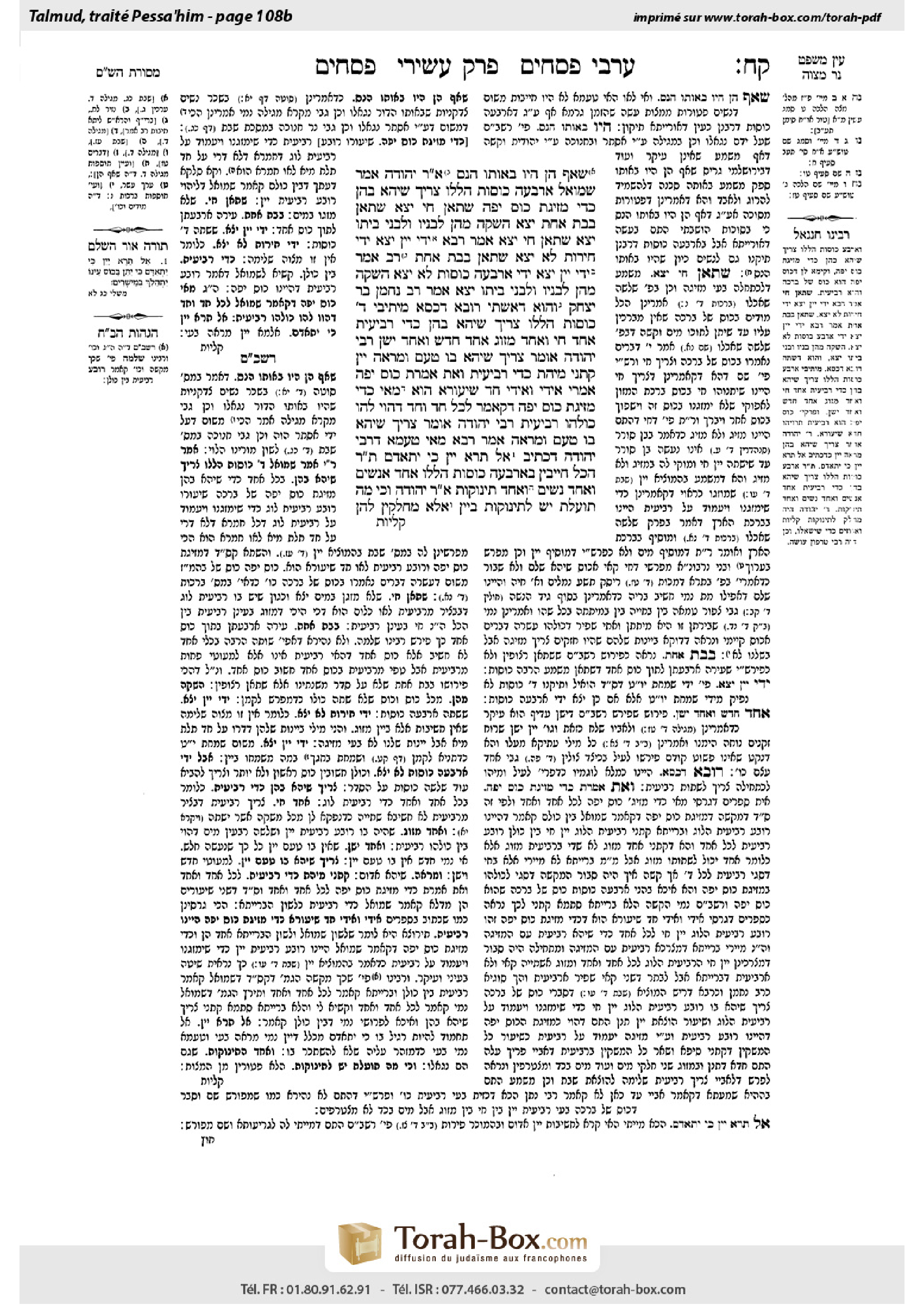
Pesachim 108b: Talmud study for Daf Yomi
Daf Yomi is the daily study of one Talmud folio. Explore 37 tractates with scans, Hebrew text, Sefaria English and AI-generated French translations where annotated.
Passage selection and English or AI-generated French translation are available where the scan has annotations. Daf Study is independent of Torah-Box and Sefaria.
Browse Pesachim · פסחים · All tractatesPesachim 108b text and translations
This page of Pesachim includes the Aramaic text, an English translation and an AI-generated French translation, alongside the scan above.
פסחים ק״ח ב · Aramaic and Hebrew text
שֶׁאַף הֵן הָיוּ בְּאוֹתוֹ הַנֵּס.
אָמַר רַב יְהוּדָה אָמַר שְׁמוּאֵל: אַרְבָּעָה כּוֹסוֹת הַלָּלוּ צָרִיךְ שֶׁיְּהֵא בָּהֶן כְּדֵי מְזִיגַת כּוֹס יָפֶה. שְׁתָאָן חַי — יָצָא. שְׁתָאָן בְּבַת אַחַת — יָצָא. הִשְׁקָה מֵהֶן לְבָנָיו וְלִבְנֵי בֵיתוֹ — יָצָא.
שְׁתָאָן חַי יָצָא, אָמַר רָבָא: יְדֵי יַיִן — יָצָא, יְדֵי חֵירוּת — לֹא יָצָא.
שְׁתָאָן בְּבַת אַחַת, רַב אָמַר: יְדֵי יַיִן — יָצָא, יְדֵי אַרְבָּעָה כּוֹסוֹת — לֹא יָצָא. הִשְׁקָה מֵהֶן לְבָנָיו וְלִבְנֵי בֵיתוֹ — יָצָא, אָמַר רַב נַחְמָן בַּר יִצְחָק: וְהוּא דְּאִשְׁתִּי רוּבָּא דְכָסָא.
מֵיתִיבִי: אַרְבָּעָה כּוֹסוֹת הַלָּלוּ צָרִיךְ שֶׁיְּהֵא בָּהֶן כְּדֵי רְבִיעִית, אֶחָד חַי וְאֶחָד מָזוּג, אֶחָד חָדָשׁ וְאֶחָד יָשָׁן. רַבִּי יְהוּדָה אוֹמֵר: צָרִיךְ שֶׁיְּהֵא בּוֹ טַעַם וּמַרְאֵה יַיִן. קָתָנֵי מִיהַת כְּדֵי רְבִיעִית, וְאַתְּ אָמְרַתְּ כּוֹס יָפֶה!
אָמְרִי: אִידֵּי וְאִידֵּי חַד שִׁיעוּרָא הוּא, מַאי ״כְּדֵי מְזִיגַת כּוֹס יָפֶה״ דְּקָאָמַר — לְכׇל חַד וְחַד, דְּהָוֵי לְהוּ כּוּלְּהוּ רְבִיעִית.
רַבִּי יְהוּדָה אוֹמֵר: צָרִיךְ שֶׁיְּהֵא בּוֹ טַעַם וּמַרְאֶה. אָמַר רָבָא: מַאי טַעְמָא דְּרַבִּי יְהוּדָה, דִּכְתִיב: ״אַל תֵּרֶא יַיִן כִּי יִתְאַדָּם״.
תָּנוּ רַבָּנַן: הַכֹּל חַיָּיבִין בְּאַרְבָּעָה כּוֹסוֹת הַלָּלוּ, אֶחָד אֲנָשִׁים, וְאֶחָד נָשִׁים, וְאֶחָד תִּינוֹקוֹת. אָמַר רַבִּי יְהוּדָה: וְכִי מָה תּוֹעֶלֶת יֵשׁ לְתִינוֹקוֹת בְּיַיִן? אֶלָּא מְחַלְּקִין לָהֶן
Pesachim 108b · English translation
As they too were included in that miracle of the Exodus, they are therefore obligated to participate in the celebration.
Rav Yehuda said that Shmuel said: These four cups must contain enough undiluted wine to allow for diluting a significant cup. In talmudic times, people would not drink pure wine. They would dilute it with water, generally adding three times as much water as wine. If one drank them undiluted, he has fulfilled his obligation. If one drank them all at once, i.e., he poured all four cups of wine into one large cup and drank it, he has fulfilled the obligation. If one gave his sons or the members of his household to drink from them, he has nevertheless fulfilled the obligation.
The Gemara now addresses each of these rulings of Shmuel in turn. Shmuel said that if one drank them undiluted he has fulfilled his obligation. Rava said: He has fulfilled the obligation to drink the four cups of wine, but he has not fulfilled the obligation to drink in a way that expresses freedom, which is the preferable way to fulfill the mitzva, as aristocrats do not drink undiluted wine.
If one drank the four cups all at once, Rav said that he has fulfilled the obligation to drink wine as an expression of rejoicing on the Festival, but he has not fulfilled the obligation to drink four cups, which requires four distinct cups, each drunk separately. Shmuel also stated that if one gave his sons or the members of his household to drink from them, he has nevertheless fulfilled his obligation. Rav Naḥman bar Yitzḥak said: And this is the case only if he himself drank the majority of the cup.
The Gemara raises an objection to the above rulings from a baraita: These four cups must contain one quarter-log, whether the wine is undiluted or diluted, whether it is new or aged. Rabbi Yehuda says: It must have the taste and appearance of wine. In any event, this baraita is teaching that each cup must contain at least the amount of one quarter-log, and yet you said that each must contain enough for diluting a significant cup.
They say in response that this and that are one and the same measure. The Gemara explains: What is the meaning of the expression: Enough for diluting a significant cup, which Shmuel said? He meant that there must be enough undiluted wine for each and every one of the cups, i.e., one quarter-log of diluted wine. This amounts to one quarter-log of undiluted wine for all of them combined. A significant cup contains one quarter-log. This quarter-log is comprised of one quarter undiluted wine and three quarters water. Therefore, each cup must contain at least one quarter of one quarter-log of undiluted wine, so that one consumes a full quarter-log of liquid from each cup.
The baraita stated that Rabbi Yehuda says the cup from which one drinks must have the taste and appearance of wine. Rava said: What is the reason for the opinion of Rabbi Yehuda? As it is written: “Look not upon wine when it is red” (Proverbs 23:31). This verse proves that the appearance of wine and not only its taste is important.
The Sages taught in a baraita: All are obligated in these four cups, including men, women, and children. Rabbi Yehuda said: What benefit do children receive from wine? They do not enjoy it. Rather, one distributes to them
Pesachim 108b · Traduction française (IA)
Comme eux aussi ont été inclus dans le miracle de l’Exode, ils sont donc tenus de prendre part à la célébration.
Rav Yehouda a dit au nom de Shmuel : Ces quatre coupes doivent contenir suffisamment de vin non dilué pour pouvoir préparer une coupe importante. À l’époque talmudique, on ne buvait pas de vin pur. On le diluait avec de l’eau, généralement en ajoutant trois fois plus d’eau que de vin. Si quelqu’un les a bues sans les diluer, il s’est acquitté de son obligation. S’il les a toutes bues en une seule fois, c’est-à-dire s’il a versé le contenu des quatre coupes dans une grande coupe et l’a bue, il s’est acquitté de son obligation. S’il en a fait boire à ses fils ou aux membres de sa maisonnée, il s’est néanmoins acquitté de son obligation.
La Guemara examine maintenant tour à tour chacune de ces décisions de Shmuel. Shmuel a dit que si quelqu’un les a bues sans les diluer, il s’est acquitté de son obligation. Rava a dit : Il s’est acquitté de l’obligation de boire les quatre coupes de vin, mais pas de celle de boire d’une manière qui exprime la liberté, ce qui est la manière préférable d’accomplir la mitsva, car les aristocrates ne boivent pas de vin non dilué.
Si quelqu’un a bu les quatre coupes en une seule fois, Rav a dit qu’il s’est acquitté de l’obligation de boire du vin pour exprimer la réjouissance de la fête, mais pas de l’obligation de boire quatre coupes, qui exige quatre coupes distinctes, chacune bue séparément. Shmuel a également déclaré que si quelqu’un en a fait boire à ses fils ou aux membres de sa maisonnée, il s’est néanmoins acquitté de son obligation. Rav Naḥman bar Yitzḥak a dit : Cela n’est vrai que s’il a lui-même bu la majeure partie de la coupe.
La Guemara soulève une objection aux décisions précédentes à partir d’une baraïta : Ces quatre coupes doivent contenir un quart de log, que le vin soit non dilué ou dilué, nouveau ou vieux. Rabbi Yehouda dit : Il doit avoir le goût et l’apparence du vin. Quoi qu’il en soit, cette baraïta enseigne que chaque coupe doit contenir au moins un quart de log, alors que vous avez dit que chacune doit contenir suffisamment de vin pour préparer une coupe importante.
Ils répondent que ces deux mesures n’en font qu’une. La Guemara explique : Que signifie l’expression « suffisamment pour préparer une coupe importante », employée par Shmuel ? Il voulait dire qu’il doit y avoir assez de vin non dilué pour obtenir, pour chacune des coupes, un quart de log de vin dilué. Pour les quatre coupes réunies, cela représente un quart de log de vin non dilué. Une coupe importante contient un quart de log. Ce quart de log est composé d’un quart de vin non dilué et de trois quarts d’eau. Par conséquent, chaque coupe doit contenir au moins un quart d’un quart de log de vin non dilué, afin que l’on consomme un quart de log de liquide dans chacune des coupes.
La baraïta indiquait que, selon Rabbi Yehouda, la coupe dont on boit doit avoir le goût et l’apparence du vin. Rava a dit : Quelle est la raison de l’opinion de Rabbi Yehouda ? C’est qu’il est écrit : « Ne regarde pas le vin quand il est rouge » (Proverbes 23, 31). Ce verset prouve que l’apparence du vin importe, et pas seulement son goût.
Les Sages ont enseigné dans une baraïta : Tous sont tenus de boire ces quatre coupes, y compris les hommes, les femmes et les enfants. Rabbi Yehouda a dit : Quel plaisir les enfants tirent-ils du vin ? Ils ne l’apprécient pas. On leur distribue plutôt
Traduction française générée par IA à partir de l’édition anglaise de Sefaria. Vérifie toujours un passage avec le texte source.
Text from Sefaria: William Davidson Edition - Vocalized Aramaic (CC BY NC); William Davidson Edition - English (CC BY NC).