Pesachim 109a: Talmud study for Daf Yomi
Daf Yomi is the daily study of one Talmud folio. Explore 37 tractates with scans, Hebrew text, Sefaria English and AI-generated French translations where annotated.
Passage selection and English or AI-generated French translation are available where the scan has annotations. Daf Study is independent of Torah-Box and Sefaria.
Browse Pesachim · פסחים · All tractatesPesachim 109a text and translations
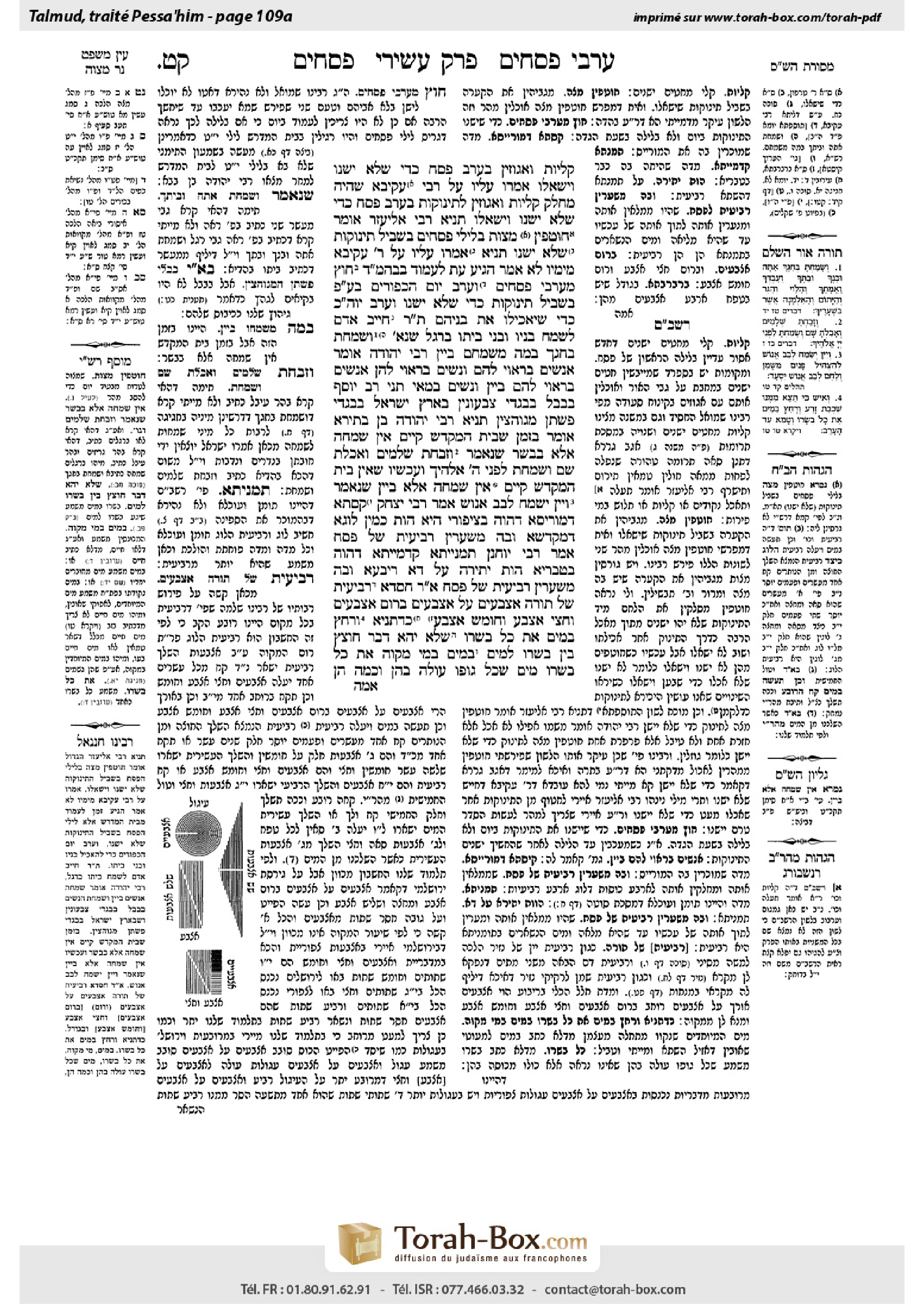
This page of Pesachim includes the Aramaic text, an English translation and an AI-generated French translation, alongside the scan above.
פסחים ק״ט א · Aramaic and Hebrew text
קְלָיוֹת וֶאֱגוֹזִין בְּעֶרֶב פֶּסַח כְּדֵי שֶׁלֹּא יִשְׁנוּ, וְיִשְׁאֲלוּ. אָמְרוּ עָלָיו עַל רַבִּי עֲקִיבָא שֶׁהָיָה מְחַלֵּק קְלָיוֹת וֶאֱגוֹזִין לְתִינוֹקוֹת בְּעֶרֶב פֶּסַח כְּדֵי שֶׁלֹּא יִשְׁנוּ, וְיִשְׁאֲלוּ. תַּנְיָא, רַבִּי אֱלִיעֶזֶר אוֹמֵר: חוֹטְפִין מַצּוֹת בְּלֵילֵי פְּסָחִים בִּשְׁבִיל תִּינוֹקוֹת שֶׁלֹּא יִשְׁנוּ.
תַּנְיָא, אָמְרוּ עָלָיו עַל רַבִּי עֲקִיבָא: מִיָּמָיו לֹא אָמַר הִגִּיעַ עֵת לַעֲמוֹד בְּבֵית הַמִּדְרָשׁ, חוּץ מֵעַרְבֵי פְסָחִים וְעֶרֶב יוֹם הַכִּפּוּרִים. בְּעֶרֶב פֶּסַח — בִּשְׁבִיל תִּינוֹקוֹת, כְּדֵי שֶׁלֹּא יִשְׁנוּ. וְעֶרֶב יוֹם הַכִּפּוּרִים — כְּדֵי שֶׁיַּאֲכִילוּ אֶת בְּנֵיהֶם.
תָּנוּ רַבָּנַן: חַיָּיב אָדָם לְשַׂמֵּחַ בָּנָיו וּבְנֵי בֵיתוֹ בָּרֶגֶל, שֶׁנֶּאֱמַר: ״וְשָׂמַחְתָּ בְּחַגֶּךָ״. בַּמֶּה מְשַׂמְּחָם — בְּיַיִן.
רַבִּי יְהוּדָה אוֹמֵר: אֲנָשִׁים בָּרָאוּי לָהֶם, וְנָשִׁים בָּרָאוּי לָהֶן. אֲנָשִׁים בָּרָאוּי לָהֶם — בְּיַיִן. וְנָשִׁים בְּמַאי? תָּנֵי רַב יוֹסֵף: בְּבָבֶל — בְּבִגְדֵי צִבְעוֹנִין, בְּאֶרֶץ יִשְׂרָאֵל — בְּבִגְדֵי פִּשְׁתָּן מְגוֹהָצִין.
תַּנְיָא, רַבִּי יְהוּדָה בֶּן בְּתֵירָא אוֹמֵר: בִּזְמַן שֶׁבֵּית הַמִּקְדָּשׁ קַיָּים אֵין שִׂמְחָה אֶלָּא בְּבָשָׂר, שֶׁנֶּאֱמַר: ״וְזָבַחְתָּ שְׁלָמִים וְאָכַלְתָּ שָּׁם וְשָׂמַחְתָּ לִפְנֵי ה׳ אֱלֹהֶיךָ״, וְעַכְשָׁיו שֶׁאֵין בֵּית הַמִּקְדָּשׁ קַיָּים, אֵין שִׂמְחָה אֶלָּא בְּיַיִן, שֶׁנֶּאֱמַר: ״וְיַיִן יְשַׂמַּח לְבַב אֱנוֹשׁ״.
אָמַר רַבִּי יִצְחָק: קִסְתָּא דְמוּרְיְסָא דַּהֲוָה בְּצִיפּוֹרִי הִיא הֲוָת כְּמִין לוּגָּא דְּמַקְדְּשָׁא, וּבָהּ מְשַׁעֲרִין רְבִיעִית שֶׁל פֶּסַח. אָמַר רַבִּי יוֹחָנָן: תְּמָנְיָיתָא קַדְמָיְיתָא דַּהֲוָה בִּטְבֶרְיָא הֲוָת יַתִּירָה עַל דָּא רִיבְעָא, וּבָהּ מְשַׁעֲרִין רְבִיעִית שֶׁל פֶּסַח.
אָמַר רַב חִסְדָּא: רְבִיעִית שֶׁל תּוֹרָה אֶצְבָּעַיִם עַל אֶצְבָּעַיִם בְּרוּם אֶצְבָּעַיִם וַחֲצִי אֶצְבַּע וְחוֹמֶשׁ אֶצְבַּע. כִּדְתַנְיָא: ״וְרָחַץ בַּמַּיִם אֶת כָּל בְּשָׂרוֹ״ — שֶׁלֹּא יְהֵא דָּבָר חוֹצֵץ בֵּין בְּשָׂרוֹ לַמַּיִם. ״בַּמַּיִם״ — בְּמֵי מִקְוֶה. ״אֶת כׇּל בְּשָׂרוֹ״ — מַיִם שֶׁכׇּל גּוּפוֹ עוֹלֶה בָּהֶן, וְכַמָּה הֵן?
Pesachim 109a · English translation
roasted grains and nuts on Passover eve, so that they will not sleep and also so they will ask the four questions at night. They said about Rabbi Akiva that he would distribute roasted grains and nuts to children on Passover eve, so that they would not sleep and so they would ask. It was taught in a baraita that Rabbi Eliezer says: One grabs the matzot on the nights of Passover. One should eat them very quickly on account of the children, so that, due to the hasty consumption of the meal, they will not sleep and they will inquire into the meaning of this unusual practice.
It was taught in a baraita: They said about Rabbi Akiva that in all his days he never said to his students that the time had come to arise from their learning in the study hall. Instead, he would continue to teach as long as they were willing to listen. This was true except for the eves of Passover and the eve of Yom Kippur, when he would stop teaching. The Gemara explains the reasons for these exceptions: On the eve of Passover, he would stop on account of the children, so that they would go to sleep during the day, so that they would not be tired and sleep at night. And on the eve of Yom Kippur, he would stop so that his students would remember to feed their children.
The Sages taught: A man is obligated to gladden his children and the members of his household on a Festival, as it is stated: “And you shall rejoice on your Festival, you, and your son, and your daughter, and your manservant, and your maidservant, and the Levite, and the stranger, and the fatherless, and the widow that are within your gates” (Deuteronomy 16:14). With what should one make them rejoice? With wine.
Rabbi Yehuda says: One should enable each member of his household to rejoice with an item that pleases them, men with what is fit for them and women with what is fit for them. Rabbi Yehuda elaborates: Men with what is fit for them, i.e., with wine. And as for the women, with what should one cause them to rejoice? Rav Yosef teaches: One should delight them with new clothes, in Babylonia with colored clothes and in Eretz Yisrael with the pressed linen clothes that are manufactured there.
It was taught in a baraita that Rabbi Yehuda ben Beteira says: When the Temple is standing, rejoicing is only through the eating of sacrificial meat, as it is stated: “And you shall sacrifice peace-offerings and you shall eat there and you shall rejoice before the Lord your God” (Deuteronomy 27:7). And now that the Temple is not standing and one cannot eat sacrificial meat, he can fulfill the mitzva of rejoicing on a Festival only by drinking wine, as it is stated: “And wine that gladdens the heart of man” (Psalms 104:15).
Rabbi Yitzḥak said: The vessel used for measuring brine [moraysa] that was in Tzippori was the same volume as the log in the Temple, and with it the Sages would measure the quarter-log of Passover. They would fill this vessel and then divide the liquid it contained into four equal parts. The result was one quarter-log, which is the minimum measure of wine for the four cups on Passover and for certain other halakhot. Rabbi Yoḥanan said: The old eighth measure that was in use in Tiberias was greater than this eighth measure by one quarter-log, and with it we measure the quarter-log of Passover. When the old measure is filled and poured into the newer version, the amount left in the original vessel is one quarter-log.
Rav Ḥisda said: The quarter-log measurement of the Torah is two fingerbreadths by two fingerbreadths in volume, by the height of two fingerbreadths and one half fingerbreadth and one-fifth of a fingerbreadth. This statement is as it was taught in a baraita concerning a ritual bath, about which the verse states: “And he shall bathe all his flesh in the water” (Leviticus 15:16), from which the Sages expounded: This phrase teaches that there should be nothing interposing between one’s flesh and the water. The expression “in the water” indicates that the verse is referring to a specific body of water, i.e., in the water of a ritual bath. The phrase “all his flesh” teaches that one must immerse in water that his whole body can enter at once. And how much is that?
Pesachim 109a · Traduction française (IA)
des grains grillés et des noix, la veille de Pessa’h, afin qu’ils ne s’endorment pas et qu’ils posent aussi les quatre questions le soir. On disait de Rabbi Akiva qu’il distribuait des grains grillés et des noix aux enfants la veille de Pessa’h, afin qu’ils ne s’endorment pas et qu’ils posent des questions. Il a été enseigné dans une baraïta que Rabbi Eliezer dit : « On saisit les matsot les nuits de Pessa’h. » Il faut les manger très rapidement à cause des enfants, afin que, le repas étant pris à la hâte, ils ne s’endorment pas et s’interrogent sur le sens de cette pratique inhabituelle.
Il a été enseigné dans une baraïta : On disait de Rabbi Akiva que, de toute sa vie, il n’avait jamais dit à ses élèves qu’il était temps de se lever et de quitter la maison d’étude. Au contraire, il continuait à enseigner tant qu’ils étaient disposés à l’écouter. Il n’en allait autrement que les veilles de Pessa’h et de Yom Kippour, où il cessait d’enseigner. La Guemara explique les raisons de ces exceptions : la veille de Pessa’h, il arrêtait à cause des enfants, afin qu’ils dorment pendant la journée et ne soient pas fatigués au point de s’endormir le soir. La veille de Yom Kippour, il arrêtait afin que ses élèves se souviennent de nourrir leurs enfants.
Les Sages ont enseigné : Un homme est tenu de réjouir ses enfants et les membres de son foyer lors d’une fête, comme il est dit : « Tu te réjouiras lors de ta fête, toi, ton fils, ta fille, ton serviteur, ta servante, le Lévite, l’étranger, l’orphelin et la veuve qui sont dans tes portes » (Deutéronome 16:14). Avec quoi doit-on les réjouir ? Avec du vin.
Rabbi Yehouda dit : On doit permettre à chaque membre de son foyer de se réjouir avec ce qui lui plaît : aux hommes avec ce qui leur convient et aux femmes avec ce qui leur convient. Rabbi Yehouda précise : Les hommes, avec ce qui leur convient, c’est-à-dire du vin. Et les femmes, avec quoi doit-on les réjouir ? Rav Yossef enseigne : On doit les réjouir avec des vêtements neufs : en Babylonie, avec des vêtements colorés, et en Eretz Israël, avec les vêtements de lin pressé qui y sont fabriqués.
Il a été enseigné dans une baraïta que Rabbi Yehouda ben Beteira dit : Lorsque le Temple est debout, on ne se réjouit que par la consommation de viande sacrificielle, comme il est dit : « Vous offrirez des sacrifices de paix, vous les mangerez là et vous vous réjouirez devant l’Éternel, votre Dieu » (Deutéronome 27:7). Maintenant que le Temple n’est plus debout et qu’on ne peut pas manger de viande sacrificielle, on ne peut accomplir la mitsva de se réjouir lors d’une fête qu’en buvant du vin, comme il est dit : « Et le vin qui réjouit le cœur de l’homme » (Psaumes 104:15).
Rabbi Yitsḥak a dit : Le récipient servant à mesurer la saumure [moraysa] qui se trouvait à Tsippori avait le même volume que le log du Temple ; les Sages s’en servaient pour mesurer le quart de log de Pessa’h. Ils remplissaient ce récipient, puis partageaient le liquide qu’il contenait en quatre parts égales. On obtenait ainsi un quart de log, qui est la mesure minimale de vin pour les quatre coupes de Pessa’h et pour certaines autres halakhot. Rabbi Yoḥanan a dit : L’ancienne mesure d’un huitième en usage à Tibériade était supérieure d’un quart de log à la nouvelle mesure d’un huitième ; c’est avec l’ancienne mesure que nous mesurons le quart de log de Pessa’h. Lorsqu’on remplit l’ancienne mesure et qu’on en verse le contenu dans la mesure plus récente, la quantité qui reste dans le récipient d’origine est d’un quart de log.
Rav Ḥisda a dit : La mesure d’un quart de log de la Torah correspond à un volume de deux largeurs de doigt sur deux largeurs de doigt, sur une hauteur de deux largeurs de doigt, d’une demi-largeur de doigt et d’un cinquième de largeur de doigt. Cette déclaration correspond à ce qui a été enseigné dans une baraïta au sujet d’un bain rituel, à propos duquel le verset dit : « Il baignera toute sa chair dans l’eau » (Lévitique 15:16). Les Sages en ont déduit : L’expression « toute sa chair » enseigne qu’il ne doit y avoir aucun obstacle entre la chair de la personne et l’eau. L’expression « dans l’eau » indique que le verset parle d’une étendue d’eau précise, c’est-à-dire de l’eau d’un bain rituel. Les mots « toute sa chair » enseignent qu’il faut s’immerger dans une quantité d’eau dans laquelle tout son corps peut entrer à la fois. Et quelle est cette quantité ?
Traduction française générée par IA à partir de l’édition anglaise de Sefaria. Vérifie toujours un passage avec le texte source.
Text from Sefaria: William Davidson Edition - Vocalized Aramaic (CC BY NC); William Davidson Edition - English (CC BY NC).