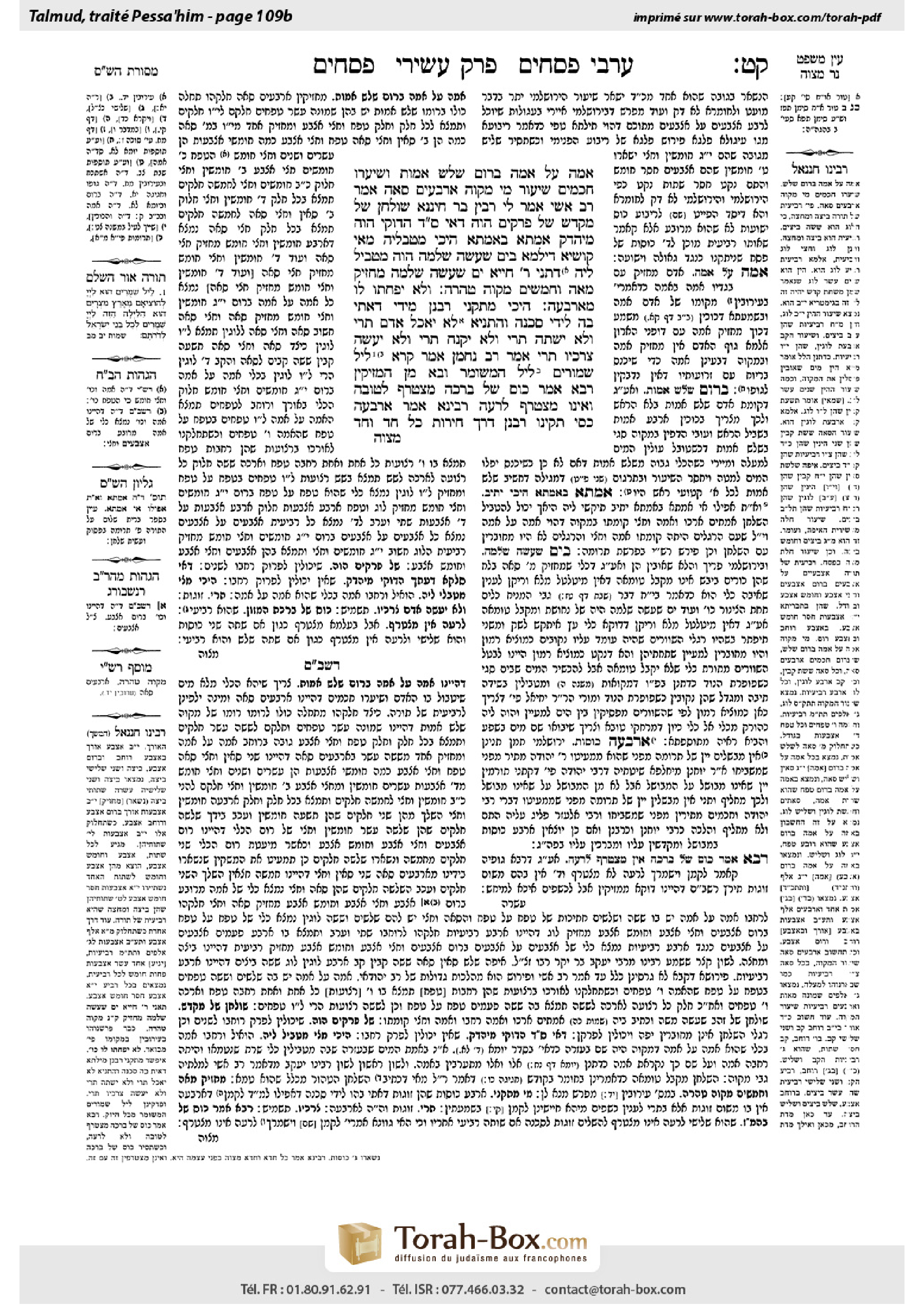
Pesachim 109b: Talmud study for Daf Yomi
Daf Yomi is the daily study of one Talmud folio. Explore 37 tractates with scans, Hebrew text, Sefaria English and AI-generated French translations where annotated.
Passage selection and English or AI-generated French translation are available where the scan has annotations. Daf Study is independent of Torah-Box and Sefaria.
Browse Pesachim · פסחים · All tractatesPesachim 109b text and translations
This page of Pesachim includes the Aramaic text, an English translation and an AI-generated French translation, alongside the scan above.
פסחים ק״ט ב · Aramaic and Hebrew text
אַמָּה עַל אַמָּה בְּרוּם שָׁלֹשׁ אַמּוֹת, וְשִׁיעֲרוּ חֲכָמִים שִׁיעוּר מֵי מִקְוֶה אַרְבָּעִים סְאָה.
אָמַר רַב אָשֵׁי: אָמַר לִי רָבִין בַּר חִינָּנָא, שׁוּלְחָן שֶׁל מִקְדָּשׁ — שֶׁל פְּרָקִים הֲוָה, דְּאִי סָלְקָא דַּעְתָּךְ הַדּוֹקֵי הֲוָה מִיהַדַּק, אַמְּתָא בְּאַמְּתָא הֵיכִי מַטְבְּלֵיהּ?!
מַאי קוּשְׁיָא? דִּילְמָא בְּיָם שֶׁעָשָׂה שְׁלֹמֹה הֲוָה מַטְבֵּיל לֵיהּ. דְּתָנֵי רַבִּי חִיָּיא: יָם שֶׁעָשָׂה שְׁלֹמֹה מַחֲזִיק מֵאָה וַחֲמִשִּׁים מִקְוֵה טׇהֳרָה.
וְלֹא יִפְחֲתוּ לוֹ מֵאַרְבָּעָה. הֵיכִי מְתַקְּנִי רַבָּנַן מִידֵּי דְּאָתֵי בֵּהּ לִידֵי סַכָּנָה, וְהָתַנְיָא: לֹא יֹאכַל אָדָם תְּרֵי, וְלֹא יִשְׁתֶּה תְּרֵי, וְלֹא יְקַנַּח תְּרֵי, וְלֹא יַעֲשֶׂה צְרָכָיו תְּרֵי?
אָמַר רַב נַחְמָן, אָמַר קְרָא: ״לֵיל שִׁמּוּרִים״ — לַיִל הַמְשׁוּמָּר וּבָא מִן הַמַּזִּיקִין.
רָבָא אָמַר: כּוֹס שֶׁל בְּרָכָה מִצְטָרֵף לְטוֹבָה, וְאֵינוֹ מִצְטָרֵף לְרָעָה. רָבִינָא אָמַר: אַרְבָּעָה כָּסֵי תַּקִּינוּ רַבָּנַן דֶּרֶךְ חֵירוּת, כׇּל חַד וְחַד
Pesachim 109b · English translation
A cubit, by a cubit, by a height of three cubits. And the Sages measured the measure of the water necessary for a ritual bath at forty se’a.
The Gemara cites a discussion related to the topic of measurements. Rav Ashi said: Ravin bar Ḥinnana said to me: The table of the Temple, upon which the shewbread was placed, was comprised of assembled parts. For if it should enter your mind that the table was firmly connected and could not be taken apart, how could the priests immerse a cubit in a cubit? The dimensions of the table were two cubits by one cubit, with a height of one and a half cubits. If the table contracted ritual impurity, it had to be immersed in a ritual bath. If a ritual bath contains an area of one cubit by one cubit, the table can fit inside only if it is dismantled.
The Gemara responds: What is the difficulty? Perhaps the priest would immerse it in the sea that King Solomon built, which was a very wide ritual bath, as it states: “And he made the molten sea of ten cubits from brim to brim, round in compass” (I Kings 7:23). As Rabbi Ḥiyya taught: The sea that Solomon built contained the volume of water of one hundred and fifty ritual purification baths. It was certainly possible to immerse even large vessels in this sea.
We learned in the mishna that even with regard to the poorest of Jews, the charity distributors should not give him less than four cups of wine. The Gemara asks: How could the Sages establish a matter through which one will come to expose himself to danger? But wasn’t it taught in a baraita: A person should not eat pairs, i.e., an even number of food items; and he should not drink pairs of cups; and he should not wipe himself with pairs; and he should not attend to his sexual needs in pairs. The concern was that one who uses pairs exposes himself to sorcery or demons. Why would the Sages require one to drink an even number of cups and thereby place himself in a position of danger?
Rav Naḥman said that the verse said: “It was a night of watching to the Lord” (Exodus 12:42), which indicates that Passover night is a night that remains guarded from demons and harmful spirits of all kinds. Therefore, there is no cause for concern about this form of danger on this particular night.
Rava said a different answer: The cup of blessing for Grace after Meals on Passover night is used in the performance of an additional mitzva and is not simply an expression of freedom. Therefore, it combines with the other cups for the good, i.e., to fulfill the mitzva to drink four cups, and it does not combine for the bad. With regard to the danger of drinking pairs of cups, it is as though one drinks only three cups. Ravina said: The Sages instituted four separate cups, each of which is consumed in a manner that demonstrates freedom. Therefore, each and every one
Pesachim 109b · Traduction française (IA)
Une coudée sur une coudée, sur une hauteur de trois coudées. Les Sages ont évalué à quarante séa la quantité d’eau nécessaire pour un bain rituel.
La Guemara rapporte une discussion sur les mesures. Rav Ashi dit : « Ravin bar Ḥinnana m’a dit : La table du Temple, sur laquelle était disposé le pain de proposition, était composée d’éléments assemblés. En effet, si l’on devait penser que la table était solidement fixée et ne pouvait pas être démontée, comment les prêtres auraient-ils pu l’immerger dans un bain rituel d’une coudée sur une coudée ? » La table mesurait deux coudées sur une coudée et avait une hauteur d’une coudée et demie. Si la table contractait l’impureté rituelle, il fallait l’immerger dans un bain rituel. Si le bain avait une superficie d’une coudée sur une coudée, la table ne pouvait y entrer qu’à condition d’être démontée.
La Guemara répond : Où est la difficulté ? Peut-être le prêtre l’immergeait-il dans la mer que le roi Salomon avait construite, un bain rituel très vaste, comme il est dit : « Il fit la mer de métal fondu, de dix coudées d’un bord à l’autre, ronde tout autour » (I Rois 7:23). Rabbi Ḥiyya enseignait en effet que la mer construite par Salomon contenait un volume d’eau équivalant à cent cinquante bains de purification rituelle. Il était certainement possible d’y immerger même de grands ustensiles.
Nous avons appris dans la Michna que même au plus pauvre des Juifs, les collecteurs de l’aumône ne doivent pas donner moins de quatre coupes de vin. La Guemara demande : Comment les Sages auraient-ils pu instituer une mesure qui exposerait quelqu’un à un danger ? N’a-t-on pas enseigné dans une baraïta : « Une personne ne doit pas manger par paires, c’est-à-dire un nombre pair d’aliments ; elle ne doit pas boire un nombre pair de coupes ; elle ne doit pas s’essuyer par paires ; et elle ne doit pas accomplir ses besoins sexuels par paires. » On craignait que celui qui agit par paires ne s’expose à la sorcellerie ou aux démons. Pourquoi les Sages exigeraient-ils qu’on boive un nombre pair de coupes et l’exposeraient-ils ainsi à un danger ?
Rav Naḥman dit que le verset déclare : « Ce fut une nuit de veille pour le Seigneur » (Exode 12:42), ce qui indique que la nuit de Pessa’h demeure protégée contre les démons et les esprits malfaisants de toute sorte. Il n’y a donc pas lieu de s’inquiéter de ce type de danger cette nuit-là.
Rava donna une autre réponse : La coupe de bénédiction pour la Grâce après le repas, la nuit de Pessa’h, sert à accomplir une mitsva supplémentaire et n’est pas simplement une expression de liberté. Elle se combine donc aux autres coupes pour le bien, c’est-à-dire pour accomplir la mitsva de boire quatre coupes, mais elle ne se combine pas pour le mal. En ce qui concerne le danger lié au fait de boire un nombre pair de coupes, c’est comme si l’on ne buvait que trois coupes. Ravina dit : Les Sages ont institué quatre coupes distinctes, chacune devant être consommée d’une manière qui manifeste la liberté. Par conséquent, chacune
Traduction française générée par IA à partir de l’édition anglaise de Sefaria. Vérifie toujours un passage avec le texte source.
Text from Sefaria: William Davidson Edition - Vocalized Aramaic (CC BY NC); William Davidson Edition - English (CC BY NC).