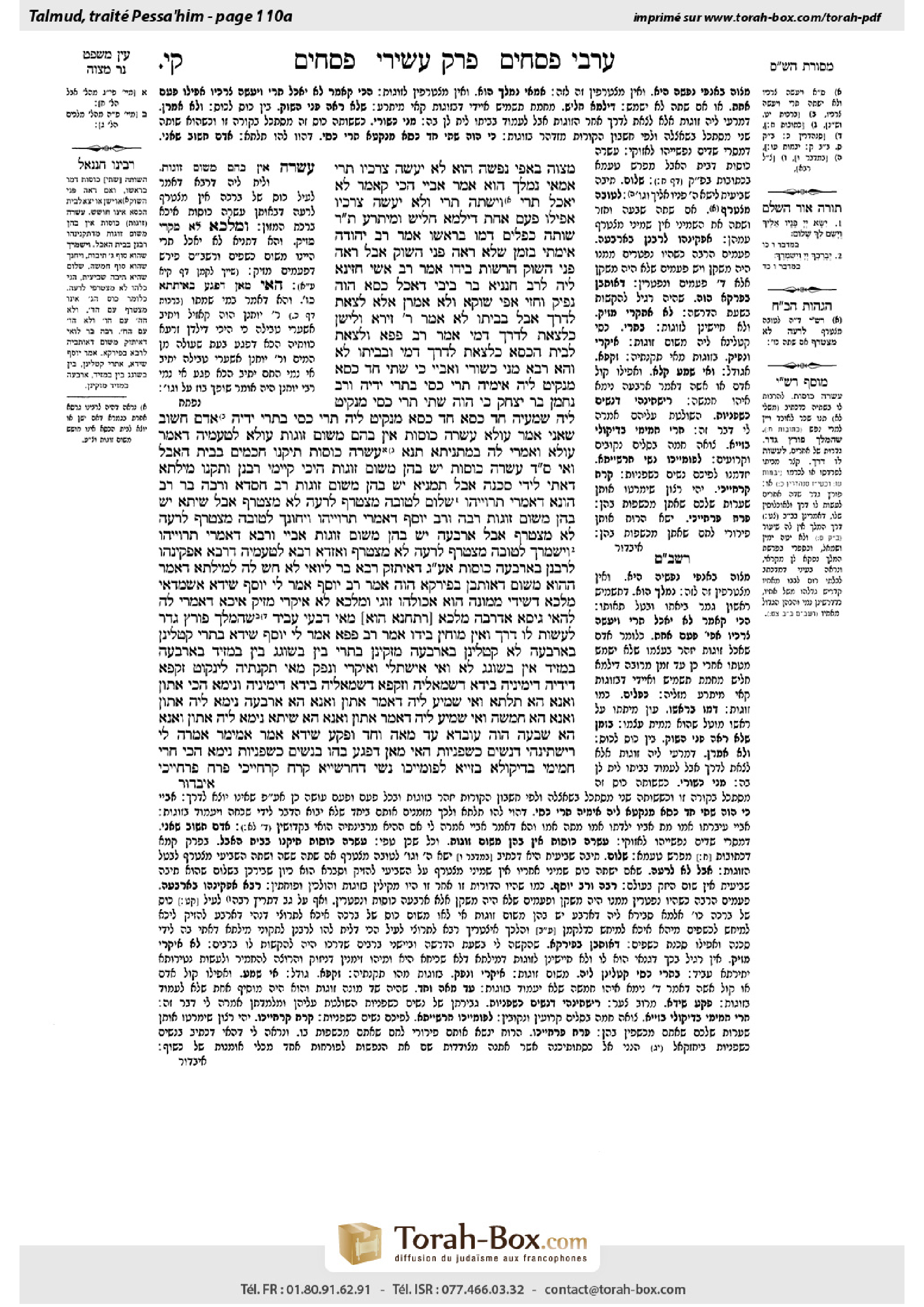
Pesachim 110a: Talmud study for Daf Yomi
Daf Yomi is the daily study of one Talmud folio. Explore 37 tractates with scans, Hebrew text, Sefaria English and AI-generated French translations where annotated.
Passage selection and English or AI-generated French translation are available where the scan has annotations. Daf Study is independent of Torah-Box and Sefaria.
Browse Pesachim · פסחים · All tractatesPesachim 110a text and translations
This page of Pesachim includes the Aramaic text, an English translation and an AI-generated French translation, alongside the scan above.
פסחים ק״י א · Aramaic and Hebrew text
מִצְוָה בְּאַפֵּי נַפְשַׁהּ הוּא.
״לֹא יַעֲשֶׂה צְרָכָיו תְּרֵי״, אַמַּאי? נִמְלָךְ הוּא! אָמַר אַבָּיֵי, הָכִי קָאָמַר: לֹא יֹאכַל תְּרֵי וְיִשְׁתֶּה תְּרֵי, וְלֹא יַעֲשֶׂה צְרָכָיו אֲפִילּוּ פַּעַם אַחַת — דִּילְמָא חָלֵישׁ וּמִיתְּרַע.
תָּנוּ רַבָּנַן: שׁוֹתֶה כִּפְלַיִם — דָּמוֹ בְּרֹאשׁוֹ. אָמַר רַב יְהוּדָה: אֵימָתַי — בִּזְמַן שֶׁלֹּא רָאָה פְּנֵי הַשּׁוּק, אֲבָל רָאָה פְּנֵי הַשּׁוּק — הָרְשׁוּת בְּיָדוֹ. אָמַר רַב אָשֵׁי: חֲזֵינָא לֵיהּ לְרַב חֲנַנְיָא בַּר בִּיבִי, דְּאַכֹּל כָּסָא הֲוָה נָפֵיק וְחָזֵי אַפֵּי שׁוּקָא.
וְלָא אֲמַרַן אֶלָּא לָצֵאת לַדֶּרֶךְ, אֲבָל בְּבֵיתוֹ — לָא. אָמַר רַבִּי זֵירָא: וּלְיָשֵׁן — כְּלָצֵאת לַדֶּרֶךְ דָּמֵי. אָמַר רַב פָּפָּא: וְלָצֵאת לְבֵית הַכִּסֵּא — כְּלָצֵאת לַדֶּרֶךְ דָּמֵי. וּבְבֵיתוֹ לָא? וְהָא רָבָא מָנֵי כְּשׁוּרֵי.
וְאַבָּיֵי, כִּי שָׁתֵי חַד כָּסָא, מְנַקֵּיט לֵיהּ אִימֵּיהּ תְּרֵי כָסֵי בִּתְרֵי יְדֵיהּ. וְרַב נַחְמָן בַּר יִצְחָק, כִּי הֲוָה שָׁתֵי תְּרֵי כָסֵי, מְנַקֵּיט לֵיהּ שַׁמָּעֵיהּ חַד כָּסָא, חַד כָּסָא — מְנַקֵּיט לֵיהּ תְּרֵי כָסֵי בִּתְרֵי יְדֵיהּ! אָדָם חָשׁוּב שָׁאנֵי.
אָמַר עוּלָּא: עֲשָׂרָה כּוֹסוֹת אֵין בָּהֶם מִשּׁוּם זוּגוֹת. עוּלָּא לְטַעְמֵיהּ, דְּאָמַר עוּלָּא, וְאָמְרִי לַהּ בְּמַתְנִיתָא תָּנָא: עֲשָׂרָה כּוֹסוֹת תִּיקְּנוּ חֲכָמִים בְּבֵית הָאֵבֶל, וְאִי סָלְקָא דַעְתָּךְ עֲשָׂרָה כּוֹסוֹת יֵשׁ בָּהֶן מִשּׁוּם זוּגוֹת, הֵיכִי קָיְימִי רַבָּנַן וְתַקִּנוּ מִילְּתָא דְּאָתֵי לִידֵי סַכָּנָה?! אֲבָל תְּמָנְיָא יֵשׁ בָּהֶן מִשּׁוּם זוּגוֹת.
רַב חִסְדָּא וְרַבָּה בַּר רַב הוּנָא דְּאָמְרִי תַּרְוַיְיהוּ: ״שָׁלוֹם״, לְטוֹבָה — מִצְטָרֵף, לְרָעָה — לֹא מִצְטָרֵף. אֲבָל שִׁיתָּא יֵשׁ בָּהֶן מִשּׁוּם זוּגוֹת.
רַבָּה וְרַב יוֹסֵף דְּאָמְרִי תַּרְוַיְיהוּ: ״וִיחֻנֶּךָּ״, לְטוֹבָה — מִצְטָרֵף. לְרָעָה — לֹא מִצְטָרֵף. אֲבָל אַרְבָּעָה יֵשׁ בָּהֶן מִשּׁוּם זוּגוֹת.
אַבָּיֵי וְרָבָא דְּאָמְרִי תַּרְוַיְיהוּ: ״וְיִשְׁמְרֶךָ״, לְטוֹבָה — מִצְטָרֵף, לְרָעָה — לֹא מִצְטָרֵף.
וְאַזְדָּא רָבָא לְטַעְמֵיהּ, דְּרָבָא אַפְּקִינְהוּ לְרַבָּנַן בְּאַרְבָּעָה כּוֹסוֹת, אַף עַל גַּב דְּאִיתַּזַּק רָבָא בַּר לֵיוַאי, לָא חַשׁ לַהּ לְמִילְּתָא, דְּאָמַר: הָהוּא מִשּׁוּם דְּאוֹתְבַן בְּפִירְקָא הֲוָה.
אָמַר רַב יוֹסֵף, אָמַר לִי יוֹסֵף שֵׁידָא: אַשְׁמְדַאי מַלְכָּא דְשֵׁידֵי — מְמוּנֶּה הוּא אַכּוּלְּהוּ זוּגֵי, וּמַלְכָּא לָא אִיקְּרִי מַזִּיק. אִיכָּא דְּאָמְרִי לַהּ לְהַאי גִּיסָא: אַדְּרַבָּה, מַלְכָּא [רַתְחָנָא הוּא], מַאי דְּבָעֵי עָבֵיד, שֶׁהַמֶּלֶךְ פּוֹרֵץ גָּדֵר לַעֲשׂוֹת לוֹ דֶּרֶךְ וְאֵין מוֹחִין בְּיָדוֹ.
אָמַר רַב פָּפָּא, אָמַר לִי יוֹסֵף שֵׁידָא: בִּתְרֵי קָטְלִינַן, בְּאַרְבְּעָה לָא קָטְלִינַן, בְּאַרְבְּעָה מַזְּקִינַן. בִּתְרֵי, בֵּין בְּשׁוֹגֵג בֵּין בְּמֵזִיד. בְּאַרְבְּעָה, בְּמֵזִיד — אִין, בְּשׁוֹגֵג — לָא.
וְאִי אִישְׁתְּלִי וְאִיקְּרִי וּנְפַק, מַאי תַּקַּנְתֵּיהּ? לִינְקוֹט זַקְפָּא דִידֵיהּ דְּיַמִּינֵיהּ בִּידָא דִשְׂמָאלֵיהּ וְזַקְפָּא דִשְׂמָאלֵיהּ בִּידָא דְיַמִּינֵיהּ, וְנֵימָא הָכִי: ״אַתּוּן וַאֲנָא — הָא תְּלָתָא״. וְאִי שְׁמִיעַ לֵיהּ דְּאָמַר: ״אַתּוּן וַאֲנָא — הָא אַרְבְּעָה״, נֵימָא לֵיהּ: ״אַתּוּן וַאֲנָא — הָא חַמְשָׁה״. וְאִי שְׁמִיעַ לֵיהּ דְּאָמַר: ״אַתּוּן וַאֲנָא — הָא שִׁיתָּא״, נֵימָא לֵיהּ: ״אַתּוּן וַאֲנָא — הָא שִׁבְעָה״. הֲוָה עוֹבָדָא עַד מְאָה וְחַד, וּפְקַע שֵׁידָא.
אָמַר אַמֵּימָר: אֲמַרָה לִי רֵישָׁתִינְהִי דְּנָשִׁים כַּשְׁפָנִיּוֹת: הַאי מַאן דְּפָגַע בְּהוּ בְּנָשִׁים כַּשְׁפָנִיּוֹת, נֵימָא הָכִי: ״חָרֵי חַמִּימֵי בְּדִיקּוּלָא בַּזְיָיא לְפוּמַּיְיכוּ נְשֵׁי דְּחָרָשַׁיָּיא, קָרַח קָרְחַיְיכִי, פָּרַח פָּרְחַיְיכִי,
Pesachim 110a · English translation
is a distinct mitzva in its own right. In other words, each cup is treated separately and one is not considered to be drinking in pairs.
The baraita taught that one should not attend to his sexual needs in pairs. The Gemara asks: Why should one be concerned for this; he has changed his mind? One does not plan in advance to engage in marital relations twice, and therefore the two acts should not combine to form a dangerous pair. Abaye said: This is what the tanna is saying, i.e., the baraita should be understood in the following manner: One should not eat in pairs nor drink in pairs, and if he does so he should not attend to his sexual needs right afterward even once, lest he is weakened by the act and will be harmed for having eaten or drunk in pairs.
The Sages taught in another baraita: If one drinks in pairs his blood is upon his head, i.e., he bears responsibility for his own demise. Rav Yehuda said: When is that the case? When one did not leave the house and view the marketplace between cups. However, if he saw the marketplace after the first cup, he has permission to drink another cup without concern. Likewise, Rav Ashi said: I saw Rav Ḥananya bar Beivai follow this policy: Upon drinking each cup, he would leave the house and view the marketplace.
And we said that there is concern for the safety of one who drinks in pairs only when he intends to set out on the road after drinking, but if he intends to remain in his home there is no need for concern. Rabbi Zeira said: And one who plans to sleep is comparable to one who is setting out on the road. He should be concerned that he might be harmed. Rav Pappa said: And going to the bathroom is comparable to setting out on the road. The Gemara asks: And if one intends to remain in his home, is there no cause for concern? But Rava would count the beams of the house to keep track of the number of cups he had drunk so as to ensure that he would not consume an even number.
And likewise Abaye, when he would drink one cup, his mother would immediately place two cups in his two hands so that he would not inadvertently drink only one more cup and thereby expose himself to the danger of drinking in pairs. And similarly, when Rav Naḥman bar Yitzḥak would drink two cups, his attendant would immediately place one more cup in his hand, and if he would drink one cup, the attendant would place two cups in his two hands. These reports indicate that one should be concerned for his safety after drinking an even number of cups, even when he remains at home. The Gemara answers: An important person is different. The demons focus their attention on him, and he must therefore be more careful than the average person.
Ulla said: Ten cups contain no element of the danger associated with pairs. Ulla rules here in accordance with his reasoning stated elsewhere, as Ulla said, and some say it was taught in a baraita: The Sages instituted that one must drink ten cups of wine in the house of a mourner during the meal of comfort. And if it could enter your mind that ten cups do contain the element of danger associated with pairs, how could the Sages arise and institute something that might bring a person to a state of danger? However, eight cups do contain the element of danger associated with pairs.
Rav Ḥisda and Rabba bar Rav Huna both say that eight is also safe from the dangers of pairs, as the number seven, represented by the word shalom, combines with the previous cups for the good but does not combine for the bad. The final verse of the priestly benediction reads: “The Lord lift His countenance upon you and give you peace [shalom]” (Numbers 6:26). The word shalom, the seventh Hebrew word in this verse, has a purely positive connotation. Rav Ḥisda and Rabba bar Rav Huna therefore maintain that the seventh cup combines with the previous six only for good purposes. After the seventh cup, i.e., from the eighth cup and on, the cups constitute pairs for the good but not for the bad. However, six cups do contain the element of danger associated with pairs.
Rabba and Rav Yosef both say that even drinking six cups is not dangerous. The reason is that the fifth cup, represented by the word viḥuneka in the second verse of the priestly benediction: “The Lord make His face to shine upon you, and be gracious to you [viḥuneka]” (Numbers 6:25), combines with the previous cups for the good but does not combine for the bad. However, four cups do contain the element of danger associated with pairs.
Abaye and Rava both say that even the number four is not dangerous, as veyishmerekha, the third word in the first verse of the priestly benediction, reads: “The Lord bless you and keep you [veyishmerekha]” (Numbers 6:24). It combines for the good but does not combine for the bad.
And Rava follows his standard line of reasoning in this regard, as Rava allowed the Sages to leave after having drunk four cups and was not concerned for their safety. Although Rava bar Livai was injured on one such occasion, Rava was not concerned that the matter had been caused by his consumption of an even number of cups, as he said: That injury occurred because Rava bar Livai challenged me during the public lecture. It is improper for a student to raise difficulties against his rabbi during a public lecture, lest the rabbi be embarrassed by his inability to answer.
Rav Yosef said: Yosef the Demon said to me: Ashmedai, the king of the demons, is appointed over all who perform actions in pairs, and a king is not called a harmful spirit. A king would not cause harm. Consequently, there is no reason to fear the harm of demons for having performed an action in pairs. Some say this statement in this manner: On the contrary, he is an angry king who does what he wants, as the halakha is that a king may breach the fence of an individual in order to form a path for himself, and none may protest his action. Similarly, the king of demons has full license to harm people who perform actions in pairs.
Rav Pappa said: Yosef the Demon said to me: If one drinks two cups, we demons kill him; if he drinks four, we do not kill him. But this person who drank four, we harm him. There is another difference between two and four: With regard to one who drinks two, whether he did so unwittingly or intentionally, we harm him. With regard to one who drinks four, if he does so intentionally, yes, he is harmed; if he does so unwittingly, no, he will not be harmed.
The Gemara asks: And if one forgets and it happens that he goes outside after having drunk an even number of cups, what is his solution? The Gemara answers: He should take his right thumb in his left hand, and his left thumb in his right hand, and say as follows: You, my thumbs, and I are three, which is not a pair. And if he hears a voice that says: You and I are four, which makes a pair, he should say to it: You and I are five. And if he hears it say: You and I are six, he should say to it: You and I are seven. The Gemara relates that there was an incident in which someone kept counting after the demon until he reached a hundred and one, and the demon burst in anger.
Ameimar said: The chief of witches said to me: One who encounters witches should say this incantation: Hot feces in torn date baskets in your mouth, witches; may your hairs fall out because you use them for witchcraft; your crumbs, which you use for witchcraft, should scatter in the wind;
Pesachim 110a · Traduction française (IA)
est une mitsva distincte à part entière. Autrement dit, chaque coupe est considérée séparément : on n’est donc pas réputé boire par paires.
La baraïta enseignait qu’il ne faut pas satisfaire ses besoins sexuels par paires. La Guemara demande : Pourquoi faudrait-il s’en préoccuper ? Il a changé d’avis. On ne prévoit pas à l’avance d’avoir deux fois des rapports conjugaux ; les deux actes ne devraient donc pas se combiner pour former une paire dangereuse. Abayé dit : Voici ce que dit le tanna ; autrement dit, il faut comprendre la baraïta ainsi : il ne faut ni manger ni boire par paires, et si l’on agit ainsi, il ne faut pas satisfaire ses besoins sexuels juste après, même une seule fois, de peur que cet acte ne l’affaiblisse et qu’il ne soit atteint pour avoir mangé ou bu par paires.
Les Sages enseignèrent dans une autre baraïta : Si quelqu’un boit par paires, son sang est sur sa tête, c’est-à-dire qu’il porte la responsabilité de sa propre mort. Rav Yehouda dit : Dans quel cas cela s’applique-t-il ? Lorsqu’il n’est pas sorti de la maison pour regarder le marché entre deux coupes. Mais s’il a vu le marché après la première coupe, il lui est permis d’en boire une autre sans inquiétude. De même, Rav Achi dit : J’ai vu Rav Ḥananya bar Beivai suivre cette pratique : après chaque coupe, il sortait de la maison pour regarder le marché.
Nous avons dit que la sécurité de celui qui boit par paires n’est menacée que s’il a l’intention de prendre la route après avoir bu ; mais s’il compte rester chez lui, il n’y a pas lieu de s’inquiéter. Rabbi Zeira dit : Celui qui prévoit de dormir est comparable à celui qui prend la route. Il doit craindre d’être atteint. Rav Pappa dit : Aller aux toilettes est comparable au fait de prendre la route. La Guemara demande : S’il compte rester chez lui, n’y a-t-il vraiment aucun motif d’inquiétude ? Pourtant, Rava comptait les poutres de la maison pour suivre le nombre de coupes qu’il avait bues et veiller à ne pas en consommer un nombre pair.
De même, lorsqu’Abayé buvait une coupe, sa mère lui mettait aussitôt deux coupes dans les mains, afin qu’il ne lui arrive pas par inadvertance de ne boire qu’une seule coupe de plus et de s’exposer ainsi au danger de boire par paires. De même, lorsque Rav Naḥman bar Yitzḥak buvait deux coupes, son serviteur lui en mettait aussitôt une troisième dans la main ; et s’il en buvait une, le serviteur lui en mettait deux dans les mains. Ces récits indiquent qu’il faut se soucier de sa sécurité après avoir bu un nombre pair de coupes, même si l’on reste chez soi. La Guemara répond : Le cas d’un personnage important est différent. Les démons fixent leur attention sur lui ; il doit donc prendre plus de précautions qu’une personne ordinaire.
Oulla dit : Dix coupes ne comportent aucun danger lié aux paires. Oulla statue ici conformément à son raisonnement exposé ailleurs, car il dit — et certains disent que cela a été enseigné dans une baraïta — : Les Sages ont institué que l’on boive dix coupes de vin dans la maison d’un endeuillé, pendant le repas de consolation. S’il pouvait venir à l’esprit que dix coupes comportent le danger lié aux paires, comment les Sages auraient-ils pu instituer une pratique susceptible de mettre quelqu’un en danger ? En revanche, huit coupes comportent le danger lié aux paires.
Rav Ḥisda et Rabba bar Rav Houna disent tous deux que huit coupes sont également sans danger, car le nombre sept, représenté par le mot shalom, se combine aux coupes précédentes pour le bien, mais pas pour le mal. Le dernier verset de la bénédiction sacerdotale dit : « Que l’Éternel tourne vers toi sa face et te donne la paix [shalom] » (Nombres 6,26). Le mot shalom, qui est le septième mot hébreu de ce verset, a une connotation entièrement positive. Rav Ḥisda et Rabba bar Rav Houna soutiennent donc que la septième coupe se combine aux six précédentes uniquement pour le bien. Après la septième coupe, c’est-à-dire à partir de la huitième, les coupes forment des paires pour le bien, mais pas pour le mal. En revanche, six coupes comportent le danger lié aux paires.
Rabba et Rav Yossef disent tous deux que même boire six coupes n’est pas dangereux. En effet, la cinquième coupe, représentée par le mot viḥuneka dans le deuxième verset de la bénédiction sacerdotale — « Que l’Éternel fasse rayonner sa face sur toi et te fasse grâce [viḥuneka] » (Nombres 6,25) — se combine aux coupes précédentes pour le bien, mais pas pour le mal. En revanche, quatre coupes comportent le danger lié aux paires.
Abayé et Rava disent tous deux que même le nombre quatre n’est pas dangereux, car veyishmerekha, le troisième mot du premier verset de la bénédiction sacerdotale, figure dans ces paroles : « Que l’Éternel te bénisse et te garde [veyishmerekha] » (Nombres 6,24). Il se combine pour le bien, mais pas pour le mal.
Rava suit ici sa position habituelle, car il a permis aux Sages de partir après avoir bu quatre coupes et ne s’est pas inquiété pour leur sécurité. Bien que Rava bar Livai ait été blessé à une occasion de ce genre, Rava ne craignit pas que cela fût dû à la consommation d’un nombre pair de coupes, car il dit : « Cette blessure est survenue parce que Rava bar Livai m’a interpellé pendant le cours public. » Il ne convient pas qu’un élève soulève des objections contre son maître pendant un cours public, de peur que le maître ne soit embarrassé s’il ne parvient pas à répondre.
Rav Yossef dit : Yossef le Démon m’a dit : Ashmedaï, le roi des démons, est préposé à tous ceux qui accomplissent des actes par paires, et un roi n’est pas appelé un esprit malfaisant. Un roi ne causerait pas de tort. Par conséquent, il n’y a aucune raison de craindre que les démons nuisent à quelqu’un parce qu’il a accompli un acte par paire. Certains rapportent cette déclaration sous cette forme : Au contraire, c’est un roi irascible qui agit à sa guise, car, selon la halakha, un roi peut franchir la clôture d’un particulier pour se créer un chemin, sans que personne puisse s’opposer à son acte. De même, le roi des démons a toute latitude pour nuire aux personnes qui accomplissent des actes par paires.
Rav Pappa dit : Yossef le Démon m’a dit : « Si quelqu’un boit deux coupes, nous, les démons, le tuons ; s’il en boit quatre, nous ne le tuons pas. Mais celui qui en a bu quatre, nous lui faisons du mal. » Il existe une autre différence entre deux et quatre : celui qui boit deux coupes, qu’il l’ait fait involontairement ou intentionnellement, nous lui faisons du mal. Celui qui boit quatre coupes, en revanche, s’il le fait intentionnellement, oui, il sera atteint ; s’il le fait involontairement, non, il ne sera pas atteint.
La Guemara demande : Et si quelqu’un oublie et qu’il lui arrive de sortir après avoir bu un nombre pair de coupes, quelle est la solution ? La Guemara répond : Il doit prendre son pouce droit dans sa main gauche et son pouce gauche dans sa main droite, puis dire : « Vous, mes pouces, et moi, nous sommes trois », ce qui ne forme pas une paire. Et s’il entend une voix dire : « Toi et moi, nous sommes quatre », ce qui forme une paire, il doit lui répondre : « Toi et moi, nous sommes cinq. » Et s’il l’entend dire : « Toi et moi, nous sommes six », il doit lui répondre : « Toi et moi, nous sommes sept. » La Guemara rapporte qu’un homme continua ainsi à compter après le démon jusqu’à cent un, et que le démon éclata de colère.
Amemar dit : Le chef des sorcières m’a dit : « Celui qui rencontre des sorcières doit prononcer cette incantation : “Excréments chauds dans des paniers de dattes déchirés, dans vos bouches, sorcières ; que vos cheveux tombent, puisque vous les utilisez pour la sorcellerie ; que vos miettes, dont vous vous servez pour la sorcellerie, soient dispersées par le vent ;” »
Traduction française générée par IA à partir de l’édition anglaise de Sefaria. Vérifie toujours un passage avec le texte source.
Text from Sefaria: William Davidson Edition - Vocalized Aramaic (CC BY NC); William Davidson Edition - English (CC BY NC).