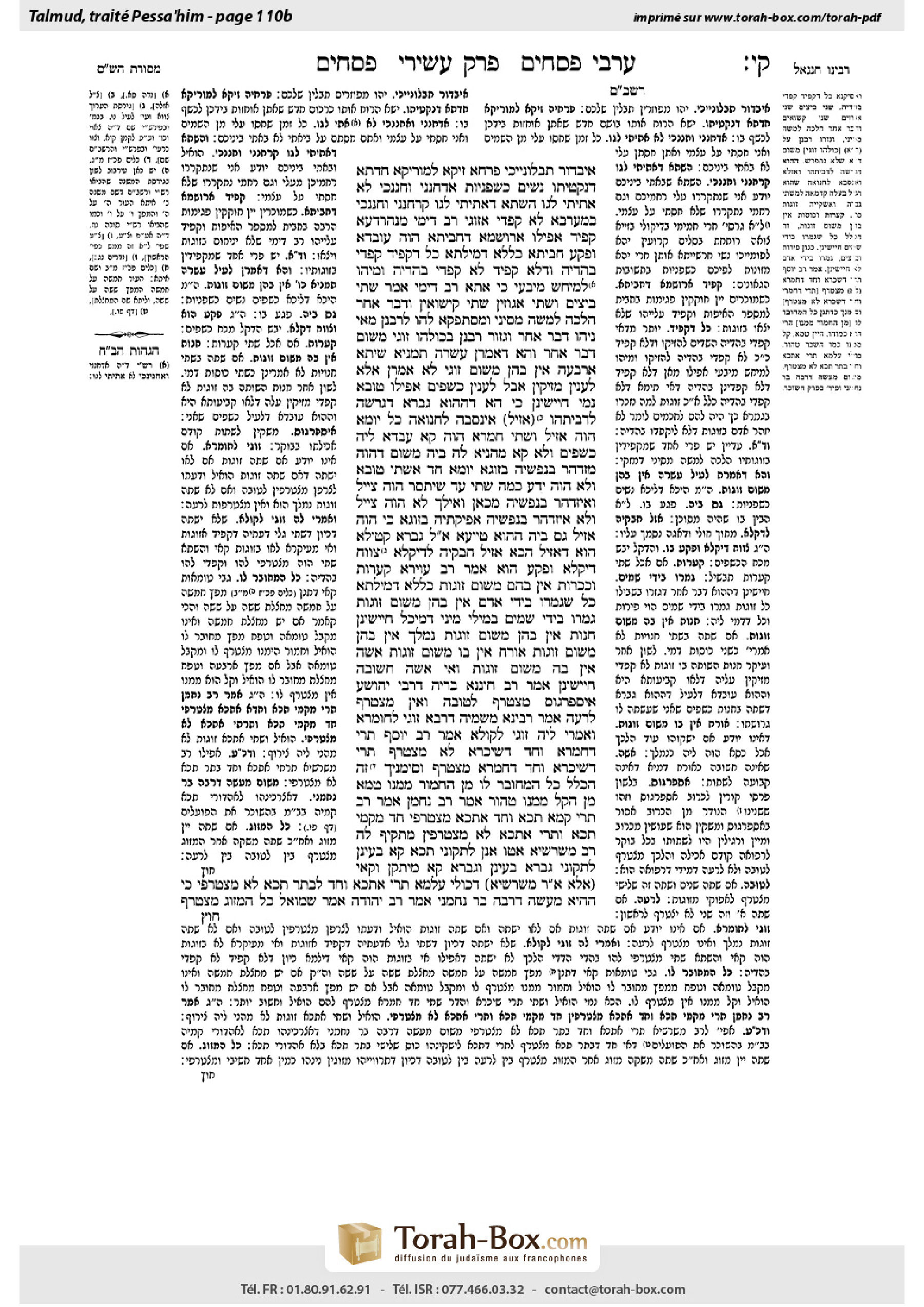
Pesachim 110b: Talmud study for Daf Yomi
Daf Yomi is the daily study of one Talmud folio. Explore 37 tractates with scans, Hebrew text, Sefaria English and AI-generated French translations where annotated.
Passage selection and English or AI-generated French translation are available where the scan has annotations. Daf Study is independent of Torah-Box and Sefaria.
Browse Pesachim · פסחים · All tractatesPesachim 110b text and translations
This page of Pesachim includes the Aramaic text, an English translation and an AI-generated French translation, alongside the scan above.
פסחים ק״י ב · Aramaic and Hebrew text
אִיבַּדּוּר תַּבְלוּנַיְיכִי, פָּרְחָא זִיקָא לְמוֹרִיקָא חַדְתָּא דְּנָקְטִיתוּ נָשִׁים כַּשְׁפָנִיּוֹת, אַדְּחַנַּנִּי וְחַנַּנְכִי לָא אֲתֵיתִי לְגוֹ, הַשְׁתָּא דַּאֲתֵיתִי לְגוֹ — קַרְחַנְנִי וַחֲנַנְכִי״.
בְּמַעְרְבָא לָא קָפְדִי אַזּוּגֵי. רַב דִּימִי מִנְּהַרְדְּעָא קָפֵיד אֲפִילּוּ אַרוּשְׁמָא דְחָבִיתָא. הֲוָה עוֹבָדָא וּפְקַע חָבִיתָא. כְּלָלָא דְמִילְּתָא, כׇּל דְּקָפֵיד — קָפְדִי בַּהֲדֵיהּ, וּדְלָא קָפֵיד — לָא קָפְדִי בַּהֲדֵיהּ, וּמִיהוּ לְמֵיחַשׁ מִיבְּעֵי.
כִּי אֲתָא רַב דִּימִי, אָמַר: שְׁתֵּי בֵיצִים, וּשְׁתֵּי אֱגוֹזִין, שְׁתֵּי קִישּׁוּאִין, וְדָבָר אַחֵר — הֲלָכָה לְמֹשֶׁה מִסִּינַי. וּמִסְתַּפְּקָא לְהוּ לְרַבָּנַן מַאי נִיהוּ דָּבָר אַחֵר, וּגְזוּר רַבָּנַן בְּכוּלְּהוּ זוּגֵי מִשּׁוּם דָּבָר אַחֵר.
וְהָא דַּאֲמַרַן עֲשָׂרָה, תְּמָנְיָא, שִׁיתָּא, אַרְבְּעָה אֵין בָּהֶן מִשּׁוּם זוּגֵי, לָא אֲמַרַן אֶלָּא לְעִנְיַן מַזִּיקִין. אֲבָל לְעִנְיַן כְּשָׁפִים — אֲפִילּוּ טוּבָא נָמֵי חָיְישִׁינַן.
כִּי הָא דְּהָהוּא גַּבְרָא דְּגָרְשַׁהּ לִדְבֵיתְהוּ. (אֲזִיל) אִינַּסְבָה לְחַנְוָאָה. כׇּל יוֹמָא הֲוָה אָזֵיל וְשָׁתֵי חַמְרָא. הֲוָה קָא עָבְדָא לֵיהּ כְּשָׁפִים וְלָא קָא מַהְנְיָא לַהּ בֵּיהּ, מִשּׁוּם דַּהֲוָה מִזְדְּהַר בְּנַפְשֵׁיהּ בְּזוּגָא.
יוֹמָא חַד אִשְׁתִּי טוּבָא, וְלָא הֲוָה יָדַע כַּמָּה שָׁתֵי. עַד שִׁיתְּסַר הֲוָה צְיִיל וְאִיזְדְּהַר בְּנַפְשֵׁיהּ, מִכָּאן וְאֵילָךְ לָא הֲוָה צְיִיל וְלָא אִיזְדְּהַר בְּנַפְשֵׁיהּ, אַפֵּיקְתֵּיהּ בְּזוּגָא. כִּי הֲוָה אָזֵיל, גָּס בֵּיהּ הָהוּא טַיָּיעָא, אֲמַר לֵיהּ: גַּבְרָא קְטִילָא הוּא דְּאָזֵיל הָכָא. אָזֵיל חַבְּקֵיהּ לְדִיקְלָא, צְוַוח דִּיקְלָא וּפְקַע הוּא.
אָמַר רַב עַוִּירָא: קְעָרוֹת וְכִכָּרוֹת אֵין בָּהֶם מִשּׁוּם זוּגוֹת. כְּלָלָא דְּמִילְּתָא: כׇּל שֶׁגְּמָרוֹ בִּידֵי אָדָם — אֵין בָּהֶן מִשּׁוּם זוּגוֹת. גְּמָרוֹ בִּידֵי שָׁמַיִם — בְּמִילֵּי מִינֵי דְמֵיכַל חָיְישִׁינַן.
חֲנוּת — אֵין בָּהֶן מִשּׁוּם זוּגוֹת. נִמְלָךְ — אֵין בָּהֶן מִשּׁוּם זוּגוֹת. אוֹרֵחַ — אֵין בּוֹ מִשּׁוּם זוּגוֹת. אִשָּׁה — אֵין בָּהּ מִשּׁוּם זוּגוֹת. וְאִי אִשָּׁה חֲשׁוּבָה, חָיְישִׁינַן.
אָמַר רַב חִינָּנָא בְּרֵיהּ דְּרַבִּי יְהוֹשֻׁעַ: אִיסְפָּרָגוֹס — מִצְטָרֵף לְטוֹבָה, וְאֵין מִצְטָרֵף לְרָעָה.
אָמַר רָבִינָא מִשְּׁמֵיהּ דְּרָבָא: זוּגֵי — לְחוּמְרָא. וְאָמְרִי לֵיהּ: זוּגֵי — לְקוּלָּא. אָמַר רַב יוֹסֵף: תְּרֵי דְחַמְרָא וְחַד דְּשִׁיכְרָא — לָא מִצְטָרֵף, תְּרֵי דְשִׁיכְרָא וְחַד דְּחַמְרָא — מִצְטָרֵף.
וְסִימָנָיךְ, זֶה הַכְּלָל: כׇּל הַמְחוּבָּר לוֹ מִן הֶחָמוּר מִמֶּנּוּ — טָמֵא, מִן הַקַּל מִמֶּנּוּ — טָהוֹר.
אָמַר רַב נַחְמָן אָמַר רַב: תְּרֵי קַמֵּי תַּכָּא וְחַד אַתַּכָּא — מִצְטָרְפִי. חַד מִקַּמֵּי תַּכָּא וּתְרֵי אַתַּכָּא — לֹא מִצְטָרְפִין.
מַתְקֵיף לַהּ רַב מְשַׁרְשְׁיָא: אַטּוּ אֲנַן לְתַקּוֹנֵי תַּכָּא קָא בָּעֵינַן? לְתַקּוֹנֵי גַּבְרָא בָּעֵינַן, וְגַבְרָא קָא מִיתְּקַן וְקָאֵי.
(אֶלָּא אָמַר רַב מְשַׁרְשְׁיָא): דְּכוּלֵּי עָלְמָא תְּרֵי אַתַּכָּא וְחַד לְבָתַר תַּכָּא — לָא מִצְטָרְפִי. כִּי הַהִיא מַעֲשֶׂה דְּרַבָּה בַּר נַחְמָנִי.
אָמַר רַב יְהוּדָה אָמַר שְׁמוּאֵל: כׇּל הַמָּזוּג — מִצְטָרֵף,
Pesachim 110b · English translation
your spices, which you use for your witchcraft, should scatter; the wind should carry away the fresh saffron that you witches hold to perform your witchcraft. As long as I was shown favor from Heaven and you showed me favor, I did not come here. Now that I have come here, your favor toward me has cooled and you should find favor.
The Gemara relates that in the West, Eretz Yisrael, they were not particular with regard to pairs. Rav Dimi from Neharde’a was particular about pairs even with regard to the signs on a barrel; he would not write pairs of symbols on a barrel. There was an incident in which there were pairs of symbols on a barrel and the barrel burst. The Gemara concludes: The rule of the matter is that all who are particular about pairs, the demons are particular with him; and if one is not particular, they are not particular with him. However, one is required to be concerned about the harm that might result from purposely performing actions in pairs.
When Rav Dimi came from Eretz Yisrael to Babylonia, he said: With regard to two eggs, two nuts, two cucumbers, and another matter, there is a halakha transmitted to Moses from Sinai that they are dangerous in pairs. But the Sages are uncertain about what the other matter is, and therefore the Sages decreed that all pairs are prohibited due to that other matter.
And the Gemara notes that that which we said above, that the numbers ten, eight, six, and four do not cause the danger associated with pairs, we said only with regard to harmful spirits. However, with regard to witchcraft, we are concerned even with regard to one who performed an activity a greater number of times.
This is like that incident involving a certain man who divorced his wife. She went and married a shopkeeper who sold wine in his store. Every day, the first husband would go and drink wine in that shop. His ex-wife would perform witchcraft upon him, and it would not be effective for her in her attempts to harm him because he was careful with regard to pairs.
One day he drank a lot, and he did not know how much he drank. Until he drank sixteen cups, he was lucid and was careful with regard to himself, to keep track of how many cups he had drunk. From here onward he was not lucid and was not careful to watch himself, and she caused him to leave after having consumed a pair, i.e., an even number of cups. As he walked, a certain Arab met him and, noticing that he was bewitched, said to him: It is a dead man who walks here. He went and hugged a palm tree for support; the palm tree dried out due to the witchcraft, and he burst.
Rav Avira said: Plates and loaves do not contain the element of danger associated with pairs. The Gemara elaborates upon this point: The rule of the matter is that anything whose production was completed by people, whether a vessel or food, they do not contain the element of danger associated with pairs. Conversely, if the object was completed by Heaven, e.g., with regard to types of food, we are concerned.
Furthermore, a store does not contain the element of danger associated with pairs. If one eats there, there is no danger, as this is not his regular place. If one changed one’s mind after drinking an odd number of cups and added one more, his drinking does not contain the element of danger associated with pairs, as he did not initially intend to drink an even number. The behavior of a guest who eats or drinks in someone else’s house does not contain the element of danger associated with pairs, as his host determines how much he will eat and drink. The behavior of a woman does not contain the element of danger associated with pairs, as demons are not particular with regard to how much a woman eats or drinks. But if she is an important woman, we are concerned.
Rav Ḥinnana, son of Rav Yehoshua, said: Isparegus, a wine-based drink with added spices that people would regularly consume in the morning, combines with the number of cups of wine one has already consumed for the good, to raise the total to an odd number, and does not combine for the bad, to bring the sum to an even number.
Ravina said in the name of Rava: If one is in doubt as to whether he has drunk in pairs, he should be stringent and drink another cup. And some say that one who is uncertain with regard to pairs should be lenient and not drink an additional cup, lest the additional cup be the even number. Rav Yosef said: Two cups of wine and one cup of beer do not combine; two cups of beer and one cup of wine do combine.
And this is your mnemonic by which to remember this rule is a mishna concerning the halakhot of ritual purity. This is the rule: With regard to anything attached to an object, if the smaller piece is more stringent than the larger one, the combined object is ritually impure; if the attached substance is more lenient than it, the combined object is ritually pure. In other words, if a small piece of a type of fabric that contracts ritual impurity when it is relatively small, which is a stringency, is attached to a larger object comprised of a less valuable fabric that contracts ritual impurity only when it is bigger, the two materials combine to form a unified fabric that contracts ritual impurity if together they amount to the larger requisite size. However, if there is more of the stringent material, the two substances do not combine halakhically to form the amount of the smaller requisite size. Similarly, in the case of pairs, the wine is more significant than the beer. Therefore, the wine combines with the beer but not vice versa.
Rav Naḥman said that Rav said: If one drinks two cups before the table is brought and the meal begins and one cup over the table they combine, the person is not considered to have drunk a pair of cups. However, if one drinks one cup before the table is brought and two cups over the table they do not combine; the two cups he drank during the meal are considered a pair.
Rav Mesharshiya strongly objects to this ruling: Is that to say that we need to resolve the problem of pairs with regard to the table? Is the presence of the table the decisive factor here? We need to resolve the problem with regard to the person, and with regard to the person it is considered resolved. He began drinking before the table was brought, and he has consumed an odd number of cups.
Rather, Rav Mesharshiya said: Everyone agrees that if one drank two cups over the table during the meal and one after the table has been removed, they do not combine. This is like that incident involving Rabba bar Naḥmani, in which someone drank in pairs and was harmed. Rabba instructed them to return the table so that the man could drink an additional cup over the table. This shows that the additional cup counts only if the drinker returns to the table.
Rav Yehuda said that Shmuel said: Any type of drink that is diluted combines to form an even or odd number,
Pesachim 110b · Traduction française (IA)
Que vos épices, dont vous vous servez pour votre sorcellerie, se dispersent ; que le vent emporte le safran frais que vous, les sorcières, tenez pour pratiquer vos sortilèges. Tant que le Ciel m’accordait sa faveur et que vous me témoigniez la vôtre, je ne venais pas ici. Maintenant que je suis venu ici, votre faveur envers moi s’est refroidie ; puissiez-vous me témoigner votre faveur.
La Guemara rapporte qu’en Occident, en Terre d’Israël, on ne prêtait pas attention aux paires. Rav Dimi de Nehardea, lui, prêtait attention aux paires, même pour les signes inscrits sur un tonneau : il n’y inscrivait pas de symboles par paires. Un jour, des symboles par paires furent inscrits sur un tonneau, qui éclata. La Guemara conclut : La règle est la suivante : les démons s’en prennent à quiconque prête attention aux paires ; mais si quelqu’un n’y prête pas attention, ils ne s’en prennent pas à lui. Toutefois, il faut se préoccuper du dommage susceptible de résulter d’actes accomplis délibérément par paires.
Lorsque Rav Dimi vint de Terre d’Israël en Babylonie, il dit : Au sujet de deux œufs, de deux noix, de deux concombres et d’une autre chose, une halakha fut transmise à Moïse au Sinaï : ces choses sont dangereuses par paires. Mais les Sages ne savent pas quelle est cette autre chose ; ils décrétèrent donc que toutes les paires sont interdites à cause de cette autre chose.
Et la Guemara relève que ce que nous avons dit plus haut, à savoir que les nombres dix, huit, six et quatre ne présentent pas le danger associé aux paires, ne vaut que pour les esprits malfaisants. En revanche, en matière de sorcellerie, il faut s’en inquiéter même lorsqu’une activité a été accomplie un plus grand nombre de fois.
Cela ressemble à l’histoire d’un certain homme qui avait divorcé de sa femme. Celle-ci alla épouser un marchand qui vendait du vin dans sa boutique. Chaque jour, le premier mari allait boire du vin dans cette boutique. Son ex-femme lui jetait des sorts, mais ceux-ci n’avaient aucun effet lorsqu’elle essayait de lui nuire, car il prenait garde aux paires.
Un jour, il but beaucoup et ne sut plus combien il avait bu. Jusqu’à ce qu’il eût bu seize coupes, il était lucide et veillait à compter les coupes qu’il avait bues. À partir de là, il ne fut plus lucide et ne prit plus garde à lui-même ; elle le fit partir après qu’il eut bu un nombre pair de coupes. En chemin, un certain Arabe le rencontra et, remarquant qu’il était ensorcelé, lui dit : « C’est un mort qui marche ici. » Il alla s’appuyer à un palmier en l’étreignant ; le palmier sécha sous l’effet de la sorcellerie, et il éclata.
Rav Avira dit : Les assiettes et les pains ne présentent pas le danger associé aux paires. La Guemara précise : La règle est que tout ce dont la fabrication a été achevée par des hommes, qu’il s’agisse d’un ustensile ou d’un aliment, ne présente pas le danger associé aux paires. En revanche, si la chose a été achevée par le Ciel, par exemple certains aliments, il faut s’en préoccuper.
De plus, une boutique ne présente pas le danger associé aux paires. Si quelqu’un y mange, il n’y a pas de danger, car ce n’est pas son lieu habituel. Si quelqu’un change d’avis après avoir bu un nombre impair de coupes et en ajoute une autre, sa consommation ne présente pas le danger associé aux paires, car il n’avait pas l’intention initiale de boire un nombre pair. Le comportement d’un invité qui mange ou boit chez autrui ne présente pas non plus le danger associé aux paires, car c’est son hôte qui détermine la quantité qu’il mangera et boira. Le comportement d’une femme ne présente pas le danger associé aux paires, car les démons ne prêtent pas attention à la quantité qu’une femme mange ou boit. Mais si c’est une femme importante, il faut s’en préoccuper.
Rav Ḥinnana, fils de Rav Yehoshua, dit : L’isparegus, une boisson à base de vin additionnée d’épices que l’on consommait régulièrement le matin, s’ajoute au nombre de coupes de vin déjà bues pour le bien, afin de porter le total à un nombre impair, mais ne s’y ajoute pas pour le mal, afin de porter le total à un nombre pair.
Ravina dit au nom de Rava : Si quelqu’un doute d’avoir bu par paires, il doit être rigoureux et boire une autre coupe. Certains disent au contraire que celui qui n’est pas sûr au sujet des paires doit être indulgent et ne pas boire de coupe supplémentaire, de peur que cette coupe supplémentaire ne porte le total à un nombre pair. Rav Yosef dit : Deux coupes de vin et une coupe de bière ne s’additionnent pas ; deux coupes de bière et une coupe de vin, elles, s’additionnent.
Et voici le moyen mnémotechnique qui permet de se rappeler cette règle : une Michna concernant les lois de pureté rituelle. La règle est la suivante : lorsqu’une substance est attachée à un objet, si le petit élément est plus rigoureux que le grand, l’objet composé est impur rituellement ; si la substance attachée est moins rigoureuse, l’objet composé est pur rituellement. Autrement dit, si un petit morceau d’un type de tissu qui contracte l’impureté rituelle même lorsqu’il est de petite taille — ce qui constitue une rigueur — est attaché à un objet plus grand composé d’un tissu moins précieux, qui ne contracte l’impureté rituelle que lorsqu’il est plus grand, les deux matières s’additionnent pour former un tissu unique qui contracte l’impureté rituelle si elles atteignent ensemble la plus grande taille requise. Toutefois, si la matière plus rigoureuse est en quantité supérieure, les deux substances ne s’additionnent pas du point de vue de la halakha pour atteindre la plus petite taille requise. De même, dans le cas des paires, le vin a plus d’importance que la bière. Le vin s’additionne donc à la bière, mais pas l’inverse.
Rav Naḥman dit au nom de Rav : Si quelqu’un boit deux coupes avant que la table soit apportée et que le repas commence, puis une coupe à table, elles s’additionnent et l’on ne considère pas qu’il a bu une paire de coupes. En revanche, s’il boit une coupe avant que la table soit apportée, puis deux coupes à table, elles ne s’additionnent pas ; les deux coupes qu’il a bues pendant le repas sont considérées comme une paire.
Rav Mesharshiya s’oppose vivement à cette décision : Faut-il donc résoudre la question des paires en fonction de la table ? La présence de la table est-elle le facteur décisif ici ? Il faut résoudre la question en fonction de la personne ; or, pour cette personne, la question est réglée : elle a commencé à boire avant que la table soit apportée et a bu un nombre impair de coupes.
Rav Mesharshiya dit plutôt : Tout le monde convient que si quelqu’un a bu deux coupes à table pendant le repas, puis une autre après que la table a été desservie, elles ne s’additionnent pas. C’est comme dans l’histoire de Rabba bar Naḥmani, où quelqu’un avait bu par paires et en avait subi les conséquences. Rabba leur ordonna de remettre la table afin que cet homme puisse boire une coupe supplémentaire à table. Cela montre que la coupe supplémentaire ne compte que si celui qui boit revient à table.
Rav Yehuda dit au nom de Shmuel : Toute boisson diluée s’additionne pour former un nombre pair ou impair,
Traduction française générée par IA à partir de l’édition anglaise de Sefaria. Vérifie toujours un passage avec le texte source.
Text from Sefaria: William Davidson Edition - Vocalized Aramaic (CC BY NC); William Davidson Edition - English (CC BY NC).