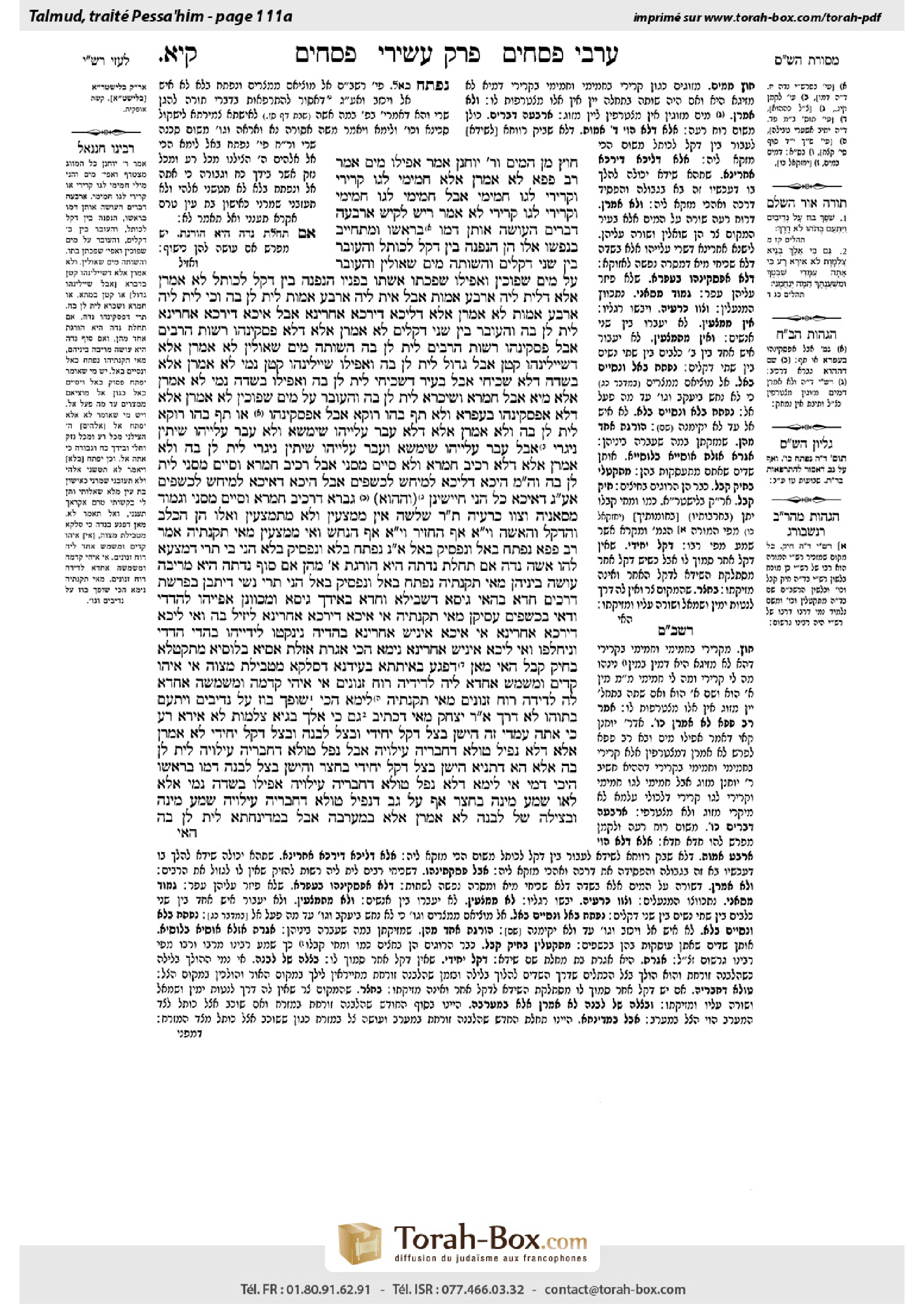
Pesachim 111a: Talmud study for Daf Yomi
Daf Yomi is the daily study of one Talmud folio. Explore 37 tractates with scans, Hebrew text, Sefaria English and AI-generated French translations where annotated.
Passage selection and English or AI-generated French translation are available where the scan has annotations. Daf Study is independent of Torah-Box and Sefaria.
Browse Pesachim · פסחים · All tractatesPesachim 111a text and translations
This page of Pesachim includes the Aramaic text, an English translation and an AI-generated French translation, alongside the scan above.
פסחים קי״א א · Aramaic and Hebrew text
חוּץ מִן הַמַּיִם. וְרַבִּי יוֹחָנָן אָמַר: אֲפִילּוּ מַיִם. אָמַר רַב פָּפָּא: לָא אֲמַרַן, אֶלָּא חַמִּימֵי לְגוֹ קָרִירֵי, וְקָרִירֵי לְגוֹ חַמִּימֵי. אֲבָל חַמִּימֵי לְגוֹ חַמִּימֵי, וְקָרִירֵי לְגוֹ קָרִירֵי — לָא.
אָמַר רֵישׁ לָקִישׁ: אַרְבָּעָה דְּבָרִים הָעוֹשֶׂה אוֹתָן דָּמוֹ בְּרֹאשׁוֹ וּמִתְחַיֵּיב בְּנַפְשׁוֹ. אֵלּוּ הֵן: הַנִּפְנֶה בֵּין דֶּקֶל לְכוֹתֶל, וְהָעוֹבֵר בֵּין שְׁנֵי דְקָלִים, וְהַשּׁוֹתֶה מַיִם שְׁאוּלִין, וְהָעוֹבֵר עַל מַיִם שְׁפוּכִין, וַאֲפִילּוּ שְׁפָכַתּוּ אִשְׁתּוֹ בְּפָנָיו.
הַנִּפְנֶה בֵּין דֶּקֶל לְכוֹתֶל — לָא אֲמַרַן אֶלָּא דְּלֵית לֵיהּ אַרְבַּע אַמּוֹת, אֲבָל אִית לֵיהּ אַרְבַּע אַמּוֹת — לֵית לַן בַּהּ. וְכִי לֵית לֵיהּ אַרְבַּע אַמּוֹת, לָא אֲמַרַן אֶלָּא דְּלֵיכָּא דִּירְכָּא אַחֲרִינָא, אֲבָל אִיכָּא דִּירְכָּא אַחֲרִינָא — לֵית לַן בַּהּ.
וְהָעוֹבֵר בֵּין שְׁנֵי דְקָלִים — לָא אֲמַרַן אֶלָּא דְּלָא פַּסְקִינְהוּ רְשׁוּת הָרַבִּים, אֲבָל פַּסְקִינְהוּ רְשׁוּת הָרַבִּים — לֵית לַן בַּהּ. הַשּׁוֹתֶה מַיִם שְׁאוּלִין — לָא אֲמַרַן אֶלָּא דְּשַׁיְילִינְהוּ קָטָן, אֲבָל גָּדוֹל — לֵית לַן בַּהּ.
וַאֲפִילּוּ שַׁיְילִינְהוּ קָטָן נָמֵי — לָא אֲמַרַן אֶלָּא בַּשָּׂדֶה, דְּלָא שְׁכִיחִי, אֲבָל בָּעִיר, דִּשְׁכִיחִי — לֵית לַן בָּהּ. וַאֲפִילּוּ בַּשָּׂדֶה נָמֵי — לָא אֲמַרַן אֶלָּא מַיָּא, אֲבָל חַמְרָא וְשִׁיכְרָא — לֵית לַן בַּהּ.
וְהָעוֹבֵר עַל מַיִם שְׁפוּכִין — לָא אֲמַרַן אֶלָּא דְּלָא אַפְסְקִינְהוּ בְּעַפְרָא וְלָא תַּף בְּהוּ רוּקָּא, אֲבָל אַפְסְקִינְהוּ אוֹ תַּף בְּהוּ רוּקָּא — לֵית לַן בַּהּ. וְלָא אֲמַרַן אֶלָּא דְּלָא עֲבַר עֲלַיְיהוּ שִׁימְשָׁא וְלָא עֲבַר עֲלַיְיהוּ שִׁיתִּין נִיגְרֵי, אֲבָל עֲבַר עֲלַיְיהוּ שִׁימְשָׁא וַעֲבַר עֲלַיְיהוּ שִׁיתִּין נִיגְרֵי — לֵית לַן בַּהּ. וְלָא אֲמַרַן אֶלָּא דְּלָא רְכִיב חֲמָרָא וְלָא סָיֵים מְסָנֵי, אֲבָל רְכִיב חֲמָרָא וְסָיֵים מְסָנֵי — לֵית לַן בַּהּ.
וְהָנֵי מִילֵּי הֵיכָא דְּלֵיכָּא לְמֵיחַשׁ לִכְשָׁפִים, אֲבָל הֵיכָא דְּאִיכָּא לְמֵיחַשׁ לִכְשָׁפִים, אַף עַל גַּב דְּאִיכָּא כׇּל הָנֵי — חָיְישִׁינַן. (וְהָהוּא) גַּבְרָא דִּרְכִיב חֲמָרָא וְסָיֵים מְסָנֵי, וּגְמוּד מְסָאנֵיהּ וּצְווֹ כַּרְעֵיהּ.
תָּנוּ רַבָּנַן: שְׁלֹשָׁה אֵין מְמַצְּעִין וְלֹא מִתְמַצְּעִין. וְאֵלּוּ הֵן: הַכֶּלֶב וְהַדֶּקֶל וְהָאִשָּׁה. וְיֵשׁ אוֹמְרִים: אַף הַחֲזִיר, וְיֵשׁ אוֹמְרִים: אַף הַנָּחָשׁ.
וְאִי מְמַצְּעִין מַאי תַּקַּנְתֵּיהּ? אָמַר רַב פָּפָּא: נִפְתַּח בְּ״אֵל״ וְנַפְסֵיק בְּ״אֵל״.
אִי נָמֵי, נִפְתַּח בְּ״לֹא״ וְנַפְסֵיק בְּ״לֹא״.
הָנֵי בֵּי תְרֵי דְּמַצַּעָא לְהוּ אִשָּׁה נִדָּה, אִם תְּחִלַּת נִדָּתָהּ הִיא — הוֹרֶגֶת אֶחָד מֵהֶן, אִם סוֹף נִדָּתָהּ הִיא — מְרִיבָה עוֹשָׂה בֵּינֵיהֶן. מַאי תַּקַּנְתֵּיהּ? נִפְתַּח בְּ״אֵל״ וְנַפְסֵיק בְּ״אֵל״.
הָנֵי תְּרֵי נְשֵׁי דְּיָתְבָן בְּפָרָשַׁת דְּרָכִים, חֲדָא בְּהַאי גִּיסָא דִּשְׁבִילָא, וַחֲדָא בְּאִידַּךְ גִּיסָא, וּמְכַוְּונָן אַפַּיְיהוּ לַהֲדָדֵי — וַדַּאי בִּכְשָׁפִים עֲסִיקָן. מַאי תַּקַּנְתֵּיהּ? אִי אִיכָּא דִּירְכָּא אַחֲרִינָא — לֵיזִיל בַּהּ. וְאִי לֵיכָּא דִּירְכָּא אַחֲרִינָא, אִי אִיכָּא אִינִישׁ אַחֲרִינָא בַּהֲדֵיהּ — נִינְקְטוֹ לִידַיְיהוּ בַּהֲדֵי הֲדָדֵי וְנִיחַלְּפוּ. וְאִי לֵיכָּא אִינִישׁ אַחֲרִינָא, נֵימָא הָכִי: ״אָגְרַת אָזְלַת אָסְיָא בְּלוּסְיָא, מִתְקַטְלָא בְּחֵיק קָבָל״.
הַאי מַאן דְּפָגַע בְּאִיתְּתָא בְּעִידָּנָא דְּסָלְקָא מִטְּבִילַת מִצְוָה, אִי אִיהוּ קָדֵים וּמְשַׁמֵּשׁ — אָחֲדָא לֵיהּ לְדִידֵיהּ רוּחַ זְנוּנִים. אִי אִיהִי קָדְמָה וּמְשַׁמְּשָׁה — אָחֲדָא לַהּ לְדִידַהּ רוּחַ זְנוּנִים. מַאי תַּקַּנְתֵּיהּ? לֵימָא הָכִי: ״שׁוֹפֵךְ בּוּז עַל נְדִיבִים וַיַּתְעֵם בְּתוֹהוּ לֹא דָרֶךְ״.
אָמַר רַבִּי יִצְחָק, מַאי דִּכְתִיב: ״גַּם כִּי אֵלֵךְ בְּגֵיא צַלְמָוֶת לֹא אִירָא רָע כִּי אַתָּה עִמָּדִי״ — זֶה הַיָּשֵׁן בְּצֵל דֶּקֶל יְחִידִי, וּבְצֵל לְבָנָה. וּבְצֵל דֶּקֶל יְחִידִי — לָא אֲמַרַן אֶלָּא דְּלָא נָפֵיל טוּלָּא דְחַבְרֵיהּ עִילָּוֵיהּ, אֲבָל נָפֵל טוּלָּא דְחַבְרֵיהּ עִילָּוֵיהּ — לֵית לַן בַּהּ.
אֶלָּא הָא דְּתַנְיָא: הַיָּשֵׁן בְּצֵל דֶּקֶל יְחִידִי בֶּחָצֵר, וְהַיָּשֵׁן בְּצֵל לְבָנָה — דָּמוֹ בְּרֹאשׁוֹ, הֵיכִי דָמֵי? אִי לֵימָא דְּלָא נָפֵל טוּלָּא דְּחַבְרֵיהּ עִילָּוֵיהּ, אֲפִילּוּ בַּשָּׂדֶה נָמֵי! אֶלָּא לָאו שְׁמַע מִינַּהּ: בְּחָצֵר אַף עַל גַּב דְּנָפֵיל טוּלָּא דְּחַבְרֵיהּ עִילָּוֵיהּ. שְׁמַע מִינַּהּ.
וּבְצִילָּהּ שֶׁל לְבָנָה — לָא אֲמַרַן אֶלָּא בְּמַעְרְבָה, אֲבָל בְּמַדִּינְחֲתָא — לֵית לַן בַּהּ.
Pesachim 111a · English translation
except for water. If one mixes water with other water, it is not considered diluted and does not count toward the number of cups. And Rabbi Yoḥanan said: Even water joins the number of cups. Rav Pappa said: We said this statement only about hot water poured into cold water, and cold water poured into hot water. Rabbi Yoḥanan maintains that these cups are considered diluted. However, everyone agrees that hot water poured into hot water or cold water poured into cold water, no, they are not considered diluted.
The Gemara cites more statements concerning superstitions and witchcraft. Reish Lakish said: There are four matters. The one who performs them, his blood is upon his own head, and he is held liable for his own life, due to the evil spirit that rests upon him: One who relieves himself in a spot between a palm tree and a wall, one who passes between two palm trees, one who drinks borrowed water, and one who passes over spilled water, even if his wife poured it out in front of him.
The Gemara elaborates: With regard to one who relieves himself between a palm tree and a wall, we said that he places himself in danger only when there are not four cubits of space between the two objects. However, if there are four cubits, we have no problem with it. The demons have enough room to pass, and he will not obstruct them. And furthermore, even when there are not four cubits, we said there is a problem only when the demons have no other route besides that one. However, if they have another route, we have no problem with it.
And with regard to one who passes between two palm trees, we said that he is in danger only if a public domain does not cross between them. However, if a public domain crosses between them, we have no problem with it, as demons are not permitted to cause harm in a public place. And with regard to one who drinks borrowed water, we said it is dangerous only if a minor borrowed it. However, if an adult borrowed the water, we have no problem with it.
And even if a minor borrowed it, we said this poses a danger only if it occurred in a field, where water is not found. However, in a city, where water can be found, we have no problem with it. And even in a field, we said there is cause for concern only in a case of borrowed water; however, with regard to wine and beer, we have no problem with it.
And with regard to one who passes over spilled water, we said he places himself in danger only if no one sprinkled dirt over it and no one spat in it. However, if someone sprinkled dirt over it or spat in it, we have no problem with it. And we said this is a concern only if the sun did not pass over it, i.e., it occurred at night, and sixty steps of people walking in the area have not passed over it. However, if the sun passed over it and sixty steps passed over it, we have no problem with it. And we said this concern only if he was not riding a donkey and not wearing shoes; however, if he was riding a donkey and wearing shoes, we have no problem with it.
The Gemara comments: And all this applies only where there is no reason for concern for witchcraft, as no one is interested in harming him. However, where there is reason for concern for witchcraft, even if all of these limiting conditions are in place, we are nevertheless concerned. And this is similar to what happened to a certain man who was riding a donkey and wearing shoes. Nevertheless, he passed over water and his shoes shrank and his feet shriveled up.
The Gemara continues to discuss this issue. The Sages taught: Three objects should not be allowed to pass between two people walking along a road, and people should not walk between two of them: A dog, a palm tree, and a woman. And some say: Also a pig. And some say: Also a snake. All of these were associated with witchcraft.
The Gemara asks: And if they pass between them, what is the remedy to prevent one from harm? Rav Pappa said: He should begin reciting a verse that starts with the word God and conclude with a verse that ends with the word God. In other words, he should recite the passage: “God Who brought them out of Egypt is for them like the lofty horns of the wild ox. For there is no enchantment with Jacob, nor is there any divination with Israel; now is it said of Jacob and of Israel: What has been performed by God” (Numbers 23:22–23). This verse indicates that spells do not affect the Jewish people.
Alternatively, he should open with a verse that begins with the word lo, no, and should conclude with the same verse that ends with lo: “No [lo] man is God that he should lie; neither the son of man that he should repent. When He has said will He not do it, or when He has spoken will He not [lo] make it good?” (Numbers 23:19).
Similarly, these two men, between whom a menstruating woman passes, if she is at the beginning of her menstruation she kills one of them, i.e., she causes the death of one of the two men. If she is at the end of her menstruation she does not kill, but she causes a fight between them. What is his remedy? He should open with a verse that begins with the word God and he should conclude with a verse that ends with the word God, as explained above.
The Gemara further states: These two women, who are sitting at a crossroads, one on this side of the road and the other on the other side, and they are facing each other, they are certainly engaging in witchcraft. What is the remedy for one who walks by? If there is another route, he should go by it. And if there is no other route, if there is another person with him, they should hold hands and switch places. And if there is no other person with him, he should say as follows: Iggeret, Azlat, Asiya, Belusiya are killed by arrows. These are names of demons invoked by witches.
The Gemara cites a related statement: One who meets a woman when she is ascending from the ritual immersion of a mitzva, after her menstruation, if he has intercourse with any woman first, a spirit of immorality overtakes him; if she has intercourse first, a spirit of immorality overtakes her. What is his remedy? He should say this: “He pours contempt upon princes, and causes them to wander in the waste, where there is no way” (Psalms 107:40).
Rav Yitzḥak said: What is the meaning of that which is written: “Though I walk through the valley of the shadow of death, I will fear no evil, for You are with me” (Psalms 23:4)? This is a person who sleeps in the shadow of a single palm tree, and in the shadow of the moon. Despite his dangerous position, he trusts God and is not afraid. The Gemara qualifies the previous statement: And with regard to one who sleeps in the shadow of a single palm tree, we said he is in danger only if the shadow of another palm tree does not fall upon him. However, if the shadow of another palm tree falls upon him, we have no problem with it.
The Gemara asks: But what about that which was taught in a baraita: With regard to one who sleeps in the shadow of a single palm tree in a courtyard and one who sleeps in the shadow of the moon, his blood is upon his own head. What are the circumstances? If we say that the shadow of another palm tree does not fall on him, he would also be harmed if he were in a field. Rather, must one not conclude from this baraita that if one is in a courtyard, even if the shadow of another tree fell on him, it remains dangerous? The Gemara concludes: Indeed, learn from it that this is so.
The Gemara adds: And with regard to the shadow of the moon, we said it is dangerous to sleep there only at the end of the month when the moon shines in the east, and therefore its shadow is in the west. However, at the start of the month, when the moon shines in the west and its shadow is in the east, we have no problem with it.
Pesachim 111a · Traduction française (IA)
à l’exception de l’eau. Si l’on mélange de l’eau avec de l’eau, elle n’est pas considérée comme diluée et ne compte pas dans le nombre de coupes. Rabbi Yoḥanan a dit : Même l’eau s’ajoute au nombre de coupes. Rav Pappa a dit : Nous n’avons dit cela que pour de l’eau chaude versée dans de l’eau froide, ou de l’eau froide versée dans de l’eau chaude. Rabbi Yoḥanan considère que ces coupes sont diluées. Cependant, tous s’accordent à dire que de l’eau chaude versée dans de l’eau chaude ou de l’eau froide versée dans de l’eau froide ne les dilue pas.
La Guemara cite d’autres propos au sujet des superstitions et de la sorcellerie. Reish Lakish a dit : Il y a quatre choses dont celui qui les accomplit porte le sang sur sa propre tête et engage sa vie, en raison du mauvais esprit qui s’abat sur lui : celui qui se soulage dans l’espace entre un palmier et un mur, celui qui passe entre deux palmiers, celui qui boit de l’eau empruntée et celui qui passe au-dessus d’eau répandue, même si c’est sa femme qui l’a versée devant lui.
La Guemara précise : à propos de celui qui se soulage entre un palmier et un mur, nous avons dit qu’il se met en danger uniquement lorsqu’il y a moins de quatre coudées d’espace entre les deux. Mais s’il y a quatre coudées, il n’y a pas de problème : les démons ont suffisamment de place pour passer et il ne leur fera pas obstacle. En outre, même lorsqu’il y a moins de quatre coudées, nous avons dit qu’il y a un problème uniquement si les démons n’ont pas d’autre passage. Mais s’ils disposent d’un autre passage, il n’y a pas de problème.
Et à propos de celui qui passe entre deux palmiers, nous avons dit qu’il est en danger uniquement si une voie publique ne passe pas entre eux. Mais si une voie publique passe entre eux, il n’y a pas de problème, car les démons ne sont pas autorisés à nuire dans un lieu public. Et à propos de celui qui boit de l’eau empruntée, nous avons dit qu’il ne court un danger que si un mineur l’a empruntée. Mais si l’eau a été empruntée par un adulte, il n’y a pas de problème.
Et même si c’est un mineur qui l’a empruntée, nous avons dit qu’il y a danger uniquement si cela s’est produit dans un champ, où l’on ne trouve pas d’eau. Mais dans une ville, où l’on peut trouver de l’eau, il n’y a pas de problème. Et même dans un champ, nous avons dit qu’il y a lieu de s’inquiéter uniquement dans le cas d’eau empruntée ; en revanche, pour le vin et la bière, il n’y a pas de problème.
Et à propos de celui qui passe au-dessus d’eau répandue, nous avons dit qu’il se met en danger uniquement si personne n’a répandu de terre dessus et si personne n’a craché dedans. Mais si quelqu’un a répandu de la terre dessus ou y a craché, il n’y a pas de problème. Nous avons dit qu’il y a lieu de s’inquiéter uniquement si le soleil n’est pas passé au-dessus de l’eau, c’est-à-dire si cela s’est produit la nuit, et si soixante pas de personnes qui marchent dans les environs ne sont pas passés au-dessus. Mais si le soleil est passé au-dessus et que soixante pas y sont passés, il n’y a pas de problème. Nous avons dit qu’il y a lieu de s’inquiéter uniquement s’il ne chevauchait pas un âne et ne portait pas de chaussures ; mais s’il chevauchait un âne et portait des chaussures, il n’y a pas de problème.
La Guemara fait remarquer : tout cela ne s’applique que lorsqu’il n’y a pas lieu de craindre la sorcellerie, car personne ne cherche à lui faire du mal. Mais lorsqu’il y a lieu de craindre la sorcellerie, même si toutes ces conditions restrictives sont réunies, il y a tout de même lieu de s’inquiéter. C’est ce qui arriva à un certain homme qui chevauchait un âne et portait des chaussures. Pourtant, il passa au-dessus d’eau répandue : ses chaussures rétrécirent et ses pieds se ratatinèrent.
La Guemara poursuit sur ce sujet. Les Sages ont enseigné : trois choses ne doivent pas passer entre deux personnes qui marchent sur une route, et les gens ne doivent pas passer entre deux d’entre elles : un chien, un palmier et une femme. Certains disent : également un porc. D’autres disent : également un serpent. Toutes ces choses étaient associées à la sorcellerie.
La Guemara demande : et si elles passent entre eux, quel est le remède pour éviter tout dommage ? Rav Pappa a dit : il doit commencer par réciter un verset qui débute par le mot « Dieu » et terminer par un verset qui se termine par le mot « Dieu ». Autrement dit, il doit réciter le passage suivant : « Dieu, qui les a fait sortir d’Égypte, est pour eux comme les cornes élevées du buffle sauvage. Car il n’y a pas de sortilège en Jacob, ni de divination en Israël ; maintenant, on dit de Jacob et d’Israël : qu’a accompli Dieu ? » (Nombres 23, 22-23). Ce verset indique que les sortilèges n’ont pas d’effet sur le peuple juif.
Autrement, il doit commencer par un verset qui débute par le mot lo, « non », et terminer par ce même verset, qui se termine par lo : « Non [lo], Dieu n’est pas un homme pour mentir, ni un fils d’homme pour se repentir. Lorsqu’il a dit, ne le fera-t-il pas ? Ou lorsqu’il a parlé, ne l’accomplira-t-il pas [lo] ? » (Nombres 23, 19).
De même, si une femme qui a ses règles passe entre ces deux hommes, au début de ses règles, elle tue l’un d’eux, c’est-à-dire qu’elle provoque la mort de l’un des deux hommes. Si elle est à la fin de ses règles, elle ne tue pas, mais provoque une dispute entre eux. Quel est le remède ? Il doit commencer par un verset qui débute par le mot « Dieu » et terminer par un verset qui se termine par le mot « Dieu », comme expliqué plus haut.
La Guemara ajoute : ces deux femmes, assises à un carrefour, l’une d’un côté de la route et l’autre de l’autre côté, face à face, pratiquent certainement la sorcellerie. Quel est le remède pour celui qui passe par là ? S’il existe un autre chemin, il doit l’emprunter. S’il n’y a pas d’autre chemin, mais qu’une autre personne est avec lui, ils doivent se tenir la main et échanger leurs places. Et s’il n’y a personne avec lui, il doit dire ce qui suit : Iggeret, Azlat, Asiya, Belusiya sont tuées par des flèches. Ce sont des noms de démons invoqués par les sorcières.
La Guemara cite une déclaration liée à ce sujet : celui qui rencontre une femme alors qu’elle remonte de l’immersion rituelle accomplie pour une mitsva, après ses règles, si lui a des rapports sexuels avec une femme en premier, un esprit de débauche le saisit ; si elle a des rapports sexuels en premier, un esprit de débauche la saisit. Quel est son remède ? Il doit dire ceci : « Il répand le mépris sur les princes et les fait errer dans le désert, où il n’y a pas de chemin » (Psaumes 107, 40).
Rav Yitzḥak a dit : que signifie ce qui est écrit : « Même si je marche dans la vallée de l’ombre de la mort, je ne crains aucun mal, car Tu es avec moi » (Psaumes 23, 4) ? Cela désigne une personne qui dort à l’ombre d’un palmier isolé, et à l’ombre de la lune. Bien que sa situation soit dangereuse, elle fait confiance à Dieu et n’a pas peur. La Guemara précise la déclaration précédente : à propos de celui qui dort à l’ombre d’un palmier isolé, nous avons dit qu’il est en danger uniquement si l’ombre d’un autre palmier ne tombe pas sur lui. Mais si l’ombre d’un autre palmier tombe sur lui, il n’y a pas de problème.
La Guemara demande : mais qu’en est-il de ce qui a été enseigné dans une baraïta : celui qui dort à l’ombre d’un palmier isolé dans une cour, ainsi que celui qui dort à l’ombre de la lune, porte le sang sur sa propre tête. Dans quelles circonstances ? Si l’ombre d’un autre palmier ne tombe pas sur lui, il serait également atteint s’il se trouvait dans un champ. Ne faut-il donc pas conclure de cette baraïta que, lorsqu’on se trouve dans une cour, même si l’ombre d’un autre arbre tombe sur lui, cela reste dangereux ? La Guemara conclut : en effet, déduis-en qu’il en est ainsi.
La Guemara ajoute : à propos de l’ombre de la lune, nous avons dit qu’il est dangereux d’y dormir uniquement à la fin du mois, lorsque la lune brille à l’est et que son ombre se trouve donc à l’ouest. Mais au début du mois, lorsque la lune brille à l’ouest et que son ombre se trouve à l’est, il n’y a pas de problème.
Traduction française générée par IA à partir de l’édition anglaise de Sefaria. Vérifie toujours un passage avec le texte source.
Text from Sefaria: William Davidson Edition - Vocalized Aramaic (CC BY NC); William Davidson Edition - English (CC BY NC).