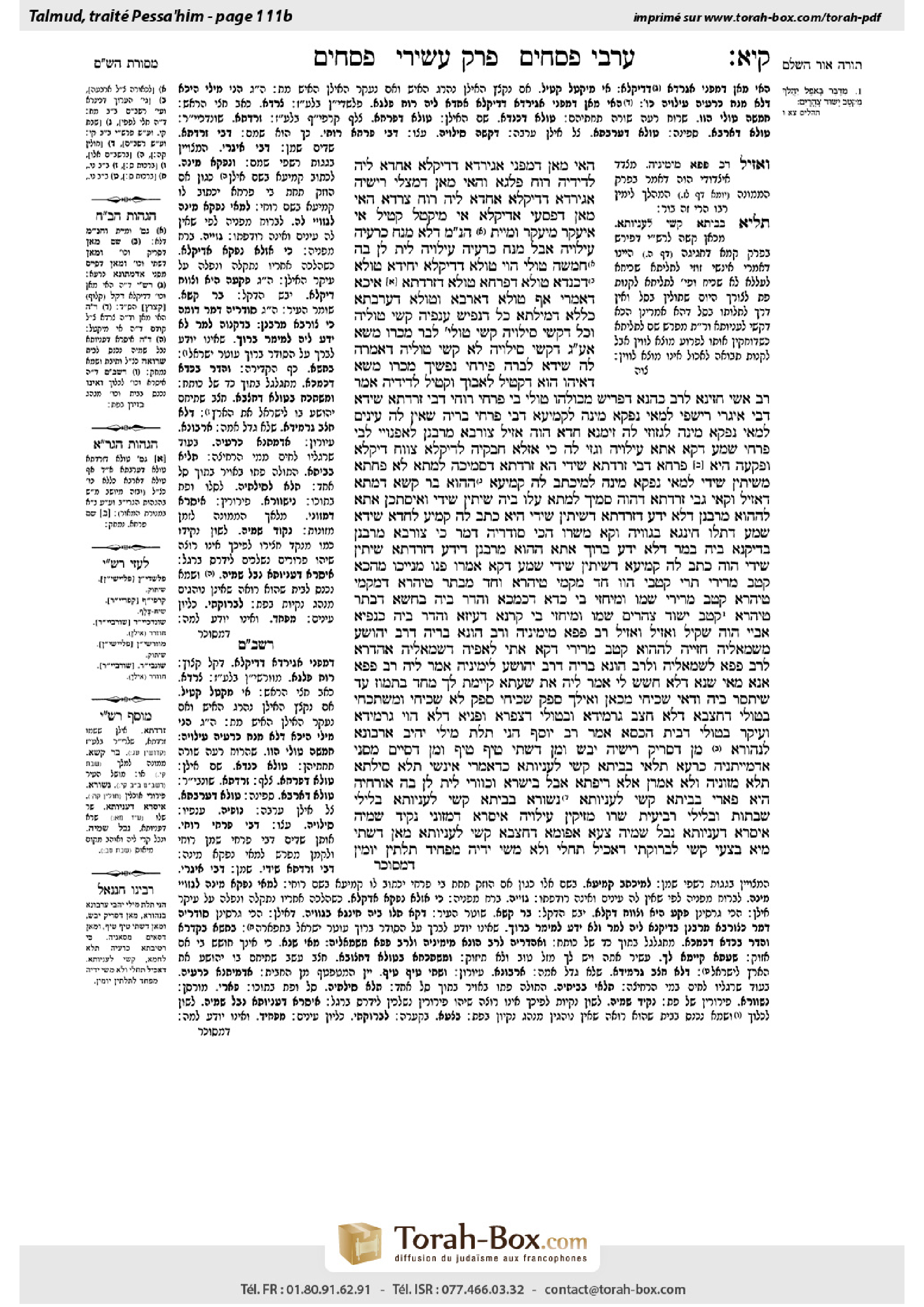
Pesachim 111b: Talmud study for Daf Yomi
Daf Yomi is the daily study of one Talmud folio. Explore 37 tractates with scans, Hebrew text, Sefaria English and AI-generated French translations where annotated.
Passage selection and English or AI-generated French translation are available where the scan has annotations. Daf Study is independent of Torah-Box and Sefaria.
Browse Pesachim · פסחים · All tractatesPesachim 111b text and translations
This page of Pesachim includes the Aramaic text, an English translation and an AI-generated French translation, alongside the scan above.
פסחים קי״א ב · Aramaic and Hebrew text
הַאי מַאן דְּמִפְּנֵי אַגִּירְדָּא דְּדִיקְלָא — אָחֲדָא לֵיהּ לְדִידֵיהּ רוּחַ פַּלְגָא. וְהַאי מַאן דְּמַצְלֵי רֵישֵׁיהּ אַגִּירְדָּא דְּדִיקְלָא — אָחֲדָא לֵיהּ רוּחַ צְרָדָא. הַאי מַאן דְּפָסְעִי אַדִּיקְלָא, אִי מִיקְּטַל — קְטִיל, אִי אִיעֲקַר — מִיעֲקַר וּמָיֵית. הָנֵי מִילֵּי דְּלָא מַנַּח כַּרְעֵיהּ עִילָּוֵיהּ, אֲבָל מַנַּח כַּרְעֵיהּ — עִילָּוֵיהּ לֵית לַן בַּהּ.
חֲמִשָּׁה טוּלֵּי הָוֵי: טוּלָּא דְּדִיקְלָא יְחִידָא, טוּלָּא דְכִנָּדָא, טוּלָּא דְפִרְחָא, טוּלָּא דְזַרְדְּתָא. אִיכָּא דְּאָמְרִי: אַף טוּלָּא דְאַרְבָּא, וְטוּלָּא דַעֲרַבְתָּא. כְּלָלָא דְּמִילְּתָא: כֹּל דִּנְפִישׁ עַנְפֵיהּ — קְשֵׁי טוּלֵּיהּ,
וְכֹל דִּקְשֵׁי סִילְוֵיהּ — קְשֵׁי טוּלֵּיהּ, לְבַר מִכְּרוּ מְשָׁא, אַף עַל גַּב דִּקְשֵׁי סִילְוֵיהּ — לָא קְשֵׁי טוּלֵּיהּ, דַּאֲמַרָה לֵהּ שֵׁידָא לִבְרַהּ: פִּירְחִי נַפְשָׁיךְ מִכְּרוּ מְשָׁא, דְּאִיהוּ הוּא דְּקָטֵיל לַאֲבוּךְ, וְקָטֵיל לְדִידֵיהּ. אָמַר רַב אָשֵׁי: חֲזֵינָא לְרַב כָּהֲנָא דְּפָרֵישׁ מִכּוּלְּהוּ טוּלֵּי.
בֵּי פִרְחֵי — רוּחֵי. דְּבֵי זַרְדְּתָא — שֵׁידָא. דְּבֵי אִיגָּרֵי — רִישְׁפֵּי. לְמַאי נָפְקָא מִינַּהּ? לִקְמִיעָא.
דְּבֵי פִרְחֵי — בְּרִיָּה שֶׁאֵין לָהּ עֵינַיִם. לְמַאי נָפְקָא מִינַּהּ — לְגַזּוֹזֵי לַהּ. זִימְנָא חֲדָא הֲוָה אָזֵיל צוּרְבָּא מֵרַבָּנַן לְאִפְּנוֹיֵי לְבֵי פִרְחֵי, שְׁמַע דְּקָא אָתָא עִילָּוֵיהּ, וְגַזִּי לַהּ. כִּי אָזְלָא, חַבְּקַיהּ לְדִיקְלָא — צְוַוח דִּיקְלָא וּפְקַעָה הִיא.
פִּרְחָא דְּבֵי זַרְדְּתָא — שֵׁידֵי. הָא זַרְדְּתָא דִּסְמִיכָה לְמָתָא — לָא פָּחֲתָא מִשִּׁיתִּין שֵׁידֵי. לְמַאי נָפְקָא מִינַּהּ? לְמִיכְתַּב לַהּ קְמִיעָא.
הָהוּא בַּר קַשָּׁא דְּמָתָא דְּאָזֵיל וְקָאֵי גַּבֵּי זַרְדְּתָא, דַּהֲוָה סְמִיךְ לְמָתָא, עַלּוּ בֵּיהּ שִׁיתִּין שֵׁידֵי וְאִיסְתַּכַּן. אֲתָא לְהָהוּא מֵרַבָּנַן דְּלָא יְדַע דְּזַרְדְּתָא דְּשִׁיתִּין שֵׁידֵי הִיא, כְּתַב לַהּ קְמִיעַ לַחֲדָא שֵׁידָא. שְׁמַע דְּתָלוּ חִינְגָּא בְּגַוֵּויהּ, וְקָא מְשָׁרוּ הָכִי: סוּדָרֵיהּ דְּמָר כִּי צוּרְבָּא מֵרַבָּנַן, בָּדֵיקְנָא בֵּיהּ בְּמָר דְּלָא יָדַע ״בָּרוּךְ״. אֲתָא הָהוּא מֵרַבָּנַן דִּידַע דְּזַרְדְּתָא שִׁיתִּין שֵׁידֵי הֲוָה, כְּתַב לַהּ קְמִיעָא דְּשִׁיתִּין שֵׁידֵי, שְׁמַע דְּקָא אָמְרוּ: פַּנּוּ מָנַיְיכוּ מֵהָכָא.
קֶטֶב מְרִירִי — תְּרֵי קִטְבֵי הָווּ. חַד מִקַּמֵּי טִיהֲרָא, וְחַד מִבָּתַר טִיהֲרָא. דְּמִקַּמֵּי טִיהֲרָא — ״קֶטֶב מְרִירִי״ שְׁמוֹ, וּמִיחֲזֵי בֵּי כַדָּא דְּכַמְכָּא וְהָדַר בֵּיהּ בַּחְשָׁא. דְּבָתַר טִיהֲרָא — ״קֶטֶב יָשׁוּד צׇהֳרָיִם״ שְׁמוֹ, וּמִיחֲזֵי בֵּי קַרְנָא דְּעִיזָּא, וְהָדַר בֵּיהּ כְּנָפְיָא.
אַבָּיֵי הֲוָה שָׁקֵיל וְאָזֵיל, וְאָזֵיל רַב פָּפָּא מִיַּמִּינֵיהּ וְרַב הוּנָא בְּרֵיהּ דְּרַב יְהוֹשֻׁעַ מִשְּׂמָאלֵיהּ. חַזְיֵיהּ לְהָהוּא קֶטֶב מְרִירִי דְּקָא אָתֵי לְאַפֵּיהּ דִּשְׂמָאלֵיהּ. אַהְדְּרֵא לְרַב פָּפָּא לִשְׂמָאלֵיהּ, וּלְרַב הוּנָא בְּרֵיהּ דְּרַב יְהוֹשֻׁעַ לְיַמִּינֵיהּ. אֲמַר לֵיהּ רַב פָּפָּא: אֲנָא מַאי שְׁנָא דְּלָא חָשֵׁשׁ לִי? אֲמַר לֵיהּ: אַתְּ שַׁעְתָּא קָיְימָא לָךְ.
מֵחַד בְּתַמּוּז עַד שִׁיתְּסַר בֵּיהּ — וַדַּאי שְׁכִיחִי. מִכָּאן וְאֵילָךְ — סָפֵק שְׁכִיחִי, סָפֵק לָא שְׁכִיחִי. וּמִשְׁתַּכְחִי בְּטוּלֵּי דְּחַצְבָּא דְּלָא חֲצַב גַּרְמִידָא, וּבְטוּלֵּי דְּצַפְרָא וּפַנְיָא דְּלָא הָוֵי גַּרְמִידָא, וְעִיקָּר בְּטוּלֵּי דְּבֵית הַכִּסֵּא.
אָמַר רַב יוֹסֵף: הָנֵי תְּלָת מִילֵּי יָהֵיב אַרְבּוֹנָא לִנְהוֹרָא: מַן דְּסָרֵיק רֵישֵׁיהּ יַבִּשׁ, וּמַן דְּשָׁתֵי טִיף טִיף, וּמַן דְּסָיֵים מְסָנֵי אַדְּמִייתִנְיָה כַּרְעָא.
תְּלַאי בְּבֵיתָא קְשֵׁי לְעַנְיוּתָא. כִּדְאָמְרִי אִינָשֵׁי: תְּלָא סִילְתָּא — תְּלָא מְזוֹנֵיהּ. וְלָא אֲמַרַן אֶלָּא רִיפְתָּא, אֲבָל בִּישְׂרָא וְכַוְורֵי — לֵית לַן בַּהּ, אוֹרְחֵיהּ הִיא. פָּארֵי בְּבֵיתָא — קְשֵׁי לְעַנְיוּתָא. נִשְׁוָרָא בְּבֵיתָא — קְשֵׁי לְעַנְיוּתָא. בְּלֵילֵי שַׁבָּתוֹת וּבְלֵילֵי רְבִיעִית — שָׁרוּ מַזִּיקִין עִילָּוֵיהּ.
אִיסָּרָא דִמְזוֹנֵי ״נְקִיד״ שְׁמֵיהּ. אִיסָּרָא דְעַנְיוּתָא ״נָבָל״ שְׁמֵיהּ. צָעָא אַפּוּמָּא דְחַצְבָּא — קְשֵׁי לְעַנְיוּתָא. מַאן דְּשָׁתֵי מַיָּא בְּצָעֵי — קְשֵׁי לִבְרוּקְתִּי. דְּאָכֵיל תַּחְלֵי וְלָא מָשֵׁי יְדֵיהּ — מְפַחֵיד תְּלָתִין יוֹמִין.
Pesachim 111b · English translation
The Gemara continues to discuss harmful spirits. One who relieves himself on the stump of a palm tree will be seized by a spirit of sickness, and one who places his head on the stump of a palm tree will be seized by a spirit of a headache of half his head, i.e., a migraine. One who walks over a palm tree, if the tree is cut down, he too will be killed. If that tree is uprooted, he will also be uprooted and will die. The Gemara comments: This statement applies only if he does not place his legs upon it; however, if he places his legs upon it, we have no problem with it.
The Gemara cites another statement with regard to shadows. There are five types of dangerous shadows: The shadow of a single palm tree, the shadow of a tree called kanda, the shadow of a caper-bush, and the shadow of the sorb tree. Some say: Also the shadow of a ship and the shadow of a willow. The general rule of the matter is: Whatever has many branches, its shadow is dangerous.
And any tree whose wood is hard, its shadow is dangerous, except for the tree called kero masa. Although its wood is hard, its shadow is not dangerous, as the demon said to her son: Leave the kero masa tree alone, as it was that tree that killed your father. And the tree later killed the son too. The kero masa tree is harmful to demons. Rav Ashi said: I saw that Rav Kahana avoided all types of shadows.
The Gemara comments: The demons near the caper-bush are called ruḥei. A demon found near the sorb trees is called shida. The demons found on roofs are called rishfei. The Gemara asks: What is the practical difference of these definitions? It makes a difference for writing an amulet on behalf of one who has been harmed. It is necessary to know the name of the demon who caused the damage.
The Gemara further comments: The demon found near the caper-bush is a creature with no eyes. What is the practical halakhic difference of this observation? It is relevant with regard to fleeing from it. The Gemara relates: Once a Torah scholar went to relieve himself near a caper-bush. He heard the demon coming and fled from it. When this evil spirit went, it grabbed a palm tree and got stuck there. The palm tree dried out and the demon burst.
It was stated above that the demons found near the sorb tree are called sheidei. The Gemara comments: This sorb tree that is close to the city contains no less than sixty demons. The Gemara asks: What is the practical difference of this statement? The Gemara answers: It is relevant for writing an amulet for this number.
The Gemara relates: A certain ruler of a city walked and stood by a sorb tree that was near a city. Sixty sheidei demons came upon him and he was in danger. One of the Sages who did not know that it was a sorb tree of sixty sheidei came and wrote him an amulet for one shida demon. That man heard that there was a celebration inside the tree, and the demons were singing: The scarf of the Master is like that of a Torah scholar, but we checked the Master and he does not know how to say barukh, the blessing when donning a scarf. The demons were mocking him and saying that he did not know how to write an amulet. Another one of the Sages, who knew that it was a sorb tree of sixty sheidei, came and wrote an amulet against sixty demons. He heard them saying: Clear your items away from here.
The Gemara discusses the ketev meriri, a demon mentioned in the Torah (Deuteronomy 32:24). There are two types of ketev demons, one that comes before noon in the morning and the other one comes in the afternoon. The one that comes before noon is called ketev meriri, and it appears in a jug of kutaḥ, a Babylonian spice, and continuously revolves around inside it. The ketev in the afternoon is called ketev yashud tzaharayim (Psalms 91:6), and it appears inside the horn of a goat and revolves around inside it like a sifter.
The Gemara relates: Abaye was coming and walking along the street. And Rav Pappa was walking on his right and Rav Huna, son of Rav Yehoshua, was on his left. Abaye saw a certain ketev meriri coming on his left side and he switched Rav Pappa to his left and Rav Huna, son of Rav Yehoshua, to his right. Rav Pappa said to Abaye: And I, what is different that you were not concerned about any possible harm to me? Abaye said to him: The time is in your favor. You are wealthy and fortunate, and therefore I believe that you will most likely not be harmed by the demon.
The Gemara comments: From the first of Tammuz to the sixteenth of that month, these demons are certainly found. From here onward it is uncertain whether they are found or whether they are not found. And they can be found in the shadow of a sea squill that has not grown a cubit, and in the shadow of objects in the morning and evening when their length is less than a cubit. And they are mostly found in the shadow of a privy.
Rav Yosef said: These three matters cause blindness to the light of one’s eyes: One who combs his hair when it is dry, one who drinks wine that is dripping from the barrel, and one who puts on shoes when his feet are wet after being washed.
If a food is hanging in one’s house, it causes poverty. This is as people say in a popular proverb: He who hangs the basket hangs his sustenance, i.e., he loses it. And we said this only about hanging bread; however, if one hangs meat and fish, we have no problem with it. The reason is that it is the common practice to hang meat and fish. Bran [parei] in the house causes poverty. Bread crumbs in the house cause poverty. If these crumbs are spread throughout the house on Shabbat nights, i.e., Friday nights, or on Tuesday nights, when demons are present, harmful spirits rest on them.
The administering angel appointed over food is called Nakid, i.e., he is clean [naki] and particular about cleanliness. The administering angel appointed over poverty is called Naval. The angel appointed over food will not stay in a dirty place, while the angel appointed over poverty will thrive there. A plate placed on a jug causes poverty. One who drinks water from a plate causes eye pain. One who eats cress without washing his hands will be afraid for thirty days.
Pesachim 111b · Traduction française (IA)
La Guemara poursuit son propos sur les esprits nuisibles. Celui qui fait ses besoins sur la souche d’un palmier sera saisi par un esprit de maladie, et celui qui pose sa tête sur la souche d’un palmier sera saisi par un esprit provoquant une douleur dans la moitié de la tête, c’est-à-dire une migraine. Celui qui passe au-dessus d’un palmier sera tué si l’arbre est abattu. Si l’arbre est déraciné, il sera lui aussi déraciné et mourra. La Guemara précise : cela ne s’applique que s’il ne pose pas ses jambes dessus ; en revanche, s’il les pose dessus, il n’y a pas de problème.
La Guemara cite une autre affirmation au sujet des ombres. Il existe cinq sortes d’ombres dangereuses : l’ombre d’un palmier isolé, celle d’un arbre appelé kanda, celle d’un câprier et celle d’un sorbier. Certains disent qu’il faut également compter l’ombre d’un bateau et celle d’un saule. La règle générale est la suivante : l’ombre de tout arbre qui a de nombreuses branches est dangereuse.
L’ombre de tout arbre dont le bois est dur est dangereuse, à l’exception de celle de l’arbre appelé kero masa. Bien que son bois soit dur, son ombre n’est pas dangereuse, car le démon dit à son fils : « Laisse le kero masa tranquille, car c’est cet arbre qui a tué ton père. » Plus tard, l’arbre tua aussi le fils. Le kero masa est nuisible aux démons. Rav Ashi dit : « J’ai vu que Rav Kahana évitait toutes sortes d’ombres. »
La Guemara précise : les démons qui se trouvent près du câprier sont appelés ruḥei. Un démon qui se trouve près des sorbiers est appelé shida. Ceux qui se trouvent sur les toits sont appelés rishfei. La Guemara demande : quelle est la conséquence pratique de ces définitions ? Elles sont utiles lorsqu’on écrit une amulette pour quelqu’un qui a subi un dommage : il faut connaître le nom du démon qui l’a causé.
La Guemara ajoute que le démon qui se trouve près du câprier est une créature dépourvue d’yeux. Quelle est la conséquence pratique de cette observation ? Elle concerne la manière de lui échapper. La Guemara rapporte qu’un jour, un érudit en Torah alla faire ses besoins près d’un câprier. Il entendit le démon arriver et s’enfuit. Lorsque cet esprit mauvais s’en alla, il saisit un palmier et s’y retrouva coincé. Le palmier se dessécha et le démon éclata.
Il a été dit plus haut que les démons qui se trouvent près du sorbier sont appelés sheidei. La Guemara précise que ce sorbier situé près de la ville abrite au moins soixante démons. La Guemara demande : quelle est la conséquence pratique de cette affirmation ? Elle est utile pour écrire une amulette contre ce nombre de démons.
La Guemara rapporte qu’un certain gouverneur d’une ville passa près d’un sorbier situé à proximité de celle-ci et s’y arrêta. Soixante démons sheidei s’en prirent à lui, et il fut en danger. L’un des Sages, qui ignorait qu’il s’agissait d’un sorbier abritant soixante sheidei, vint et lui écrivit une amulette contre un seul démon shida. Cet homme entendit une fête à l’intérieur de l’arbre, et les démons chantaient : « L’écharpe du Maître ressemble à celle d’un érudit en Torah, mais nous avons vérifié : le Maître ne sait pas dire barukh, la bénédiction prononcée lorsqu’on met une écharpe. » Les démons se moquaient de lui et disaient qu’il ne savait pas écrire une amulette. Un autre Sage, qui savait qu’il s’agissait d’un sorbier abritant soixante sheidei, vint et écrivit une amulette contre soixante démons. Il les entendit dire : « Enlevez vos affaires d’ici. »
La Guemara traite du ketev meriri, un démon mentionné dans la Torah (Deutéronome 32,24). Il existe deux sortes de démons ketev : l’un apparaît le matin, avant midi, et l’autre l’après-midi. Celui qui apparaît avant midi est appelé ketev meriri ; il se manifeste dans un pot de kutaḥ, un condiment babylonien, et tourne sans cesse à l’intérieur. Le ketev de l’après-midi est appelé ketev yashud tzaharayim (Psaumes 91,6) ; il apparaît à l’intérieur de la corne d’un bouc et y tourne comme un tamis.
La Guemara rapporte qu’Abaye avançait dans la rue. Rav Pappa marchait à sa droite et Rav Huna, fils de Rav Yehoshua, à sa gauche. Abaye vit un certain ketev meriri arriver de son côté gauche ; il fit passer Rav Pappa à sa gauche et Rav Huna, fils de Rav Yehoshua, à sa droite. Rav Pappa dit à Abaye : « Et moi, en quoi suis-je différent, pour que tu ne te sois pas soucié du danger que je pourrais courir ? » Abaye lui répondit : « Le moment t’est favorable. Tu es riche et chanceux ; je pense donc que le démon ne te fera probablement pas de mal. »
La Guemara précise que du premier au seizième jour de Tammouz, ces démons sont assurément présents. À partir de là, il n’est pas certain qu’ils soient encore présents. On peut les trouver dans l’ombre d’une scille maritime qui n’a pas atteint une coudée, ainsi que dans l’ombre d’objets, le matin et le soir, lorsque celle-ci mesure moins d’une coudée. Ils se trouvent surtout dans l’ombre des latrines.
Rav Yosef dit : trois choses altèrent la vue : se peigner les cheveux lorsqu’ils sont secs, boire le vin qui goutte du tonneau et mettre des chaussures alors que les pieds sont encore mouillés après avoir été lavés.
Un aliment suspendu dans la maison provoque la pauvreté. C’est ce qu’exprime un proverbe populaire : « Celui qui suspend la corbeille suspend sa subsistance », c’est-à-dire qu’il la perd. Cela ne concerne que le pain suspendu ; en revanche, il n’y a pas de problème à suspendre la viande et le poisson, car il est d’usage de les suspendre. Le son [parei] dans la maison provoque la pauvreté. Les miettes de pain dans la maison provoquent la pauvreté. Si ces miettes sont éparpillées dans toute la maison les nuits de Chabbat, c’est-à-dire le vendredi soir, ou le mardi soir, lorsque les démons sont présents, les esprits nuisibles se posent dessus.
L’ange préposé à la nourriture s’appelle Nakid, c’est-à-dire qu’il est propre [naki] et exige la propreté. L’ange préposé à la pauvreté s’appelle Naval. L’ange préposé à la nourriture ne demeure pas dans un endroit sale, tandis que celui de la pauvreté s’y épanouit. Poser une assiette sur une cruche provoque la pauvreté. Boire de l’eau dans une assiette provoque des douleurs aux yeux. Celui qui mange du cresson sans se laver les mains aura peur pendant trente jours.
Traduction française générée par IA à partir de l’édition anglaise de Sefaria. Vérifie toujours un passage avec le texte source.
Text from Sefaria: William Davidson Edition - Vocalized Aramaic (CC BY NC); William Davidson Edition - English (CC BY NC).