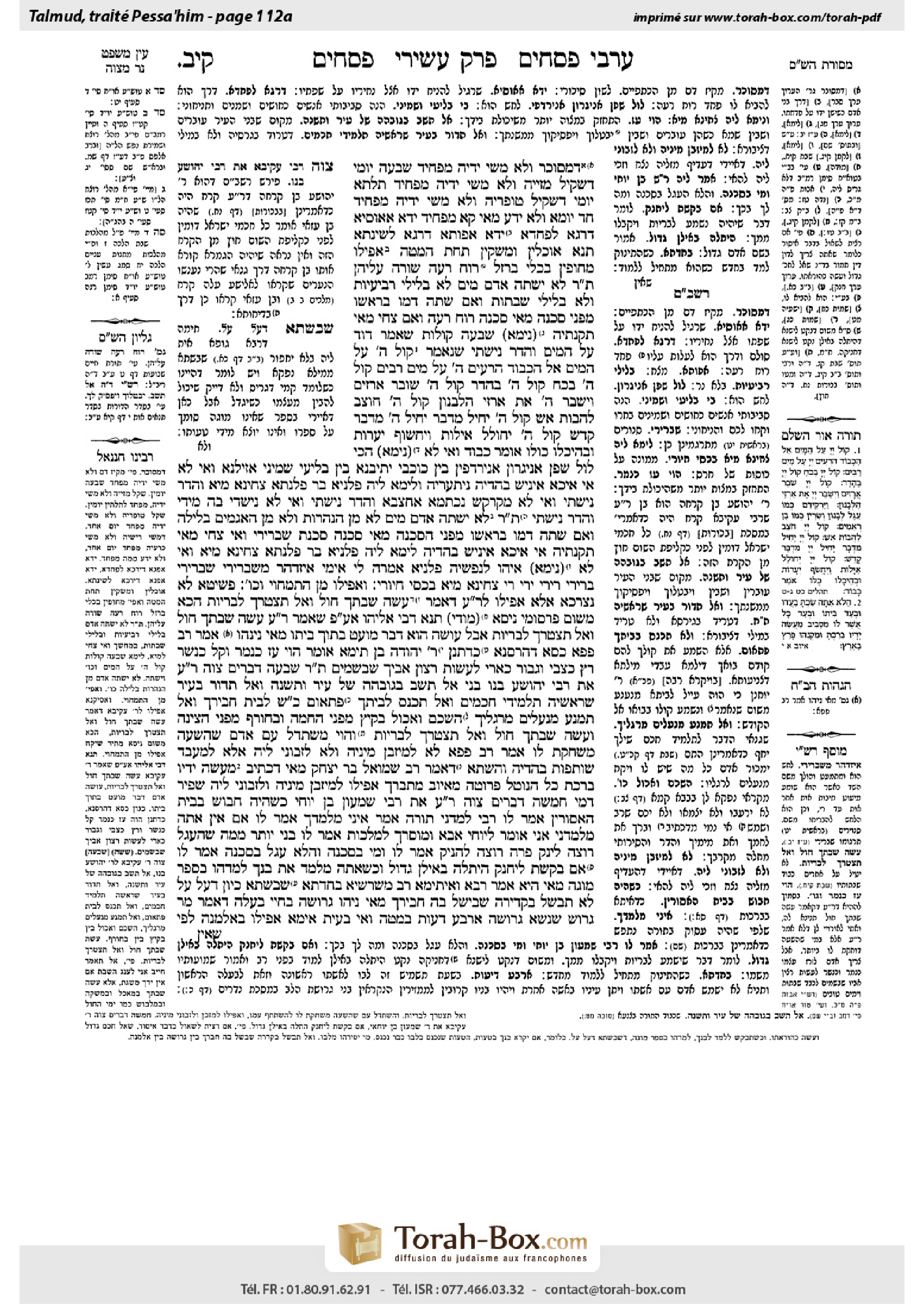
Pesachim 112a: Talmud study for Daf Yomi
Daf Yomi is the daily study of one Talmud folio. Explore 37 tractates with scans, Hebrew text, Sefaria English and AI-generated French translations where annotated.
Passage selection and English or AI-generated French translation are available where the scan has annotations. Daf Study is independent of Torah-Box and Sefaria.
Browse Pesachim · פסחים · All tractatesPesachim 112a text and translations
This page of Pesachim includes the Aramaic text, an English translation and an AI-generated French translation, alongside the scan above.
פסחים קי״ב א · Aramaic and Hebrew text
דִּמְסוֹכַר וְלָא מָשֵׁי יְדֵיהּ — מְפַחֵיד שִׁבְעָה יוֹמֵי. דְּשָׁקֵיל מַזְיֵיהּ וְלָא מָשֵׁי יְדֵיהּ — מְפַחֵיד תְּלָתָא יוֹמֵי. דְּשָׁקֵיל טוּפְרֵיהּ וְלָא מָשֵׁי יְדֵיהּ — מְפַחֵיד חַד יוֹמָא, וְלָא יָדַע מַאי קָא מְפַחֵיד. יְדָא אַאוּסְיָא — דַּרְגָּא לְפַחְדָּא. יְדָא אַפּוּתָא — דַּרְגָּא לְשִׁינְתָּא.
תָּנָא: אוֹכָלִין וּמַשְׁקִין תַּחַת הַמִּטָּה, אֲפִילּוּ מְחוּפִּין בִּכְלִי בַּרְזֶל — רוּחַ רָעָה שׁוֹרָה עֲלֵיהֶן. תָּנוּ רַבָּנַן: לֹא יִשְׁתֶּה אָדָם מַיִם לֹא בְּלֵילֵי רְבִיעִיּוֹת וְלֹא בְּלֵילֵי שַׁבָּתוֹת, וְאִם שָׁתָה — דָּמוֹ בְּרֹאשׁוֹ מִפְּנֵי סַכָּנָה. מַאי סַכָּנָה? רוּחַ רָעָה.
וְאִם צָחֵי מַאי תַּקַּנְתֵּיהּ? (נֵימָא) שִׁבְעָה קוֹלוֹת שֶׁאָמַר דָּוִד עַל הַמַּיִם, וַהֲדַר נִישְׁתֵּי, שֶׁנֶּאֱמַר: ״קוֹל ה׳ עַל הַמָּיִם אֵל הַכָּבוֹד הִרְעִים ה׳ עַל מַיִם רַבִּים קוֹל ה׳ בַּכֹּחַ קוֹל ה׳ בֶּהָדָר קוֹל ה׳ שׁוֹבֵר אֲרָזִים וַיְשַׁבֵּר ה׳ אֶת אַרְזֵי הַלְּבָנוֹן קוֹל ה׳ חוֹצֵב לַהֲבוֹת אֵשׁ קוֹל ה׳ יָחִיל מִדְבָּר יָחִיל ה׳ מִדְבַּר קָדֵשׁ קוֹל ה׳ יְחוֹלֵל אַיָּלוֹת וַיֶּחֱשׂוֹף יְעָרוֹת וּבְהֵיכָלוֹ כּוּלּוֹ אוֹמֵר כָּבוֹד״.
וְאִי לָא, (נֵימָא) הָכִי: ״לוּל שָׁפָן אֲנִיגְרוֹן אֲנִירָדְפִין בֵּין כּוֹכְבֵי יָתֵיבְנָא, בֵּין בְּלִיעִי שַׁמִּינֵי אָזֵילְנָא״. וְאִי לָא, אִי אִיכָּא אִינִישׁ בַּהֲדֵיהּ — נַיתְעֲרֵיהּ וְלֵימָא לֵיהּ: ״פְּלָנְיָא בַּר פְּלָנִתָא צָחֵינָא מַיָּא״, וַהֲדַר נִישְׁתֵּי. וְאִי לָא — מְקַרְקֵשׁ נִכְתְּמָא אַחַצְבָּא וַהֲדַר נִישְׁתֵּי. וְאִי לָא — נִישְׁדֵּי בַּהּ מִידֵּי, וַהֲדַר נִישְׁתֵּי.
תָּנוּ רַבָּנַן: לֹא יִשְׁתֶּה אָדָם מַיִם לֹא מִן הַנְּהָרוֹת וְלֹא מִן הָאֲגַמִּים בַּלַּיְלָה, וְאִם שָׁתָה — דָּמוֹ בְּרֹאשׁוֹ, מִפְּנֵי הַסַּכָּנָה. מַאי סַכָּנָה? סַכָּנַת שַׁבְרִירֵי. וְאִי צַחֵי מַאי תַּקַּנְתֵּיהּ? אִי אִיכָּא אִינִישׁ בַּהֲדֵיהּ — לֵימָא לֵיהּ: ״פְּלָנְיָא בַּר פְּלָנִתָא, צָחֵינָא מַיָּא״. וְאִי לָא, (נֵימָא) אִיהוּ לְנַפְשֵׁיהּ: ״פְּלָנְיָא, אֲמַרָה לִי אִימִּי אִיזְדְּהַר מִשַּׁבְרִירֵי שַׁבְרִירֵי בְּרִירֵי רִירֵי יְרֵי רֵי — צָחֵינָא מַיָּא בְּכָסֵי חִיוָּרֵי״.
וַאֲפִילּוּ מִן הַתַּמְחוּי וְכוּ׳. פְּשִׁיטָא!
לֹא נִצְרְכָא אֶלָּא אֲפִילּוּ לְרַבִּי עֲקִיבָא, דְּאָמַר: עֲשֵׂה שַׁבַּתְּךָ חוֹל וְאַל תִּצְטָרֵךְ לַבְּרִיּוֹת — הָכָא מִשּׁוּם פַּרְסוֹמֵי נִיסָּא (מוֹדֵי).
תָּנָא דְּבֵי אֵלִיָּהוּ, אַף עַל פִּי שֶׁאָמַר רַבִּי עֲקִיבָא: עֲשֵׂה שַׁבַּתְּךָ חוֹל וְאַל תִּצְטָרֵךְ לַבְּרִיּוֹת, אֲבָל עוֹשֶׂה הוּא דָּבָר מוּעָט בְּתוֹךְ בֵּיתוֹ. מַאי נִינְהוּ? אָמַר רַב פָּפָּא: כָּסָא דְהַרְסָנָא. כְּדִתְנַן, רַבִּי יְהוּדָה בֶּן תֵּימָא אוֹמֵר: הֱוֵי עַז כַּנָּמֵר וְקַל כַּנֶּשֶׁר, רָץ כַּצְּבִי וְגִבּוֹר כָּאֲרִי לַעֲשׂוֹת רְצוֹן אָבִיךָ שֶׁבַּשָּׁמַיִם.
תָּנוּ רַבָּנַן, שִׁבְעָה דְּבָרִים צִוָּה רַבִּי עֲקִיבָא אֶת רַבִּי יְהוֹשֻׁעַ בְּנוֹ: בְּנִי, אַל תֵּשֵׁב בְּגוֹבְהָהּ שֶׁל עִיר וְתִשְׁנֶה, וְאַל תָּדוּר בְּעִיר שֶׁרָאשֶׁיהָ תַּלְמִידֵי חֲכָמִים.
וְאַל תִּכָּנֵס לְבֵיתְךָ פִּתְאוֹם, כׇּל שֶׁכֵּן לְבֵית חֲבֵירְךָ. וְאַל תִּמְנַע מִנְעָלִים מֵרַגְלֶיךָ. הַשְׁכֵּם וֶאֱכוֹל, בַּקַּיִץ מִפְּנֵי הַחַמָּה, וּבַחוֹרֶף מִפְּנֵי הַצִּינָּה. וַעֲשֵׂה שַׁבַּתְּךָ חוֹל וְאַל תִּצְטָרֵךְ לַבְּרִיּוֹת. וֶהֱוֵי מִשְׁתַּדֵּל עִם אָדָם שֶׁהַשָּׁעָה מְשַׂחֶקֶת לוֹ.
אָמַר רַב פָּפָּא: לָא לְמִיזְבַּן מִינֵּיהּ וְלָא לְזַבּוֹנֵי לֵיהּ, אֶלָּא לְמֶעְבַּד שׁוּתָּפוּת בַּהֲדֵיהּ. וְהַשְׁתָּא דְּאָמַר רַב שְׁמוּאֵל בַּר יִצְחָק: מַאי דִּכְתִיב ״מַעֲשֵׂה יָדָיו בֵּרַכְתָּ״ — כׇּל הַנּוֹטֵל פְּרוּטָה מֵאִיּוֹב מִתְבָּרֵךְ, אֲפִילּוּ לְמִיזְבַּן מִינֵּיהּ וּלְזַבּוֹנֵי לֵיהּ שַׁפִּיר דָּמֵי.
חֲמִשָּׁה דְּבָרִים צִוָּה רַבִּי עֲקִיבָא אֶת רַבִּי שִׁמְעוֹן בֶּן יוֹחַי כְּשֶׁהָיָה חָבוּשׁ בְּבֵית הָאֲסוּרִין. אָמַר לוֹ: רַבִּי, לַמְּדֵנִי תּוֹרָה, אָמַר: אֵינִי מְלַמְּדֶךָ. אָמַר לוֹ: אִם אֵין אַתָּה מְלַמְּדֵנִי אֲנִי אוֹמֵר לְיוֹחַי אַבָּא וּמוֹסֶרְךָ לַמַּלְכוּת. אָמַר לוֹ: בְּנִי, יוֹתֵר מִמַּה שֶּׁהָעֵגֶל רוֹצֶה לִינַק פָּרָה רוֹצֶה לְהָנִיק. אָמַר לוֹ: וּמִי בְּסַכָּנָה? וַהֲלֹא עֵגֶל בְּסַכָּנָה.
אָמַר לוֹ: אִם בִּקַּשְׁתָּ לֵיחָנֵק — הִיתָּלֵה בְּאִילָן גָּדוֹל. וּכְשֶׁאַתָּה מְלַמֵּד אֶת בִּנְךָ — לַמְּדֵהוּ בְּסֵפֶר מוּגָּהּ. מַאי הִיא? אָמַר רָבָא, וְאִיתֵּימָא רַב מְשַׁרְשְׁיָא: בְּחַדְתָּא, שַׁבֶּשְׁתָּא כֵּיוָן דְּעָל — עָל.
לֹא תְּבַשֵּׁל בִּקְדֵירָה שֶׁבִּישֵּׁל בָּהּ חֲבֵירֶךָ. מַאי נִיהוּ — גְּרוּשָׁה בְּחַיֵּי בַּעְלָהּ, דְּאָמַר מָר גָּרוּשׁ שֶׁנָּשָׂא גְּרוּשָׁהּ — אַרְבַּע דֵּעוֹת בַּמִּטָּה. וְאִי בָּעֵית אֵימָא: אֲפִילּוּ בְּאַלְמָנָה, לְפִי
Pesachim 112a · English translation
One who lets blood and does not wash his hands will be afraid for seven days. One who cuts his hair and does not wash his hands will be afraid for three days. One who cuts his nails and does not wash his hands will be afraid for one day, and he will not know what is frightening him. Placing one’s hand on his nostrils is a way to become afraid. Placing one’s hand on his forehead is a way to fall asleep.
A Sage taught: If food and drink are under one’s bed, even if they are covered with iron vessels, an evil spirit rests upon them. The Sages taught: A person should not drink water on Tuesday nights or on Shabbat nights, i.e., Friday nights. And if he drinks water, his blood is upon his own head, due to the danger. The Gemara asks: What is this danger? The Gemara answers: The danger of the evil spirit that rules on these days.
The Gemara asks: And if he is thirsty, what is his remedy? What should he drink? The Gemara answers: He should say the seven voices that David said over the water, and afterward he may drink. As it is stated: “The voice of the Lord is upon the waters; God of glory thunders, even the Lord upon many waters. The voice of the Lord is powerful; the voice of the Lord is full of majesty. The voice of the Lord breaks the cedars; the Lord breaks in pieces the cedars of Lebanon. He makes them also skip like a calf; Lebanon and Sirion like a young wild ox. The voice of the Lord hews out flames of fire. The voice of the Lord shakes the wilderness; the Lord shakes the wilderness of Kadesh. The voice of the Lord makes the hinds to calve, and strips the forests bare; and in His temple all say: Glory” (Psalms 29:3–9).
And if he does not remember that verse, he should say as follows: Lul, Shafan, Anigron, Anirdafin, which are names of demons, I sit between the stars, I walk between thin and fat people, take any of them if you wish but leave me alone. And if he does not recall this incantation, if there is another person with him, he should wake him and say to him: So-and-so, son of so-and-so, I thirst for water; and then he may drink. And if there is no other person with him, he should knock the cover on the cup and then drink. And if he is not able to do this, he should throw some object in it and then drink.
The Sages taught: A person should not drink water from rivers or from ponds at night. And if he drank, his blood is upon his own head due to the danger. The Gemara explains: What is this danger? The danger of blindness. The Gemara asks: And if he is thirsty, what is his remedy? If there is another person with him, he should say to him: So-and-so, son of so-and-so, I thirst for water. And if there is no one else with him, he should say to himself: So-and-so, my mother said to me to beware of shavrirei, the demon of blindness. He should continue to say the following incantation, in the first part of which the demon’s name gradually disappears: Shavrirei berirei rirei yiri ri; I thirst for water in white earthenware cups. This is an incantation against those demons.
The Gemara returns to the statement of the mishna that on Passover one must drink no less than four cups of wine: And this halakha applies even if the poor person accepts funds from the charity plate. The Gemara asks: It is obvious that this is the case. If there is a mitzva to drink these four cups, they must be provided for him.
The Gemara answers: The mishna is necessary only to teach that this halakha applies even according to the opinion of Rabbi Akiva, who said: Make your Shabbat like an ordinary weekday and do not be beholden to other beings. If one is unable to honor Shabbat without financial help from others, it is better for him to save money and eat his Shabbat meals as he would on a weekday rather than rely on other people. Here, in the case of the four cups, Rabbi Akiva concedes that it is appropriate for a poor person to request assistance from the community, due to the obligation to publicize the miracle.
With regard to this issue, the school of Eliyahu taught that although Rabbi Akiva said: Make your Shabbat like a weekday and do not be beholden to other beings; however, one should nevertheless perform some small alteration in his house to distinguish Shabbat from a weekday. The Gemara asks: What is this alteration? Rav Pappa said: For example, one should serve small, fried fish. As we learned in a mishna: Rabbi Yehuda ben Teima says: Be bold like a leopard, light like an eagle, run like a deer, and be strong like a lion to perform the will of your Father in Heaven. This statement teaches that one should exert every effort to perform a mitzva.
The Gemara cites the full source of Rabbi’s Akiva statement with regard to Shabbat preparations. The Sages taught: Rabbi Akiva commanded Rabbi Yehoshua, his son, about seven matters: My son, do not sit at the high point of a city, where many people pass, and study there, as the passersby will interrupt you. And do not live in a city whose leaders are Torah scholars, as they are too busy studying to govern properly.
Rabbi Akiva continued: And do not enter your house suddenly, without knocking first; all the more so do not enter the house of another, as he might not be ready to receive you. And do not withhold shoes from your feet, as it is disgraceful to go barefoot. Wake up and eat, in the summer due to the heat, as it is best to eat before it grows hot, and in the winter due to the strength you will need to tolerate the cold. And make your Shabbat like a weekday and do not be beholden to other beings. And exert yourself to join together with a person upon whom the hour smiles, i.e., a successful person.
Rav Pappa said in explanation of this last statement: Do not buy from him and do not sell to him. If he is the beneficiary of good fortune, he will profit from any business transaction and you will suffer from it. Rather, form a partnership with him. And now we have heard that Rav Shmuel bar Yitzḥak said: What is the meaning of that which is written: “You have blessed the work of his hands” (Job 1:10)? This means that anyone who took a peruta from Job would be blessed, even if he received it via a business transaction. This shows that one should engage in business with a person who is blessed, for even if he wishes to buy from him or to sell to him it is well, i.e., he will share in the good fortune of the other.
The Gemara continues to cite similar advice dispensed by Rabbi Akiva. Rabbi Akiva commanded Rabbi Shimon ben Yoḥai to do five matters when Rabbi Akiva was imprisoned. Beforehand, Rabbi Shimon said to him: Rabbi, teach me Torah. Rabbi Akiva said to him: I will not teach you, as it is dangerous to do so at the present time. Rabbi Shimon said to him in jest: If you will not teach me, I will tell Yoḥai my father, and he will turn you over to the government. In other words, I have no means of persuading you; you are already in prison. Rabbi Akiva said: My son, know that more than the calf wishes to suck, the cow wants to suckle, but I am afraid of the danger. Rabbi Shimon said to him: And who is in danger? Isn’t the calf in danger, as you are in jail and I am the one at risk?
Rabbi Akiva said to him: If so, I will tell you a few matters. First of all, if you wish to strangle yourself, hang yourself on a tall tree. This proverb means that if one wants others to accept what he has to say, he should attribute his statement to a great man. And when you teach your son, teach him from a corrected text. The Gemara asks: What is the meaning of that statement? Rava said, and some say Rav Mesharshiya said: Rabbi Akiva was referring to learning a new topic, for once a mistake enters one’s mind, it has entered there and is difficult to put right.
Rabbi Akiva further told Rabbi Shimon ben Yoḥai: Do not cook in a pot in which your colleague cooked his food. The Gemara asks: What is the meaning of this statement? The Gemara explains: Rabbi Akiva is referring to marrying a divorced woman in the lifetime of her former husband. As the Master said: If a divorced man marries a divorced woman, there are four minds in the bed during intimacy. Each person thinks about his current and former spouse, which verges on illegitimacy. And if you wish, say instead that this advice holds true even with regard to marrying a widow, as
Pesachim 112a · Traduction française (IA)
Celui qui se fait saigner et ne se lave pas les mains sera effrayé pendant sept jours. Celui qui se coupe les cheveux et ne se lave pas les mains sera effrayé pendant trois jours. Celui qui se coupe les ongles et ne se lave pas les mains sera effrayé pendant un jour, sans savoir ce qui l’effraie. Poser sa main sur ses narines est un moyen de se faire peur. Poser sa main sur son front est un moyen de s’endormir.
Un Sage enseigna : Si de la nourriture et une boisson se trouvent sous le lit de quelqu’un, même recouvertes de récipients en fer, un esprit malfaisant se pose sur elles. Les Sages enseignèrent : Une personne ne doit pas boire d’eau les nuits du mardi ni du Chabbat, c’est-à-dire le vendredi soir. Si elle boit de l’eau, son sang retombera sur sa propre tête, en raison du danger. La Guemara demande : De quel danger s’agit-il ? La Guemara répond : Du danger que représente l’esprit malfaisant qui règne ces nuits-là.
La Guemara demande : Et si elle a soif, quel est son remède ? Que doit-elle boire ? La Guemara répond : Elle doit réciter les sept voix que David a prononcées au sujet de l’eau, puis elle peut boire. Comme il est dit : « La voix de l’Éternel est sur les eaux ; le Dieu de gloire tonne, l’Éternel sur les grandes eaux. La voix de l’Éternel est puissante ; la voix de l’Éternel est majestueuse. La voix de l’Éternel brise les cèdres ; l’Éternel brise les cèdres du Liban. Il les fait bondir comme un veau, le Liban et le Sirion comme un jeune taureau sauvage. La voix de l’Éternel taille des flammes de feu. La voix de l’Éternel fait trembler le désert ; l’Éternel fait trembler le désert de Qadesh. La voix de l’Éternel fait mettre bas les biches et dépouille les forêts ; et dans son Temple, tous disent : Gloire ! » (Psaumes 29, 3-9).
Et si elle ne se souvient pas de ce verset, elle doit dire ce qui suit : « Lul, Shafan, Anigron, Anirdafin, qui sont des noms de démons, je suis assis entre les étoiles, je marche entre les gens maigres et les gens corpulents ; prends l’un d’eux si tu le souhaites, mais laisse-moi tranquille. » Et si elle ne se rappelle pas cette incantation, mais qu’une autre personne est avec elle, elle doit la réveiller et lui dire : « Untel, fils d’untel, j’ai soif d’eau » ; elle peut alors boire. Et si personne d’autre n’est avec elle, elle doit frapper le couvercle du récipient, puis boire. Et si elle ne peut pas faire cela, elle doit y jeter un objet, puis boire.
Les Sages enseignèrent : Une personne ne doit pas boire la nuit de l’eau provenant de rivières ou de mares. Si elle en boit, son sang retombera sur sa propre tête, en raison du danger. La Guemara explique : De quel danger s’agit-il ? Du danger de devenir aveugle. La Guemara demande : Et si elle a soif, quel est son remède ? S’il y a une autre personne avec elle, elle doit lui dire : « Untel, fils d’untel, j’ai soif d’eau. » Et si personne d’autre n’est avec elle, elle doit se dire : « Untel, ma mère m’a dit de me méfier des shavrirei, le démon de la cécité. » Elle doit poursuivre en récitant l’incantation suivante, dans la première partie de laquelle le nom du démon disparaît peu à peu : « Shavrirei berirei rirei yiri ri ; j’ai soif d’eau dans des gobelets de terre blanche. » C’est une incantation contre ces démons.
La Guemara revient à l’énoncé de la Michna selon lequel, à Pessa’h, on doit boire au moins quatre coupes de vin : cette halakha s’applique même si le pauvre reçoit de l’argent du fonds de charité. La Guemara demande : Cela va de soi. S’il y a une mitsva de boire ces quatre coupes, il faut les lui fournir.
La Guemara répond : La Michna est nécessaire uniquement pour enseigner que cette halakha s’applique même selon l’opinion de Rabbi Akiva, qui a dit : « Fais de ton Chabbat un jour de semaine ordinaire et ne dépends pas d’autrui. » Si quelqu’un ne peut honorer le Chabbat sans aide financière d’autrui, mieux vaut qu’il économise et prenne ses repas de Chabbat comme en semaine plutôt que de dépendre d’autres personnes. Ici, dans le cas des quatre coupes, Rabbi Akiva concède qu’il convient qu’un pauvre demande l’aide de la communauté, en raison de l’obligation de faire connaître le miracle.
À ce sujet, l’école d’Eliyahou enseigna que, bien que Rabbi Akiva ait dit : « Fais de ton Chabbat un jour de semaine et ne dépends pas d’autrui », il faut néanmoins apporter chez soi une petite modification afin de distinguer le Chabbat d’un jour de semaine. La Guemara demande : Quelle est cette modification ? Rav Pappa dit : Par exemple, on peut servir de petits poissons frits. En effet, nous avons appris dans une Michna : Rabbi Yehuda ben Teima dit : « Sois hardi comme un léopard, léger comme un aigle, rapide comme un cerf et fort comme un lion pour accomplir la volonté de ton Père qui est aux cieux. » Cet enseignement indique qu’il faut déployer tous ses efforts pour accomplir une mitsva.
La Guemara cite la source complète de la déclaration de Rabbi Akiva concernant les préparatifs du Chabbat. Les Sages enseignèrent : Rabbi Akiva donna à son fils, Rabbi Yehoshua, sept recommandations : « Mon fils, ne t’assieds pas au point le plus élevé d’une ville, où passent beaucoup de gens, pour y étudier, car les passants t’interrompraient. Et ne vis pas dans une ville dont les dirigeants sont des érudits de Torah, car ils sont trop occupés à étudier pour bien gouverner. »
Rabbi Akiva poursuivit : « N’entre pas chez toi à l’improviste, sans frapper d’abord ; à plus forte raison, n’entre pas chez autrui, car cette personne pourrait ne pas être prête à te recevoir. Ne te prive pas de chaussures aux pieds, car il est honteux d’aller pieds nus. Réveille-toi et mange : en été, à cause de la chaleur, car il vaut mieux manger avant qu’il ne fasse chaud ; et en hiver, à cause de la force dont tu auras besoin pour supporter le froid. Fais de ton Chabbat un jour de semaine et ne dépends pas d’autrui. Et efforce-toi de t’associer à une personne à qui la chance sourit, c’est-à-dire une personne qui réussit. »
Rav Pappa dit, pour expliquer cette dernière déclaration : « N’achète pas auprès de lui et ne lui vends pas. S’il est favorisé par la chance, il tirera profit de toute transaction commerciale et tu en pâtiras. Associe-toi plutôt à lui. » Et nous avons maintenant appris que Rav Shmuel bar Yitzḥak a dit : « Quel est le sens de ce qui est écrit : “Tu as béni le travail de ses mains” (Job 1, 10) ? » Cela signifie que quiconque recevait une perouta de Job était béni, même s’il la recevait dans le cadre d’une transaction commerciale. Cela montre qu’il faut faire des affaires avec une personne bénie : même si l’on souhaite lui acheter ou lui vendre quelque chose, cela convient, c’est-à-dire que l’on partagera sa bonne fortune.
La Guemara poursuit en citant des conseils semblables donnés par Rabbi Akiva. Rabbi Akiva recommanda cinq choses à Rabbi Shimon ben Yoḥai alors qu’il était emprisonné. Auparavant, Rabbi Shimon lui avait dit : « Rabbi, enseigne-moi la Torah. » Rabbi Akiva lui répondit : « Je ne t’enseignerai pas, car cela est dangereux en ce moment. » Rabbi Shimon lui dit sur le ton de la plaisanterie : « Si tu ne m’enseignes pas, je le dirai à Yoḥai, mon père, et il te livrera au gouvernement. » Autrement dit, je n’ai aucun moyen de te convaincre ; tu es déjà en prison. Rabbi Akiva dit : « Mon fils, sache que plus le veau désire téter, plus la vache désire l’allaiter, mais j’ai peur du danger. » Rabbi Shimon lui dit : « Et qui est en danger ? N’est-ce pas le veau qui est en danger, puisque tu es en prison et que c’est moi qui risque quelque chose ? »
Rabbi Akiva lui dit : « Dans ce cas, je vais te dire quelques recommandations. Tout d’abord, si tu veux t’étrangler, suspends-toi à un grand arbre. » Ce proverbe signifie que si l’on veut que les autres acceptent ce qu’on a à dire, il faut attribuer ses propos à un grand homme. « Et lorsque tu enseignes à ton fils, enseigne-lui à partir d’un texte corrigé. » La Guemara demande : Que signifie cette déclaration ? Rava dit, et certains disent que c’est Rav Mesharshiya qui l’a dit : Rabbi Akiva faisait référence à l’étude d’un nouveau sujet, car une fois qu’une erreur s’est introduite dans l’esprit, elle y demeure et il est difficile de la corriger.
Rabbi Akiva dit encore à Rabbi Shimon ben Yoḥai : « Ne fais pas cuire dans une marmite où ton collègue a fait cuire son repas. » La Guemara demande : Que signifie cette déclaration ? La Guemara explique : Rabbi Akiva fait référence au fait d’épouser une femme divorcée du vivant de son ancien mari. Car le Maître a dit : « Si un homme divorcé épouse une femme divorcée, il y a quatre esprits dans le lit au moment de l’intimité. » Chacun pense à son conjoint actuel et à son ancien conjoint, ce qui frôle l’illégitimité. Et si tu veux, dis plutôt que ce conseil s’applique aussi au mariage avec une veuve, car
Traduction française générée par IA à partir de l’édition anglaise de Sefaria. Vérifie toujours un passage avec le texte source.
Text from Sefaria: William Davidson Edition - Vocalized Aramaic (CC BY NC); William Davidson Edition - English (CC BY NC).