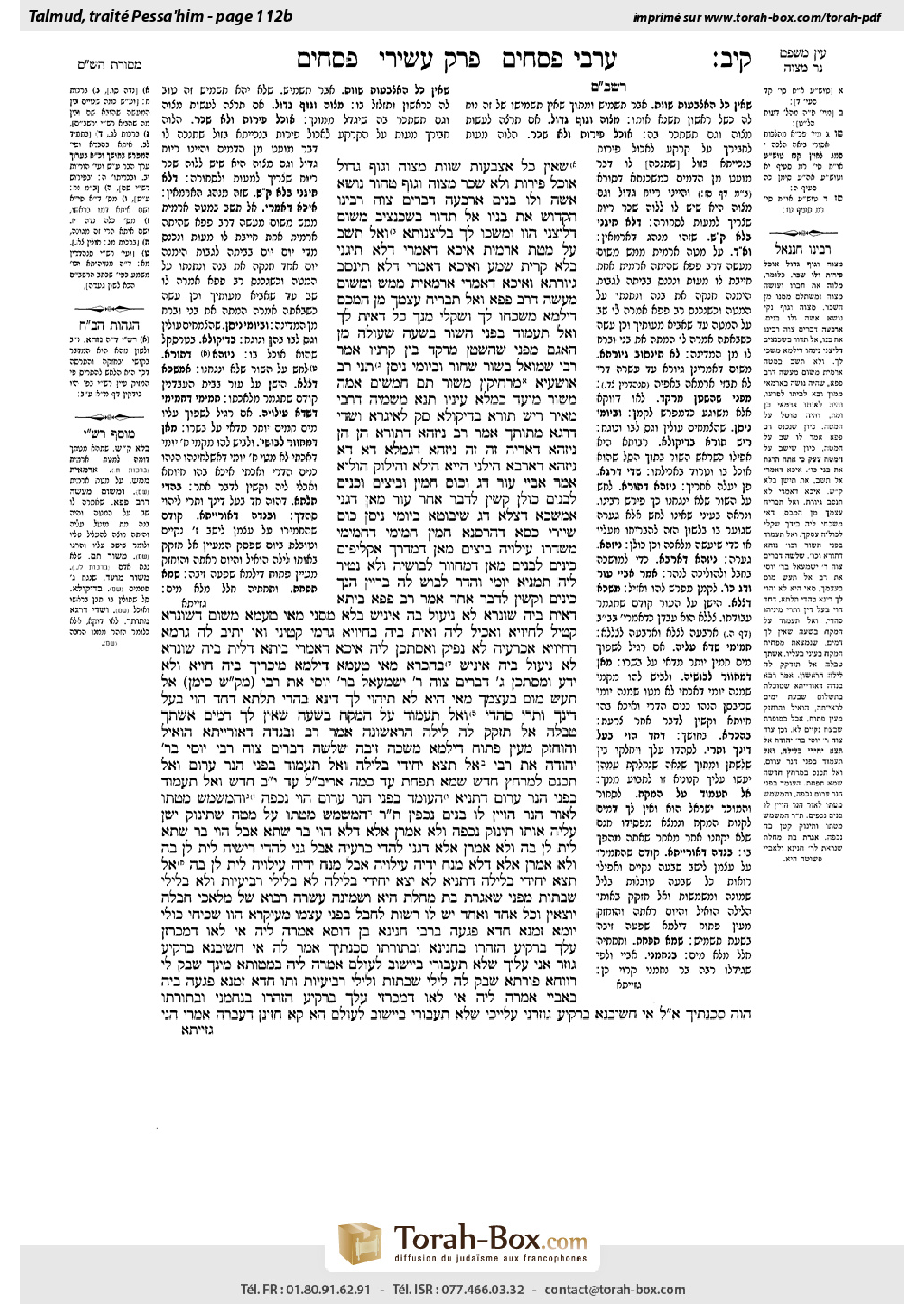
Pesachim 112b: Talmud study for Daf Yomi
Daf Yomi is the daily study of one Talmud folio. Explore 37 tractates with scans, Hebrew text, Sefaria English and AI-generated French translations where annotated.
Passage selection and English or AI-generated French translation are available where the scan has annotations. Daf Study is independent of Torah-Box and Sefaria.
Browse Pesachim · פסחים · All tractatesPesachim 112b text and translations
This page of Pesachim includes the Aramaic text, an English translation and an AI-generated French translation, alongside the scan above.
פסחים קי״ב ב · Aramaic and Hebrew text
שֶׁאֵין כׇּל אֶצְבָּעוֹת שָׁווֹת.
מִצְוָה וְגוּף גָּדוֹל — אוֹכֵל פֵּירוֹת וְלֹא שָׂכָר. מִצְוָה וְגוּף טָהוֹר — נוֹשֵׂא אִשָּׁה וְלוֹ בָּנִים.
אַרְבָּעָה דְּבָרִים צִוָּה רַבֵּינוּ הַקָּדוֹשׁ אֶת בָּנָיו: אַל תָּדוּר בְּשַׁכְנְצִיב מִשּׁוּם דְּלֵיצָנֵי הָווּ, וּמָשְׁכוּ לָךְ בְּלֵיצָנוּתָא.
וְאַל תֵּשֵׁב עַל מִטַּת אֲרַמִּית. אִיכָּא דְאָמְרִי: דְּלָא תִּיגְנֵי בְּלָא קְרִיַּת שְׁמַע. וְאִיכָּא דְאָמְרִי: דְּלָא תִּינְסַב גִּיּוֹרְתָּא.
וְאִיכָּא דְאָמְרִי: אֲרַמָּאִית מַמָּשׁ, וּמִשּׁוּם מַעֲשֶׂה דְרַב פָּפָּא.
וְאֶל תַּבְרִיחַ עַצְמְךָ מִן הַמֶּכֶס, דִּילְמָא מַשְׁכְּחוּ לָךְ וְשָׁקְלִי מִנָּךְ כׇּל דְּאִית לָךְ. וְאַל תַּעֲמוֹד בִּפְנֵי הַשּׁוֹר בְּשָׁעָה שֶׁעוֹלֶה מִן הָאֲגַם, מִפְּנֵי שֶׁהַשָּׂטָן מְרַקֵּד בֵּין קַרְנָיו. אָמַר רַבִּי שְׁמוּאֵל: בְּשׁוֹר שָׁחוֹר, וּבְיוֹמֵי נִיסָן.
תָּנֵי רַב אוֹשַׁעְיָא: מַרְחִיקִין מִשּׁוֹר תָּם — חֲמִשִּׁים אַמָּה, מִשּׁוֹר מוּעָד — כִּמְלֹא עֵינָיו.
תָּנָא מִשְּׁמֵיהּ דְּרַבִּי מֵאִיר: רֵישׁ תּוֹרָא בְּדִיקּוּלָא — סַק לְאִיגָּרָא וּשְׁדִי דַּרְגָּא מִתּוּתָךְ. אָמַר רַב: נִיזְהָא דְתוֹרָא — ״הֵן הֵן״. נִיזְהָא דְאַרְיָה — ״זֶה זֶה״. נִיזְהָא דְגַמְלָא — ״דָּא דָּא״. נִיזְהָא דְאַרְבָּא — ״הֵילֵנִי הַיָּיא הִילָא וְהִילּוּק הוּלְיָא״.
אָמַר אַבָּיֵי: עוֹר, דָּג, וְכוֹס, חַמִּין, וּבֵיצִים, וְכִנִּים לְבָנִים — כּוּלָּן קָשִׁין לְדָבָר אַחֵר. עוֹר — מַאן דְּגָנֵי אַמַּשְׁכָּא דְצַלָּא. דָּג — שִׁיבּוּטָא בְּיוֹמֵי נִיסָן. כּוֹס — שִׁיּוּרֵי כָּסָא דְהַרְסָנָא. חַמִּין — חַמִּימֵי דְחַמִּימֵי מְשַׁדְּרוּ עִילָּוֵיהּ. בֵּיצִים — מַאן דִּמְדָרֵךְ אַקְּלִיפִּים. כִּינִּים לְבָנִים — מַאן דִּמְחַוַּור לְבוּשֵׁיהּ וְלָא נָטֵיר לֵיהּ תְּמָנְיָא יוֹמֵי וַהֲדַר לָבֵישׁ לֵהּ — בָּרְיָין הָנָךְ כִּינִּים, וְקַשְׁיָן לְדָבָר אַחֵר.
אָמַר רַב פָּפָּא: בֵּיתָא דְּאִית בֵּיהּ שׁוּנָּרָא לָא נֵיעוּל בַּהּ אִינִישׁ בְּלָא מְסָנֵי. מַאי טַעְמָא — מִשּׁוּם דְּשׁוּנָּרָא קָטֵיל לְחִיוְיָא וְאָכֵיל לֵיהּ, וְאִית בֵּיהּ בְּחִיוְיָא גַּרְמֵי קַטִּינֵי, וְאִי יָתֵיב לֵהּ גַּרְמָא דְחִיוְיָא אַכַּרְעֵיהּ — לָא נָפֵיק וְאִסְתַּכַּן לֵיהּ. אִיכָּא דְאָמְרִי: בֵּיתָא דְּלֵית בֵּיהּ שׁוּנָּרָא — לָא נֵיעוּל בֵּיהּ אִינִישׁ בְּהַכְרָא, מַאי טַעְמָא — דִילְמָא מִיכְּרִיךְ בֵּיהּ חִוְיָא וְלָא יָדַע וּמִסְתַּכַּן.
שְׁלֹשָׁה דְּבָרִים צִוָּה רַבִּי יִשְׁמָעֵאל בְּרַבִּי יוֹסֵי אֶת רַבִּי: (מק״ש סִימָן) אַל תַּעַשׂ מוּם בְּעַצְמְךָ. מַאי הִיא? לָא תֶּיהְוֵי לָךְ דִּינָא בַּהֲדֵי תְּלָתָא, דְּחַד הָוֵי בַּעַל דִּינָךְ וּתְרֵי סָהֲדֵי. וְאַל תַּעֲמוֹד עַל הַמִּקָּח בְּשָׁעָה שֶׁאֵין לְךָ דָּמִים.
אִשְׁתְּךָ טָבְלָה — אַל תִּזָּקֵק לָהּ לַיְלָה הָרִאשׁוֹנָה. אָמַר רַב: וּבְנִדָּה דְאוֹרָיְיתָא, הוֹאִיל וְהוּחְזַק מַעְיָן פָּתוּחַ, דִּילְמָא מָשְׁכָה זִיבָה.
שְׁלֹשָׁה דְּבָרִים צִוָּה רַבִּי יוֹסֵי בְּרַבִּי יְהוּדָה אֶת רַבִּי: אַל תֵּצֵא יְחִידִי בַּלַּיְלָה, וְאַל תַּעֲמוֹד בִּפְנֵי הַנֵּר עָרוֹם, וְאַל תִּכָּנֵס לְמֶרְחָץ חָדָשׁ, שֶׁמָּא תִּפָּחֵת. עַד כַּמָּה? אָמַר רַבִּי יְהוֹשֻׁעַ בֶּן לֵוִי: עַד שְׁנֵים עָשָׂר חֹדֶשׁ. וְאַל תַּעֲמוֹד בִּפְנֵי הַנֵּר עָרוֹם, דְּתַנְיָא: הָעוֹמֵד בִּפְנֵי הַנֵּר עָרוֹם — הָוֵי נִכְפֶּה. וְהַמְשַׁמֵּשׁ מִטָּתוֹ לְאוֹר הַנֵּר — הָוַיִין לוֹ בָּנִים נִכְפִּין.
תָּנוּ רַבָּנַן: הַמְשַׁמֵּשׁ מִטָּתוֹ עַל מִטָּה שֶׁתִּינוֹק יָשֵׁן עָלֶיהָ — אוֹתוֹ תִּינוֹק נִכְפֶּה. וְלָא אֲמַרַן אֶלָּא דְּלָא הָוֵי בַּר שַׁתָּא, אֲבָל הָוֵי בַּר שַׁתָּא — לֵית לַן בַּהּ. וְלָא אֲמַרַן אֶלָּא דְּגָנֵי לַהֲדֵי כַּרְעֵיהּ, אֲבָל גָּנֵי לַהֲדֵי רֵישֵׁיהּ — לֵית לַן בַּהּ. וְלָא אֲמַרַן אֶלָּא דְּלָא מַנַּח יְדֵיהּ עִילָּוֵיהּ, אֲבָל מַנַּח יְדֵיהּ עִילָּוֵיהּ — לֵית לַן בַּהּ.
אֵל תֵּצֵא יְחִידִי בַּלַּיְלָה, דְּתַנְיָא: לֹא יֵצֵא יְחִידִי בַּלַּיְלָה, לֹא בְּלֵילֵי רְבִיעִיּוֹת וְלֹא בְּלֵילֵי שַׁבָּתוֹת, מִפְּנֵי שֶׁאָגְרַת בַּת מָחֲלַת, הִיא וּשְׁמוֹנֶה עֶשְׂרֵה רִבּוֹא שֶׁל מַלְאֲכֵי חַבָּלָה יוֹצְאִין, וְכׇל אֶחָד וְאֶחָד יֵשׁ לוֹ רְשׁוּת לְחַבֵּל בִּפְנֵי עַצְמוֹ.
מֵעִיקָּרָא הֲווֹ שְׁכִיחִי כּוּלֵּי יוֹמָא. זִמְנָא חֲדָא פְּגַעָה בְּרַבִּי חֲנִינָא בֶּן דּוֹסָא, אֲמַרָה לֵיהּ: אִי לָאו דְּמַכְרְזִן עֲלָךְ בְּרָקִיעַ: ״הִזָּהֲרוּ בַּחֲנִינָא וּבְתוֹרָתוֹ״ — סַכַּנְתָּיךְ. אֲמַר לַהּ: אִי חֲשִׁיבְנָא בְּרָקִיעַ, גּוֹזֵר אֲנִי עָלַיִךְ שֶׁלֹּא תַּעֲבוֹרִי בַּיִּישּׁוּב לְעוֹלָם. אֲמַרָה לֵיהּ: בְּמָטוּתָא מִינָּךְ, שְׁבֹק לִי רַוְוחָא פּוּרְתָּא. שְׁבַק לַהּ לֵילֵי שַׁבָּתוֹת וְלֵילֵי רְבִיעִיּוֹת.
וְתוּ: חֲדָא זִמְנָא פְּגַעָה בֵּיהּ בְּאַבָּיֵי, אֲמַרָה לֵיהּ: אִי לָאו דְּמַכְרְזִי עֲלָךְ בְּרָקִיעַ: ״הִזָּהֲרוּ בְּנַחְמָנִי וּבְתוֹרָתוֹ״ — הֲוָה סַכַּנְתָּיךְ. אֲמַר לַהּ: אִי חֲשִׁיבְנָא בְּרָקִיעַ, גּוֹזְרַנִי עֲלַיְיכִי שֶׁלֹּא תַּעֲבוּרִי בַּיִּישּׁוּב לְעוֹלָם. הָא קָא חָזֵינַן דְּעָבְרָה?! אָמְרִי: הָנֵי
Pesachim 112b · English translation
not all fingers are equal. It is possible that intimate relations with her second husband might not be as pleasing as with the first, leading her to disparage and even hate him.
Rabbi Akiva continued to offer instruction: It is a mitzva and a great material benefit to one’s body to eat fruits without payment. That is, when one lends money and takes land as collateral, deducting from the loan the value of the fruit he eats, both the borrower and the lender benefit from this practice. One who both performs a mitzva and retains a pure body is one who marries a woman, as his thoughts will remain pure and he will merit to have children.
The Gemara cites more instructions issued by a Sage to his heirs. Our holy rabbi, Rabbi Yehuda HaNasi, commanded his sons to do four matters: Do not live in Shekhantziv in Babylonia, because they are mockers. And they will draw you in to their mockery and lead you to abandon your Torah studies.
Rabbi Yehuda HaNasi further commanded his sons: Do not sit on the bed of an Aramean woman. This advice is explained in different ways. Some say it means that you should not go to sleep without reciting Shema, as a Jew who does this acts like a gentile. And some say it means that you should not marry a convert, i.e., a Jewish woman who was once an Aramean.
And some say that Rabbi Yehuda HaNasi meant the actual bed of an Aramean woman, and this is due to the concern for a similar outcome to the later incident involving Rav Pappa. The incident in question was as follows: Rav Pappa entered the house of a gentile woman to collect a debt. The woman asked him to sit on her bed until she brought the money. As it turned out, she had placed her dead baby under the bed. Rav Pappa was subsequently accused of killing the baby and was forced to flee the district.
Rabbi Yehuda HaNasi continued: And do not avoid paying taxes, lest they find you and confiscate everything you own. And do not stand before an ox when it emerges from the marsh because Satan dances between its horns, i.e., an ox is particularly menacing at that time. Rabbi Shmuel said: This is referring to a black ox, and specifically during the days of Nisan, when the ox is most dangerous.
Rav Oshaya teaches with regard to the same issue: One distances himself fifty cubits from an innocuous ox [shor tam], an ox with no consistent history of causing damage with the intent to injure. From a forewarned ox [shor muad], an ox whose owner was forewarned because his ox already gored a person three times, one distances himself until it is beyond eyeshot.
A Sage taught citing the name of Rabbi Meir, in an exaggerated vein: Even if the head of the ox is in its food basket, go up to the roof and kick the ladder out from underneath you to escape from it. Rav said: The cry that one says to lead an ox is hen hen. The cry to lead a lion is zeh zeh. The cry to lead a camel is da da. The cry to laborers using ropes to pull a ship along a river is heleni, hayya, hela, vehilook, hulya.
Abaye said: Hide, fish, and a cup, hot water, and eggs, and white lice all cause the other matter, i.e., leprosy. The Gemara elaborates: Hide is referring to one who sleeps on a tanner’s hide before it has been tanned. Fish is referring to the shibuta fish in the days of Nisan. The cup is referring to one who eats the leftovers of small fried fish. Hot water is referring to very hot water that one pours on himself. Eggs means one who steps on eggshells. White lice is referring to one who washes his garment but does not keep it for eight days before wearing it again, a habit which creates these lice. And all of these practices cause the other matter, leprosy.
Rav Pappa said: With regard to a house in which there is a cat, a person should not enter there barefoot. What is the reason? Because the cat might kill a snake and eat it, and the snake has small bones, and if a small bone gets into one’s foot it cannot be removed, and he will be in danger. Some say that Rav Pappa said: With regard to a house in which there is no cat, a person should not enter there in the dark. What is the reason? Since there is no cat to hunt snakes, perhaps a snake will wrap itself around him without him knowing and he will be in danger.
Rabbi Yishmael, son of Rabbi Yosei, commanded Rabbi Yehuda HaNasi with regard to three matters. Parenthetically, the Gemara states that mem, kuf, shin is a mnemonic for the three statements, as it stands for mum, blemish, mekaḥ, a purchase, and ishtekha, your wife. The first matter is: Do not inflict a blemish upon yourself. The Gemara asks: What is the meaning of that statement? The Gemara explains: Do not have a court case against three people, as one will be your opponent and two will act as witnesses and testify against you whatever they wish. And do not stand over and display interest in a purchase when you do not have enough money even for the price you are offering, as this constitutes fraud.
The Gemara cites the third instruction that Rabbi Yishmael, son of Rabbi Yosei, commanded Rabbi Yehuda HaNasi. After your wife has immersed, do not engage in intimacy with her on the first night. Rather, wait an additional night. Rav said: And this is referring to a menstruating woman whose status applies by Torah law. According to Torah law, even if a woman experiences a continuous emission of blood for seven days, if the flow stops on the seventh day, she may immerse that night and engage in relations with her husband without delay. However, Rav maintains that one must act stringently in this case. His reasoning is: Since there is a presumption that the flow of blood is open, perhaps her zava blood will continue afterward, i.e., she will see more blood after engaging in intimacy.
The Gemara continues: Rabbi Yosei, son of Rabbi Yehuda, commanded Rabbi Yehuda HaNasi with regard to three matters: Do not go out alone at night; do not stand naked before a candle; and do not enter a new bathhouse, lest it collapse when they light the fire beneath it. The Gemara asks: Until when is a bathhouse considered new? Rabbi Yehoshua ben Levi said: Until twelve months have passed. With regard to the statement: And do not stand naked before a candle, the Gemara comments that this is as it was taught in a baraita: One who stands naked before a candle will become epileptic, and one who engages in intimacy by candlelight will have epileptic children.
Likewise, the Sages taught: One who engages in intimacy in a bed upon which a baby is sleeping, that child becomes epileptic. And we said that this will occur only if the child is not yet one year old; however, if he is one year old we have no problem with it, as he is old enough not to be affected. And furthermore, we said this only concerning a baby that is sleeping near the father’s feet; but if the baby is sleeping near his head he is sufficiently far away so that we have no problem with it. And we said this only if he does not place his hand on the baby at the time, but if he places his hands on the baby to serve as a barrier between them, we have no problem with it.
With regard to the instruction: Do not go out alone at night, the Gemara states that this is as it was taught in a baraita: One should not go out alone at night, neither on Tuesday nights nor on Shabbat nights, i.e., Friday nights, because the demon Agrat, daughter of Maḥalat, she and 180,000 angels of destruction go out at these times. And as each and every one of them has permission to destroy by itself, they are all the more dangerous when they go forth together.
The Gemara states: Initially, these demons were present every day. Once Agrat, daughter of Maḥalat, met Rabbi Ḥanina ben Dosa and said to him: Had they not announced about you in the Heavens: Be careful of Ḥanina and his Torah, I would have placed you in danger. He said to her: If I am considered important in Heaven, I decree upon you that you should never travel through inhabited places. She said to him: I beg you, leave me a little space. He left for her Shabbat nights and Tuesday nights.
And furthermore, once Agrat, daughter of Maḥalat met Abaye and said to him: Had they not announced about you in the Heavens: Be careful of Naḥmani, Abaye, and his Torah, I would have placed you in danger. He said to her: If I am considered important in Heaven, I decree upon you that you should never pass through inhabited places. The Gemara asks: But we see that, notwithstanding these anecdotes, demons do pass through inhabited areas. The Sages say in explanation: These demons
Pesachim 112b · Traduction française (IA)
Les doigts ne sont pas tous égaux. Il se peut que les relations intimes avec son second mari ne soient pas aussi agréables qu’avec le premier, ce qui l’amènerait à le dénigrer, voire à le haïr.
Rabbi Akiva poursuivit ses enseignements : Il est une mitsva, et cela procure un grand bienfait matériel au corps, que de manger des fruits sans les payer. Autrement dit, lorsqu’on prête de l’argent et qu’on prend une terre en garantie, en déduisant du prêt la valeur des fruits que l’on consomme, cette pratique profite à la fois à l’emprunteur et au prêteur. Celui qui accomplit une mitsva tout en préservant la pureté de son corps, c’est celui qui épouse une femme, car ses pensées resteront pures et il méritera d’avoir des enfants.
La Guemara rapporte d’autres instructions qu’un Sage donna à ses héritiers. Notre saint maître, Rabbi Yehuda HaNasi, ordonna quatre choses à ses fils : N’habitez pas à Shekhantziv, en Babylonie, car ses habitants sont des railleurs. Ils vous entraîneront dans leurs railleries et vous amèneront à délaisser l’étude de la Torah.
Rabbi Yehuda HaNasi ordonna encore à ses fils : Ne vous asseyez pas sur le lit d’une Araméenne. Ce conseil est expliqué de différentes manières. Certains disent qu’il signifie qu’il ne faut pas s’endormir sans réciter le Chéma, car un Juif qui agit ainsi se comporte comme un non-Juif. D’autres disent qu’il signifie qu’il ne faut pas épouser une convertie, c’est-à-dire une femme juive qui était auparavant Araméenne.
D’autres disent que Rabbi Yehuda HaNasi parlait du lit proprement dit d’une Araméenne, par crainte d’un dénouement semblable à celui de l’incident ultérieur impliquant Rav Pappa. Voici ce qui s’était passé : Rav Pappa entra chez une femme non juive pour recouvrer une dette. La femme lui demanda de s’asseoir sur son lit en attendant qu’elle apporte l’argent. Or, elle avait placé son bébé mort sous le lit. Rav Pappa fut par la suite accusé d’avoir tué le bébé et dut fuir la région.
Rabbi Yehuda HaNasi poursuivit : Ne cherchez pas à éviter de payer les impôts, de peur qu’on ne vous retrouve et qu’on ne confisque tout ce que vous possédez. Et ne vous tenez pas devant un bœuf lorsqu’il sort du marécage, car Satan danse entre ses cornes, autrement dit, le bœuf est particulièrement menaçant à ce moment-là. Rabbi Shmuel dit : Il s’agit d’un bœuf noir, et plus précisément pendant les jours de Nisan, où le bœuf est le plus dangereux.
Rav Oshaya enseigne à propos de la même question : On se tient à une distance de cinquante coudées d’un bœuf inoffensif [shor tam], un bœuf qui n’a pas l’habitude de causer des dommages dans l’intention de blesser. D’un bœuf déclaré dangereux [shor muad], dont le propriétaire a été averti parce que son bœuf a déjà encorné une personne à trois reprises, on se tient à une distance telle qu’il ne soit plus visible.
Un Sage enseigna au nom de Rabbi Meir, sur le mode de l’exagération : Même si la tête du bœuf est dans sa mangeoire, montez sur le toit et donnez un coup de pied à l’échelle pour la faire tomber sous vos pieds, afin de lui échapper. Rav dit : Le cri pour faire avancer un bœuf est « hen hen ». Celui pour faire avancer un lion est « zeh zeh ». Celui pour faire avancer un chameau est « da da ». Le cri adressé aux ouvriers qui tirent un bateau le long d’un fleuve à l’aide de cordes est « heleni, hayya, hela, vehilook, hulya ».
Abaye dit : La peau, le poisson, une coupe, l’eau chaude, les œufs et les poux blancs provoquent tous l’autre affection, c’est-à-dire la lèpre. La Guemara précise : La peau désigne celui qui dort sur une peau de tanneur avant qu’elle soit tannée. Le poisson désigne le poisson shibuta pendant les jours de Nisan. La coupe désigne celui qui mange les restes de petits poissons frits. L’eau chaude désigne l’eau très chaude que l’on se verse dessus. Les œufs désignent celui qui marche sur des coquilles d’œufs. Les poux blancs désignent celui qui lave son vêtement, mais ne le laisse pas de côté pendant huit jours avant de le remettre, une habitude qui engendre ces poux. Toutes ces pratiques provoquent l’autre affection, la lèpre.
Rav Pappa dit : Dans une maison où il y a un chat, il ne faut pas entrer pieds nus. Pour quelle raison ? Parce que le chat peut tuer un serpent et le manger ; or le serpent a de petits os. Si un petit os pénètre dans le pied, il est impossible de le retirer et la personne sera en danger. Certains disent que Rav Pappa a dit : Dans une maison où il n’y a pas de chat, il ne faut pas entrer dans l’obscurité. Pour quelle raison ? Comme il n’y a pas de chat pour chasser les serpents, un serpent risque de s’enrouler autour de la personne à son insu, et elle sera en danger.
Rabbi Yishmael, fils de Rabbi Yosei, recommanda à Rabbi Yehuda HaNasi trois choses. À titre incident, la Guemara indique que les lettres mem, kuf, shin servent de moyen mnémotechnique pour ces trois propos : elles renvoient à mum, « défaut », mekaḥ, « achat », et ishtekha, « ta femme ». Le premier propos est : Ne vous infligez pas de défaut. La Guemara demande : Que signifie cette déclaration ? La Guemara explique : N’intentez pas un procès contre trois personnes, car l’une sera votre adversaire et deux témoigneront contre vous de tout ce qu’elles voudront. Et ne vous attardez pas à manifester de l’intérêt pour un achat si vous n’avez même pas assez d’argent pour payer le prix que vous proposez, car cela constitue une fraude.
La Guemara rapporte la troisième instruction que Rabbi Yishmael, fils de Rabbi Yosei, donna à Rabbi Yehuda HaNasi : Après que votre femme s’est immergée, n’ayez pas de relations intimes avec elle la première nuit. Attendez plutôt une nuit supplémentaire. Rav dit : Cela concerne une femme menstruée dont le statut relève de la Torah. Selon la Torah, même si une femme a un écoulement de sang continu pendant sept jours, si le flux s’arrête le septième jour, elle peut s’immerger cette nuit-là et avoir sans attendre des relations avec son mari. Cependant, Rav estime qu’il faut agir avec rigueur dans ce cas. Voici sa raison : puisque l’on présume que l’écoulement de sang est en cours, son sang de zava pourrait peut-être continuer ensuite, c’est-à-dire qu’elle pourrait voir encore du sang après avoir eu des relations intimes.
La Guemara poursuit : Rabbi Yosei, fils de Rabbi Yehuda, recommanda à Rabbi Yehuda HaNasi trois choses : Ne sortez pas seul la nuit ; ne vous tenez pas nu devant une bougie ; et n’entrez pas dans un bain public neuf, de peur qu’il ne s’effondre lorsqu’on allumera le feu en dessous. La Guemara demande : Jusqu’à quand un bain public est-il considéré comme neuf ? Rabbi Yehoshua ben Levi dit : Jusqu’à ce que douze mois se soient écoulés. Au sujet de la déclaration « Ne vous tenez pas nu devant une bougie », la Guemara fait remarquer que cela correspond à ce qui a été enseigné dans une baraïta : Celui qui se tient nu devant une bougie deviendra épileptique, et celui qui a des relations intimes à la lumière d’une bougie aura des enfants épileptiques.
De même, les Sages enseignèrent : Celui qui a des relations intimes dans un lit où dort un bébé rend cet enfant épileptique. Et nous avons dit que cela ne se produit que si l’enfant n’a pas encore un an ; mais s’il a un an, il n’y a pas de problème, car il est assez âgé pour ne pas en être affecté. Nous avons en outre dit que cela ne concerne qu’un bébé qui dort près des pieds du père ; mais si le bébé dort près de sa tête, il est suffisamment éloigné et il n’y a pas de problème. Et nous avons dit que cela ne se produit que s’il ne pose pas la main sur le bébé à ce moment-là ; mais s’il pose les mains sur le bébé pour faire écran entre eux, il n’y a pas de problème.
Au sujet de l’instruction « Ne sortez pas seul la nuit », la Guemara indique que cela correspond à ce qui a été enseigné dans une baraïta : Il ne faut pas sortir seul la nuit, ni les nuits du mardi ni celles du Chabbat, c’est-à-dire le vendredi soir, car le démon Agrat, fille de Maḥalat, ainsi que 180 000 anges de la destruction, sortent à ces moments-là. Et puisque chacun d’eux a individuellement la permission de détruire, ils sont d’autant plus dangereux lorsqu’ils sortent tous ensemble.
La Guemara indique qu’au début, ces démons étaient présents tous les jours. Un jour, Agrat, fille de Maḥalat, rencontra Rabbi Ḥanina ben Dosa et lui dit : Si l’on n’avait pas proclamé dans les Cieux à ton sujet : « Prenez garde à Ḥanina et à sa Torah », je t’aurais mis en danger. Il lui dit : Si je suis considéré comme important dans les Cieux, je décrète que tu ne traverseras plus jamais de lieux habités. Elle lui dit : Je t’en prie, laisse-moi un peu d’espace. Il lui laissa les nuits de Chabbat et les nuits du mardi.
De plus, un jour, Agrat, fille de Maḥalat, rencontra Abaye et lui dit : Si l’on n’avait pas proclamé dans les Cieux à ton sujet : « Prenez garde à Naḥmani, Abaye, et à sa Torah », je t’aurais mis en danger. Il lui dit : Si je suis considéré comme important dans les Cieux, je décrète que tu ne traverseras plus jamais de lieux habités. La Guemara demande : Pourtant, nous voyons que, malgré ces récits, les démons traversent effectivement des lieux habités. Les Sages expliquent : Ces démons
Traduction française générée par IA à partir de l’édition anglaise de Sefaria. Vérifie toujours un passage avec le texte source.
Text from Sefaria: William Davidson Edition - Vocalized Aramaic (CC BY NC); William Davidson Edition - English (CC BY NC).