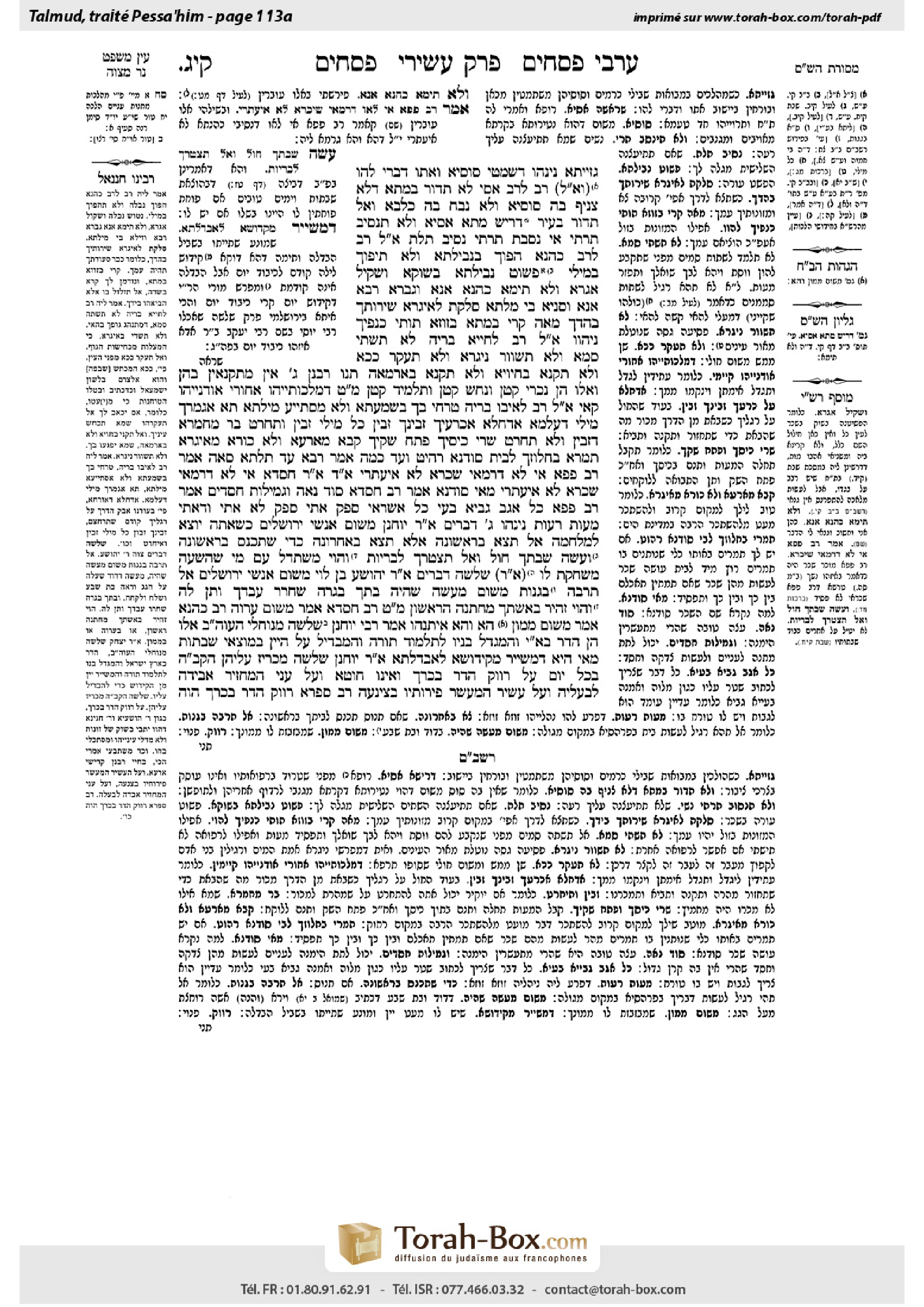
Pesachim 113a: Talmud study for Daf Yomi
Daf Yomi is the daily study of one Talmud folio. Explore 37 tractates with scans, Hebrew text, Sefaria English and AI-generated French translations where annotated.
Passage selection and English or AI-generated French translation are available where the scan has annotations. Daf Study is independent of Torah-Box and Sefaria.
Browse Pesachim · פסחים · All tractatesPesachim 113a text and translations
This page of Pesachim includes the Aramaic text, an English translation and an AI-generated French translation, alongside the scan above.
פסחים קי״ג א · Aramaic and Hebrew text
גָּזְיָיתָא נִינְהוּ, דְּשָׁמְטִי סוּסַיָּא וְאָתוּ דָּבְרִי לְהוּ.
(וַאֲמַר לֵיהּ) רַב לְרַב אַסִּי: לָא תְּדוּר בְּמָתָא דְּלָא צָנֵיף בַּהּ סוּסְיָא וְלָא נָבַח בַּהּ כַּלְבָּא. וְאַל תָּדוּר בְּעִיר דְּרֵישׁ מָתָא אָסְיָא, וְלָא תִּנְסֵיב תַּרְתֵּי. אִי נָסְבַתְּ תַּרְתֵּי — נְסֵיב תְּלָת.
אֲמַר לֵיהּ רַב לְרַב כָּהֲנָא: הֲפוֹךְ בִּנְבֵילְתָּא וְלָא תֵּיפוֹךְ בְּמִילֵּי. פְּשׁוֹט נְבֵילְתָּא בְּשׁוּקָא וּשְׁקֵיל אַגְרָא, וְלָא תֵּימָא ״כָּהֲנָא אֲנָא, וְגַבְרָא רַבָּא אֲנָא, וְסַנְיָא בִּי מִלְּתָא״. סָלְקַתְּ לְאִיגָּרָא — שֵׁירוּתָךְ בַּהֲדָךְ. מְאָה קָרֵי בְּמָתָא בְּזוּזָא — תּוּתֵי כַּנְפָיךְ נִיהְווֹ.
אֲמַר לֵיהּ רַב לְחִיָּיא בְּרֵיהּ: לָא תִּשְׁתֵּי סַמָּא, וְלָא תְּשַׁוַּור נִיגְרָא, וְלָא תִּעְקַר כַּכָּא, וְלָא תְּקַנֵּא בְּחִיוְיָא, וְלָא תְּקַנֵּא בְּאַרְמָאָה.
תָּנוּ רַבָּנַן: שְׁלֹשָׁה אֵין מִתְקַנְּאִין בָּהֶן, וְאֵלּוּ הֵן: גּוֹי קָטָן, וְנָחָשׁ קָטָן, וְתַלְמִיד קָטָן. מַאי טַעְמָא — דְּמַלְכוּתַיְיהוּ אֲחוֹרֵי אוּדְנַיְיהוּ קָאֵי.
אֲמַר לֵיהּ רַב לְאַיְבוּ בְּרֵיהּ: טְרַחִי בָּךְ בִּשְׁמַעְתָּא וְלָא מִסְתַּיַּיע מִילְּתָא. תָּא אַגְמְרָךְ מִילֵּי דְעָלְמָא. אַדְּחָלָא אַכַּרְעָיךָ — זְבִינָךְ זַבֵּין. כֹּל מִילֵּי זַבֵּין וְתִחָרַט — בַּר מֵחַמְרָא, דְּזַבֵּין וְלָא תִּחָרַט.
שְׁרֵי כִּיסָיךְ, פְּתַח שַׂקָּיךָ. קַבָּא מֵאַרְעָא, וְלָא כּוֹרָא מֵאִיגָּרָא.
תַּמְרֵי בַּחֲלוּזָךְ — לְבֵית סוּדָנָא רְהוֹט. וְעַד כַּמָּה? אָמַר רָבָא: עַד תְּלָת סְאָה. אָמַר רַב פָּפָּא: אִי לָא דִּרְמַאי שִׁכְרָא לָא אִיעַתַּרִי. אִיכָּא דְּאָמְרִי, אָמַר רַב חִסְדָּא: אִי לָא דִּרְמַאי שִׁכְרָא לָא אִיעַתַּרִי: מַאי ״סוּדָנָא״? אָמַר רַב חִסְדָּא: סוֹד נָאֶה, וּגְמִילוּת חֲסָדִים.
אָמַר רַב פָּפָּא: כׇּל אַגַּב — גְּבִיָּא בָּעֵי. כֹּל אַשְׁרַאי — סָפֵק אָתֵי סָפֵק לָא אָתֵי. וּדְאָתֵי — מָעוֹת רָעוֹת נִינְהוּ.
שְׁלֹשָׁה דְּבָרִים אָמַר רַבִּי יוֹחָנָן מִשּׁוּם אַנְשֵׁי יְרוּשָׁלַיִם: כְּשֶׁאַתָּה יוֹצֵא לַמִּלְחָמָה — אַל תֵּצֵא בָּרִאשׁוֹנָה, אֶלָּא תֵּצֵא בָּאַחֲרוֹנָה, כְּדֵי שֶׁתִּכָּנֵס בָּרִאשׁוֹנָה. וַעֲשֵׂה שַׁבַּתְּךָ חוֹל, וְאַל תִּצְטָרֵךְ לַבְּרִיּוֹת. וֶהֱוֵי מִשְׁתַּדֵּל עִם מִי שֶׁהַשָּׁעָה מְשַׂחֶקֶת לוֹ.
שְׁלֹשָׁה דְּבָרִים אָמַר רַבִּי יְהוֹשֻׁעַ בֶּן לֵוִי מִשּׁוּם אַנְשֵׁי יְרוּשָׁלַיִם: אַל תַּרְבֶּה בִּגְנוּת, מִשּׁוּם מַעֲשֶׂה שֶׁהָיָה. בִּתְּךָ בָּגְרָה — שַׁחְרֵר עַבְדְּךָ וְתֵן לָהּ. וֶהֱוֵי זָהִיר בְּאִשְׁתְּךָ מֵחֲתָנָהּ הָרִאשׁוֹן. מַאי טַעְמָא? רַב חִסְדָּא אָמַר: מִשּׁוּם עֶרְוָה, רַב כָּהֲנָא אָמַר: מִשּׁוּם מָמוֹן. הָא וְהָא אִיתַנְהוּ.
אָמַר רַבִּי יוֹחָנָן: שְׁלֹשָׁה מִנּוֹחֲלֵי הָעוֹלָם הַבָּא. אֵלּוּ הֵן: הַדָּר בְּאֶרֶץ יִשְׂרָאֵל, וְהַמְגַדֵּל בָּנָיו לְתַלְמוּד תּוֹרָה, וְהַמַּבְדִּיל עַל הַיַּיִן בְּמוֹצָאֵי שַׁבָּתוֹת. מַאי הִיא? דִּמְשַׁיַּיר מִקִּידּוּשָׁא לְאַבְדָּלְתָּא.
אָמַר רַבִּי יוֹחָנָן, שְׁלֹשָׁה מַכְרִיז עֲלֵיהֶן הַקָּדוֹשׁ בָּרוּךְ הוּא בְּכׇל יוֹם: עַל רַוּוֹק הַדָּר בִּכְרַךְ וְאֵינוֹ חוֹטֵא, וְעַל עָנִי הַמַּחֲזִיר אֲבֵידָה לִבְעָלֶיהָ, וְעַל עָשִׁיר הַמְעַשֵּׂר פֵּירוֹתָיו בְּצִינְעָה. רַב סָפְרָא רַוּוֹק הַדָּר בִּכְרַךְ הֲוָה,
Pesachim 113a · English translation
are found on the paths [gazyata] near the city, as horses belonging to the demons flee along those paths, and the demons come to lead them away. Generally, however, demons do not enter inhabited places.
And Rav said to Rav Asi: Do not live in a city where horses do not neigh and where dogs do not bark, as these animals provide security and protection. And do not live in a city where the mayor is a doctor, as he will be too busy working to govern properly. And do not marry two women, as they will likely join forces against you. And if you do marry two, marry a third as well. If two of your wives plot against you, the third will inform you of their plans.
Rav said to Rav Kahana: It is better for one to turn over a carcass than to turn over his word, i.e., to break his promise. Rav further said: Skin a carcass in the market and take payment, but do not say: I am a priest, or: I am a great man, and this matter disgusts me. It is preferable for one to work, even in menial labor, than to be dependent on others. Rav also advised Rav Kahana: If you ascend to the roof, carry your food with you. One should always carry his sustenance with him, even if he goes only on a short trip. If one hundred pumpkins in the city cost a zuz, place them carefully under the corners of your clothes. Treat food respectfully even if it is inexpensive.
Rav said to Ḥiyya, his son: Do not get into the habit of drinking medications, lest you develop an addiction. And do not leap over a ditch, as you might hurt yourself in the process. And do not pull out a tooth, but try to heal it if possible. And do not provoke a snake in your house to try to kill it or chase it away. And do not provoke a gentile, as this too is dangerous.
Similarly, the Sages taught: There are three beings one should not provoke: A small gentile, and a small snake, and a small Torah scholar. What is the reason? Because their authority stands behind their ears. They will eventually grow up, assume power, each in his own way, and avenge those who have harassed them.
Rav said to Ayvu, his son: I struggled to teach you halakha but my efforts did not succeed, as you did not become a great scholar. Come and I will teach you about mundane matters: Sell your merchandise while the dust from the road is still on your feet. As soon you return from your travels, sell your wares, lest the prices fall in the meantime. Furthermore, it is possible that anything you sell might later cause you to regret the sale, except for wine, which you can sell without regret. Since wine might go bad and be entirely lost, its sale is always advisable.
Rav further advised his son: Open your purse to accept payment, and only then open your sack to deliver the goods, to ensure you will receive payment for your merchandise. It is better to earn a kav from the ground than a kor from the roof. A kor is one hundred and eighty times larger than a kav. This proverb means that it is preferable to earn a small amount from a local, safe transaction than to attempt to earn more through a distant, risky venture.
Rav continued: If there are dates in your storeroom, run to the brewery to sell them. If you wait, there is a good chance the dates will go bad. The Gemara asks: And how many dates should one keep for himself? Rava said: Up to three se’a. Rav Pappa said: If I were not a beer manufacturer I would not have become wealthy. Some say that it was Rav Ḥisda who said: If I were not a beer manufacturer I would not have become wealthy. The Gemara asks: What is the meaning of the word sudana, the Aramaic term for a brewer? Rav Ḥisda said: A pleasant secret [sod na’e] and acts of loving kindness, as brewing is a good way to make money and also enables one to perform good deeds.
The Gemara continues to offer advice about mundane matters. Rav Pappa said: Anything you acquire with a document by means of which ownership is transferred, i.e., a bill of acquisition or obligation, requires collection, despite the fact that you are the legal owner. Any sale on credit is uncertain whether or not it will come to fruition. And even if it does come to fruition, the money is bad. These funds are difficult to collect, and they are generally not paid on time.
Rabbi Yoḥanan said three matters, citing the people of Jerusalem: When you go to war do not go out first, but go out last. The reason is so that if your side is defeated and you need to flee for your life, you will enter the refuge of the city first. And it is better to make your Shabbat like an ordinary weekday and do not be beholden to other beings. And exert yourself to join together with one upon whom the hour smiles.
Rabbi Yehoshua ben Levi said three matters, citing the people of Jerusalem: Do not indulge in a shameful act in public, because of the incident that occurred involving David and Bathsheba (see II Samuel 11–12). If your daughter has grown up, it is better to free your Canaanite slave and give him to her than to leave her to find a husband on her own. And be careful with your wife with regard to her first son-in-law, as she is especially fond of him. What is the reason for this warning? Rav Ḥisda said: Due to the possibility of licentiousness. Rav Kahana said: Due to the fact that she might give him all your money and leave you impoverished. The Gemara comments: Since either of these could happen, it is best to be prudent.
Rabbi Yoḥanan said: Three people are among those who inherit the World-to-Come: One who lives in Eretz Yisrael; one who raises his sons to engage in Torah study; and one who recites havdala over wine at the conclusion of Shabbat. The Gemara asks: What is the special importance of that mitzva, to recite havdala over wine? The Gemara answers: This is referring to an individual with only a small amount of wine, who nevertheless leaves some of his kiddush wine for havdala.
Rabbi Yoḥanan further said: The Holy One, Blessed be He, proclaims about the goodness of three kinds of people every day, as exceptional and noteworthy individuals: About a bachelor who lives in a city and does not sin with women; about a poor person who returns a lost object to its owners despite his poverty; and about a wealthy person who tithes his produce in private, without publicizing his behavior. The Gemara reports: Rav Safra was a bachelor living in a city.
Pesachim 113a · Traduction française (IA)
se trouvent sur les chemins [gazyata] près de la ville, car les chevaux appartenant aux démons fuient par ces chemins, et les démons viennent les emmener. En général, toutefois, les démons n’entrent pas dans les lieux habités.
Rav dit à Rav Asi : Ne vis pas dans une ville où les chevaux ne hennissent pas et où les chiens n’aboient pas, car ces animaux assurent la sécurité et la protection. Ne vis pas non plus dans une ville dont le maire est médecin, car il sera trop occupé à exercer son métier pour bien gouverner. Ne prends pas deux femmes, car elles risquent de s’allier contre toi. Et si tu en prends deux, prends-en aussi une troisième. Si deux de tes femmes complotent contre toi, la troisième t’informera de leurs projets.
Rav dit à Rav Kahana : Mieux vaut retourner une carcasse que revenir sur sa parole, c’est-à-dire manquer à sa promesse. Rav dit encore : Dépouille une carcasse sur le marché et fais-toi payer, mais ne dis pas : « Je suis prêtre » ou « Je suis un grand homme, et cette tâche me répugne. » Il vaut mieux travailler, même à une tâche humble, que de dépendre des autres. Rav conseilla aussi à Rav Kahana : Si tu montes sur le toit, emporte ta nourriture avec toi. Il faut toujours avoir ses provisions avec soi, même si l’on ne part que pour un court trajet. Si cent citrouilles coûtent un zouz dans la ville, glisse-les soigneusement sous les pans de tes vêtements. Traite la nourriture avec respect, même si elle est peu coûteuse.
Rav dit à son fils Ḥiyya : Ne prends pas l’habitude de boire des médicaments, de peur d’en devenir dépendant. Ne franchis pas non plus un fossé d’un bond, car tu pourrais te blesser. N’arrache pas une dent, mais essaie de la soigner si possible. Ne provoque pas un serpent chez toi en essayant de le tuer ou de le chasser. Ne provoque pas non plus un non-Juif, car cela aussi est dangereux.
De même, les Sages ont enseigné : Il y a trois êtres qu’il ne faut pas provoquer : un jeune non-Juif, un jeune serpent et un jeune érudit en Torah. Pour quelle raison ? Parce que leur pouvoir se tient derrière leurs oreilles. Ils finiront par grandir, accéder au pouvoir chacun à sa manière et se venger de ceux qui les ont harcelés.
Rav dit à son fils Ayvu : J’ai peiné à t’enseigner la halakha, mais mes efforts n’ont pas abouti, car tu n’es pas devenu un grand érudit. Viens, je vais t’enseigner les choses de la vie courante : vends ta marchandise tant que la poussière de la route est encore sur tes pieds. Dès ton retour de voyage, vends tes marchandises, de peur que les prix ne baissent entre-temps. De plus, la vente de n’importe quel article risque de te faire regretter plus tard, à l’exception du vin, que tu peux vendre sans regret. Puisque le vin risque de tourner et d’être entièrement perdu, il vaut toujours mieux le vendre.
Rav conseilla encore à son fils : Ouvre ta bourse pour recevoir le paiement, et seulement ensuite ouvre ton sac pour livrer la marchandise, afin de t’assurer d’être payé. Mieux vaut gagner un kav au sol que gagner un kor sur le toit. Un kor est cent quatre-vingts fois plus grand qu’un kav. Ce proverbe signifie qu’il vaut mieux gagner une petite somme grâce à une transaction locale et sûre que tenter d’en gagner davantage dans une entreprise lointaine et risquée.
Rav poursuivit : Si tu as des dattes dans ton entrepôt, cours à la brasserie pour les vendre. Si tu attends, il y a de fortes chances que les dattes se gâtent. La Guemara demande : Combien de dattes faut-il en garder pour soi ? Rava dit : Jusqu’à trois sé’a. Rav Pappa dit : Si je n’avais pas été brasseur de bière, je ne serais pas devenu riche. Certains disent que c’est Rav Ḥisda qui dit : Si je n’avais pas été brasseur de bière, je ne serais pas devenu riche. La Guemara demande : Que signifie le mot sudana, le terme araméen désignant un brasseur ? Rav Ḥisda dit : « Un secret agréable » [sod na’e] et des actes de bienfaisance, car le brassage est un bon moyen de gagner de l’argent et permet aussi d’accomplir de bonnes actions.
La Guemara poursuit en donnant des conseils sur les choses de la vie courante. Rav Pappa dit : Tout ce que tu acquiers au moyen d’un document qui transfère la propriété, c’est-à-dire un acte d’acquisition ou une reconnaissance de dette, doit encore être recouvré, bien que tu en sois le propriétaire légal. Toute vente à crédit reste incertaine quant à son aboutissement. Et même si elle aboutit, l’argent est mauvais : il est difficile à recouvrer et, en général, il n’est pas versé à temps.
Rabbi Yoḥanan énonça trois conseils au nom des habitants de Jérusalem : Quand tu pars à la guerre, ne pars pas le premier, mais le dernier. Ainsi, si ton camp est vaincu et que tu dois fuir pour sauver ta vie, tu arriveras le premier au refuge de la ville. Il vaut mieux aussi faire de ton Chabbat un jour ordinaire et ne pas dépendre d’autrui. Efforce-toi de t’associer à quelqu’un à qui la chance sourit.
Rabbi Yehoshua ben Levi énonça trois conseils au nom des habitants de Jérusalem : Ne commets pas d’acte honteux en public, en raison de l’épisode de David et Bethsabée (voir II Samuel 11–12). Si ta fille a grandi, mieux vaut affranchir ton esclave cananéen et le lui donner pour mari que de la laisser trouver seule un époux. Sois prudent avec ta femme au sujet de son premier gendre, car elle lui est particulièrement attachée. Quelle est la raison de cette mise en garde ? Rav Ḥisda dit : En raison du risque de débauche. Rav Kahana dit : Parce qu’elle pourrait lui donner tout ton argent et te laisser démuni. La Guemara commente : Puisque l’un ou l’autre de ces risques peut se réaliser, mieux vaut être prudent.
Rabbi Yoḥanan dit : Trois personnes comptent parmi ceux qui héritent du Monde futur : celui qui vit en Eretz Yisrael ; celui qui élève ses fils afin qu’ils se consacrent à l’étude de la Torah ; et celui qui récite la havdala sur du vin à la fin du Chabbat. La Guemara demande : Quelle est l’importance particulière de cette mitsva, celle de réciter la havdala sur du vin ? La Guemara répond : Il s’agit d’une personne qui ne possède qu’une petite quantité de vin, mais qui en réserve néanmoins un peu de celui qu’elle a utilisé pour le kiddouch, afin de réciter la havdala.
Rabbi Yoḥanan dit encore : Chaque jour, le Saint, béni soit-Il, proclame les mérites de trois catégories de personnes, qu’Il distingue comme remarquables : le célibataire qui vit dans une ville et ne pèche pas avec des femmes ; le pauvre qui rend un objet perdu à ses propriétaires malgré sa pauvreté ; et le riche qui prélève la dîme sur ses produits en privé, sans faire étalage de son comportement. La Guemara rapporte : Rav Safra était célibataire et vivait dans une ville.
Traduction française générée par IA à partir de l’édition anglaise de Sefaria. Vérifie toujours un passage avec le texte source.
Text from Sefaria: William Davidson Edition - Vocalized Aramaic (CC BY NC); William Davidson Edition - English (CC BY NC).