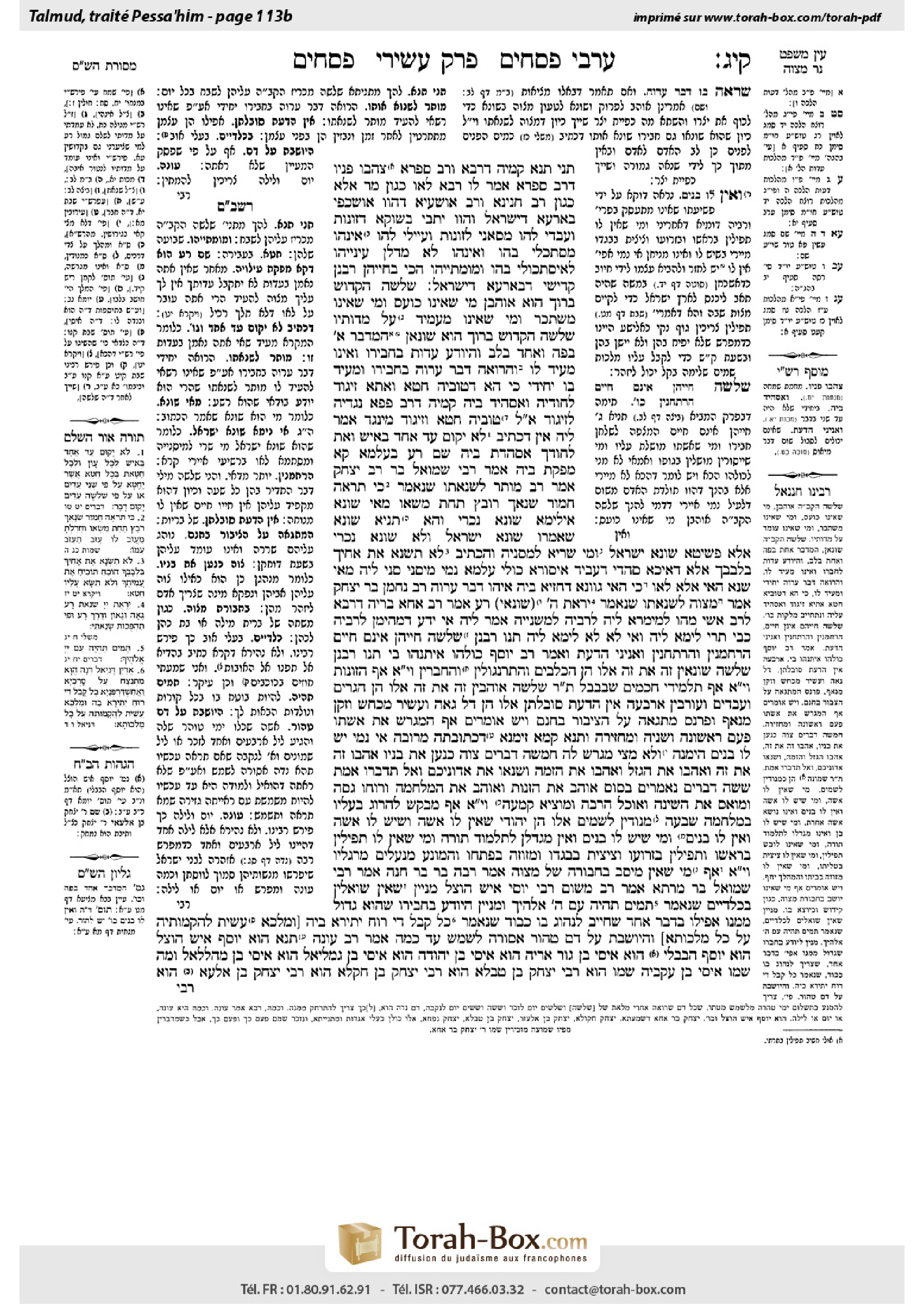
Pesachim 113b: Talmud study for Daf Yomi
Daf Yomi is the daily study of one Talmud folio. Explore 37 tractates with scans, Hebrew text, Sefaria English and AI-generated French translations where annotated.
Passage selection and English or AI-generated French translation are available where the scan has annotations. Daf Study is independent of Torah-Box and Sefaria.
Browse Pesachim · פסחים · All tractatesPesachim 113b text and translations
This page of Pesachim includes the Aramaic text, an English translation and an AI-generated French translation, alongside the scan above.
פסחים קי״ג ב · Aramaic and Hebrew text
תָּנֵי תַּנָּא קַמֵּיהּ דְּרָבָא וְרַב סָפְרָא, צָהֲבוּ פָּנָיו דְּרַב סָפְרָא. אָמַר לוֹ רָבָא: לָאו כְּגוֹן מָר, אֶלָּא כְּגוֹן רַב חֲנִינָא וְרַב אוֹשַׁעְיָא דַּהֲווֹ אוּשְׁכָּפֵי בְּאַרְעָא דְיִשְׂרָאֵל, וַהֲווֹ יָתְבִי בְּשׁוּקָא דְזוֹנוֹת, וְעָבְדִי לְהוּ מְסָאנֵי לְזוֹנוֹת, וְעָיְילִי לְהוּ. אִינְהוּ מִסְתַּכְּלִי בְּהוּ, וְאִינְהוּ לָא מַדְלָן עֵינַיְיהוּ לְאִיסְתַּכּוֹלֵי בְּהוּ. וּמוֹמָתַיְיהוּ הָכִי: בְּחַיֵּיהֶן רַבָּנַן קַדִּישֵׁי דִּבְאַרְעָא דְיִשְׂרָאֵל.
שְׁלֹשָׁה הַקָּדוֹשׁ בָּרוּךְ הוּא אוֹהֲבָן: מִי שֶׁאֵינוֹ כּוֹעֵס, וּמִי שֶׁאֵינוֹ מִשְׁתַּכֵּר, וּמִי שֶׁאֵינוֹ מַעֲמִיד עַל מִדּוֹתָיו. שְׁלֹשָׁה הַקָּדוֹשׁ בָּרוּךְ הוּא שׂוֹנְאָן: הַמְדַבֵּר אֶחָד בַּפֶּה וְאֶחָד בַּלֵּב, וְהַיּוֹדֵעַ עֵדוּת בַּחֲבֵירוֹ וְאֵינוֹ מֵעִיד לוֹ, וְהָרוֹאֶה דְּבַר עֶרְוָה בַּחֲבֵירוֹ וּמֵעִיד בּוֹ יְחִידִי.
כִּי הָא דְּטוֹבִיָּה חָטָא, וַאֲתָא זִיגּוּד לְחוּדֵיהּ וְאַסְהֵיד בֵּיהּ קַמֵּיהּ דְּרַב פָּפָּא. נַגְּדֵיהּ לְזִיגּוּד. אֲמַר לֵיהּ: טוֹבִיָּה חֲטָא וְזִיגּוּד מִינַּגַּד?! אֲמַר לֵיהּ: אִין, דִּכְתִיב: ״לֹא יָקוּם עֵד אֶחָד בְּאִישׁ״, וְאַתְּ לְחוֹדָךְ אַסְהֵדְתְּ בֵּיהּ, שֵׁם רַע בְּעָלְמָא קָא מַפְּקַתְּ בֵּיהּ.
אָמַר רַבִּי שְׁמוּאֵל בַּר רַב יִצְחָק אָמַר רַב: מוּתָּר לִשְׂנֹאתוֹ. שֶׁנֶּאֱמַר: ״כִּי תִרְאֶה חֲמוֹר שֹׂנַאֲךָ רוֹבֵץ תַּחַת מַשָּׂאוֹ״. מַאי ״שׂוֹנֵא״? אִילֵּימָא שׂוֹנֵא גּוֹי, וְהָא תַּנְיָא: שׂוֹנֵא שֶׁאָמְרוּ — שׂוֹנֵא יִשְׂרָאֵל וְלֹא שׂוֹנֵא גּוֹי.
אֶלָּא פְּשִׁיטָא, שׂוֹנֵא יִשְׂרָאֵל. וּמִי שְׁרֵיא לְמִסְנְיֵהּ? וְהָכְתִיב: ״לֹא תִשְׂנָא אֶת אָחִיךָ בִּלְבָבֶךָ״. אֶלָּא דְּאִיכָּא סָהֲדִי דְּעָבֵיד אִיסּוּרָא — כּוּלֵּי עָלְמָא נָמֵי מִיסְנֵי סָנֵי לֵיהּ, מַאי שְׁנָא הַאי? אֶלָּא לָאו כִּי הַאי גַוְונָא, דַּחֲזָיא בֵּיהּ אִיהוּ דְּבַר עֶרְוָה.
רַב נַחְמָן בַּר יִצְחָק אָמַר: מִצְוָה לִשְׂנֹאתוֹ. שֶׁנֶּאֱמַר: ״יִרְאַת ה׳ (שׂוֹנְאֵי) רָע״. אָמַר רַב אַחָא בְּרֵיהּ דְּרָבָא לְרַב אָשֵׁי: מַהוּ לְמֵימְרָא לֵיהּ לְרַבֵּיהּ לְמִשְׂנְיֵיהּ? אֲמַר לֵיהּ: אִי יָדַע דִּמְהֵימַן לְרַבֵּיהּ כְּבֵי תְרֵי — לֵימָא לֵיהּ, וְאִי לָא — לָא לֵימָא לֵיהּ.
תָּנוּ רַבָּנַן, שְׁלֹשָׁה חַיֵּיהֶן אֵינָם חַיִּים: הָרַחְמָנִין, וְהָרַתְחָנִין, וַאֲנִינֵי הַדַּעַת. וְאָמַר רַב יוֹסֵף: כּוּלְּהוּ אִיתַנְהוּ בִּי.
תָּנוּ רַבָּנַן: שְׁלֹשָׁה שׂוֹנְאִין זֶה אֶת זֶה, אֵלּוּ הֵן: הַכְּלָבִים, וְהַתַּרְנְגוֹלִין, וְהַחַבָּרִין. וְיֵשׁ אוֹמְרִים: אַף הַזּוֹנוֹת. וְיֵשׁ אוֹמְרִים: אַף תַּלְמִידֵי חֲכָמִים שֶׁבְּבָבֶל.
תָּנוּ רַבָּנַן: שְׁלֹשָׁה אוֹהֲבִין זֶה אֶת זֶה, אֵלּוּ הֵן: הַגֵּרִים, וַעֲבָדִים, וְעוֹרְבִין.
אַרְבָּעָה אֵין הַדַּעַת סוֹבַלְתָּן, אֵלּוּ הֵן: דַּל גֵּאֶה, וְעָשִׁיר מְכַחֵשׁ, וְזָקֵן מְנָאֵף, וּפַרְנָס מִתְגָּאֶה עַל הַצִּיבּוּר בְּחִנָּם. וְיֵשׁ אוֹמְרִים: אַף הַמְגָרֵשׁ אֶת אִשְׁתּוֹ פַּעַם רִאשׁוֹנָה וּשְׁנִיָּה וּמַחְזִירָהּ.
וְתַנָּא קַמָּא? זִימְנָא דִּכְתוּבָּתָהּ מְרוּבָּה. אִי נָמֵי: יֵשׁ לוֹ בָּנִים הֵימֶנָּה וְלָא מָצֵי מְגָרֵשׁ לַהּ.
חֲמִשָּׁה דְּבָרִים צִוָּה כְּנַעַן אֶת בָּנָיו: אֶהֱבוּ זֶה אֶת זֶה, וְאֶהֱבוּ אֶת הַגָּזֵל, וְאֶהֱבוּ אֶת הַזִּמָּה, וְשִׂנְאוּ אֶת אֲדוֹנֵיכֶם, וְאַל תְּדַבְּרוּ אֱמֶת.
שִׁשָּׁה דְּבָרִים נֶאֱמָרִים בַּסּוּס: אוֹהֵב אֶת הַזְּנוּת, וְאוֹהֵב אֶת הַמִּלְחָמָה, וְרוּחוֹ גַּסָּה, וּמוֹאֵס אֶת הַשֵּׁינָה, וְאוֹכֵל הַרְבֵּה וּמוֹצִיא קִמְעָה. וְיֵשׁ אוֹמְרִים: אַף מְבַקֵּשׁ לַהֲרוֹג בְּעָלָיו בַּמִּלְחָמָה.
שִׁבְעָה מְנוּדִּין לַשָּׁמַיִם, אֵלּוּ הֵן: (יְהוּדִי) [מִי] שֶׁאֵין לוֹ אִשָּׁה, וְשֶׁיֵּשׁ לוֹ אִשָּׁה וְאֵין לוֹ בָּנִים, וּמִי שֶׁיֵּשׁ לוֹ בָּנִים וְאֵין מְגַדְּלָן לְתַלְמוּד תּוֹרָה, וּמִי שֶׁאֵין לוֹ תְּפִילִּין בְּרֹאשׁוֹ וּתְפִילִּין בִּזְרוֹעוֹ וְצִיצִית בְּבִגְדוֹ וּמְזוּזָה בְּפִתְחוֹ, וְהַמּוֹנֵעַ מִנְעָלִים מֵרַגְלָיו. וְיֵשׁ אוֹמְרִים: אַף מִי שֶׁאֵין מֵיסֵב בַּחֲבוּרָה שֶׁל מִצְוָה.
אָמַר רַבָּה בַּר בַּר חָנָה אָמַר רַבִּי שְׁמוּאֵל בַּר מָרְתָא אָמַר רַב מִשּׁוּם רַבִּי יוֹסֵי אִישׁ הוּצָל: מִנַּיִין שֶׁאֵין שׁוֹאֲלִין בַּכַּלְדִּיִּים, שֶׁנֶּאֱמַר: ״תָּמִים תִּהְיֶה עִם ה׳ אֱלֹהֶיךָ״.
וּמִנַּיִין הַיּוֹדֵעַ בַּחֲבֵירוֹ שֶׁהוּא גָּדוֹל מִמֶּנּוּ אֲפִילּוּ בְּדָבָר אֶחָד, שֶׁחַיָּיב לִנְהוֹג בּוֹ כָּבוֹד, שֶׁנֶּאֱמַר: ״כׇּל קֳבֵל דִּי רוּחַ יַתִּירָא בֵּיהּ [וּמַלְכָּא עֲשִׁית לַהֲקָמוּתֵיהּ עַל כׇּל מַלְכוּתָא]״.
וְהַיּוֹשֶׁבֶת עַל דָּם טָהוֹר — אֲסוּרָה לְשַׁמֵּשׁ. עַד כַּמָּה? אָמַר רַב: עוֹנָה.
תַּנָּא, הוּא יוֹסֵף אִישׁ הוּצָל, הוּא יוֹסֵף הַבַּבְלִי, הוּא אִיסִי בֶּן גּוּר אַרְיֵה, הוּא אִיסִי בֶּן יְהוּדָה, הוּא אִיסִי בֶּן גַּמְלִיאֵל, הוּא אִיסִי בֶּן מַהֲלַלְאֵל. וּמָה שְׁמוֹ? — אִיסִי בֶּן עֲקַבְיָה שְׁמוֹ. הוּא רַבִּי יִצְחָק בֶּן טַבְלָא, הוּא רַבִּי יִצְחָק בֶּן חַקְלָא, הוּא רַבִּי יִצְחָק בֶּן אִלְעָא, הוּא
Pesachim 113b · English translation
When the tanna taught this baraita before Rava and Rav Safra, Rav Safra’s face lit up with joy, as he was listed among those praised by God. Rava said to him: This does not refer to someone like the Master. Rather, the statement applies to people like Rav Ḥanina and Rav Oshaya, who were cobblers in Eretz Yisrael, and they would sit in the marketplace of prostitutes and fashion shoes for prostitutes. And the prostitutes would enter their shops and look at them. However, due to their piety, these Sages did not raise their eyes to look at the women. And those prostitutes were so impressed with this behavior that when they swore, they would say as follows: By the lives of the holy Sages of Eretz Yisrael. It is this type of bachelor who is praised by Heaven.
The Gemara cites a similar statement. The Holy One, Blessed be He, loves three people: One who does not get angry; one who does not get drunk; and one who is forgiving. The Holy One, Blessed be He, hates three people: One who says one statement with his mouth and means another in his heart, i.e., a hypocrite; one who knows testimony about another person and does not testify on his behalf; and one who observes a licentious matter performed by another person and testifies against him alone. His testimony is meaningless, as he is the only witness; consequently, he merely gives the individual a bad reputation.
The Gemara comments: This is like that incident where Tuveya sinned with immorality, and Zigud came alone to testify about him before Rav Pappa. Rav Pappa instructed that Zigud be lashed. Zigud said to him: Tuveya sinned and Zigud is lashed, an objection that became a popular saying. He said to him: Yes, as it is written: “One witness shall not rise up against a man” (Deuteronomy 19:15), and you testified against him alone. You have merely given him a bad reputation.
Rabbi Shmuel bar Rav Yitzḥak said that Rav said: Although one who sees another committing a sin should not testify against him by himself, he is nonetheless permitted to hate him, as it is stated: “If you see the donkey of he who hates you lying under its load” (Exodus 23:5). The Gemara clarifies this verse: What is the meaning of he who hates you mentioned in the verse? If you say it is referring to a gentile who hates you, but wasn’t it taught in a baraita that the phrase: He who hates, of which the Torah spoke, is a Jew who hates you, not a gentile who hates you?
Rather, it is obvious that the verse is referring to a Jew who hates you. But is one permitted to hate a fellow Jew? But isn’t it written: “You shall not hate your brother in your heart” (Leviticus 19:17), which clearly prohibits the hatred of another Jew? Rather, perhaps you will say that the verse is referring to a situation where there are witnesses that he performed a sin. However, in that case, everyone else should also hate him. What is different about this particular person who hates him? Rather, is it not referring to a case like this, when he saw him perform a licentious matter? He is therefore permitted to hate him for his evil behavior, whereas others who are unaware of his actions may not hate him.
Rav Naḥman bar Yitzḥak said: Not only is this permitted, it is even a mitzva to hate him, as it is stated: “The fear of God is to hate evil” (Proverbs 8:13). Rav Aḥa, son of Rava, said to Rav Ashi: What is the halakha with regard to whether one who saw someone sin may tell his teacher so that he too will hate him? Rav Ashi said to him: If the student knows that he is trusted by his teacher as two witnesses, and therefore his statement will be accepted, he should tell him, and if he is not trusted by his teacher as two witnesses, he should not tell him.
The Sages taught: There are three types of people whose lives are not lives, due to their constant suffering: The compassionate, the hot tempered, and the delicate. Rav Yosef said: All of these attributes are found in me.
Furthermore, the Sages taught: Members of three groups hate other members of the same group: Dogs, roosters, and the Persian priests. And some say: Also prostitutes. And some say: Also Torah scholars in Babylonia.
Likewise, the Sages taught: Members of three groups love one another: Converts, slaves, and ravens.
Four types of people cannot be endured by anyone: An arrogant pauper; a wealthy person who denies monetary claims against him; a lecherous old man; and a leader who lords over the community for no cause. And some say: Also one who divorces his wife once and twice and takes her back a third time. He should decide definitively whether or not he wants her.
The Gemara asks: And why didn’t the first tanna mention this case of a man who remarries his wife after two divorces? The Gemara answers: Sometimes the husband’s payment to her in the event of divorce, as stipulated in her marriage contract, is large, and since he is unable to pay he is forced to take her back. Alternatively, he has children with her and cannot divorce her, as he wants someone to care for them.
The Gemara continues: Canaan commanded his sons with regard to five matters that are apparently normal behavior for slaves: Love one another, love robbery, love promiscuity, hate your masters, and do not speak the truth.
Six matters are said with regard to a horse: It loves promiscuity, it loves war, its demeanor is arrogant, it despises sleep, it eats much, and it excretes little. And some say: Just as a horse always rushes straight into the heat of a battle, it also attempts to kill its master in war.
Seven are ostracized by Heaven, despite the fact that they have not been ostracized in any court: A Jew who does not have a wife; and one who has a wife but has no sons; and one who has sons whom he does not raise to engage in Torah study; and one who does not have phylacteries on his head, and phylacteries on his arm, and ritual fringes on his garment, and a mezuza in his doorway; and one who withholds shoes from his feet. And some say: Also one who does not sit with a group that is partaking of a feast in celebration of a mitzva.
Rabba bar bar Ḥana said that Rabbi Shmuel bar Marta said that Rav said, citing Rabbi Yosei of Hutzal: From where is it derived that one may not consult astrologers? As it is stated: “You shall be wholehearted with the Lord your God” (Deuteronomy 18:13). The Torah demands absolute faith in God and acceptance of His justice, without attempting to predict the future.
And from where is it derived concerning one who knows about another that he is greater than him, even in one matter, that he must treat him with respect? As it is stated: “Because a surpassing spirit was in him, the king thought to set him over the whole realm” (Daniel 6:4). This verse teaches that one who is in any way greater than another person is worthy of his respect.
And it was also stated by Rabba bar bar Ḥana: With regard to a woman who was observing her days of ritually pure blood, and those days have ended, she is prohibited to engage in intimacy immediately, lest she see ritually impure blood. Any blood emitted by a woman within forty days after giving birth to a male child or eighty days after giving birth to a female child is ritually pure. After this period of time has passed, a woman should not have relations with her husband immediately. The Gemara asks: Until when is she prohibited to her husband? Rav said: She must wait a set interval of time for the ritual impurity of a nidda, i.e., either one day or one night.
With regard to Rabbi Yosei of Hutzal, it was taught: The Yosef of Hutzal mentioned in other places in the Gemara is the same person as Yosef the Babylonian. Yosef is the full name of Yosei. Furthermore, he is also known as Isi ben Gur Arye, he is Isi ben Yehuda, he is Isi ben Gamliel, and he is Isi ben Mahalalel. And what is his real name? His real name is Isi ben Akavya. Similarly, the Sage Rabbi Yitzḥak ben Tavla is also known as Rabbi Yitzḥak ben Ḥakla, who is Rabbi Yitzḥak ben Ela. These are two cases of one Sage with several names.
Pesachim 113b · Traduction française (IA)
Lorsque le tanna enseigna cette baraïta devant Rava et Rav Safra, le visage de Rav Safra s’illumina de joie, puisqu’il figurait parmi ceux que Dieu loue. Rava lui dit : « Cela ne concerne pas quelqu’un comme le Maître. Cette déclaration s’applique plutôt à des hommes comme Rav Ḥanina et Rav Oshaya, qui étaient cordonniers en terre d’Israël et s’installaient au marché des prostituées pour leur confectionner des chaussures. Les prostituées entraient dans leurs boutiques et les regardaient. Cependant, en raison de leur piété, ces Sages ne levaient pas les yeux vers elles. Ces prostituées étaient si impressionnées par cette conduite que, lorsqu’elles prêtaient serment, elles disaient : “Par la vie des saints Sages de la terre d’Israël !” C’est ce type de célibataire que le Ciel loue.»
La Guemara rapporte une déclaration semblable. Le Saint, béni soit-Il, aime trois personnes : celui qui ne se met pas en colère, celui qui ne s’enivre pas et celui qui pardonne. Le Saint, béni soit-Il, déteste trois personnes : celui qui dit une chose de sa bouche tout en pensant autre chose dans son cœur, c’est-à-dire un hypocrite ; celui qui connaît un témoignage concernant une autre personne et ne témoigne pas en sa faveur ; et celui qui voit une autre personne commettre un acte licencieux et témoigne contre elle à lui seul. Son témoignage est sans valeur, puisqu’il est l’unique témoin ; par conséquent, il ne fait que donner mauvaise réputation à cette personne.
La Guemara commente : cela ressemble à l’incident où Tuveya commit un acte immoral et où Zigud vint seul témoigner contre lui devant Rav Pappa. Rav Pappa ordonna qu’on fouette Zigud. Celui-ci lui dit : « Tuveya a péché et c’est Zigud qu’on fouette », une objection devenue un dicton populaire. Rav Pappa lui répondit : « Oui, car il est écrit : “Un seul témoin ne se lèvera pas contre un homme” (Deutéronome 19,15), et tu as témoigné contre lui à toi seul. Tu ne fais que lui donner mauvaise réputation. »
Rabbi Shmuel bar Rav Yitzḥak dit au nom de Rav : bien que celui qui voit une autre personne commettre un péché ne doive pas témoigner contre elle à lui seul, il lui est néanmoins permis de la haïr, comme il est dit : « Si tu vois l’âne de celui qui te hait couché sous sa charge » (Exode 23,5). La Guemara précise le sens de ce verset : que signifie « celui qui te hait », mentionné dans le verset ? Si tu dis qu’il s’agit d’un non-Juif qui te hait, n’a-t-on pas enseigné dans une baraïta que l’expression « celui qui hait », dont parle la Torah écrite, désigne un Juif qui te hait, et non un non-Juif qui te hait ?
Il est donc évident que le verset parle d’un Juif qui te hait. Mais est-il permis de haïr un autre Juif ? N’est-il pas écrit : « Tu ne haïras pas ton frère dans ton cœur » (Lévitique 19,17), ce qui interdit clairement de haïr un autre Juif ? Peut-être diras-tu plutôt que le verset parle d’une situation où des témoins attestent qu’il a commis un péché. Toutefois, dans ce cas, tous les autres devraient également le haïr. En quoi cette personne qui le hait se distingue-t-elle ? Ne s’agit-il pas plutôt d’un cas comme celui-ci, où elle l’a vu commettre un acte licencieux ? Elle est donc autorisée à le haïr en raison de sa mauvaise conduite, tandis que les autres, qui ignorent ses actes, ne peuvent pas le haïr.
Rav Naḥman bar Yitzḥak dit : non seulement cela est permis, mais c’est même une mitsva de le haïr, comme il est dit : « La crainte de Dieu, c’est haïr le mal » (Proverbes 8,13). Rav Aḥa, fils de Rava, demanda à Rav Ashi : quelle est la halakha concernant celui qui a vu quelqu’un pécher ? Peut-il le rapporter à son maître afin que celui-ci aussi le haïsse ? Rav Ashi lui répondit : si l’élève sait que son maître le tient pour aussi fiable que deux témoins, et que sa parole sera donc acceptée, il doit le lui rapporter ; si son maître ne le tient pas pour aussi fiable que deux témoins, il ne doit pas le lui rapporter.
Les Sages enseignèrent : il existe trois types de personnes dont la vie n’est pas une vie, en raison de leurs souffrances constantes : les compatissants, les colériques et les délicats. Rav Yosef dit : « Je réunis en moi toutes ces caractéristiques. »
En outre, les Sages enseignèrent : les membres de trois groupes se détestent entre eux : les chiens, les coqs et les prêtres perses. Certains disent : les prostituées également. D’autres disent : les érudits de la Torah de Babylonie également.
De même, les Sages enseignèrent : les membres de trois groupes s’aiment entre eux : les convertis, les esclaves et les corbeaux.
Quatre types de personnes sont insupportables à tous : un pauvre arrogant ; un riche qui conteste les créances pécuniaires dont il est redevable ; un vieillard lubrique ; et un dirigeant qui tyrannise la communauté sans raison. Certains disent : également celui qui divorce de sa femme une première fois, puis une deuxième, et la reprend une troisième fois. Il devrait décider une fois pour toutes s’il la veut ou non.
La Guemara demande : pourquoi le premier tanna n’a-t-il pas mentionné le cas d’un homme qui reprend sa femme après deux divorces ? La Guemara répond : parfois, la somme qu’il doit lui verser en cas de divorce, telle qu’elle est stipulée dans son contrat de mariage, est élevée et, comme il est incapable de la payer, il est contraint de la reprendre. Autre possibilité : il a des enfants avec elle et ne peut pas divorcer d’elle, car il veut qu’elle s’occupe d’eux.
La Guemara poursuit : Canaan donna à ses fils cinq consignes concernant des comportements apparemment habituels chez les esclaves : aimez-vous les uns les autres, aimez le vol, aimez la promiscuité, haïssez vos maîtres et ne dites pas la vérité.
Six traits sont attribués au cheval : il aime la promiscuité, il aime la guerre, il a une attitude arrogante, il méprise le sommeil, il mange beaucoup et excrète peu. Certains disent : de même qu’un cheval se précipite toujours droit au cœur de la bataille, il tente aussi de tuer son maître à la guerre.
Sept personnes sont mises au ban par le Ciel, bien qu’aucun tribunal ne les ait mises au ban : un Juif qui n’a pas de femme ; celui qui a une femme mais pas de fils ; celui qui a des fils qu’il n’élève pas pour qu’ils étudient la Torah ; celui qui ne porte pas de téfilines sur la tête et au bras, ne porte pas de franges rituelles sur son vêtement et n’a pas de mezouza à sa porte ; et celui qui ne porte pas de chaussures. Certains disent : également celui qui ne s’assied pas avec un groupe prenant part à un repas célébrant une mitsva.
Rabba bar bar Ḥana dit au nom de Rabbi Shmuel bar Marta, qui le tenait de Rav, citant Rabbi Yosei de Hutzal : d’où apprend-on qu’il est interdit de consulter des astrologues ? Comme il est dit : « Tu seras intègre avec le Seigneur ton Dieu » (Deutéronome 18,13). La Torah exige une foi absolue en Dieu et l’acceptation de sa justice, sans chercher à prédire l’avenir.
Et d’où apprend-on que celui qui sait qu’un autre lui est supérieur, même sur un seul point, doit le traiter avec respect ? Comme il est dit : « Parce qu’un esprit supérieur était en lui, le roi pensa à l’établir sur tout le royaume » (Daniel 6,4). Ce verset enseigne que quiconque est supérieur à une autre personne, de quelque manière que ce soit, mérite son respect.
Rabba bar bar Ḥana enseigna également : une femme qui observait ses jours de sang rituellement pur ne doit pas avoir de rapports immédiatement après la fin de ces jours, de peur qu’elle ne voie du sang rituellement impur. Tout sang émis par une femme dans les quarante jours suivant la naissance d’un garçon ou les quatre-vingts jours suivant la naissance d’une fille est rituellement pur. Après l’écoulement de cette période, une femme ne doit pas avoir immédiatement de rapports avec son mari. La Guemara demande : jusqu’à quand lui est-il interdit d’avoir des rapports avec son mari ? Rav dit : elle doit attendre un intervalle déterminé correspondant à la période d’impureté rituelle d’une nidda, c’est-à-dire un jour ou une nuit.
Au sujet de Rabbi Yosei de Hutzal, il a été enseigné : le Yosef de Hutzal mentionné ailleurs dans la Guemara est la même personne que Yosef le Babylonien. Yosef est le nom complet de Yosei. En outre, il est aussi connu sous les noms d’Isi ben Gur Arye, d’Isi ben Yehuda, d’Isi ben Gamliel et d’Isi ben Mahalalel. Quel est son véritable nom ? Son véritable nom est Isi ben Akavya. De même, le Sage Rabbi Yitzḥak ben Tavla est aussi connu sous le nom de Rabbi Yitzḥak ben Ḥakla, qui est Rabbi Yitzḥak ben Ela. Ce sont deux cas où un même Sage est connu sous plusieurs noms.
Traduction française générée par IA à partir de l’édition anglaise de Sefaria. Vérifie toujours un passage avec le texte source.
Text from Sefaria: William Davidson Edition - Vocalized Aramaic (CC BY NC); William Davidson Edition - English (CC BY NC).