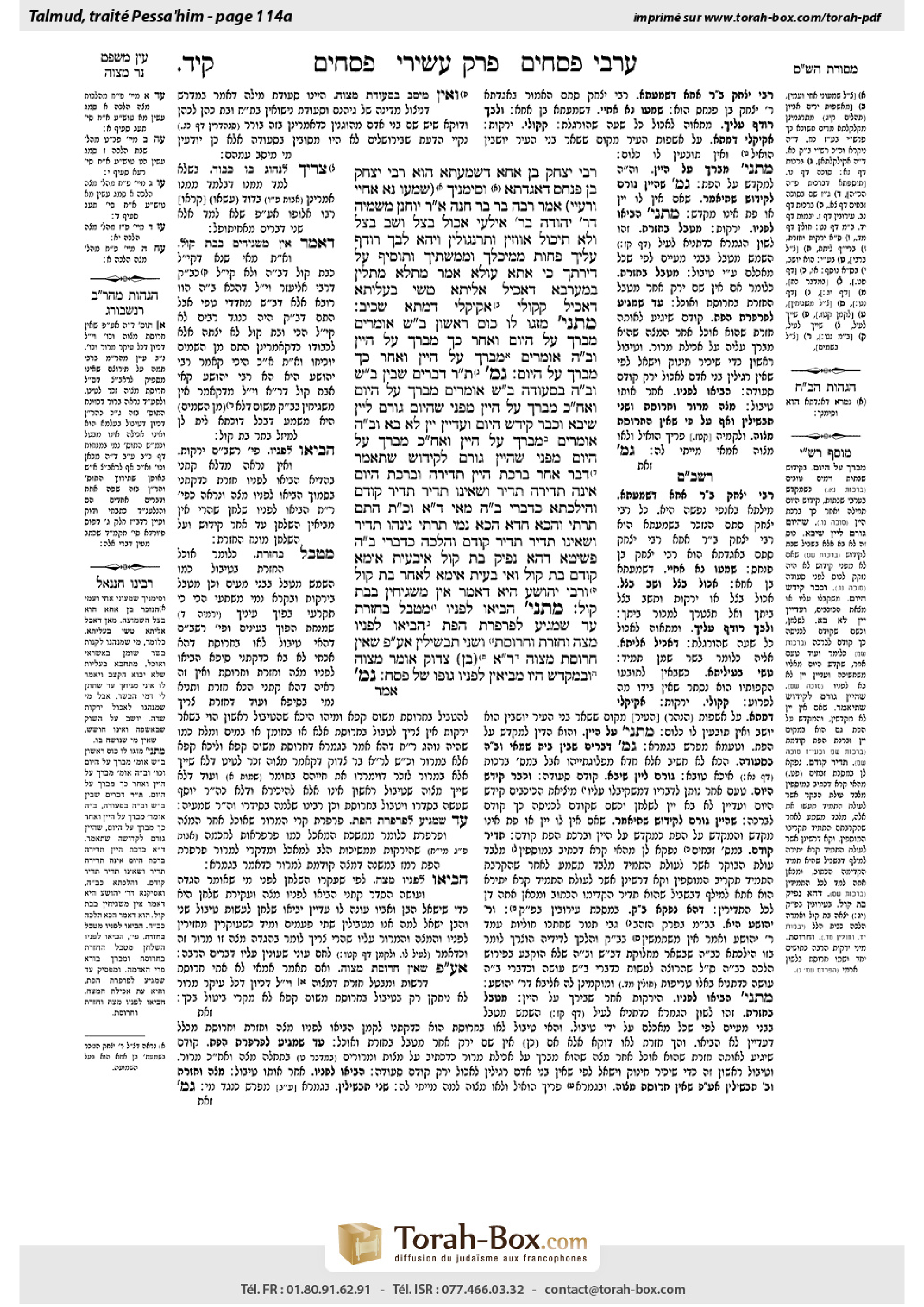
Pesachim 114a: Talmud study for Daf Yomi
Daf Yomi is the daily study of one Talmud folio. Explore 37 tractates with scans, Hebrew text, Sefaria English and AI-generated French translations where annotated.
Passage selection and English or AI-generated French translation are available where the scan has annotations. Daf Study is independent of Torah-Box and Sefaria.
Browse Pesachim · פסחים · All tractatesPesachim 114a text and translations
This page of Pesachim includes the Aramaic text, an English translation and an AI-generated French translation, alongside the scan above.
פסחים קי״ד א · Aramaic and Hebrew text
רַבִּי יִצְחָק בֶּן אַחָא דִּשְׁמַעְתָּא, הוּא רַבִּי יִצְחָק בֶּן פִּנְחָס דְּאַגָּדְתָּא. וְסִימָנָיךְ (שִׁמְעוּ נָא אַחַיי וְרֵעַיי).
אָמַר רָבָא בַּר בַּר חָנָה אָמַר רַבִּי יוֹחָנָן מִשְּׁמֵיהּ דְּרַבִּי יְהוּדָה בְּרַבִּי אִילְעַי: אֱכוֹל בָּצָל וְשֵׁב בַּצֵּל, וְלָא תֵּיכוּל אֲווֹזִין וְתַרְנְגוֹלִין וִיהֵא לִבְּךָ רוֹדֵף עָלֶיךָ. פְּחוֹת מִמֵּיכְלָךְ וּמִמִּשְׁתְּיָךְ, וְתוֹסֵיף עַל דֵּירְתָךְ.
כִּי אֲתָא עוּלָּא, אָמַר: מַתְלָא מָתְלִין בְּמַעְרְבָא דְּאָכֵיל אַלְיְתָא — טָשֵׁי בְּעִלִּיתָא. דְּאָכֵיל קָקוּלִי — אַקִּיקְלֵי דְמָתָא שָׁכֵיב.
מַתְנִי׳ מָזְגוּ לוֹ כּוֹס רִאשׁוֹן. בֵּית שַׁמַּאי אוֹמְרִים: מְבָרֵךְ עַל הַיּוֹם, וְאַחַר כָּךְ מְבָרֵךְ עַל הַיַּיִן. וּבֵית הִלֵּל אוֹמְרִים: מְבָרֵךְ עַל הַיַּיִן, וְאַחַר כָּךְ מְבָרֵךְ עַל הַיּוֹם.
גְּמָ׳ תָּנוּ רַבָּנַן: דְּבָרִים שֶׁבֵּין בֵּית שַׁמַּאי וּבֵית הִלֵּל בַּסְּעוּדָה. בֵּית שַׁמַּאי אוֹמְרִים: מְבָרֵךְ עַל הַיּוֹם, וְאַחַר כָּךְ מְבָרֵךְ עַל הַיַּיִן — מִפְּנֵי שֶׁהַיּוֹם גּוֹרֵם לַיַּיִן שֶׁיָּבֹא, וּכְבָר קִידֵּשׁ הַיּוֹם וַעֲדַיִין יַיִן לֹא בָּא.
וּבֵית הִלֵּל אוֹמְרִים: מְבָרֵךְ עַל הַיַּיִן, וְאַחַר כָּךְ מְבָרֵךְ עַל הַיּוֹם — מִפְּנֵי שֶׁהַיַּיִן גּוֹרֵם לְקִידּוּשׁ שֶׁתֵּאָמֵר. דָּבָר אַחֵר: בִּרְכַּת הַיַּיִן תְּדִירָה וּבִרְכַּת הַיּוֹם אֵינָהּ תְּדִירָה. תָּדִיר וְשֶׁאֵינוֹ תָּדִיר — תָּדִיר קוֹדֵם. וְהִילְכְתָא כְּדִבְרֵי בֵּית הִלֵּל.
מַאי דָּבָר אַחֵר? וְכִי תֵּימָא הָתָם תַּרְתֵּי וְהָכָא חֲדָא — הָכָא נָמֵי תַּרְתֵּי נִינְהוּ: תָּדִיר וְשֶׁאֵינוֹ תָּדִיר — תָּדִיר קוֹדֵם.
וַהֲלָכָה כְּדִבְרֵי בֵּית הִלֵּל: פְּשִׁיטָא, דְּהָא נְפַיק בַּת קוֹל! אִיבָּעֵית אֵימָא: קוֹדֶם בַּת קוֹל,
וְאִי בָּעֵית אֵימָא: לְאַחַר בַּת קוֹל, וְרַבִּי יְהוֹשֻׁעַ הִיא, דְּאָמַר: אֵין מַשְׁגִּיחִין בְּבַת קוֹל.
מַתְנִי׳ הֵבִיאוּ לְפָנָיו, מְטַבֵּל בַּחֲזֶרֶת עַד שֶׁמַּגִּיעַ לְפַרְפֶּרֶת הַפַּת. הֵבִיאוּ לְפָנָיו מַצָּה וַחֲזֶרֶת וַחֲרוֹסֶת וּשְׁנֵי תַבְשִׁילִין, אַף עַל פִּי שֶׁאֵין חֲרוֹסֶת מִצְוָה. רַבִּי אֱלִיעֶזֶר (בֶּן) צָדוֹק אוֹמֵר: מִצְוָה. וּבְמִקְדָּשׁ הָיוּ מְבִיאִין לְפָנָיו גּוּפוֹ שֶׁל פֶּסַח.
Pesachim 114a · English translation
The Rabbi Yitzhak ben Aḥa mentioned in a ruling of halakha is the same as the Rabbi Yitzḥak ben Pineḥas who appears in statements of aggada. And your mnemonic to remember the names is the standard phrase: Listen my brothers and friends [shimu na aḥai vere’ai]. Shimu sounds like shema’ta, the term for halakha, while aḥai is similar to the patronymic ben Aḥa.
Rabba bar bar Ḥana said that Rabbi Yoḥanan said, citing Rabbi Yehuda, son of Rabbi Elai: Eat an onion [batzal] and sit in the shade [batzel], i.e., eat inexpensive food while sitting in a comfortable place, but do not eat expensive geese and chickens, as your heart will pursue you, i.e., you will develop a taste for luxuries. Devote less to your food and your drink and spend more on your house, as one’s house is a better investment than food.
When Ulla came from Eretz Yisrael to Babylonia he said that they say the following proverb in the west, Eretz Yisrael: One who eats a fat tail [alita] must hide in the attic [aliyata] from creditors who think he is wealthy. One who eats vegetables [kakulei] can lie down in the city’s garbage [kiklei] without fear of others, as he is not in debt.
MISHNA: The tanna describes the beginning of the Passover seder. The attendants poured the wine of the first cup for the leader of the seder. Beit Shammai say: One recites the blessing over the sanctification of the day, i.e., the kiddush for the Festival: Who blesses Israel and the Festivals, and thereafter he recites the blessing over the wine: Who creates fruit of the vine. And Beit Hillel say: One recites the blessing over the wine and thereafter recites the blessing over the day.
GEMARA: The Sages taught in the Tosefta: These are the matters of dispute between Beit Shammai and Beit Hillel with regard to the halakhot of a meal. Beit Shammai say: When reciting kiddush over wine, one recites a blessing over the sanctification of the day and thereafter recites a blessing over the wine, because the day causes the wine to come before the meal. And Beit Shammai offer an additional reason. The day has already been sanctified and the wine has not yet come.
And Beit Hillel say: One recites the blessing over the wine and thereafter recites a blessing over the day, because the wine causes kiddush to be recited. Since one does not recite kiddush without wine or bread, clearly the wine is the primary feature of the ritual. Alternatively, the blessing over wine is recited frequently and the blessing over the day is not recited frequently, and there is a general principle: When a frequent practice and an infrequent practice coincide, the frequent practice takes precedence over the infrequent practice. The Tosefta concludes: And the halakha is in accordance with the statement of Beit Hillel.
The Gemara asks: What is alternatively? Why did Beit Hillel cite an additional reason? The Gemara explains: And if you say that there Beit Shammai cite two reasons, and here Beit Hillel offer only one; therefore, Beit Hillel said they are two reasons here too: When a frequent practice and an infrequent practice coincide, the frequent practice takes precedence over the infrequent practice.
It was taught in the Tosefta: And the halakha is in accordance with the statement of Beit Hillel. The Gemara comments: It is obvious that this is so, as a Divine Voice emerged and proclaimed that the halakha is always in accordance with the opinion of Beit Hillel. Why was it necessary for the Tosefta to state that in this particular case the halakha is in accordance with their opinion? The Gemara answers: If you wish, say that this Tosefta was taught before the Divine Voice emerged and proclaimed that principle.
And if you wish, say instead that this statement was indeed issued after the Divine Voice emerged, and the Tosefta is in accordance with the opinion of Rabbi Yehoshua, who said that one disregards a Divine Voice when deciding halakha. Just as Rabbi Yehoshua disregarded the Divine Voice in his dispute with Rabbi Eliezer, so too, one disregards the Divine Voice that proclaimed that the halakha is in accordance with the opinion of Beit Hillel. Therefore, it was necessary to state that the halakha is in fact in accordance with the opinion of Beit Hillel here.
MISHNA: The attendants brought vegetables before the leader of the seder prior to the meal, if there were no other vegetables on the table. He dips the ḥazeret into water or vinegar, to taste some food before he reaches the dessert of the bread, i.e., the bitter herbs, which were eaten after the matza. They brought before him matza and ḥazeret and ḥaroset, and at least two cooked dishes in honor of the Festival. The tanna comments that this was the practice, although eating ḥaroset is not a mitzva but merely a custom. Rabbi Eliezer ben Tzadok says: Actually, it is a mitzva to eat ḥaroset. And in the period when the Temple stood and they offered the Paschal lamb, they brought before him the body of the Paschal lamb.
Pesachim 114a · Traduction française (IA)
Le Rabbi Yitzhak ben Aḥa mentionné dans une décision de halakha est le même que le Rabbi Yitzḥak ben Pineḥas qui apparaît dans des enseignements d’aggada. Pour vous rappeler leurs noms, retenez cette expression courante : « Écoutez, mes frères et mes amis » [shimu na aḥai vere’ai]. Shimu évoque shema’ta, le terme désignant la halakha, tandis que aḥai rappelle le patronyme ben Aḥa.
Rabba bar bar Ḥana dit que Rabbi Yoḥanan a dit, au nom de Rabbi Yehuda, fils de Rabbi Elai : « Mange un oignon [batzal] et assieds-toi à l’ombre [batzel] », c’est-à-dire mange des aliments bon marché tout en t’installant confortablement ; mais ne mange pas d’oies ni de poulets coûteux, car ton cœur se portera vers eux, autrement dit, tu prendras goût au luxe. Dépense moins pour ta nourriture et ta boisson, et davantage pour ta maison, car celle-ci est un meilleur investissement que la nourriture.
Quand Oulla vint d’Eretz Israël en Babylonie, il dit que l’on rapporte dans l’Ouest, c’est-à-dire en Eretz Israël, le proverbe suivant : Celui qui mange une queue grasse [alita] doit se cacher dans le grenier [aliyata] pour échapper aux créanciers qui le croient riche. Celui qui mange des légumes [kakulei] peut s’allonger dans les ordures de la ville [kiklei] sans craindre autrui, car il n’a pas de dettes.
Michna : Le tanna décrit le début du séder de Pessa’h. Les assistants versaient le vin de la première coupe au maître du séder. Beit Chammaï disent : On récite la bénédiction sur la sanctification du jour, c’est-à-dire le kiddouch de la fête : « Qui sanctifie Israël et les fêtes », puis la bénédiction sur le vin : « Qui crée le fruit de la vigne ». Beit Hillel disent : On récite la bénédiction sur le vin, puis celle sur le jour.
Guemara : Les Sages ont enseigné dans la Tosefta : Voici les sujets de désaccord entre Beit Chammaï et Beit Hillel concernant les halakhot du repas. Beit Chammaï disent : Lorsqu’on récite le kiddouch sur le vin, on récite d’abord la bénédiction sur la sanctification du jour, puis celle sur le vin, car c’est le jour qui fait précéder le vin au repas. Beit Chammaï avancent également une autre raison : le jour a déjà été sanctifié, tandis que le vin n’est pas encore arrivé.
Et Beit Hillel disent : On récite d’abord la bénédiction sur le vin, puis celle sur le jour, car c’est le vin qui permet de réciter le kiddouch. Puisqu’on ne récite pas le kiddouch sans vin ni pain, il est clair que le vin est l’élément principal du rite. On peut aussi dire que la bénédiction sur le vin est récitée fréquemment, tandis que celle sur le jour ne l’est pas, et qu’il existe un principe général : lorsqu’une pratique fréquente et une pratique peu fréquente coïncident, la pratique fréquente a priorité sur la pratique peu fréquente. La Tosefta conclut : la halakha est conforme à l’opinion de Beit Hillel.
La Guemara demande : Que signifie « on peut aussi dire » ? Pourquoi Beit Hillel ont-ils avancé une raison supplémentaire ? La Guemara explique : Pour éviter que tu ne dises que, dans ce cas, Beit Shammaï avancent deux raisons, tandis que Beit Hillel n’en proposent qu’une, Beit Hillel ont donc également donné ici deux raisons : lorsqu’une pratique fréquente et une pratique peu fréquente coïncident, la pratique fréquente a priorité sur la pratique peu fréquente.
Il a été enseigné dans la Tosefta : la halakha est conforme à l’opinion de Beit Hillel. La Guemara fait remarquer : cela va de soi, puisqu’une voix céleste s’est fait entendre et a proclamé que la halakha est toujours conforme à l’opinion de Beit Hillel. Pourquoi était-il nécessaire que la Tosefta précise que, dans ce cas particulier, la halakha est conforme à leur opinion ? La Guemara répond : on peut dire que cette Tosefta a été enseignée avant que la voix céleste ne se fasse entendre et ne proclame ce principe.
On peut aussi dire que cette déclaration a bien été formulée après que la voix céleste se fut fait entendre, et que la Tosefta suit l’opinion de Rabbi Yehoshua, qui a dit qu’on ne tient pas compte d’une voix céleste pour trancher la halakha. De même que Rabbi Yehoshua n’a pas tenu compte de la voix céleste dans son différend avec Rabbi Eliezer, on ne tient pas non plus compte de la voix céleste qui a proclamé que la halakha est conforme à l’opinion de Beit Hillel. Il était donc nécessaire de préciser qu’ici, la halakha est effectivement conforme à l’opinion de Beit Hillel.
MICHNA : Les assistants apportaient des légumes au maître du séder avant le repas, s’il n’y avait pas d’autres légumes sur la table. Il trempait la ḥazeret dans l’eau ou le vinaigre afin de goûter quelque chose avant d’en arriver au dessert du pain, c’est-à-dire aux herbes amères, que l’on mangeait après la matsa. On apportait devant lui de la matsa, de la ḥazeret, du ḥaroset et au moins deux mets cuits en l’honneur de la fête. Le tanna précise que telle était la pratique, bien que manger du ḥaroset ne soit pas une mitsva, mais seulement une coutume. Rabbi Eliezer ben Tzadok dit : En réalité, manger du ḥaroset est une mitsva. À l’époque où le Temple existait et où l’on offrait le sacrifice pascal, on apportait devant lui le corps de l’agneau pascal.
Traduction française générée par IA à partir de l’édition anglaise de Sefaria. Vérifie toujours un passage avec le texte source.
Text from Sefaria: William Davidson Edition - Vocalized Aramaic (CC BY NC); William Davidson Edition - English (CC BY NC).