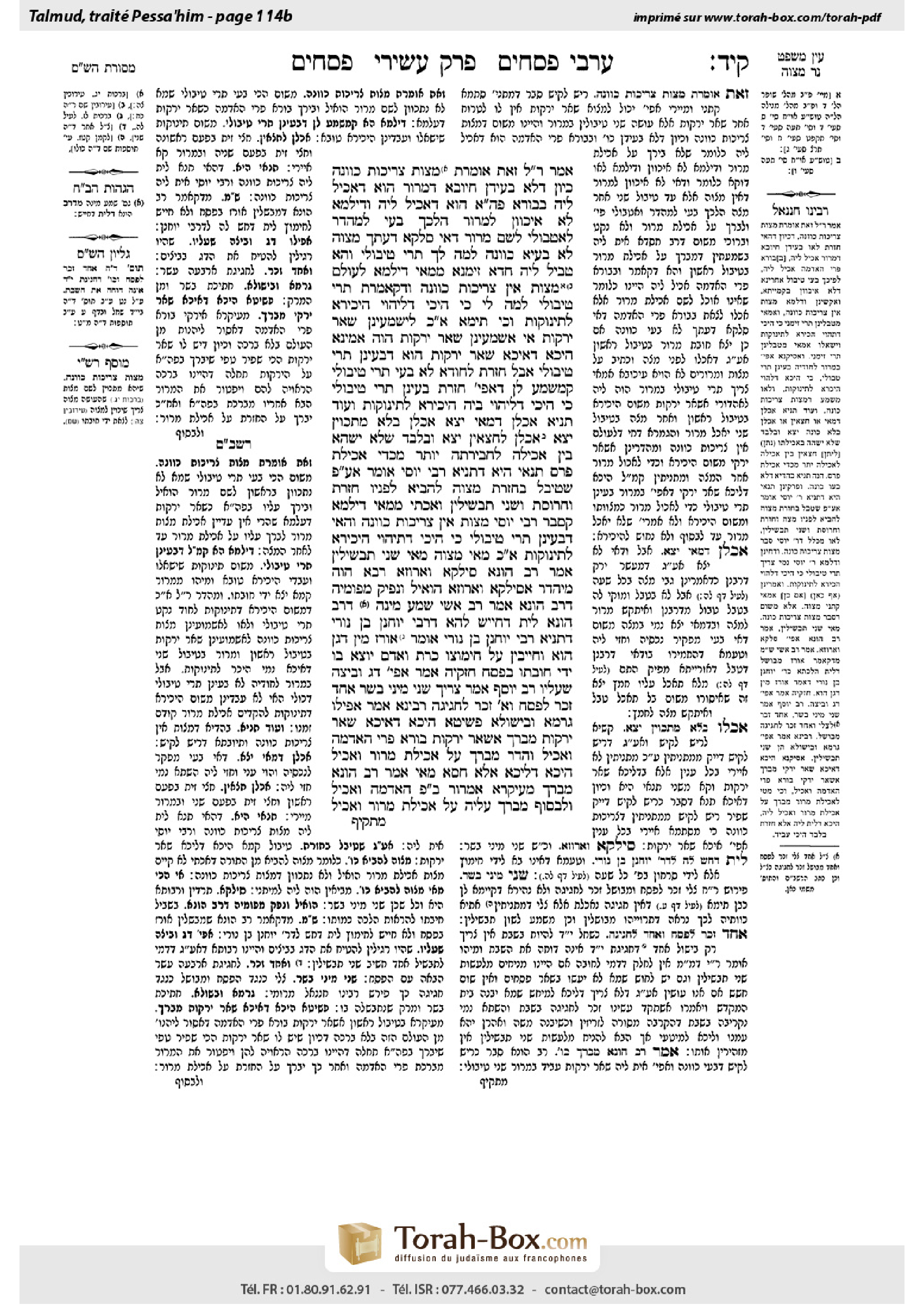
Pesachim 114b: Talmud study for Daf Yomi
Daf Yomi is the daily study of one Talmud folio. Explore 37 tractates with scans, Hebrew text, Sefaria English and AI-generated French translations where annotated.
Passage selection and English or AI-generated French translation are available where the scan has annotations. Daf Study is independent of Torah-Box and Sefaria.
Browse Pesachim · פסחים · All tractatesPesachim 114b text and translations
This page of Pesachim includes the Aramaic text, an English translation and an AI-generated French translation, alongside the scan above.
פסחים קי״ד ב · Aramaic and Hebrew text
גְּמָ׳ אָמַר רֵישׁ לָקִישׁ: זֹאת אוֹמֶרֶת מִצְוֹת צְרִיכוֹת כַּוּוֹנָה. כֵּיוָן דְּלָא בְּעִידָּן חִיּוּבָא דְּמָרוֹר הוּא דְּאָכֵיל לֵיהּ, בְּ״בוֹרֵא פְּרִי הָאֲדָמָה״ הוּא דְּאָכֵיל לֵיהּ. וְדִילְמָא לָא אִיכַּוַּון לְמָרוֹר, הִלְכָּךְ בָּעֵי לְמֶהְדַּר לְאַטְבּוֹלֵי לְשֵׁם מָרוֹר. דְּאִי סָלְקָא דַעְתָּךְ מִצְוָה לָא בָּעֲיָא כַּוּוֹנָה, לְמָה לָךְ תְּרֵי טִיבּוּלֵי? וְהָא טַבֵּיל לֵיהּ חֲדָא זִימְנָא!
מִמַּאי? דִּילְמָא: לְעוֹלָם מִצְוֹת אֵין צְרִיכוֹת כַּוּוֹנָה, וּדְקָאָמְרַתְּ תְּרֵי טִיבּוּלֵי לְמָה לִי? כִּי הֵיכִי דְּלֶיהְוֵי הֶיכֵּירָא לְתִינוֹקוֹת.
וְכִי תֵימָא: אִם כֵּן לַישְׁמְעִינַן שְׁאָר יְרָקוֹת? אִי אַשְׁמְעִינַן שְׁאָר יְרָקוֹת, הֲוָה אָמֵינָא: הֵיכָא דְּאִיכָּא שְׁאָר יְרָקוֹת הוּא דְּבָעֵינַן תְּרֵי טִיבּוּלֵי, אֲבָל חֲזֶרֶת לְחוֹדֵהּ לָא בָּעֵי תְּרֵי טִיבּוּלֵי, קָמַשְׁמַע לַן דַּאֲפִילּוּ חֲזֶרֶת בָּעֵינַן תְּרֵי טִיבּוּלֵי, כִּי הֵיכִי דְּלֶיהְוֵי בֵּיהּ הֶיכֵּירָא לְתִינוֹקוֹת.
וְעוֹד תַּנְיָא: אֲכָלָן דְּמַאי — יָצָא. אֲכָלָן בְּלֹא מִתְכַּוֵּין — יָצָא. אֲכָלָן לַחֲצָאִין — יָצָא.
וּבִלְבַד שֶׁלֹּא יִשְׁהֶא בֵּין אֲכִילָה לַחֲבֶירְתָּהּ יוֹתֵר מִכְּדֵי אֲכִילַת פְּרָס!
תַּנָּאֵי הִיא. דְּתַנְיָא, רַבִּי יוֹסֵי אוֹמֵר: אַף עַל פִּי שֶׁטִּיבֵּל בַּחֲזֶרֶת — מִצְוָה לְהָבִיא לְפָנָיו חֲזֶרֶת וַחֲרוֹסֶת וּשְׁנֵי תַבְשִׁילִין.
וְאַכַּתִּי מִמַּאי? דִּילְמָא קָסָבַר רַבִּי יוֹסֵי מִצְוֹת אֵין צְרִיכוֹת כַּוָּונָה, וְהַאי דְּבָעֵינַן תְּרֵי טִיבּוּלֵי כִּי הֵיכִי דְּתִיהְוֵי הֶיכֵּירָא לְתִינוֹקוֹת. אִם כֵּן, מַאי ״מִצְוָה״?!
מַאי שְׁנֵי תַבְשִׁילִין? אָמַר רַב הוּנָא: סִילְקָא וְאָרוֹזָא. רָבָא הֲוָה מְיהַדַּר אַסִּילְקָא וְאָרוֹזָא הוֹאִיל וְנָפֵיק מִפּוּמֵּיהּ דְּרַב הוּנָא.
אָמַר רַב אָשֵׁי: שְׁמַע מִינַּהּ דְּרַב הוּנָא, לֵית דְּחָיֵישׁ לְהָא דְּרַבִּי יוֹחָנָן בֶּן נוּרִי. דְּתַנְיָא, רַבִּי יוֹחָנָן בֶּן נוּרִי אוֹמֵר: אוֹרֶז מִין דָּגָן הוּא וְחַיָּיבִין עַל חִימּוּצוֹ כָּרֵת, וְאָדָם יוֹצֵא בּוֹ יְדֵי חוֹבָתוֹ בַּפֶּסַח.
חִזְקִיָּה אָמַר: אֲפִילּוּ דָּג וּבֵיצָה שֶׁעָלָיו. רַב יוֹסֵף אָמַר: צָרִיךְ שְׁנֵי מִינֵי בָשָׂר, אֶחָד זֵכֶר לַפֶּסַח, וְאֶחָד זֵכֶר לַחֲגִיגָה. רָבִינָא אָמַר: אֲפִילּוּ גַּרְמָא וּבִישּׁוּלָא.
פְּשִׁיטָא, הֵיכָא דְּאִיכָּא שְׁאָר יְרָקוֹת, מְבָרֵךְ אַשְּׁאָר יְרָקוֹת ״בּוֹרֵא פְּרִי הָאֲדָמָה״ וְאָכֵיל, וַהֲדַר מְבָרֵךְ ״עַל אֲכִילַת מָרוֹר״ וְאָכֵיל.
הֵיכָא דְּלֵיכָּא אֶלָּא חַסָּא, מַאי? אָמַר רַב הוּנָא: מְבָרֵךְ מֵעִיקָּרָא אַמָּרוֹר ״בּוֹרֵא פְּרִי הָאֲדָמָה״ וְאָכֵיל, וּלְבַסּוֹף מְבָרֵךְ עֲלֵיהּ ״עַל אֲכִילַת מָרוֹר״ וְאָכֵיל.
Pesachim 114b · English translation
GEMARA: Reish Lakish said: That is to say that mitzvot require intent. One who performs a mitzva must do so with the intent to fulfill his obligation. The proof of this from the mishna is that since one does not eat the lettuce at the time of his obligation to eat bitter herbs, he eats it after reciting only one blessing: Who creates fruit of the ground. And clearly the reason is that perhaps he did not intend to fulfill his obligation to eat bitter herbs, and therefore he needs to dip it again for the purpose of bitter herbs. For if it could enter your mind that mitzvot do not require intent, why do you need two dippings? But he has already dipped the lettuce once.
The Gemara rejects this contention: From where do you know that this is the case? Perhaps I can say that actually mitzvot do not require intent. And that which you said, why do I need two dippings, perhaps the reason is so that there should be a conspicuous distinction for the children, which will cause them to inquire into the difference between this night and all others.
And if you say: If so, let the tanna teach us this halakha with regard to other vegetables as well, as there is no obvious reason that lettuce is chosen for this distinction. In response, I would say that had the mishna taught us about other vegetables, I would have said that it is only where there are other vegetables that one requires two dippings, one for the other vegetables and one for the bitter herbs; however, if one has only ḥazeret, he does not require two dippings, as one dipping is sufficient. Therefore, the mishna teaches us that even if one has just ḥazeret he requires two dippings, so that there be a conspicuous distinction for the children.
And furthermore, it was taught in a baraita: On Passover, if one ate vegetables of doubtfully tithed produce, i.e., he bought the vegetables from an am ha’aretz, he has fulfilled his obligation. If he ate them without the intent of the mitzva, he has fulfilled his obligation. If he ate them in halves, by eating half an olive-bulk of bitter herbs, pausing, and then eating an additional half an olive-bulk, he has fulfilled his obligation.
And the Gemara adds: With regard to this last case, one who eats an olive-bulk in halves, that is the halakha, provided that he does not pause between eating the first half an olive-bulk and the other half an olive-bulk more than the time it takes to eat a half-loaf of bread. If one takes longer than this amount of time, the two parts of bitter herbs cannot combine. This baraita indicates that even if one eats the bitter herbs without intention he has fulfilled his obligation, which presents a difficulty for Reish Lakish.
The Gemara answers: The issue of whether or not mitzvot require intent is a dispute between tanna’im, as it was taught in a baraita: Rabbi Yosei says: Although one has already dipped the ḥazeret once, it is a mitzva to bring before him ḥazeret and ḥaroset, and two cooked dishes. Apparently, he lacked intention during his first consumption of lettuce, and therefore he must be given additional lettuce with which to fulfill his obligation.
The Gemara asks: And still this is no conclusive proof, as from where do I know that Rabbi Yosei is of the opinion that mitzvot require intent? Perhaps Rabbi Yosei maintains that mitzvot do not require intent, and the reason that we require two dippings is so that there should be a conspicuous distinction for the children. The Gemara rejects this argument: If so, for what reason does Rabbi Yosei use the term mitzva? There is no mitzva from the Torah to provide a distinction to stimulate the curiosity of the young ones. The mitzva is to eat bitter herbs, and evidently this individual must return and eat them again because he lacked intention the first time.
The Gemara asks: What are these two cooked foods mentioned in the mishna? Rav Huna said: Beets and rice. The Gemara relates that Rava would seek beets and rice for his meal on Passover night, since this ruling came from Rav Huna’s mouth. Although Rava realized that Rav Huna was merely citing examples and did not mean that one must eat those specific foods, he wanted to fulfill the statement of his teacher precisely.
Rav Ashi said: Learn incidentally another halakha from this statement of Rav Huna, that there is no one who is concerned about that statement of Rabbi Yoḥanan ben Nuri. As it was taught in a baraita: Rabbi Yoḥanan ben Nuri says: Rice is a type of grain in all regards; and one is liable to receive karet for eating it in its leavened state on Passover; and one fulfills his obligation with it on Passover, if it was properly baked into matza. It can be inferred from Rav Huna’s suggestion to use cooked rice, that rice cannot become leavened.
Ḥizkiya said: The two cooked foods can even be fish and the egg that that was fried on it. Rav Yosef said: One requires two types of meat on Passover night, one in remembrance of the Paschal lamb and the other one in remembrance of the Festival peace-offering, which was also eaten on Passover night. Ravina said: For the two cooked foods one may use even the meat on the bone and the gravy in which it was cooked.
With regard to the halakha of eating vegetables, the Gemara clarifies: It is obvious that where there are other vegetables available besides bitter herbs, at the first dipping one recites over the other vegetables the blessing: Who creates fruit of the ground, and eats, with the intention of including in this blessing the bitter herbs he will eat later. And then, at the second dipping, he recites the blessing: Commanded us over eating bitter herbs, on the lettuce and eats it.
However, what is the halakha where there is only lettuce available? When should one recite each blessing? Rav Huna said: One initially recites the blessing: Who creates fruit of the ground, over the bitter herbs, i.e., the lettuce, and eats them. And ultimately, after the matza, one recites the blessing: Commanded us over eating bitter herbs, over the lettuce and eats it.
Pesachim 114b · Traduction française (IA)
GUEMARA : Reish Lakish a dit : Cela signifie que les mitsvot requièrent une intention. Celui qui accomplit une mitsva doit le faire avec l’intention de s’acquitter de son obligation. La preuve que l’on peut tirer de la Michna est que, puisqu’on ne mange pas la laitue au moment où l’on est tenu de manger les herbes amères, on la mange après avoir récité une seule bénédiction : « Qui crée le fruit de la terre ». La raison est manifestement que l’on peut supposer qu’il n’avait pas l’intention de s’acquitter de son obligation de manger les herbes amères ; il doit donc la tremper de nouveau, cette fois en vue de manger les herbes amères. En effet, si l’on pouvait penser que les mitsvot ne requièrent pas d’intention, pourquoi faudrait-il deux trempages ? Or, il a déjà trempé la laitue une fois.
La Guemara rejette cette argumentation : D’où sais-tu qu’il en est ainsi ? Peut-être puis-je dire qu’en réalité les mitsvot ne requièrent pas d’intention. Quant à ta question — pourquoi faut-il deux trempages ? —, la raison est peut-être de créer une différence visible pour les enfants, qui les amènera à s’interroger sur la différence entre cette nuit et toutes les autres.
Et si tu dis : Dans ce cas, que le tanna nous enseigne cette halakha également à propos d’autres légumes, puisqu’il n’y a aucune raison évidente de choisir la laitue pour créer cette différence. Je répondrais que, si la Michna nous avait enseigné cela au sujet d’autres légumes, j’aurais dit que deux trempages ne sont nécessaires que lorsqu’on dispose d’autres légumes : l’un pour les autres légumes et l’autre pour les herbes amères. En revanche, si l’on ne dispose que de ḥazeret, deux trempages ne sont pas nécessaires, car un seul suffit. La Michna nous enseigne donc que même si l’on ne dispose que de ḥazeret, deux trempages sont nécessaires, afin de créer une différence visible pour les enfants.
De plus, il a été enseigné dans une baraïta : À Pessa’h, si quelqu’un a mangé des légumes dont le prélèvement des dîmes est douteux, c’est-à-dire qu’il les a achetés à un am ha’aretz, il s’est acquitté de son obligation. S’il les a mangés sans l’intention requise pour la mitsva, il s’est acquitté de son obligation. S’il les a mangés en deux fois, en mangeant un demi-volume d’olive d’herbes amères, en faisant une pause, puis en mangeant un autre demi-volume d’olive, il s’est acquitté de son obligation.
La Guemara ajoute : dans ce dernier cas, celui qui mange un volume d’olive en deux fois ne s’acquitte de son obligation que s’il ne fait pas entre la première moitié et la seconde une pause plus longue que le temps nécessaire pour manger un demi-pain. S’il prend davantage de temps, les deux portions d’herbes amères ne peuvent pas se combiner. Cette baraïta indique que même celui qui mange les herbes amères sans intention s’est acquitté de son obligation, ce qui pose une difficulté à Reish Lakish.
La Guemara répond : La question de savoir si les mitsvot requièrent ou non une intention fait l’objet d’une controverse entre tannaïm, comme il a été enseigné dans une baraïta : Rabbi Yossei dit : Bien qu’on ait déjà trempé la ḥazeret une fois, c’est une mitsva de faire apporter devant soi de la ḥazeret, du ḥaroset et deux mets cuits. Il semble donc qu’il n’avait pas d’intention lors de sa première consommation de laitue et qu’il faut par conséquent lui apporter de la laitue supplémentaire afin qu’il puisse s’acquitter de son obligation.
La Guemara demande : Cela ne constitue toujours pas une preuve concluante : d’où sais-je que Rabbi Yossei pense que les mitsvot requièrent une intention ? Peut-être Rabbi Yossei estime-t-il que les mitsvot ne requièrent pas d’intention, et que si deux trempages sont nécessaires, c’est afin de créer une différence visible pour les enfants. La Guemara rejette cette argumentation : Dans ce cas, pourquoi Rabbi Yossei emploie-t-il le terme « mitsva » ? La Torah ne prescrit aucune mitsva de créer une différence pour éveiller la curiosité des jeunes. La mitsva consiste à manger des herbes amères ; il est donc évident que cet homme doit revenir les manger, car il n’avait pas l’intention requise la première fois.
Quels sont ces deux mets cuits mentionnés dans la Michna ? Rav Houna a dit : des betteraves et du riz. La Guemara rapporte que Rava recherchait des betteraves et du riz pour son repas de la nuit de Pessa’h, puisque cette décision venait de la bouche de Rav Houna. Bien que Rava comprît que Rav Houna ne citait que des exemples et ne voulait pas dire qu’il fallait manger précisément ces aliments, il souhaitait accomplir à la lettre l’enseignement de son maître.
Rav Achi a dit : On peut déduire incidemment de cette déclaration de Rav Houna une autre halakha : personne ne tient compte de l’avis de Rabbi Yo’hanan ben Nouri. En effet, il a été enseigné dans une baraïta : Rabbi Yo’hanan ben Nouri dit : Le riz est une espèce de céréale à tous égards ; on est passible de karet si on le mange à Pessa’h à l’état de pâte levée ; et on peut s’en servir pour s’acquitter de son obligation à Pessa’h s’il a été convenablement cuit pour devenir de la matsa. On peut déduire de la suggestion de Rav Houna d’utiliser du riz cuit que le riz ne peut pas fermenter.
Ḥizkiya a dit : Les deux mets cuits peuvent même être du poisson et l’œuf qui a été frit dessus. Rav Yossef a dit : Il faut deux sortes de viande pour la nuit de Pessa’h, l’une en souvenir de l’agneau pascal et l’autre en souvenir du sacrifice de paix de la fête, qui était lui aussi consommé la nuit de Pessa’h. Ravina a dit : Pour les deux mets cuits, on peut même utiliser la viande sur l’os et le jus dans lequel elle a cuit.
Au sujet de la halakha concernant la consommation des légumes, la Guemara précise : Il est évident que, lorsqu’on dispose d’autres légumes que les herbes amères, lors du premier trempage, on récite sur les autres légumes la bénédiction « Qui crée le fruit de la terre » et on les mange, avec l’intention que cette bénédiction couvre les herbes amères que l’on mangera plus tard. Puis, lors du second trempage, on récite sur la laitue la bénédiction « Qui nous a ordonné de manger des herbes amères » et on la mange.
Cependant, quelle est la halakha lorsqu’on ne dispose que de laitue ? À quel moment récite-t-on chacune des bénédictions ? Rav Houna a dit : On récite d’abord la bénédiction « Qui crée le fruit de la terre » sur les herbes amères, c’est-à-dire la laitue, et on les mange. Puis, après la matsa, on récite sur la laitue la bénédiction « Qui nous a ordonné de manger des herbes amères » et on la mange.
Traduction française générée par IA à partir de l’édition anglaise de Sefaria. Vérifie toujours un passage avec le texte source.
Text from Sefaria: William Davidson Edition - Vocalized Aramaic (CC BY NC); William Davidson Edition - English (CC BY NC).