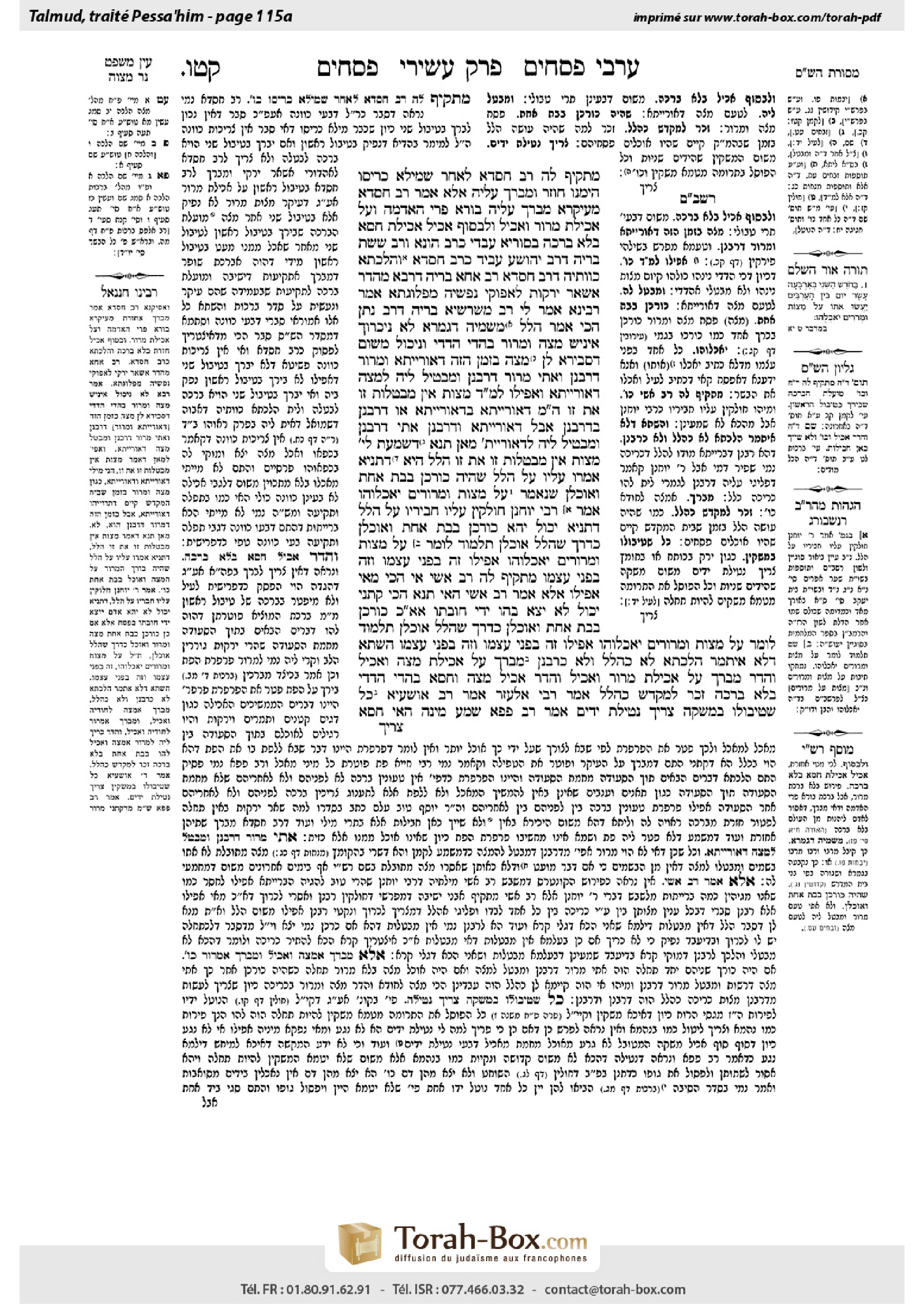
Pesachim 115a: Talmud study for Daf Yomi
Daf Yomi is the daily study of one Talmud folio. Explore 37 tractates with scans, Hebrew text, Sefaria English and AI-generated French translations where annotated.
Passage selection and English or AI-generated French translation are available where the scan has annotations. Daf Study is independent of Torah-Box and Sefaria.
Browse Pesachim · פסחים · All tractatesPesachim 115a text and translations
This page of Pesachim includes the Aramaic text, an English translation and an AI-generated French translation, alongside the scan above.
פסחים קי״ה א · Aramaic and Hebrew text
מַתְקֵיף לַהּ רַב חִסְדָּא: לְאַחַר שֶׁמִּילֵּא כְּרֵיסוֹ הֵימֶנּוּ חוֹזֵר וּמְבָרֵךְ עֲלֵיהּ? אֶלָּא אָמַר רַב חִסְדָּא: מֵעִיקָּרָא מְבָרֵךְ עֲלֵיהּ ״בּוֹרֵא פְּרִי הָאֲדָמָה״ וְ״עַל אֲכִילַת מָרוֹר״ וְאָכֵיל, וּלְבַסּוֹף אָכֵיל אֲכִילַת חַסָּא בְּלֹא בְּרָכָה.
בְּסוּרְיָא עָבְדִי כְּרַב הוּנָא, וְרַב שֵׁשֶׁת בְּרֵיהּ דְּרַב יְהוֹשֻׁעַ עָבֵיד כְּרַב חִסְדָּא. וְהִלְכְתָא כְּווֹתֵיהּ דְּרַב חִסְדָּא. רַב אַחָא בְּרֵיהּ דְּרָבָא מְהַדַּר אַשְּׁאָר יְרָקוֹת לְאַפּוֹקֵי נַפְשֵׁיהּ מִפְּלוּגְתָּא.
אָמַר רָבִינָא: אָמַר לִי רַב מְשַׁרְשְׁיָא בְּרֵיהּ דְּרַב נָתָן, הָכִי אָמַר הִלֵּל מִשְּׁמֵיהּ דִּגְמָרָא: לָא נִיכְרוֹךְ אִינִישׁ מַצָּה וּמָרוֹר בַּהֲדֵי הֲדָדֵי וְנֵיכוֹל, מִשּׁוּם דִּסְבִירָא לַן מַצָּה בִּזְמַן הַזֶּה דְּאוֹרָיְיתָא, וּמָרוֹר דְּרַבָּנַן, וְאָתֵי מָרוֹר דְּרַבָּנַן וּמְבַטֵּיל לֵיהּ לְמַצָּה דְּאוֹרָיְיתָא.
וַאֲפִילּוּ לְמַאן דְּאָמַר: מִצְוֹת אֵין מְבַטְּלוֹת זוֹ אֶת זוֹ, הָנֵי מִילֵּי דְּאוֹרָיְיתָא בִּדְאוֹרָיְיתָא אוֹ דְּרַבָּנַן בִּדְרַבָּנַן, אֲבָל דְּאוֹרָיְיתָא וּדְרַבָּנַן — אָתֵי דְּרַבָּנַן וּמְבַטֵּיל לֵיהּ לִדְאוֹרָיְיתָא.
מַאן תַּנָּא דְּשָׁמְעַתְּ לֵיהּ מִצְוֹת אֵין מְבַטְּלוֹת זוֹ אֶת זוֹ? הִלֵּל הִיא. דְּתַנְיָא, אָמְרוּ עָלָיו עַל הִלֵּל שֶׁהָיָה כּוֹרְכָן בְּבַת אַחַת וְאוֹכְלָן, שֶׁנֶּאֱמַר: ״עַל מַצּוֹת וּמְרוֹרִים יֹאכְלוּהוּ״.
אָמַר רַבִּי יוֹחָנָן: חוֹלְקִין עָלָיו חֲבֵירָיו עַל הִלֵּל. דְּתַנְיָא: יָכוֹל יְהֵא כּוֹרְכָן בְּבַת אַחַת וְאוֹכְלָן כְּדֶרֶךְ שֶׁהִלֵּל אוֹכְלָן, תַּלְמוּד לוֹמַר: ״עַל מַצּוֹת וּמְרוֹרִים יֹאכְלוּהוּ״, אֲפִילּוּ זֶה בִּפְנֵי עַצְמוֹ וְזֶה בִּפְנֵי עַצְמוֹ. מַתְקֵיף לַהּ רַב אָשֵׁי: אִי הָכִי, מַאי אֲפִילּוּ?
אֶלָּא אָמַר רַב אָשֵׁי, הַאי תַּנָּא הָכִי קָתָנֵי: יָכוֹל לֹא יָצָא בְּהוּ יְדֵי חוֹבָתוֹ אֶלָּא אִם כֵּן כּוֹרְכָן בְּבַת אַחַת וְאוֹכְלָן כְּדֶרֶךְ שֶׁהִלֵּל אוֹכְלָן — תַּלְמוּד לוֹמַר: ״עַל מַצּוֹת וּמְרוֹרִים יֹאכְלוּהוּ״ — אֲפִילּוּ זֶה בִּפְנֵי עַצְמוֹ וְזֶה בִּפְנֵי עַצְמוֹ.
הַשְׁתָּא דְּלָא אִיתְּמַר הִלְכְתָא לָא כְּהִלֵּל וְלָא כְּרַבָּנַן, מְבָרֵךְ ״עַל אֲכִילַת מַצָּה״ וְאָכֵיל, וַהֲדַר מְבָרֵךְ ״עַל אֲכִילַת מָרוֹר״ וְאָכֵיל, וַהֲדַר אָכֵיל מַצָּה וְחַסָּא בַּהֲדֵי הֲדָדֵי בְּלֹא בְּרָכָה זֵכֶר לַמִּקְדָּשׁ, כְּהִלֵּל.
אָמַר רַבִּי אֶלְעָזָר אָמַר רַב אוֹשַׁעְיָא: כׇּל שֶׁטִּיבּוּלוֹ בְּמַשְׁקֶה — צָרִיךְ נְטִילַת יָדַיִם. אָמַר רַב פָּפָּא: שְׁמַע מִינַּהּ, הַאי חַסָּא
Pesachim 115a · English translation
Rav Ḥisda strongly objects to this opinion: Do you think that after one fills his belly with lettuce, he then recites another blessing over it? Rather, Rav Ḥisda said: Initially one recites two blessings over the lettuce: Who creates fruit of the ground, and: Commanded us over eating bitter herbs, and he eats it; and later in the seder he eats lettuce without a blessing.
The Gemara comments: In Syria, they act in accordance with the opinion of Rav Huna. And Rav Sheshet, son of Rav Yehoshua, acted in accordance with the opinion of Rav Ḥisda. The Gemara summarizes: And the halakha is in accordance with the opinion of Rav Ḥisda. The Gemara relates that Rav Aḥa, son of Rava, would seek other vegetables for Passover to preclude himself from taking sides in the dispute. He first recited only the blessing: Who creates fruit of the ground, and later added the blessing: Commanded us over eating bitter herbs, thereby satisfying all opinions.
Ravina said: Rav Mesharshiya, son of Rav Natan, said to me that Hillel said as follows, citing tradition: A person should not wrap matza and bitter herbs together and eat them. He ruled in this manner because he maintains that today, after the destruction of the Temple, the obligation to eat matza applies by Torah law, and the obligation to eat bitter herbs without the Paschal lamb applies by rabbinic law. And if one were to wrap them together, the bitter herbs, whose obligation applies by rabbinic law, would come and nullify the matza, whose obligation applies by Torah law.
And even according to the one who says that mitzvot do not nullify each other, that principle applies only to a mixture of one food whose obligation applies by Torah law with another food whose obligation applies by Torah law, or to a mixture of one food whose obligation applies by rabbinic law with another food whose obligation applies by rabbinic law. However, in a case of a mixture of one food whose obligation applies by Torah law with another food whose obligation applies by rabbinic law, the food whose obligation applies by rabbinic law comes and nullifies the food whose obligation applies by Torah law.
The Gemara asks: Who is the tanna that you heard say that mitzvot do not nullify each other? It is Hillel, as it was taught in a baraita: They said about Hillel that he would wrap matza and bitter herbs together and eat them, as it is stated: “They shall eat it with matzot and bitter herbs” (Numbers 9:11), which indicates that these two foods should be consumed together.
Rabbi Yoḥanan said: Hillel’s colleagues disagree with him, as it was taught in another baraita: I might have thought that one should wrap matzot and bitter herbs together and eat them in the manner that Hillel eats them; therefore the verse states: “They shall eat it with matzot and bitter herbs,” meaning that one may eat even this, the matza, by itself, and that, the bitter herbs, by themselves. Rav Ashi strongly objects to this proof: If so, if the Sages disagree with Hillel and maintain that mitzvot nullify each other, what is the meaning of the word even in this baraita? This wording indicates that Hillel’s opinion is not rejected entirely, but that one fulfills his obligation even if he eats the items without combining them.
Rather, Rav Ashi said: This is what this tanna is teaching: I might have thought that one fulfills his obligation with them only if he wraps matzot and bitter herbs together and eats them in the manner that Hillel eats them. Therefore, the verse states: “They shall eat it with matzot and bitter herbs,” i.e., one fulfills his obligation even if he eats the matza by itself and the bitter herbs by themselves.
The Gemara comments: Now that the halakha was stated neither in accordance with the opinion of Hillel nor in accordance with the opinion of the Rabbis, one recites the blessing: Commanded us over eating matza, and eats matza to fulfill his obligation. And then he recites the blessing: Commanded us over eating bitter herbs, and eats the lettuce as bitter herbs. And then he eats matza and lettuce together without a blessing in remembrance of the Temple, in the manner of Hillel in the days of the Temple, who ate matza and bitter herbs together with the Paschal lamb.
Rabbi Elazar said that Rav Oshaya said: Anything that is dipped in a liquid before it is eaten requires the ritual of washing of the hands. The obligation to wash one’s hands was instituted to preserve ritual purity and to prevent people from causing teruma food to contract ritual impurity. Hands are generally considered impure to the second degree of ritual impurity, and they confer impurity upon any liquid with which they come in contact. Liquids that become ritually impure are automatically impure to the first degree and will therefore transfer ritual impurity to any food that is dipped in them. Rav Pappa said: Learn from this halakha, which requires the washing of hands, that for this lettuce on Passover,
Pesachim 115a · Traduction française (IA)
Rav Ḥisda s’oppose vivement à cette opinion : Penses-tu qu’après s’être rempli le ventre de laitue, on récite encore une bénédiction à son sujet ? Rav Ḥisda dit plutôt : Au début, on récite deux bénédictions sur la laitue : « Qui crée le fruit de la terre » et « Qui nous a ordonné de manger des herbes amères », puis on la mange ; plus tard, au cours du seder, on mange de la laitue sans bénédiction.
La Guemara commente : En Syrie, on suit l’opinion de Rav Huna. Rav Sheshet, fils de Rav Yehoshua, suivait, lui, l’opinion de Rav Ḥisda. La Guemara résume : la halakha suit l’opinion de Rav Ḥisda. La Guemara rapporte que Rav Aḥa, fils de Rava, cherchait d’autres légumes pour Pessa’h afin de ne pas prendre parti dans la controverse. Il récitait d’abord uniquement la bénédiction « Qui crée le fruit de la terre », puis ajoutait la bénédiction « Qui nous a ordonné de manger des herbes amères », satisfaisant ainsi toutes les opinions.
Ravina dit : Rav Mesharshiya, fils de Rav Natan, m’a dit que Hillel enseignait ceci, en transmettant la tradition : On ne doit pas envelopper ensemble de la matsa et des herbes amères pour les manger. Il statuait ainsi parce qu’il estime qu’aujourd’hui, après la destruction du Temple, l’obligation de manger de la matsa relève de la Torah, tandis que l’obligation de manger des herbes amères sans l’agneau pascal relève de la loi rabbinique. Si l’on enveloppait les deux ensemble, les herbes amères, dont l’obligation relève de la loi rabbinique, viendraient annuler la matsa, dont l’obligation relève de la Torah.
Même selon celui qui affirme que les mitsvot ne s’annulent pas les unes les autres, ce principe ne s’applique qu’au mélange d’un aliment dont l’obligation relève de la Torah avec un autre aliment dont l’obligation relève de la Torah, ou au mélange d’un aliment dont l’obligation relève de la loi rabbinique avec un autre aliment dont l’obligation relève de la loi rabbinique. En revanche, dans le cas du mélange d’un aliment dont l’obligation relève de la Torah avec un autre aliment dont l’obligation relève de la loi rabbinique, l’aliment dont l’obligation relève de la loi rabbinique vient annuler celui dont l’obligation relève de la Torah.
La Guemara demande : Quel est le tanna que vous avez entendu affirmer que les mitsvot ne s’annulent pas les unes les autres ? C’est Hillel, comme l’enseigne une baraïta : On disait de Hillel qu’il enveloppait ensemble de la matsa et des herbes amères et les mangeait, ainsi qu’il est dit : « Ils la mangeront avec des matsot et des herbes amères » (Nombres 9:11), ce qui indique que ces deux aliments doivent être consommés ensemble.
Rabbi Yoḥanan dit : Les collègues de Hillel ne sont pas d’accord avec lui, comme l’enseigne une autre baraïta : J’aurais pu penser qu’il faut envelopper ensemble de la matsa et des herbes amères et les manger comme Hillel le fait ; c’est pourquoi le verset dit : « Ils la mangeront avec des matsot et des herbes amères », ce qui signifie qu’on peut manger même la matsa séparément, et les herbes amères séparément. Rav Ashi s’oppose vivement à cette preuve : Si tel est le cas, si les Sages ne sont pas d’accord avec Hillel et estiment que les mitsvot s’annulent les unes les autres, que signifie le mot « même » dans cette baraïta ? Cette formulation indique que l’opinion de Hillel n’est pas entièrement rejetée, mais que l’on s’acquitte de son obligation même si l’on mange les aliments sans les combiner.
Rav Ashi dit plutôt : Voici ce que ce tanna enseigne : J’aurais pu penser qu’on ne s’acquitte de son obligation avec ces aliments que si l’on enveloppe ensemble de la matsa et des herbes amères et qu’on les mange comme Hillel le fait. C’est pourquoi le verset dit : « Ils la mangeront avec des matsot et des herbes amères », c’est-à-dire qu’on s’acquitte de son obligation même si l’on mange la matsa séparément et les herbes amères séparément.
La Guemara commente : Puisque la halakha n’a été établie ni selon l’opinion de Hillel ni selon celle des Rabbins, on récite la bénédiction « Qui nous a ordonné de manger de la matsa », puis on mange de la matsa pour s’acquitter de son obligation. Ensuite, on récite la bénédiction « Qui nous a ordonné de manger des herbes amères », puis on mange la laitue comme herbe amère. Enfin, on mange ensemble de la matsa et de la laitue, sans bénédiction, en souvenir du Temple, à la manière de Hillel à l’époque du Temple, qui mangeait ensemble de la matsa et des herbes amères avec l’agneau pascal.
Rabbi Elazar dit que Rav Oshaya a dit : Tout aliment que l’on trempe dans un liquide avant de le manger requiert l’ablution rituelle des mains. L’obligation de se laver les mains a été instituée pour préserver la pureté rituelle et empêcher que les aliments de terouma ne deviennent impurs. En règle générale, les mains sont considérées comme impures au deuxième degré et transmettent l’impureté à tout liquide avec lequel elles entrent en contact. Les liquides qui deviennent rituellement impurs sont automatiquement impurs au premier degré et transmettent donc l’impureté rituelle à tout aliment que l’on y trempe. Rav Pappa dit : Apprends de cette halakha, qui impose l’ablution des mains, que pour cette laitue à Pessa’h,
Traduction française générée par IA à partir de l’édition anglaise de Sefaria. Vérifie toujours un passage avec le texte source.
Text from Sefaria: William Davidson Edition - Vocalized Aramaic (CC BY NC); William Davidson Edition - English (CC BY NC).