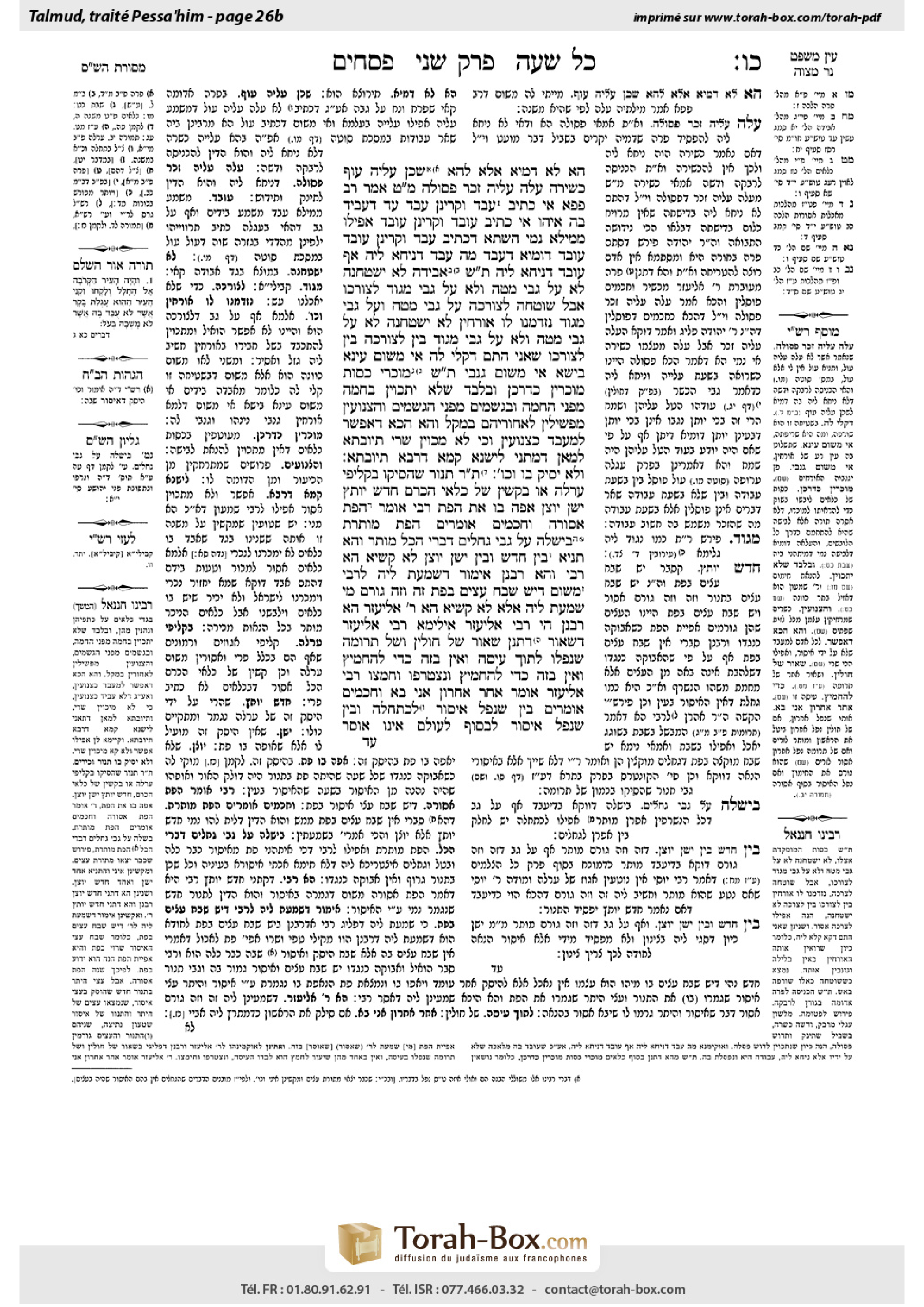
Pesachim 26b: Talmud study for Daf Yomi
Daf Yomi is the daily study of one Talmud folio. Explore 37 tractates with scans, Hebrew text, Sefaria English and AI-generated French translations where annotated.
Passage selection and English or AI-generated French translation are available where the scan has annotations. Daf Study is independent of Torah-Box and Sefaria.
Browse Pesachim · פסחים · All tractatesPesachim 26b text and translations
This page of Pesachim includes the Aramaic text, an English translation and an AI-generated French translation, alongside the scan above.
פסחים כ״ו ב · Aramaic and Hebrew text
הָא לָא דָּמְיָא אֶלָּא לְהָא: שָׁכַן עָלֶיהָ עוֹף — כְּשֵׁירָה, עָלָה עָלֶיהָ זָכָר — פְּסוּלָה. מַאי טַעְמָא?
אָמַר רַב פָּפָּא: אִי כְּתִיב ״עָבַד״ וְקָרֵינַן ״עָבַד״ — עַד דְּעָבֵיד בָּהּ אִיהוּ. אִי כְּתִיב ״עוּבַּד״ וְקָרֵינַן ״עוּבַּד״ — אֲפִילּוּ מִמֵּילָא נָמֵי.
הַשְׁתָּא דִּכְתִיב ״עָבַד״ וְקָרֵינַן ״עוּבַּד״ — עוּבַּד דּוּמְיָא דְּעָבַד. מָה עָבַד דְּנִיחָא לֵיהּ, אַף עוּבַּד דְּנִיחָא לֵיהּ.
תָּא שְׁמַע: אֲבֵידָה, לֹא יִשְׁטָחֶנָּה לֹא עַל גַּבֵּי מִטָּה וְלֹא עַל גַּבֵּי מַגּוֹד לְצוֹרְכּוֹ, אֲבָל שׁוֹטְחָהּ לְצוֹרְכָּהּ עַל גַּבֵּי מִטָּה וְעַל גַּבֵּי מַגּוֹד. נִזְדַּמְּנוּ לוֹ אוֹרְחִין, לֹא יִשְׁטָחֶנָּה לֹא עַל גַּבֵּי מִטָּה וְלֹא עַל גַּבֵּי מַגּוֹד, בֵּין לְצוֹרְכָּהּ בֵּין לְצוֹרְכּוֹ.
שָׁאנֵי הָתָם דְּקָלֵי לַהּ, אִי מִשּׁוּם עֵינָא בִּישָׁא, אִי מִשּׁוּם גַּנָּבֵי.
תָּא שְׁמַע: מוֹכְרֵי כְסוּת מוֹכְרִין כְּדַרְכָּן, וּבִלְבַד שֶׁלֹּא יִתְכַּוֵּין בַּחַמָּה מִפְּנֵי הַחַמָּה, וּבַגְּשָׁמִים מִפְּנֵי הַגְּשָׁמִים. וְהַצְּנוּעִין מַפְשִׁילִין לַאֲחוֹרֵיהֶם בְּמַקֵּל.
וְהָא הָכָא דְּאֶפְשָׁר לְמֶעְבַּד כִּצְנוּעִין, וְכִי לָא מְכַוֵּין — שְׁרֵי. תְּיוּבְתָּא לְמַאן דְּמַתְנֵי לִישָּׁנָא קַמָּא דְּרָבָא, תְּיוּבְתָּא.
וְלֹא יַסִּיק בּוֹ וְכוּ׳. תָּנוּ רַבָּנַן: תַּנּוּר שֶׁהִסִּיקוֹ בִּקְלִיפֵּי עׇרְלָה אוֹ בְּקַשִּׁין שֶׁל כִּלְאֵי הַכֶּרֶם, חָדָשׁ — יוּתַּץ, יָשָׁן — יוּצַן.
אָפָה בּוֹ אֶת הַפַּת, רַבִּי אוֹמֵר: הַפַּת אֲסוּרָה, וַחֲכָמִים אוֹמְרִים: הַפַּת מוּתֶּרֶת. בִּישְּׁלָהּ עַל גַּבֵּי גֶּחָלִים — דִּבְרֵי הַכֹּל מוּתָּר.
וְהָא תַּנְיָא: בֵּין חָדָשׁ וּבֵין יָשָׁן יוּצַן! לָא קַשְׁיָא: הָא — רַבִּי, וְהָא — רַבָּנַן.
אֵימוֹר דְּשָׁמְעַתְּ לֵיהּ לְרַבִּי מִשּׁוּם דְּיֵשׁ שֶׁבַח עֵצִים בַּפַּת. זֶה וָזֶה גּוֹרֵם מִי שָׁמְעַתְּ לֵיהּ? אֶלָּא, לָא קַשְׁיָא: הָא — רַבִּי אֱלִיעֶזֶר, הָא — רַבָּנַן.
הֵי רַבִּי אֱלִיעֶזֶר? אִילֵימָא רַבִּי אֱלִיעֶזֶר דִּשְׂאוֹר, דִּתְנַן: שְׂאוֹר שֶׁל חוּלִּין וְשֶׁל תְּרוּמָה שֶׁנָּפְלוּ לְתוֹךְ עִיסָּה, וְאֵין בָּזֶה כְּדֵי לְהַחְמִיץ וְאֵין בָּזֶה כְּדֵי לְהַחְמִיץ, וְנִצְטָרְפוּ וְחִמְּצוּ — רַבִּי אֱלִיעֶזֶר אוֹמֵר: אַחַר אַחֲרוֹן אֲנִי בָּא, וַחֲכָמִים אוֹמְרִים: בֵּין שֶׁנָּפַל אִיסּוּר לְכַתְּחִלָּה, וּבֵין שֶׁנָּפַל אִיסּוּר לְבַסּוֹף — לְעוֹלָם אֵינוֹ אוֹסֵר
Pesachim 26b · English translation
The Gemara answers. This case is comparable only to that other case: If a bird landed on the red heifer it remains valid, since this is not considered to be like bearing a yoke. If a male animal mounted it to mate with it, it is unfit and may not be used for the ritual. The same applies in this case: When the owner moves the heifer into a pen and it threshes, since the owner is uninterested in this action, it is like the case of the bird and the heifer remains valid. The Gemara asks: What is the reason for the difference between the case where a bird lands on it and where a male animal attempts to mate with it?
Rav Pappa said that the verse says: “And the elders of that city shall take a heifer of the herd, which has not been used for work, and which has not drawn in the yoke” (Deuteronomy 21:3). If it were written: “He worked [avad],” and we read: “He worked [avad],” this word choice would indicate that the heifer could still be used until he, the owner of the heifer himself, used it willingly for labor. If it were written: “It was worked [ubbad],” and we read: “It was worked [ubbad],” it would indicate that even if it performed labor on its own it is also prohibited to use it, since some form of labor had been done with it.
Now that it is written: “He worked [avad],” but we read this word as: “It was worked [ubbad],” both meanings are intended: It is prohibited if it is worked in a similar manner to the way he works. In other words, just as the owner works the animal in a way that is beneficial to him, so too, the animal becomes prohibited only when it is worked in a way that causes him to derive benefit from this labor. Therefore, it still may be used if a bird lands on it, because the owner does not derive benefit from this in any way. However, if a male bull mates with this heifer it is rendered unfit, since the owner generally has an interest in this occurring.
The Gemara cites an additional proof. Come and hear from that which is taught: If one finds a lost item, he may not spread it out over a bed or over a frame for his own purposes, since this is deriving benefit from an object that does not belong to him. However, he may spread it out over a bed or a frame for its own sake if it requires airing. If guests happen to come to him, he may not spread it out, neither for its sake nor for his own purpose. Apparently, the benefit is unavoidable and intended, as there is no other way for him to care for the lost object, and he benefits from having his guests see the item; nonetheless, it is still prohibited. This seems to prove that Rava’s opinion is correct.
The Gemara rejects this conclusion: It is different there, as he risks damaging it, either due to the evil eye that he casts upon it or due to the thieves who will now know that this valuable item is in his possession and will attempt to steal it. It is not prohibited because of the benefit; rather, it is prohibited due to the concern that he may damage the item.
The Gemara offers a final proof. Come and hear a proof based on the following mishna: Clothing merchants who sell garments made of diverse kinds, a prohibited mixture of wool and linen, may sell them as they normally would to gentiles. A merchant may place the garments he is selling on his shoulders and need not be concerned about the prohibition against wearing diverse kinds, provided he does not intend to benefit from the garments in the sun as protection from the sun, or in the rain as protection from the rain. However, the modest people, those who are meticulous in their performance of mitzvot, suspend the wool and linen garments on a stick behind them.
And here, isn’t it a case where it is possible for all clothing merchants to act like the modest people and not derive benefit from the mixture of wool and linen? Nonetheless, the mishna states that when one does not intend to benefit from the prohibited item, it is permitted to do so. This presents a conclusive refutation to he who taught the first version of Rava’s statement. According to this version, one is prohibited from deriving benefit when it is possible to avoid doing so and he does not intend to derive benefit. The Gemara concludes: Indeed, it is a conclusive refutation.
It was taught in the mishna that one may not even light the oven with leavened bread. The Sages taught in a baraita: With regard to an oven that one lit with the peels of orla fruit, or with straw of grain that was planted in a prohibited mixture of diverse kinds in a vineyard, if it was a new oven, and by lighting it he hardened the oven and made it stronger for use in the future, then it must be shattered. Since prohibited items were used in the process of forming the oven, one may not derive benefit from the use of the prohibited items. However, if it was an old oven, it may be cooled, and it is prohibited to use the oven only while it is still hot.
With regard to one who baked bread in the oven while it was heated or strengthened by the prohibited items, Rabbi Yehuda HaNasi says: It is prohibited to eat or derive benefit from the bread, since prohibited items were involved in the process of preparation. And the Rabbis say: It is permitted to eat and derive benefit from the bread. If he cooked the bread over the coals that remained from prohibited wood, everyone agrees that it is permitted.
The Gemara asks. Wasn’t it taught in a baraita: Whether it was an old oven or a new oven it may be cooled; there is never a need to shatter the oven? The Gemara answers: This is not difficult. This baraita, which states that one is required to shatter the oven, is in accordance with the opinion of Rabbi Yehuda HaNasi. And that baraita, which states that it is sufficient to let the oven cool, is in accordance with the opinion of the Rabbis. Since the prohibited objects merely strengthen the oven, the Rabbis hold that it is enough to let the oven cool. By cooling the oven one no longer derives benefit from the prohibited items used to light it, and there is no need to shatter the oven.
The Gemara challenges this answer: Say that you heard that Rabbi Yehuda HaNasi prohibits one from deriving benefit from bread baked using the prohibited objects as kindling because there is improvement from the wood used to light the oven in the bread, and therefore, it is prohibited. However, in a different case, namely, when both this and that cause it, i.e., both permitted and prohibited items contribute to the result, such as when one subsequently bakes in this oven and benefit is derived both from the prohibited wood that strengthened the oven and from permitted wood that is used in subsequent baking, did you hear him say that it is prohibited as well? Rather, reject this explanation and say: This is not difficult. This stringent baraita is in accordance with the opinion of Rabbi Eliezer, who says that in a case where both this and that cause it, it is prohibited. And that lenient baraita is in accordance with the Rabbis, who disagree with regard to that principle.
The Gemara asks: Which statement of Rabbi Eliezer serves as the basis for this explanation? If you say that it is the opinion of Rabbi Eliezer with regard to leaven, as we learned in a mishna: In a case where non-sacred leaven and leaven of teruma fell into non-sacred dough, and neither one alone is potent enough to cause the dough to become leavened bread, and they were joined together and caused the dough to become leavened bread, there is a dispute as to whether this dough is considered to be teruma or non-sacred bread. Rabbi Eliezer says: I follow the final element that fell into the dough. If the teruma fell in last, the dough is prohibited to non-priests. And the Rabbis say: Whether the prohibited item, i.e., the teruma, fell in first or the prohibited item fell in last, it never renders the dough prohibited
Pesachim 26b · Traduction française (IA)
La Guemara répond : ce cas ne peut être comparé qu’à l’autre cas : si un oiseau se pose sur la vache rousse, celle-ci reste valide, car cela n’est pas considéré comme le fait de porter un joug. Si un mâle la monte pour s’accoupler avec elle, elle est invalide et ne peut pas être utilisée pour le rituel. Il en va de même ici : lorsque le propriétaire conduit la vache dans un enclos et qu’elle y foule le grain, puisque le propriétaire ne souhaite pas cette action, la situation est comparable à celle de l’oiseau, et la vache reste valide. La Guemara demande : quelle est la raison de la différence entre le cas où un oiseau se pose sur elle et celui où un mâle tente de s’accoupler avec elle ?
Rav Pappa dit que le verset énonce : « Les anciens de cette ville prendront une génisse du troupeau, qui n’a pas été employée au travail et qui n’a pas tiré sous le joug » (Deutéronome 21,3). S’il était écrit « il a travaillé [avad] » et que nous lisions « il a travaillé [avad] », ce choix de mots indiquerait que la génisse pourrait encore être utilisée jusqu’à ce que son propriétaire lui-même l’emploie volontairement à un travail. S’il était écrit « elle a été employée au travail [ubbad] » et que nous lisions « elle a été employée au travail [ubbad] », cela indiquerait que même si elle a accompli un travail de son propre chef, il serait également interdit de l’utiliser, puisqu’un travail quelconque aurait été effectué avec elle.
Or, puisqu’il est écrit « il a travaillé [avad] », mais que nous lisons ce mot « elle a été employée au travail [ubbad] », les deux sens sont visés : il est interdit d’utiliser la génisse si elle a été employée d’une manière comparable à celle dont le propriétaire la fait travailler. Autrement dit, de même que le propriétaire fait travailler l’animal d’une manière qui lui est utile, de même l’animal ne devient interdit que lorsqu’il est employé d’une façon qui procure au propriétaire un bénéfice tiré de ce travail. Il peut donc encore être utilisé si un oiseau se pose sur lui, car le propriétaire n’en tire aucun bénéfice. En revanche, si un taureau s’accouple avec cette génisse, celle-ci devient invalide, puisque le propriétaire souhaite généralement que cela se produise.
La Guemara cite une preuve supplémentaire. Viens et entends ce qui est enseigné : celui qui trouve un objet perdu ne peut pas l’étaler sur un lit ou sur un support pour son propre usage, car il tirerait ainsi profit d’un objet qui ne lui appartient pas. Il peut toutefois l’étaler sur un lit ou sur un support pour le bien de l’objet, s’il a besoin d’être aéré. Si des invités viennent chez lui, il ne peut pas l’étaler, ni pour le bien de l’objet ni pour son propre usage. Il semble donc que le bénéfice soit inévitable et recherché, puisqu’il n’a pas d’autre moyen de prendre soin de l’objet perdu et que ses invités le voient, ce qui lui est bénéfique ; néanmoins, cela reste interdit. Cela semble prouver que l’opinion de Rava est juste.
La Guemara rejette cette conclusion : le cas est différent, car il risque d’abîmer l’objet, soit en lui portant le mauvais œil, soit parce que des voleurs sauront désormais qu’il possède cet objet de valeur et tenteront de le dérober. Ce n’est pas le bénéfice qui rend la chose interdite ; elle l’est plutôt par crainte qu’il n’abîme l’objet.
La Guemara apporte une dernière preuve. Viens et entends une preuve fondée sur la Michna suivante : les marchands de vêtements qui vendent des habits faits d’un mélange interdit de laine et de lin peuvent les vendre comme à l’ordinaire à des non-Juifs. Un marchand peut placer les vêtements qu’il vend sur ses épaules et n’a pas à se soucier de l’interdiction de porter des mélanges de laine et de lin, à condition de ne pas avoir l’intention d’en tirer profit au soleil, en s’en protégeant, ni sous la pluie, en s’en protégeant. Toutefois, les gens modestes, ceux qui sont scrupuleux dans l’accomplissement des mitsvot, suspendent les vêtements de laine et de lin à un bâton derrière eux.
Or, dans ce cas, n’est-il pas possible à tous les marchands de vêtements d’agir comme les gens modestes et de ne tirer aucun bénéfice du mélange de laine et de lin ? Pourtant, la Michna enseigne que, lorsqu’on n’a pas l’intention de tirer bénéfice de l’objet interdit, on peut agir ainsi. Cela constitue une réfutation définitive de celui qui a enseigné la première version de la déclaration de Rava. Selon cette version, il est interdit de tirer bénéfice d’un objet interdit lorsqu’il est possible d’éviter ce bénéfice, même sans avoir l’intention d’en tirer. La Guemara conclut : en effet, c’est une réfutation définitive.
Il a été enseigné dans la Michna qu’on ne peut même pas allumer le four avec du pain levé. Les Sages ont enseigné dans une baraïta : si quelqu’un a allumé un four avec des pelures de fruits issus d’orla, ou avec de la paille provenant de céréales plantées dans un mélange interdit d’espèces différentes dans une vigne, et s’il s’agissait d’un four neuf qu’il a ainsi durci et renforcé pour un usage futur, il faut le briser. Puisque des objets interdits ont servi à la fabrication du four, on ne peut pas tirer bénéfice de leur utilisation. En revanche, s’il s’agissait d’un vieux four, il suffit de le laisser refroidir, et il est interdit de l’utiliser uniquement tant qu’il est encore chaud.
Quant à celui qui a cuit du pain dans le four alors qu’il avait été chauffé ou renforcé par des objets interdits, Rabbi Yehouda HaNassi dit : il est interdit de manger ce pain ou d’en tirer bénéfice, puisque des objets interdits ont participé à sa préparation. Les Rabbins disent : il est permis de manger ce pain et d’en tirer bénéfice. S’il a cuit le pain au-dessus des braises qui restaient du bois interdit, tous conviennent que cela est permis.
La Guemara demande : n’a-t-il pas été enseigné dans une baraïta que, qu’il s’agisse d’un vieux four ou d’un four neuf, il suffit de le laisser refroidir et qu’il n’est jamais nécessaire de le briser ? La Guemara répond : il n’y a pas de difficulté. Cette baraïta, qui dit qu’il faut briser le four, suit l’opinion de Rabbi Yehouda HaNassi. L’autre baraïta, qui dit qu’il suffit de laisser refroidir le four, suit l’opinion des Rabbins. Puisque les objets interdits ne font que renforcer le four, les Rabbins estiment qu’il suffit de le laisser refroidir. Une fois le four refroidi, on ne tire plus bénéfice des objets interdits qui ont servi à l’allumer, et il n’est pas nécessaire de le briser.
La Guemara conteste cette réponse : tu as entendu que Rabbi Yehouda HaNassi interdit de tirer bénéfice du pain cuit à l’aide d’objets interdits employés comme combustible parce que le bois utilisé pour allumer le four améliore le pain et que, par conséquent, celui-ci est interdit. Mais, dans un autre cas, à savoir lorsque ceci et cela y contribuent, c’est-à-dire lorsque des objets permis et interdits concourent au résultat — par exemple, lorsqu’on cuit ensuite dans ce four et que le bénéfice provient à la fois du bois interdit qui a renforcé le four et du bois permis utilisé pour la cuisson ultérieure —, l’as-tu entendu dire que cela est également interdit ? Il faut plutôt rejeter cette explication et dire : il n’y a pas de difficulté. Cette baraïta rigoureuse suit l’opinion de Rabbi Éliézer, qui dit que, lorsque ceci et cela y contribuent, c’est interdit. L’autre baraïta, indulgente, suit l’opinion des Rabbins, qui sont en désaccord sur ce principe.
La Guemara demande : quelle déclaration de Rabbi Éliézer sert de fondement à cette explication ? Si tu dis qu’il s’agit de l’opinion de Rabbi Éliézer concernant le levain, comme nous l’avons appris dans une Michna : lorsqu’un levain profane et un levain de terouma tombent dans une pâte profane, et qu’aucun des deux, à lui seul, n’est assez puissant pour faire lever la pâte, mais qu’ensemble ils la font lever, il y a désaccord sur la question de savoir si cette pâte est considérée comme de la terouma ou comme une pâte profane. Rabbi Éliézer dit : je me fonde sur le dernier élément qui est tombé dans la pâte. Si la terouma est tombée en dernier, la pâte est interdite aux non-prêtres. Les Rabbins disent : que l’élément interdit, c’est-à-dire la terouma, soit tombé en premier ou en dernier, il ne rend jamais la pâte interdite.
Traduction française générée par IA à partir de l’édition anglaise de Sefaria. Vérifie toujours un passage avec le texte source.
Text from Sefaria: William Davidson Edition - Vocalized Aramaic (CC BY NC); William Davidson Edition - English (CC BY NC).