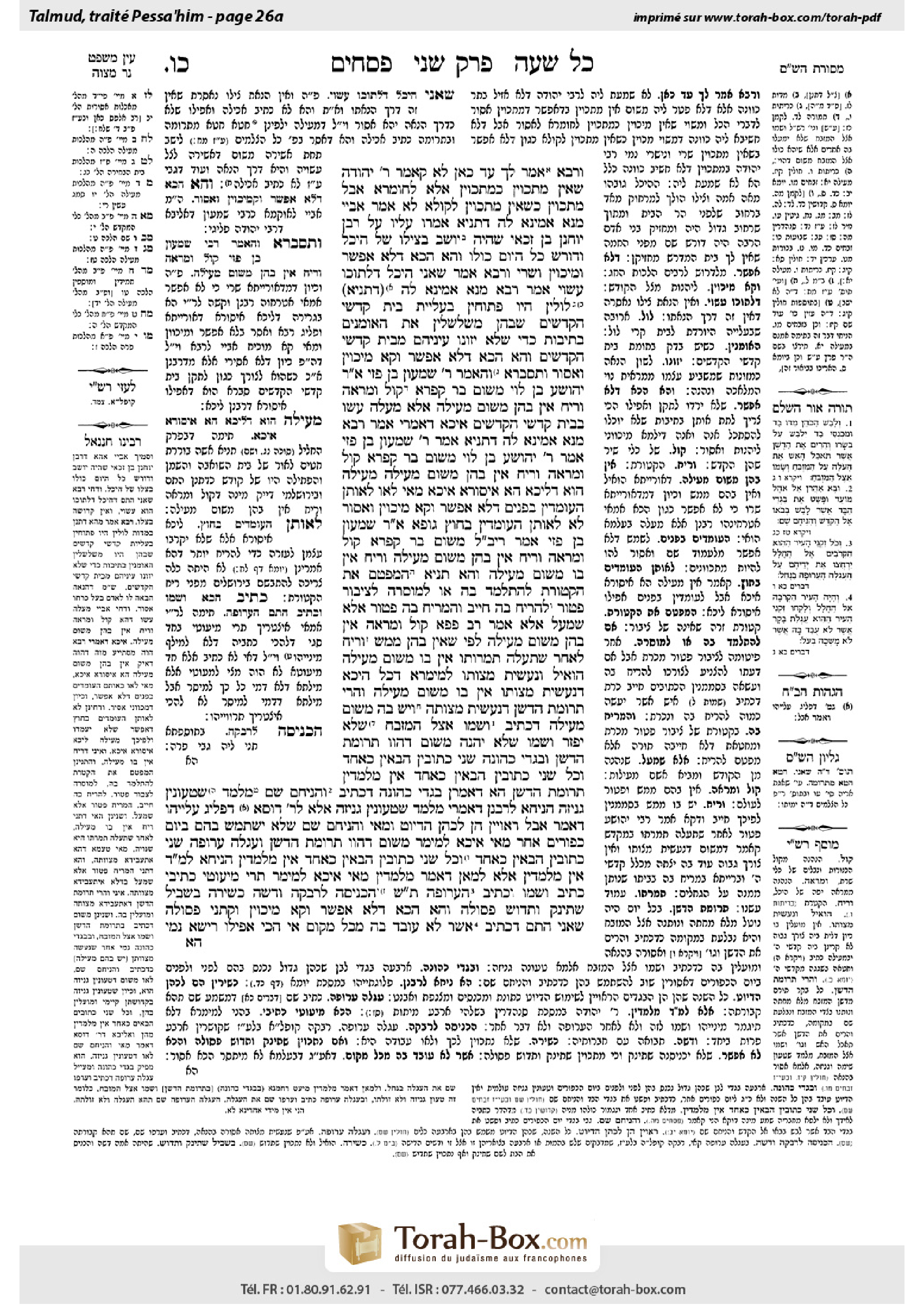
Pesachim 26a: Talmud study for Daf Yomi
Daf Yomi is the daily study of one Talmud folio. Explore 37 tractates with scans, Hebrew text, Sefaria English and AI-generated French translations where annotated.
Passage selection and English or AI-generated French translation are available where the scan has annotations. Daf Study is independent of Torah-Box and Sefaria.
Browse Pesachim · פסחים · All tractatesPesachim 26a text and translations
This page of Pesachim includes the Aramaic text, an English translation and an AI-generated French translation, alongside the scan above.
פסחים כ״ו א · Aramaic and Hebrew text
וְרָבָא אָמַר לָךְ: עַד כָּאן לָא קָאָמַר רַבִּי יְהוּדָה שֶׁאֵין מִתְכַּוֵּין כְּמִתְכַּוֵּין — אֶלָּא לְחוּמְרָא, אֲבָל מִתְכַּוֵּין כְּשֶׁאֵין מִתְכַּוֵּין לְקוּלָּא — לָא.
אָמַר אַבָּיֵי: מְנָא אָמֵינָא לַהּ — דְּתַנְיָא: אָמְרוּ עָלָיו עַל רַבָּן יוֹחָנָן בֶּן זַכַּאי שֶׁהָיָה יוֹשֵׁב בְּצִילּוֹ שֶׁל הֵיכָל, וְדוֹרֵשׁ כׇּל הַיּוֹם כּוּלּוֹ. וְהָא הָכָא דְּלָא אֶפְשָׁר וּמִיכַּוֵין, וְשָׁרֵי.
וְרָבָא אָמַר: שָׁאנֵי הֵיכָל דִּלְתוֹכוֹ עָשׂוּי.
אָמַר רָבָא: מְנָא אָמֵינָא לַהּ, (דְּתַנְיָא) לוּלִין הָיוּ פְּתוּחִין בַּעֲלִיַּית בֵּית קׇדְשֵׁי הַקֳּדָשִׁים, שֶׁבָּהֶן מְשַׁלְשְׁלִין אֶת הָאוּמָּנִים בְּתֵיבוֹת כְּדֵי שֶׁלֹּא יָזוּנוּ עֵינֵיהֶם מִבֵּית קׇדְשֵׁי הַקֳּדָשִׁים. וְהָא הָכָא דְּלָא אֶפְשָׁר וְקָא מִיכַּוֵּין — וְאָסוּר.
וְתִסְבְּרָא?! וְהָאָמַר רַבִּי שִׁמְעוֹן בֶּן פַּזִּי אָמַר רַבִּי יְהוֹשֻׁעַ בֶּן לֵוִי מִשּׁוּם בַּר קַפָּרָא: קוֹל וּמַרְאֶה וָרֵיחַ אֵין בָּהֶן מִשּׁוּם מְעִילָה! אֶלָּא, מַעֲלָה עָשׂוּ בְּבֵית קׇדְשֵׁי הַקֳּדָשִׁים.
אִיכָּא דְּאָמְרִי, אָמַר רָבָא: מְנָא אָמֵינָא לַהּ? דְּתַנְיָא: אָמַר רַבִּי שִׁמְעוֹן בֶּן פַּזִּי אָמַר רַבִּי יְהוֹשֻׁעַ בֶּן לֵוִי מִשּׁוּם בַּר קַפָּרָא: קוֹל וּמַרְאֶה וָרֵיחַ אֵין בָּהֶן מִשּׁוּם מְעִילָה. מְעִילָה — הוּא דְּלֵיכָּא, הָא אִיסּוּרָא — אִיכָּא.
מַאי לָאו, לְאוֹתָן הָעוֹמְדִין בִּפְנִים, דְּלָא אֶפְשָׁר וְקָא מִיכַּוֵּין — וְאָסוּר! לָא, לְאוֹתָן הָעוֹמְדִין בַּחוּץ.
גּוּפָא. אָמַר רַבִּי שִׁמְעוֹן בֶּן פַּזִּי אָמַר רַבִּי יְהוֹשֻׁעַ בֶּן לֵוִי מִשּׁוּם בַּר קַפָּרָא: קוֹל וּמַרְאֶה וָרֵיחַ אֵין בָּהֶן מִשּׁוּם מְעִילָה. וְרֵיחַ אֵין בּוֹ מִשּׁוּם מְעִילָה? וְהָא תַּנְיָא: הַמְפַטֵּם אֶת הַקְּטוֹרֶת לְהִתְלַמֵּד בָּהּ, אוֹ לְמוֹסְרָהּ לַצִּיבּוּר — פָּטוּר. לְהָרִיחַ בָּהּ — חַיָּיב. וְהַמֵּרִיחַ בָּהּ — פָּטוּר, אֶלָּא שֶׁמָּעַל!
אֶלָּא אָמַר רַב פָּפָּא: קוֹל וּמַרְאֶה אֵין בָּהֶן מִשּׁוּם מְעִילָה, לְפִי שֶׁאֵין בָּהֶן מַמָּשׁ. וְרֵיחַ לְאַחַר שֶׁתַּעֲלֶה תִּמְרוֹתוֹ — אֵין בּוֹ מִשּׁוּם מְעִילָה, הוֹאִיל וְנַעֲשֵׂית מִצְוָתוֹ.
לְמֵימְרָא דְּכֹל הֵיכָא דְּנַעֲשֵׂית מִצְוָתוֹ אֵין בּוֹ מִשּׁוּם מְעִילָה?! וַהֲרֵי תְּרוּמַת הַדֶּשֶׁן, דְּנַעֲשֵׂית מִצְוָתָהּ — וְיֵשׁ בָּהּ מִשּׁוּם מְעִילָה. דִּכְתִיב: ״וְשָׂמוֹ אֵצֶל הַמִּזְבֵּחַ״ — שֶׁלֹּא יְפַזֵּר, ״וְשָׂמוֹ״ — שֶׁלֹּא יֵהָנֶה.
מִשּׁוּם דְּהָווּ תְּרוּמַת הַדֶּשֶׁן וּבִגְדֵי כְהוּנָּה שְׁנֵי כְתוּבִין הַבָּאִין כְּאֶחָד, וְכׇל שְׁנֵי כְתוּבִין הַבָּאִין כְּאֶחָד אֵין מְלַמְּדִין.
תְּרוּמַת הַדֶּשֶׁן — הָא דַּאֲמַרַן. בִּגְדֵי כְהוּנָּה, דִּכְתִיב: ״וְהִנִּיחָם שָׁם״ — מְלַמֵּד שֶׁטְּעוּנִין גְּנִיזָה.
הָנִיחָא לְרַבָּנַן דְּאָמְרִי מְלַמֵּד שֶׁטְּעוּנִין גְּנִיזָה, אֶלָּא לְרַבִּי דּוֹסָא דִּפְלִיג עֲלַיְיהוּ, דְּאָמַר: אֲבָל רְאוּיִין הֵן לְכֹהֵן הֶדְיוֹט, וּמַאי ״וְהִנִּיחָם שָׁם״ — שֶׁלֹּא יִשְׁתַּמֵּשׁ בָּהֶם בְּיוֹם כִּפּוּרִים אַחֵר, מַאי אִיכָּא לְמֵימַר?
מִשּׁוּם דְּהָווּ תְּרוּמַת הַדֶּשֶׁן וְעֶגְלָה עֲרוּפָה שְׁנֵי כְתוּבִין הַבָּאִין כְּאֶחָד, וְכׇל שְׁנֵי כְתוּבִין הַבָּאִין כְּאֶחָד אֵין מְלַמְּדִין.
הָנִיחָא לְמַאן דְּאָמַר אֵין מְלַמְּדִין, אֶלָּא לְמַאן דְּאָמַר מְלַמְּדִין — מַאי אִיכָּא לְמֵימַר? תְּרֵי מִיעוּטֵי כְּתִיבִי: כְּתִיב ״וְשָׂמוֹ״, וּכְתִיב ״הָעֲרוּפָה״.
תָּא שְׁמַע: הִכְנִיסָה לְרִבְקָה וְדָשָׁה — כְּשֵׁירָה. בִּשְׁבִיל שֶׁתִּינַק וְתָדוּשׁ — פְּסוּלָה.
וְהָא הָכָא דְּלָא אֶפְשָׁר וְקָא מִיכַּוֵּין, וְקָתָנֵי פְּסוּלָה! שָׁאנֵי הָתָם, דִּכְתִיב: ״אֲשֶׁר לֹא עֻבַּד בָּהּ״, מִכׇּל מָקוֹם.
אִי הָכִי אֲפִילּוּ רֵישָׁא נָמֵי!
Pesachim 26a · English translation
And Rava could have said to you: Rabbi Yehuda stated that one who lacks intent has the same legal status as one who has intent only with regard to a stringency. In other words, a lack of intent does not negate the fact that the prohibited act has been performed and one is liable. However, to say that one who has intent has the same legal status as one who lacks intent such that it leads to a leniency, no. There is no evidence that Rabbi Yehuda would agree that it would ever be permitted for one who has intent to derive benefit from an otherwise prohibited object, even if he could not avoid the situation.
Abaye said: From where do I say my opinion? As it was taught in a baraita: They said about Rabban Yoḥanan ben Zakkai that he would sit in the street adjacent to the Temple Mount in the shade of the Sanctuary and expound to a large number of people all day long. And here, isn’t it a case where it was not possible to act differently, as there was no other place where so many people could congregate, and he certainly intended to derive benefit from the shade of the Sanctuary, and yet it was permitted? Apparently, when it is not possible to avoid the situation and one intends to derive benefit, it is permitted to do so.
And Rava said in response: The Sanctuary is different, as it was constructed for its interior. It is prohibited to derive benefit only from the interior of the Sanctuary walls, because it was constructed for the use of its internal space; there is no prohibition at all to benefit from its shade when on the outside.
Rava said: From where do I say this? As it was taught in a baraita: There were openings in the loft of the Holy of Holies through which they would lower artisans in containers into the Holy of Holies, so that their eyes would not gaze upon the Holy of Holies itself when they were renovating it. And here, isn’t it a case where it was not possible to act differently? It was necessary to renovate the Holy of Holies periodically, and it is impossible to do so without entering the chamber. And since it is plausible that the artisan will intend to enjoy the appearance of the Holy of Holies, it should be prohibited.
The Gemara rejects this: And how can you understand the baraita as a proof? Didn’t Rabbi Shimon ben Pazi say that Rabbi Yehoshua ben Levi said in the name of Bar Kappara: The sound of the musical instruments in the Temple, and the sight and smell of the incense are not subject to the prohibition of misuse of consecrated property? This is because the prohibition of deriving benefit from a consecrated object applies only to its tangible use. Rather, they established a higher standard of stringency with regard to the Holy of Holies and decreed that one may not even gaze upon it. Therefore, no principle can be derived from the case.
Some say this statement differently. Rava said: From where do I say this? As it was taught in a baraita: Rabbi Shimon ben Pazi said that Rabbi Yehoshua ben Levi said in the name of Bar Kappara: The sound of the musical instruments in the Temple and the sight and smell of the incense are not subject to the prohibition of misuse of consecrated property. The implication is that there is no violation of the prohibition of misuse of consecrated property by Torah law in this case. However, there is a violation of the prohibition by rabbinic law.
What, is it not referring to those standing inside the Sanctuary, for whom it is not possible that they will not hear these sounds or they will not observe the sight and smell of the incense? And in such a case, if they intend to derive benefit, it is prohibited. The Gemara rejects this: No, it is referring to those who are standing outside. Since they are not required to be there at that time, it is a case where it is possible to avoid the situation and one intends to derive benefit, which is prohibited according to all opinions.
Apropos this halakha, the Gemara discusses the matter itself. Rabbi Shimon ben Pazi said that Rabbi Yehoshua ben Levi said in the name of Bar Kappara: The sound of the musical instruments in the Temple and the sight and smell of the incense are not subject to the prohibition of misuse of consecrated property. The Gemara asks: Isn’t smell subject to the prohibition of misuse of consecrated property? Wasn’t it taught in a baraita: One who prepares the incense mixture in order to teach himself how to prepare it or to transfer it to the community is exempt from punishment. However, if one prepares it in order to smell it, he is liable to receive punishment, as it states in the Torah: “He who makes it in order to smell it shall be cut off from his people” (Exodus 30:38). And one who actually smells the incense mixture is exempt from the punishment of karet and from bringing a sin-offering; however, he has misused consecrated property. Apparently, the halakha of misuse of consecrated property applies to smelling.
Rather, Rav Pappa said: Sound and sight are not subject to the prohibition of misuse of consecrated property, because they have no substance. And with regard to the smell of the spices themselves, the following distinction applies: The smell of the incense that is emitted when the spices are placed on the coals is subject to the prohibition, since this is the way the mitzva is performed; however, the smell that is emitted after the flame catches and the column of smoke rises is not subject to the prohibition of misuse of consecrated property, since its mitzva has already been performed.
The Gemara asks: Is that to say that in any case where its mitzva has already been performed, the object is not subject to the prohibition of misuse of consecrated property? And the daily removal of ashes of the offerings from the altar occurs after its mitzva has been performed, and the ashes are subject to the prohibition of misuse of consecrated property, as it is written: “And the priest shall put on his linen garment, and his linen breeches shall he put upon his flesh; and he shall take up the ashes of what the fire has consumed of the burnt-offering on the altar, and he shall put them beside the altar” (Leviticus 6:3). The Sages derive from the phrase: “And he shall put them” that he may not scatter these ashes; rather, they should be placed gently. “And he shall put them” also indicates that one may not derive benefit from these ashes.
The Gemara answers: This case does not prove a principle, because the halakhot of removal of ashes from the altar and of the priestly garments worn by the High Priest on Yom Kippur are two verses that come as one. The principle is that two verses that come as one do not teach a principle. In other words, if a halakha is stated twice, with regard to two individual cases in the Torah, the understanding is that this halakha applies only to those cases. Had this halakha applied to all other relevant cases as well, it would not have been necessary for the Torah to teach it twice. The fact that two cases are mentioned indicates that they are the exceptions rather than the rule.
The Gemara delineates the two cases: The halakha of the removal of ashes is that which we said. Where is this halakha stated with regard to the priestly garments? As it is written: “And Aharon shall come into the Tent of Meeting, and shall take off the linen garments, which he put on when he went into the sacred place, and he shall leave them there” (Leviticus 16:23). The phrase: “And he shall leave them” teaches that they require burial. Although their use for the mitzva has been completed, it is prohibited to derive benefit from them.
The Gemara comments: It works out well that there are two cases according to the opinion of the Rabbis, who say that this verse teaches that they require burial. However, according to the opinion of Rabbi Dosa, who disagrees with them and says: These priestly clothes may no longer be used by the High Priest on Yom Kippur, but they are fit for use by a common priest, since these garments are similar to those worn by common priests every day. And what is the meaning of: “And he shall leave them there”? This indicates that the High Priest may not use them on another Yom Kippur. According to this opinion, what can be said? According to the opinion of Rabbi Dosa, there is only one verse that teaches about misuse of consecrated property with an item that has already been used for performing its mitzva. Therefore, it should be possible to derive a principle from the verse dealing with the removal of ashes.
The Gemara answers: A principle cannot be based on this verse, because removal of ashes and the heifer whose neck is broken, from which one may not derive benefit after the ceremony, are two verses that come as one. And two verses that come as one do not teach a principle.
The Gemara asks: It works out well according to the one who said that they do not teach a principle, i.e., according to the Rabbis. However, according to the one who said that they do teach a principle, i.e., Rabbi Yehuda in tractate Sanhedrin, what can be said? The Gemara answers: Two phrases indicating exclusions are written with regard to these halakhot, limiting this rule to them. With regard to the removal of ashes it is written: “And he shall put it.” The word “it” limits the halakha to this particular circumstance. With regard to the heifer whose neck is broken it is written: “The heifer which had its neck broken” (Deuteronomy 21:6). The word “the” indicates that this halakha applies only to this type of heifer and not to any other similar case.
After this tangential discussion of the laws of misuse of consecrated property, the Gemara returns to Abaye and Rava’s dispute about the status of unintended benefit, seeking to prove one side or the other. Come and hear a proof based on what was taught: If one brought the heifer whose neck is to be broken or the red heifer into a cow pen, and it threshes grain while walking with other cows, then it is valid. Under normal circumstances, had one used the heifer for work, it would be disqualified from use in its ceremony. However, in this case, the red heifer may still be burned, and the heifer is still fit to have its neck broken in the ritual. Apparently, the verses “Upon which a yoke has not been placed” (Numbers 19:2) and “Which has not been used for work” (Deuteronomy 21:3) still apply to it, because the owner did not intend for it to work. If he brought it in so that it may nurse from its mother and so it will thresh grain, then it is disqualified from use in these rituals.
And here, isn’t it a case where it was not possible to act differently, as the heifer needs to nurse, and he intended that it thresh the grain? And it is teaching that the heifer is disqualified from use. This proves that when one intends to derive benefit, even if there is no other way to act, it is prohibited to derive benefit. The Gemara rejects this: It is different there, as it is written: “Which has not been used for work” in any case. Therefore, while the heifer is disqualified from use even if the situation was unavoidable, no general conclusion can be drawn from this case.
The Gemara challenges: If so, that this verse means that it has not performed any work at all, then it should apply even to the first clause. Even when it threshes the grain against the will of the owner, it has still done work and should be rendered disqualified.
Pesachim 26a · Traduction française (IA)
Rava aurait pu te répondre : Rabbi Yehouda a dit que celui qui n’a pas d’intention a le même statut que celui qui en a une, mais seulement lorsqu’il s’agit d’appliquer une rigueur. Autrement dit, l’absence d’intention n’annule pas le fait que l’acte interdit a été accompli et que l’on en est passible. En revanche, dire que celui qui a une intention a le même statut que celui qui n’en a pas, de sorte que cela entraîne un allègement, non. Rien ne prouve que Rabbi Yehouda admettrait qu’il soit jamais permis à celui qui a l’intention d’en tirer profit de bénéficier d’un objet par ailleurs interdit, même s’il ne pouvait éviter la situation.
Abayé dit : D’où est-ce que je tire mon opinion ? De ce qui a été enseigné dans une baraïta : On disait de Rabban Yoḥanan ben Zakkaï qu’il s’asseyait dans la rue, près du mont du Temple, à l’ombre du Sanctuaire, et qu’il enseignait toute la journée à une grande foule. Or, n’est-ce pas un cas où il était impossible d’agir autrement, puisqu’il n’y avait aucun autre endroit où autant de personnes pouvaient se rassembler ? Il avait certainement l’intention de profiter de l’ombre du Sanctuaire, et pourtant cela était permis. Apparemment, lorsqu’il est impossible d’éviter la situation et que l’on a l’intention d’en tirer profit, cela est permis.
Rava répondit : Le Sanctuaire est différent, car il a été construit pour son espace intérieur. Il est interdit de tirer profit uniquement de l’intérieur des murs du Sanctuaire, car il a été construit pour l’usage de son espace intérieur ; il n’est aucunement interdit de profiter de son ombre depuis l’extérieur.
Rava dit : D’où est-ce que je tire cela ? De ce qui a été enseigné dans une baraïta : Il y avait des ouvertures dans le grenier du Saint des Saints, par lesquelles on descendait des artisans dans des caisses dans le Saint des Saints, afin que leurs yeux ne contemplent pas le Saint des Saints lui-même lorsqu’ils le rénovaient. Or, n’est-ce pas un cas où il était impossible d’agir autrement ? Il fallait rénover périodiquement le Saint des Saints, et il était impossible de le faire sans entrer dans la pièce. Et puisqu’il est plausible que l’artisan ait l’intention de se délecter de la vue du Saint des Saints, cela devrait être interdit.
La Guemara rejette cette preuve : Comment peut-on comprendre la baraïta comme une preuve ? Rabbi Shimon ben Pazi n’a-t-il pas dit que Rabbi Yehoshua ben Lévi avait dit au nom de Bar Kappara : Le son des instruments de musique dans le Temple, ainsi que la vue et l’odeur de l’encens, ne sont pas soumis à l’interdiction de détournement des biens consacrés ? En effet, l’interdiction de tirer profit d’un objet consacré ne s’applique qu’à son usage matériel. Les Sages ont plutôt imposé une rigueur supplémentaire concernant le Saint des Saints et décrété qu’on ne pouvait même pas le contempler. On ne peut donc tirer aucun principe de ce cas.
Certains transmettent cette déclaration sous une autre forme. Rava dit : D’où est-ce que je tire cela ? De ce qui a été enseigné dans une baraïta : Rabbi Shimon ben Pazi dit que Rabbi Yehoshua ben Lévi avait dit au nom de Bar Kappara : Le son des instruments de musique dans le Temple, ainsi que la vue et l’odeur de l’encens, ne sont pas soumis à l’interdiction de détournement des biens consacrés. Cela implique que, dans ce cas, il n’y a pas de transgression de l’interdiction de détournement des biens consacrés selon la Torah écrite. Toutefois, cette interdiction est enfreinte selon la loi rabbinique.
Ne s’agit-il pas de personnes qui se tiennent à l’intérieur du Sanctuaire, pour lesquelles il est impossible de ne pas entendre ces sons ou de ne pas percevoir la vue et l’odeur de l’encens ? Dans un tel cas, si elles ont l’intention d’en tirer profit, cela est interdit. La Guemara rejette cette interprétation : Non, il s’agit de personnes qui se tiennent à l’extérieur. Puisqu’elles ne sont pas tenues de s’y trouver à ce moment-là, il s’agit d’un cas où il est possible d’éviter la situation et où elles ont l’intention d’en tirer profit, ce qui est interdit selon toutes les opinions.
À propos de cette halakha, la Guemara examine la question elle-même. Rabbi Shimon ben Pazi dit que Rabbi Yehoshua ben Lévi avait dit au nom de Bar Kappara : Le son des instruments de musique dans le Temple, ainsi que la vue et l’odeur de l’encens, ne sont pas soumis à l’interdiction de détournement des biens consacrés. La Guemara demande : L’odeur n’est-elle pas soumise à l’interdiction de détournement des biens consacrés ? N’a-t-il pas été enseigné dans une baraïta : Celui qui prépare le mélange d’encens pour apprendre à le préparer ou pour le remettre à la communauté est exempt de peine. En revanche, s’il le prépare afin d’en sentir l’odeur, il est passible de peine, comme il est écrit dans la Torah : « Celui qui en fera pour en sentir l’odeur sera retranché de son peuple » (Exode 30:38). Celui qui sent effectivement le mélange d’encens est exempt de la peine de karet et de l’obligation d’apporter un sacrifice expiatoire ; toutefois, il a détourné des biens consacrés. Apparemment, l’interdiction de détournement des biens consacrés s’applique au fait de sentir.
Rav Pappa dit plutôt : Le son et la vue ne sont pas soumis à l’interdiction de détournement des biens consacrés, car ils n’ont pas de substance. Quant à l’odeur des épices elles-mêmes, la distinction suivante s’applique : l’odeur de l’encens qui se dégage lorsque les épices sont placées sur les braises est soumise à l’interdiction, puisque c’est ainsi que la mitsva est accomplie ; en revanche, l’odeur qui se dégage après que la flamme a pris et que la colonne de fumée s’élève n’est pas soumise à l’interdiction de détournement des biens consacrés, puisque la mitsva a déjà été accomplie.
La Guemara demande : Cela signifie-t-il que, dans tous les cas où la mitsva a déjà été accomplie, l’objet n’est pas soumis à l’interdiction de détournement des biens consacrés ? Or, le retrait quotidien des cendres des sacrifices de l’autel a lieu après l’accomplissement de la mitsva, et les cendres restent soumises à cette interdiction, comme il est écrit : « Le prêtre revêtira son vêtement de lin et mettra sur sa chair un caleçon de lin ; il enlèvera les cendres de ce que le feu a consumé de l’holocauste sur l’autel, et les déposera à côté de l’autel » (Lévitique 6:3). Les Sages déduisent de l’expression « il les déposera » qu’il ne doit pas disperser ces cendres, mais les déposer avec précaution. L’expression « il les déposera » indique aussi qu’il est interdit de tirer profit de ces cendres.
La Guemara répond : Ce cas ne prouve pas de principe, car les halakhot relatives au retrait des cendres de l’autel et aux vêtements sacerdotaux portés par le grand prêtre à Yom Kippour sont deux versets qui viennent enseigner la même chose. Le principe est que deux versets qui viennent enseigner la même chose ne permettent pas d’établir une règle générale. Autrement dit, lorsqu’une halakha est énoncée deux fois à propos de deux cas particuliers dans la Torah, on comprend qu’elle ne s’applique qu’à ces cas. Si cette halakha s’appliquait aussi à tous les autres cas pertinents, il n’aurait pas été nécessaire que la Torah l’enseigne deux fois. Le fait que deux cas soient mentionnés indique qu’ils constituent des exceptions plutôt que la règle.
La Guemara précise les deux cas : la halakha concernant le retrait des cendres est celle que nous avons mentionnée. Où cette halakha est-elle énoncée à propos des vêtements sacerdotaux ? Comme il est écrit : « Aharon entrera dans la Tente d’assignation et retirera les vêtements de lin qu’il avait revêtus lorsqu’il était entré dans le lieu saint, et il les laissera là » (Lévitique 16:23). L’expression « il les laissera » enseigne qu’ils doivent être enterrés. Bien que leur usage pour la mitsva soit achevé, il est interdit d’en tirer profit.
La Guemara remarque : Il est logique qu’il y ait deux cas selon l’opinion des Rabbins, qui disent que ce verset enseigne que les vêtements doivent être enterrés. Mais que peut-on dire selon l’opinion de Rabbi Dossa, qui n’est pas d’accord avec eux et dit que ces vêtements sacerdotaux ne peuvent plus être utilisés par le grand prêtre à Yom Kippour, mais qu’ils conviennent à un prêtre ordinaire, puisqu’ils sont semblables aux vêtements que les prêtres ordinaires portent chaque jour ? Que signifie alors l’expression « il les laissera là » ? Elle indique que le grand prêtre ne peut pas les utiliser lors d’un autre Yom Kippour. Selon cette opinion, que peut-on répondre ? Selon Rabbi Dossa, un seul verset enseigne que l’interdiction de détournement des biens consacrés s’applique à un objet qui a déjà servi à accomplir sa mitsva. Il devrait donc être possible de déduire une règle générale du verset relatif au retrait des cendres.
La Guemara répond : On ne peut pas fonder une règle générale sur ce verset, car le retrait des cendres et la génisse dont on brise la nuque, dont il est interdit de tirer profit après la cérémonie, sont deux versets qui viennent enseigner la même chose. Or, deux versets qui viennent enseigner la même chose ne permettent pas d’établir une règle générale.
La Guemara demande : Cela est logique selon celui qui dit que deux versets qui viennent enseigner la même chose ne permettent pas d’établir une règle générale, c’est-à-dire selon les Rabbins. Mais que peut-on dire selon celui qui affirme qu’ils permettent d’établir une règle générale, c’est-à-dire Rabbi Yehouda, dans le traité Sanhédrin ? La Guemara répond : À propos de ces halakhot, deux expressions d’exclusion sont écrites, limitant cette règle à ces cas. Concernant le retrait des cendres, il est écrit : « Et il les déposera. » Le mot « les » limite la halakha à cette situation particulière. Concernant la génisse dont on brise la nuque, il est écrit : « La génisse dont on aura brisé la nuque » (Deutéronome 21:6). L’article défini indique que cette halakha ne s’applique qu’à ce type de génisse et non à tout autre cas semblable.
Après cette discussion incidente sur les lois du détournement des biens consacrés, la Guemara revient au différend entre Abayé et Rava concernant le statut du profit tiré sans intention, afin de chercher à prouver le point de vue de l’un ou de l’autre. Viens et entends une preuve fondée sur ce qui a été enseigné : Si quelqu’un fait entrer la génisse dont on doit briser la nuque ou la vache rousse dans un enclos à vaches, et qu’elle batte le grain en marchant parmi les autres vaches, elle reste valide. Dans des circonstances normales, si l’on avait utilisé la génisse pour travailler, elle serait disqualifiée pour la cérémonie. Toutefois, dans ce cas, la vache rousse peut encore être brûlée et la génisse reste apte au rituel consistant à lui briser la nuque. Apparemment, les versets « sur laquelle aucun joug n’a été posé » (Nombres 19:2) et « qui n’a pas été mise au travail » (Deutéronome 21:3) continuent de s’appliquer à elle, parce que son propriétaire n’avait pas l’intention de la faire travailler. Si quelqu’un l’a fait entrer pour qu’elle tète sa mère et qu’elle batte le grain, elle est disqualifiée pour ces rituels.
Or, n’est-ce pas un cas où il était impossible d’agir autrement, puisque la génisse doit téter, et où l’on avait l’intention qu’elle batte le grain ? La baraïta enseigne qu’elle est disqualifiée. Cela prouve que, lorsqu’on a l’intention d’en tirer profit, même s’il n’existe aucun autre moyen d’agir, il est interdit d’en tirer profit. La Guemara rejette cette conclusion : ce cas est différent, car il est écrit dans tous les cas : « Qui n’a pas été mise au travail. » Par conséquent, bien que la génisse soit disqualifiée même si la situation était inévitable, on ne peut tirer aucune conclusion générale de ce cas.
La Guemara objecte : Dans ce cas, si ce verset signifie qu’elle n’a accompli aucun travail, cela devrait s’appliquer même à la première clause. Même lorsqu’elle bat le grain contre la volonté du propriétaire, elle a tout de même travaillé et devrait être disqualifiée.
Traduction française générée par IA à partir de l’édition anglaise de Sefaria. Vérifie toujours un passage avec le texte source.
Text from Sefaria: William Davidson Edition - Vocalized Aramaic (CC BY NC); William Davidson Edition - English (CC BY NC).