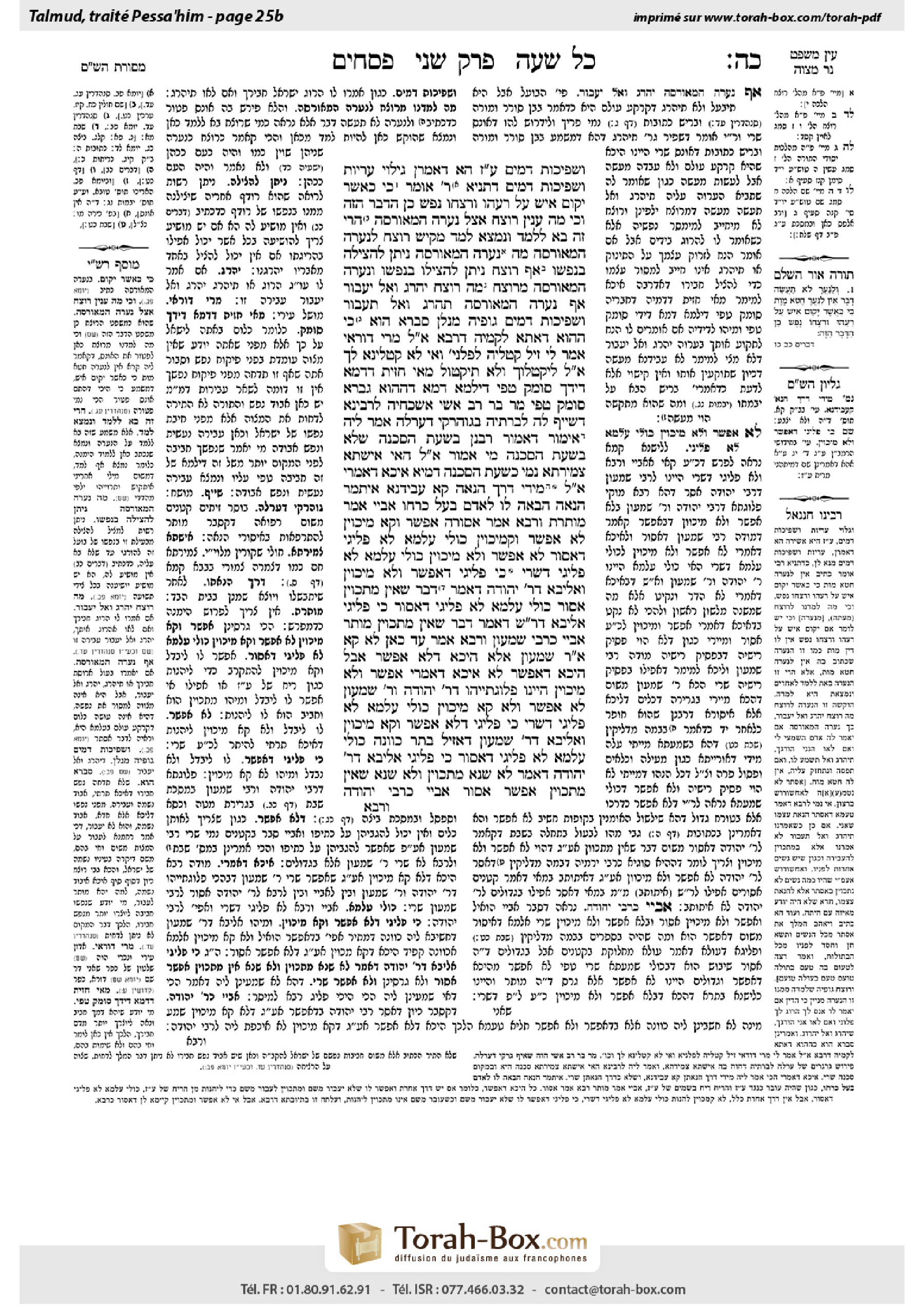
Pesachim 25b: Talmud study for Daf Yomi
Daf Yomi is the daily study of one Talmud folio. Explore 37 tractates with scans, Hebrew text, Sefaria English and AI-generated French translations where annotated.
Passage selection and English or AI-generated French translation are available where the scan has annotations. Daf Study is independent of Torah-Box and Sefaria.
Browse Pesachim · פסחים · All tractatesPesachim 25b text and translations
This page of Pesachim includes the Aramaic text, an English translation and an AI-generated French translation, alongside the scan above.
פסחים כ״ה ב · Aramaic and Hebrew text
וּשְׁפִיכוּת דָּמִים.
עֲבוֹדָה זָרָה — הָא דַּאֲמַרַן. גִּילּוּי עֲרָיוֹת וּשְׁפִיכוּת דָּמִים, דְּתַנְיָא, רַבִּי אוֹמֵר: ״כִּי כַּאֲשֶׁר יָקוּם אִישׁ עַל רֵעֵהוּ וּרְצָחוֹ נֶפֶשׁ כֵּן הַדָּבָר הַזֶּה״. וְכִי מָה עִנְיַן רוֹצֵחַ אֵצֶל נַעֲרָה הַמְאוֹרָסָה?
הֲרֵי זֶה בָּא לְלַמֵּד, וְנִמְצָא לָמֵד. מַקִּישׁ רוֹצֵחַ לְנַעֲרָה הַמְאוֹרָסָה: מָה נַעֲרָה הַמְאוֹרָסָה — נִיתָּן לְהַצִּילָהּ בְּנַפְשׁוֹ, אַף רוֹצֵחַ — נִיתָּן לְהַצִּילוֹ בְּנַפְשׁוֹ. וְנַעֲרָה הַמְאוֹרָסָה מֵרוֹצֵחַ: מָה רוֹצֵחַ — יֵהָרֵג וְאַל יַעֲבוֹר, אַף נַעֲרָה הַמְאוֹרָסָה — תֵּהָרֵג וְאַל תַּעֲבוֹר.
וּשְׁפִיכוּת דָּמִים גּוּפֵיהּ מְנָלַן? סְבָרָא הוּא: כִּי הָהוּא דַּאֲתָא לְקַמֵּיהּ דְּרָבָא, אֲמַר לֵיהּ: מָרֵי דּוּרַאי אֲמַר לִי: זִיל קַטְלֵיהּ לִפְלָנְיָא, וְאִי לָא — קָטְלִינָא לָךְ. אֲמַר לֵיהּ: לִיקְטְלוּךְ וְלָא תִּיקְטוֹל, מַאי חָזֵית דִּדְמָא דִידָךְ סוּמָּק טְפֵי? דִּילְמָא דְּמָא דְּהָהוּא גַּבְרָא סוּמָּק טְפֵי.
מָר בַּר רַב אָשֵׁי אַשְׁכְּחֵיהּ לְרָבִינָא דְּשָׁיֵיף לַהּ לִבְרַתֵּיהּ בְּגוּהַרְקֵי דְעׇרְלָה. אֲמַר לֵיהּ: אֵימוֹר דַּאֲמוּר רַבָּנַן בִּשְׁעַת הַסַּכָּנָה, שֶׁלֹּא בִּשְׁעַת הַסַּכָּנָה מִי אֲמוּר?
אֲמַר לֵיהּ: הַאי אִישָּׁתָא צְמִירְתָּא נָמֵי כִּשְׁעַת הַסַּכָּנָה דָּמְיָא. אִיכָּא דְאָמְרִי, אֲמַר לֵיהּ: מִידֵּי דֶּרֶךְ הֲנָאָה קָא עָבֵידְנָא?
אִיתְּמַר: הֲנָאָה הַבָּאָה לוֹ לְאָדָם בְּעַל כׇּרְחוֹ, אַבָּיֵי אָמַר: מוּתֶּרֶת, וְרָבָא אָמַר: אֲסוּרָה.
אֶפְשָׁר וְקָא מִיכַּוֵּין, לָא אֶפְשָׁר וְקָמִיכַּוֵין — כּוּלֵּי עָלְמָא לָא פְּלִיגִי דְּאָסוּר. לָא אֶפְשָׁר וְלָא מִיכַּוֵּין — כּוּלֵּי עָלְמָא לָא פְּלִיגִי דִּשְׁרֵי. כִּי פְּלִיגִי דְּאֶפְשָׁר וְלָא מִיכַּוֵּין.
וְאַלִּיבָּא דְּרַבִּי יְהוּדָה, דְּאָמַר: דָּבָר שֶׁאֵין מִתְכַּוֵּין אָסוּר — כּוּלֵּי עָלְמָא לָא פְּלִיגִי דְּאָסוּר. כִּי פְּלִיגִי אַלִּיבָּא דְּרַבִּי שִׁמְעוֹן, דְּאָמַר: דָּבָר שֶׁאֵין מִתְכַּוֵּין מוּתָּר. אַבָּיֵי כְּרַבִּי שִׁמְעוֹן, וְרָבָא אָמַר: עַד כָּאן לָא קָא אָמַר רַבִּי שִׁמְעוֹן — אֶלָּא הֵיכָא דְּלָא אֶפְשָׁר, אֲבָל הֵיכָא דְּאֶפְשָׁר — לָא.
אִיכָּא דְּאָמְרִי: אֶפְשָׁר וְלָא מִיכַּוֵּין — הַיְינוּ פְּלוּגְתַּיְיהוּ דְּרַבִּי יְהוּדָה וְרַבִּי שִׁמְעוֹן. לָא אֶפְשָׁר וְלָא קָא מִיכַּוֵּין — כּוּלֵּי עָלְמָא לָא פְּלִיגִי דִּשְׁרֵי. כִּי פְּלִיגִי, דְּלָא אֶפְשָׁר וְקָא מִיכַּוֵּין. וְאַלִּיבָּא דְּרַבִּי שִׁמְעוֹן דְּאָזֵיל בָּתַר כַּוּוֹנָה — כּוּלֵּי עָלְמָא לָא פְּלִיגִי דְּאָסוּר, כִּי פְּלִיגִי אַלִּיבָּא דְּרַבִּי יְהוּדָה, דְּאָמַר: לָא שְׁנָא מִתְכַּוֵּין וְלָא שְׁנָא שֶׁאֵין מִתְכַּוֵּין, אֶפְשָׁר אָסוּר.
אַבָּיֵי כְּרַבִּי יְהוּדָה.
Pesachim 25b · English translation
or bloodshed.
That one may not heal oneself with idolatry even when his life is in danger is learned from that which we just said, based on the verse: “With all your soul and with all your might.” From where is this halakha derived with regard to forbidden sexual relations and murder? As it was taught in a baraita that Rabbi Yehuda HaNasi says: The verse says about one who rapes a betrothed woman: “But you shall do nothing to the young woman; the young woman has committed no sin worthy of death; for as when a man rises against his neighbor, and slays him, so too with this matter” (Deuteronomy 22:26). What does a murderer have to do with a betrothed young woman who was raped? Why would the verse mention murder in this context?
Rather, the mention of murder comes in order to teach a halakha about the betrothed young woman, and it turns out that, in addition, it derives a halakha from that case. The Torah juxtaposes a murderer to a betrothed young woman to indicate that just as in the case of a betrothed young woman one may save her by taking the rapist’s life, so too, one may save a potential murder victim by taking the pursuer’s life. Conversely, it is possible to learn about the case of a young betrothed woman from the case of a murderer. Just as with regard to a potential murderer the halakha is that if one is being forced to murder someone else, he should allow himself to be killed and not transgress that prohibition, so too, with regard to a betrothed young woman the halakha is that she should allow herself to be killed and not transgress the prohibition of forbidden relations.
The Gemara asks: And from where do we derive this halakha with regard to murder itself? The Gemara answers: It is based on logical reasoning that one life is not preferable to another. The Gemara relates an incident to demonstrate this: This is similar to a certain man who came before Rava and said to him: A local official said to me: Go kill so-and-so, and if not I will kill you. Rava said to him: It is preferable that he should kill you and you should not kill. What did you think, that your blood is redder and more precious than his? Perhaps that man’s blood is redder. Apparently, one may not save his own life by taking someone else’s.
The Gemara relates: Mar bar Rav Ashi found Ravina rubbing his daughter with unripe olives [guharkei] of orla for medicinal purposes. Mar bar Rav Ashi said to him: Say that the Sages said that one may derive benefit from such a prohibited item at a time of danger; however, who says that one is permitted to do so when it is not a time of danger?
Ravina said to him: A high fever is also deemed a time of danger, and one may derive benefit from a prohibited item it such a situation. Some say that Ravina said to him as follows: Am I deriving benefit in a usual manner? The usual way to derive benefit from these olives is to use them after they have become ripe, so that their oil can be drawn out. Since Ravina was not deriving benefit in the usual manner, he was permitted to do so, although his daughter’s life was not in danger.
The Gemara continues to discuss various halakhot that apply to prohibited items. It was stated: With regard to deriving benefit from a prohibited item that comes to a person against his will, i.e., one’s circumstance results in his deriving benefit although he did not place himself in that circumstance in order to derive benefit, Abaye said: Deriving benefit in this manner is permitted, and Rava said: It is prohibited.
The Gemara explains: In a case where it is possible to avoid deriving benefit and he intends to derive benefit from the prohibited object, or where it is not possible to avoid it and he intends to derive benefit, everyone agrees that it is prohibited, because he intended to derive benefit that was prohibited. And when it is not possible to avoid it and he does not intend to derive benefit, everyone agrees that it is permitted, as one had no choice in the matter. Where they disagree is in a case where it is possible for him to avoid the prohibition, and he does not intend to derive benefit from it.
The Gemara limits the dispute further: And according to Rabbi Yehuda, who said that an unintentional prohibited act is prohibited, everyone agrees that it is prohibited, as Rabbi Yehuda maintains that one’s action is more significant than his intent. Where they disagree is in accordance with the opinion of Rabbi Shimon, who said that an unintentional prohibited act is permitted. Apparently, Abaye holds in accordance with the opinion of Rabbi Shimon. And Rava would say: Rabbi Shimon stated his opinion only with regard to a case where it is not possible to avoid the prohibition. However, in a case where it is possible to avoid the prohibition, no, he did not permit one to derive benefit from such a prohibition even unintentionally. This is one version of the dispute.
Some say that the dispute should be understood as follows: In a case where it is possible to avoid deriving benefit and he does not intend to derive benefit, this is the case of dispute between Rabbi Yehuda and Rabbi Shimon. Where it is not possible to avoid it and he does not intend to derive benefit from the prohibited item, everyone agrees that it is permitted to do so. Where they disagree is in a case where it is not possible to avoid deriving benefit and he intends to derive benefit from it. The Gemara limits the dispute further: According to the opinion of Rabbi Shimon, who follows one’s intent, everyone agrees that it is prohibited. Where they disagree is in accordance with the opinion of Rabbi Yehuda, who said: There is no difference whether one intends or does not intend; the issue is whether he can avoid it or not. Therefore, if it is possible to avoid deriving benefit, it is prohibited.
Based on this understanding of the dispute, Abaye holds in accordance with the opinion of Rabbi Yehuda. In other words, in a case where it is not possible to avoid the situation completely, even if one has intent it is permitted.
Pesachim 25b · Traduction française (IA)
ou l’effusion de sang.
On apprend de ce qui vient d’être dit, à partir du verset « de toute ton âme et de toute ta force », qu’il est interdit de se soigner au moyen de l’idolâtrie, même lorsque sa vie est en danger. D’où tire-t-on cette halakha concernant les relations sexuelles interdites et le meurtre ? Comme il a été enseigné dans une baraïta, Rabbi Yehouda HaNassi dit : le verset dit, à propos de celui qui viole une jeune fille fiancée : « Mais tu ne feras rien à la jeune fille ; la jeune fille n’a commis aucun péché passible de mort ; car, comme un homme qui se lève contre son prochain et le tue, ainsi en est-il de cette affaire » (Deutéronome 22, 26). Quel rapport un meurtrier a-t-il avec une jeune fille fiancée qui a été violée ? Pourquoi le verset mentionne-t-il le meurtre dans ce contexte ?
En réalité, la mention du meurtre vise à enseigner une halakha concernant la jeune fille fiancée, et il se trouve qu’en outre, une halakha est déduite de ce cas. La Torah rapproche le meurtrier de la jeune fille fiancée pour indiquer que, de même que dans le cas d’une jeune fille fiancée, on peut la sauver en ôtant la vie au violeur, de même on peut sauver une victime potentielle d’un meurtre en ôtant la vie au poursuivant. À l’inverse, il est possible de tirer une règle concernant le cas d’une jeune fille fiancée du cas du meurtrier. De même que, dans le cas d’une personne que l’on contraint à tuer quelqu’un d’autre, la halakha est qu’elle doit se laisser tuer plutôt que de transgresser cette interdiction, de même, dans le cas d’une jeune fille fiancée, la halakha est qu’elle doit se laisser tuer plutôt que de transgresser l’interdiction des relations sexuelles interdites.
La Guemara demande : d’où tire-t-on cette halakha concernant le meurtre lui-même ? La Guemara répond : elle repose sur un raisonnement logique : une vie n’est pas préférable à une autre. La Guemara rapporte un incident pour l’illustrer : un homme se présenta devant Rava et lui dit : « Un fonctionnaire local m’a dit : “Va tuer untel, sinon je te tuerai.” » Rava lui dit : « Mieux vaut qu’il te tue et que tu ne tues pas. Qu’as-tu pensé ? Que ton sang est plus rouge et plus précieux que le sien ? Peut-être que le sang de cet homme est plus rouge. » Il apparaît donc qu’on ne peut pas sauver sa propre vie en prenant celle d’un autre.
La Guemara rapporte : Mar bar Rav Ashi trouva Ravina en train de frotter sa fille avec des olives non mûres [guharkei] d’orla à des fins médicinales. Mar bar Rav Ashi lui dit : « Admettons que les Sages aient dit qu’on peut tirer profit d’un tel objet interdit en cas de danger ; mais qui dit qu’on est autorisé à le faire lorsqu’il n’y a pas de danger ? »
Ravina lui dit : « Une forte fièvre est également considérée comme une situation de danger, et dans une telle situation, on peut tirer profit d’un objet interdit. » Selon une autre version, Ravina lui dit : « Est-ce que j’en tire profit de la manière habituelle ? La manière habituelle de tirer profit de ces olives consiste à les utiliser une fois mûres, afin d’en extraire l’huile. Puisque Ravina n’en tirait pas profit de la manière habituelle, il était autorisé à le faire, bien que la vie de sa fille ne fût pas en danger. »
La Guemara poursuit son examen des différentes halakhot qui s’appliquent aux objets interdits. Il a été rapporté : concernant le fait de tirer profit d’un objet interdit auquel une personne est exposée contre son gré, c’est-à-dire lorsque sa situation fait qu’elle en tire profit, bien qu’elle ne se soit pas placée dans cette situation dans le but d’en tirer profit, Abayé dit que tirer profit de cette manière est permis, tandis que Rava dit que c’est interdit.
La Guemara explique : lorsqu’il est possible d’éviter d’en tirer profit et que la personne a l’intention d’en tirer profit, ou lorsqu’il est impossible de l’éviter et qu’elle a l’intention d’en tirer profit, tous conviennent que c’est interdit, car elle avait l’intention de tirer profit de ce qui était interdit. Lorsqu’il est impossible de l’éviter et qu’elle n’a pas l’intention d’en tirer profit, tous conviennent que c’est permis, puisqu’elle n’avait pas le choix. Leur désaccord porte sur le cas où il lui est possible d’éviter l’interdit, mais où elle n’a pas l’intention d’en tirer profit.
La Guemara précise davantage le désaccord : selon Rabbi Yehouda, qui a dit qu’un acte interdit accompli sans intention est interdit, tous conviennent que c’est interdit, car Rabbi Yehouda considère que l’acte d’une personne a plus de poids que son intention. Leur désaccord porte sur l’opinion de Rabbi Shimon, qui a dit qu’un acte interdit accompli sans intention est permis. Apparemment, Abayé suit l’opinion de Rabbi Shimon. Rava pourrait répondre : Rabbi Shimon n’a énoncé son opinion que dans un cas où il est impossible d’éviter l’interdit. En revanche, dans un cas où il est possible de l’éviter, il ne l’a pas autorisé à tirer profit d’un tel interdit, même involontairement. Telle est une version de ce désaccord.
Selon une autre version, le désaccord doit être compris ainsi : le cas où il est possible d’éviter d’en tirer profit et où la personne n’a pas l’intention d’en tirer profit fait l’objet du désaccord entre Rabbi Yehouda et Rabbi Shimon. Lorsqu’il est impossible d’éviter d’en tirer profit et que la personne n’a pas l’intention de tirer profit de l’objet interdit, tous conviennent qu’elle est autorisée à le faire. Leur désaccord porte sur le cas où il est impossible d’éviter d’en tirer profit et où la personne a l’intention d’en tirer profit. La Guemara précise davantage le désaccord : selon l’opinion de Rabbi Shimon, qui s’en tient à l’intention de la personne, tous conviennent que c’est interdit. Leur désaccord porte sur l’opinion de Rabbi Yehouda, qui a dit qu’il n’y a pas de différence entre le fait d’en avoir l’intention et celui de ne pas en avoir l’intention ; la question est de savoir si la personne peut l’éviter ou non. Par conséquent, s’il est possible d’éviter d’en tirer profit, c’est interdit.
Selon cette compréhension du désaccord, Abayé suit l’opinion de Rabbi Yehouda. Autrement dit, lorsqu’il est impossible d’éviter complètement la situation, même si la personne en a l’intention, cela est permis.
Traduction française générée par IA à partir de l’édition anglaise de Sefaria. Vérifie toujours un passage avec le texte source.
Text from Sefaria: William Davidson Edition - Vocalized Aramaic (CC BY NC); William Davidson Edition - English (CC BY NC).