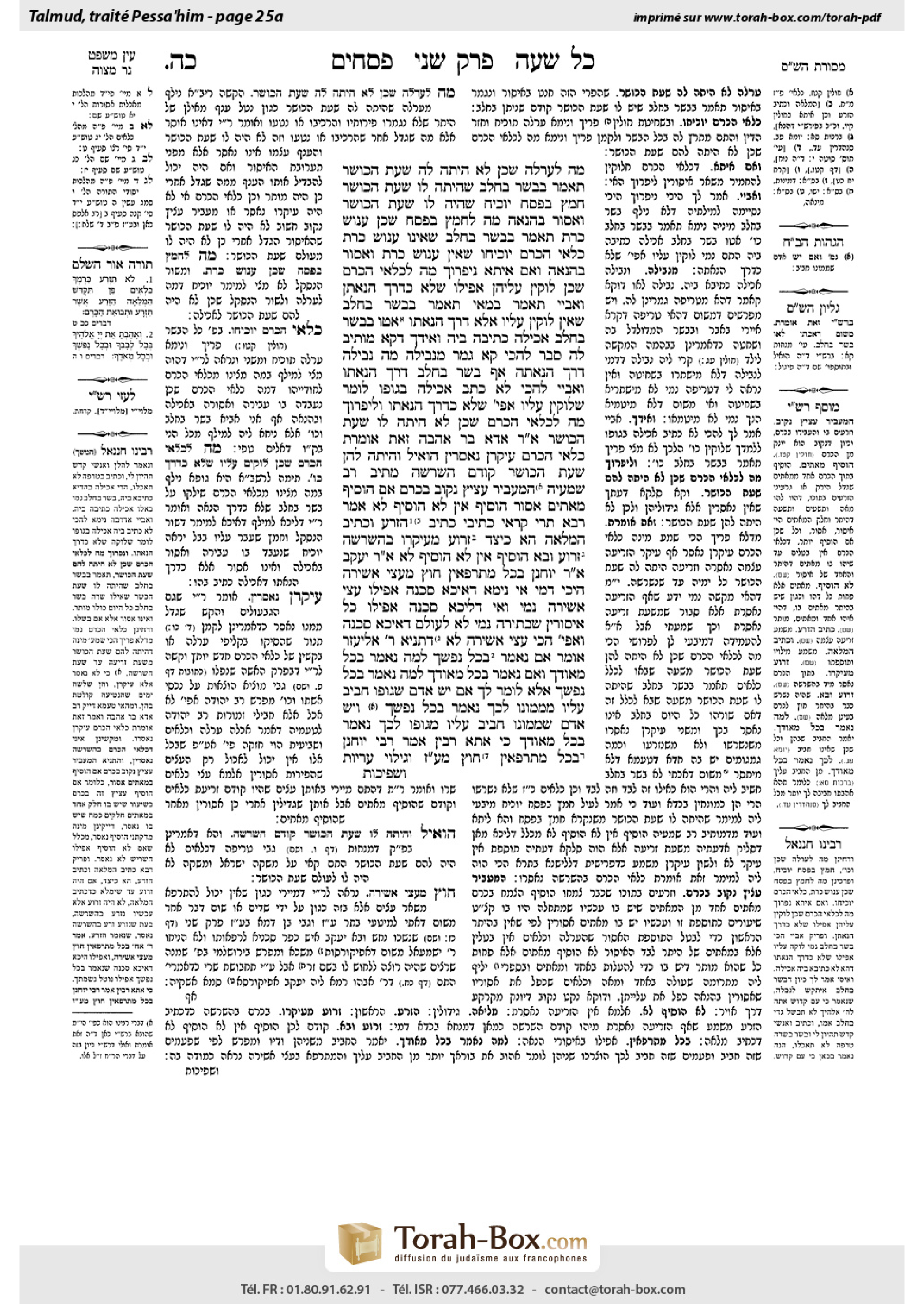
Pesachim 25a: Talmud study for Daf Yomi
Daf Yomi is the daily study of one Talmud folio. Explore 37 tractates with scans, Hebrew text, Sefaria English and AI-generated French translations where annotated.
Passage selection and English or AI-generated French translation are available where the scan has annotations. Daf Study is independent of Torah-Box and Sefaria.
Browse Pesachim · פסחים · All tractatesPesachim 25a text and translations
This page of Pesachim includes the Aramaic text, an English translation and an AI-generated French translation, alongside the scan above.
פסחים כ״ה א · Aramaic and Hebrew text
מָה לְעׇרְלָה שֶׁכֵּן לֹא הָיְתָה לָהּ שְׁעַת הַכּוֹשֶׁר — תֹּאמַר בְּבָשָׂר בְּחָלָב שֶׁהָיְתָה לוֹ שְׁעַת הַכּוֹשֶׁר! חָמֵץ בַּפֶּסַח יוֹכִיחַ — שֶׁהָיָה לוֹ שְׁעַת הַכּוֹשֶׁר, וְאָסוּר בַּהֲנָאָה.
מָה לְחָמֵץ בַּפֶּסַח — שֶׁכֵּן עָנוּשׁ כָּרֵת, תֹּאמַר בְּבָשָׂר בְּחָלָב שֶׁאֵינוֹ עָנוּשׁ כָּרֵת! כִּלְאֵי הַכֶּרֶם יוֹכִיחוּ, שֶׁאֵין עָנוּשׁ כָּרֵת — וְאָסוּר בַּהֲנָאָה.
וְאִם אִיתָא, נִיפְרוֹךְ: מָה לְכִלְאֵי הַכֶּרֶם — שֶׁכֵּן לוֹקִין עֲלֵיהֶן אֲפִילּוּ שֶׁלֹּא כְּדֶרֶךְ הֲנָאָתָן.
וְאַבָּיֵי, ״תֹּאמַר״ בְּמַאי?! תֹּאמַר בְּבָשָׂר בְּחָלָב שֶׁאֵין לוֹקִין עָלָיו אֶלָּא דֶּרֶךְ הֲנָאָתוֹ — אַטּוּ בְּבָשָׂר בְּחָלָב אֲכִילָה כְּתִיבָה בֵּיהּ?!
וְאִידַּךְ דְּקָא מוֹתֵיב לַהּ! סָבַר, לְהָכִי קָא גָּמַר מִנְּבֵילָה. מָה נְבֵילָה דֶּרֶךְ הֲנָאָתָהּ — אַף בָּשָׂר בְּחָלָב דֶּרֶךְ הֲנָאָתוֹ.
וְאַבָּיֵי: לְהָכִי לֹא כָּתַב אֲכִילָה בְּגוּפוֹ, לוֹמַר שֶׁלּוֹקִין עָלָיו אֲפִילּוּ שֶׁלֹּא כְּדֶרֶךְ הֲנָאָתוֹ.
וְלִיפְרוֹךְ: מָה לְכִלְאֵי הַכֶּרֶם שֶׁכֵּן לֹא הָיְתָה לוֹ שְׁעַת הַכּוֹשֶׁר! אָמַר רַבִּי אַדָּא בַּר אַהֲבָה: זֹאת אוֹמֶרֶת כִּלְאֵי הַכֶּרֶם עִיקָּרָן נֶאֱסָרִין, הוֹאִיל וְהָיְתָה לָהֶן שְׁעַת הַכּוֹשֶׁר קוֹדֶם הַשְׁרָשָׁה.
מֵתִיב רַב שְׁמַעְיָה: הַמַּעֲבִיר עָצִיץ נָקוּב בַּכֶּרֶם, אִם הוֹסִיף מָאתַיִם — אָסוּר. הוֹסִיף אִין, לֹא הוֹסִיף לָא!
אָמַר רָבָא, תְּרֵי קְרָאֵי כְּתִיבִי: כְּתִיב ״הַזָּרַע״ וּכְתִיב ״הַמְּלֵאָה״, הָא כֵּיצַד? זָרוּעַ מֵעִיקָּרוֹ — בְּהַשְׁרָשָׁה. זָרוּעַ וּבָא, הוֹסִיף — אִין, לֹא הוֹסִיף — לָא.
אָמַר רַבִּי יַעֲקֹב אָמַר רַבִּי יוֹחָנָן: בַּכֹּל מִתְרַפְּאִין, חוּץ מֵעֲצֵי אֲשֵׁירָה. הֵיכִי דָמֵי? אִי נֵימָא דְּאִיכָּא סַכָּנָה — אֲפִילּוּ עֲצֵי אֲשֵׁירָה נָמֵי! וְאִי דְּלֵיכָּא סַכָּנָה — אֲפִילּוּ כׇּל אִיסּוּרִין שֶׁבַּתּוֹרָה נָמֵי לָא?!
לְעוֹלָם דְּאִיכָּא סַכָּנָה, וַאֲפִילּוּ הָכִי עֲצֵי אֲשֵׁירָה לָא. דְּתַנְיָא, רַבִּי אֱלִיעֶזֶר אוֹמֵר: אִם נֶאֱמַר ״בְּכׇל נַפְשְׁךָ״, לָמָּה נֶאֱמַר ״בְּכׇל מְאֹדֶךָ״. וְאִם נֶאֱמַר ״בְּכׇל מְאֹדֶךָ״, לָמָּה נֶאֱמַר ״בְּכׇל נַפְשְׁךָ״?
אֶלָּא לוֹמַר לָךְ: אִם יֵשׁ אָדָם שֶׁגּוּפוֹ חָבִיב עָלָיו מִמָּמוֹנוֹ — לְכָךְ נֶאֱמַר ״בְּכׇל נַפְשְׁךָ״. וְיֵשׁ אָדָם שֶׁמָּמוֹנוֹ חָבִיב עָלָיו מִגּוּפוֹ — לְכָךְ נֶאֱמַר ״בְּכׇל מְאֹדֶךָ״.
כִּי אֲתָא רָבִין אָמַר רַבִּי יוֹחָנָן: בַּכֹּל מִתְרַפְּאִין, חוּץ מֵעֲבוֹדָה זָרָה וְגִילּוּי עֲרָיוֹת
Pesachim 25a · English translation
The Gemara rejects this inference: What comparison can be made to orla, which is more stringent than meat in milk, as it never had a time when it was fit? Can you say the same with regard to meat in milk, which had a time when it was fit? Unlike orla fruits, which were prohibited from the beginning of their existence, both meat and milk were permitted on their own before they were cooked together. Therefore, the Gemara brings other proofs: Let leavened bread on Passover prove that this issue is not a factor, as it had a time when it was fit, before Passover, and yet it is prohibited to derive benefit from it.
The Gemara rejects this: What comparison can be made to leavened bread on Passover, which is a stringent prohibition, as one who eats it is punished with karet? Can you say the same with regard to one who eats meat in milk, who is not punished with karet? The Gemara answers: Let the case of diverse kinds planted in the vineyard prove that this is not relevant, as one who violates that prohibition is not punished with karet, and yet it is prohibited to derive benefit from the resulting mixtures.
The Gemara returns to the issue of Abaye’s statement with regard to the unique stringency of diverse kinds planted in a vineyard: And if it is so that one is flogged for deriving benefit from diverse kinds planted in a vineyard, even if one derives benefit from them in an unusual manner, we can challenge this last proof: How can one compare meat in milk to diverse kinds in a vineyard, as with regard to diverse kinds in a vineyard, one is flogged even if he derives benefit from them in an unusual manner?
And how would Abaye respond to this question? When one draws this challenge to its logical conclusion with the phrase: Can you say, and explains in detail how the prohibition of meat in milk differs from that of diverse kinds in a vineyard, with regard to what difference would the challenge be raised? You may say that with regard to meat in milk one is flogged only for deriving benefit in the usual manner, as opposed to the halakha with regard to diverse kinds, according to which one is flogged even for deriving benefit in an unusual manner. However, is that to say that the term eating is written in the Torah with regard to meat in milk? The basis for this halakha with regard to diverse kinds in a vineyard is the lack of the term eating in the verse; however, the prohibition of meat in milk is also missing that term. Therefore, there are no grounds for this challenge: If the lack of the word eating leads to the conclusion that one is flogged even when deriving benefit in an unusual manner, logically that punishment should apply to both diverse kinds and meat in milk.
The Gemara asks: And the other Sage, who raised this objection, holds that for this reason Isi ben Yehuda derives this aspect of the prohibition from the case of an animal carcass. Just as with regard to an animal carcass one is flogged only when deriving benefit in the usual manner, as the verse that prohibits it uses the term eating, so too, with regard to meat in milk, one is flogged only when deriving benefit in the usual manner. Despite what is written in the Gemara, the fact that one is flogged only for deriving benefit from the animal in the usual manner is not derived from the carcass of an unslaughtered animal but from tereifa, an animal with a condition that will cause it to die within twelve months. With regard to tereifa it is written: “And you shall be holy men unto Me; therefore you shall not eat any flesh that is torn of beasts in the field [tereifa]; you shall cast it to the dogs” (Exodus 22:30). From the fact that one may cast it to the dogs it can be derived that one may derive benefit in any manner other than the usual manner, i.e., eating.
And Abaye holds that for this reason it did not write the term eating in the verse itself with regard to the prohibition of meat in milk: In order to say that one is flogged even when deriving benefit in an unusual manner.
The Gemara continues. Let Isi ben Yehuda challenge: What comparison can be made to diverse kinds in a vineyard, as the forbidden produce had no time that it was fit because the prohibition came into effect as soon as the produce began to grow? Rabbi Adda bar Ahava said: Apparently, since this question was not asked, that is to say that with regard to diverse kinds in a vineyard, their roots are forbidden as well, including the seeds and saplings from which the mature plants grow. Therefore, no challenge can be raised, since they had a time when they were fit, before taking root.
Rav Shemaya raised an objection based on what was taught in a mishna: With regard to one who transfers a perforated pot with seeds in it into a vineyard, if the size of the seeds growing in the pot increases by one two-hundredth of their previous size, such that the permitted portion is not two hundred times the forbidden, newly grown portion, then the mixture is prohibited due to the prohibition against planting diverse kinds in a vineyard. The forbidden portion is nullified only if it comprises less than one two-hundredth of the mixture. The Gemara reads precisely: If it increases, yes, it is prohibited; if it does not increase, no, it is not prohibited. Apparently, only additional growth is prohibited, and not the seeds themselves.
Rava said: Two verses are written about this halakha, i.e., two separate terms in one verse indicate two separate prohibitions. The verse states: “You shall not sow your vineyard with two kinds of seed; lest the fullness of the seed which you have sown be forfeited together with the increase of the vineyard” (Deuteronomy 22:9). It is written: “The seed,” indicating that it is prohibited once it is planted and takes root, and it is written: “The fullness,” indicating that it is prohibited only if it has grown. How can these two terms be reconciled? If it were planted initially in the vineyard, it becomes prohibited immediately upon taking root. If it were planted elsewhere and brought into the vineyard later, such as in a perforated pot, then the following distinction applies: If its size increases in the vineyard, yes, it is prohibited; if its size does not increase, no, it is not prohibited.
The Gemara discusses another matter pertaining to deriving benefit. Rabbi Ya’akov said that Rabbi Yoḥanan said with regard to objects from which it is prohibited to derive benefit: One may heal oneself with any substance except for wood of a tree designated for idolatry [asheira]. The Gemara asks: What are the circumstances? If we say it is a case in which there is danger to a person’s life, then it is permitted to use even the wood of an asheira. And if it is a situation where there is no danger, then all the prohibited substances in the Torah also may not be used, as one may not derive benefit from them.
The Gemara answers: Actually, it is referring to a case where there is danger, and even so, one my not derive benefit from the wood of an asheira. As it was taught in a baraita that Rabbi Eliezer says: If it is stated: “And you shall love the Lord your God with all your heart, and with all your soul,” why is it stated: “And with all your might” (Deuteronomy 6:5)? And if it is stated: “With all your might,” why is it stated: “With all your soul”? One of these statements appears to be superfluous.
Rather, it is to tell you that if there is a person whose body is more beloved to him than his property, therefore it is stated: “With all your soul.” The verse teaches that one must be willing to sacrifice his life to sanctify God’s name. And there is a person whose property is more beloved to him than his body, therefore it is stated: “With all your might.” Rabbi Eliezer understands the phrase: “With all your might,” to mean: With all your possessions. Apparently, there are circumstances in which a person must be prepared to die rather than be healed with a prohibited substance.
When Ravin came from the Eretz Yisrael to Babylonia, he said that Rabbi Yoḥanan said: One may heal oneself with any substance from which one may not derive benefit, except for idolatry or forbidden sexual relations
Pesachim 25a · Traduction française (IA)
La Guemara rejette cette déduction : quelle comparaison peut-on faire avec l’orla, dont l’interdiction est plus sévère que celle du mélange de viande et de lait, puisqu’il n’y a jamais eu de moment où elle était permise ? Peut-on en dire autant du mélange de viande et de lait, qui a connu un moment où il était permis ? Contrairement aux fruits de l’orla, interdits dès le début de leur existence, la viande et le lait étaient chacun permis avant d’être cuits ensemble. La Guemara apporte donc d’autres preuves : que le pain levé à Pessa’h démontre que cela n’est pas un facteur déterminant, car il était permis avant Pessa’h et il est pourtant interdit d’en tirer profit.
La Guemara rejette cette preuve : quelle comparaison peut-on faire avec le pain levé à Pessa’h, dont l’interdiction est particulièrement sévère, puisque celui qui en mange est passible de karet ? Peut-on en dire autant de celui qui mange un mélange de viande et de lait, qui n’est pas passible de karet ? La Guemara répond : que le cas des espèces mélangées plantées dans une vigne démontre que cela n’est pas pertinent, car celui qui transgresse cette interdiction n’est pas passible de karet, et il est pourtant interdit de tirer profit des mélanges qui en résultent.
La Guemara revient sur la question de la déclaration d’Abayé concernant la sévérité particulière des espèces mélangées plantées dans une vigne : s’il en est ainsi, et que l’on est passible de flagellation pour avoir tiré profit de ces espèces, même d’une manière inhabituelle, on peut contester cette dernière preuve : comment comparer le mélange de viande et de lait aux espèces mélangées dans une vigne, puisque, pour ces dernières, on est passible de flagellation même si l’on en tire profit d’une manière inhabituelle ?
Et comment Abayé répondrait-il à cette question ? Lorsqu’on pousse cette objection jusqu’à sa conclusion logique au moyen de la formule « Peut-on en dire autant ? » et qu’on explique en détail en quoi l’interdiction du mélange de viande et de lait diffère de celle des espèces mélangées dans une vigne, sur quelle différence l’objection porterait-elle ? On pourrait dire que, pour le mélange de viande et de lait, on n’est passible de flagellation que si l’on en tire profit de la manière habituelle, contrairement à la halakha concernant les espèces mélangées, selon laquelle on est passible de flagellation même si l’on en tire profit d’une manière inhabituelle. Mais cela signifie-t-il que le terme « manger » figure dans la Torah à propos du mélange de viande et de lait ? La base de cette halakha concernant les espèces mélangées dans une vigne est l’absence du terme « manger » dans le verset ; or ce terme est également absent de l’interdiction du mélange de viande et de lait. Cette objection n’est donc pas fondée : si l’absence du mot « manger » conduit à conclure qu’on est passible de flagellation même lorsqu’on tire profit d’une manière inhabituelle, logiquement, cette peine devrait s’appliquer aussi bien aux espèces mélangées qu’au mélange de viande et de lait.
La Guemara demande : l’autre Sage, qui a soulevé cette objection, considère-t-il que c’est pour cette raison qu’Isi ben Yehouda déduit cet aspect de l’interdiction du cas d’une carcasse d’animal ? De même que, dans le cas d’une carcasse d’animal, on n’est passible de flagellation que lorsqu’on en tire profit de la manière habituelle, puisque le verset qui l’interdit emploie le terme « manger », de même, à propos du mélange de viande et de lait, on n’est passible de flagellation que lorsqu’on en tire profit de la manière habituelle. Malgré ce qui est écrit dans la Guemara, le fait qu’on ne soit passible de flagellation que si l’on tire profit de l’animal de la manière habituelle ne se déduit pas de la carcasse d’un animal non abattu rituellement, mais de la tereifa, un animal atteint d’une affection qui entraînera sa mort dans les douze mois. Au sujet de la tereifa, il est écrit : « Vous serez pour Moi des hommes saints ; vous ne mangerez donc aucune chair déchirée dans les champs par des bêtes [tereifa] ; vous la jetterez aux chiens » (Exode 22:30). Du fait qu’on peut la jeter aux chiens, on déduit qu’on peut en tirer profit de toute autre manière que la manière habituelle, c’est-à-dire en la mangeant.
Et Abayé considère que c’est pour cette raison que le terme « manger » n’a pas été écrit dans le verset lui-même à propos de l’interdiction du mélange de viande et de lait : afin d’indiquer qu’on est passible de flagellation même lorsqu’on en tire profit d’une manière inhabituelle.
La Guemara poursuit. Qu’Isi ben Yehouda soulève l’objection suivante : quelle comparaison peut-on faire avec les espèces mélangées dans une vigne, puisque les produits interdits n’ont jamais connu de moment où ils étaient permis, l’interdiction prenant effet dès que les produits commencent à pousser ? Rabbi Adda bar Ahava dit : apparemment, puisque cette question n’a pas été posée, cela signifie que, dans le cas des espèces mélangées dans une vigne, leurs racines sont également interdites, y compris les graines et les jeunes plants dont poussent les plantes adultes. On ne peut donc pas soulever cette objection, puisqu’ils ont connu un moment où ils étaient permis, avant de prendre racine.
Rav Shemaya souleva une objection fondée sur ce qui est enseigné dans une Michna : à propos de celui qui transfère dans une vigne un pot percé contenant des graines, si la taille des graines qui poussent dans le pot augmente d’un deux-centième par rapport à leur taille précédente, de sorte que la part permise ne représente plus deux cents fois la part interdite nouvellement poussée, le mélange est interdit en vertu de l’interdiction de planter des espèces mélangées dans une vigne. La part interdite n’est annulée que si elle représente moins d’un deux-centième du mélange. La Guemara relève la précision du texte : si elle augmente, alors oui, c’est interdit ; si elle n’augmente pas, alors non, ce n’est pas interdit. Il semble que seule la croissance supplémentaire soit interdite, et non les graines elles-mêmes.
Rava dit : deux termes sont écrits à propos de cette halakha, c’est-à-dire que deux termes distincts dans un même verset indiquent deux interdictions distinctes. Le verset dit : « Tu ne sèmeras pas ta vigne de deux sortes de semences, de peur que la totalité de ce que tu as semé ne soit vouée à l’interdit, avec le produit de la vigne » (Deutéronome 22:9). Le terme « semence » est écrit, ce qui indique que c’est interdit une fois que la plante est plantée et a pris racine ; le terme « totalité » est également écrit, ce qui indique que cela n’est interdit que si elle a poussé. Comment concilier ces deux termes ? Si elle a été plantée dès le départ dans la vigne, elle devient immédiatement interdite dès qu’elle prend racine. Si elle a été plantée ailleurs puis apportée ensuite dans la vigne, par exemple dans un pot percé, la distinction suivante s’applique : si sa taille augmente dans la vigne, alors oui, c’est interdit ; si sa taille n’augmente pas, alors non, ce n’est pas interdit.
La Guemara aborde une autre question concernant le fait de tirer profit. Rabbi Ya’akov dit au nom de Rabbi Yoḥanan, au sujet des objets dont il est interdit de tirer profit : on peut se soigner avec n’importe quelle substance, à l’exception du bois d’un arbre consacré à l’idolâtrie [asheira]. La Guemara demande : dans quelles circonstances ? S’il s’agit d’un cas où la vie d’une personne est en danger, alors il est permis d’utiliser même le bois d’une asheira. Et s’il s’agit d’une situation où il n’y a pas de danger, alors il est également interdit d’utiliser toutes les substances proscrites par la Torah, puisqu’on ne peut pas en tirer profit.
La Guemara répond : en réalité, il s’agit d’un cas où la vie est en danger, et même ainsi, il est interdit de tirer profit du bois d’une asheira. Car il a été enseigné dans une baraïta que Rabbi Éliézer dit : s’il est dit : « Tu aimeras l’Éternel, ton Dieu, de tout ton cœur et de toute ton âme », pourquoi est-il dit : « et de toute ta force » (Deutéronome 6:5) ? Et s’il est dit : « de toute ta force », pourquoi est-il dit : « de toute ton âme » ? L’une de ces expressions semble superflue.
Mais c’est pour t’enseigner que, pour une personne dont le corps est plus cher que ses biens, il est dit : « de toute ton âme ». Le verset enseigne qu’on doit être prêt à sacrifier sa vie pour sanctifier le nom de Dieu. Et pour une personne dont les biens sont plus chers que son corps, il est dit : « de toute ta force ». Rabbi Éliézer comprend l’expression « de toute ta force » comme signifiant : de tous tes biens. Il apparaît donc qu’il existe des circonstances dans lesquelles une personne doit être prête à mourir plutôt que de se soigner avec une substance interdite.
Lorsque Ravin vint de la terre d’Israël en Babylonie, il dit au nom de Rabbi Yoḥanan : on peut se soigner avec toute substance dont il est interdit de tirer profit, sauf l’idolâtrie ou les relations sexuelles interdites.
Traduction française générée par IA à partir de l’édition anglaise de Sefaria. Vérifie toujours un passage avec le texte source.
Text from Sefaria: William Davidson Edition - Vocalized Aramaic (CC BY NC); William Davidson Edition - English (CC BY NC).