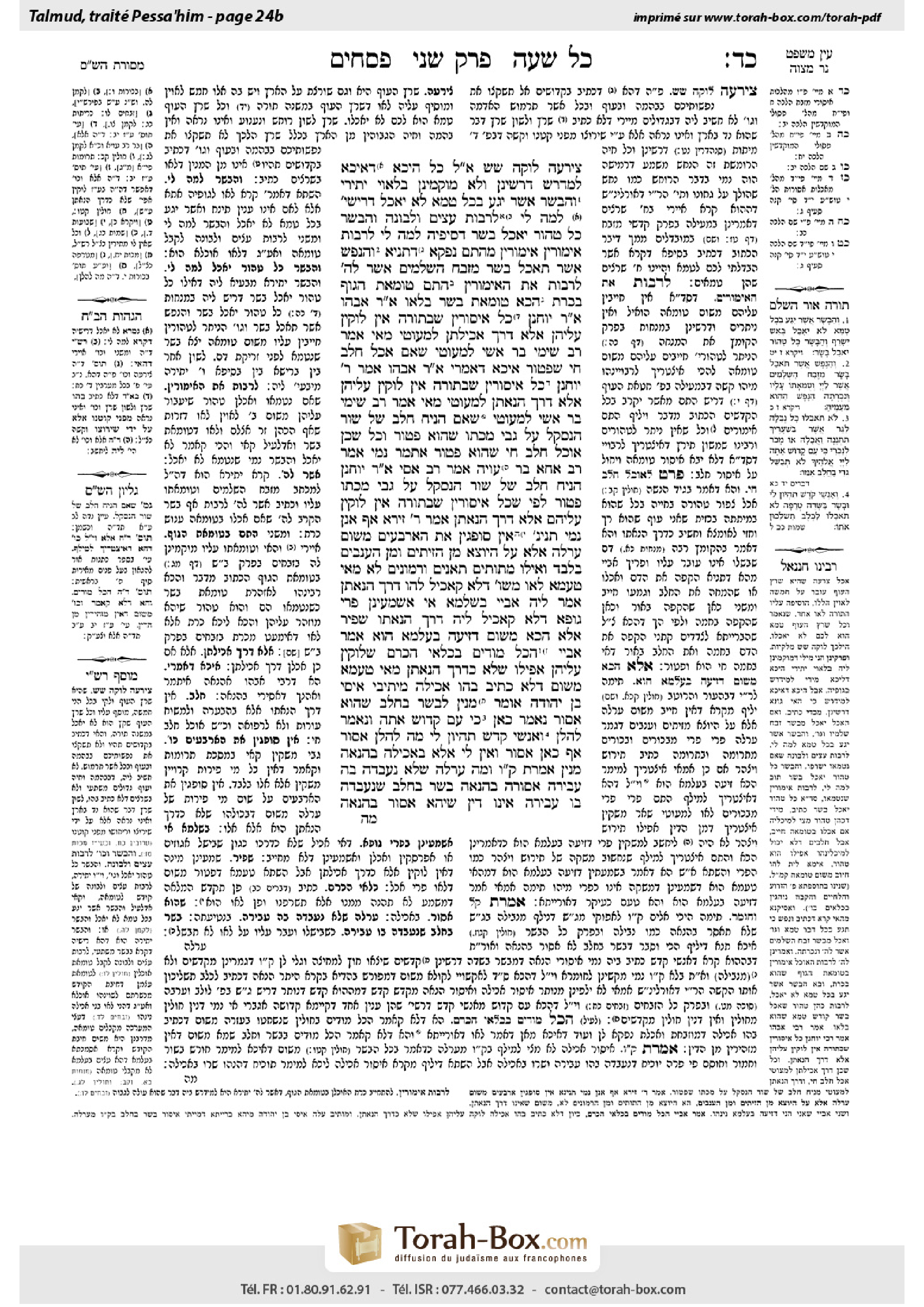
Pesachim 24b: Talmud study for Daf Yomi
Daf Yomi is the daily study of one Talmud folio. Explore 37 tractates with scans, Hebrew text, Sefaria English and AI-generated French translations where annotated.
Passage selection and English or AI-generated French translation are available where the scan has annotations. Daf Study is independent of Torah-Box and Sefaria.
Browse Pesachim · פסחים · All tractatesPesachim 24b text and translations
This page of Pesachim includes the Aramaic text, an English translation and an AI-generated French translation, alongside the scan above.
פסחים כ״ד ב · Aramaic and Hebrew text
צִירְעָה — לוֹקֶה שֵׁשׁ! אֲמַר לֵיהּ: כֹּל הֵיכָא דְּאִיכָּא לְמִדְרַשׁ — דָּרְשִׁינַן, וְלָא מוֹקְמִינַן בְּלָאוֵי יַתִּירֵי.
״וְהַבָּשָׂר אֲשֶׁר יִגַּע בְּכׇל טָמֵא לֹא יֵאָכֵל״ דְּרֵישֵׁיהּ לְמָה לִי? לְרַבּוֹת עֵצִים וּלְבוֹנָה. ״וְהַבָּשָׂר כׇּל טָהוֹר יֹאכַל בָּשָׂר״ דְּסֵיפֵיהּ לְמָה לִי? לְרַבּוֹת אֵימוּרִין.
אֵימוּרִין מֵהָתָם נָפְקָא, דְּתַנְיָא: ״וְהַנֶּפֶשׁ אֲשֶׁר תֹּאכַל בָּשָׂר מִזֶּבַח הַשְּׁלָמִים אֲשֶׁר לַה׳״ — לְרַבּוֹת אֶת הָאֵימוּרִין!
הָתָם טוּמְאַת הַגּוּף — בְּכָרֵת, הָכָא טוּמְאַת בָּשָׂר — בְּלָאו.
אָמַר רַבִּי אֲבָהוּ אָמַר רַבִּי יוֹחָנָן: כׇּל אִיסּוּרִין שֶׁבַּתּוֹרָה אֵין לוֹקִין עֲלֵיהֶן אֶלָּא דֶּרֶךְ אֲכִילָתָן. לְמַעוֹטֵי מַאי? אָמַר רַב שִׁימִי בַּר אָשֵׁי: לְמַעוֹטֵי שֶׁאִם אָכַל חֵלֶב חַי, שֶׁפָּטוּר.
אִיכָּא דְאָמְרִי, אָמַר רַבִּי אֲבָהוּ אָמַר רַבִּי יוֹחָנָן: כׇּל אִיסּוּרִין שֶׁבַּתּוֹרָה אֵין לוֹקִין עֲלֵיהֶן אֶלָּא דֶּרֶךְ הֲנָאָתָן. לְמַעוֹטֵי מַאי? אָמַר רַב שִׁימִי בַּר אָשֵׁי: לְמַעוֹטֵי שֶׁאִם הִנִּיחַ חֵלֶב שֶׁל שׁוֹר הַנִּסְקָל עַל גַּבֵּי מַכָּתוֹ, שֶׁהוּא פָּטוּר. וְכׇל שֶׁכֵּן אוֹכֵל חֵלֶב חַי, שֶׁהוּא פָּטוּר.
אִתְּמַר נָמֵי, אָמַר רַב אַחָא בַּר עַוְיָה אָמַר רַב אַסִּי אָמַר רַבִּי יוֹחָנָן: הִנִּיחַ חֵלֶב שֶׁל שׁוֹר הַנִּסְקָל עַל גַּבֵּי מַכָּתוֹ — פָּטוּר, לְפִי שֶׁכׇּל אִיסּוּרִין שֶׁבַּתּוֹרָה אֵין לוֹקִין עֲלֵיהֶם אֶלָּא דֶּרֶךְ הֲנָאָתָן.
אָמַר רַבִּי זֵירָא, אַף אֲנַן נָמֵי תְּנֵינָא: אֵין סוֹפְגִין אֶת הָאַרְבָּעִים מִשּׁוּם עׇרְלָה, אֶלָּא עַל הַיּוֹצֵא מִן הַזֵּיתִים וּמִן הָעֲנָבִים בִּלְבַד. וְאִילּוּ מִתּוּתִים תְּאֵנִים וְרִמּוֹנִים — לָא. מַאי טַעְמָא — לָאו מִשּׁוּם דְּלָא קָאָכֵיל לְהוּ דֶּרֶךְ הֲנָאָתָן?!
אֲמַר לֵיהּ אַבָּיֵי: בִּשְׁלָמָא אִי אַשְׁמְעִינַן פְּרִי גּוּפָא דְּלָא קָאָכֵיל לֵיהּ דֶּרֶךְ הֲנָאָתוֹ — שַׁפִּיר, אֶלָּא הָכָא, מִשּׁוּם דְּזֵיעָה בְּעָלְמָא הוּא.
אָמַר אַבָּיֵי: הַכֹּל מוֹדִים בְּכִלְאֵי הַכֶּרֶם שֶׁלּוֹקִין עֲלֵיהֶן אֲפִילּוּ שֶׁלֹּא כְּדֶרֶךְ הֲנָאָתָן, מַאי טַעְמָא — מִשּׁוּם דְּלָא כְּתִיב בְּהוּ אֲכִילָה.
מֵיתִיבִי, אִיסִי בֶּן יְהוּדָה אוֹמֵר: מִנַּיִן לְבָשָׂר בְּחָלָב שֶׁהוּא אָסוּר? נֶאֱמַר כָּאן ״כִּי עַם קָדוֹשׁ אַתָּה״, וְנֶאֱמַר לְהַלָּן ״וְאַנְשֵׁי קֹדֶשׁ תִּהְיוּן לִי״. מָה לְהַלָּן אָסוּר, אַף כָּאן אָסוּר.
וְאֵין לִי אֶלָּא בַּאֲכִילָה, בַּהֲנָאָה מִנַּיִן? אָמַרְתָּ, קַל וָחוֹמֶר: וּמָה עׇרְלָה שֶׁלֹּא נֶעֶבְדָה בָּהּ עֲבֵירָה, אֲסוּרָה בַּהֲנָאָה. בָּשָׂר בְּחָלָב שֶׁנֶּעֶבְדָה בּוֹ עֲבֵירָה, אֵינוֹ דִּין שֶׁיְּהֵא אָסוּר בַּהֲנָאָה?
Pesachim 24b · English translation
If one ate a hornet, he is flogged with six sets of lashes. Since a hornet creeps along the ground, all of the previously mentioned prohibitions with regard to an ant apply to it as well. An additional prohibition is stated in the following verse: “And all flying insects are impure to you; they shall not be eaten” (Deuteronomy 14:19). Based on this precedent, it is possible to say that the addition of the phrase “It shall not be eaten” with regard to impure meat indicates merely an additional negative mitzva for which one would be punished; however, it does not necessarily indicate a prohibition to derive benefit. Rav Ashi said to him: Anywhere that it is possible to expound a new halakha, we expound, and we do not establish the verse as containing additional negative mitzvot with regard to that same prohibition.
The Gemara asks: Why do I need the beginning of the verse: “And the flesh that touches any impure thing shall not be eaten” (Leviticus 7:19)? The Gemara explains: This comes to include wood and incense; although they are not eaten, they are susceptible to ritual impurity of foods. The Gemara asks: Why do I need the end of this verse: “And as for the flesh, every one that is pure may eat of it” (Leviticus 7:19)? The Gemara answers: This comes to include the sacrificial parts of the animal offered on the altar, such as the fats; they, too, have the legal status of meat and are susceptible to ritual impurity of foods. If these portions become ritually impure and one eats them, even if he is pure, he is liable to be flogged.
The Gemara challenges: The halakha that these sacrificial parts can become impure and are then prohibited to be eaten is derived from there, i.e., from another source, as it was taught in a baraita: “But the soul that eats from the flesh of the sacrifice of peace-offerings, which belong to the Lord, having his impurity upon him, that soul shall be cut off from his people” (Leviticus 7:20). The added words “which belong to the Lord” come to include these sacrificial parts, which are meant to be offered to God and not eaten by other people, within this prohibition against eating sacrificial meat when it is impure.
The Gemara rejects this: There, it is referring to a case of impurity of the body; if one who is ritually impure eats sacrificial parts he is punishable with karet. Here, it is referring to a case of impurity of the flesh, where the meat is impure but the person eating it is pure; one who does so is merely in violation of a negative mitzva.
After discussing the prohibitions against eating and deriving benefit from certain items, the Gemara cites that which Rabbi Abbahu said that Rabbi Yoḥanan said: With regard to all prohibitions against eating in the Torah, one may be flogged for violating them only if he eats the prohibited item in its usual manner of consumption. The Gemara asks: To exclude what case did Rabbi Yoḥanan say this? Rav Shimi bar Ashi said: To exclude a case where one eats raw fat; he teaches that one who does so is exempt, since this is not the usual manner of eating it.
Some say that this is what Rabbi Abbahu said that Rabbi Yoḥanan said: With regard to all prohibitions against deriving benefit in the Torah, one is flogged for violating them only if he derives benefit from the prohibited item in the usual manner. The Gemara asks: To exclude what case did Rabbi Yoḥanan say this? Rav Shimi bar Ashi said: To exclude a case where one placed the fat of an ox that is stoned on his wound to help it heal. He teaches that, although one generally may not derive benefit from forbidden fats, in this case he is exempt because these fats are not normally used for medicinal purposes. And all the more so one who eats raw fat is exempt, as this is certainly not an ordinary way to benefit from fat.
It was also stated that Rav Aḥa bar Avya said that Rav Asi said that Rabbi Yoḥanan said: If one placed the fat of an ox that is stoned on his wound for medicinal purposes, he is exempt, because with regard to all prohibitions against deriving benefit in the Torah, one is flogged for violating them only if he derives benefit from the prohibited item in its usual manner.
Rabbi Zeira said: We, too, have also learned in a mishna that the Rabbis said: One absorbs the forty lashes due to drinking the juice squeezed from orla fruits only for that which seeps from olives, oil, and from grapes, wine. In contrast, for drinking the juice that seeps from mulberries, figs, and pomegranates one is not flogged, despite the fact that it is prohibited to consume those juices. What is the reason for this? Is it not because he is not eating them in their usual manner of deriving benefit? Generally, these fruits are eaten and not squeezed for their juice.
Abaye said to him that this mishna does not necessarily prove this same point: Granted, had the mishna taught us the case of the fruit itself, as he is not eating it in its usual manner of deriving benefit, it would work out well. However, here, where the case is with regard to their juice, the reason he is not flogged is because it is merely moisture that drips from the fruit, which is not considered to be an essential part of the fruit.
Abaye said: All concede with regard to prohibited mixtures of diverse kinds planted in a vineyard that one is flogged for deriving benefit from them even if he does not benefit from them in their usual manner. What is the reason for this? It is because no prohibition against eating is written about them explicitly in the Torah. Therefore, the verse is interpreted to mean that it is prohibited to benefit from them in any manner; rather, one must burn them immediately.
The Gemara raises an objection. Isi ben Yehuda says: From where is it derived that it is prohibited to eat meat that has been cooked in milk? It is stated here: “For you are a sacred people unto the Lord your God. You shall not cook a kid in its mother’s milk” (Deuteronomy 14:21). And it is stated there: “And you shall be sacred men unto Me; therefore you shall not eat any flesh that is torn of beasts in the field [tereifa]; you shall cast it to the dogs” (Exodus 22:30). Just as there, with regard to a tereifa, it is prohibited to eat it, so too here, with regard to meat in milk, it is prohibited to eat it.
From the above comparison I have derived only that it is prohibited to eat it, as it is prohibited to eat a tereifa; from where do I derive that it is prohibited to derive benefit from it as well? You may state an a fortiori inference: If with regard to orla, through which no sin has been committed, as it is part of the ordinary growth process of the tree to produce fruit during the first three years, yet still it is prohibited to deriving benefit from it; then with regard to meat in milk, through which a sin has been committed, as the two were illicitly cooked together, is it not right that it should be prohibited to derive benefit from it?
Pesachim 24b · Traduction française (IA)
Si quelqu’un mange un frelon, il reçoit six séries de coups. Puisqu’un frelon rampe sur le sol, toutes les interdictions déjà mentionnées au sujet de la fourmi s’appliquent également à lui. Une interdiction supplémentaire figure dans le verset suivant : « Tous les insectes ailés sont impurs pour vous ; vous ne les mangerez pas » (Deutéronome 14,19). Sur la base de cet exemple, on pourrait dire que l’ajout de l’expression « Il ne sera pas mangé » au sujet de la viande impure indique simplement une mitsva négative supplémentaire, passible de coups, sans nécessairement indiquer une interdiction d’en tirer profit. Rav Ashi lui répondit : partout où il est possible de déduire une nouvelle halakha, nous la déduisons, et nous ne considérons pas que le verset ajoute des mitsvot négatives au sujet de cette même interdiction.
La Guemara demande : pourquoi le début du verset est-il nécessaire : « La chair qui touche une chose impure ne sera pas mangée » (Lévitique 7,19) ? La Guemara explique : cela vient inclure le bois et l’encens ; bien qu’ils ne soient pas mangés, ils sont susceptibles de contracter l’impureté rituelle des aliments. La Guemara demande : pourquoi la fin de ce verset est-elle nécessaire : « Quant à la chair, toute personne pure peut en manger » (Lévitique 7,19) ? La Guemara répond : cela vient inclure les parties sacrificielles de l’animal offertes sur l’autel, comme les graisses ; elles aussi ont le statut juridique de viande et sont susceptibles de contracter l’impureté rituelle des aliments. Si ces morceaux deviennent rituellement impurs et que quelqu’un les mange, il est passible de coups, même s’il est pur.
La Guemara objecte : la halakha selon laquelle ces parties sacrificielles peuvent devenir impures et sont alors interdites à la consommation est déduite d’un autre passage, comme l’enseigne une baraïta : « Mais la personne qui mange de la chair du sacrifice de paix, qui appartient à l’Éternel, alors qu’elle est elle-même impure, cette personne sera retranchée de son peuple » (Lévitique 7,20). Les mots ajoutés « qui appartient à l’Éternel » viennent inclure ces parties sacrificielles, destinées à être offertes à Dieu et non consommées par d’autres, dans cette interdiction de manger de la viande sacrificielle lorsqu’elle est impure.
La Guemara rejette cette objection : là, il s’agit d’un cas d’impureté de la personne ; si une personne rituellement impure mange des parties sacrificielles, elle est passible de karet. Ici, il s’agit d’un cas d’impureté de la chair : la viande est impure, mais la personne qui la mange est pure ; celui qui agit ainsi ne transgresse qu’une mitsva négative.
Après avoir examiné les interdictions de manger certains éléments et d’en tirer profit, la Guemara rapporte ce que Rabbi Abbahu a dit au nom de Rabbi Yoḥanan : pour toutes les interdictions alimentaires de la Torah, on ne reçoit des coups que si l’on mange l’élément interdit de la manière dont il est habituellement consommé. La Guemara demande : quel cas Rabbi Yoḥanan voulait-il exclure par cette déclaration ? Rav Shimi bar Ashi dit : le cas où quelqu’un mange du suif cru ; il enseigne que celui qui agit ainsi est quitte, car ce n’est pas la manière habituelle de le manger.
Selon certains, voici ce que Rabbi Abbahu a dit au nom de Rabbi Yoḥanan : pour toutes les interdictions de tirer profit énoncées dans la Torah, on ne reçoit des coups que si l’on tire profit de l’élément interdit de la manière habituelle. La Guemara demande : quel cas Rabbi Yoḥanan voulait-il exclure par cette déclaration ? Rav Shimi bar Ashi dit : le cas où quelqu’un applique sur sa plaie, pour la soigner, la graisse d’un bœuf lapidé. Il enseigne que, bien qu’il soit généralement interdit de tirer profit des graisses interdites, dans ce cas la personne est quitte, car ces graisses ne sont pas habituellement utilisées à des fins médicinales. À plus forte raison, celui qui mange du suif cru est quitte, car ce n’est certainement pas une manière habituelle de tirer profit du suif.
Il a également été enseigné que Rav Aḥa bar Avya a dit au nom de Rav Asi, qui l’a lui-même dit au nom de Rabbi Yoḥanan : si quelqu’un applique sur sa plaie, à des fins médicinales, la graisse d’un bœuf lapidé, il est quitte, car, pour toutes les interdictions de tirer profit énoncées dans la Torah, on ne reçoit des coups que si l’on tire profit de l’élément interdit de la manière habituelle.
Rabbi Zeira dit : nous aussi, nous avons appris dans une Michna que les Sages ont dit : on ne reçoit les quarante coups pour avoir bu le jus extrait des fruits d’orla que lorsqu’il provient d’olives — l’huile — ou de raisins — le vin. En revanche, on ne reçoit pas de coups pour avoir bu le jus extrait des mûres, des figues et des grenades, bien qu’il soit interdit de consommer ces jus. Quelle en est la raison ? N’est-ce pas parce que l’on n’en tire pas profit de la manière habituelle ? En général, ces fruits se mangent et ne sont pas pressés pour en extraire le jus.
Abaye lui répondit que cette Michna ne prouve pas nécessairement ce même point : certes, si la Michna nous avait enseigné le cas du fruit lui-même, puisqu’on n’en tire pas profit de la manière habituelle, cela aurait bien convenu. Mais ici, puisqu’il s’agit de leur jus, on ne reçoit pas de coups parce qu’il s’agit seulement du liquide qui s’écoule du fruit et qui n’est pas considéré comme une partie essentielle de celui-ci.
Abaye dit : tous reconnaissent que, pour les mélanges interdits d’espèces différentes plantées dans une vigne, on reçoit des coups si l’on en tire profit, même si l’on n’en tire pas profit de la manière habituelle. Pour quelle raison ? Parce qu’aucune interdiction de les manger n’est explicitement énoncée dans la Torah. Le verset est donc interprété comme signifiant qu’il est interdit d’en tirer profit de quelque manière que ce soit ; il faut plutôt les brûler immédiatement.
La Guemara soulève une objection. Isi ben Yehuda dit : d’où déduit-on qu’il est interdit de manger de la viande cuite dans du lait ? Il est dit ici : « Car tu es un peuple saint pour l’Éternel, ton Dieu. Tu ne feras pas cuire un chevreau dans le lait de sa mère » (Deutéronome 14,21). Et il est dit là : « Vous serez pour Moi des hommes saints ; vous ne mangerez donc aucune chair déchirée par les bêtes dans les champs [tereifa] ; vous la jetterez aux chiens » (Exode 22,30). De même que là, au sujet d’une tereifa, il est interdit de la manger, de même ici, au sujet de la viande cuite dans du lait, il est interdit de la manger.
De cette comparaison, je n’ai déduit que l’interdiction de la manger, comme il est interdit de manger une tereifa ; d’où déduis-je qu’il est également interdit d’en tirer profit ? On peut avancer un raisonnement a fortiori : si, dans le cas de l’orla, qui n’est la conséquence d’aucune faute — puisque l’arbre produit naturellement des fruits durant ses trois premières années —, il est néanmoins interdit d’en tirer profit, alors, dans le cas de la viande cuite dans du lait, où une faute a été commise puisque les deux ont été cuits ensemble illicitement, n’est-il pas d’autant plus juste qu’il soit interdit d’en tirer profit ?
Traduction française générée par IA à partir de l’édition anglaise de Sefaria. Vérifie toujours un passage avec le texte source.
Text from Sefaria: William Davidson Edition - Vocalized Aramaic (CC BY NC); William Davidson Edition - English (CC BY NC).