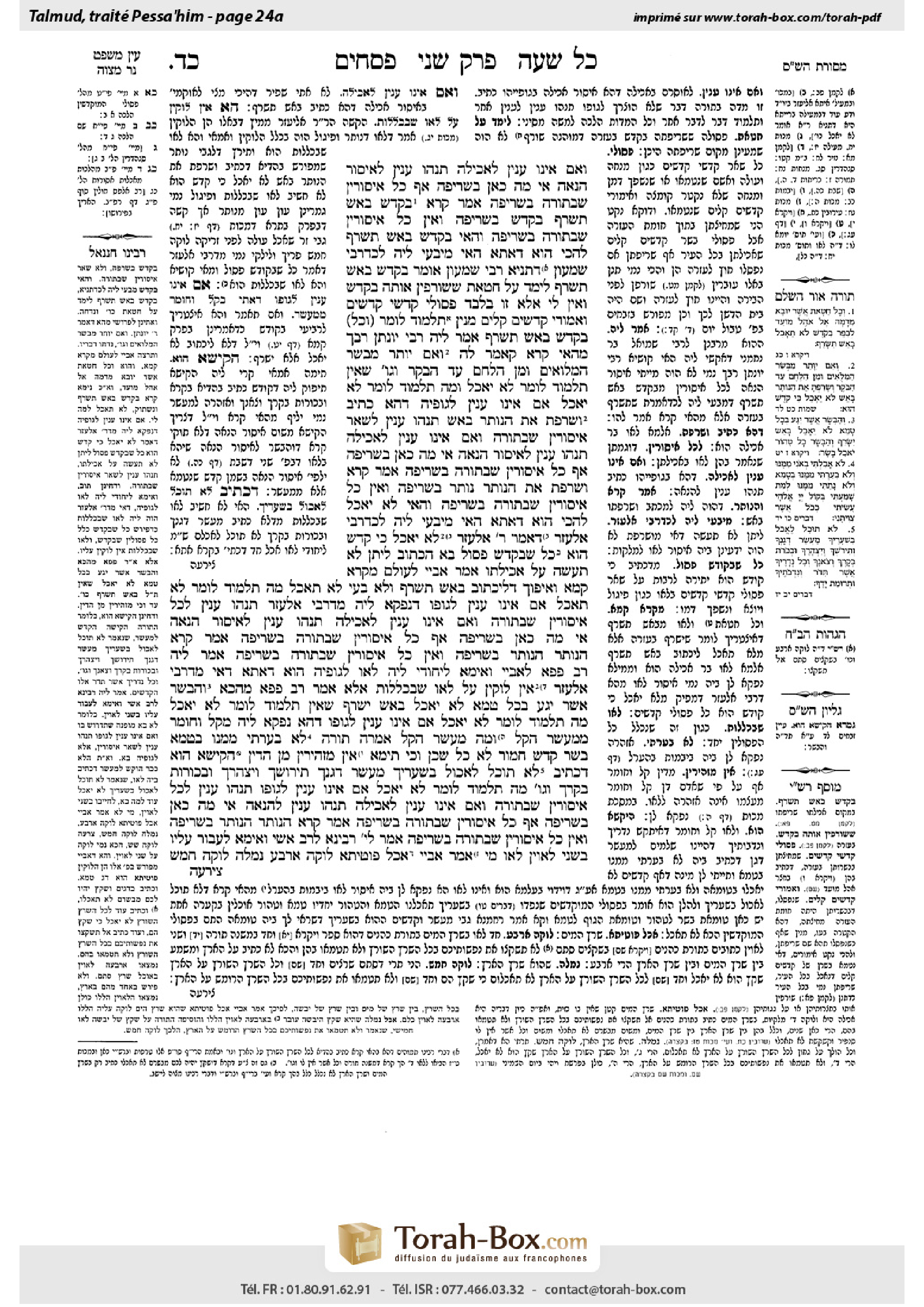
Pesachim 24a: Talmud study for Daf Yomi
Daf Yomi is the daily study of one Talmud folio. Explore 37 tractates with scans, Hebrew text, Sefaria English and AI-generated French translations where annotated.
Passage selection and English or AI-generated French translation are available where the scan has annotations. Daf Study is independent of Torah-Box and Sefaria.
Browse Pesachim · פסחים · All tractatesPesachim 24a text and translations
This page of Pesachim includes the Aramaic text, an English translation and an AI-generated French translation, alongside the scan above.
פסחים כ״ד א · Aramaic and Hebrew text
וְאִם אֵינוֹ עִנְיָן לַאֲכִילָה, תְּנֵהוּ עִנְיָן לְאִיסּוּר הֲנָאָה.
אִי, מָה כָּאן בִּשְׂרֵיפָה — אַף כׇּל אִיסּוּרִין שֶׁבַּתּוֹרָה בִּשְׂרֵיפָה! אָמַר קְרָא ״בַּקֹּדֶשׁ ... בָּאֵשׁ תִּשָּׂרֵף״, בַּקֹּדֶשׁ — בִּשְׂרֵיפָה, וְאֵין כׇּל אִיסּוּרִין שֶׁבַּתּוֹרָה בִּשְׂרֵיפָה.
וְהַאי ״בַּקֹּדֶשׁ ... בָּאֵשׁ תִּשָּׂרֵף״ לְהָכִי הוּא דַּאֲתָא?! הַאי מִיבְּעֵי לֵיהּ לְכִדְרַבִּי שִׁמְעוֹן! דְּתַנְיָא, רַבִּי שִׁמְעוֹן אוֹמֵר: ״בַּקֹּדֶשׁ ... בָּאֵשׁ תִּשָּׂרֵף״ — לִימֵּד עַל חַטָּאת שֶׁשּׂוֹרְפִין אוֹתָהּ בַּקֹּדֶשׁ. וְאֵין לִי אֶלָּא זוֹ בִּלְבַד, פְּסוּלֵי קׇדְשֵׁי קָדָשִׁים וְאֵמוּרֵי קָדָשִׁים קַלִּים מִנַּיִן? תַּלְמוּד לוֹמַר: ״(וְכׇל) בַּקֹּדֶשׁ ... בָּאֵשׁ תִּשָּׂרֵף״.
אֲמַר לֵיהּ, רַבִּי יוֹנָתָן רַבָּךְ מֵהַאי קְרָא קָאָמַר לַהּ: ״וְאִם יִוָּתֵר מִבְּשַׂר הַמִּלֻּאִים וּמִן הַלֶּחֶם עַד הַבֹּקֶר וְגוֹ׳״, שֶׁאֵין תַּלְמוּד לוֹמַר ״לֹא יֵאָכֵל״, וּמָה תַּלְמוּד לוֹמַר ״לֹא יֵאָכֵל״ — אִם אֵינוֹ עִנְיָן לְגוּפֵיהּ, דְּהָא כְּתִיב ״וְשָׂרַפְתָּ אֶת הַנּוֹתָר בָּאֵשׁ״, תְּנֵהוּ עִנְיָן לִשְׁאָר אִיסּוּרִין שֶׁבַּתּוֹרָה. וְאִם אֵינוֹ עִנְיָן לַאֲכִילָה, תְּנֵהוּ עִנְיָן לְאִיסּוּר הֲנָאָה.
אִי, מָה כָּאן בִּשְׂרֵיפָה, אַף כׇּל אִיסּוּרִין שֶׁבַּתּוֹרָה בִּשְׂרֵיפָה! אָמַר קְרָא ״וְשָׂרַפְתָּ אֶת הַנּוֹתָר״ — נוֹתָר בִּשְׂרֵיפָה, וְאֵין כׇּל אִיסּוּרִין שֶׁבַּתּוֹרָה בִּשְׂרֵיפָה.
וְהַאי ״לֹא יֵאָכֵל״ לְהָכִי הוּא דַּאֲתָא? הַאי מִיבְּעֵי לֵיהּ לְכִדְרַבִּי אֶלְעָזָר. דְּאָמַר רַבִּי אֶלְעָזָר: ״לֹא יֵאָכֵל כִּי קֹדֶשׁ הוּא״ — כׇּל שֶׁבַּקֹּדֶשׁ פָּסוּל, בָּא הַכָּתוּב לִיתֵּן לֹא תַעֲשֶׂה עַל אֲכִילָתוֹ.
אָמַר אַבָּיֵי: לְעוֹלָם מִקְרָא קַמָּא, וְאֵיפוֹךְ: דְּלִיכְתּוֹב ״בָּאֵשׁ תִּשָּׂרֵף״, וְלָא בָּעֵי ״לֹא תֵאָכֵל״, מָה תַּלְמוּד לוֹמַר ״לֹא תֵאָכֵל״ — אִם אֵינוֹ עִנְיָן לְגוּפוֹ, דְּנָפְקָא לֵיהּ מִדְּרַבִּי אֶלְעָזָר, תְּנֵהוּ עִנְיָן לְכׇל אִיסּוּרִין שֶׁבַּתּוֹרָה. וְאִם אֵינוֹ עִנְיָן לַאֲכִילָה, תְּנֵהוּ עִנְיָן לְאִיסּוּר הֲנָאָה.
אִי מָה כָּאן בִּשְׂרֵיפָה, אַף כׇּל אִיסּוּרִין שֶׁבַּתּוֹרָה בִּשְׂרֵיפָה. אָמַר קְרָא ״הַנּוֹתָר״ — הַנּוֹתָר בִּשְׂרֵיפָה, וְאֵין כׇּל אִיסּוּרִין שֶׁבַּתּוֹרָה בִּשְׂרֵיפָה.
אֲמַר לֵיהּ רַב פָּפָּא לְאַבָּיֵי: וְאֵימָא לְיַחוֹדֵי לֵיהּ לָאו לְגוּפֵיהּ הוּא דַּאֲתָא, דְּאִי מִדְּרַבִּי אֶלְעָזָר — אֵין לוֹקִין עַל לָאו שֶׁבִּכְלָלוֹת.
אֶלָּא אָמַר רַב פָּפָּא, מֵהָכָא: ״וְהַבָּשָׂר אֲשֶׁר יִגַּע בְּכׇל טָמֵא לֹא יֵאָכֵל בָּאֵשׁ יִשָּׂרֵף״, שֶׁאֵין תַּלְמוּד לוֹמַר ״לֹא יֵאָכֵל״, מַה תַּלְמוּד לוֹמַר ״לֹא יֵאָכֵל״?
אִם אֵינוֹ עִנְיָן לְגוּפוֹ, דְּהָא נָפְקָא לֵיהּ מִקַּל וָחוֹמֶר מִמַּעֲשֵׂר הַקַּל: וּמָה מַעֲשֵׂר הַקַּל, אָמְרָה תּוֹרָה ״לֹא בִעַרְתִּי מִמֶּנּוּ בְּטָמֵא״ — בְּשַׂר קֹדֶשׁ חָמוּר לֹא כׇּל שֶׁכֵּן?!
וְכִי תֵּימָא ״אֵין מַזְהִירִין מִן הַדִּין״. הֶקֵּישָׁא הוּא, דִּכְתִיב: ״לֹא תוּכַל לֶאֱכֹל בִּשְׁעָרֶיךָ מַעְשַׂר דְּגָנְךָ תִּירֹשְׁךָ וְיִצְהָרֶךָ וּבְכֹרֹת בְּקָרְךָ וְגוֹ׳״ —
מָה תַּלְמוּד לוֹמַר ״לֹא יֵאָכֵל״? אִם אֵינוֹ עִנְיָן לְגוּפוֹ, תְּנֵהוּ עִנְיָן לְכׇל אִיסּוּרִין שֶׁבַּתּוֹרָה. וְאִם אֵינוֹ עִנְיָן לַאֲכִילָה, תְּנֵהוּ עִנְיָן לַהֲנָאָה.
אִי, מָה כָּאן בִּשְׂרֵיפָה — אַף כׇּל אִיסּוּרִין שֶׁבַּתּוֹרָה בִּשְׂרֵיפָה! אָמַר קְרָא ״הַנּוֹתָר״ — הַנּוֹתָר בִּשְׂרֵיפָה, וְאֵין כׇּל אִיסּוּרִין שֶׁבַּתּוֹרָה בִּשְׂרֵיפָה.
אֲמַר לֵיהּ רָבִינָא לְרַב אָשֵׁי: וְאֵימָא, לַעֲבוֹר עָלָיו בִּשְׁנֵי לָאוִין. לָאו מִי אָמַר אַבָּיֵי: אָכַל פּוּטִיתָא — לוֹקֶה אַרְבַּע.
נְמָלָה — לוֹקֶה חָמֵשׁ.
Pesachim 24a · English translation
And if it does not apply to the matter of the prohibition against eating, as the prohibition against eating these items has already been mentioned, apply it to the matter of the prohibition of deriving benefit.
The Gemara continues: Lest one say that the verse indicates that just as here, the sin-offering is disposed of with burning, so too, all the prohibited items in the Torah must be disposed of with burning, therefore the verse said: “In the sacred place…shall be burnt with fire” (Leviticus 6:23). This indicates that only that which is disqualified in the sacred place is disposed of with burning, but all other prohibited items in the Torah need not be disposed of with burning.
Rabbi Shmuel bar Naḥmani asked: And did this verse: “In the sacred place…shall be burnt with fire,” come to teach this halakha? It is needed to teach in accordance with the opinion of Rabbi Shimon, as it was taught in a baraita that Rabbi Shimon says: “In the sacred place…shall be burnt with fire”; this taught that one must burn a disqualified sin-offering in the sacred place, and not outside the Temple. And I have only derived this, meaning the sin-offering. From where do I derive that disqualified offerings of the most sacred order and portions consumed on the altar, such as the fats of offerings of minor sanctity that become impure, are burned in the Temple courtyard? The verse states: “In the sacred place…shall be burnt with fire.” This indicates that any disqualified offering must be burned in the sacred place.
The Sage who taught this halakha to Rabbi Shmuel bar Naḥmani said to him: Rabbi Yonatan, your teacher, said that same halakha from this verse: “And if the flesh of the consecration offering, or of the bread, remains until the morning, then you shall burn the leftover with fire; it shall not be eaten, because it is sacred” (Exodus 29:34). As there is no need for the verse to state: “It shall not be eaten,” what is the meaning when the verse states: “It shall not be eaten”? If it does not refer to the subject matter itself, as it is already written explicitly: “Then you shall burn the leftover with fire,” which indicates that one may not eat it, refer it to the matter of the other prohibitions in the Torah. And if it does not refer to the matter of the prohibition against eating, as eating these items is explicitly prohibited, refer it to the matter of the prohibition of deriving benefit. This indicates that it is prohibited for one to derive benefit from any item that it is prohibited for him to eat.
The Gemara continues: Lest one say that the verse indicates that just as here, the sin-offering is disposed of with burning, so too, all the prohibited items in the Torah, from which one may not benefit, must be disposed of with burning, therefore the verse said: “You shall burn the leftover,” indicating that the leftover sacrificial meat must be disposed of with burning; however, all other prohibitions in the Torah need not be disposed of with burning, despite the fact that it is prohibited to derive benefit from them.
The Gemara challenges: And did this phrase: “It shall not be eaten,” come to teach this prohibition against deriving benefit? This phrase is needed to teach in accordance with the opinion of Rabbi Elazar, as Rabbi Elazar said with regard to the statement in the verse: “It shall not be eaten, because it is sacred,” that the verse comes to place a negative mitzva of eating on whatever has been rendered disqualified in the sacred place. In other words, this verse teaches a general halakha that one who eats from offerings that have been disqualified in the Temple transgresses a negative mitzva and is liable to be flogged. It teaches nothing with regard to a prohibition against deriving benefit.
Abaye said: Actually, derive this halakha from the first verse cited by Rabbi Yehoshua ben Levi: “And any sin-offering, of which any of the blood is brought into the tent of meeting to make atonement in the sacred place, shall not be eaten; it shall be burnt with fire” (Leviticus 6:23). And reverse the construct of his exposition. Let the verse write: “It shall be burnt with fire,” and it will not need to write: “Shall not be eaten.” For what purpose then does the verse state: “It shall not be eaten”? If it does not apply to the subject matter itself, as that was already derived from the statement of Rabbi Elazar that whatever has been rendered disqualified in the sacred place may not be eaten, apply it to all other prohibitions in the Torah, including leavened bread on Passover and a stoned ox. And if it does not apply to the prohibition against eating, which is written explicitly, then apply it to the prohibition of deriving benefit.
The Gemara asks: Lest one say that the verse indicates that just as here, the leftover sacrificial meat is disposed of with burning, so too, all the prohibited items in the Torah, from which one may not benefit, must be disposed of with burning, therefore the verse said: “You shall burn the leftover,” indicating that the leftover sacrificial meat must be disposed of with burning; however, all other prohibited items in the Torah need not be disposed of with burning.
Rav Pappa said to Abaye: And why do you hold that the phrase: “You shall not eat,” describing the sin-offering that was sacrificed inside the Sanctuary, is not needed for other purposes? Say that this expression comes in order to designate a negative mitzva for this prohibition itself. As, if this prohibition were derived only from the source quoted by Rabbi Elazar, there will be a prohibition to eat the meat of the sin-offering whose blood was brought into the sanctuary; however, one would not be liable to be flogged for violating it, because one is not flogged for violating a negative mitzva stated in general terms. One is not flogged for violating a negative mitzva that contains several different prohibitions, such as this one, which refers to all disqualified offerings. This is because the negative mitzva is formulated too broadly. Therefore, it is possible to say that when the Torah states: “You shall not eat” with regard to this issue, it is teaching that there is a particular prohibition here and that one is flogged for violating it. If so, the verse cannot indicate a general prohibition against deriving benefit.
Rather, this suggestion should be rejected, and Rav Pappa said that one derives this halakha from here: “And the flesh that touches any impure thing shall not be eaten; it shall be burnt with fire. And as for the flesh, every one that is pure may eat of it” (Leviticus 7:19). As there is no need for the verse to state: “It shall not be eaten,” what does it mean when the verse states: “It shall not be eaten”?
If it does not refer to the subject matter itself, as that can be derived by means of an a fortiori inference from the second tithe, the halakhot of which are more lenient than those of offerings, then it must refer to something else. As it is possible to say: If with regard to the second tithe, which is more lenient because it does not have the status of an offering, the Torah said that when one recites the confession over the tithes, when destroying the tithes remaining in one’s possession that had not yet been given to the appropriate recipient, he says: “I have not eaten from it in my mourning, neither have I removed it while impure” (Deuteronomy 26:14), indicating that it is prohibited for one to remove tithes while impure, then with regard to consecrated meat, which is more stringent, all the more so is it not clear that it may not be eaten while a person is impure?
And if you say that there is a general principle that we do not warn, i.e., we may not deduce a prohibition, through logical derivation alone, then one could respond that his issue is not only derived through an a fortiori inference; rather, it is also derived from an analogy based on a juxtaposition. As it is written: “You may not eat within your gates the tithe of your grain, or of your wine, or of your oil, or the firstborn of your herd or of your flock, nor any of your vows which you have vowed, nor your voluntary offerings, nor the offering of your hand” (Deuteronomy 12:17). Since the verse itself juxtaposes tithes to offerings, it indicates that there is a prohibition with regard to offerings just as there is with regard to tithes.
The Gemara continues explaining Rav Pappa’s opinion: For what purpose then does the verse state: “It shall not be eaten” with regard to impure consecrated meat? If it does not apply to the subject matter of this verse itself, as that prohibition is derived from the second tithe, then apply it to the matter of all prohibited items in the Torah. And if it does not apply to the prohibition against eating, since that is clear, apply it to the prohibition of deriving benefit.
And if you say: Lest one say that the verse indicates that just as here, the meat that became impure in the Temple is disposed of with burning, so too, all the prohibited items in the Torah must be disposed of with burning, therefore the verse said: “The leftover,” indicating that the leftover sacrificial meat must be disposed of with burning; however, all other prohibited items in the Torah need not be disposed of with burning.
Ravina said to Rav Ashi: And say that this expression: “It shall not be eaten,” comes to teach not the prohibition against deriving benefit, but rather that one who transgresses this negative mitzva violates two prohibitions. And there is precedent for such an explanation, as didn’t Abaye say with regard to a parallel case: If one ate a small water creature [putita], he is flogged with four sets of lashes because one violates four prohibitions when eating such a creature? Two of these prohibitions are found in the verse that discusses all types of creeping animals: “You shall not make yourselves detestable with any swarming thing that swarms, neither shall you make yourselves impure with them, that you should be defiled by them” (Leviticus 11:43). A third prohibition applies to creeping animals that live in the water, as the verses say: “And all that have neither fins nor scales…They shall be a detestable thing unto you; you shall not eat of their flesh” (Leviticus 11:10–11). A fourth prohibition is cited in the verse: “And whatever does not have fins and scales you shall not eat; it is impure unto you” (Deuteronomy 14:10).
Similarly, if one ate an ant, he is flogged with five sets of lashes, two sets for the previously mentioned prohibitions of eating a creeping animal, a third based on the verse: “And every creeping thing that swarms upon the earth is a detestable thing; it shall not be eaten” (Leviticus 11:41), and a fourth based on the verse: “All creeping things that swarm upon the earth, them you shall not eat; for they are a detestable thing” (Leviticus 11:42). A fifth prohibition is stated in the verse: “You shall not make yourselves impure through every creeping thing that swarms upon the earth” (Leviticus 11:44).
Pesachim 24a · Traduction française (IA)
Et si cela ne concerne pas l’interdiction de manger, puisque celle-ci a déjà été mentionnée à propos de ces éléments, que cela concerne l’interdiction d’en tirer profit.
La Guemara poursuit : De peur que l’on dise que le verset indique que, de même qu’ici, le sacrifice expiatoire est éliminé par le feu, de même tous les éléments interdits par la Torah doivent être éliminés par le feu, le verset dit donc : « Dans le lieu saint… il sera brûlé par le feu » (Lévitique 6:23). Cela indique que seul ce qui est invalidé dans le lieu saint doit être éliminé par le feu, tandis que les autres éléments interdits par la Torah n’ont pas à l’être.
Rabbi Shmuel bar Naḥmani demanda : Le verset « Dans le lieu saint… il sera brûlé par le feu » vient-il enseigner cette halakha ? Il est nécessaire pour enseigner selon l’opinion de Rabbi Shimon, comme il a été enseigné dans une baraïta : Rabbi Shimon dit : « Dans le lieu saint… il sera brûlé par le feu. » Cela enseigne qu’un sacrifice expiatoire invalidé doit être brûlé dans le lieu saint, et non à l’extérieur du Temple. Or, je n’ai déduit que cela, c’est-à-dire le cas du sacrifice expiatoire. D’où déduis-je que les offrandes de très haute sainteté invalidées et les parts destinées à être consumées sur l’autel, telles que les graisses d’offrandes de moindre sainteté devenues impures, doivent être brûlées dans la cour du Temple ? Le verset dit : « Dans le lieu saint… il sera brûlé par le feu. » Cela indique que toute offrande invalidée doit être brûlée dans le lieu saint.
Le Sage qui avait enseigné cette halakha à Rabbi Shmuel bar Naḥmani lui dit : Rabbi Yonatan, ton maître, a enseigné cette même halakha à partir de ce verset : « Si la chair de l’offrande d’investiture ou du pain reste jusqu’au matin, tu brûleras le reste par le feu ; il ne sera pas mangé, car il est saint » (Exode 29:34). Puisqu’il n’est pas nécessaire que le verset précise : « Il ne sera pas mangé », que signifie cette précision ? Si elle ne concerne pas le sujet lui-même, puisqu’il est déjà écrit explicitement : « Tu brûleras le reste par le feu », ce qui indique qu’on ne peut pas le manger, qu’elle concerne les autres interdictions de la Torah. Et si elle ne concerne pas l’interdiction de manger, puisque celle-ci est déjà explicite pour ces éléments, qu’elle concerne l’interdiction d’en tirer profit. Cela indique qu’il est interdit de tirer profit de tout élément qu’il est interdit de manger.
La Guemara poursuit : De peur que l’on dise que le verset indique que, de même qu’ici, le sacrifice expiatoire est éliminé par le feu, de même tous les éléments interdits par la Torah dont il est interdit de tirer profit doivent être éliminés par le feu, le verset dit donc : « Tu brûleras le reste », ce qui indique que les restes de la viande sacrificielle doivent être éliminés par le feu. Cependant, les autres éléments interdits par la Torah n’ont pas à l’être, bien qu’il soit interdit d’en tirer profit.
La Guemara objecte : L’expression « Il ne sera pas mangé » vient-elle enseigner cette interdiction d’en tirer profit ? Elle est nécessaire pour enseigner selon l’opinion de Rabbi Elazar. En effet, Rabbi Elazar a dit au sujet de la formule du verset « Il ne sera pas mangé, car il est saint » que le verset institue une mitsva négative concernant tout ce qui a été invalidé dans le lieu saint. Autrement dit, ce verset enseigne une halakha générale : celui qui mange des offrandes invalidées dans le Temple transgresse une mitsva négative et encourt la flagellation. Il n’enseigne rien au sujet de l’interdiction d’en tirer profit.
Abayé dit : En réalité, déduis cette halakha du premier verset cité par Rabbi Yehoshua ben Levi : « Tout sacrifice expiatoire dont une partie du sang est apportée dans la tente d’assignation pour faire l’expiation dans le lieu saint ne sera pas mangé ; il sera brûlé par le feu » (Lévitique 6:23). Et inverse la structure de son interprétation. Que le verset écrive : « Il sera brûlé par le feu », sans avoir besoin d’écrire : « Il ne sera pas mangé ». Pourquoi donc le verset précise-t-il : « Il ne sera pas mangé » ? Si cela ne concerne pas le sujet lui-même, puisqu’on l’a déjà déduit de l’enseignement de Rabbi Elazar selon lequel tout ce qui a été invalidé dans le lieu saint ne peut pas être mangé, que cela concerne toutes les autres interdictions de la Torah, notamment le pain levé à Pessa’h et un bœuf lapidé. Et si cela ne concerne pas l’interdiction de manger, qui est explicitement énoncée, que cela concerne l’interdiction d’en tirer profit.
La Guemara demande : De peur que l’on dise que le verset indique que, de même qu’ici, les restes de la viande sacrificielle sont éliminés par le feu, de même tous les éléments interdits par la Torah dont il est interdit de tirer profit doivent être éliminés par le feu, le verset dit donc : « Tu brûleras le reste », ce qui indique que les restes de la viande sacrificielle doivent être éliminés par le feu. Cependant, les autres éléments interdits par la Torah n’ont pas à l’être.
Rav Pappa dit à Abayé : Pourquoi considères-tu que l’expression « Tu ne mangeras pas », qui décrit le sacrifice expiatoire offert à l’intérieur du Sanctuaire, n’est pas nécessaire à d’autres fins ? Dis plutôt que cette expression vient instituer une mitsva négative propre à cette interdiction. En effet, si cette interdiction était déduite uniquement de la source citée par Rabbi Elazar, il serait interdit de manger la viande du sacrifice expiatoire dont le sang a été apporté dans le Sanctuaire ; cependant, on n’encourrait pas la flagellation pour l’avoir transgressée, car on ne flagelle pas pour la transgression d’une mitsva négative formulée en termes généraux. On ne flagelle pas pour la transgression d’une mitsva négative qui englobe plusieurs interdictions différentes, comme celle-ci, qui concerne toutes les offrandes invalidées, car elle est formulée de manière trop générale. On peut donc dire que, lorsque la Torah dit à ce sujet : « Tu ne mangeras pas », elle enseigne qu’il existe ici une interdiction particulière et que celui qui la transgresse encourt la flagellation. Si tel est le cas, le verset ne peut pas indiquer une interdiction générale d’en tirer profit.
Il faut plutôt rejeter cette proposition. Rav Pappa dit que l’on déduit cette halakha d’ici : « La chair qui touche quoi que ce soit d’impur ne sera pas mangée ; elle sera brûlée par le feu. Quant à la chair, toute personne pure peut en manger » (Lévitique 7:19). Puisqu’il n’est pas nécessaire que le verset précise : « Elle ne sera pas mangée », que signifie cette précision ?
Si cela ne concerne pas le sujet lui-même, puisque cela peut être déduit par un raisonnement a fortiori à partir de la seconde dîme, dont les lois sont moins strictes que celles des offrandes, cela doit nécessairement concerner autre chose. On peut en effet dire : si, à propos de la seconde dîme, qui est moins stricte parce qu’elle n’a pas le statut d’une offrande, la Torah dit que, lorsqu’on récite la déclaration sur les dîmes, au moment de détruire les dîmes encore en sa possession et qui n’ont pas encore été remises à leur destinataire, on dit : « Je n’en ai pas mangé dans mon deuil, je n’en ai rien retiré alors que j’étais impur » (Deutéronome 26:14), ce qui indique qu’il est interdit de retirer les dîmes lorsqu’on est impur, alors, à plus forte raison, est-il évident que la viande consacrée, qui est soumise à des règles plus strictes, ne peut être mangée par une personne impure ?
Et si tu dis qu’il existe un principe général selon lequel on ne formule pas d’avertissement, c’est-à-dire qu’on ne peut pas déduire une interdiction du seul raisonnement logique, on peut répondre que cette interdiction n’est pas déduite uniquement par un raisonnement a fortiori ; elle est également déduite d’une analogie fondée sur une juxtaposition. Car il est écrit : « Vous ne mangerez pas dans tes villes la dîme de ton blé, de ton vin ou de ton huile, ni les premiers-nés de ton gros ou de ton petit bétail, ni aucun de tes vœux que tu auras faits, ni tes offrandes volontaires, ni l’offrande de ta main » (Deutéronome 12:17). Puisque le verset juxtapose lui-même les dîmes aux offrandes, cela indique qu’il existe une interdiction concernant les offrandes, tout comme il en existe une concernant les dîmes.
La Guemara poursuit en expliquant l’opinion de Rav Pappa : Pourquoi donc le verset précise-t-il, à propos de la viande consacrée devenue impure : « Elle ne sera pas mangée » ? Si cela ne concerne pas le sujet même de ce verset, puisque cette interdiction est déduite de la seconde dîme, que cela concerne tous les éléments interdits par la Torah. Et si cela ne concerne pas l’interdiction de manger, puisque celle-ci est évidente, que cela concerne l’interdiction d’en tirer profit.
Et si tu dis : De peur que l’on dise que le verset indique que, de même qu’ici, la viande devenue impure dans le Temple est éliminée par le feu, de même tous les éléments interdits par la Torah doivent être éliminés par le feu, le verset dit donc : « Le reste », ce qui indique que les restes de la viande sacrificielle doivent être éliminés par le feu. Cependant, les autres éléments interdits par la Torah n’ont pas à l’être.
Ravina dit à Rav Ashi : Dis plutôt que cette expression, « Elle ne sera pas mangée », vient enseigner non pas l’interdiction d’en tirer profit, mais que celui qui transgresse cette mitsva négative enfreint deux interdictions. Une telle explication a un précédent : Abayé n’a-t-il pas dit, à propos d’un cas analogue, que si quelqu’un mange une petite créature aquatique [putita], il encourt quatre séries de flagellation, car manger une telle créature enfreint quatre interdictions ? Deux de ces interdictions figurent dans le verset qui traite de toutes les sortes d’animaux grouillants : « Ne vous rendez pas abominables par aucune bestiole qui pullule, et ne vous rendez pas impurs par elles, de peur que vous ne soyez souillés par elles » (Lévitique 11:43). Une troisième interdiction s’applique aux animaux grouillants qui vivent dans l’eau, comme le disent les versets : « Et tous ceux qui n’ont ni nageoires ni écailles… Ils seront une abomination pour vous ; vous ne mangerez pas de leur chair » (Lévitique 11:10–11). Une quatrième interdiction est mentionnée dans le verset : « Tout ce qui n’a ni nageoires ni écailles, vous ne le mangerez pas ; il est impur pour vous » (Deutéronome 14:10).
De même, si quelqu’un mange une fourmi, il encourt cinq séries de flagellation : deux séries pour les interdictions de manger un animal grouillant mentionnées précédemment, une troisième en vertu du verset : « Toute bestiole qui pullule sur la terre est une abomination ; elle ne sera pas mangée » (Lévitique 11:41), et une quatrième en vertu du verset : « Toutes les bestioles qui pullulent sur la terre, vous ne les mangerez pas, car elles sont une abomination » (Lévitique 11:42). Une cinquième interdiction est énoncée dans le verset : « Vous ne vous rendrez pas impurs par toute bestiole qui pullule sur la terre » (Lévitique 11:44).
Traduction française générée par IA à partir de l’édition anglaise de Sefaria. Vérifie toujours un passage avec le texte source.
Text from Sefaria: William Davidson Edition - Vocalized Aramaic (CC BY NC); William Davidson Edition - English (CC BY NC).