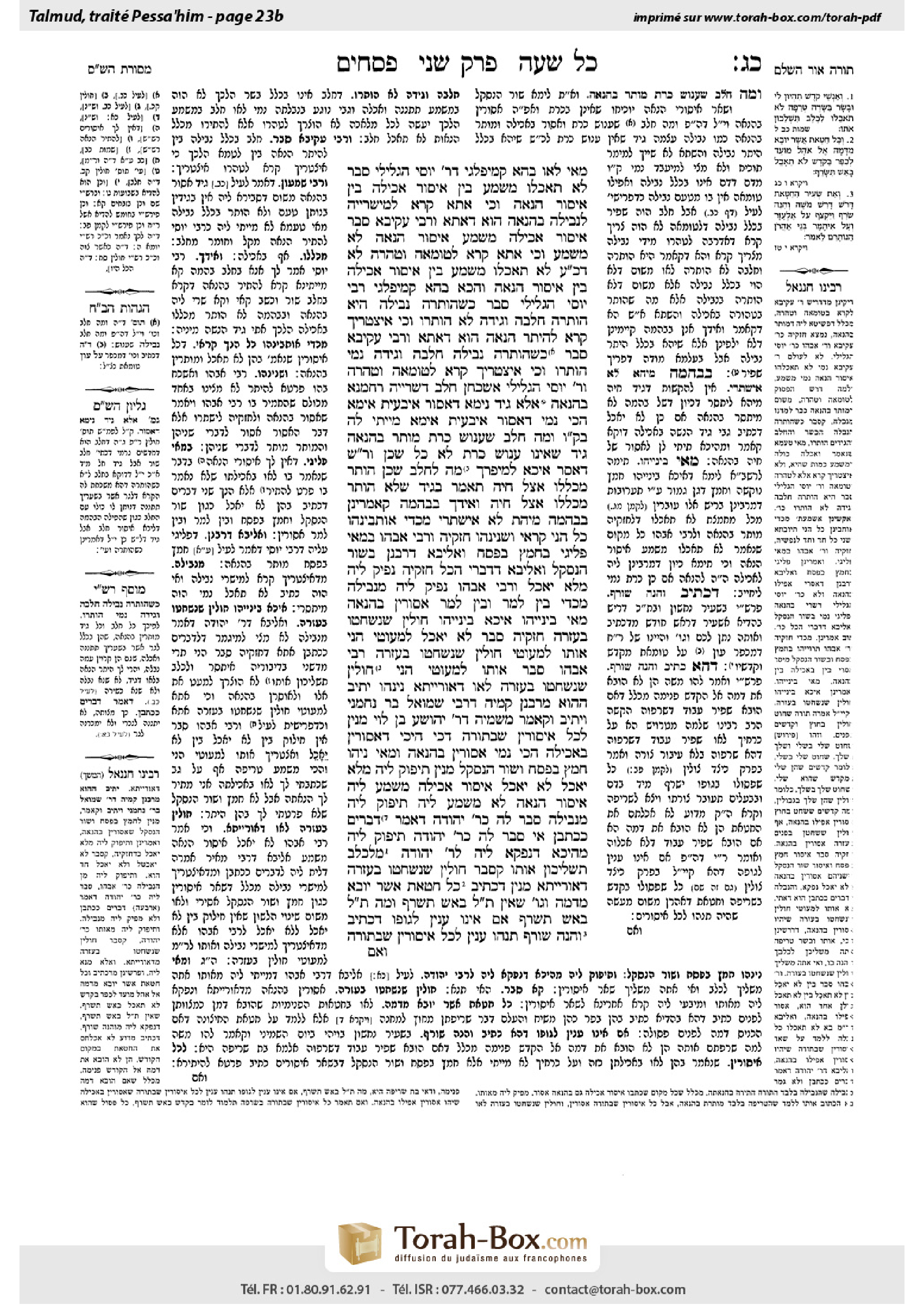
Pesachim 23b: Talmud study for Daf Yomi
Daf Yomi is the daily study of one Talmud folio. Explore 37 tractates with scans, Hebrew text, Sefaria English and AI-generated French translations where annotated.
Passage selection and English or AI-generated French translation are available where the scan has annotations. Daf Study is independent of Torah-Box and Sefaria.
Browse Pesachim · פסחים · All tractatesPesachim 23b text and translations
This page of Pesachim includes the Aramaic text, an English translation and an AI-generated French translation, alongside the scan above.
פסחים כ״ג ב · Aramaic and Hebrew text
מַאי לָאו בְּהָא קָמִיפַּלְגִי, דְּרַבִּי יוֹסֵי הַגְּלִילִי סָבַר: ״לֹא תֹאכְלוּ״ מַשְׁמַע בֵּין אִיסּוּר אֲכִילָה בֵּין אִיסּוּר הֲנָאָה, וְכִי אֲתָא קְרָא לְמִישְׁרְיַיהּ לִנְבֵילָה — בַּהֲנָאָה הוּא דַּאֲתָא. וְרַבִּי עֲקִיבָא סָבַר: אִיסּוּר אֲכִילָה — מַשְׁמַע, אִיסּוּר הֲנָאָה לָא מַשְׁמַע. וְכִי אֲתָא קְרָא — לְטוּמְאָה וְטׇהֳרָה.
לָא, דְּכוּלֵּי עָלְמָא ״לֹא תֹאכְלוּ״ מַשְׁמַע בֵּין אִיסּוּר אֲכִילָה בֵּין אִיסּוּר הֲנָאָה. וְהָכָא בְּהָא קָמִיפַּלְגִי, רַבִּי יוֹסֵי הַגְּלִילִי סָבַר: כְּשֶׁהוּתְּרָה נְבֵילָה — הִיא הוּתְּרָה, חֶלְבָּהּ וְגִידָהּ — לֹא הוּתְּרוּ. וְכִי אִיצְטְרִיךְ קְרָא — לְהֶיתֵּר הֲנָאָה הוּא דַּאֲתָא. וְרַבִּי עֲקִיבָא סָבַר: כְּשֶׁהוּתְּרָה נְבֵילָה — חֶלְבָּהּ וְגִידָהּ נָמֵי הוּתְּרוּ. וְכִי אִיצְטְרִיךְ קְרָא — לְטוּמְאָה וְטׇהֳרָה.
וְרַבִּי יוֹסֵי הַגְּלִילִי, אַשְׁכְּחַן חֵלֶב דְּשַׁרְיֵיהּ רַחֲמָנָא בַּהֲנָאָה, אֶלָּא גִּיד נֵימָא דְּאָסוּר! אִיבָּעֵית אֵימָא: הָכִי נָמֵי דְּאָסוּר. אִיבָּעֵית אֵימָא, מַיְיתֵי לַהּ בְּקַל וָחוֹמֶר: וּמָה חֵלֶב שֶׁעָנוּשׁ כָּרֵת — מוּתָּר בַּהֲנָאָה, גִּיד שֶׁאֵינוֹ עָנוּשׁ כָּרֵת — לֹא כׇּל שֶׁכֵּן.
וְרַבִּי שִׁמְעוֹן דְּאָסַר? אִיכָּא לְמִיפְרַךְ, מָה לְחֵלֶב שֶׁכֵּן הוּתַּר מִכְּלָלוֹ אֵצֶל חַיָּה, תֹּאמַר בְּגִיד שֶׁלֹּא הוּתַּר מִכְּלָלוֹ אֵצֶל חַיָּה.
וְאִידַּךְ? בִּבְהֵמָה קָאָמְרִינַן — בִּבְהֵמָה מִיהַת לָא אִישְׁתְּרִי.
מִכְּדֵי אוֹתְבִינְהוּ כׇּל הָנֵי קְרָאֵי וְשַׁנִּינְהוּ. חִזְקִיָּה וְרַבִּי אֲבָהוּ בְּמַאי פְּלִיגִי! בְּחָמֵץ בַּפֶּסַח וְאַלִּיבָּא דְרַבָּנַן, בְּשׁוֹר הַנִּסְקָל וְאַלִּיבָּא דְּדִבְרֵי הַכֹּל. חִזְקִיָּה נָפֵיק לֵיהּ מִ״לֹּא יֵאָכֵל״, וְרַבִּי אֲבָהוּ נָפֵיק לֵיהּ מִנְּבֵילָה.
מִכְּדִי בֵּין לְמָר וּבֵין לְמָר אֲסוּרִין בַּהֲנָאָה, מַאי בֵּינַיְיהוּ? אִיכָּא בֵּינַיְיהוּ חוּלִּין שֶׁנִּשְׁחֲטוּ בָּעֲזָרָה. חִזְקִיָּה סָבַר: ״לֹא יֵאָכֵל״ — לְמַעוֹטֵי הָנֵי, ״אֹתוֹ״ — לְמַעוֹטֵי חוּלִּין שֶׁנִּשְׁחֲטוּ בַּעֲזָרָה.
רַבִּי אֲבָהוּ סָבַר: ״אֹתוֹ״ — לְמַעוֹטֵי הָנֵי, חוּלִּין שֶׁנִּשְׁחֲטוּ בַּעֲזָרָה לָאו דְּאוֹרָיְיתָא נִינְהוּ.
יָתֵיב הָהוּא מֵרַבָּנַן קַמֵּיהּ דְּרַבִּי שְׁמוּאֵל בַּר נַחְמָנִי, וְיָתֵיב וְקָאָמַר מִשְּׁמֵיהּ דְּרַבִּי יְהוֹשֻׁעַ בֶּן לֵוִי: מִנַּיִן לְכׇל אִיסּוּרִין שֶׁבַּתּוֹרָה דְּכִי הֵיכִי דַּאֲסוּרִין בַּאֲכִילָה הָכִי נָמֵי אֲסוּרִין בַּהֲנָאָה? וּמַאי נִיהוּ — חָמֵץ בַּפֶּסַח וְשׁוֹר הַנִּסְקָל. מִנַּיִן?! תִּיפּוֹק לֵיהּ מִ״לֹּא יֵאָכֵל״! ״לֹא יֵאָכֵל״, אִיסּוּר אֲכִילָה — מַשְׁמַע לֵיהּ, אִיסּוּר הֲנָאָה — לָא מַשְׁמַע לֵיהּ.
תִּיפּוֹק לֵיהּ מִנְּבֵילָה?! סָבַר לַהּ כְּרַבִּי יְהוּדָה, דְּאָמַר: דְּבָרִים כִּכְתָבָן.
אִי סָבַר לַהּ כְּרַבִּי יְהוּדָה, תִּיפּוֹק לֵיהּ מֵהֵיכָא דְּנָפְקָא לֵיהּ לְרַבִּי יְהוּדָה, מִ״לַּכֶּלֶב תַּשְׁלִיכוּן אֹתוֹ״!
קָסָבַר: חוּלִּין שֶׁנִּשְׁחֲטוּ בָּעֲזָרָה דְּאוֹרָיְיתָא. מִנַּיִן, דִּכְתִיב: ״כׇּל חַטָּאת אֲשֶׁר יוּבָא מִדָּמָהּ וְגוֹ׳״.
שֶׁאֵין תַּלְמוּד לוֹמַר ״בָּאֵשׁ תִּשָּׂרֵף״, וּמָה תַּלְמוּד לוֹמַר ״בָּאֵשׁ תִּשָּׂרֵף״? אִם אֵינוֹ עִנְיָן לְגוּפוֹ, דִּכְתִיב ״וְהִנֵּה שֹׂרָף״, תְּנֵהוּ עִנְיָן לְכׇל אִיסּוּרִין שֶׁבַּתּוֹרָה.
Pesachim 23b · English translation
The Gemara asks: What, is it not that they disagree about this, the following issue? Rabbi Yosei HaGelili holds: “You shall not eat” indicates both the prohibition of eating and the prohibition of deriving benefit; therefore, one may not derive benefit from an animal carcass. And when the verse came and said: “For any other service,” it came to permit one to derive benefit from an animal carcass. And Rabbi Akiva holds: “You shall not eat” indicates that there is only a prohibition of eating; it does not indicate a prohibition of deriving benefit. Therefore, no verse is necessary to learn that it is permitted to derive benefit from an animal carcass. When the verse came and said: “For any other service,” it came to teach about the halakhot of ritual purity and impurity. Apparently, there is a tannaitic dispute about the meaning of the words: “You shall not eat.”
The Gemara rejects this assumption. No, it is possible to say that everyone holds that “You shall not eat” indicates both a prohibition of eating and a prohibition of deriving benefit. And here, they disagree about this: Rabbi Yosei HaGelili holds that when it was permitted to derive benefit from an animal carcass, the carcass itself was permitted; however, its fat and its sinews were not permitted. And the phrase “for any other service” in the verse is necessary to permit one to derive benefit from this fat. However, Rabbi Akiva holds: When it was permitted to derive benefit from an animal carcass, it was also permitted to derive benefit from its fat and sinews. Therefore, the phrase “for any other service” in the verse is necessary for the issue of purity and impurity.
The Gemara asks: And according to the opinion of Rabbi Yosei HaGelili, we find that the Merciful One explicitly permits one to derive benefit from fat; however, let us say that the sinew of the sciatic nerve is prohibited. The Gemara answers: If you wish, say that it is indeed so that it is prohibited to derive benefit from the sciatic nerve. And if you wish, say instead that one is permitted to derive benefit from the sciatic nerve, and Rabbi Yosei HaGelili derives that the sciatic nerve is permitted through an a fortiori inference: If with regard to forbidden fat, for which one is punished with karet if he eats it intentionally, it is permitted to derive benefit, with regard to the sciatic nerve, for which the punishment for one who eats it is not karet, all the more so is it not clear that it is permitted to derive benefit?
The Gemara asks: And why does Rabbi Shimon, who prohibits deriving benefit from the sciatic nerve, not accept this a fortiori inference? The Gemara answers: This inference can be refuted, as it is possible to say: What is unique to fat? It is that it is released from its general prohibition with regard to non-domesticated animals, as the prohibition only applies to the fats of kosher domesticated animals. Can you say the same with regard to the sciatic nerve, which is not released from its general prohibition with regard to non-domesticated animals and remains prohibited? Apparently, in some ways the prohibition of the sciatic nerve is more stringent than that of fat.
The Gemara asks: And how does the other Sage, Rabbi Yosei, who permits one to derive benefit from the sciatic nerve based on this a fortiori inference, respond? The Gemara says: When we state this a fortiori inference, it is with regard to a domesticated animal; in any case, with regard to a domesticated animal its fat is not permitted. Since with regard to a domesticated animal the prohibition of fat is more stringent than that of the sciatic nerve, the a fortiori inference is valid.
After discussing numerous cases that involve prohibitions of eating and deriving benefit, the Gemara asks: Since we raised objections from all of these verses and answered them, and in every case it is apparent that despite the fact that the verse said: “You shall not eat” there was no dispute as to whether or not one may derive benefit from these items, then with regard to what issue do Ḥizkiya and Rabbi Abbahu disagree? The Gemara answers: They disagree with regard to leavened bread on Passover, in accordance with the opinion of the Rabbis, who prohibit one to derive benefit from it; and they disagree with regard to an ox that is stoned, in accordance with everyone. The Gemara explains: Ḥizkiya derived that it is prohibited to derive benefit in this case from the words: “It shall not be eaten,” and Rabbi Abbahu derived that it is prohibited from the fact that the Torah explicitly had to permit one to derive benefit in the case of an animal carcass.
The Gemara asks: Now, both according to the one Master and according to the other Master, it is prohibited to derive benefit from these items. The fact that they disagree about the source of this halakha notwithstanding, what is the practical difference between them? The Gemara answers: The practical difference between them is with regard to non-sacrificial animals that were slaughtered in the Temple courtyard. Ḥizkiya holds: “It shall not be eaten” comes to exclude these cases of leavened bread and the ox that is stoned. Although in most cases a prohibition against eating does not extend to a prohibition against deriving benefit, the language of the verse in these cases indicates that there is a prohibition against deriving benefit as well. Furthermore, “It shall be thrown to the dog” comes to exclude non-sacrificial animals slaughtered in the Temple courtyard, indicating that it is prohibited to derive benefit from them.
However, Rabbi Abbahu holds that according to Rabbi Yehuda, who maintained that the prohibition against eating an animal carcass cannot be used to derive the prohibition against deriving benefit: “It shall be thrown to the dog” comes to exclude these two cases, leavened bread and an ox that is stoned, where deriving benefit is prohibited. And the prohibition to derive benefit from non-sacrificial animals slaughtered in the Temple courtyard is not by Torah law, as there is no source from which to derive this prohibition. Therefore, the only practical difference between them is whether the prohibition of deriving benefit from non-sacrificial animals slaughtered in the Temple courtyard is by Torah law or by rabbinic law.
The Gemara relates: One of the Sages sat before Rabbi Shmuel bar Naḥmani, and he sat and said in the name of Rabbi Yehoshua ben Levi: From where is it derived with regard to all the prohibitions in the Torah that just as it is prohibited to eat them, so too, it is prohibited to benefit from them? And what are the prohibited objects to which this statement refers? They are leavened bread on Passover and an ox that is stoned. The Gemara asks: Why ask from where? Derive the prohibition from the phrase: “It shall not be eaten.” The Gemara answers that he derived a prohibition of eating this item from: “It shall not be eaten”; however, he did not derive a prohibition of deriving benefit from this phrase.
The Gemara challenges: Derive this general prohibition against deriving benefit from the fact that the Torah had to explicitly permit one to benefit from an animal carcass. The Gemara answers: Rabbi Yehoshua ben Levi holds in accordance with the opinion of Rabbi Yehuda, who said with regard to an animal carcass: The matters are as they are written, and the words in the verse do not indicate anything beyond their simple meaning.
The Gemara challenges: If he holds in accordance with the opinion of Rabbi Yehuda, then let him derive this halakha from where Rabbi Yehuda derives it, i.e., from the verse: “And you shall be sacred men unto Me; therefore you shall not eat any flesh that is torn of beasts in the field; you shall cast it to the dog” (Exodus 22:30). Rabbi Yehuda expounded that one may throw it to a dog, but one may not throw any of the other prohibited items mentioned in the Torah to a dog. From this he infers that it is prohibited to derive benefit from leavened bread on Passover or from other similar items.
The Gemara responds: This Sage holds that the prohibition to derive benefit from non-sacrificial animals that were slaughtered in the Temple courtyard is by Torah law, and that it is the word “it” in the verse that indicates they are prohibited. And from where is it derived that this prohibition against deriving benefit applies to leavened bread and to an ox that is stoned as well? As it is written: “And no sin-offering, of which any of the blood is brought into the Tent of Meeting to make atonement in the sacred place, shall be eaten; it shall be burnt with fire” (Leviticus 6:23).
As there is no need for the verse to state: “It shall be burnt with fire”; And for what purpose then does the verse state: “It shall be burnt with fire”? If it does not apply to the subject matter itself in its context, as it is already written: “And Moshe diligently inquired about the goat of the sin-offering, and, behold, it was burnt” (Leviticus 10:16), apply it to the matter of all the prohibitions in the Torah.
Pesachim 23b · Traduction française (IA)
La Guemara demande : N’est-ce pas sur cette question qu’ils sont en désaccord ? Rabbi Yosei HaGelili considère que les mots « Vous ne mangerez pas » indiquent à la fois l’interdiction de manger et celle de tirer profit ; par conséquent, il est interdit de tirer profit d’une carcasse animale. Lorsque le verset dit ensuite « pour tout autre usage », c’est pour autoriser à tirer profit d’une carcasse animale. Rabbi Akiva, lui, considère que les mots « Vous ne mangerez pas » indiquent uniquement l’interdiction de manger, et non celle de tirer profit. Il n’est donc pas nécessaire de s’appuyer sur un verset pour apprendre qu’il est permis de tirer profit d’une carcasse animale. Lorsque le verset dit « pour tout autre usage », c’est pour enseigner les lois de la pureté et de l’impureté. Il semble donc qu’il existe un désaccord entre les tanaïm sur le sens des mots « Vous ne mangerez pas ».
La Guemara rejette cette hypothèse : Non, on peut dire que tous considèrent que les mots « Vous ne mangerez pas » indiquent à la fois l’interdiction de manger et celle de tirer profit. Leur désaccord porte sur le point suivant : selon Rabbi Yosei HaGelili, lorsque tirer profit d’une carcasse animale a été autorisé, seule la carcasse elle-même l’a été ; sa graisse et ses tendons, en revanche, ne l’ont pas été. L’expression « pour tout autre usage » dans le verset est donc nécessaire pour autoriser à tirer profit de cette graisse. Rabbi Akiva, en revanche, considère que lorsque tirer profit d’une carcasse animale a été autorisé, il a également été permis de tirer profit de sa graisse et de ses tendons. L’expression « pour tout autre usage » dans le verset est donc nécessaire au sujet de la pureté et de l’impureté.
La Guemara demande : Selon l’opinion de Rabbi Yosei HaGelili, le Miséricordieux autorise explicitement à tirer profit de la graisse ; mais ne devrait-on pas alors dire que le nerf sciatique est interdit ? La Guemara répond : Si tu veux, dis qu’il est effectivement interdit de tirer profit du nerf sciatique. Ou bien, si tu veux, dis qu’il est permis d’en tirer profit, et que Rabbi Yosei HaGelili déduit cette permission par un raisonnement a fortiori : si, pour la graisse interdite, dont la consommation intentionnelle entraîne la peine de karet, il est permis de tirer profit, à plus forte raison est-il évident qu’il est permis de tirer profit du nerf sciatique, dont la consommation n’entraîne pas la peine de karet.
La Guemara demande : Pourquoi Rabbi Shimon, qui interdit de tirer profit du nerf sciatique, n’accepte-t-il pas ce raisonnement a fortiori ? La Guemara répond : On peut réfuter ce raisonnement en disant : En quoi la graisse est-elle particulière ? Son interdiction générale ne s’applique pas aux animaux non domestiques, car elle ne concerne que la graisse des animaux domestiques purs. Peut-on en dire autant du nerf sciatique, dont l’interdiction générale ne connaît pas d’exception pour les animaux non domestiques et qui demeure interdit ? Il semble donc que, sous certains aspects, l’interdiction du nerf sciatique soit plus sévère que celle de la graisse.
La Guemara demande : Et comment l’autre Sage, Rabbi Yosei, qui autorise à tirer profit du nerf sciatique sur la base de ce raisonnement a fortiori, répond-il ? La Guemara dit : Lorsque nous formulons ce raisonnement a fortiori, nous parlons d’un animal domestique ; en tout état de cause, la graisse d’un animal domestique n’est pas autorisée. Puisque, pour un animal domestique, l’interdiction de la graisse est plus sévère que celle du nerf sciatique, le raisonnement a fortiori est valable.
Après avoir examiné de nombreux cas impliquant des interdictions de manger et de tirer profit, la Guemara demande : Puisque nous avons soulevé des objections à partir de tous ces versets et que nous y avons répondu, et que, dans chaque cas, il apparaît que, bien que le verset dise « Vous ne mangerez pas », aucun désaccord ne porte sur la possibilité de tirer profit ou non de ces éléments, sur quoi Ḥizkiya et Rabbi Abbahu sont-ils en désaccord ? La Guemara répond : Ils sont en désaccord au sujet du pain levé à Pessa’h, conformément à l’opinion des Sages, qui interdisent d’en tirer profit, ainsi qu’au sujet d’un taureau lapidé, conformément à l’opinion de tous. La Guemara explique : Ḥizkiya déduit l’interdiction d’en tirer profit des mots « Il ne sera pas mangé », tandis que Rabbi Abbahu la déduit du fait que la Torah a dû explicitement autoriser à tirer profit d’une carcasse animale.
La Guemara demande : À présent, selon l’un comme selon l’autre Sage, il est interdit de tirer profit de ces éléments. Malgré leur désaccord sur la source de cette halakha, quelle différence pratique y a-t-il entre eux ? La Guemara répond : La différence pratique concerne les animaux non consacrés qui ont été abattus dans le parvis du Temple. Ḥizkiya considère que les mots « Il ne sera pas mangé » viennent exclure ces deux cas : le pain levé et le taureau lapidé. Bien que, dans la plupart des cas, l’interdiction de manger ne s’étende pas à l’interdiction de tirer profit, la formulation du verset indique, dans ces cas, qu’il est également interdit d’en tirer profit. En outre, les mots « Il sera jeté au chien » viennent exclure les animaux non consacrés abattus dans le parvis du Temple, indiquant qu’il est interdit d’en tirer profit.
Rabbi Abbahu, en revanche, considère que, selon Rabbi Yehuda, qui soutenait que l’interdiction de manger une carcasse animale ne permet pas de déduire l’interdiction d’en tirer profit, les mots « Il sera jeté au chien » viennent exclure ces deux cas — le pain levé et le taureau lapidé — dont il est interdit de tirer profit. L’interdiction de tirer profit des animaux non consacrés abattus dans le parvis du Temple n’est pas d’ordre toranique, car aucune source ne permet de la déduire. La seule différence pratique entre eux est donc de savoir si l’interdiction de tirer profit des animaux non consacrés abattus dans le parvis du Temple relève de la Torah ou de la loi rabbinique.
La Guemara rapporte : Un des Sages était assis devant Rabbi Shmuel bar Naḥmani et enseignait au nom de Rabbi Yehoshua ben Levi : D’où déduit-on que, pour toutes les interdictions de la Torah, de même qu’il est interdit d’en manger, il est également interdit d’en tirer profit ? Et à quels objets interdits cette affirmation se rapporte-t-elle ? Au pain levé à Pessa’h et au taureau lapidé. La Guemara demande : Pourquoi demander d’où cela se déduit ? Déduis l’interdiction des mots « Il ne sera pas mangé ». La Guemara répond qu’il déduit de « Il ne sera pas mangé » l’interdiction de manger cet élément, mais non l’interdiction d’en tirer profit.
La Guemara objecte : Déduis cette interdiction générale de tirer profit du fait que la Torah a dû explicitement autoriser à tirer profit d’une carcasse animale. La Guemara répond : Rabbi Yehoshua ben Levi suit l’opinion de Rabbi Yehuda, qui a dit au sujet d’une carcasse animale : les choses sont telles qu’elles sont écrites, et les mots du verset n’indiquent rien au-delà de leur sens littéral.
La Guemara objecte : S’il suit l’opinion de Rabbi Yehuda, qu’il déduise alors cette halakha de la source utilisée par Rabbi Yehuda, c’est-à-dire du verset : « Vous serez pour Moi des hommes saints ; vous ne mangerez donc pas la chair d’un animal déchiré dans les champs ; vous la jetterez au chien » (Exode 22,30). Rabbi Yehuda a interprété ce verset ainsi : on peut la jeter à un chien, mais on ne peut jeter à un chien aucun des autres éléments interdits mentionnés dans la Torah. Il en déduit qu’il est interdit de tirer profit du pain levé à Pessa’h ou d’éléments similaires.
La Guemara répond : Ce Sage considère que l’interdiction de tirer profit des animaux non consacrés abattus dans le parvis du Temple est d’ordre toranique, et que c’est le mot « la » dans le verset qui indique qu’ils sont interdits. Et d’où déduit-on que cette interdiction de tirer profit s’applique également au pain levé et au taureau lapidé ? Du verset suivant : « Aucun sacrifice expiatoire dont une partie du sang est portée dans la Tente d’assignation pour accomplir l’expiation dans le lieu saint ne sera mangé ; il sera brûlé au feu » (Lévitique 6,23).
Car le verset n’a pas besoin de préciser : « Il sera brûlé au feu ». Dans quel but le verset le précise-t-il donc ? Si cela ne s’applique pas au sujet même traité dans son contexte, puisqu’il est déjà écrit : « Moïse s’enquit soigneusement du bouc du sacrifice expiatoire, et voici qu’il avait été brûlé » (Lévitique 10,16), appliquons-le au cas de toutes les interdictions de la Torah.
Traduction française générée par IA à partir de l’édition anglaise de Sefaria. Vérifie toujours un passage avec le texte source.
Text from Sefaria: William Davidson Edition - Vocalized Aramaic (CC BY NC); William Davidson Edition - English (CC BY NC).