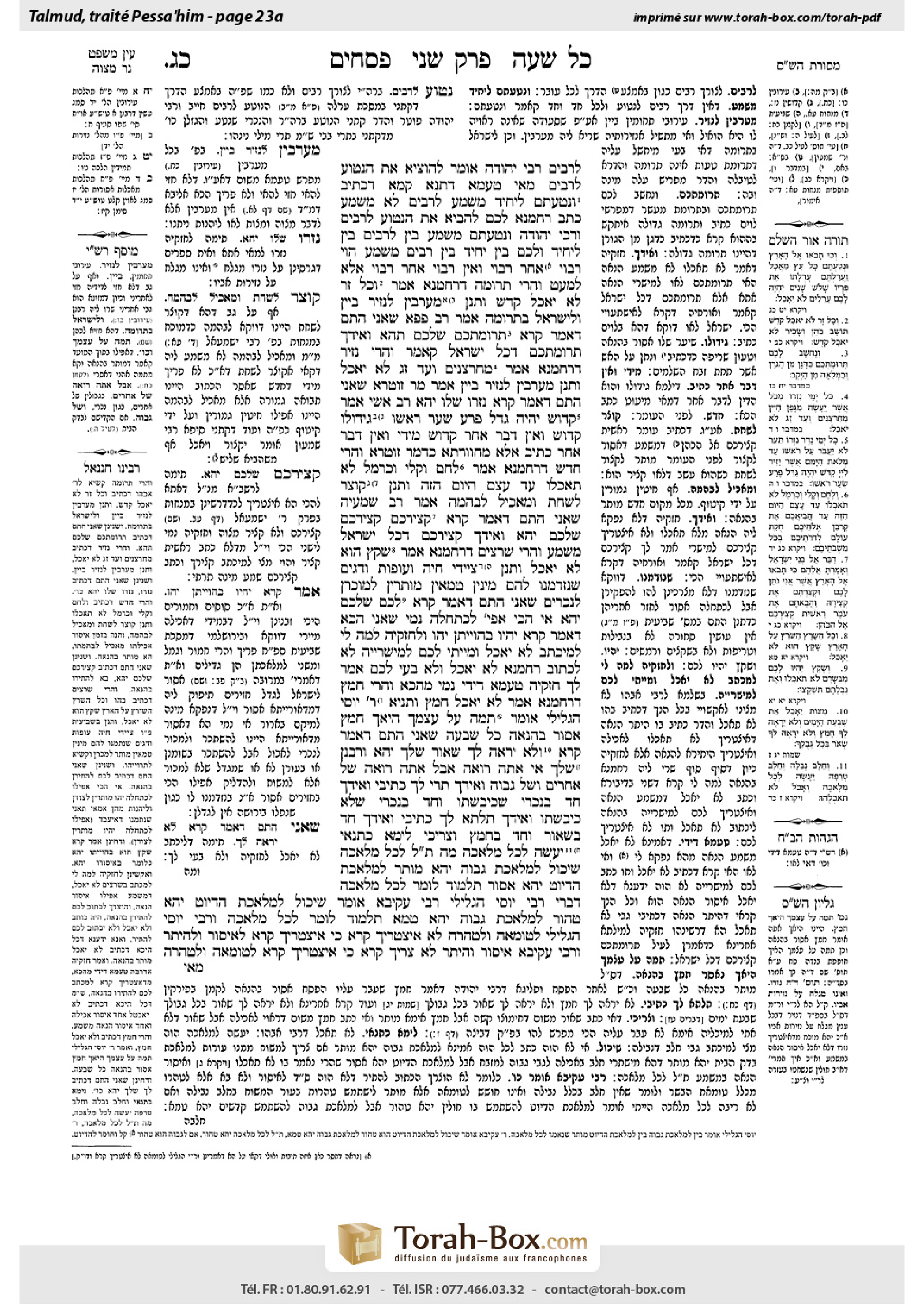
Pesachim 23a: Talmud study for Daf Yomi
Daf Yomi is the daily study of one Talmud folio. Explore 37 tractates with scans, Hebrew text, Sefaria English and AI-generated French translations where annotated.
Passage selection and English or AI-generated French translation are available where the scan has annotations. Daf Study is independent of Torah-Box and Sefaria.
Browse Pesachim · פסחים · All tractatesPesachim 23a text and translations
This page of Pesachim includes the Aramaic text, an English translation and an AI-generated French translation, alongside the scan above.
פסחים כ״ג א · Aramaic and Hebrew text
לְרַבִּים. רַבִּי יְהוּדָה אוֹמֵר: לְהוֹצִיא אֶת הַנָּטוּעַ לְרַבִּים.
מַאי טַעְמָא דְּתַנָּא קַמָּא — דִּכְתִיב ״וּנְטַעְתֶּם״, לְיָחִיד מַשְׁמַע, לְרַבִּים לָא מַשְׁמַע. כְּתַב רַחֲמָנָא ״לָכֶם״ — לְהָבִיא אֶת הַנָּטוּעַ לְרַבִּים. וְרַבִּי יְהוּדָה: ״וּנְטַעְתֶּם״ מַשְׁמַע בֵּין לְרַבִּים בֵּין לְיָחִיד, וְ״לָכֶם״ בֵּין יָחִיד בֵּין רַבִּים מַשְׁמַע. הָוֵי רִבּוּי אַחַר רִבּוּי — וְאֵין רִבּוּי אַחַר רִבּוּי אֶלָּא לְמַעֵט.
וַהֲרֵי תְּרוּמָה, דְּרַחֲמָנָא אָמַר: ״וְכׇל זָר לֹא יֹאכַל קֹדֶשׁ״, וּתְנַן: מְעָרְבִין לְנָזִיר בְּיַיִן, וּלְיִשְׂרָאֵל בִּתְרוּמָה!
אָמַר רַב פָּפָּא: שָׁאנֵי הָתָם דְּאָמַר קְרָא ״תְּרוּמַתְכֶם״ — שֶׁלָּכֶם תְּהֵא. וְאִידַּךְ? ״תְּרוּמַתְכֶם״ — דְּכׇל יִשְׂרָאֵל קָאָמַר.
וַהֲרֵי נָזִיר, דְּרַחֲמָנָא אָמַר: ״מֵחַרְצַנִּים וְעַד זָג לֹא יֹאכֵל״, וּתְנַן: מְעָרְבִין לַנָּזִיר בְּיַיִן. אָמַר מָר זוּטְרָא: שָׁאנֵי הָתָם, דְּאָמַר קְרָא ״נִזְרוֹ״ — שֶׁלּוֹ יְהֵא.
רַב אָשֵׁי אָמַר: ״קָדֹשׁ יִהְיֶה גַּדֵּל פֶּרַע שְׂעַר רֹאשׁוֹ״, גִּידּוּלוֹ קָדוֹשׁ, וְאֵין דָּבָר אַחֵר קָדוֹשׁ. מִידֵּי ״וְאֵין דָּבָר אַחֵר״ כְּתִיב?! אֶלָּא מְחַוַּורְתָּא כִּדְמָר זוּטְרָא.
וַהֲרֵי חָדָשׁ, דְּרַחֲמָנָא אָמַר: ״לֶחֶם וְקָלִי וְכַרְמֶל לֹא תֹאכְלוּ עַד עֶצֶם הַיּוֹם הַזֶּה״, וּתְנַן: קוֹצֵר לְשַׁחַת, וּמַאֲכִיל לַבְּהֵמָה!
אָמַר רַב שְׁמַעְיָה: שָׁאנֵי הָתָם דְּאָמַר קְרָא: ״קְצִירְכֶם״ — קְצִירְכֶם שֶׁלָּכֶם יְהֵא. וְאִידַּךְ? ״קְצִירְכֶם״ — דְּכׇל יִשְׂרָאֵל מַשְׁמַע.
וַהֲרֵי שְׁרָצִים, דְּרַחֲמָנָא אָמַר: ״שֶׁקֶץ הוּא לֹא יֵאָכֵל״, וּתְנַן: צַיָּידֵי חַיָּה וְעוֹפוֹת וְדָגִים שֶׁנִּזְדַּמְּנוּ לָהֶם מִינִין טְמֵאִין — מוּתָּרִין לְמוֹכְרָן לְגוֹיִם. שָׁאנֵי הָתָם, דְּאָמַר קְרָא: ״לָכֶם״ — שֶׁלָּכֶם יְהֵא.
אִי הָכִי, אֲפִילּוּ לְכַתְּחִלָּה נָמֵי! שָׁאנֵי הָכָא, דְּאָמַר קְרָא: ״יִהְיוּ״ — בַּהֲוָיָיתָן יְהוּ.
וּלְחִזְקִיָּה, לְמָה לִי לְמִיכְתַּב ״לֹא יֵאָכֵל״, וּמַיְיתֵי ״לָכֶם״ לְמִישְׁרְיֵיהּ? לָא לִכְתּוֹב רַחֲמָנָא ״לֹא יֵאָכֵל״, וְלָא בָּעֵי ״לָכֶם״! אָמַר לָךְ חִזְקִיָּה, טַעְמָא דִּידִי נָמֵי מֵהָכָא.
וַהֲרֵי חָמֵץ, דְּרַחֲמָנָא אָמַר: ״לֹא יֵאָכֵל חָמֵץ״, וְתַנְיָא, רַבִּי יוֹסֵי הַגְּלִילִי אוֹמֵר: תְּמַהּ עַל עַצְמְךָ הֵיאַךְ חָמֵץ אָסוּר בַּהֲנָאָה כׇּל שִׁבְעָה? שָׁאנֵי הָתָם, דְּאָמַר קְרָא: ״וְלֹא יֵרָאֶה לְךָ שְׂאוֹר״ — שֶׁלְּךָ יְהֵא.
וְרַבָּנַן? שֶׁלְּךָ אִי אַתָּה רוֹאֶה, אֲבָל אַתָּה רוֹאֶה שֶׁל אֲחֵרִים וְשֶׁל גָּבוֹהַּ. וְאִידַּךְ? תְּרֵי ״לְךָ״ כְּתִיבִי.
וְאִידַּךְ? חַד — בְּגוֹי שֶׁכִּיבַּשְׁתּוֹ, וְחַד — בְּגוֹי שֶׁלֹּא כִּיבַּשְׁתּוֹ. וְאִידַּךְ? תְּלָתָא ״לְךָ״ כְּתִיבִי. וְאִידַּךְ? חַד — בִּשְׂאוֹר, וְחַד — בְּחָמֵץ. וּצְרִיכִי.
לֵימָא כְּתַנָּאֵי. ״יֵעָשֶׂה לְכׇל מְלָאכָה״, מַה תַּלְמוּד לוֹמַר: ״לְכׇל מְלָאכָה״, שֶׁיָּכוֹל לִמְלֶאכֶת גָּבוֹהַּ יְהֵא מוּתָּר, לִמְלֶאכֶת הֶדְיוֹט יְהֵא אָסוּר, תַּלְמוּד לוֹמַר: ״לְכׇל מְלָאכָה״ — דִּבְרֵי רַבִּי יוֹסֵי הַגְּלִילִי.
רַבִּי עֲקִיבָא אוֹמֵר: שֶׁיָּכוֹל לִמְלֶאכֶת הֶדְיוֹט יְהֵא טָהוֹר, לִמְלֶאכֶת גָּבוֹהַּ יְהֵא טָמֵא, תַּלְמוּד לוֹמַר: ״לְכׇל מְלָאכָה״.
וְרַבִּי יוֹסֵי הַגְּלִילִי, לְטוּמְאָה וּלְטׇהֳרָה לָא אִיצְטְרִיךְ קְרָא. כִּי אִיצְטְרִיךְ קְרָא — לְאִיסּוּר וּלְהֶיתֵּר. וְרַבִּי עֲקִיבָא, אִיסּוּר וְהֶיתֵּר לָא צְרִיךְ קְרָא, כִּי אִיצְטְרִיךְ קְרָא — לְטוּמְאָה וּלְטׇהֳרָה.
Pesachim 23a · English translation
for the public; all the details of the prohibition of orla apply to a tree planted for public purposes. Rabbi Yehuda says: This verse comes to exclude a tree planted for the public, i.e., it is exempt from the laws of orla.
The Gemara explains: What is the reason for the opinion of the first tanna? As it is written: “And you shall plant.” That the mitzva applies to an individual is indicated, since planting a tree is ordinarily an individual activity; however, that the mitzva of orla applies to a tree planted for the public is not indicated by the verse. Therefore, the Merciful One writes “for you” in the plural, to include within this prohibition that which is planted for the public. And Rabbi Yehuda concedes that the phrase “and you shall plant” indicates that orla applies both to a tree planted for the public and for an individual; and the phrase “for you” also indicates that orla applies both to a tree planted for an individual and for the public. If so, then this is one amplificatory expression after another, and there is a principle that one amplificatory expression after another is restrictive. Therefore, the term: “For you” comes to exclude from this prohibition a tree planted for the public.
The Gemara further challenges Rabbi Abbahu’s opinion: And yet there is the prohibition that a non-priest shall not eat teruma, as the Merciful One says: “No stranger shall eat of the sacred food; a tenant of a priest, or a hired servant, shall not eat of the sacred food” (Leviticus 22:10). And we learned in a mishna: One may establish an eiruv, such as a joining of Shabbat boundaries, on behalf of a nazirite with wine, even though he may not drink it. And one may establish an eiruv on behalf of an Israelite with teruma, although it is prohibited for him to eat it. Apparently, it is permitted for an Israelite to derive benefit from the teruma even though the verse says: “He shall not eat.” This appears to be a challenge to the opinion of Rabbi Abbahu.
Rav Pappa said: It is different there, with regard to teruma, as the verse said: “And your teruma shall be reckoned unto you, as though it were the grain of the threshing floor, and as the fullness of the winepress” (Numbers 18:27). The Sages derived from the inclusion of the possessive pronoun “your” that the teruma shall be yours; therefore, it is permitted for an Israelite to benefit from teruma. The Gemara asks: And what does the other Sage, Ḥizkiya, derive from this phrase, as he holds that: “He shall not eat” already indicates that it is permitted to benefit from teruma? The Gemara answers: According to his opinion the phrase: “Your teruma” is referring to all of the teruma of the entire Jewish people. This is common biblical vernacular, and nothing may be derived from it.
The Gemara continues to challenge Rabbi Abbahu’s opinion: And yet there is the prohibition against the nazirite eating grape products, as the Merciful One says: “All the days of his naziriteship he shall eat nothing that is made of the grapevine, from the seeds to the grape skin” (Numbers 6:4). And we learned in the mishna: One may establish an eiruv on behalf of a nazirite with wine even though he may not drink it. Apparently, a nazirite may derive benefit from wine despite the fact that the verse says that he may not drink it. Mar Zutra said: It is different there, as the verse said: “His naziriteship.” He derives from this verse that it shall be his; in other words, the nazirite may continue to own wine and to benefit from it.
Rav Ashi said: This halakha is derived from another source. As the verse says: “He shall be sacred, he shall let the locks of the hair of his head grow long” (Numbers 6:5). Rav Ashi reads the verse precisely to indicate that the growth of the nazirite’s hair is sacred and must be burned, but no other element of his naziriteship is sacred. In other words, he may derive benefit from the other elements prohibited to him during his naziriteship, i.e., from grape products. The Gemara challenges: And is it written: No other element of his naziriteship? There is no indication that this statement means that the prohibition against deriving benefit is limited to this one element. Rather, it is clear that the derivation of this halakha is in accordance with the explanation of Mar Zutra.
The Gemara continues to challenge Rabbi Abbahu’s opinion: And yet there is the prohibition of new grain, which was harvested before the bringing of the omer offering, as the Merciful One says: “And you shall eat neither bread, nor parched grain, nor fresh stalks until this day itself, until you have brought the offering of your God; it is a statute forever throughout your generations in all your dwellings” (Leviticus 23:14). And we learned in a mishna: One may harvest grain before the omer as fodder and feed it to his animal. Apparently, one may derive benefit from this grain even though the verse says: “You shall not eat.”
Rav Shemaya said: It is different there, as the verse said: “Your harvest” (Leviticus 23:10), indicating that your harvest will be yours. In other words, one may benefit from it, as it is still considered to be his. The Gemara asks: And what does the other Sage, Ḥizkiya, derive from this phrase? The Gemara answers that according to his opinion, “your harvest” is referring to the harvest of the entire Jewish people. This is common biblical vernacular, and nothing may be derived from it.
The Gemara challenges both opinions. And yet there is the prohibition against eating creeping animals, as the Merciful One says: “And every creeping thing that swarms upon the earth is a detestable thing; it shall not be eaten” (Leviticus 11:41). And we learned in a mishna: If hunters of undomesticated animals, birds, and fish happen to catch non-kosher species that they did not intend to trap, it is permitted for them to sell them to gentiles. Apparently, one may derive benefit from non-kosher species even though the verse says: “It shall not be eaten.” The Gemara answers: It is different there, as the verse said: “For you” (Leviticus 11:10), indicating that they will be yours, that one may derive benefit from them.
The Gemara asks: If so, that it is permitted to derive benefit from these creeping animals, then even if one intends to catch them it should also be permitted to sell them to gentiles ab initio. However, the mishna indicates that this is prohibited. The Gemara answers: It is different here, in the case of creeping animals, as the verse said: “They shall be” (Leviticus 11:11). It is derived from this that they shall be as they are. In other words, they should remain in their detestable state, and one should stay away from them.
The Gemara asks: And according to the opinion of Ḥizkiya, why do I need the verse to write: “It shall not be eaten,” to teach that one may not derive benefit from them, and afterward to say: “For you,” to permit deriving benefit from them? Let the Merciful One not write: “It shall not be eaten,” and it will not need to say: “For you.” Ḥizkiya could have said to you: My reason is also derived from here, as this verse is a central source for my opinion. Since the verse needed to say explicitly: “For you,” it is evident that when the Torah writes only: “It shall not be eaten,” it is indicating that it is prohibited to benefit from the item as well.
The Gemara further challenges the opinions of Ḥizkiya and Rabbi Abbahu: And yet there is the prohibition of leavened bread, as the Merciful One says: “Leavened bread shall not be eaten,” and it was taught in a baraita that Rabbi Yosei HaGelili says: Be astounded with yourself; how is it prohibited to derive benefit from leavened bread for all seven days? Apparently, he holds that it is permitted for one to derive benefit from leavened bread for all seven days of Passover and certainly afterward. The Gemara answers: It is different there, as the verse said: “Matzot shall be eaten throughout the seven days; and no leavened bread shall be seen with you, neither shall there be leaven seen with you, in all your borders” (Exodus 13:7). The phrase “with you” indicates that it is yours, i.e., it is still considered to be in one’s possession, and it is permitted for him to derive benefit from it.
The Gemara asks: And what do the Rabbis, who say that it is prohibited to derive benefit from leavened bread, learn from the phrase “with you”? The Gemara answers: They derive that you may not see your own leavened bread; however, you may see that of others and that which is consecrated to God but remained in one’s possession. The Gemara asks: And what does the other Sage, Rabbi Yosei HaGelili, say about this halakha? The Gemara answers: There are two occurrences of the phrase “with you” written. One indicates that it is permitted to see leavened bread that belongs to a gentile, and the other indicates that one may derive benefit from leavened bread.
The Gemara asks: And according to the opinion of the other Sages, the Rabbis, why is the phrase “with you” written twice? They explain: One is written with regard to a gentile whom he has conquered, i.e., who is under his control. And the other is written with regard to a gentile whom he has not conquered. In either case, one is permitted to keep the gentile’s leavened bread in his possession on Passover. And from where does the other Sage, Rabbi Yosei HaGelili, derive this halakha that one may see even the leavened bread of a gentile who is under his control? He points out that there are three occurrences of the phrase “with you” written. And what do the other Sages, the Rabbis, learn from the extra instance of the phrase “with you”? They learn that it is used once to teach about leaven, and once to teach about leavened bread. And they are both necessary and must be mentioned explicitly, as one cannot derive this principle with regard to leavened bread from leaven or vice versa.
The Gemara suggests: Let us say this dispute between Ḥizkiya and Rabbi Abbahu with regard to the implication of the phrase: It shall not be eaten, is parallel to a dispute between tanna’im. The verse states: “And the fat of the animal carcass, and the fat of that which is torn of beasts, may be used for any other service; but you shall surely not eat of it” (Leviticus 7:24). What does it mean when the verse states: “For any other service”? I might have thought that with regard to the Temple service it should be permitted to use this fat for the following reason: Because fats may generally be offered on the altar, it is as though it is permitted to consume them; therefore, they may be used for other sacred purposes as well. However, I might have thought that with regard to common use it should be prohibited to use them, as the verse states: “You shall surely not eat of it.” Therefore, the verse states: “For any other service,” meaning that its use is permitted in all contexts. This is the statement of Rabbi Yosei HaGelili.
Rabbi Akiva says: Although its use is clearly permitted, I might have thought that despite the fact that an animal carcass is impure, with regard to common use its fat should be ritually pure; however, with regard to the Temple service it should be ritually impure. Therefore, the verse states: “For any other service,” meaning that it is considered pure in all contexts.
The Gemara explains their dispute: Rabbi Yosei HaGelili holds that with regard to purity and impurity no verse is necessary, as there is no reason to assume that the fat of an animal carcass is impure. The verse is necessary to establish the prohibited or permitted status of this fat. And Rabbi Akiva holds that to teach whether this fat is prohibited or permitted no separate verse is necessary; it is necessary to establish its status with regard to ritual purity or impurity.
Pesachim 23a · Traduction française (IA)
pour la collectivité ; tous les détails de l’interdiction de l’orla s’appliquent à un arbre planté à des fins collectives. Rabbi Yehouda dit : Ce verset vient exclure un arbre planté pour la collectivité, c’est-à-dire qu’il est exempt des lois de l’orla.
La Guemara explique : Quelle est la raison de l’opinion du premier tanna ? Comme il est écrit : « Et vous planterez. » Le fait que la mitsva s’applique à un particulier est indiqué, puisque planter un arbre est ordinairement une activité individuelle ; toutefois, le verset n’indique pas que la mitsva de l’orla s’applique à un arbre planté pour la collectivité. C’est pourquoi le Miséricordieux écrit « pour vous », au pluriel, afin d’inclure dans cette interdiction ce qui est planté pour la collectivité. Rabbi Yehouda admet que l’expression « et vous planterez » indique que l’orla s’applique aussi bien à un arbre planté pour la collectivité qu’à un arbre planté pour un particulier ; et l’expression « pour vous » indique également que l’orla s’applique aussi bien à un arbre planté pour un particulier qu’à un arbre planté pour la collectivité. Si tel est le cas, il s’agit d’une expression amplificatrice suivie d’une autre, et un principe veut qu’une expression amplificatrice venant après une autre ait une portée restrictive. Par conséquent, le terme « pour vous » vient exclure de cette interdiction un arbre planté pour la collectivité.
La Guemara conteste encore l’opinion de Rabbi Abbahou : or, il y a aussi l’interdiction faite à un non-prêtre de manger de la terouma, comme le dit le Miséricordieux : « Aucun étranger ne mangera d’une chose sainte ; ni le résident chez un prêtre ni son salarié ne mangeront d’une chose sainte » (Lévitique 22:10). Et nous avons appris dans une Michna : On peut établir un érouv, par exemple un érouv de limites de Chabbat, pour un nazir avec du vin, bien qu’il ne puisse pas en boire. On peut aussi établir un érouv pour un Israélite avec de la terouma, bien qu’il lui soit interdit d’en manger. Il semble donc qu’un Israélite puisse tirer profit de la terouma, même si le verset dit : « Il ne mangera pas. » Cela paraît contredire l’opinion de Rabbi Abbahou.
Rav Pappa dit : Le cas de la terouma est différent, car le verset dit : « Votre terouma vous sera comptée comme le grain de l’aire de battage et comme le produit du pressoir » (Nombres 18:27). Les Sages ont déduit de l’ajout du pronom possessif « votre » que la terouma vous appartient ; un Israélite peut donc en tirer profit. La Guemara demande : Et que déduit l’autre Sage, Hizkiya, de cette expression, puisqu’il considère que « il ne mangera pas » indique déjà qu’il est permis de tirer profit de la terouma ? La Guemara répond : Selon son opinion, l’expression « votre terouma » désigne toute la terouma de l’ensemble du peuple juif. C’est un tour courant de la langue biblique, et on ne peut rien en déduire.
La Guemara poursuit sa contestation de l’opinion de Rabbi Abbahou : or, il y a aussi l’interdiction faite au nazir de consommer des produits de la vigne, comme le dit le Miséricordieux : « Pendant tous les jours de son naziréat, il ne mangera rien de ce qui provient de la vigne, depuis les pépins jusqu’à la peau du raisin » (Nombres 6:4). Et nous avons appris dans la Michna : On peut établir un érouv pour un nazir avec du vin, bien qu’il ne puisse pas en boire. Il semble donc qu’un nazir puisse tirer profit du vin, malgré le fait que le verset dise qu’il ne peut pas en boire. Mar Zoutra dit : Le cas est différent, car le verset dit : « Son naziréat. » Il déduit de ce verset que cela lui appartient ; autrement dit, le nazir peut continuer à posséder du vin et à en tirer profit.
Rav Ashi dit : Cette halakha se déduit d’une autre source. Car le verset dit : « Il sera saint ; il laissera pousser les cheveux de sa tête » (Nombres 6:5). Rav Ashi interprète précisément le verset comme indiquant que la pousse des cheveux du nazir est sacrée et doit être brûlée, mais qu’aucun autre élément de son naziréat n’est sacré. Autrement dit, il peut tirer profit des autres éléments qui lui sont interdits pendant son naziréat, c’est-à-dire des produits de la vigne. La Guemara objecte : Est-il écrit : « Aucun autre élément de son naziréat » ? Rien n’indique que cette déclaration signifie que l’interdiction de tirer profit se limite à cet élément. Il est donc clair que la déduction de cette halakha suit l’explication de Mar Zoutra.
La Guemara poursuit sa contestation de l’opinion de Rabbi Abbahou : or, il y a aussi l’interdiction de la nouvelle récolte moissonnée avant l’offrande du ômer, comme le dit le Miséricordieux : « Vous ne mangerez ni pain, ni grain grillé, ni épis frais jusqu’à ce jour même, jusqu’à ce que vous ayez apporté l’offrande de votre Dieu ; c’est une loi éternelle pour vos générations, dans toutes vos demeures » (Lévitique 23:14). Et nous avons appris dans une Michna : On peut moissonner du grain avant le ômer pour en faire du fourrage et le donner à son animal. Il semble donc qu’on puisse tirer profit de ce grain, même si le verset dit : « Vous ne mangerez pas. »
Rav Shemaya dit : Le cas est différent, car le verset dit : « Votre récolte » (Lévitique 23:10), ce qui indique que votre récolte vous appartient. Autrement dit, on peut en tirer profit, puisqu’elle est toujours considérée comme lui appartenant. La Guemara demande : Et que déduit l’autre Sage, Hizkiya, de cette expression ? La Guemara répond que, selon son opinion, « votre récolte » désigne la récolte de l’ensemble du peuple juif. C’est un tour courant de la langue biblique, et on ne peut rien en déduire.
La Guemara conteste les deux opinions. Or, il y a aussi l’interdiction de manger des animaux rampants, comme le dit le Miséricordieux : « Toute créature rampante qui grouille sur la terre est une chose répugnante ; elle ne sera pas mangée » (Lévitique 11:41). Et nous avons appris dans une Michna : Si des chasseurs d’animaux sauvages, d’oiseaux et de poissons prennent par hasard des espèces non cachères qu’ils n’avaient pas l’intention de capturer, il leur est permis de les vendre à des non-Juifs. Il semble donc qu’on puisse tirer profit des espèces non cachères, même si le verset dit : « Elle ne sera pas mangée. » La Guemara répond : Le cas est différent, car le verset dit : « Pour vous » (Lévitique 11:10), ce qui indique qu’elles vous appartiendront et qu’on peut en tirer profit.
La Guemara demande : Si tel est le cas, s’il est permis de tirer profit de ces animaux rampants, alors il devrait aussi être permis de les vendre d’emblée à des non-Juifs, même si l’on avait l’intention de les capturer. Pourtant, la Michna indique que cela est interdit. La Guemara répond : Le cas des animaux rampants est différent, car le verset dit : « Ils seront » (Lévitique 11:11). On en déduit qu’ils doivent rester tels qu’ils sont. Autrement dit, ils doivent demeurer dans leur état répugnant, et il faut s’en tenir éloigné.
La Guemara demande : Et selon l’opinion de Hizkiya, pourquoi le verset doit-il écrire : « Elle ne sera pas mangée », pour enseigner qu’on ne peut pas tirer profit de ces animaux, puis ajouter : « Pour vous », qui autorise à en tirer profit ? Que le Miséricordieux n’écrive pas : « Elle ne sera pas mangée », et il n’aurait pas besoin de dire : « Pour vous. » Hizkiya aurait pu te répondre : Ma raison se déduit également d’ici, car ce verset est une source centrale de mon opinion. Puisque le verset devait dire explicitement : « Pour vous », il est évident que lorsque la Torah écrit seulement : « Elle ne sera pas mangée », cela indique qu’il est également interdit de tirer profit de l’objet.
La Guemara conteste encore les opinions de Hizkiya et de Rabbi Abbahou : or, il y a aussi l’interdiction du pain levé, comme le dit le Miséricordieux : « Le pain levé ne sera pas mangé », et une baraïta enseigne que Rabbi Yossei HaGelili dit : Étonnez-vous donc : comment peut-il être interdit de tirer profit du pain levé pendant les sept jours ? Il semble qu’il considère qu’il est permis de tirer profit du pain levé pendant les sept jours de Pessa’h, et à plus forte raison par la suite. La Guemara répond : Le cas est différent, car le verset dit : « On mangera des matsot pendant les sept jours ; et l’on ne verra chez vous aucun pain levé, et l’on ne verra pas de levain chez vous, dans toutes vos frontières » (Exode 13:7). L’expression « chez vous » indique que cela vous appartient, c’est-à-dire que la chose est toujours considérée comme étant en sa possession, et qu’il lui est permis d’en tirer profit.
La Guemara demande : Et qu’apprennent les Rabbins, qui disent qu’il est interdit de tirer profit du pain levé, de l’expression « chez vous » ? La Guemara répond : Ils en déduisent qu’on ne peut pas voir son propre pain levé ; en revanche, on peut voir celui d’autrui et celui qui a été consacré à Dieu mais est resté en possession de quelqu’un. La Guemara demande : Et que dit l’autre Sage, Rabbi Yossei HaGelili, au sujet de cette halakha ? La Guemara répond : L’expression « chez vous » apparaît deux fois. L’une indique qu’il est permis de voir le pain levé appartenant à un non-Juif, et l’autre indique qu’on peut tirer profit du pain levé.
La Guemara demande : Et selon l’opinion des autres Sages, les Rabbins, pourquoi l’expression « chez vous » est-elle écrite deux fois ? Ils expliquent : L’une est écrite au sujet d’un non-Juif qu’il a soumis, c’est-à-dire qui est sous son contrôle ; l’autre est écrite au sujet d’un non-Juif qu’il n’a pas soumis. Dans les deux cas, il est permis de garder en sa possession, pendant Pessa’h, le pain levé du non-Juif. Et d’où l’autre Sage, Rabbi Yossei HaGelili, déduit-il cette halakha selon laquelle on peut même voir le pain levé d’un non-Juif qui est sous son contrôle ? Il fait remarquer que l’expression « chez vous » apparaît trois fois. Et qu’apprennent les autres Sages, les Rabbins, de l’occurrence supplémentaire de l’expression « chez vous » ? Ils apprennent qu’elle sert une fois à enseigner au sujet du levain, et une fois au sujet du pain levé. Ces deux enseignements sont nécessaires et doivent être mentionnés explicitement, car on ne peut pas déduire la règle concernant le pain levé de celle concernant le levain, ni inversement.
La Guemara propose : Peut-on dire que la controverse entre Hizkiya et Rabbi Abbahou sur le sens de l’expression « elle ne sera pas mangée » correspond à une controverse entre des tannaïm ? Le verset dit : « La graisse d’une bête morte et la graisse d’une bête déchirée pourront servir à tout autre usage ; mais vous n’en mangerez certainement pas » (Lévitique 7:24). Que signifie l’expression « à tout autre usage » ? J’aurais pu penser que, pour le service du Temple, il serait permis d’utiliser cette graisse, pour la raison suivante : puisque les graisses peuvent généralement être offertes sur l’autel, c’est comme si leur consommation était permise ; elles pourraient donc également être utilisées à d’autres fins sacrées. Cependant, j’aurais pu penser que, pour un usage profane, il serait interdit de les utiliser, comme le verset dit : « Vous n’en mangerez certainement pas. » Le verset dit donc : « À tout autre usage », ce qui signifie que leur usage est permis dans tous les contextes. Telle est la déclaration de Rabbi Yossei HaGelili.
Rabbi Akiva dit : Bien que son usage soit clairement permis, j’aurais pu penser que, malgré le fait qu’une bête morte soit impure, sa graisse serait rituellement pure pour un usage profane ; cependant, elle serait rituellement impure pour le service du Temple. Le verset dit donc : « À tout autre usage », ce qui signifie qu’elle est considérée comme pure dans tous les contextes.
La Guemara explique leur controverse : Rabbi Yossei HaGelili considère qu’aucun verset n’est nécessaire au sujet de la pureté et de l’impureté, car rien ne permet de supposer que la graisse d’une bête morte soit impure. Le verset est nécessaire pour déterminer si cette graisse est interdite ou permise. Rabbi Akiva, lui, considère qu’aucun verset distinct n’est nécessaire pour enseigner si cette graisse est interdite ou permise ; il est nécessaire pour déterminer son statut au regard de la pureté ou de l’impureté rituelles.
Traduction française générée par IA à partir de l’édition anglaise de Sefaria. Vérifie toujours un passage avec le texte source.
Text from Sefaria: William Davidson Edition - Vocalized Aramaic (CC BY NC); William Davidson Edition - English (CC BY NC).