Pesachim 22b: Talmud study for Daf Yomi
Daf Yomi is the daily study of one Talmud folio. Explore 37 tractates with scans, Hebrew text, Sefaria English and AI-generated French translations where annotated.
Passage selection and English or AI-generated French translation are available where the scan has annotations. Daf Study is independent of Torah-Box and Sefaria.
Browse Pesachim · פסחים · All tractatesPesachim 22b text and translations
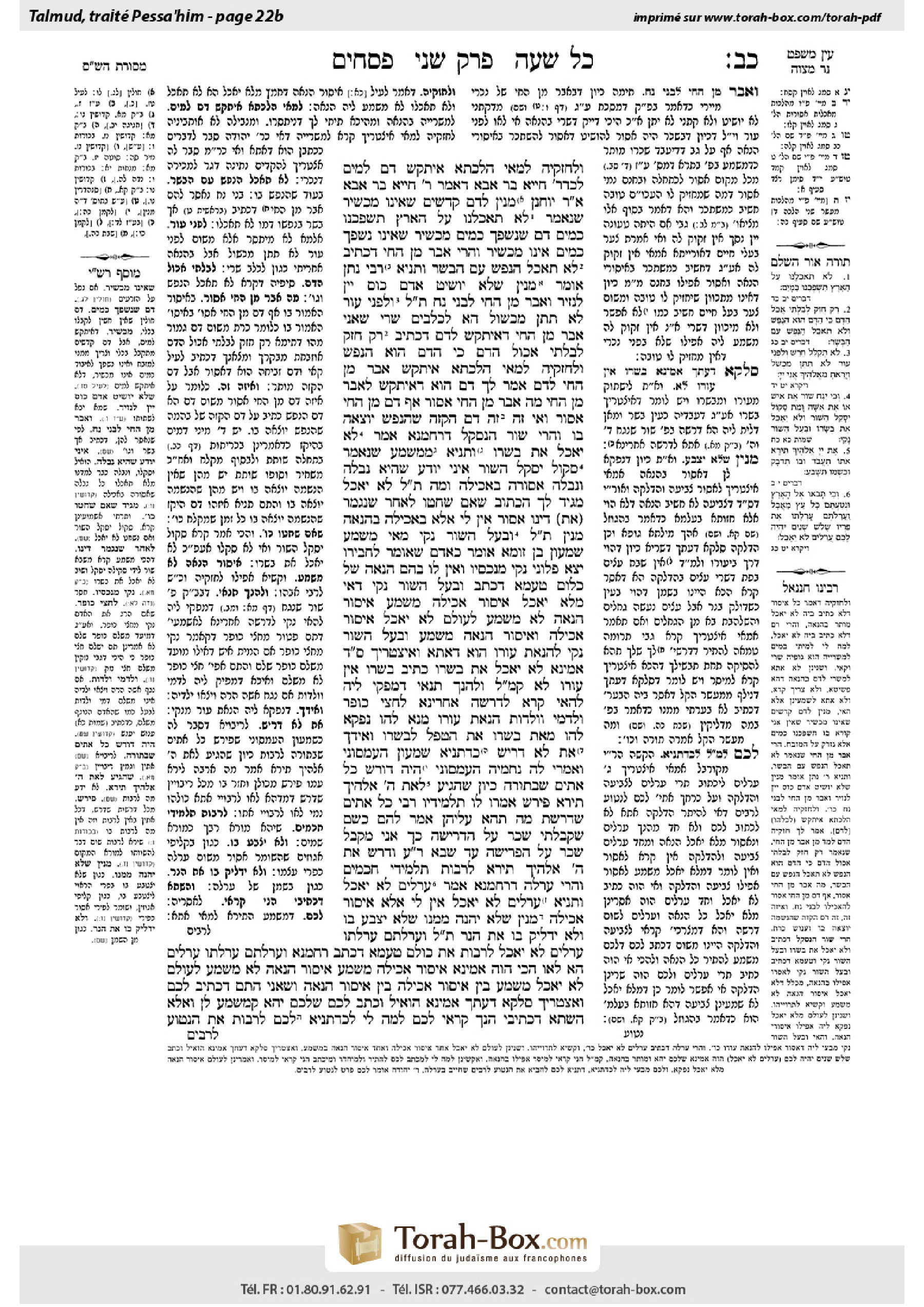
This page of Pesachim includes the Aramaic text, an English translation and an AI-generated French translation, alongside the scan above.
פסחים כ״ב ב · Aramaic and Hebrew text
וּלְחִזְקִיָּה, לְמַאי הִלְכְתָא אִיתַּקַּשׁ דָּם לְמַיִם? לְכִדְרַבִּי חִיָּיא בַּר אַבָּא, דְּאָמַר רַבִּי חִיָּיא בַּר אַבָּא אָמַר רַבִּי יוֹחָנָן: מִנַּיִן לְדַם קָדָשִׁים שֶׁאֵינוֹ מַכְשִׁיר — שֶׁנֶּאֱמַר ״לֹא תֹּאכְלֶנּוּ עַל הָאָרֶץ תִּשְׁפְּכֶנּוּ כַּמָּיִם״, דָּם שֶׁנִּשְׁפָּךְ כַּמַּיִם — מַכְשִׁיר, שֶׁאֵינוֹ נִשְׁפָּךְ כַּמַּיִם — אֵינוֹ מַכְשִׁיר.
וַהֲרֵי אֵבֶר מִן הַחַי, דִּכְתִיב ״לֹא תֹאכַל הַנֶּפֶשׁ עִם הַבָּשָׂר״, וְתַנְיָא, רַבִּי נָתָן אוֹמֵר: מִנַּיִן שֶׁלֹּא יוֹשִׁיט אָדָם כּוֹס יַיִן לְנָזִיר וְאֵבֶר מִן הַחַי לִבְנֵי נֹחַ — תַּלְמוּד לוֹמַר ״וְלִפְנֵי עִוֵּר לֹא תִתֵּן מִכְשֹׁל״, הָא לִכְלָבִים — שְׁרֵי!
שָׁאנֵי אֵבֶר מִן הַחַי דְּאִיתַּקַּשׁ לְדָם, דִּכְתִיב: ״רַק חֲזַק לְבִלְתִּי אֲכֹל הַדָּם כִּי הַדָּם הוּא הַנָּפֶשׁ״.
וּלְחִזְקִיָּה, לְמַאי הִלְכְתָא אִיתַּקַּשׁ אֵבֶר מִן הַחַי לְדָם? אָמַר לָךְ, דָּם הוּא דְּאִיתַּקַּשׁ לְאֵבֶר מִן הַחַי: מָה אֵבֶר מִן הַחַי אָסוּר — אַף דָּם מִן הַחַי אָסוּר. וְאִי זֶה — זֶה דַּם הַקָּזָה, שֶׁהַנֶּפֶשׁ יוֹצְאָה בּוֹ.
וַהֲרֵי שׁוֹר הַנִּסְקָל, דְּרַחֲמָנָא אָמַר: ״לֹא יֵאָכֵל אֶת בְּשָׂרוֹ״, וְתַנְיָא: מִמַּשְׁמַע שֶׁנֶּאֱמַר ״סָקוֹל יִסָּקֵל הַשּׁוֹר״ אֵינִי יוֹדֵעַ שֶׁהִיא נְבֵלָה, וּנְבֵלָה אֲסוּרָה בַּאֲכִילָה?! וּמָה תַּלְמוּד לוֹמַר ״לֹא יֵאָכֵל״? מַגִּיד לְךָ הַכָּתוּב שֶׁאִם שְׁחָטוֹ לְאַחַר שֶׁנִּגְמַר (אֶת) דִּינוֹ — אָסוּר.
אֵין לִי אֶלָּא בַּאֲכִילָה, בַּהֲנָאָה מִנַּיִן? תַּלְמוּד לוֹמַר ״וּבַעַל הַשּׁוֹר נָקִי״. מַאי מַשְׁמַע? שִׁמְעוֹן בֶּן זוֹמָא אוֹמֵר: כְּאָדָם שֶׁאוֹמֵר לַחֲבֵירוֹ ״יָצָא פְּלוֹנִי נָקִי מִנְּכָסָיו״, וְאֵין לוֹ בָּהֶם הֲנָאָה שֶׁל כְּלוּם.
טַעְמָא דִּכְתַב ״וּבַעַל הַשּׁוֹר נָקִי״, דְּאִי מִ״לֹּא יֵאָכֵל״, אִיסּוּר אֲכִילָה — מַשְׁמַע, אִיסּוּר הֲנָאָה — לָא מַשְׁמַע!
לְעוֹלָם ״לֹא יֵאָכֵל״ אִיסּוּר אֲכִילָה וְאִיסּוּר הֲנָאָה מַשְׁמַע, ״וּבַעַל הַשּׁוֹר נָקִי״ לַהֲנָאַת עוֹרוֹ הוּא דַּאֲתָא. וְאִיצְטְרִיךְ, סָלְקָא דַּעְתָּךְ אָמֵינָא: ״לֹא יֵאָכֵל אֶת בְּשָׂרוֹ״ כְּתִיב: בְּשָׂרוֹ — אִין, עוֹרוֹ — לָא, קָא מַשְׁמַע לַן.
וּלְהָנָךְ תַּנָּאֵי דְּמַפְּקִי לֵיהּ לְהַאי קְרָא לִדְרָשָׁה אַחֲרִינָא, לַחֲצִי כּוֹפֶר וְלִדְמֵי וְולָדוֹת, הֲנָאַת עוֹרוֹ מְנָא לְהוּ? נָפְקָא לְהוּ מֵ״אֶת בְּשָׂרוֹ״ — אֶת הַטָּפֵל לִבְשָׂרוֹ.
וְאִידַּךְ? ״אֶת״ לָא דָּרֵישׁ.
כִּדְתַנְיָא: שִׁמְעוֹן הָעַמְסוֹנִי, וְאָמְרִי לַהּ נְחֶמְיָה הָעַמְסוֹנִי, הָיָה דּוֹרֵשׁ כׇּל ׳אֶתִּים׳ שֶׁבַּתּוֹרָה, כֵּיוָן שֶׁהִגִּיעַ לְ״אֶת ה׳ אֱלֹהֶיךָ תִּירָא״ פֵּירַשׁ. אָמְרוּ לוֹ תַּלְמִידָיו: רַבִּי, כׇּל ׳אֶתִּים׳ שֶׁדָּרַשְׁתָּ מָה תְּהֵא עֲלֵיהֶן? אָמַר לָהֶם: כְּשֵׁם שֶׁקִּבַּלְתִּי שָׂכָר עַל הַדְּרִישָׁה, כָּךְ אֲנִי מְקַבֵּל שָׂכָר עַל הַפְּרִישָׁה. עַד שֶׁבָּא רַבִּי עֲקִיבָא וְדָרַשׁ: ״אֶת ה׳ אֱלֹהֶיךָ תִּירָא״ — לְרַבּוֹת תַּלְמִידֵי חֲכָמִים.
וַהֲרֵי עׇרְלָה, דְּרַחֲמָנָא אָמַר: ״עֲרֵלִים לֹא יֵאָכֵל״, וְתַנְיָא: ״עֲרֵלִים לֹא יֵאָכֵל״, אֵין לִי אֶלָּא אִיסּוּר אֲכִילָה. מִנַּיִן שֶׁלֹּא יֵהָנֶה מִמֶּנּוּ, שֶׁלֹּא יִצְבַּע בּוֹ, וְלֹא יַדְלִיק בּוֹ אֶת הַנֵּר? תַּלְמוּד לוֹמַר: ״וַעֲרַלְתֶּם עׇרְלָתוֹ ... עֲרֵלִים לֹא יֵאָכֵל״ — לְרַבּוֹת אֶת כּוּלָּם.
טַעְמָא דִּכְתַב רַחֲמָנָא ״וַעֲרַלְתֶּם עׇרְלָתוֹ ... עֲרֵלִים״, הָא לָאו הָכִי, הֲוָה אָמֵינָא: אִיסּוּר אֲכִילָה — מַשְׁמַע, אִיסּוּר הֲנָאָה — לָא מַשְׁמַע!
לְעוֹלָם ״לֹא יֵאָכֵל״ מַשְׁמַע בֵּין אִיסּוּר אֲכִילָה בֵּין אִיסּוּר הֲנָאָה, וְשָׁאנֵי הָתָם דִּכְתִיב ״לָכֶם״. וְאִצְטְרִיךְ, סָלְקָא דַּעְתָּךְ אָמֵינָא: הוֹאִיל וּכְתַב ״לָכֶם״ — שֶׁלָּכֶם יְהֵא, קָמַשְׁמַע לַן.
וְאֶלָּא הַשְׁתָּא דִּכְתִיבִי הָנָךְ קְרָאֵי, ״לָכֶם״ לְמָה לִי? לְכִדְתַנְיָא: ״לָכֶם״, לְרַבּוֹת אֶת הַנָּטוּעַ
Pesachim 22b · English translation
The Gemara asks: According to Ḥizkiya, who says that: You shall not eat, indicates only that eating is prohibited but that benefit is permitted, for what halakha is blood juxtaposed to water? According to his opinion, there is no need for the verse to teach that one may benefit from blood. The Gemara answers that he needs this verse to derive that which was taught by Rabbi Ḥiyya bar Abba, as Rabbi Ḥiyya bar Abba said that Rabbi Yoḥanan said: From where is it derived that the blood of sacrifices does not render food susceptible to ritual impurity? As it is stated: “You shall not eat it; you shall pour it out upon the earth like water” (Deuteronomy 12:24). Blood that is poured out like water, such as that of a slaughtered, non-sacrificial animal, renders food susceptible to ritual impurity. However, sacrificial blood, which is not poured out like water and is instead sprinkled on the altar, does not render food susceptible to ritual impurity.
The Gemara further challenges Rabbi Abbahu’s opinion: And yet there is the prohibition against eating a limb cut from a living animal, as it is written: “Only be steadfast in not eating the blood; for the blood is the life; and you shall not eat the life with the flesh” (Deuteronomy 12:23). And it was taught in a baraita that Rabbi Natan says: From where is it derived that a person may not offer a cup of wine to a nazirite, who is prohibited from drinking wine, and that he may not offer a limb cut from a living animal to a descendant of Noah, who is prohibited by Noahide law from eating a limb from a living animal? The verse states: “You shall not put a stumbling block before the blind” (Leviticus 19:14). Causing another person to sin is like placing a stumbling block before a blind person; one who does so violates this prohibition. The prohibition of giving a limb from a living animal to a gentile is apparently due only to the prohibition of placing a stumbling block. However, it is permitted for one to throw it to dogs. Therefore, despite the fact that the verse says: “You shall not eat it,” apparently there is no prohibition against benefiting from this prohibited item. This challenges Rabbi Abbahu’s principle.
The Gemara answers: A limb from a living animal is different, as it is juxtaposed in the Torah to blood. As it is written: “Only be steadfast in not eating the blood; for the blood is the life; and you shall not eat the life with the flesh” (Deuteronomy 12:23). Just as it is permitted to benefit from blood, it is likewise permitted to benefit from a limb torn from a living animal.
The Gemara asks: And according to Ḥizkiya, in order to teach what halakha is the prohibition against eating a limb from a living animal juxtaposed to the prohibition against eating blood? The Gemara answers: He could have said to you that the juxtaposition comes to teach the opposite. It is blood that is juxtaposed to a limb from a living animal to teach the following: Just as a limb from a living animal is prohibited, so too, blood of a living being is prohibited. And to which blood is this referring? This is referring to blood spilled in the process of bloodletting, through which the soul departs. That is considered to be blood from a living being, and even the descendants of Noah are prohibited from eating it (Rabbeinu Ḥananel).
The Gemara asks: And yet there is the prohibition against eating the meat from an ox that is stoned, as the Merciful One says: “And if an ox gores a man or a woman to death, the ox shall be surely stoned, and of its flesh shall not be eaten; but the owner of the ox shall be clear” (Exodus 21:28). And it was taught in a baraita: By inference from that which is stated: “The ox shall surely be stoned,” in which case it is not to be slaughtered properly, don’t I know that it is an animal carcass, and it is prohibited to eat an animal carcass? What does it mean when the verse states: “Its flesh shall not be eaten”? The verse is telling you that even if one slaughtered the ox after its verdict had been reached but before it had been carried out, it is still prohibited.
The baraita continues: I have derived only that one is prohibited from eating this ox; from where do I derive that one is prohibited from deriving benefit from it as well? The verse states: “But the owner of the ox shall be clear [naki].” The Gemara asks: From where may it be inferred that one may not benefit from this ox? Shimon ben Zoma says: This is like a person who says to his fellow: So-and-so was left clear [naki] of his property, and he has no benefit from it at all. Similarly, “But the owner of the ox shall be clear” means that he has no benefit from the ox.
The Gemara infers from the verse that the reason that it is prohibited to derive benefit from the ox is that the Torah specifically wrote: “But the owner of the ox shall be clear.” As, if this prohibition were derived from: “It shall not be eaten,” apparently the prohibition of eating would be implied, but the prohibition of deriving benefit would not be implied. This presents a challenge even for Ḥizkiya, who agrees that the passive formulation: “It shall not be eaten,” indicates that in addition one may not benefit from the item.
The Gemara answers: Actually, the phrase: “It shall not be eaten” indicates both a prohibition of eating and a prohibition of deriving benefit. And the phrase: “But the owner of the ox shall be clear,” comes to prohibit deriving benefit from the hide of the ox that has been stoned. And it is necessary to mention this explicitly, as it could enter your mind to say that since it is written: “Its flesh shall not be eaten,” with regard to its flesh, yes, it is prohibited, but with regard to its hide, no, it is not. Therefore, the verse teaches us that it is prohibited to benefit from its hide as well.
The Gemara asks: And according to those tanna’im who expound this verse: “But the owner of the ox shall be clear,” for another interpretation, namely, to teach that the owner of an innocuous ox, i.e., one that is not known to cause damage with the intent to injure, is exempt from the payment of half of the indemnity if that ox killed a person, or that he is exempt from payment for offspring if his ox gores a pregnant woman and causes her to miscarry; from where do they derive this prohibition against benefiting from the ox’s hide? The Gemara answers: They derive this halakha from the wording: “Of [et] its flesh.” The verse could have been formulated: And its flesh shall not be eaten. The addition of the word et comes to include that which is secondary to the flesh, i.e., the hide.
The Gemara asks: And the other tanna, who derives the prohibition against benefiting from the hide from the verse: “But the owner of the ox shall be clear,” what does he learn from the additional word et? The Gemara answers: This Sage does not interpret the word et as a means to derive new halakhot. He considers the word et to be an ordinary part of the sentence structure and not a source for exegetical exposition.
As it was taught in a baraita: Shimon HaAmmassoni, and some say that it was Neḥemya HaAmmassoni, would interpret all occurrences of the word et in the Torah, deriving additional halakhot with regard to the particular subject matter. Once he reached the verse: “You shall be in awe of [et] the Lord your God; you shall serve Him; and to Him you shall cleave, and by His name you shall swear” (Deuteronomy 10:20), he withdrew from this method of exposition, as how could one add to God Himself? His students said to him: Rabbi, what will be with all the etim that you interpreted until now? He said to them: Just as I received reward for the interpretation, so I shall receive reward for my withdrawal from using this method of exposition. The word et in this verse was not explained until Rabbi Akiva came and expounded: “You shall be in awe of [et] the Lord your God”: The word et comes to include Torah scholars, and one is commanded to fear them just as one fears God. In any case, Shimon HaAmmassoni no longer derived additional halakhot from the word et.
The Gemara further challenges: And yet there is the prohibition of fruit that grows on a tree during the first three years after it was planted [orla], as the Merciful One says: “And when you come into the land, and you shall plant all types of trees for food, then you shall count the fruit thereof as prohibited; three years shall it be prohibited [arelim] to you; it shall not be eaten” (Leviticus 19:23). And it was taught in a baraita: “Shall it be prohibited to you; it shall not be eaten”: I have only derived a prohibition to eat it. From where do I derive that one may not even benefit from it, e.g., that he may not paint with the dye that can be extracted from the fruit, nor may he light a lamp with its oil? The verse states: “You shall count the fruit thereof [orlato] as prohibited [araltem]; three years shall it be prohibited [arelim] to you; it shall not be eaten.” This repetition of the term arel comes to include all forms of benefit.
The Gemara reads precisely: The reason that all forms of benefit are prohibited is that the Merciful One writes: “You shall count the fruit thereof as prohibited [araltem]; three years shall it be prohibited [arelim].” The double use of the word arel indicates a two-fold prohibition. However, were that not the case, I would have said: The prohibition of eating is indicated here; however, the prohibition to derive benefit is not indicated. This is a challenge even to Ḥizkiya’s opinion, as the verse says: “It shall not be eaten,” indicating that it is prohibited to derive benefit as well.
The Gemara rejects this. Actually, in general, “it shall not be eaten” indicates both a prohibition of eating and a prohibition to derive benefit. However, it is different there, with regard to orla, as it is written: “Three years shall it be prohibited [arelim] to you.” And, therefore, it was necessary for the verse to repeat the prohibition using several terms, as it could enter your mind to say that since it wrote “to you” it means that it shall be yours, namely that one is permitted to benefit from it. Therefore, it teaches us that it is prohibited to derive benefit.
The Gemara asks: However, now that these words in the verses are written, indicating the prohibition to derive benefit from orla, why do I need the words “to you,” i.e., what does this phrase teach us here? The Gemara answers: As it was taught in a baraita: That which is stated: “To you,” comes to include that which is planted
Pesachim 22b · Traduction française (IA)
La Guemara demande : Selon Ḥizkiya, qui affirme que « tu ne mangeras pas » indique seulement que la consommation est interdite, mais que tirer profit est permis, à quelle halakha le sang est-il juxtaposé à l’eau ? Selon lui, le verset n’a pas besoin d’enseigner qu’il est permis de tirer profit du sang. La Guemara répond qu’il a besoin de ce verset pour déduire ce qui a été enseigné par Rabbi Ḥiyya bar Abba. En effet, Rabbi Ḥiyya bar Abba a dit au nom de Rabbi Yoḥanan : D’où sait-on que le sang des sacrifices ne rend pas les aliments aptes à contracter l’impureté rituelle ? Car il est dit : « Tu ne le mangeras pas ; tu le répandras sur la terre comme de l’eau » (Deutéronome 12,24). Le sang répandu comme de l’eau, tel celui d’un animal abattu qui n’est pas consacré, rend les aliments aptes à contracter l’impureté rituelle. En revanche, le sang sacrificiel, qui n’est pas répandu comme de l’eau mais aspergé sur l’autel, ne rend pas les aliments aptes à contracter l’impureté rituelle.
La Guemara met encore en difficulté l’opinion de Rabbi Abbahu : il y a pourtant l’interdiction de manger un membre prélevé sur un animal vivant, comme il est écrit : « Seulement, sois résolu à ne pas manger le sang, car le sang, c’est la vie ; et tu ne mangeras pas la vie avec la chair » (Deutéronome 12,23). Or, il a été enseigné dans une baraïta que Rabbi Natan dit : D’où sait-on qu’une personne ne peut pas offrir une coupe de vin à un nazir, à qui il est interdit de boire du vin, ni un membre prélevé sur un animal vivant à un descendant de Noé, à qui la loi noachide interdit de manger un membre d’un animal vivant ? Le verset dit : « Tu ne mettras pas d’obstacle devant un aveugle » (Lévitique 19,14). Faire pécher autrui revient à placer un obstacle devant un aveugle ; celui qui agit ainsi transgresse cette interdiction. Apparemment, l’interdiction de donner un membre prélevé sur un animal vivant à un non-Juif découle uniquement de l’interdiction de placer un obstacle devant un aveugle. Pourtant, il est permis de le jeter aux chiens. Ainsi, bien que le verset dise : « Tu ne le mangeras pas », il n’y aurait apparemment aucune interdiction de tirer profit de cet aliment interdit. Cela met en difficulté le principe de Rabbi Abbahu.
La Guemara répond : Un membre prélevé sur un animal vivant est différent, car il est juxtaposé dans la Torah au sang. Comme il est écrit : « Seulement, sois résolu à ne pas manger le sang, car le sang, c’est la vie ; et tu ne mangeras pas la vie avec la chair » (Deutéronome 12,23). De même qu’il est permis de tirer profit du sang, il est également permis de tirer profit d’un membre arraché à un animal vivant.
La Guemara demande : Et selon Ḥizkiya, pour enseigner quelle halakha l’interdiction de manger un membre prélevé sur un animal vivant est-elle juxtaposée à l’interdiction de manger le sang ? La Guemara répond : Il aurait pu te répondre que la juxtaposition vient enseigner l’inverse. C’est le sang qui est juxtaposé à un membre prélevé sur un animal vivant afin d’enseigner ceci : de même qu’un membre prélevé sur un animal vivant est interdit, le sang d’un être vivant est lui aussi interdit. De quel sang s’agit-il ? Du sang répandu lors d’une saignée, par laquelle l’âme quitte le corps. Il est considéré comme du sang provenant d’un être vivant, et même les descendants de Noé ont l’interdiction de le manger (Rabbenou Ḥananel).
La Guemara demande : Il y a pourtant l’interdiction de manger la viande d’un bœuf lapidé, car le Miséricordieux dit : « Si un bœuf encorne un homme ou une femme et entraîne sa mort, le bœuf sera certainement lapidé et on ne mangera pas sa chair ; mais le propriétaire du bœuf sera quitte » (Exode 21,28). Or, il a été enseigné dans une baraïta : D’après ce qui est dit : « Le bœuf sera certainement lapidé », auquel cas il ne sera pas abattu selon les règles, ne sais-je pas qu’il s’agit d’une carcasse, qu’il est interdit de manger ? Que signifie alors la suite du verset : « On ne mangera pas sa chair » ? Le verset t’enseigne que même si l’on a abattu le bœuf après que le verdict a été prononcé, mais avant son exécution, il reste interdit.
La baraïta poursuit : J’ai seulement déduit qu’il est interdit de manger ce bœuf ; d’où déduis-je qu’il est également interdit d’en tirer profit ? Le verset dit : « Mais le propriétaire du bœuf sera quitte [naki]. » La Guemara demande : D’où peut-on déduire qu’il est interdit de tirer profit de ce bœuf ? Shimon ben Zoma dit : Cela ressemble à quelqu’un qui dirait à son prochain : « Untel a été quitte [naki] de ses biens », c’est-à-dire qu’il n’en tire aucun profit. De même, « le propriétaire du bœuf sera quitte » signifie qu’il ne tire aucun profit du bœuf.
La Guemara déduit du verset que la raison pour laquelle il est interdit de tirer profit du bœuf est que la Torah a expressément écrit : « Mais le propriétaire du bœuf sera quitte. » En effet, si cette interdiction était déduite de « on ne le mangera pas », seule l’interdiction de le manger serait apparemment impliquée, mais pas celle d’en tirer profit. Cela met aussi en difficulté Ḥizkiya, qui admet que la formulation passive « on ne le mangera pas » indique qu’il est également interdit de tirer profit de l’objet.
La Guemara répond : En réalité, l’expression « on ne le mangera pas » indique à la fois l’interdiction de le manger et celle d’en tirer profit. Quant à l’expression « mais le propriétaire du bœuf sera quitte », elle vient interdire de tirer profit de la peau du bœuf lapidé. Il fallait le mentionner explicitement, car on aurait pu penser que, puisqu’il est écrit « on ne mangera pas sa chair », la chair, oui, est interdite, mais pas sa peau. Le verset nous enseigne donc qu’il est également interdit de tirer profit de sa peau.
La Guemara demande : Et selon les tannaïm qui interprètent autrement ce verset, « mais le propriétaire du bœuf sera quitte », à savoir pour enseigner que le propriétaire d’un bœuf inoffensif — c’est-à-dire dont on ne sait pas qu’il cause des dégâts avec l’intention de blesser — est exempt du paiement de la moitié de l’indemnité si ce bœuf a tué une personne, ou qu’il est exempt de payer pour les fœtus si son bœuf encorne une femme enceinte et provoque une fausse couche, d’où déduisent-ils l’interdiction de tirer profit de la peau du bœuf ? La Guemara répond : Ils déduisent cette halakha de la formulation « de [et] sa chair ». Le verset aurait pu être formulé ainsi : « Et on ne mangera pas sa chair. » L’ajout du mot et vient inclure ce qui est secondaire par rapport à la chair, c’est-à-dire la peau.
La Guemara demande : Et l’autre tanna, qui déduit du verset « mais le propriétaire du bœuf sera quitte » l’interdiction de tirer profit de la peau, que déduit-il du mot supplémentaire et ? La Guemara répond : Ce sage n’interprète pas le mot et comme un moyen de déduire de nouvelles halakhot. Il considère que ce mot fait simplement partie de la construction ordinaire de la phrase et ne sert pas de fondement à une interprétation exégétique.
Car il a été enseigné dans une baraïta : Shimon HaAmmassoni — certains disent qu’il s’agissait de Neḥemya HaAmmassoni — interprétait toutes les occurrences du mot et dans la Torah, en déduisant des halakhot supplémentaires relatives au sujet concerné. Lorsqu’il arriva au verset : « Tu craindras [et] le Seigneur ton Dieu ; tu Le serviras ; tu t’attacheras à Lui et tu jureras par Son nom » (Deutéronome 10,20), il renonça à cette méthode d’interprétation, car comment ajouter quoi que ce soit à Dieu Lui-même ? Ses élèves lui dirent : Rabbi, que deviendront tous les etim que tu as interprétés jusqu’à présent ? Il leur répondit : De même que j’ai reçu une récompense pour l’interprétation, je recevrai une récompense pour avoir renoncé à cette méthode d’interprétation. Le mot et de ce verset ne fut expliqué qu’à l’arrivée de Rabbi Akiva, qui interpréta ainsi : « Tu craindras [et] le Seigneur ton Dieu » : le mot et vient inclure les sages de la Torah, et il est ordonné de les craindre comme on craint Dieu. Quoi qu’il en soit, Shimon HaAmmassoni ne déduisait plus de halakhot supplémentaires du mot et.
La Guemara met encore en difficulté : il y a pourtant l’interdiction relative aux fruits qui poussent sur un arbre pendant les trois premières années suivant sa plantation [orla], car le Miséricordieux dit : « Quand vous serez entrés dans le pays et que vous aurez planté toutes sortes d’arbres fruitiers, vous considérerez leurs fruits comme interdits ; pendant trois ans, ils vous seront interdits [arelim] ; on ne les mangera pas » (Lévitique 19,23). Or, il a été enseigné dans une baraïta : « Ils vous seront interdits ; on ne les mangera pas » : j’ai seulement déduit qu’il est interdit de les manger. D’où déduis-je qu’il est également interdit d’en tirer profit, par exemple de peindre avec le colorant que l’on peut extraire de ces fruits ou d’allumer une lampe avec leur huile ? Le verset dit : « Vous considérerez leurs fruits [orlato] comme interdits [araltem] ; pendant trois ans, ils vous seront interdits [arelim] ; on ne les mangera pas. » Cette répétition du terme arel vient inclure toutes les formes de profit.
La Guemara lit le verset avec précision : si toutes les formes de profit sont interdites, c’est parce que le Miséricordieux a écrit : « Vous considérerez leurs fruits comme interdits [araltem] ; pendant trois ans, ils vous seront interdits [arelim]. » Le double emploi du mot arel indique une double interdiction. Cependant, si ce n’était pas le cas, j’aurais dit : l’interdiction de manger est indiquée ici, mais pas celle d’en tirer profit. Cela met même en difficulté l’opinion de Ḥizkiya, puisque le verset dit : « On ne les mangera pas », ce qui indiquerait également l’interdiction d’en tirer profit.
La Guemara rejette cette objection. En réalité, de manière générale, « on ne le mangera pas » indique à la fois l’interdiction de manger et celle d’en tirer profit. Cependant, le cas de l’orla est différent, car il est écrit : « Pendant trois ans, ils vous seront interdits [arelim]. » C’est pourquoi le verset devait répéter l’interdiction au moyen de plusieurs termes, car on aurait pu penser que, puisqu’il est écrit « à vous », cela signifie que les fruits vous appartiennent, c’est-à-dire qu’il est permis d’en tirer profit. Le verset nous enseigne donc qu’il est interdit d’en tirer profit.
La Guemara demande : Cependant, puisque ces mots figurent dans les versets et indiquent l’interdiction de tirer profit de l’orla, pourquoi ai-je besoin des mots « à vous » ? Autrement dit, que nous enseignent-ils ici ? La Guemara répond : Comme il a été enseigné dans une baraïta : la mention « à vous » vient inclure ce qui est planté
Traduction française générée par IA à partir de l’édition anglaise de Sefaria. Vérifie toujours un passage avec le texte source.
Text from Sefaria: William Davidson Edition - Vocalized Aramaic (CC BY NC); William Davidson Edition - English (CC BY NC).