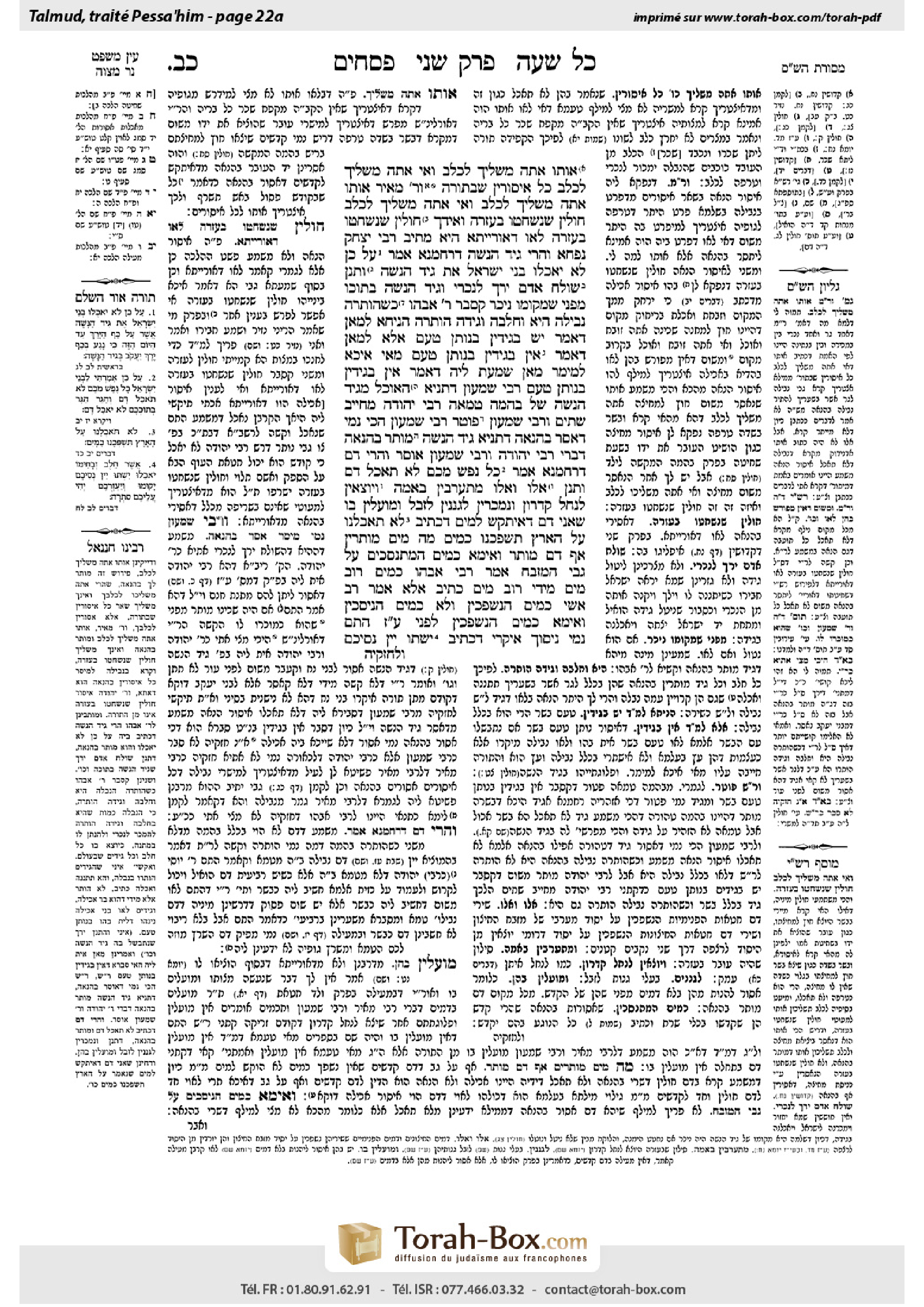
Pesachim 22a: Talmud study for Daf Yomi
Daf Yomi is the daily study of one Talmud folio. Explore 37 tractates with scans, Hebrew text, Sefaria English and AI-generated French translations where annotated.
Passage selection and English or AI-generated French translation are available where the scan has annotations. Daf Study is independent of Torah-Box and Sefaria.
Browse Pesachim · פסחים · All tractatesPesachim 22a text and translations
This page of Pesachim includes the Aramaic text, an English translation and an AI-generated French translation, alongside the scan above.
פסחים כ״ב א · Aramaic and Hebrew text
אוֹתוֹ אַתָּה מַשְׁלִיךְ לַכֶּלֶב, וְאִי אַתָּה מַשְׁלִיךְ לַכֶּלֶב כׇּל אִיסּוּרִין שֶׁבַּתּוֹרָה. וְרַבִּי מֵאִיר? אוֹתוֹ אַתָּה מַשְׁלִיךְ לַכֶּלֶב, וְאִי אַתָּה מַשְׁלִיךְ לַכֶּלֶב חוּלִּין שֶׁנִּשְׁחֲטוּ בַּעֲזָרָה.
וְאִידַּךְ? חוּלִּין שֶׁנִּשְׁחֲטוּ בַּעֲזָרָה לָאו דְּאוֹרָיְיתָא הִיא.
מֵתִיב רַבִּי יִצְחָק נַפָּחָא: וַהֲרֵי גִּיד הַנָּשֶׁה, דְּרַחֲמָנָא אָמַר: ״עַל כֵּן לֹא יֹאכְלוּ בְנֵי יִשְׂרָאֵל אֶת גִּיד הַנָּשֶׁה״, וּתְנַן: שׁוֹלֵחַ אָדָם יָרֵךְ לְגוֹי, וְגִיד הַנָּשֶׁה בְּתוֹכוֹ, מִפְּנֵי שֶׁמְּקוֹמוֹ נִיכָּר!
קָסָבַר רַבִּי אֲבָהוּ: כְּשֶׁהוּתְּרָה נְבֵילָה — הִיא וְחֶלְבָּהּ וְגִידָהּ הוּתְּרָה. הָנִיחָא לְמַאן דְּאָמַר ״יֵשׁ בְּגִידִין בְּנוֹתֵן טַעַם״. אֶלָּא לְמַאן דְּאָמַר ״אֵין בְּגִידִין בְּנוֹתֵן טַעַם״, מַאי אִיכָּא לְמֵימַר?
מַאן שָׁמְעַתְּ לֵיהּ דְּאָמַר ״אֵין בְּגִידִין בְּנוֹתֵן טַעַם״ רַבִּי שִׁמְעוֹן, דְּתַנְיָא: הָאוֹכֵל מִגִּיד הַנָּשֶׁה שֶׁל בְּהֵמָה טְמֵאָה, רַבִּי יְהוּדָה מְחַיֵּיב שְׁתַּיִם, וְרַבִּי שִׁמְעוֹן פּוֹטֵר.
רַבִּי שִׁמְעוֹן הָכִי נָמֵי דְּאָסַר בַּהֲנָאָה, דְּתַנְיָא: גִּיד הַנָּשֶׁה מוּתָּר בַּהֲנָאָה, דִּבְרֵי רַבִּי יְהוּדָה, וְרַבִּי שִׁמְעוֹן אוֹסֵר.
וַהֲרֵי דָּם, דְּרַחֲמָנָא אָמַר: ״כׇּל נֶפֶשׁ מִכֶּם לֹא תֹאכַל דָּם״, וּתְנַן: אֵלּוּ וָאֵלּוּ מִתְעָרְבִין בָּאַמָּה, וְיוֹצְאִין לְנַחַל קִדְרוֹן, וְנִמְכָּרִין לַגַּנָּנִין לְזַבֵּל, וּמוֹעֲלִין בּוֹ!
שָׁאנֵי דָּם דְּאִיתַּקַּשׁ לְמַיִם, דִּכְתִיב ״לֹא תֹּאכְלֶנּוּ עַל הָאָרֶץ תִּשְׁפְּכֶנּוּ כַּמָּיִם״ — מָה מַיִם מוּתָּרִין, אַף דָּם מוּתָּר.
וְאֵימָא, כַּמַּיִם הַמִּתְנַסְּכִים עַל גַּבֵּי הַמִּזְבֵּחַ! אָמַר רַבִּי אֲבָהוּ ״כַּמַּיִם״ — רוֹב מַיִם. מִידֵּי ״רוֹב מַיִם״ כְּתִיב?! אֶלָּא אָמַר רַב אָשֵׁי: כַּמַּיִם הַנִּשְׁפָּכִין, וְלֹא כַּמַּיִם הַנִּיסָּכִין.
וְאֵימָא: כַּמַּיִם הַנִּשְׁפָּכִין לִפְנֵי עֲבוֹדָה זָרָה! הָתָם נָמֵי נִיסּוּךְ אִיקְּרִי, דִּכְתִיב ״יִשְׁתּוּ יֵין נְסִיכָם״.
Pesachim 22a · English translation
The Gemara concludes: It, i.e., a tereifa, you may throw to a dog, but you may not throw all other items prohibited by Torah law to a dog, as both eating and deriving benefit are prohibited. The Gemara asks: And what halakha does Rabbi Meir learn from this verse? The Gemara answers that Rabbi Meir draws the following inference: It, you may throw to a dog, but you may not throw the meat of a non-sacred animal that was slaughtered in the Temple courtyard to a dog, as it is prohibited to benefit from it.
And from where does the other Sage, Rabbi Yehuda, learn this halakha about non-sacrificial meat that was slaughtered in the Temple courtyard? The Gemara answers: He holds that the prohibition of deriving benefit from the meat of a non-sacrificial animal that was slaughtered in the courtyard is not by Torah law; rather, the Sages decreed that it is prohibited. Since it is not prohibited by Torah law, no verse is necessary.
Rabbi Yitzḥak Nappaḥa raised an objection: And yet there is still the prohibition of the sciatic nerve, as the Merciful One says: “Therefore the children of Israel may not eat the sciatic nerve” (Genesis 32:33), and we learned in a mishna: A person may send the thigh of an animal to a gentile as a gift with the sciatic nerve inside it, he is not required to remove it. This is due to the fact that its place is clear, and it is obvious that this nerve has not been removed. Therefore, there is no concern that another Jew will assume that the first Jew removed this portion of the animal, which might cause him to accidentally eat the sciatic nerve. Apparently, one may benefit from this prohibited portion of the animal even though the verse says that one may not eat it.
The Gemara rejects this: Rabbi Abbahu holds that when it was permitted by the Torah to derive benefit from an animal carcass, it, its fats, and its sinews, such as the sciatic nerve, were all permitted. Therefore, the sciatic nerve is included in this exception and one may benefit from it. The Gemara challenges: It works out well according to the one who said that sinews give flavor, meaning that they have the taste of meat and therefore have the legal status of meat of an animal carcass. However, according to the one who says that sinews do not give flavor and are not categorized as meat, what can be said? If they are not considered to be meat, why are they included in the exception made for an animal carcass?
The Gemara answers: Whom did you hear that said that sinews do not give flavor? It is Rabbi Shimon, as it was taught in a baraita: With regard to one who eats the sciatic nerve from a non-kosher domesticated animal, Rabbi Yehuda deems him liable to receive two sets of lashes: One for eating the sciatic nerve and one for eating the meat of a non-kosher animal. And Rabbi Shimon exempts him entirely, since according to his opinion the prohibition to eat the sciatic nerve applies only to a kosher animal. In addition, one violates the prohibition of eating from a non-kosher animal only when it has the flavor of meat.
And it indeed follows logically that just as Rabbi Shimon exempts one who eats the sciatic nerve in that particular case, so too here, Rabbi Shimon prohibits deriving benefit from the sciatic nerve. As it was taught in a baraita: It is permitted to derive benefit from the sciatic nerve; this is the statement of Rabbi Yehuda, and Rabbi Shimon prohibits it. Since Rabbi Shimon holds that the sciatic nerve does not give flavor, it cannot be included in the exception of the animal carcass. Therefore, from the verse that prohibits eating the sciatic nerve he learns that one may not benefit from it either, in accordance with the opinion of Rabbi Abbahu. Rabbi Abbahu’s position fits according to both opinions. However, the mishna that indicates that it is permitted to derive benefit from the sciatic nerve is in accordance with the opinion of Rabbi Yehuda, as he holds that the sciatic nerve gives flavor and is therefore included in the exception of the animal carcass.
The Gemara further challenges Rabbi Abbahu’s opinion: And yet there is the prohibition of eating blood, as the Merciful One says: “Therefore I said to the children of Israel: No soul of you shall eat blood, neither shall any convert that dwells among you eat blood” (Leviticus 17:12). According to Rabbi Abbahu’s opinion, one may derive from this verse that in addition to the prohibition against eating blood, it is prohibited to benefit from it as well. And we learned in a mishna: Both these and these, the remnants of the blood from sin-offerings brought on the altar and other blood sprinkled on it, descend and mix in the canal from which water leaves the Temple. They then exit to the Kidron Valley and are sold at a special price to gardeners as a fertilizer. And one who does not first purchase the blood from the Temple misuses consecrated property. Apparently, under certain circumstances, one may benefit from blood which it is prohibited to consume.
The Gemara answers: Blood is different, as it is juxtaposed in the Torah to water. As it is written with regard to blood: “You shall not eat it; you shall pour it out upon the earth like water” (Deuteronomy 12:24). From here it is derived: Just as it is permitted to benefit from water, so too, it is permitted to benefit from blood.
The Gemara asks: And say instead that blood is meant to be like water offered as a libation on the altar, which is consecrated and from which one is prohibited to benefit. Rabbi Abbahu said: The comparison to permitted water can be deduced from that which the verse says: “Like water [kamayim],” meaning, like most water; and one is permitted to benefit from most types of water. The Gemara asks: And is it written: Most water? The Torah wrote: “Like water,” which could indicate a comparison to any type of water. Rather, Rav Ashi said that the verse should be understood as follows: Like water that is poured out, from which one may benefit, and not like water that is offered as a libation. Water offered on the altar is described using the term libation, and not using the term poured as found in the verse.
The Gemara asks: And say that blood is meant to be like water poured before idolatry, from which one may not benefit. The Gemara rejects this: There, that is also called a libation and not pouring, as it is written: “Who did eat the fat of their sacrifices, and drink the wine of their libations” (Deuteronomy 32:38).
Pesachim 22a · Traduction française (IA)
La Guemara conclut : Cela, c’est-à-dire une bête tereifa, tu peux le jeter à un chien, mais tu ne peux pas jeter à un chien les autres choses interdites par la Torah, car il est interdit d’en consommer et d’en tirer profit. La Guemara demande : Et quelle halakha Rabbi Meïr déduit-il de ce verset ? La Guemara répond que Rabbi Meïr en tire l’inférence suivante : Cela, tu peux le jeter à un chien, mais tu ne peux pas jeter à un chien la viande d’un animal non consacré qui a été abattu dans la cour du Temple, car il est interdit d’en tirer profit.
Et d’où l’autre Sage, Rabbi Yehouda, déduit-il cette halakha concernant la viande non consacrée abattue dans la cour du Temple ? La Guemara répond : Il estime que l’interdiction de tirer profit de la viande d’un animal non consacré abattu dans la cour n’est pas d’ordre toranique ; les Sages ont plutôt décrété qu’elle était interdite. Puisqu’elle n’est pas interdite par la Torah, aucun verset n’est nécessaire.
Rabbi Yitzḥak Nappaḥa souleva une objection : Pourtant, il y a encore l’interdiction du nerf sciatique, car le Miséricordieux dit : « C’est pourquoi les enfants d’Israël ne mangeront pas le nerf sciatique » (Genèse 32:33), et nous avons appris dans une Michna : On peut envoyer en cadeau à un non-Juif la cuisse d’un animal avec le nerf sciatique à l’intérieur ; on n’est pas tenu de l’en retirer. Cela tient au fait que son emplacement est évident, et qu’il est clair que ce nerf n’a pas été enlevé. Il n’y a donc pas lieu de craindre qu’un autre Juif suppose que le premier Juif a retiré cette partie de l’animal, ce qui pourrait l’amener à manger par inadvertance le nerf sciatique. Apparemment, on peut tirer profit de cette partie interdite de l’animal, bien que le verset dise qu’on ne peut pas la manger.
La Guemara rejette cette objection : Rabbi Abbahou estime que lorsque la Torah a autorisé à tirer profit d’une carcasse d’animal, cela comprenait aussi ses graisses et ses nerfs, comme le nerf sciatique. Le nerf sciatique relève donc de cette exception et on peut en tirer profit. La Guemara objecte : Cela fonctionne bien selon celui qui dit que les nerfs donnent du goût, c’est-à-dire qu’ils ont le goût de la viande et ont donc le statut juridique de la viande d’une carcasse. Mais que peut-on dire selon celui qui affirme que les nerfs ne donnent pas de goût et ne sont pas considérés comme de la viande ? S’ils ne sont pas considérés comme de la viande, pourquoi sont-ils inclus dans l’exception concernant la carcasse ?
La Guemara répond : Qui as-tu entendu affirmer que les nerfs ne donnent pas de goût ? Rabbi Shimon. En effet, il a été enseigné dans une baraïta : Celui qui mange le nerf sciatique d’un animal domestique non cachère, Rabbi Yehouda le déclare passible de deux séries de coups : l’une pour avoir mangé le nerf sciatique, l’autre pour avoir mangé la viande d’un animal non cachère. Rabbi Shimon l’en exempte entièrement, car, selon son opinion, l’interdiction de manger le nerf sciatique ne s’applique qu’à un animal cachère. En outre, on ne transgresse l’interdiction de manger un animal non cachère que si celui-ci a le goût de la viande.
Il s’ensuit effectivement que, de même que Rabbi Shimon exempte celui qui mange le nerf sciatique dans ce cas précis, de même, ici, Rabbi Shimon interdit d’en tirer profit. En effet, il a été enseigné dans une baraïta : Il est permis de tirer profit du nerf sciatique ; telle est la déclaration de Rabbi Yehouda, tandis que Rabbi Shimon l’interdit. Puisque Rabbi Shimon estime que le nerf sciatique ne donne pas de goût, il ne peut pas être inclus dans l’exception concernant la carcasse. Il déduit donc du verset qui interdit de manger le nerf sciatique qu’il est également interdit d’en tirer profit, conformément à l’opinion de Rabbi Abbahou. La position de Rabbi Abbahou convient selon les deux opinions. Toutefois, la Michna qui indique qu’il est permis de tirer profit du nerf sciatique est conforme à l’opinion de Rabbi Yehouda, car celui-ci estime que le nerf sciatique donne du goût et est donc inclus dans l’exception concernant la carcasse.
La Guemara soulève une autre objection contre l’opinion de Rabbi Abbahou : Pourtant, il y a l’interdiction de manger du sang, car le Miséricordieux dit : « C’est pourquoi j’ai dit aux enfants d’Israël : Aucune personne parmi vous ne mangera de sang, et aucun étranger résidant parmi vous ne mangera de sang » (Lévitique 17:12). Selon l’opinion de Rabbi Abbahou, on pourrait déduire de ce verset qu’en plus de l’interdiction de manger du sang, il est également interdit d’en tirer profit. Or, nous avons appris dans une Michna : Ces uns comme les autres, les restes du sang des sacrifices expiatoires offerts sur l’autel et les autres sangs qui y sont aspergés, descendent et se mêlent dans le canal par lequel l’eau quitte le Temple. Ils s’écoulent ensuite vers la vallée du Cédron et sont vendus à prix spécial aux jardiniers comme engrais. Celui qui n’achète pas d’abord le sang au Temple commet un abus portant sur un bien consacré. Apparemment, dans certaines circonstances, on peut tirer profit du sang qu’il est interdit de consommer.
La Guemara répond : Le sang est différent, car il est rapproché de l’eau dans la Torah. En effet, il est écrit au sujet du sang : « Tu ne le mangeras pas ; tu le répandras sur la terre comme de l’eau » (Deutéronome 12:24). On en déduit que, de même qu’il est permis de tirer profit de l’eau, de même il est permis de tirer profit du sang.
La Guemara demande : Et si l’on disait plutôt que le sang est comparé à l’eau offerte en libation sur l’autel, qui est consacrée et dont il est interdit de tirer profit ? Rabbi Abbahou dit : La comparaison avec l’eau dont il est permis de tirer profit se déduit de l’expression du verset : « comme de l’eau [kamayim] », c’est-à-dire comme la plupart des eaux ; or, il est permis de tirer profit de la plupart des sortes d’eau. La Guemara demande : Est-il écrit « la plupart des eaux » ? La Torah a écrit « comme de l’eau », ce qui pourrait indiquer une comparaison avec n’importe quelle sorte d’eau. Rav Achi dit plutôt qu’il faut comprendre le verset ainsi : comme de l’eau que l’on répand, dont on peut tirer profit, et non comme de l’eau offerte en libation. L’eau offerte sur l’autel est désignée par le terme de libation, et non par celui d’eau répandue, qui figure dans le verset.
La Guemara demande : Et si l’on disait que le sang est comparé à l’eau répandue devant une idole, dont il est interdit de tirer profit ? La Guemara rejette cette hypothèse : Là aussi, cela est appelé une libation, et non une aspersion, comme il est écrit : « Qui ont mangé la graisse de leurs sacrifices et bu le vin de leurs libations » (Deutéronome 32:38).
Traduction française générée par IA à partir de l’édition anglaise de Sefaria. Vérifie toujours un passage avec le texte source.
Text from Sefaria: William Davidson Edition - Vocalized Aramaic (CC BY NC); William Davidson Edition - English (CC BY NC).