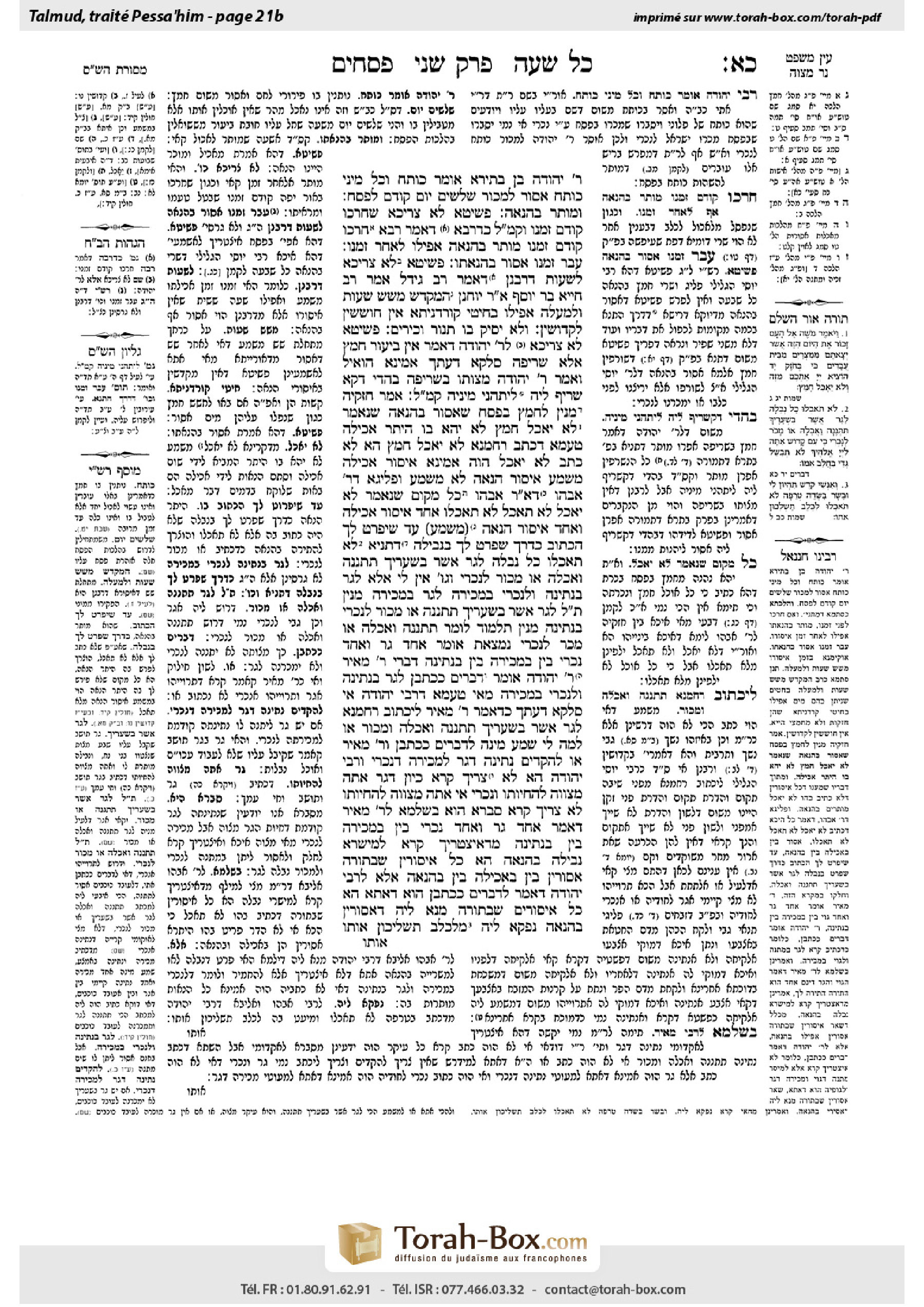
Pesachim 21b: Talmud study for Daf Yomi
Daf Yomi is the daily study of one Talmud folio. Explore 37 tractates with scans, Hebrew text, Sefaria English and AI-generated French translations where annotated.
Passage selection and English or AI-generated French translation are available where the scan has annotations. Daf Study is independent of Torah-Box and Sefaria.
Browse Pesachim · פסחים · All tractatesPesachim 21b text and translations
This page of Pesachim includes the Aramaic text, an English translation and an AI-generated French translation, alongside the scan above.
פסחים כ״א ב · Aramaic and Hebrew text
רַבִּי יְהוּדָה בֶּן בְּתֵירָא אוֹמֵר: כּוּתָּח וְכׇל מִינֵי כוּתָּח — אָסוּר לִמְכּוֹר שְׁלֹשִׁים יוֹם קוֹדֶם לַפֶּסַח.
וּמוּתָּר בַּהֲנָאָה. פְּשִׁיטָא! לָא צְרִיכָא שֶׁחֲרָכוֹ קוֹדֶם זְמַנּוֹ. וְקָא מַשְׁמַע לַן כִּדְרָבָא, דְּאָמַר רָבָא: חֲרָכוֹ קוֹדֶם זְמַנּוֹ — מוּתָּר בַּהֲנָאָה אֲפִילּוּ לְאַחַר זְמַנּוֹ.
עָבַר זְמַנּוֹ אָסוּר בַּהֲנָאָתוֹ. פְּשִׁיטָא! לָא צְרִיכָא, לְשָׁעוֹת דְּרַבָּנַן. דְּאָמַר רַב גִּידֵּל אָמַר רַב חִיָּיא בַּר יוֹסֵף אָמַר רַבִּי יוֹחָנָן: הַמְקַדֵּשׁ מִשֵּׁשׁ שָׁעוֹת וּלְמַעְלָה, אֲפִילּוּ בְּחִיטֵּי קוּרְדִּנְיָתָא — אֵין חוֹשְׁשִׁין לְקִדּוּשִׁין.
וְלֹא יַסִּיק בּוֹ תַּנּוּר וְכִירַיִם. פְּשִׁיטָא! לָא צְרִיכָא, לְרַבִּי יְהוּדָה דְּאָמַר אֵין בִּיעוּר חָמֵץ אֶלָּא שְׂרֵיפָה. סָלְקָא דַּעְתָּךְ אָמֵינָא: הוֹאִיל וְאָמַר רַבִּי יְהוּדָה מִצְוָתוֹ בִּשְׂרֵיפָה, בַּהֲדֵי דְּקָא שָׂרֵיף לֵיהּ לִיתְהֲנֵי מִינֵּיהּ, קָא מַשְׁמַע לַן.
אָמַר חִזְקִיָּה: מִנַּיִן לְחָמֵץ בַּפֶּסַח שֶׁאָסוּר בַּהֲנָאָה? שֶׁנֶּאֱמַר ״לֹא יֵאָכֵל חָמֵץ״ — לֹא יְהֵא בּוֹ הֶיתֵּר אֲכִילָה: טַעְמָא דִּכְתַב רַחֲמָנָא ״לֹא יֵאָכֵל חָמֵץ״, הָא לָא כְּתַב ״לֹא יֵאָכֵל״, הֲוָה אָמֵינָא: אִיסּוּר אֲכִילָה — מַשְׁמַע, אִיסּוּר הֲנָאָה — לָא מַשְׁמַע.
וּפְלִיגָא דְּרַבִּי אֲבָהוּ. דְּאָמַר רַבִּי אֲבָהוּ: כׇּל מָקוֹם שֶׁנֶּאֱמַר ״לֹא יֵאָכֵל״, ״לֹא תֹאכַל״, ״לֹא תֹאכְלוּ״ — אֶחָד אִיסּוּר אֲכִילָה וְאֶחָד אִיסּוּר הֲנָאָה (מַשְׁמַע), עַד שֶׁיִּפְרֹט לְךָ הַכָּתוּב כְּדֶרֶךְ שֶׁפָּרַט לְךָ בִּנְבֵילָה.
דְּתַנְיָא: ״לֹא תֹאכְלוּ כׇּל נְבֵלָה לַגֵּר אֲשֶׁר בִּשְׁעָרֶיךָ תִּתְּנֶנָּה וַאֲכָלָהּ אוֹ מָכֹר לְנׇכְרִי וְגוֹ׳״, אֵין לִי אֶלָּא לַגֵּר בִּנְתִינָה וְלַגּוֹי בִּמְכִירָה. לַגֵּר בִּמְכִירָה מִנַּיִן? תַּלְמוּד לוֹמַר: ״לַגֵּר אֲשֶׁר בִּשְׁעָרֶיךָ תִּתְּנֶנָּה אוֹ מָכֹר״. לַגּוֹי בִּנְתִינָה מִנַּיִן? תַּלְמוּד לוֹמַר: ״תִּתְּנֶנָּה וַאֲכָלָהּ אוֹ מָכֹר לְנָכְרִי״. נִמְצֵאתָ אוֹמֵר: אֶחָד גֵּר וְאֶחָד גּוֹי, בֵּין בִּמְכִירָה בֵּין בִּנְתִינָה, דִּבְרֵי רַבִּי מֵאִיר.
רַבִּי יְהוּדָה אוֹמֵר, דְּבָרִים כִּכְתָבָן: לַגֵּר בִּנְתִינָה וְלַגּוֹי בִּמְכִירָה. מַאי טַעְמָא דְּרַבִּי יְהוּדָה? אִי סָלְקָא דַעְתָּךְ כִּדְאָמַר רַבִּי מֵאִיר, לִיכְתּוֹב רַחֲמָנָא: ״לַגֵּר אֲשֶׁר בִּשְׁעָרֶיךָ תִּתְּנֶנָּה וַאֲכָלָהּ וּמָכֹר״. ״אוֹ״ לְמָה לִי? שְׁמַע מִינַּהּ לִדְבָרִים כִּכְתָבָן.
וְרַבִּי מֵאִיר? ״אוֹ״ לְהַקְדִּים נְתִינָה דְגֵר לִמְכִירָה דְּגוֹי. וְרַבִּי יְהוּדָה? הָא לָא צָרִיךְ קְרָא: כֵּיוָן דְּגֵר אַתָּה מְצֻוֶּוה לְהַחְיוֹתוֹ, וְגוֹי אִי אַתָּה מְצֻוֶּוה לְהַחֲיוֹתוֹ, לָא צְרִיךְ קְרָא, סְבָרָא הוּא.
בִּשְׁלָמָא לְרַבִּי מֵאִיר, דְּאָמַר: אֶחָד גֵּר וְאֶחָד גּוֹי, בֵּין בִּמְכִירָה בֵּין בִּנְתִינָה. מִדְּאִיצְטְרִיךְ קְרָא לְמִישְׁרֵא נְבֵילָה בַּהֲנָאָה — הָא כׇּל אִיסּוּרִין שֶׁבַּתּוֹרָה אֲסוּרִין בֵּין בַּאֲכִילָה בֵּין בַּהֲנָאָה.
אֶלָּא לְרַבִּי יְהוּדָה, דְּאָמַר: לִדְבָרִים כִּכְתָבָן הוּא דַּאֲתָא — הָא כׇּל אִיסּוּרִים שֶׁבַּתּוֹרָה מְנָא לֵיהּ דַּאֲסוּרִין בַּהֲנָאָה? נָפְקָא לֵיהּ מִ״לַּכֶּלֶב תַּשְׁלִיכוּן אֹתוֹ״.
Pesachim 21b · English translation
Rabbi Yehuda ben Beteira, who agrees in principle with Beit Shammai’s opinion, says: With regard to kutaḥ, a dip that contains leavened breadcrumbs, and all types of kutaḥ, it is prohibited to sell it to a gentile thirty days before Passover. Because kutaḥ is spicy, people use only a bit at a time, so it will likely last until Passover.
It was stated in the mishna that as long as leavened bread may be eaten, it is permitted to derive benefit from it. The Gemara asks: Isn’t that obvious? The Gemara answers: No, it is necessary to teach this in a case where one charred the leavened bread with fire before its time, i.e., before it became prohibited, rendering it inedible. And it teaches us that the halakha is in accordance with the opinion of Rava. As Rava said: If one charred leavened bread before its time, it is permitted to derive benefit from it even after its time, since it no longer has the legal status of leavened bread.
It was stated in the mishna: After its time passes, it is prohibited to benefit from it. The Gemara asks: Isn’t that obvious? The Gemara answers: No, it is necessary for the mishna to teach that it remains prohibited to benefit from leavened bread during additional hours that are delineated by rabbinic law. As Rav Giddel said that Rav Ḥiyya bar Yosef said that Rabbi Yoḥanan said: With regard to one who takes wheat grains that may have come into contact with water and become leavened and betroths a woman with the leaven from the beginning of the sixth hour, when the leaven is prohibited by rabbinic law, and onward on Passover eve, even if he betrothed her with wheat from the mountains, which is especially hard and unlikely to become leavened, nonetheless, we are not concerned that this betrothal is valid. This is because when performing a betrothal with money one must give the woman an object worth as least the value of a peruta, and leaven from which one is prohibited to benefit is considered worthless.
It was stated in the mishna: And one may not even light an oven or a stove with leavened bread once it becomes prohibited. The Gemara asks: Isn’t that obvious, as this is also a type of benefit? The Gemara answers: No, it is necessary to teach this due to the opinion of Rabbi Yehuda, who said that the removal of leavened bread is to be performed only through burning. Otherwise, it could enter your mind to say: Since Rabbi Yehuda said that its mitzva is performed through burning, while one is burning it let him benefit from it. Therefore, it teaches us that it is prohibited to benefit from leavened bread even while burning it.
Ḥizkiya said: From where is it derived in the mishna that it is prohibited to derive benefit from leavened bread on Passover? As it is stated: “Leavened bread shall not be eaten” (Exodus 13:3). Since the verse uses the passive, it should be understood as follows: There shall be no permitted consumption of it at all, even deriving benefit, as benefit could be exchanged for money, which could be used to buy food. The Gemara reads precisely: The reason deriving benefit is prohibited is that the Merciful One writes in the Torah: “Leavened bread shall not be eaten.” Had the Torah not written: “Shall not be eaten,” and instead used the active form: You shall not eat, I would have said that the prohibition of eating is implied but that the prohibition of deriving benefit is not implied.
The Gemara comments: And this conclusion disagrees with the opinion of Rabbi Abbahu, as Rabbi Abbahu said that wherever it is stated: “It shall not be eaten,” “You, singular, shall not eat,” or “You, plural, shall not eat,” both a prohibition of eating and a prohibition of deriving benefit are implied, unless the verse specifies that one may benefit, in the manner that it specified with regard to an unslaughtered animal carcass.
As it was taught in a baraita: “You shall not eat of any unslaughtered animal; you may give it to the resident alien who is within your gates, that he may eat it; or you may sell it to a foreigner; for you are a sacred people to the Lord your God” (Deuteronomy 14:21). I have derived only that it is permitted to a resident alien through giving and to a gentile through selling. From where do I derive that it is permitted to a resident alien through selling? The verse states: “You may give it to the resident alien who is within your gates…or you may sell it,” meaning that one has the option to do either of these. From where is it derived that it is permitted to a gentile through giving and one is not required to sell it to him? The verse states: “You may give it…that he may eat it, or you may sell it to a foreigner.” Therefore, you may say that he may transfer it to both a resident alien and a gentile, both through giving and through selling. This is the statement of Rabbi Meir.
The baraita concludes: Rabbi Yehuda says: These matters are meant to be understood as they are written; he may transfer an unslaughtered animal carcass to a resident alien only through giving and to a gentile only through selling. The Gemara asks: What is the reason for the opinion of Rabbi Yehuda? The Gemara answers: If it could enter your mind to understand the verse in accordance with that which Rabbi Meir said, then let the Merciful One write: You may give it to the resident alien who is within your gates that he may eat it and sell it to a foreigner. Why do I need the word “or” between these two options? Learn from it that the matters are to be understood as they are written.
The Gemara asks: And how does Rabbi Meir explain the formulation of the verse? The Gemara answers that Rabbi Meir would explain that the word “or” teaches one to give precedence to giving to a resident alien over selling to a gentile. The Gemara asks: And from where does Rabbi Yehuda derive this halakha? According to Rabbi Yehuda, this matter does not need a verse, since you are commanded to sustain a resident alien, as it is a mitzva for one to sustain a resident alien who has renounced idol worship, and you are not commanded to sustain a gentile. There is no need for a verse to teach this; it is based on a logical inference.
The Gemara applies this discussion to the previously mentioned topic. Granted, Rabbi Abbahu’s opinion is reasonable according to Rabbi Meir, who said that one may transfer an animal carcass to both a convert and a gentile, both through selling and through giving. From the fact that a verse was necessary to permit one to derive benefit from an animal carcass, one can learn that with regard to all other prohibitions in the Torah about which it states only that one may not eat an item, it is prohibited both to eat it and to derive benefit from it.
However, according to Rabbi Yehuda, who said that the word “or” comes to teach that the matters are to be understood as they are written, from where does he derive with regard to all prohibitions of eating mentioned in the Torah that it is prohibited to derive benefit as well? The Gemara answers: He derives it from another verse. It is stated with regard to an animal with a condition that will cause it to die within twelve months [tereifa]: “And you shall be sacred men to Me, therefore you shall not eat any flesh that is torn of beasts in the field; you shall cast it to the dogs” (Exodus 22:30).
Pesachim 21b · Traduction française (IA)
Rabbi Yehouda ben Beteira, qui approuve en principe l’opinion de Beit Chammaï, dit : Concernant le koutaḥ, une sauce contenant des miettes de pain levé, et toutes les sortes de koutaḥ, il est interdit d’en vendre à un non-Juif dans les trente jours précédant Pessa’h. Comme le koutaḥ est épicé, on n’en utilise qu’un peu à la fois ; il risque donc d’en rester jusqu’à Pessa’h.
La Michna a enseigné que tant qu’il est permis de manger du pain levé, il est permis d’en tirer profit. La Guemara demande : N’est-ce pas évident ? La Guemara répond : Non, cela est nécessaire pour enseigner le cas où l’on a carbonisé du pain levé avant le moment où il est devenu interdit, le rendant ainsi immangeable. Cela nous enseigne que la halakha suit l’opinion de Rava. En effet, Rava a dit : Si l’on a carbonisé du pain levé avant le moment où il est devenu interdit, il est permis d’en tirer profit même après ce moment, puisqu’il n’a plus le statut légal de pain levé.
La Michna a enseigné : Une fois ce délai passé, il est interdit d’en tirer profit. La Guemara demande : N’est-ce pas évident ? La Guemara répond : Non, la Michna doit enseigner qu’il reste interdit de tirer profit du pain levé pendant les heures supplémentaires définies par la loi rabbinique. En effet, Rav Giddel a dit au nom de Rav Ḥiyya bar Yosef, qui l’a dit au nom de Rabbi Yoḥanan : Si quelqu’un prend des grains de blé qui ont pu entrer en contact avec de l’eau et avoir levé, et qu’il s’en sert pour épouser une femme à partir du début de la sixième heure, lorsque le pain levé est interdit par décret rabbinique, et jusqu’à la veille de Pessa’h, nous ne considérons pas ces fiançailles comme valides, même s’il l’a épousée avec du blé des montagnes, particulièrement dur et peu susceptible de lever. En effet, pour procéder à des fiançailles avec de l’argent, il faut donner à la femme un objet d’une valeur au moins égale à une perouta, et le pain levé dont il est interdit de tirer profit est considéré comme dépourvu de valeur.
La Michna a enseigné : On ne peut même pas allumer un four ou un poêle avec du pain levé une fois que celui-ci devient interdit. La Guemara demande : N’est-ce pas évident, puisque cela constitue aussi une manière d’en tirer profit ? La Guemara répond : Non, cela est nécessaire en raison de l’opinion de Rabbi Yehouda, qui a dit que l’élimination du pain levé doit se faire uniquement par le feu. Sinon, on pourrait penser : puisque Rabbi Yehouda a dit que la mitsva s’accomplit par le feu, on pourrait en tirer profit pendant qu’on le brûle. Cela nous enseigne qu’il est interdit de tirer profit du pain levé même lorsqu’on le brûle.
Ḥizkiya a dit : D’où déduit-on dans la Michna qu’il est interdit de tirer profit du pain levé pendant Pessa’h ? Car il est dit : « Le pain levé ne sera pas mangé » (Exode 13,3). Puisque le verset emploie la forme passive, il faut le comprendre ainsi : aucun usage n’en est permis, pas même le fait d’en tirer profit, car le profit pourrait être échangé contre de l’argent, qui pourrait servir à acheter de la nourriture. La Guemara précise : la raison pour laquelle il est interdit d’en tirer profit est que le Miséricordieux écrit dans la Torah : « Le pain levé ne sera pas mangé. » Si la Torah n’avait pas écrit « ne sera pas mangé », mais avait plutôt employé la forme active « tu ne mangeras pas », j’aurais dit que l’interdiction de manger est sous-entendue, mais pas celle d’en tirer profit.
La Guemara fait remarquer : Cette conclusion est contraire à l’opinion de Rabbi Abbahou, car Rabbi Abbahou a dit que chaque fois qu’il est dit : « Il ne sera pas mangé », « Tu ne mangeras pas », au singulier, ou « Vous ne mangerez pas », au pluriel, cela implique à la fois une interdiction de manger et une interdiction de tirer profit, à moins que le verset ne précise qu’il est permis d’en tirer profit, comme il le précise au sujet d’une carcasse d’animal non abattu rituellement.
Comme il a été enseigné dans une baraïta : « Vous ne mangerez d’aucune bête morte ; tu peux la donner à l’étranger résidant dans tes portes, afin qu’il la mange, ou tu peux la vendre à un étranger ; car tu es un peuple saint pour le Seigneur ton Dieu » (Deutéronome 14,21). J’ai seulement déduit qu’il est permis de la donner à un étranger résidant et de la vendre à un non-Juif. D’où déduit-on qu’il est permis de la vendre à un étranger résidant ? Le verset dit : « Tu peux la donner à l’étranger résidant dans tes portes… ou tu peux la vendre », ce qui signifie qu’on a le choix entre l’une et l’autre possibilité. D’où déduit-on qu’il est permis de la donner à un non-Juif et qu’on n’est pas tenu de la lui vendre ? Le verset dit : « Tu peux la donner… afin qu’il la mange, ou tu peux la vendre à un étranger. » On peut donc dire qu’on peut la transférer aussi bien à un étranger résidant qu’à un non-Juif, par don comme par vente. Telle est l’opinion de Rabbi Meïr.
La baraïta conclut : Rabbi Yehouda dit : Ces dispositions doivent être comprises selon leur formulation ; on ne peut transférer une carcasse d’animal non abattu rituellement à un étranger résidant que par don, et à un non-Juif que par vente. La Guemara demande : Quelle est la raison de l’opinion de Rabbi Yehouda ? La Guemara répond : Si l’on pouvait comprendre le verset conformément à l’opinion de Rabbi Meïr, que le Miséricordieux écrive : « Tu peux la donner à l’étranger résidant dans tes portes afin qu’il la mange, et la vendre à un étranger. » Pourquoi ai-je besoin du mot « ou » entre ces deux possibilités ? On en déduit que ces dispositions doivent être comprises selon leur formulation.
La Guemara demande : Et comment Rabbi Meïr explique-t-il la formulation du verset ? La Guemara répond que Rabbi Meïr expliquerait que le mot « ou » enseigne qu’il faut donner la priorité au don à un étranger résidant plutôt qu’à la vente à un non-Juif. La Guemara demande : Et d’où Rabbi Yehouda déduit-il cette halakha ? Selon Rabbi Yehouda, il n’est pas nécessaire d’avoir un verset pour cette disposition, puisqu’on a le devoir de subvenir aux besoins d’un étranger résidant : c’est une mitsva de subvenir aux besoins d’un étranger résidant qui a renoncé au culte des idoles, alors qu’on n’a pas le devoir de subvenir aux besoins d’un non-Juif. Un verset n’est pas nécessaire pour l’enseigner ; cela découle d’un raisonnement logique.
La Guemara applique cette discussion au sujet mentionné précédemment. Certes, l’opinion de Rabbi Abbahou est compréhensible selon Rabbi Meïr, qui a dit qu’on peut transférer une carcasse d’animal aussi bien à un converti qu’à un non-Juif, par vente comme par don. Puisqu’un verset était nécessaire pour autoriser à tirer profit d’une carcasse d’animal, on peut en déduire que, pour toutes les autres interdictions de la Torah au sujet desquelles il est seulement dit qu’on ne peut pas manger un aliment, il est interdit à la fois de le manger et d’en tirer profit.
Cependant, selon Rabbi Yehouda, qui a dit que le mot « ou » vient enseigner que ces dispositions doivent être comprises selon leur formulation, d’où déduit-il que toutes les interdictions de manger mentionnées dans la Torah interdisent également d’en tirer profit ? La Guemara répond : Il le déduit d’un autre verset. Au sujet d’un animal atteint d’une affection qui entraînera sa mort dans les douze mois [tereifa], il est dit : « Vous serez des hommes saints pour Moi ; vous ne mangerez donc aucune chair déchirée par des bêtes dans les champs ; vous la jetterez aux chiens » (Exode 22,30).
Traduction française générée par IA à partir de l’édition anglaise de Sefaria. Vérifie toujours un passage avec le texte source.
Text from Sefaria: William Davidson Edition - Vocalized Aramaic (CC BY NC); William Davidson Edition - English (CC BY NC).