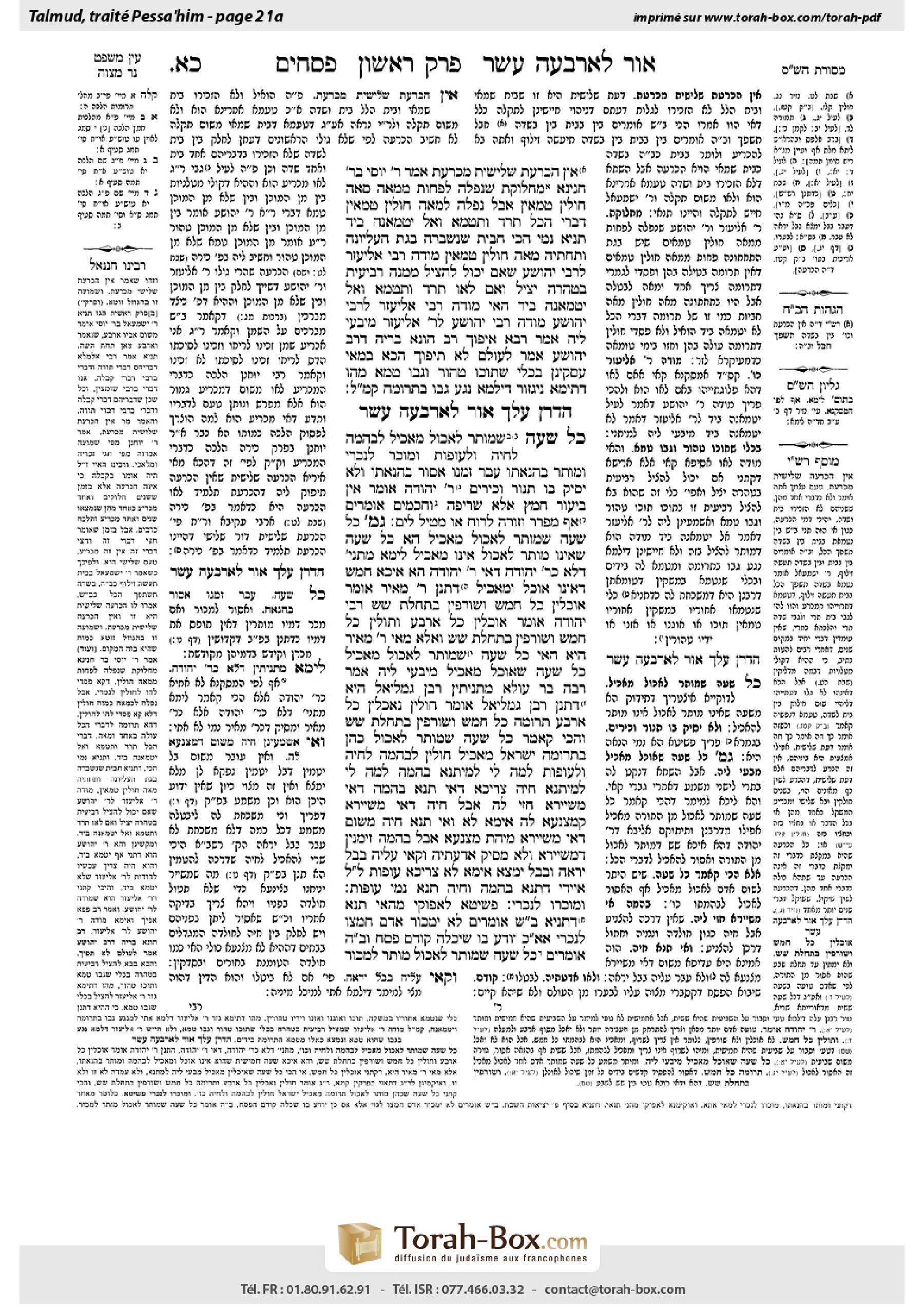
Pesachim 21a: Talmud study for Daf Yomi
Daf Yomi is the daily study of one Talmud folio. Explore 37 tractates with scans, Hebrew text, Sefaria English and AI-generated French translations where annotated.
Passage selection and English or AI-generated French translation are available where the scan has annotations. Daf Study is independent of Torah-Box and Sefaria.
Browse Pesachim · פסחים · All tractatesPesachim 21a text and translations
This page of Pesachim includes the Aramaic text, an English translation and an AI-generated French translation, alongside the scan above.
פסחים כ״א א · Aramaic and Hebrew text
אֵין הַכְרָעַת שְׁלִישִׁית מַכְרַעַת.
אָמַר רַבִּי יוֹסֵי בְּרַבִּי חֲנִינָא: מַחְלוֹקֶת שֶׁנָּפְלָה לְפָחוֹת מִמֵּאָה סְאָה חוּלִּין טְמֵאִין.
אֲבָל נָפְלָה לְמֵאָה חוּלִּין טְמֵאִין — דִּבְרֵי הַכֹּל תֵּרֵד וְתִטַּמֵּא, וְאַל יְטַמְּאֶנָּה בַּיָּד.
תַּנְיָא נָמֵי הָכִי: חָבִית שֶׁנִּשְׁבְּרָה בַּגַּת הָעֶלְיוֹנָה, וְתַחְתֶּיהָ מֵאָה חוּלִּין טְמֵאִין — מוֹדֶה רַבִּי אֱלִיעֶזֶר לְרַבִּי יְהוֹשֻׁעַ שֶׁאִם יָכוֹל לְהַצִּיל מִמֶּנָּה רְבִיעִית בְּטׇהֳרָה — יַצִּיל, וְאִם לָאו — תֵּרֵד וְתִטַּמֵּא וְאַל יְטַמְּאֶנָּה בַּיָּד.
הַאי ״מוֹדֶה רַבִּי אֱלִיעֶזֶר לְרַבִּי יְהוֹשֻׁעַ״, מוֹדֶה רַבִּי יְהוֹשֻׁעַ לְרַבִּי אֱלִיעֶזֶר מִיבְּעֵי לֵיהּ! אָמַר רָבָא: אֵיפוֹךְ.
רַב הוּנָא בְּרֵיהּ דְּרַב יְהוֹשֻׁעַ אָמַר, לְעוֹלָם לָא תֵּיפוֹךְ: הָכָא בְּמַאי עָסְקִינַן — בִּכְלִי שֶׁתּוֹכוֹ טָהוֹר וְגַבּוֹ טָמֵא. מַהוּ דְּתֵימָא נִיגְזוֹר דִּילְמָא נָגַע גַּבּוֹ בִּתְרוּמָה, קָא מַשְׁמַע לַן.
הַדְרָן עֲלָךְ אוֹר לְאַרְבָּעָה עָשָׂר
מַתְנִי׳ כׇּל שָׁעָה שֶׁמּוּתָּר לֶאֱכוֹל, מַאֲכִיל לַבְּהֵמָה לַחַיָּה וְלָעוֹפוֹת, וּמוֹכֵר לַנׇּכְרִי, וּמוּתָּר בַּהֲנָאָתוֹ. עָבַר זְמַנּוֹ — אָסוּר בַּהֲנָאָתוֹ, וְלֹא יַסִּיק בּוֹ תַּנּוּר וְכִירַיִם. רַבִּי יְהוּדָה אוֹמֵר: אֵין בִּיעוּר חָמֵץ אֶלָּא שְׂרֵיפָה. וַחֲכָמִים אוֹמְרִים: אַף מְפָרֵר וְזוֹרֶה לְרוּחַ אוֹ מֵטִיל לַיָּם.
גְּמָ׳ כׇּל שָׁעָה שֶׁמּוּתָּר לֶאֱכוֹל — מַאֲכִיל, הָא כׇּל שָׁעָה שֶׁאֵינוֹ מוּתָּר לֶאֱכוֹל — אֵינוֹ מַאֲכִיל. לֵימָא מַתְנִיתִין דְּלָא כְּרַבִּי יְהוּדָה. דְּאִי רַבִּי יְהוּדָה, הָא אִיכָּא חָמֵשׁ דְּאֵינוֹ אוֹכֵל — וּמַאֲכִיל. דִּתְנַן, רַבִּי מֵאִיר אוֹמֵר: אוֹכְלִין כׇּל חָמֵשׁ, וְשׂוֹרְפִין בִּתְחִלַּת שֵׁשׁ. רַבִּי יְהוּדָה אוֹמֵר: אוֹכְלִין כׇּל אַרְבַּע, וְתוֹלִין כׇּל חָמֵשׁ, וְשׂוֹרְפִין בִּתְחִלַּת שֵׁשׁ!
וְאֶלָּא מַאי, רַבִּי מֵאִיר הִיא? הַאי ״כׇּל שָׁעָה שֶׁמּוּתָּר לֶאֱכוֹל מַאֲכִיל״ — ״כׇּל שָׁעָה שֶׁאוֹכֵל מַאֲכִיל״ מִיבְּעֵי לֵיהּ.
אָמַר רַבָּה בַּר עוּלָּא: מַתְנִיתִין רַבָּן גַּמְלִיאֵל הִיא. דִּתְנַן, רַבָּן גַּמְלִיאֵל אוֹמֵר: חוּלִּין נֶאֱכָלִין כׇּל אַרְבַּע, תְּרוּמָה כׇּל חָמֵשׁ, וְשׂוֹרְפִין בִּתְחִלַּת שֵׁשׁ. וְהָכִי קָאָמַר: כׇּל שָׁעָה שֶׁמּוּתָּר לֶאֱכוֹל כֹּהֵן בִּתְרוּמָה, יִשְׂרָאֵל מַאֲכִיל חוּלִּין לַבְּהֵמָה לַחַיָּה וְלָעוֹפוֹת.
לְמָה לִי לְמִיתְנָא בְּהֵמָה, לְמָה לִי לְמִיתְנָא חַיָּה? צְרִיכָא. דְּאִי תְּנָא בְּהֵמָה — דְּאִי מְשַׁיְּירָא חָזֵי לַהּ. אֲבָל חַיָּה, דְּאִי מְשַׁיְּירָא קָמַצְנְעָא לַהּ — אֵימָא לָא.
וְאִי תְּנָא חַיָּה — מִשּׁוּם דְּאִי מְשַׁיְּירָא מִיהַת מַצְנְעָא. אֲבָל בְּהֵמָה, זִימְנִין דִּמְשַׁיְּירָא וְלָא מַסֵּיק אַדַּעְתֵּיהּ, וְקָאֵי עֲלֵיהּ בְּ״בַל יֵרָאֶה וּבְבַל יִמָּצֵא״ — אֵימָא לָא, צְרִיכָא.
עוֹפוֹת לְמָה לִי? אַיְּידֵי דִּתְנָא בְּהֵמָה וְחַיָּה, תְּנָא נָמֵי עוֹפוֹת.
וּמוֹכְרוֹ לְגוֹי. פְּשִׁיטָא! לְאַפּוֹקֵי מֵהַאי תַּנָּא דְּתַנְיָא, בֵּית שַׁמַּאי אוֹמְרִים: לֹא יִמְכּוֹר אָדָם חֲמֵצוֹ לְגוֹי אֶלָּא אִם כֵּן יוֹדֵעַ בּוֹ שֶׁיִּכְלֶה קוֹדֶם פֶּסַח. וּבֵית הִלֵּל אוֹמְרִים: כׇּל שָׁעָה שֶׁמּוּתָּר לֶאֱכוֹל — מוּתָּר לִמְכּוֹר.
Pesachim 21a · English translation
The decision of the third opinion of Rabbi Yishmael, son of Rabbi Yosei, is not considered a decision in this case, as the other two Sages do not raise the issue of a stumbling block at all.
Rabbi Yosei, son of Rabbi Ḥanina, said: The dispute between Rabbi Eliezer and Rabbi Yehoshua with regard to a barrel of teruma that broke in an upper press and was flowing down into the lower press applies only to a case where one se’a of teruma fell into less than one hundred se’a of impure, non-sacred wine in the lower press.
However, if the teruma wine fell into one hundred se’a of ritually impure, non-sacred produce, everyone agrees that the wine should be allowed to descend and become ritually impure by itself, and one should not actively render it impure with his hand. The reason is that if teruma falls into non-sacred produce one hundred times greater in quantity than itself, the teruma is nullified by the non-sacred produce, and therefore, it would be permitted for a non-priest to eat it. Although it becomes ritually impure, the legal status of the nullified teruma is that of non-sacred produce.
The Gemara comments: That was also taught in a baraita: With regard to a barrel of teruma wine that broke in the upper winepress, and in the lower press there is one hundred times that amount of ritually impure, non-sacred wine, Rabbi Eliezer concedes to Rabbi Yehoshua that if one is able to rescue even a quarter-log from the barrel that broke and keep the wine in a state of ritual purity, he should rescue it. And if not, one should let the teruma wine descend and become impure on its own, but he should not actively render it impure with his hand.
After citing proof for the opinion of Rabbi Yosei, son of Rabbi Ḥanina, from this source, the Gemara questions the formulation of the baraita itself. This expression: Rabbi Eliezer concedes to Rabbi Yehoshua, is puzzling, as Rabbi Eliezer ruled that one may never directly render the barrel impure. The baraita should say the opposite: Rabbi Yehoshua concedes to Rabbi Eliezer, as it is Rabbi Yehoshua who concedes that one may not render impure the barrel of teruma in the upper vat. Rava said: Reverse the names, so that it is Rabbi Yehoshua who concedes to Rabbi Eliezer.
Rav Huna, son of Rav Yehoshua, said: Actually, do not reverse the names. Rather, with what are we dealing here? We are referring to a case where it is possible to collect the wine only in a vessel whose interior is ritually pure and whose exterior is impure by rabbinic law, having become impure through contact with impure liquids. Lest you say that we should issue a decree that one may not rescue even a quarter-log, lest the vessel’s exterior touch the teruma and render it impure, the baraita teaches us that Rabbi Eliezer concedes to Rabbi Yehoshua that despite that concern, it is permitted to rescue a quarter-log of pure teruma.
MISHNA: For the entire time that it is permitted to eat leavened bread, one may also feed it to his domesticated animals, to non-domesticated animals, and to birds; and one may sell it to a gentile; and it is permitted to derive benefit from it. After its time passes, it is prohibited to derive benefit from it, and one may not even light an oven or a stove with leavened bread. With regard to the manner of removal of leavened bread, Rabbi Yehuda says: The removal of leavened bread is to be accomplished only through burning. And the Rabbis say: Burning is not required, as one may even crumble it and throw it into the wind or cast it into the sea.
GEMARA: The Gemara reads the mishna precisely: For the entire time that it is permitted to eat leavened bread, one may feed it to his animals. However, apparently, for the entire time that it is not permitted to eat leavened bread, one may not feed his animals. Let us say that the mishna is not in accordance with the opinion of Rabbi Yehuda. As, if it were in accordance with the opinion of Rabbi Yehuda, isn’t there the fifth hour, when one may not eat leavened bread but one may feed it to his animals? As we learned in a mishna that Rabbi Meir says: One may eat leavened bread on the morning of the fourteenth day of Nisan for the entire fifth hour, and he burns it at the beginning of the sixth hour. Rabbi Yehuda says: One may eat it for the entire fourth hour, he suspends his consumption of it for the entire fifth hour, and he burns it at the beginning of the sixth hour. Apparently, there is an hour in which it is prohibited to eat leavened bread, but it is permitted to feed it to one’s animals.
The Gemara asks: Rather, what can be said? This mishna follows the opinion of Rabbi Meir. If so, this statement: For the entire time that it is permitted to eat leavened bread one may feed, is imprecise. It should have said: For the entire time that one eats leavened bread he may feed. As it stands, there is no parallel between the phrase: It is permitted to eat, and the phrase: One may feed. Therefore, it appears that the mishna is referring to two different people or cases.
Rabba bar Ulla said: The mishna is in accordance with the opinion of Rabban Gamliel. As we learned in a mishna that Rabban Gamliel says: Non-sacred leavened bread may be eaten on the fourteenth of Nisan during the entire fourth hour, leavened bread that is teruma may be eaten during the entire fifth hour, and one burns the leavened bread at the beginning of the sixth hour. And this is what the mishna is saying: For the entire time that it is permitted for a priest to partake of teruma, although an Israelite may not eat leavened bread at that time, an Israelite may feed non-sacred food to his domesticated animals, to non-domesticated animals, and to birds.
The Gemara continues to read the mishna precisely. The mishna states that one may feed his leavened bread to his domesticated animals, to non-domesticated animals, and to birds. The Gemara asks: Why do I need the mishna to teach about the case of domesticated animals, and why do I need it to teach about non-domesticated animals as well? The halakha should be the same for both cases. The Gemara answers: It is necessary to teach us both cases, as had it taught only about domesticated animals, one would have said that it is permitted feed them because if the animal leaves over some leavened bread one will see what is left over and dispose of it. However, with regard to a non-domesticated animal, if it leaves over any of the leavened bread, it hides it to save for later. Therefore, one could say that it is not permitted to feed it so close to the time when leavened bread is prohibited.
And had it taught only the case of a non-domesticated animal, one might say that it is permitted to feed leavened bread to such an animal because if it leaves over any food in any case it will hide it, and the owner will not violate the prohibition: It shall not be seen. However, with regard to a domesticated animal, sometimes it leaves over food, and it does not enter his mind that the animal will do so. And in that case both prohibitions: It shall not be seen and it shall not be found, would apply to him. Consequently, one could say that it would not be permitted for him to feed a domesticated animal. Therefore, it was necessary to teach both cases.
The Gemara asks: Why do I need the mishna to mention birds as well? The Gemara answers: There is no inherent need to mention birds; however, since the mishna taught the cases of domesticated animals and non-domesticated animals, it also taught the case of birds, as these are normally grouped together.
It was stated in the mishna that whenever it is permitted to eat leavened bread, one may also sell it to a gentile. The Gemara asks: Isn’t that obvious, as the mishna already taught that one may benefit from it? The Gemara answers: This is stated to exclude the opinion of this tanna, as it was taught in a baraita that Beit Shammai say: A person may not sell his leavened bread to a gentile unless he knows that the leavened bread will be consumed before Passover. According to Beit Shammai, a person retains some responsibility for his leavened bread even when it is no longer in his possession. And Beit Hillel say: For the entire time that it is permitted for a Jew to eat leavened bread, it is also permitted for him to sell it to a gentile. The Jew ceases to be responsible for leavened bread sold to a gentile from the moment it is sold.
Pesachim 21a · Traduction française (IA)
La décision du troisième avis, celui de Rabbi Yishmael, fils de Rabbi Yosei, n’est pas retenue dans ce cas, car les deux autres Sages ne soulèvent pas du tout la question de l’obstacle.
Rabbi Yosei, fils de Rabbi Ḥanina, dit : La controverse entre Rabbi Eliezer et Rabbi Yehoshua au sujet d’un tonneau de terouma qui s’est brisé dans le pressoir supérieur et dont le contenu s’écoulait vers le pressoir inférieur ne concerne que le cas où un séa de terouma est tombé dans moins de cent séa de vin profane impur, dans le pressoir inférieur.
Cependant, si le vin de terouma est tombé dans cent séa de vin profane rituellement impur, tous s’accordent à dire qu’il faut le laisser descendre et devenir impur de lui-même, sans le rendre activement impur de sa main. En effet, si de la terouma tombe dans une quantité de produit profane cent fois supérieure à la sienne, elle est annulée par le produit profane ; un non-prêtre serait donc autorisé à la consommer. Bien qu’elle devienne rituellement impure, la terouma annulée a le statut de produit profane.
La Guemara fait remarquer : Cela a également été enseigné dans une baraïta : Si un tonneau de vin de terouma se brise dans le pressoir supérieur et que le pressoir inférieur contient une quantité de vin profane rituellement impur cent fois supérieure, Rabbi Eliezer concède à Rabbi Yehoshua que, s’il est possible de récupérer ne serait-ce qu’un quart de log du contenu du tonneau brisé et de garder le vin rituellement pur, il faut le récupérer. Sinon, il faut laisser le vin de terouma descendre et devenir impur de lui-même, sans le rendre activement impur de sa main.
Après avoir cité cette source à l’appui de l’avis de Rabbi Yosei, fils de Rabbi Ḥanina, la Guemara s’interroge sur la formulation même de la baraïta. La formule « Rabbi Eliezer concède à Rabbi Yehoshua » est étonnante, puisque Rabbi Eliezer a statué qu’on ne peut jamais rendre directement le tonneau impur. La baraïta devrait dire l’inverse : « Rabbi Yehoshua concède à Rabbi Eliezer », car c’est Rabbi Yehoshua qui concède qu’on ne peut pas rendre impur le tonneau de terouma dans la cuve supérieure. Rava dit : Inverse les noms, de sorte que ce soit Rabbi Yehoshua qui concède à Rabbi Eliezer.
Rav Huna, fils de Rav Yehoshua, dit : En réalité, n’inverse pas les noms. De quel cas s’agit-il donc ? D’un cas où l’on ne peut recueillir le vin que dans un récipient dont l’intérieur est rituellement pur et l’extérieur rituellement impur selon le droit rabbinique, parce que le récipient a été rendu impur au contact de liquides impurs. De peur que tu ne dises qu’il faut décréter qu’on ne peut même pas récupérer un quart de log, car l’extérieur du récipient pourrait toucher la terouma et la rendre impure, la baraïta nous enseigne que Rabbi Eliezer concède à Rabbi Yehoshua que, malgré cette crainte, il est permis de récupérer un quart de log de terouma pure.
MICHNA : Tant qu’il est permis de manger du pain levé, on peut aussi en donner à manger à ses animaux domestiques, à ses animaux non domestiques et aux oiseaux ; on peut également le vendre à un non-Juif et en tirer profit. Une fois ce délai passé, il est interdit d’en tirer profit, et l’on ne peut même pas allumer un four ou un poêle avec du pain levé. Quant à la manière de se débarrasser du pain levé, Rabbi Yehuda dit : On ne doit s’en débarrasser que par le feu. Les Sages disent : Il n’est pas nécessaire de le brûler ; on peut même l’émietter et le jeter au vent, ou le jeter dans la mer.
GUEMARA : La Guemara examine précisément la Michna : Tant qu’il est permis de manger du pain levé, on peut en donner à manger à ses animaux. Mais il semblerait que, pendant toute la période où il est interdit d’en manger, on ne puisse pas en donner à ses animaux. Faut-il donc dire que la Michna ne suit pas l’avis de Rabbi Yehuda ? En effet, si elle suivait son avis, n’y a-t-il pas la cinquième heure, pendant laquelle il est interdit de manger du pain levé, mais où il est permis d’en donner à ses animaux ? Car nous avons appris dans une Michna que Rabbi Meïr dit : On peut manger du pain levé le matin du quatorze Nissan pendant toute la cinquième heure, et on le brûle au début de la sixième heure. Rabbi Yehuda dit : On peut en manger pendant toute la quatrième heure, on suspend sa consommation pendant toute la cinquième heure, et on le brûle au début de la sixième heure. Il y a donc apparemment une heure durant laquelle il est interdit de manger du pain levé, mais où il est permis d’en donner à ses animaux.
La Guemara demande : Que peut-on donc répondre ? Cette Michna suivrait l’avis de Rabbi Meïr. Dans ce cas, la formule « Tant qu’il est permis de manger du pain levé, on peut en donner à manger » est imprécise. Elle aurait dû dire : « Tant qu’on mange du pain levé, on peut en donner à manger. » Telle qu’elle est formulée, les expressions « il est permis de manger » et « on peut en donner à manger » ne sont pas parallèles. Il semble donc que la Michna parle de deux personnes ou de deux cas différents.
Rabba bar Ulla dit : La Michna suit l’avis de Rabban Gamliel. En effet, nous avons appris dans une Michna que Rabban Gamliel dit : On peut manger du pain levé profane le quatorze Nissan pendant toute la quatrième heure, et du pain levé de terouma pendant toute la cinquième heure ; on brûle le pain levé au début de la sixième heure. Voici donc ce que dit la Michna : Pendant toute la période où il est permis à un prêtre de consommer de la terouma, bien qu’un Israélite ne puisse pas alors manger de pain levé, celui-ci peut donner de la nourriture profane à ses animaux domestiques, à ses animaux non domestiques et aux oiseaux.
La Guemara poursuit son examen précis de la Michna. Celle-ci indique qu’on peut donner du pain levé à ses animaux domestiques, à ses animaux non domestiques et aux oiseaux. La Guemara demande : Pourquoi la Michna doit-elle mentionner les animaux domestiques et aussi les animaux non domestiques ? La halakha ne devrait-elle pas être la même dans les deux cas ? La Guemara répond : Il est nécessaire de nous enseigner les deux cas. En effet, si elle n’avait mentionné que les animaux domestiques, on aurait dit qu’il est permis de leur donner du pain levé, car si l’animal en laisse, on verra ce qui reste et on s’en débarrassera. En revanche, si un animal non domestique laisse du pain levé, il le cache pour le garder pour plus tard. On pourrait donc dire qu’il n’est pas permis de lui en donner à l’approche du moment où le pain levé devient interdit.
Et si la Michna n’avait mentionné que le cas d’un animal non domestique, on aurait pu dire qu’il est permis de lui donner du pain levé, car, s’il en laisse, il le cachera de toute façon, et son propriétaire ne transgressera pas l’interdit : « Il ne sera pas vu. » En revanche, un animal domestique laisse parfois de la nourriture, sans que son propriétaire pense que cela puisse arriver. Dans ce cas, les deux interdits — « Il ne sera pas vu » et « Il ne sera pas trouvé » — s’appliqueraient à lui. On pourrait donc dire qu’il ne lui est pas permis de donner à manger à un animal domestique. Il était donc nécessaire d’enseigner les deux cas.
La Guemara demande : Pourquoi la Michna doit-elle également mentionner les oiseaux ? La Guemara répond : Il n’est pas nécessaire en soi de mentionner les oiseaux ; toutefois, puisque la Michna a enseigné les cas des animaux domestiques et des animaux non domestiques, elle a également mentionné les oiseaux, car on les regroupe habituellement.
La Michna a indiqué que, chaque fois qu’il est permis de manger du pain levé, on peut également le vendre à un non-Juif. La Guemara demande : N’est-ce pas évident, puisque la Michna a déjà enseigné qu’on peut en tirer profit ? La Guemara répond : Cela est enseigné afin d’exclure l’avis de ce tanna. En effet, une baraïta enseigne que Beit Shammaï disent : Une personne ne peut pas vendre son pain levé à un non-Juif, à moins de savoir qu’il sera consommé avant Pessa’h. Selon Beit Shammaï, une personne conserve une certaine responsabilité à l’égard de son pain levé même lorsqu’il ne se trouve plus en sa possession. Beit Hillel, quant à eux, disent : Tant qu’il est permis à un Juif de manger du pain levé, il lui est également permis de le vendre à un non-Juif. Le Juif cesse d’être responsable du pain levé vendu à un non-Juif dès le moment de la vente.
Traduction française générée par IA à partir de l’édition anglaise de Sefaria. Vérifie toujours un passage avec le texte source.
Text from Sefaria: William Davidson Edition - Vocalized Aramaic (CC BY NC); William Davidson Edition - English (CC BY NC).