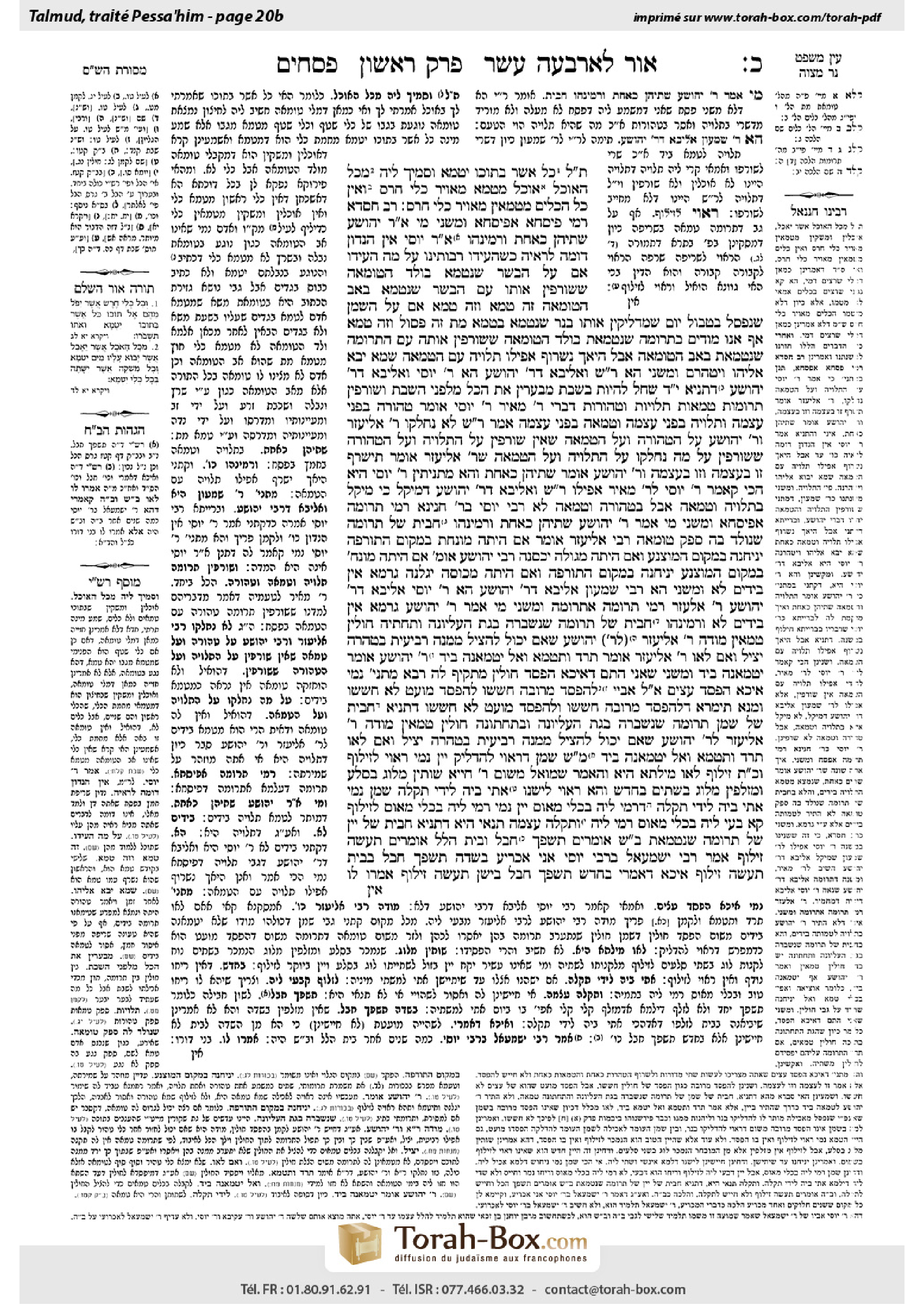
Pesachim 20b: Talmud study for Daf Yomi
Daf Yomi is the daily study of one Talmud folio. Explore 37 tractates with scans, Hebrew text, Sefaria English and AI-generated French translations where annotated.
Passage selection and English or AI-generated French translation are available where the scan has annotations. Daf Study is independent of Torah-Box and Sefaria.
Browse Pesachim · פסחים · All tractatesPesachim 20b text and translations
This page of Pesachim includes the Aramaic text, an English translation and an AI-generated French translation, alongside the scan above.
פסחים כ׳ ב · Aramaic and Hebrew text
תַּלְמוּד לוֹמַר: ״כֹּל אֲשֶׁר בְּתוֹכוֹ יִטְמָא״, וּסְמִיךְ לֵיהּ: ״מִכׇּל הָאֹכֶל״. אוֹכֶל מִטַּמֵּא מֵאֲוִיר כְּלִי חֶרֶס, וְאֵין כׇּל הַכֵּלִים מִטַּמְּאִין מֵאֲוִיר כְּלִי חֶרֶס.
רַב חִסְדָּא רָמֵי פִּיסְחָא אַפִּיסְחָא וּמְשַׁנֵּי: מִי אָמַר רַבִּי יְהוֹשֻׁעַ שְׁתֵּיהֶן כְּאַחַת?
וּרְמִינְהוּ, אָמַר רַבִּי יוֹסֵי: אֵין הַנִּדּוֹן דּוֹמֶה לִרְאָיָה, כְּשֶׁהֵעִידוּ רַבּוֹתֵינוּ — עַל מָה הֵעִידוּ? אִם עַל הַבָּשָׂר שֶׁנִּטְמָא בִּוְלַד הַטּוּמְאָה שֶׁשּׂוֹרְפִין אוֹתוֹ עִם הַבָּשָׂר שֶׁנִּטְמָא בְּאַב הַטּוּמְאָה — זֶה טָמֵא וְזֶה טָמֵא.
אִם עַל הַשֶּׁמֶן שֶׁנִּפְסַל בִּטְבוּל יוֹם, שֶׁמַּדְלִיקִין אוֹתוֹ בְּנֵר שֶׁנִּטְמָא בִּטְמֵא מֵת — זֶה פָּסוּל וְזֶה טָמֵא. אַף אָנוּ מוֹדִים בִּתְרוּמָה שֶׁנִּטְמֵאת בִּוְלַד הַטּוּמְאָה שֶׁשּׂוֹרְפִין אוֹתָהּ עִם הַתְּרוּמָה שֶׁנִּטְמֵאת בְּאַב הַטּוּמְאָה, אֲבָל הֵיאַךְ נִשְׂרוֹף אֲפִילּוּ תְּלוּיָה עִם הַטְּמֵאָה, שֶׁמָּא יָבֹא אֵלִיָּהוּ וִיטַהֲרֵם.
וּמְשַׁנֵּי: הָא רַבִּי שִׁמְעוֹן, וְאַלִּיבָּא דְּרַבִּי יְהוֹשֻׁעַ. הָא רַבִּי יוֹסֵי, וְאַלִּיבָּא דְּרַבִּי יְהוֹשֻׁעַ.
דְּתַנְיָא: אַרְבָּעָה עָשָׂר שֶׁחָל לִהְיוֹת בְּשַׁבָּת, מְבַעֲרִין אֶת הַכֹּל מִלִּפְנֵי הַשַּׁבָּת, וְשׂוֹרְפִין תְּרוּמוֹת טְמֵאוֹת תְּלוּיוֹת וּטְהוֹרוֹת, דִּבְרֵי רַבִּי מֵאִיר. רַבִּי יוֹסֵי אוֹמֵר: טְהוֹרָה בִּפְנֵי עַצְמָהּ, וּתְלוּיָה בִּפְנֵי עַצְמָהּ, וּטְמֵאָה בִּפְנֵי עַצְמָהּ.
אָמַר רַבִּי שִׁמְעוֹן: לֹא נֶחְלְקוּ רַבִּי אֱלִיעֶזֶר וְרַבִּי יְהוֹשֻׁעַ עַל הַטְּהוֹרָה וְעַל הַטְּמֵאָה שֶׁאֵין שׂוֹרְפִין, עַל הַתְּלוּיָה וְעַל הַטְּהוֹרָה שֶׁשּׂוֹרְפִין. עַל מָה נֶחְלְקוּ — עַל הַתְּלוּיָה וְעַל הַטְּמֵאָה, שֶׁרַבִּי אֱלִיעֶזֶר אוֹמֵר: תִּישָּׂרֵף זוֹ בְּעַצְמָהּ וְזוֹ בְּעַצְמָהּ. וְרַבִּי יְהוֹשֻׁעַ אוֹמֵר: שְׁתֵּיהֶן כְּאַחַת.
וְהָא מַתְנִיתִין רַבִּי יוֹסֵי הִיא! הָכִי קָאָמַר רַבִּי יוֹסֵי לְרַבִּי מֵאִיר: אֲפִילּוּ רַבִּי שִׁמְעוֹן וְאַלִּיבָּא דְּרַבִּי יְהוֹשֻׁעַ, דְּמֵיקֵל, כִּי מֵיקֵל בִּתְלוּיָה וּטְמֵאָה, אֲבָל בִּטְהוֹרָה וּטְמֵאָה — לָא.
רַבִּי יוֹסֵי בְּרַבִּי חֲנִינָא רָמֵי תְּרוּמָה אַפִּיסְחָא, וּמְשַׁנֵּי: מִי אָמַר רַבִּי יְהוֹשֻׁעַ שְׁתֵּיהֶן כְּאַחַת?
וּרְמִינְהוּ: חָבִית שֶׁל תְּרוּמָה שֶׁנּוֹלַד בָּהּ סְפֵק טוּמְאָה, רַבִּי אֱלִיעֶזֶר אוֹמֵר: אִם הָיְתָה מוּנַּחַת בִּמְקוֹם הַתּוּרְפָּה — יַנִּיחֶנָּה בְּמָקוֹם הַמּוּצְנָע, וְאִם הָיְתָה מְגוּלָּה יְכַסֶּנָּה. רַבִּי יְהוֹשֻׁעַ אוֹמֵר: אִם הָיְתָה מוּנַּחַת בְּמָקוֹם הַמּוּצְנָע — יַנִּיחֶנָּה בִּמְקוֹם הַתּוּרְפָּה, וְאִם הָיְתָה מְכוּסֶּה יְגַלֶּנָּה.
גְּרָמָא — אִין, בְּיָדַיִם — לָא! וּמְשַׁנֵּי: הָא רַבִּי שִׁמְעוֹן אַלִּיבָּא דְּרַבִּי יְהוֹשֻׁעַ, הָא רַבִּי יוֹסֵי אַלִּיבָּא דְּרַבִּי יְהוֹשֻׁעַ.
רַבִּי אֶלְעָזָר רָמֵי תְּרוּמָה אַתְּרוּמָה, וּמְשַׁנֵּי: מִי אָמַר רַבִּי יְהוֹשֻׁעַ גְּרָמָא אִין, בְּיָדַיִם לָא?
וּרְמִינְהוּ: חָבִית שֶׁל תְּרוּמָה שֶׁנִּשְׁבְּרָה בַּגַּת הָעֶלְיוֹנָה וְתַחְתֶּיהָ חוּלִּין טְמֵאִין —
מוֹדֶה רַבִּי אֱלִיעֶזֶר (לְרַבִּי) יְהוֹשֻׁעַ שֶׁאִם יָכוֹל לְהַצִּיל מִמֶּנָּה רְבִיעִית בְּטׇהֳרָה — יַצִּיל, וְאִם לָאו — רַבִּי אֱלִיעֶזֶר אוֹמֵר: תֵּרֵד וְתִטַּמֵּא, וְאַל יְטַמְּאֶנָּה בַּיָּד.
רַבִּי יְהוֹשֻׁעַ אוֹמֵר: יְטַמְּאֶנָּה בַּיָּד!
וּמְשַׁנֵּי: שָׁאנֵי הָתָם דְּאִיכָּא הֶפְסֵד חוּלִּין.
מַתְקֵיף לַהּ רָבָא: מַתְנִיתִין נָמֵי אִיכָּא הֶפְסֵד עֵצִים! אֲמַר לֵיהּ אַבָּיֵי: לְהֶפְסֵד מְרוּבֶּה — חָשְׁשׁוּ, לְהֶפְסֵד מוּעָט — לֹא חָשְׁשׁוּ.
ומְנָא תֵּימְרָא דִּלְהֶפְסֵד מְרוּבֶּה חָשְׁשׁוּ, וּלְהֶפְסֵד מוּעָט לֹא חָשְׁשׁוּ, דְּתַנְיָא: חָבִית שֶׁל שֶׁמֶן תְּרוּמָה שֶׁנִּשְׁבְּרָה בַּגַּת הָעֶלְיוֹנָה, וּבַתַּחְתּוֹנָה חוּלִּין טְמֵאִין — מוֹדֶה רַבִּי אֱלִיעֶזֶר לְרַבִּי יְהוֹשֻׁעַ שֶׁאִם יָכוֹל לְהַצִּיל מִמֶּנָּה רְבִיעִית בְּטׇהֳרָה — יַצִּיל, וְאִם לָאו — תֵּרֵד וְתִטַּמֵּא וְאַל יְטַמְּאֶנָּה בַּיָּד.
מַאי שְׁנָא שֶׁמֶן, דְּרָאוּי לְהַדְלִיק? יַיִן נָמֵי רָאוּי לְזִילּוּף!
וְכִי תֵימָא זִילּוּף לָאו מִילְּתָא הִיא, וְהָאָמַר שְׁמוּאֵל מִשּׁוּם רַבִּי חִיָּיא: שׁוֹתִין מִלּוֹג בְּסֶלַע, וּמְזַלְּפִין מִלּוֹג בִּשְׁתַּיִם! בְּחָדָשׁ.
וְהָא רָאוּי לְיַשְּׁנוֹ! אָתֵי בֵּיהּ לִידֵי תַּקָּלָה. שֶׁמֶן נָמֵי, אָתֵי בֵּיהּ לִידֵי תַּקָּלָה!
דְּרָמֵי לֵיהּ בִּכְלִי מָאוּס. יַיִן נָמֵי, רָמֵי לֵיהּ בִּכְלִי מָאוּס! לְזִילּוּף קָא בָעֵי לֵיהּ, בִּכְלִי מָאוּס רָמֵי לֵיהּ?!
וְתַקָּלָה עַצְמָהּ, תַּנָּאֵי הִיא. דְּתַנְיָא: חָבִית שֶׁל יַיִן שֶׁל תְּרוּמָה שֶׁנִּטְמֵאת, בֵּית שַׁמַּאי אוֹמְרִים: תִּשָּׁפֵךְ חֲבָל, וּבֵית הִלֵּל אוֹמְרִים: תֵּעָשֶׂה זִילּוּף.
אָמַר רַבִּי יִשְׁמָעֵאל בְּרַבִּי יוֹסֵי, אֲנִי אַכְרִיעַ: בַּשָּׂדֶה — תִּשָּׁפֵךְ חֲבָל, בַּבַּיִת — תֵּעָשֶׂה זִילּוּף. אִיכָּא דְּאָמְרִי: בְּחָדָשׁ — תִּשָּׁפֵךְ חֲבָל, בְּיָשָׁן — תֵּעָשֶׂה זִילּוּף. אָמְרוּ לוֹ:
Pesachim 20b · English translation
Therefore, the verse states with regard to creeping animals: “And every earthenware vessel into which any of them falls, whatever is in it shall be impure, and you shall break it” (Leviticus 11:33). And juxtaposed to it is the verse: “From all food in it which may be eaten, upon which water comes, shall be impure” (Leviticus 11:34). This indicates that food is rendered impure by the airspace of an earthenware vessel, but not all vessels are rendered impure by the airspace of an earthenware vessel. This baraita proves that the earthenware vessel itself is not considered to be filled with carcasses of creeping animals, and therefore it does not render everything inside it impure with first-degree impurity. Were the earthenware vessel indeed considered as if it were filled with impurity, vessels inside it would also assume first-degree ritual impurity.
Rav Ḥisda raised a contradiction between one statement with regard to Passover and another statement with regard to Passover, and he resolved this contradiction himself. The Gemara elaborates: Did Rabbi Yehoshua actually say that both of them may be burned as one, teruma whose purity is uncertain, and definitely impure teruma, on Passover eve?
And he raised a contradiction from the Tosefta, as Rabbi Yosei said: The inferred conclusion of burning pure and impure leaven together is not similar to the case from which you cited proof. When Rabbi Meir said that the Sages, Rabbi Ḥanina the deputy High Priest and Rabbi Akiva, testified, about what did they testify? If you assert that Rabbi Meir said with regard to meat that became ritually impure through contact with a secondary source of impurity, that one may burn it together with meat that became impure through contact with a primary source of impurity, that is a case where both this meat is impure and that meat is impure, albeit not at the same level of impurity.
Rabbi Yosei continues: If you say that Rabbi Meir is referring to the statement of Rabbi Akiva, with regard to oil that was disqualified by one who immersed himself during that day, that one may kindle it in a lamp that became ritually impure with first-degree impurity through contact with one who became ritually impure with impurity imparted by a corpse, that is a case where this substance is disqualified and that object is impure. We also concede with regard to teruma that became impure from a secondary source of impurity, that one may burn it with teruma that became ritually impure from a primary source of impurity, even though the first teruma will assume a greater degree of impurity. However, how will we burn teruma in abeyance, i.e., teruma whose impure status is uncertain, together with ritually impure teruma? Perhaps Elijah the Prophet will come and establish prophetically that the teruma is not ritually impure, and render it ritually pure.
And Rav Ḥisda himself resolved the contradiction: This statement that was taught in the name of Rabbi Yehoshua, that one burns teruma in abeyance together with ritually impure teruma, is the ruling of Rabbi Shimon and in accordance with the opinion of Rabbi Yehoshua, whereas that statement, that one may not burn them together, is the ruling of Rabbi Yosei and in accordance with the opinion of Rabbi Yehoshua.
The Gemara cites the source of this tannaitic dispute with regard to Rabbi Yehoshua’s opinion. As it was taught in a baraita: If the fourteenth of Nisan occurs on Shabbat, one may not remove the leaven on Passover eve in the usual manner, and therefore one removes everything before Shabbat, and he burns all teruma together, impure teruma, teruma in abeyance, and pure teruma. This is the statement of Rabbi Meir. Rabbi Yosei says: One burns pure teruma by itself, teruma in abeyance by itself, and impure teruma by itself.
Rabbi Shimon said: Rabbi Eliezer and Rabbi Yehoshua did not disagree about ritually pure teruma and about impure teruma. They agree that one may not burn them together. And neither did they disagree about teruma in abeyance and about pure teruma. They agree that one may burn them together. Since the teruma is not definitely impure, he does not appear to be directly impurifying the teruma. With regard to what did they disagree? They disagree with regard to burning teruma in abeyance and impure teruma together, as Rabbi Eliezer says: This teruma should be burned by itself and that teruma by itself. Since this case involves teruma that is definitely impure, if the teruma in abeyance is actually pure, by burning them together he will have rendered it impure. And Rabbi Yehoshua says: One may burn both of them as one.
The Gemara raises a difficulty: Isn’t the mishna in accordance with the opinion of Rabbi Yosei? How can Rabbi Yosei’s statement be attributed to Rabbi Shimon? The Gemara answers: This is what Rabbi Yosei is saying to Rabbi Meir: Even according to Rabbi Shimon in accordance with the opinion of Rabbi Yehoshua, who is lenient, where he rules leniently it is only with regard to burning teruma in abeyance and impure teruma together. However, with regard to ritually pure teruma and impure teruma together, no, even he does not permit burning them together.
Similarly, Rabbi Yosei, son of Rabbi Ḥanina, raised a contradiction between the previous statement with regard to teruma and a halakha of Passover, and he resolved it himself. The Gemara clarifies: Did Rabbi Yehoshua actually say that both teruma in abeyance and impure teruma may be burned together?
And he raised a contradiction from a mishna: In the case of a barrel of teruma produce with regard to which uncertainty developed about its impurity, Rabbi Eliezer says: If the barrel was resting in a vulnerable place, where it may come into contact with impurity, one should place it in a concealed place, and if it was exposed he should cover it. Rabbi Yehoshua says: If it was placed in a concealed place he may place it in a vulnerable place. And if it was covered he may expose it.
The Gemara infers from this mishna: In any case, passive causation of teruma whose impurity is uncertain to become definitely impure, yes, it is permitted. However, to actively render teruma impure with one’s hands, no, it is prohibited. This ruling contradicts the previous halakha that one may burn teruma in abeyance and impure teruma together. And Rabbi Yosei, son of Rabbi Ḥanina, resolved this apparent contradiction himself: This statement, that one is permitted to burn teruma in abeyance together with ritually impure teruma, is the ruling of Rabbi Shimon in accordance with the opinion of Rabbi Yehoshua, whereas that statement, that one may cause this impurity only passively, is the ruling of Rabbi Yosei in accordance with the opinion of Rabbi Yehoshua.
Similarly, Rabbi Elazar raised a contradiction between one halakha with regard to teruma and another halakha with regard to teruma, and resolved the contradiction himself. The Gemara explains: Did Rabbi Yehoshua actually say that passive causation of teruma whose impurity is uncertain to become definitely impure, yes, it is permitted; however, to actively render teruma impure with his hands, no, it is prohibited?
And he raised a contradiction against this from a mishna: With regard to a barrel of teruma wine that broke in the upper area in a winepress, where grapes are pressed, and there is impure, non-sacred wine in the lower area of the press, where the wine flows from the upper area, if the teruma wine would flow into the non-sacred wine, the teruma wine would be rendered ritually impure. The result would be significant financial loss, as the legal status of all the wine in the lower press would be that of impure teruma, which is prohibited even for priests to drink.
Rabbi Eliezer concedes to Rabbi Yehoshua that if one is able to rescue even a quarter-log from the barrel that broke and keep the wine in a state of ritual purity, by receiving the teruma wine in a vessel before it becomes impure, he should rescue it. And if one cannot receive the wine in a pure vessel, as only impure vessels are available, so that if he uses them to receive the wine or to seal the upper press he will render the teruma impure, Rabbi Eliezer says: The teruma wine should be allowed to descend and become impure on its own, but one should not actively render it impure with his hand.
Rabbi Yehoshua says: One may even actively render it impure with his hand, by stopping the pipe connecting between the upper and lower presses with an impure vessel or by receiving the wine in impure vessels. Evidently, Rabbi Yehoshua allows one even to actively impurify pure teruma.
And Rabbi Elazar resolved this contradiction himself: There, with regard to the broken barrel, it is different, as, in that case, there is the potential loss of non-sacred produce, when the teruma wine descends to the lower press. The non-sacred wine will become prohibited due to the mixture with impure teruma.
Rava strongly objects to this claim: In the mishna too there is a loss of wood, as one requires additional wood to kindle a second fire and burn the impure teruma separately. Abaye said to him: With regard to this and similar issues, the Sages were concerned about a great loss. However, they were not concerned about the minimal loss of several pieces of wood.
And from where do you say that the Sages were concerned about a great loss and they were not concerned about a minimal loss? As it was taught in a baraita: With regard to a barrel of teruma oil that broke in the upper area of the olive press, and in the lower area of the press there is impure, non-sacred produce, Rabbi Eliezer concedes to Rabbi Yehoshua that if one can rescue even a quarter-log of the oil in a state of purity from the barrel, he should rescue it. And if one cannot receive the oil in a pure vessel, the teruma oil should be allowed to descend and become impure on its own, but one should not actively render it impure with his hand.
The Gemara answers: What is different about oil that, as opposed to wine, everyone agrees may not be actively rendered impure? If you say the reason is that even if the teruma falls into the lower press and is intermingled with impure teruma, it is still suitable for lighting and not entirely lost, if so, wine is also fit for sprinkling in one’s house to provide a pleasant fragrance. Impure teruma wine could be used for that purpose.
And lest you say that sprinkling wine is not a significant matter, and would be tantamount to destroying the teruma, didn’t Shmuel say in the name of Rabbi Ḥiyya: One drinks from wine valued at a log for a sela, and one sprinkles from wine valued at a log for two sela. Apparently, sprinkling is a more significant use than drinking. The Gemara answers: The baraita is referring to new wine still in the press, which does not have a strong fragrance and cannot be used for sprinkling.
The Gemara raises an objection: But isn’t the wine fit to be aged, at which point it could be used for sprinkling, and would not be entirely lost. The Gemara answers: One may thereby come to encounter a stumbling block, as he might, with the passage of time, forget that it is ritually impure and come to drink it. The Gemara asks: If so, with regard to oil too, one may thereby come to encounter a stumbling block, in the same way.
The Gemara answers: The Gemara answers: Ritually impure teruma oil is permitted because he places it in a repulsive vessel, so that people will be disinclined to consume it and will use it only for lighting. The Gemara suggests: With regard to wine, too, he can place it in a repulsive vessel. The Gemara rejects this suggestion: That is not possible. Is it reasonable that one who wants the wine for sprinkling will place it in a repulsive vessel? One sprinkles wine to add a pleasant odor, which would not be the case if the wine has been left in a disgusting vessel.
The Gemara comments: And concern for a stumbling block by keeping prohibited items is itself subject to a dispute between tanna’im. As it was taught in a baraita: With regard to a barrel of teruma wine that became ritually impure, Beit Shammai say: It should be poured out all at once, and Beit Hillel say: One should wait until it ages, at which stage it may be used for spraying.
Rabbi Yishmael, son of Rabbi Yosei, said: I will decide this dispute. If the barrel was in a field, it should be poured out all at once, lest the ritual impurity of the barrel be forgotten by the time it is brought inside the house. However, if the barrel was in the house, where it could be used immediately, it may be used for sprinkling. Some say that Rabbi Yishmael, son of Rabbi Yosei, decided: In the case of new wine, it should be poured out all at once; but in the case of old wine, it should be used for spraying. They said to him:
Pesachim 20b · Traduction française (IA)
C’est pourquoi le verset dit au sujet des animaux rampants : « Tout récipient de terre dans lequel tombera l’un d’eux, tout ce qui s’y trouve sera impur, et vous le briserez » (Lévitique 11, 33). Lui est juxtaposé le verset : « Toute nourriture que l’on mange, sur laquelle de l’eau aura été mise, sera impure » (Lévitique 11, 34). Cela indique que la nourriture devient impure par l’espace intérieur d’un récipient de terre, mais que les récipients ne deviennent pas tous impurs par l’espace intérieur d’un récipient de terre. Cette baraïta prouve que le récipient de terre lui-même n’est pas considéré comme rempli de cadavres d’animaux rampants ; il ne rend donc pas tout ce qui se trouve à l’intérieur impur au premier degré. Si le récipient de terre était effectivement considéré comme rempli d’impureté, les récipients qui s’y trouvent deviendraient eux aussi impurs au premier degré.
Rav Ḥisda souleva une contradiction entre un enseignement relatif à Pessa’h et un autre enseignement relatif à Pessa’h, puis la résolut lui-même. La Guemara développe : Rabbi Yehoshua a-t-il réellement dit que l’on peut brûler ensemble les deux sortes de terouma, celle dont le statut de pureté est incertain et celle qui est certainement impure, la veille de Pessa’h ?
Il souleva une contradiction à partir de la Tossefta, car Rabbi Yosei a dit : La conclusion déduite du fait que l’on brûle ensemble du hamets pur et du hamets impur ne ressemble pas au cas que vous avez cité à l’appui de votre preuve. Quand Rabbi Meir a dit que les Sages, Rabbi Ḥanina, le suppléant du grand prêtre, et Rabbi Akiva avaient témoigné, qu’avaient-ils témoigné ? Si vous affirmez que Rabbi Meir parlait de viande devenue rituellement impure au contact d’une source secondaire d’impureté, et qu’on peut la brûler avec de la viande devenue impure au contact d’une source primaire d’impureté, alors il s’agit d’un cas où les deux viandes sont impures, même si leur degré d’impureté diffère.
Rabbi Yosei poursuit : Si vous dites que Rabbi Meir fait référence à l’enseignement de Rabbi Akiva concernant l’huile disqualifiée par quelqu’un qui s’est immergé dans un mikvé ce jour-là, et que l’on peut l’allumer dans une lampe devenue rituellement impure au premier degré au contact d’une personne devenue rituellement impure par l’impureté transmise par un cadavre, il s’agit alors d’un cas où la première substance est disqualifiée et le second objet est impur. Nous admettons également, au sujet de la terouma devenue impure au contact d’une source secondaire d’impureté, qu’on peut la brûler avec de la terouma devenue rituellement impure au contact d’une source primaire d’impureté, bien que la première terouma acquière ainsi un degré d’impureté plus élevé. Mais comment brûler ensemble une terouma en suspens, c’est-à-dire une terouma dont le statut d’impureté est incertain, et de la terouma rituellement impure ? Peut-être le prophète Élie viendra-t-il et établira-t-il par prophétie que la terouma n’est pas rituellement impure, la déclarant ainsi rituellement pure.
Rav Ḥisda résolut lui-même la contradiction : cet enseignement, transmis au nom de Rabbi Yehoshua, selon lequel on brûle ensemble la terouma en suspens et la terouma rituellement impure, relève de l’avis de Rabbi Shimon, conformément à l’opinion de Rabbi Yehoshua ; tandis que cet autre enseignement, selon lequel on ne peut pas les brûler ensemble, relève de l’avis de Rabbi Yosei, conformément à l’opinion de Rabbi Yehoshua.
La Guemara cite la source de cette controverse entre tannaïm concernant l’opinion de Rabbi Yehoshua. En effet, il a été enseigné dans une baraïta : Si le quatorze Nissan tombe un Chabbat, on ne peut pas retirer le hamets la veille de Pessa’h de la manière habituelle ; on retire donc tout avant Chabbat et l’on brûle ensemble toute la terouma : la terouma impure, la terouma en suspens et la terouma pure. Telle est l’opinion de Rabbi Meir. Rabbi Yosei dit : On brûle la terouma pure à part, la terouma en suspens à part et la terouma impure à part.
Rabbi Shimon dit : Rabbi Eliezer et Rabbi Yehoshua ne sont pas en désaccord au sujet de la terouma rituellement pure ni au sujet de la terouma impure. Ils conviennent qu’on ne peut pas les brûler ensemble. Ils ne sont pas non plus en désaccord au sujet de la terouma en suspens et de la terouma pure. Ils conviennent qu’on peut les brûler ensemble. Puisque la terouma n’est pas certainement impure, il ne semble pas qu’on la rende directement impure. Sur quoi sont-ils en désaccord ? Sur le fait de brûler ensemble la terouma en suspens et la terouma impure. Rabbi Eliezer dit : Il faut brûler cette terouma à part et l’autre terouma à part. Puisque, dans ce cas, la terouma impure est certainement impure, si la terouma en suspens est en réalité pure, en la brûlant avec l’autre, on l’aura rendue impure. Rabbi Yehoshua, lui, dit : On peut les brûler toutes les deux ensemble.
La Guemara soulève une difficulté : la Michna n’est-elle pas conforme à l’opinion de Rabbi Yosei ? Comment peut-on attribuer à Rabbi Shimon la déclaration de Rabbi Yosei ? La Guemara répond : Voici ce que Rabbi Yosei dit à Rabbi Meir : Même selon Rabbi Shimon, conformément à l’opinion indulgente de Rabbi Yehoshua, cette indulgence ne concerne que le fait de brûler ensemble la terouma en suspens et la terouma impure. En revanche, brûler ensemble la terouma rituellement pure et la terouma impure, non : même lui ne l’autorise pas.
De même, Rabbi Yosei, fils de Rabbi Ḥanina, souleva une contradiction entre l’enseignement précédent concernant la terouma et une halakha relative à Pessa’h, puis la résolut lui-même. La Guemara précise : Rabbi Yehoshua a-t-il réellement dit que l’on peut brûler ensemble la terouma en suspens et la terouma impure ?
Il souleva une contradiction à partir d’une Michna : Dans le cas d’un tonneau de produits de terouma dont le statut d’impureté est devenu incertain, Rabbi Eliezer dit : Si le tonneau se trouvait dans un endroit exposé au risque de contact avec l’impureté, on doit le placer dans un endroit caché ; et s’il était à découvert, on doit le couvrir. Rabbi Yehoshua dit : S’il avait été placé dans un endroit caché, on peut le placer dans un endroit exposé au risque ; et s’il avait été couvert, on peut le découvrir.
La Guemara déduit de cette Michna : Dans tous les cas, laisser passivement une terouma dont le statut d’impureté est incertain devenir certainement impure, oui, c’est permis. Mais rendre activement la terouma impure de ses propres mains, non, c’est interdit. Cette décision contredit la halakha précédente, selon laquelle on peut brûler ensemble la terouma en suspens et la terouma impure. Rabbi Yosei, fils de Rabbi Ḥanina, résolut lui-même cette contradiction apparente : cet enseignement, selon lequel il est permis de brûler ensemble la terouma en suspens et la terouma rituellement impure, relève de l’avis de Rabbi Shimon, conformément à l’opinion de Rabbi Yehoshua ; tandis que cet autre enseignement, selon lequel on ne peut provoquer l’impureté que passivement, relève de l’avis de Rabbi Yosei, conformément à l’opinion de Rabbi Yehoshua.
De même, Rabbi Elazar souleva une contradiction entre une halakha concernant la terouma et une autre halakha concernant la terouma, puis la résolut lui-même. La Guemara explique : Rabbi Yehoshua a-t-il réellement dit que laisser passivement une terouma dont le statut d’impureté est incertain devenir certainement impure, oui, c’est permis ; mais rendre activement la terouma impure de ses propres mains, non, c’est interdit ?
Il souleva une contradiction à partir d’une Michna : Dans le cas d’un tonneau de vin de terouma qui se brisa dans la partie supérieure d’un pressoir à vin, où l’on presse les raisins, et où se trouve, dans la partie inférieure, du vin profane impur, si le vin de terouma s’écoulait dans le vin profane, le vin de terouma deviendrait rituellement impur. Il en résulterait une perte financière importante, car tout le vin du pressoir inférieur aurait le statut de terouma impure, qu’il est interdit même aux prêtres de boire.
Rabbi Eliezer concède à Rabbi Yehoshua que, s’il est possible de sauver du tonneau brisé ne serait-ce qu’un quart-log de vin en le gardant rituellement pur, en recueillant le vin de terouma dans un récipient avant qu’il ne devienne impur, il faut le sauver. Si l’on ne peut pas recueillir le vin dans un récipient pur, parce que seuls des récipients impurs sont disponibles, de sorte qu’en les utilisant pour recueillir le vin ou pour boucher le pressoir supérieur on rendrait la terouma impure, Rabbi Eliezer dit : Il faut laisser le vin de terouma s’écouler et devenir impur de lui-même, mais on ne doit pas le rendre activement impur de ses propres mains.
Rabbi Yehoshua dit : On peut même le rendre activement impur de ses propres mains, en bouchant le conduit reliant les pressoirs supérieur et inférieur avec un récipient impur, ou en recueillant le vin dans des récipients impurs. Il apparaît donc que Rabbi Yehoshua permet même de rendre activement impure une terouma pure.
Rabbi Elazar résolut lui-même cette contradiction : dans le cas du tonneau brisé, c’est différent, car il existe alors un risque de perte de produits profanes lorsque le vin de terouma s’écoule dans le pressoir inférieur. Le vin profane deviendrait interdit en raison du mélange avec de la terouma impure.
Rava s’oppose vivement à cette affirmation : dans la Michna aussi, il y a une perte de bois, puisqu’il faut du bois supplémentaire pour allumer un second feu et brûler la terouma impure séparément. Abaye lui dit : Dans cette situation et les cas semblables, les Sages se sont souciés d’une perte importante. Mais ils ne se sont pas souciés de la perte minime de quelques morceaux de bois.
Et d’où sais-tu que les Sages se sont souciés d’une perte importante, mais pas d’une perte minime ? Car il a été enseigné dans une baraïta : Dans le cas d’un tonneau d’huile de terouma qui se brisa dans la partie supérieure d’un pressoir à olives, alors que des produits profanes impurs se trouvent dans la partie inférieure du pressoir, Rabbi Eliezer concède à Rabbi Yehoshua que, si l’on peut sauver du tonneau ne serait-ce qu’un quart-log d’huile en la gardant pure, il faut le sauver. Si l’on ne peut pas recueillir l’huile dans un récipient pur, il faut laisser l’huile de terouma s’écouler et devenir impure d’elle-même, mais on ne doit pas la rendre activement impure de ses propres mains.
La Guemara répond : En quoi l’huile diffère-t-elle du vin, puisque tous conviennent qu’on ne peut pas rendre activement l’huile impure ? Si tu dis que la raison est que, même si la terouma tombe dans le pressoir inférieur et se mélange à de la terouma impure, elle peut encore servir à l’éclairage et n’est donc pas entièrement perdue, alors le vin aussi peut servir à être répandu dans la maison pour y apporter un parfum agréable. Le vin de terouma impur pourrait être utilisé à cette fin.
Et si tu dis que répandre du vin n’est pas un usage important et équivaut à détruire la terouma, Shmuel n’a-t-il pas dit au nom de Rabbi Ḥiyya : On boit du vin dont la valeur est d’un log pour un sela, et on répand du vin dont la valeur est d’un log pour deux sela ? Il apparaît donc que répandre le vin est un usage plus important que le boire. La Guemara répond : La baraïta parle de vin nouveau, encore dans le pressoir, qui n’a pas un parfum prononcé et ne peut pas être utilisé pour être répandu.
La Guemara soulève une objection : Mais le vin peut être conservé jusqu’à ce qu’il vieillisse, puis être utilisé pour être répandu ; il ne serait donc pas entièrement perdu. La Guemara répond : On risque ainsi de commettre une faute, car avec le temps, on pourrait oublier qu’il est rituellement impur et finir par le boire. La Guemara demande : Si c’est le cas, pour l’huile aussi, on risque de commettre une faute de la même manière.
La Guemara répond : L’huile de terouma rituellement impure est permise parce qu’on la place dans un récipient répugnant, de sorte que les gens n’aient pas envie de la consommer et ne l’utilisent que pour l’éclairage. La Guemara propose : Pour le vin aussi, on peut le placer dans un récipient répugnant. La Guemara rejette cette proposition : C’est impossible. Est-il raisonnable que quelqu’un qui veut utiliser le vin pour le répandre le place dans un récipient répugnant ? On répand le vin pour ajouter une odeur agréable, ce qui ne serait pas le cas si le vin avait séjourné dans un récipient répugnant.
La Guemara fait remarquer que la crainte de commettre une faute en conservant des produits interdits fait elle-même l’objet d’un désaccord entre tannaïm. En effet, il a été enseigné dans une baraïta : Dans le cas d’un tonneau de vin de terouma devenu rituellement impur, Beit Shammaï disent : Il faut le vider d’un seul coup ; Beit Hillel disent : On doit attendre qu’il vieillisse, stade auquel il peut servir à être pulvérisé.
Rabbi Yishmael, fils de Rabbi Yosei, dit : Je vais trancher ce désaccord. Si le tonneau se trouvait dans un champ, il faut le vider d’un seul coup, de peur que l’on oublie son impureté rituelle avant de le rentrer dans la maison. Mais si le tonneau se trouvait dans la maison, où l’on peut l’utiliser immédiatement, on peut s’en servir pour répandre le vin. Certains disent que Rabbi Yishmael, fils de Rabbi Yosei, trancha ainsi : Dans le cas du vin nouveau, il faut le vider d’un seul coup ; mais dans le cas du vin vieux, il faut l’utiliser pour le pulvériser. Ils lui dirent :
Traduction française générée par IA à partir de l’édition anglaise de Sefaria. Vérifie toujours un passage avec le texte source.
Text from Sefaria: William Davidson Edition - Vocalized Aramaic (CC BY NC); William Davidson Edition - English (CC BY NC).