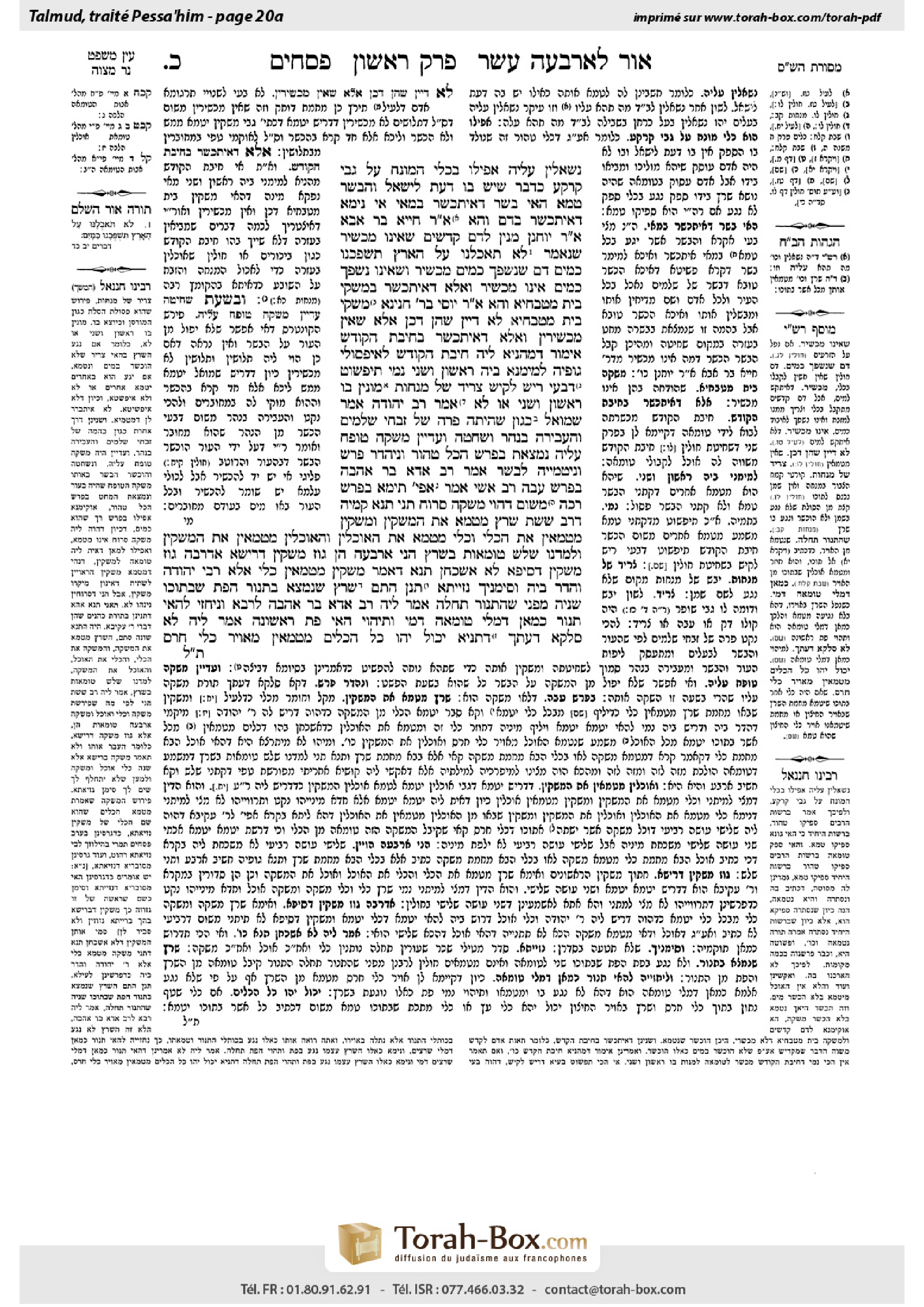
Pesachim 20a: Talmud study for Daf Yomi
Daf Yomi is the daily study of one Talmud folio. Explore 37 tractates with scans, Hebrew text, Sefaria English and AI-generated French translations where annotated.
Passage selection and English or AI-generated French translation are available where the scan has annotations. Daf Study is independent of Torah-Box and Sefaria.
Browse Pesachim · פסחים · All tractatesPesachim 20a text and translations
This page of Pesachim includes the Aramaic text, an English translation and an AI-generated French translation, alongside the scan above.
פסחים כ׳ א · Aramaic and Hebrew text
נִשְׁאָלִין עָלֶיהָ, אֲפִילּוּ בִּכְלִי הַמּוּנָּח עַל גַּבֵּי קַרְקַע — כְּדָבָר שֶׁיֵּשׁ בּוֹ דַּעַת לִישָּׁאֵל.
״וְהַבָּשָׂר טָמֵא״. הַאי בָּשָׂר דְּאִיתַּכְשַׁר בְּמַאי?
אִי נֵימָא דְּאִיתַּכְשַׁר בְּדָם, וְהָא אָמַר רַבִּי חִיָּיא בַּר אַבָּא אָמַר רַבִּי יוֹחָנָן: מִנַּיִן לְדַם קָדָשִׁים שֶׁאֵינוֹ מַכְשִׁיר — שֶׁנֶּאֱמַר: ״לֹא תֹּאכְלֶנּוּ עַל הָאָרֶץ תִּשְׁפְּכֶנּוּ כַּמָּיִם״, דָּם שֶׁנִּשְׁפָּךְ כַּמַּיִם — מַכְשִׁיר, וְשֶׁאֵינוֹ נִשְׁפָּךְ כַּמַּיִם — אֵינוֹ מַכְשִׁיר.
וְאֶלָּא דְּאִיתַּכְשַׁר בְּמַשְׁקֵי בֵּית מַטְבְּחַיָּא. וְהָא אָמַר רַבִּי יוֹסֵי בְּרַבִּי חֲנִינָא: מַשְׁקֵי בֵּית מַטְבְּחַיָּא לֹא דַּיָּין שֶׁהֵן דְּכַן, אֶלָּא שֶׁאֵין מַכְשִׁירִין!
וְאֶלָּא דְּאִיתַּכְשַׁר בְּחִיבַּת הַקּוֹדֶשׁ. אֵימוֹר דְּמַהְנְיָא לֵיהּ חִיבַּת הַקּוֹדֶשׁ לְאִיפְּסוֹלֵי גּוּפֵיהּ, לְמִימְנֵא בֵּיהּ רִאשׁוֹן וְשֵׁנִי נָמֵי?!
תִּיפְשׁוֹט דְּבָעֵי רֵישׁ לָקִישׁ: צָרִיד שֶׁל מְנָחוֹת מוֹנִין בּוֹ רִאשׁוֹן וְשֵׁנִי אוֹ לֹא!
אָמַר רַב יְהוּדָה אָמַר שְׁמוּאֵל: כְּגוֹן שֶׁהָיְתָה פָּרָה שֶׁל זִבְחֵי שְׁלָמִים, וְהֶעֱבִירָהּ בְּנָהָר וּשְׁחָטָהּ, וַעֲדַיִין מַשְׁקֶה טוֹפֵחַ עָלֶיהָ.
נִמְצֵאת בַּפֶּרֶשׁ — הַכֹּל טָהוֹר. וְנִיהְדַּר פֶּרֶשׁ וְנִיטַמְּיֵהּ לְבָשָׂר! אָמַר רַב אַדָּא בַּר אַהֲבָה: בְּפֶרֶשׁ עָבָה. רַב אָשֵׁי אָמַר: אֲפִילּוּ תֵּימָא בְּפֶרֶשׁ רַכָּה, מִשּׁוּם דְּהָוֵי מַשְׁקֶה סָרוּחַ.
תָּנֵי תַּנָּא קַמֵּיהּ דְּרַב שֵׁשֶׁת: שֶׁרֶץ מְטַמֵּא אֶת הַמַּשְׁקִין, וּמַשְׁקִין מְטַמְּאִין אֶת הַכְּלִי, וּכְלִי מְטַמֵּא אֶת הָאוֹכָלִין, וְהָאוֹכָלִין מְטַמְּאִין אֶת הַמַּשְׁקִין. וְלָמַדְנוּ שָׁלֹשׁ טוּמְאוֹת בְּשֶׁרֶץ. הָנֵי אַרְבָּעָה הֵן! גּוֹז מַשְׁקִין דְּרֵישָׁא.
אַדְּרַבָּה, גּוֹז מַשְׁקִין דְּסֵיפָא! לָא אַשְׁכְּחַן תַּנָּא דְּאָמַר ״מַשְׁקִין מְטַמְּאִין כְּלִי״ אֶלָּא רַבִּי יְהוּדָה, וַהֲדַר בֵּיהּ. וְסִימָנָיךְ: נַזְיְיתָא.
תְּנַן הָתָם: שֶׁרֶץ שֶׁנִּמְצָא בְּתַנּוּר — הַפַּת שֶׁבְּתוֹכוֹ שְׁנִיָּה, מִפְּנֵי שֶׁהַתַּנּוּר תְּחִלָּה.
אֲמַר לֵיהּ רַב אַדָּא בַּר אַהֲבָה לְרָבָא: וְנִיחְזֵי לְהַאי תַּנּוּר כְּמַאן דִּמְלֵי טוּמְאָה דָּמֵי, וְתִיהְוֵי הַאי פַּת רִאשׁוֹנָה!
אֲמַר לֵיהּ: לָא סָלְקָא דַּעְתָּךְ, דְּתַנְיָא: יָכוֹל יְהוּ כׇּל הַכֵּלִים מִטַּמְּאִין מֵאֲוִיר כְּלִי חֶרֶס —
Pesachim 20a · English translation
its owners will have no choice but to consult a Sage about it to determine whether or not it is ritually pure, as even with regard to a vessel that is placed upon the ground, which is certainly not capable of providing an answer if asked, its legal status is like that of an item that has knowledge to be asked. The fact that the knife is an inanimate object is not reason enough to rule it ritually pure. It was therefore necessary to say that the knife is ritually pure because the Temple courtyard is a public domain. If it was a private domain, the knife would be deemed impure.
It was taught that if an impure needle were found in an animal, the meat is ritually impure. The Gemara asks: With what liquid was this meat rendered susceptible to impurity? A food can become impure only if it were rendered susceptible to impurity through contact with a liquid; how, then, could the sacrificial meat become impure immediately after the animal was slaughtered?
If we say that it was rendered susceptible to impurity by the blood that flowed when it was slaughtered, didn’t Rabbi Ḥiyya bar Abba say that Rabbi Yoḥanan said: From where is it derived with regard to blood of consecrated offerings that it does not render produce susceptible to impurity? As it is stated: “You shall surely not eat the blood; you shall pour it upon the earth like water” (Deuteronomy 12:16). The Sages derived from this verse: Blood that is poured like water, i.e., blood from a non-sacred domesticated animal that is poured out when it is slaughtered and not received in a vessel like sacrificial blood, assumes the legal status of water and renders food susceptible to ritual impurity. Blood that is not poured out like water, but is received in a vessel to be sprinkled on the altar, does not render food susceptible to impurity.
Rather, say that this meat was rendered susceptible to ritual impurity by the other liquids of the slaughterhouse, e.g., the water that was kept near the altar for washing the offerings. But didn’t Rabbi Yosei, son of Rabbi Ḥanina, say with regard to the liquids of the slaughterhouse: Not only are they ritually pure, as noted in the testimony of Yosei ben Yo’ezer, but they do not even render meat susceptible to impurity?
Rather, say that the meat is rendered susceptible to ritual impurity by the esteem for sacred objects. According to this principle, certain items that cannot become impure by Torah law become susceptible to impurity by rabbinic law due to their extreme sanctity. The Gemara rejects that possibility: Say that the esteem for sacred objects is effective to disqualify the meat itself despite the fact that it was not rendered susceptible to receive impurity, but does it also transmit impurity to the extent that one counts first- and second-degree impurity from contact with that meat? Can impurity based on the esteem for sacred objects be transmitted to other objects like standard impurity?
If so, resolve from here that which Reish Lakish raised as a dilemma: With regard to a mass from meal-offerings, does one count first- and second-degree impurity from contact with it or not? Due to the esteem for sacred objects, the offering itself can become impure without having been rendered susceptible through contact with liquid; however, the dilemma is whether or not it transmits impurity to other objects.
The Gemara responds: Perhaps the dilemma with regard to the status of ritual impurity due to esteem for sacred objects has not in fact been resolved. In the case of meat, Rav Yehuda said that Shmuel said: It is referring to a case where the meat was from a cow brought as a peace-offering sacrifice, whose hide and meat belong to its owner, and the owner led it through the river to clean it, and he slaughtered it while liquid was still moist upon it. While the animal was being flayed, water fell on the meat, rendering it susceptible to impurity.
We learned in a mishna cited above: If the needle was found in the secretions of the animal’s stomach, everything, meat, knife, and hands, is pure. The Gemara raises a difficulty: And let these secretions, which are liquid, return and transmit impurity to the meat itself. Like any other liquid, the secretions assume first-degree ritual impurity by rabbinic decree. Rav Adda bar Ahava said: It is referring to thick, solid secretions, which are not liquid. Rav Ashi said: Even if you say that it is referring to soft secretions, it does not transfer impurity because it is an offensive liquid, which does not transmit impurity.
The tanna who recited mishnayot and baraitot in the study hall taught a baraita before Rav Sheshet. Based on the verses, it is possible to create the following scenario: The carcass of a creeping animal transmits impurity to liquids, the liquids transmit impurity to a vessel, the vessel transmits impurity to foods, and the foods transmit impurity to liquids. And we have thereby learned that there are three successive levels of impurity with regard to a dead creeping animal. The Gemara notes: These are four levels, not three. The Gemara answers: Cut the liquids of the first clause, so that the baraita reads: The carcass of a creeping animal transmits impurity to a vessel and the vessel to foods, etc.
The Gemara asks: On the contrary, cut the liquids of the latter clause, which states that foods transmit impurity to liquids. The Gemara explains: The only tanna that we find who said that liquids transmit impurity to a vessel is Rabbi Yehuda. And even he retracted this statement. And your mnemonic to remember the order of the transfer of impurity in this baraita is a brewing vat, as the order is similar to the production of beer. First one brings the vessel, then one places barley, the food, in it, and then the water. That is the order of the transmission of impurity in the baraita.
We learned in a mishna there: With regard to the carcass of a creeping animal that was found in an oven, the bread inside it is impure with second-degree ritual impurity. This is due to the fact that the oven is impure with first-degree impurity and transmits impurity to the bread.
Rav Adda bar Ahava said to Rava: And let us view that oven as one filled with impurity, as an earthenware vessel is rendered impure by a creeping animal in the airspace of the oven even without making contact with it. And consequently this bread should be impure with the first-degree of impurity. The oven should be considered as if it were filled with carcasses of creeping animals and the bread should assume first-degree impurity status as though it became impure directly from a creeping animal.
He said to him: This suggestion cannot enter your mind, as it was taught in a baraita: I might have thought that all the vessels found in an earthenware oven become impure from the airspace of an impure earthenware vessel.
Pesachim 20a · Traduction française (IA)
Ses propriétaires n’auront d’autre choix que de consulter un Sage à son sujet, afin de déterminer s’il est rituellement pur ou impur. En effet, même pour un ustensile posé à même le sol, qui est assurément incapable de répondre si on l’interroge, son statut juridique est celui d’un objet dont on peut demander le statut. Le fait que le couteau soit un objet inanimé ne suffit donc pas à le déclarer rituellement pur. Il fallait donc préciser que le couteau est rituellement pur parce que la cour du Temple est un domaine public. Si elle avait été un domaine privé, le couteau aurait été considéré comme impur.
Il a été enseigné qu’une aiguille impure trouvée dans un animal rend la viande rituellement impure. La Guemara demande : Par quel liquide cette viande a-t-elle été rendue apte à contracter l’impureté ? Un aliment ne peut devenir impur que s’il a été rendu apte à contracter l’impureté par le contact d’un liquide ; comment, dès lors, la viande sacrificielle a-t-elle pu devenir impure immédiatement après l’abattage de l’animal ?
Si l’on dit qu’elle a été rendue apte à contracter l’impureté par le sang qui s’est écoulé lors de l’abattage, Rabbi Ḥiyya bar Abba n’a-t-il pas dit au nom de Rabbi Yoḥanan : D’où apprend-on que le sang des sacrifices consacrés ne rend pas les produits aptes à contracter l’impureté ? Car il est dit : « Vous ne mangerez surtout pas le sang ; vous le répandrez sur la terre comme de l’eau » (Deutéronome 12,16). Les Sages déduisent de ce verset que le sang répandu comme de l’eau, c’est-à-dire le sang d’un animal domestique non consacré que l’on répand lors de l’abattage au lieu de le recueillir dans un récipient, à la différence du sang sacrificiel, acquiert le statut juridique de l’eau et rend les aliments aptes à contracter l’impureté rituelle. En revanche, le sang qui n’est pas répandu comme de l’eau, mais recueilli dans un récipient pour être aspergé sur l’autel, ne rend pas les aliments aptes à contracter l’impureté.
Dis plutôt que cette viande a été rendue apte à contracter l’impureté rituelle par les autres liquides de l’abattoir, par exemple l’eau conservée près de l’autel pour laver les sacrifices. Mais Rabbi Yosei, fils de Rabbi Ḥanina, n’a-t-il pas dit au sujet des liquides de l’abattoir : non seulement ils sont rituellement purs, comme l’atteste Yosei ben Yo’ezer, mais ils ne rendent même pas la viande apte à contracter l’impureté ?
Dis plutôt que la viande est rendue apte à contracter l’impureté rituelle par égard pour les objets sacrés. Selon ce principe, certains objets qui ne peuvent pas devenir impurs selon la Torah écrite deviennent aptes à contracter l’impureté selon la loi rabbinique, en raison de leur sainteté exceptionnelle. La Guemara rejette cette possibilité : admettons que cet égard pour les objets sacrés suffise à disqualifier la viande elle-même, bien qu’elle n’ait pas été rendue apte à recevoir l’impureté ; mais transmet-il aussi l’impureté, au point de compter des degrés d’impureté de premier et de second degré à partir du contact avec cette viande ? L’impureté fondée sur cet égard pour les objets sacrés peut-elle se transmettre à d’autres objets comme l’impureté ordinaire ?
Dans ce cas, résolvons la question que Reish Lakish a soulevée : à propos d’une masse provenant d’offrandes de farine, compte-t-on des degrés d’impureté de premier et de second degré à partir du contact avec elle, ou non ? En raison de l’égard dû aux objets sacrés, l’offrande elle-même peut devenir impure sans avoir été rendue apte à l’impureté par le contact d’un liquide ; toutefois, la question est de savoir si elle transmet ou non l’impureté à d’autres objets.
La Guemara répond : peut-être la question du statut de l’impureté rituelle due à l’égard pour les objets sacrés n’a-t-elle, en réalité, pas été résolue. Dans le cas de la viande, Rav Yehuda a dit au nom de Shmuel : il s’agit d’un cas où la viande provenait d’une vache offerte en sacrifice de paix, dont la peau et la viande appartenaient à son propriétaire. Celui-ci l’a fait passer dans la rivière pour la nettoyer, puis l’a abattue alors que le liquide était encore humide sur elle. Pendant le dépouillement de l’animal, de l’eau est tombée sur la viande et l’a rendue apte à contracter l’impureté.
Nous avons appris dans une Michna citée plus haut : si l’aiguille a été trouvée dans les sécrétions de l’estomac de l’animal, tout est pur : la viande, le couteau et les mains. La Guemara soulève une difficulté : ces sécrétions, qui sont liquides, ne devraient-elles pas transmettre à leur tour l’impureté à la viande elle-même ? Comme tout autre liquide, les sécrétions acquièrent, par décret rabbinique, une impureté rituelle de premier degré. Rav Adda bar Ahava a dit : il s’agit de sécrétions épaisses et solides, qui ne sont pas liquides. Rav Ashi a dit : même si tu dis qu’il s’agit de sécrétions molles, elles ne transmettent pas l’impureté, car c’est un liquide répugnant, qui ne transmet pas l’impureté.
Le tanna qui récitait les Michnayot et les baraïtot à la maison d’étude enseigna une baraïta devant Rav Sheshet. À partir des versets, on peut établir le scénario suivant : la carcasse d’un animal rampant transmet l’impureté aux liquides, les liquides transmettent l’impureté à un ustensile, l’ustensile la transmet aux aliments, et les aliments la transmettent aux liquides. Nous avons ainsi appris qu’il existe trois degrés successifs d’impureté concernant un animal rampant mort. La Guemara fait remarquer : il s’agit de quatre degrés, et non de trois. La Guemara répond : retranche les liquides de la première proposition, de sorte que la baraïta se lise ainsi : la carcasse d’un animal rampant transmet l’impureté à un ustensile, et l’ustensile la transmet aux aliments, etc.
La Guemara demande : au contraire, retranche les liquides de la dernière proposition, qui dit que les aliments transmettent l’impureté aux liquides. La Guemara explique : le seul tanna que nous trouvons à avoir dit que les liquides transmettent l’impureté à un ustensile est Rabbi Yehuda. Et même lui est revenu sur cette déclaration. Le moyen mnémotechnique pour retenir l’ordre de transmission de l’impureté dans cette baraïta est une cuve de brassage, car cet ordre ressemble à celui de la fabrication de la bière. On apporte d’abord le récipient, puis on y met l’orge, l’aliment, et enfin l’eau. Tel est l’ordre de transmission de l’impureté dans la baraïta.
Nous avons appris dans une Michna, là-bas : lorsqu’on trouve la carcasse d’un animal rampant dans un four, le pain qui s’y trouve est impur d’un degré d’impureté rituelle secondaire. Cela tient au fait que le four est impur d’un degré d’impureté primaire et transmet l’impureté au pain.
Rav Adda bar Ahava dit à Rava : ne devrions-nous pas considérer ce four comme rempli d’impureté, puisqu’un ustensile en terre cuite devient impur lorsqu’un animal rampant se trouve dans l’espace intérieur du four, même sans le toucher ? Par conséquent, ce pain devrait être impur du premier degré. Le four devrait être considéré comme s’il était rempli de carcasses d’animaux rampants, et le pain devrait acquérir le statut d’impureté de premier degré, comme s’il était devenu impur directement au contact d’un animal rampant.
Il lui dit : cette hypothèse ne peut te venir à l’esprit, car il a été enseigné dans une baraïta : j’aurais pu penser que tous les ustensiles trouvés dans un four en terre cuite deviennent impurs à cause de l’espace intérieur d’un ustensile en terre cuite impur.
Traduction française générée par IA à partir de l’édition anglaise de Sefaria. Vérifie toujours un passage avec le texte source.
Text from Sefaria: William Davidson Edition - Vocalized Aramaic (CC BY NC); William Davidson Edition - English (CC BY NC).