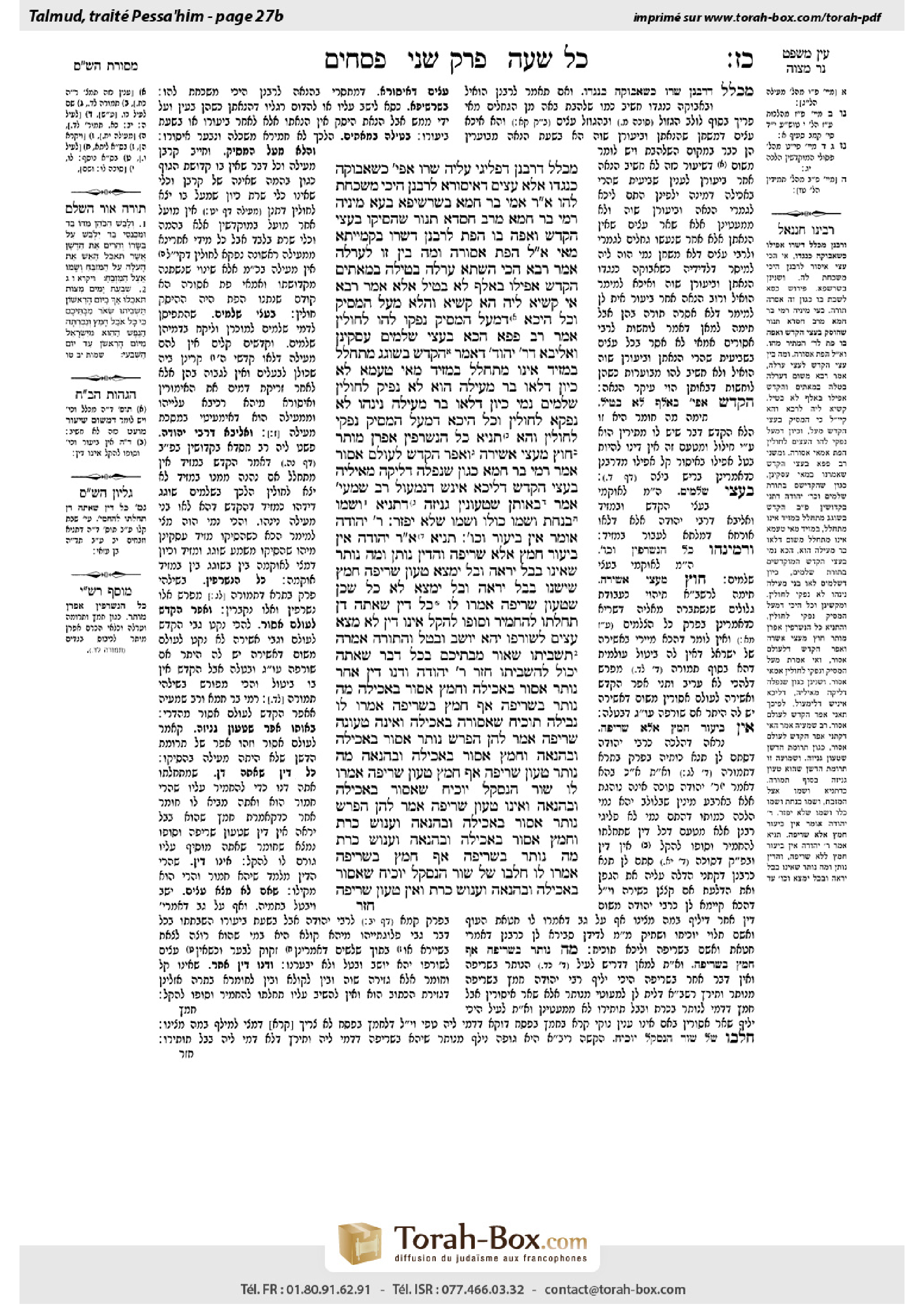
Pesachim 27b: Talmud study for Daf Yomi
Daf Yomi is the daily study of one Talmud folio. Explore 37 tractates with scans, Hebrew text, Sefaria English and AI-generated French translations where annotated.
Passage selection and English or AI-generated French translation are available where the scan has annotations. Daf Study is independent of Torah-Box and Sefaria.
Browse Pesachim · פסחים · All tractatesPesachim 27b text and translations
This page of Pesachim includes the Aramaic text, an English translation and an AI-generated French translation, alongside the scan above.
פסחים כ״ז ב · Aramaic and Hebrew text
מִכְּלָל דְּרַבָּנַן דִּפְלִיגִי עֲלֵיהּ — שָׁרוּ אֲפִילּוּ כְּשֶׁאֲבוּקָה כְּנֶגְדּוֹ, אֶלָּא עֵצִים דְּאִיסּוּרָא לְרַבָּנַן הֵיכִי מַשְׁכַּחַתְּ לְהוּ? אָמַר רַב אַמֵּי בַּר חָמָא: בְּשַׁרְשִׁיפָא.
בְּעָא מִינֵּיהּ רָמֵי בַּר חָמָא מֵרַב חִסְדָּא: תַּנּוּר שֶׁהִסִּיקוֹ בַּעֲצֵי הֶקְדֵּשׁ, וְאָפָה בּוֹ הַפַּת, לְרַבָּנַן דְּשָׁרוּ בְּקַמַּיְיתָא, מַאי? אֲמַר לֵיהּ: הַפַּת אֲסוּרָה. וּמָה בֵּין זוֹ לְעׇרְלָה?! אָמַר רָבָא: הָכִי הַשְׁתָּא?! עׇרְלָה בְּטֵילָה בְּמָאתַיִם, הֶקְדֵּשׁ אֲפִילּוּ בְּאֶלֶף לֹא בָּטֵיל.
אֶלָּא אָמַר רָבָא: אִי קַשְׁיָא לֵיהּ — הָא קַשְׁיָא: וַהֲלֹא מָעַל הַמַּסִּיק, וְכׇל הֵיכָא דְּמָעַל הַמַּסִּיק נָפְקוּ לְהוּ לְחוּלִּין!
אָמַר רַב פָּפָּא: הָכָא בַּעֲצֵי שְׁלָמִים עָסְקִינַן, וְאַלִּיבָּא דְּרַבִּי יְהוּדָה, דְּאָמַר: הֶקְדֵּשׁ בְּשׁוֹגֵג מִתְחַלֵּל, בְּמֵזִיד אֵינוֹ מִתְחַלֵּל.
בְּמֵזִיד מַאי טַעְמָא לָא? כֵּיוָן דְּלָאו בַּר מְעִילָה — הוּא לָא נָפֵיק לְחוּלִּין. שְׁלָמִים נָמֵי, כֵּיוָן דְּלָאו בַּר מְעִילָה נִינְהוּ — לָא נָפְקָא לְחוּלִּין.
וְכׇל הֵיכָא דְּמָעַל הַמַּסִּיק נָפְקִי לְחוּלִּין? וְהָא תַּנְיָא: כׇּל הַנִּשְׂרָפִין — אֶפְרָן מוּתָּר, חוּץ מֵעֲצֵי אֲשֵׁירָה. וְאֵפֶר הֶקְדֵּשׁ — לְעוֹלָם אָסוּר.
אָמַר רָמֵי בַּר חָמָא: כְּגוֹן שֶׁנָּפְלָה דְּלֵיקָה מֵאֵילֶיהָ בַּעֲצֵי הֶקְדֵּשׁ, דְּלֵיכָּא אִינָשׁ דְּנִמְעוֹל. רַב שְׁמַעְיָה אָמַר: בְּאוֹתָן שֶׁטְּעוּנִין גְּנִיזָה. דְּתַנְיָא: ״וְשָׂמוֹ״ בְּנַחַת, ״וְשָׂמוֹ״ כּוּלּוֹ, ״וְשָׂמוֹ״ שֶׁלֹּא יְפַזֵּר.
רַבִּי יְהוּדָה אוֹמֵר אֵין בִּיעוּר וְכוּ׳. תַּנְיָא, אָמַר רַבִּי יְהוּדָה: אֵין בִּיעוּר חָמֵץ אֶלָּא שְׂרֵיפָה, וְהַדִּין נוֹתֵן: וּמָה נוֹתָר שֶׁאֵינוֹ בְּ״בַל יֵרָאֶה״ וּ״בַל יִמָּצֵא״ — טָעוּן שְׂרֵיפָה, חָמֵץ שֶׁיֶּשְׁנוֹ בְּ״בַל יֵרָאֶה״ וּ״בַל יִמָּצֵא״ — לֹא כׇּל שֶׁכֵּן שֶׁטָּעוּן שְׂרֵיפָה!
אָמְרוּ לוֹ: כׇּל דִּין שֶׁאַתָּה דָּן תְּחִלָּתוֹ לְהַחְמִיר וְסוֹפוֹ לְהָקֵל אֵינוֹ דִּין. לֹא מָצָא עֵצִים לְשׂוֹרְפוֹ יְהֵא יוֹשֵׁב וּבָטֵל? וְהַתּוֹרָה אָמְרָה: ״תַּשְׁבִּיתוּ שְּׂאוֹר מִבָּתֵּיכֶם״, בְּכׇל דָּבָר שֶׁאַתָּה יָכוֹל לְהַשְׁבִּיתוֹ!
חָזַר רַבִּי יְהוּדָה וְדָנוֹ דִּין אַחֵר: נוֹתָר אָסוּר בַּאֲכִילָה וְחָמֵץ אָסוּר בַּאֲכִילָה. מָה נוֹתָר בִּשְׂרֵיפָה — אַף חָמֵץ בִּשְׂרֵיפָה.
אָמְרוּ לוֹ: נְבֵילָה תּוֹכִיחַ, שֶׁאֲסוּרָה בַּאֲכִילָה וְאֵינָהּ טְעוּנָה שְׂרֵיפָה! אָמַר לָהֶן, הֶפְרֵשׁ: נוֹתָר אָסוּר בַּאֲכִילָה וּבַהֲנָאָה, וְחָמֵץ אָסוּר בַּאֲכִילָה וּבַהֲנָאָה. מָה נוֹתָר טָעוּן שְׂרֵיפָה — אַף חָמֵץ טָעוּן שְׂרֵיפָה.
אָמְרוּ לוֹ: שׁוֹר הַנִּסְקָל יוֹכִיחַ, שֶׁאָסוּר בַּאֲכִילָה וּבַהֲנָאָה — וְאֵינוֹ טָעוּן שְׂרֵיפָה. אָמַר לָהֶן, הֶפְרֵשׁ: נוֹתָר אָסוּר בַּאֲכִילָה וּבַהֲנָאָה וְעָנוּשׁ כָּרֵת, וְחָמֵץ אָסוּר בַּאֲכִילָה וּבַהֲנָאָה וְעָנוּשׁ כָּרֵת, מָה נוֹתָר בִּשְׂרֵיפָה — אַף חָמֵץ בִּשְׂרֵיפָה. אָמְרוּ לוֹ: חֶלְבּוֹ שֶׁל שׁוֹר הַנִּסְקָל יוֹכִיחַ, שֶׁאָסוּר בַּאֲכִילָה וּבַהֲנָאָה וְעָנוּשׁ כָּרֵת — וְאֵין טָעוּן שְׂרֵיפָה!
Pesachim 27b · English translation
The Gemara asks: Does this prove by inference that the Rabbis who disagree with Rabbi Yehuda HaNasi permit one to eat this bread even when the flame is opposite it? But if this is the case, where do you find the case where it is prohibited according to the Rabbis to derive benefit from wood? Rav Ami bar Ḥama said: It is found in the case of a stool made from the wood. Although they hold that it is permitted to derive indirect benefit from the wood, even the Rabbis agree that one may not derive benefit from a stool that is made from the wood itself.
Rami bar Ḥama raised a dilemma before Rav Ḥisda: With regard to an oven that one kindled with consecrated wood and baked bread in it, according to the Rabbis, who permitted the bread in the first case where it was baked with orla wood, what is the halakha? He said to him: The bread is prohibited. He responded: What is the difference between this bread and bread baked with orla peels? Rava said: How can these cases be compared? Orla is nullified in a mixture of one part in two hundred; it is possible that less than this amount of orla was absorbed by the bread. However, consecrated wood is not nullified even in a mixture of one part in one thousand. Therefore, even when there is only a miniscule amount of the consecrated matter in the bread it is still prohibited.
Rather, Rava said: If it was difficult for Rami bar Ḥama, this is what he found difficult: Didn’t the kindler of the fire transgress the prohibition of misuse of consecrated property, as anyone who unwittingly uses consecrated property for a non-sacred use violates this prohibition? And any case where the kindler of an oven misuses consecrated property by doing so, the wood is transferred to non-sacred status. The wood loses its sanctity when misused, and the one who misused it must donate other wood to the Temple in its place. In that case, the wood used to heat the oven is non-sacred wood and the bread should be permitted.
Rav Pappa said: Here, we are dealing with wood which had been set aside for purchasing peace-offerings. This wood, while sanctified, has a lesser status of sanctity and does not become fully consecrated until the blood of the offering has been sprinkled. And this dilemma was raised in accordance with the opinion of Rabbi Yehuda, who said: If one unwittingly misused consecrated property, it becomes desecrated and loses its elevated status. However, if one used the object intentionally, it is not desecrated and remains consecrated. Since the act here is intentional, the consecrated wood does not lose its status.
The Gemara explains: What is the reason that when one intentionally uses this object it does not lose its status? Since it is not subject to the halakha of misuse of consecrated property, as one is liable to bring an offering only for unwitting misuse of consecrated property, it is not transferred to non-sacred status. The same halakha applies to the wood set aside for peace-offerings as well. Since at that stage it is not subject to the halakha of misuse of consecrated property, as that applies only after the animal’s blood has been sprinkled, then according to the opinion of Rabbi Yehuda, even if one unwittingly uses this wood, it is not transferred to non-sacred status; rather, it remains prohibited.
The Gemara asks: And anywhere the kindler of an oven transgresses the prohibition of misuse of consecrated property by using consecrated wood, is it transferred to non-sacred status? Wasn’t it taught in a baraita: With regard to all prohibited items that must be burned, their ashes are permitted after the burning, except for wood from an asheira? And consecrated ash is prohibited forever. Therefore, it is possible that when one kindles an oven with this consecrated wood, although he misuses consecrated property, the ash remains prohibited.
Rami bar Ḥama said: That baraita is discussing a case where a fire began on its own among consecrated wood and there is no one who misused consecrated property. Since this is the case, even the ash that is left from this wood remains consecrated property and one may not benefit from it. Rav Shemaya said: This baraita is dealing with those types of consecrated ash that require burial, such as the ash removed from the altar. As it was taught in a baraita: “And he shall take up the ash from where the fire has consumed the burnt-offering on the altar, and he shall put it beside the altar” (Leviticus 6:3). The phrase “And he shall put it” indicates that he must do so gently; “and he shall put it” also indicates that he must place all of it; “and he shall put it” also indicates that he may not scatter the ashes. Apparently, even after the offering has been burned it remains sacred, and one may not derive benefit from it. However, when it was burned it was not subject to misuse of consecrated property, as its burning is a necessary step in the process of sacrificing the offerings.
It was taught in the mishna that Rabbi Yehuda says: The removal of leavened bread is to be accomplished only through burning. It was taught in a baraita that Rabbi Yehuda said: The removal of leavened bread is to be accomplished only through burning. And a logical derivation leads to this conclusion: Just as that which is left over from an offering after the time period in which it may be eaten, which is not subject to the prohibitions: It shall not be seen, and: It shall not be found, requires burning, so too, with regard to leavened bread, which is more stringent as it is subject to the prohibitions of: It shall not be seen, and: It shall not be found, all the more so is it not clear that it requires burning?
The Rabbis said to him: Any logical derivation that you derive whose initial teaching is stringent but whose subsequent consequences are lenient is not a valid logical derivation. According to Rabbi Yehuda, if one did not find wood to burn his leavened bread, must he sit idly and not remove it? And the Torah said: “You shall remove leaven from your houses” (Exodus 12:15), indicating that this must be done in any manner which you can remove it. Apparently, Rabbi Yehuda’s logical derivation leads to a leniency.
Then Rabbi Yehuda presented a different logical derivation based on the principle of: What do we find with regard to, rather than on an a fortiori inference (Rashash). It is prohibited to eat the leftover of offerings and it is prohibited to eat leavened bread. Based on this similarity, one can conclude that just as the leftover of offerings requires burning, so too, leavened bread requires burning.
They said to him: The case of an animal carcass can prove that eating the leftover of offerings is not a factor in determining whether or not leavened bread requires burning, as eating an animal carcass is prohibited and it does not require burning. Therefore, there is no clear connection between the prohibition to eat a particular object and a requirement to burn it. He said to them: There is a difference between these cases, as it is explicitly stated that one may benefit from an animal corpse. Therefore, the following comparison can be made: It is prohibited to eat and derive benefit from the leftover of sacrificial meat, and it is prohibited to eat and derive benefit from leavened bread. Just as the leftover of sacrificial meat requires burning, so too, leavened bread requires burning.
The Rabbis said to him: The case of an ox that is stoned can prove that this is not a clear factor, as it is prohibited to eat and derive benefit from such an ox and it does not require burning. He said to them: There is a difference between leavened bread and an ox that is stoned, as there is an additional factor that is not relevant to the ox. It is prohibited to eat and derive benefit from the leftover of sacrificial meat, and one who does so is punished with karet. And it is prohibited to eat and derive benefit from leavened bread, and one who does so is punished with karet. Just as the leftover of sacrificial meat requires burning, so too, leavened bread requires burning. They said to him: If so, the fats of an ox that is stoned can prove that this too is an insignificant factor, as it is prohibited to eat the fats and derive benefit from them, and one who eats them is punished with karet, and they do not require burning.
Pesachim 27b · Traduction française (IA)
La Guemara demande : Faut-il en déduire que les Sages qui sont en désaccord avec Rabbi Yehouda HaNassi permettent de manger ce pain même lorsque la flamme se trouve en face de lui ? Mais, si tel est le cas, dans quel cas les Sages interdisent-ils de tirer profit du bois ? Rav Ami bar Ḥama répondit : C’est le cas d’un tabouret fabriqué avec ce bois. Bien qu’ils estiment qu’il est permis de tirer indirectement profit du bois, même les Sages admettent qu’il est interdit de tirer profit d’un tabouret fabriqué directement avec ce bois.
Rami bar Ḥama posa une question à Rav Ḥisda : concernant un four que l’on a allumé avec du bois consacré et dans lequel on a fait cuire du pain, quelle est la halakha selon les Sages, qui ont permis le pain dans le premier cas, lorsqu’il avait été cuit avec du bois d’orla ? Il lui répondit : Le pain est interdit. Rami bar Ḥama lui demanda : Quelle différence y a-t-il entre ce pain et du pain cuit avec des écorces d’orla ? Rava dit : Comment peut-on comparer ces cas ? L’orla est annulée dans un mélange à raison d’une part pour deux cents ; il est possible que le pain ait absorbé une quantité d’orla inférieure à cette proportion. En revanche, le bois consacré n’est pas annulé même dans un mélange à raison d’une part pour mille. Par conséquent, même si le pain ne contient qu’une quantité infime de matière consacrée, il reste interdit.
Rava dit plutôt : Si Rami bar Ḥama avait une difficulté, voici ce qui lui posait problème : celui qui a allumé le feu n’a-t-il pas transgressé l’interdiction de détourner un bien consacré à un usage profane, puisque quiconque utilise par inadvertance un bien consacré à un usage profane transgresse cette interdiction ? Or, dans tout cas où celui qui allume le four détourne ainsi un bien consacré à un usage profane, le bois passe au statut de bien profane. Le bois perd sa sainteté lorsqu’il est détourné, et celui qui l’a détourné doit donner au Temple du bois en remplacement. Dans ce cas, le bois utilisé pour chauffer le four est profane, et le pain devrait donc être permis.
Rav Pappa dit : Ici, il s’agit de bois qui avait été mis de côté pour acheter des sacrifices de paix. Ce bois, bien que consacré, possède un degré de sainteté moindre et ne devient pleinement consacré qu’après l’aspersion du sang du sacrifice. Cette question a été soulevée conformément à l’opinion de Rabbi Yehouda, qui a dit : Si quelqu’un détourne par inadvertance un bien consacré à un usage profane, celui-ci est désacralisé et perd son statut supérieur. Toutefois, si quelqu’un utilise l’objet intentionnellement, celui-ci n’est pas désacralisé et reste consacré. Puisque l’acte est ici intentionnel, le bois consacré ne perd pas son statut.
La Guemara explique : Pourquoi l’objet ne perd-il pas son statut lorsqu’on l’utilise intentionnellement ? Parce qu’il n’est pas soumis à la halakha du détournement d’un bien consacré à un usage profane, car on n’est passible d’apporter un sacrifice qu’en cas de détournement involontaire d’un bien consacré ; il ne passe donc pas au statut de bien profane. La même halakha s’applique au bois mis de côté pour les sacrifices de paix. Puisqu’à ce stade, il n’est pas soumis à la halakha du détournement d’un bien consacré à un usage profane, laquelle ne s’applique qu’après l’aspersion du sang de l’animal, alors, selon l’opinion de Rabbi Yehouda, même si quelqu’un utilise ce bois par inadvertance, il ne passe pas au statut de bien profane ; au contraire, il reste interdit.
La Guemara demande : Chaque fois que celui qui allume un four transgresse l’interdiction de détourner un bien consacré à un usage profane en utilisant du bois consacré, celui-ci passe-t-il au statut de bien profane ? N’a-t-on pas enseigné dans une baraïta : tous les objets interdits qui doivent être brûlés ont des cendres permises après leur combustion, à l’exception du bois d’une asheira ? Quant aux cendres consacrées, elles restent interdites à jamais. Il est donc possible que, lorsqu’on allume un four avec ce bois consacré, les cendres restent interdites, bien que celui qui l’a utilisé ait détourné un bien consacré à un usage profane.
Rami bar Ḥama dit : Cette baraïta traite d’un cas où le feu a pris de lui-même parmi du bois consacré et où personne n’a détourné de bien consacré à un usage profane. Dans ce cas, même les cendres qui restent de ce bois demeurent consacrées, et l’on ne peut en tirer profit. Rav Shemaya dit : Cette baraïta traite des types de cendres consacrées qui doivent être enterrées, comme les cendres retirées de l’autel. En effet, on a enseigné dans une baraïta : « Il prendra les cendres de l’endroit où le feu a consumé l’holocauste sur l’autel et les déposera à côté de l’autel » (Lévitique 6, 3). L’expression « il les déposera » indique qu’il doit le faire délicatement ; elle indique également qu’il doit les déposer toutes ; elle indique enfin qu’il ne peut pas disperser les cendres. Il apparaît donc que, même après la combustion du sacrifice, les cendres restent saintes et qu’on ne peut en tirer profit. Toutefois, leur combustion ne constituait pas un détournement d’un bien consacré à un usage profane, car elle est une étape nécessaire du processus sacrificiel.
Il a été enseigné dans la Michna que Rabbi Yehouda dit : l’élimination du pain levé doit se faire uniquement par combustion. Une baraïta enseigne que Rabbi Yehouda a dit : l’élimination du pain levé doit se faire uniquement par combustion. Un raisonnement a fortiori conduit à cette conclusion : de même que ce qui reste d’un sacrifice après la période durant laquelle il peut être mangé, bien que cela ne soit pas soumis aux interdictions « Il ne sera pas vu » et « Il ne sera pas trouvé », doit être brûlé, à plus forte raison le pain levé, qui est soumis aux interdictions « Il ne sera pas vu » et « Il ne sera pas trouvé », doit-il être brûlé.
Les Sages lui dirent : Tout raisonnement a fortiori dont le point de départ est plus rigoureux, mais dont les conséquences sont plus indulgentes, n’est pas valable. Selon Rabbi Yehouda, si quelqu’un ne trouve pas de bois pour brûler son pain levé, doit-il rester sans rien faire et ne pas l’éliminer ? Or la Torah dit : « Vous éliminerez le levain de vos maisons » (Exode 12, 15), ce qui indique qu’il faut l’éliminer par tout moyen dont on dispose. Il apparaît donc que le raisonnement de Rabbi Yehouda aboutit à une indulgence.
Rabbi Yehouda présenta alors un autre raisonnement, fondé sur le principe « Que trouve-t-on à propos de… », plutôt que sur une inférence a fortiori (Rashash). Il est interdit de manger ce qui reste d’un sacrifice et il est interdit de manger du pain levé. À partir de cette similitude, on peut conclure que, de même que ce qui reste d’un sacrifice doit être brûlé, le pain levé doit lui aussi être brûlé.
Ils lui dirent : Le cas d’une carcasse d’animal montre que l’interdiction de manger ce qui reste d’un sacrifice ne permet pas de déterminer si le pain levé doit être brûlé, car il est interdit de manger une carcasse d’animal et pourtant elle ne doit pas être brûlée. Il n’existe donc pas de lien évident entre l’interdiction de manger un objet donné et l’obligation de le brûler. Il leur dit : Ces cas diffèrent, car il est explicitement indiqué qu’on peut tirer profit d’un cadavre d’animal. On peut donc établir la comparaison suivante : il est interdit de manger ce qui reste de la viande sacrificielle et d’en tirer profit, et il est interdit de manger du pain levé et d’en tirer profit. De même que ce qui reste de la viande sacrificielle doit être brûlé, le pain levé doit lui aussi être brûlé.
Les Sages lui dirent : Le cas d’un bœuf lapidé montre que ce n’est pas un critère déterminant, car il est interdit de manger un tel bœuf et d’en tirer profit, et pourtant il ne doit pas être brûlé. Il leur dit : Le pain levé et le bœuf lapidé diffèrent, car un facteur supplémentaire, qui ne concerne pas le bœuf, entre en jeu. Il est interdit de manger ce qui reste de la viande sacrificielle et d’en tirer profit, et celui qui le fait est passible de retranchement. Il est interdit de manger du pain levé et d’en tirer profit, et celui qui le fait est passible de retranchement. De même que ce qui reste de la viande sacrificielle doit être brûlé, le pain levé doit lui aussi être brûlé. Ils lui dirent : Dans ce cas, les graisses d’un bœuf lapidé montrent que ce facteur est lui aussi insignifiant, car il est interdit de manger ces graisses et d’en tirer profit, celui qui en mange est passible de retranchement, et pourtant elles ne doivent pas être brûlées.
Traduction française générée par IA à partir de l’édition anglaise de Sefaria. Vérifie toujours un passage avec le texte source.
Text from Sefaria: William Davidson Edition - Vocalized Aramaic (CC BY NC); William Davidson Edition - English (CC BY NC).