Pesachim 29b: Talmud study for Daf Yomi
Daf Yomi is the daily study of one Talmud folio. Explore 37 tractates with scans, Hebrew text, Sefaria English and AI-generated French translations where annotated.
Passage selection and English or AI-generated French translation are available where the scan has annotations. Daf Study is independent of Torah-Box and Sefaria.
Browse Pesachim · פסחים · All tractatesPesachim 29b text and translations
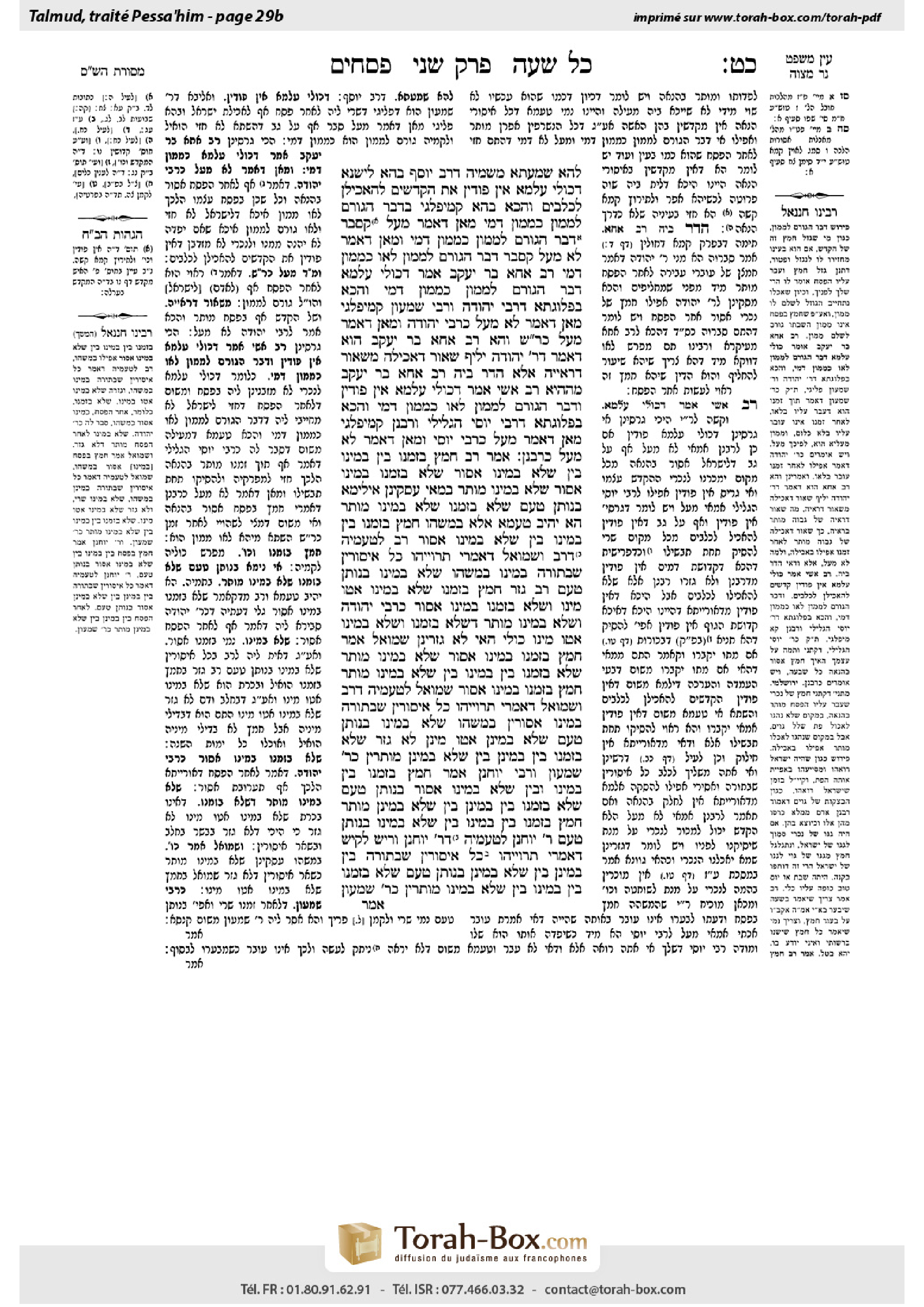
This page of Pesachim includes the Aramaic text, an English translation and an AI-generated French translation, alongside the scan above.
פסחים כ״ט ב · Aramaic and Hebrew text
לְהָא שְׁמַעְתָּא מִשְּׁמֵיהּ דְּרַב יוֹסֵף בְּהָא לִישָּׁנָא: דְּכוּלֵּי עָלְמָא אֵין פּוֹדִין אֶת הַקֳּדָשִׁים לְהַאֲכִילָן לִכְלָבִים, וְהָכָא בְּהָא קָמִיפַּלְגִי: בְּדָבָר הַגּוֹרֵם לְמָמוֹן כְּמָמוֹן דָּמֵי.
מַאן דְּאָמַר מָעַל, קָסָבַר: דָּבָר הַגּוֹרֵם לְמָמוֹן — כְּמָמוֹן דָּמֵי. וּמַאן דְּאָמַר לֹא מָעַל, קָסָבַר: דָּבָר הַגּוֹרֵם לְמָמוֹן — לָאו כְּמָמוֹן דָּמֵי.
רַב אַחָא בַּר יַעֲקֹב אָמַר: דְּכוּלֵּי עָלְמָא דָּבָר הַגּוֹרֵם לְמָמוֹן — כְּמָמוֹן דָּמֵי, וְהָכָא בִּפְלוּגְתָּא דְּרַבִּי יְהוּדָה וְרַבִּי שִׁמְעוֹן קָמִיפַּלְגִי: מַאן דְּאָמַר לֹא מָעַל — כְּרַבִּי יְהוּדָה. וּמַאן דְּאָמַר מָעַל — כְּרַבִּי שִׁמְעוֹן.
וְהָא רַב אַחָא בַּר יַעֲקֹב הוּא דְּאָמַר דְּרַבִּי יְהוּדָה יָלֵיף שְׂאוֹר דַּאֲכִילָה מִשְּׂאוֹר דִּרְאִיָּיה! אֶלָּא הֲדַר בֵּיהּ רַב אַחָא בַּר יַעֲקֹב מֵהַהִיא.
רַב אָשֵׁי אֲמַר: דְּכוּלֵּי עָלְמָא — אֵין פּוֹדִין, וְדָבָר הַגּוֹרֵם לְמָמוֹן — לָאו כְּמָמוֹן דָּמֵי, וְהָכָא בִּפְלוּגְתָּא דְּרַבִּי יוֹסֵי הַגְּלִילִי וְרַבָּנַן קָמִיפַּלְגִי. מַאן דְּאָמַר מָעַל — כְּרַבִּי יוֹסֵי. וּמַאן דְּאָמַר לֹא מָעַל — כְּרַבָּנַן.
אָמַר רַב: חָמֵץ בִּזְמַנּוֹ, בֵּין בְּמִינוֹ בֵּין שֶׁלֹּא בְּמִינוֹ — אָסוּר. שֶׁלֹּא בִּזְמַנּוֹ, בְּמִינוֹ — אָסוּר, שֶׁלֹּא בְּמִינוֹ — מוּתָּר.
בְּמַאי עָסְקִינַן? אִילֵימָא בְּנוֹתֵן טַעַם, שֶׁלֹּא בִּזְמַנּוֹ שֶׁלֹּא בְּמִינוֹ מוּתָּר? הָא יְהֵיב טַעְמָא!
אֶלָּא בְּמַשֶּׁהוּ. חָמֵץ בִּזְמַנּוֹ, בֵּין בְּמִינוֹ בֵּין שֶׁלֹּא בְּמִינוֹ אָסוּר, רַב לְטַעְמֵיהּ, דְּרַב וּשְׁמוּאֵל דְּאָמְרִי תַּרְוַיְיהוּ: כׇּל אִיסּוּרִין שֶׁבַּתּוֹרָה, בְּמִינוֹ — בְּמַשֶּׁהוּ, שֶׁלֹּא בְּמִינוֹ — בְּנוֹתֵן טַעַם.
רַב גָּזַר חָמֵץ בִּזְמַנּוֹ שֶׁלֹּא בְּמִינוֹ אַטּוּ מִינוֹ. וְשֶׁלֹּא בִּזְמַנּוֹ בְּמִינוֹ — אָסוּר, כְּרַבִּי יְהוּדָה.
וְשֶׁלֹּא בְּמִינוֹ — מוּתָּר, דְּשֶׁלֹּא בִּזְמַנּוֹ וְשֶׁלֹּא בְּמִינוֹ אַטּוּ מִינוֹ — כּוּלֵּי הַאי לָא גָּזְרִינַן.
שְׁמוּאֵל אָמַר: חָמֵץ בִּזְמַנּוֹ, בְּמִינוֹ — אָסוּר, שֶׁלֹּא בְּמִינוֹ — מוּתָּר. שֶׁלֹּא בִּזְמַנּוֹ, בֵּין בְּמִינוֹ בֵּין שֶׁלֹּא בְּמִינוֹ — מוּתָּר. חָמֵץ בִּזְמַנּוֹ, בְּמִינוֹ — אָסוּר, שְׁמוּאֵל לְטַעְמֵיהּ — דְּרַב וּשְׁמוּאֵל דְּאָמְרִי תַּרְוַיְיהוּ: כׇּל אִיסּוּרִין שֶׁבַּתּוֹרָה, בְּמִינוֹ — אֲסוּרִין בְּמַשֶּׁהוּ, שֶׁלֹּא בְּמִינוֹ — בְּנוֹתֵן טַעַם.
שֶׁלֹּא בְּמִינָן אַטּוּ מִינָן לָא גָּזַר. שֶׁלֹּא בִּזְמַנּוֹ, בֵּין בְּמִינָן בֵּין שֶׁלֹּא בְּמִינָן — מוּתָּרִין, כְּרַבִּי שִׁמְעוֹן.
וְרַבִּי יוֹחָנָן אָמַר: חָמֵץ בִּזְמַנּוֹ, בֵּין בְּמִינוֹ וּבֵין שֶׁלֹּא בְּמִינוֹ — אָסוּר בְּנוֹתֵן טַעַם. שֶׁלֹּא בִּזְמַנּוֹ, בֵּין בְּמִינָן בֵּין שֶׁלֹּא בְּמִינָן — מוּתָּר.
חָמֵץ בִּזְמַנּוֹ, בֵּין בְּמִינוֹ בֵּין שֶׁלֹּא בְּמִינוֹ בְּנוֹתֵן טַעַם — רַבִּי יוֹחָנָן לְטַעְמֵיהּ, דְּרַבִּי יוֹחָנָן וְרֵישׁ לָקִישׁ דְּאָמְרִי תַּרְוַיְיהוּ: כׇּל אִיסּוּרִין שֶׁבַּתּוֹרָה, בֵּין בְּמִינָן בֵּין שֶׁלֹּא בְּמִינָן — בְּנוֹתֵן טַעַם. שֶׁלֹּא בִּזְמַנּוֹ, בֵּין בְּמִינוֹ בֵּין שֶׁלֹּא בְּמִינוֹ מוּתָּרִין, כְּרַבִּי שִׁמְעוֹן.
Pesachim 29b · English translation
this halakha in the name of Rav Yosef with the following formulation: Everyone agrees that one may not redeem consecrated items in order to feed them to dogs. And here, they disagree with regard to the question of whether an item that can cause a financial loss is considered to be of monetary value. The Sages disagree about the status of an object that does not have any present value but if lost or destroyed will cause the owner financial loss. In other words, they disagree as to whether such an item is considered to have inherent value. This dispute can be applied to our discussion of the opinion of Rabbi Shimon, who states that one is permitted to eat leavened bread after Passover even if it was owned by a Jew.
The Gemara explains: The one who said that he misused consecrated property by using consecrated leavened bread during Passover holds that an item that can cause a financial loss is considered to be of monetary value. Although the leavened bread is currently worthless, it can be eaten after Passover and will have some value at that time. It is therefore considered to have monetary value now, such that one who uses it is guilty of misuse of consecrated items. And the one who said that he did not misuse consecrated property holds that an item that can cause a financial loss is not considered to be of monetary value. Therefore, since the leavened bread is currently worthless, one who uses it would not be guilty of misuse of consecrated property.
Rav Aḥa bar Ya’akov explains the issue as follows: Everyone agrees that an item that can cause a financial loss is considered to be of monetary value, and here they disagree with regard to the same point of dispute as Rabbi Yehuda and Rabbi Shimon. The opinion of the one who said that he did not misuse consecrated items is in accordance with the opinion of Rabbi Yehuda, who maintains that one may not derive benefit from leavened bread that was owned by a Jew during Passover. Thus, the consecrated leavened bread is worthless, since it will remain prohibited after Passover as well. And the one who said that he misused consecrated items is in accordance with the opinion of Rabbi Shimon, who maintains that one may derive benefit from leavened bread after the conclusion of Passover even if it was owned by a Jew during Passover. Therefore, the consecrated leavened bread is considered to be of monetary value, and one who uses it is guilty of misuse of consecrated items.
The Gemara raises a challenge: But isn’t it Rav Aḥa bar Ya’akov who said that Rabbi Yehuda derives the details of the prohibition against eating leaven from the details of the prohibition against seeing leaven? Just as it is permitted to see the leavened bread of a gentile or of God, so too, it is permitted to eat this type of leavened bread after Passover. Therefore, consecrated leavened bread would be permitted after Passover even according to the opinion of Rabbi Yehuda. Rather, it should be understood that Rav Aḥa bar Ya’akov retracted that explanation of Rabbi Yehuda’s opinion, and agrees with Rava, who explains that Rabbi Yehuda maintains that any leavened bread in existence during Passover is forbidden afterward.
Rav Ashi said that everyone agrees that one does not redeem consecrated property in order to feed it to dogs, and similarly, everyone agrees that an item that can cause a financial loss is not considered to be of monetary value. And here, in this baraita, they disagree with regard to the same point of dispute as do Rabbi Yosei HaGelili and the Rabbis. The opinion of the one who said that he misused consecrated items by eating the consecrated leavened bread is in accordance with the opinion of Rabbi Yosei HaGelili, who maintains that one may derive benefit from leavened bread that belongs to a Jew even during the seven days of Passover. Therefore, since the leavened bread has some value, one is guilty of misuse of consecrated items by using it. And the opinion of the one who said that he did not misuse consecrated items is in accordance with the opinion of the Rabbis, who maintain that one may not derive benefit from leavened bread during Passover, thus rendering the consecrated leavened bread worthless. Although it may have some value after Passover, an item that can cause a financial loss is not considered to be of monetary value, and therefore it is presently considered to be worthless.
Rav said: With regard to leavened bread that becomes mixed with permitted food, the following distinction applies. During its time of prohibition, i.e., during the seven days of Passover, leavened bread is forbidden whether it is mixed with its own type, for example, when leavened flour is mixed with matza flour or when unleavened matza is mixed with leavened matza, or it is mixed with another type of substance. Not during its time of prohibition, but rather after Passover, if it is mixed with its own type of substance, then it is prohibited. However, if it is mixed with another type of substance, then it is permitted.
The Gemara asks: With what are we dealing? If you say that there is enough leavened bread such that it gives flavor to the mixture, i.e., at least one part in sixty, then if it is not during its time and mixed with another type of substance, why is it permitted? Doesn’t it give flavor to the mixture, and, as one who eats this mixture will distinguish the forbidden flavor, the entire mixture is forbidden?
Rather, this case is dealing with any amount, a minimal quantity of leavened bread that has been mixed with a large quantity of matza. The halakha in this case is that leavened bread during its time of prohibition is forbidden, whether it is mixed with its own type of substance or with another type of substance. This statement of Rav conforms to his line of reasoning as follows: As it is Rav and Shmuel who both say: With regard to any foods forbidden by the Torah that become mixed with permitted foods, if the permitted food is of its own type, such that it is impossible to distinguish one from another, then even any amount of the prohibited substance renders the entire mixture prohibited. However, if the forbidden food was mixed with another type of substance, then the mixture becomes prohibited only when there is enough of the forbidden item to give flavor to the mixture.
Rav rendered an additional decree prohibiting leavened bread during its time of prohibition, when that leavened bread is mixed with another type of food even when only a small bit of it is mixed in, due to the prohibition against consuming a comparable mixture with its own type of substance. Owing to the severity of the prohibition against consuming leavened bread during Passover, Rav thought it necessary to render this additional decree. Rav’s statement that leavened bread is forbidden not during its time, when it is mixed with its own type of substance, is in accordance with the opinion of Rabbi Yehuda, who says that according to the Torah, leavened bread is forbidden even after Passover, and thus even a mixture of it is prohibited.
But if it is mixed with another type of substance it is permitted, because there is no need to go so far as to render a decree with regard to a mixture with another type of substance not during its time, due to the prohibition of a mixture with the same type of substance. Rav maintains that when any prohibited item falls into a mixture of a different type of substance, it is nullified, unless it gives flavor to the new mixture. Therefore, the same principle should apply to leavened bread after Passover, and a small amount should be nullified once the more serious prohibition no longer applies to it.
In contrast, Shmuel said that if leavened bread becomes mixed with permitted food during its time of prohibition, then the following distinction applies: If it becomes mixed with its own type of food it is forbidden, but if it becomes mixed with another type of food it is permitted. If it becomes mixed together not during its time of prohibition, but after Passover, then regardless of whether it becomes mixed with its own type or with another type of substance, it is permitted. With regard to the statement that leavened bread mixed with the same type of substance during its time of prohibition is forbidden, Shmuel conforms to his line of reasoning below: As it is Rav and Shmuel who both say: With regard to any foods prohibited by the Torah that become mixed with permitted foods, if the permitted food is of its own type, such that it is impossible to distinguish one from another, then even any amount of the prohibited substance renders the entire mixture prohibited. However, if the prohibited food is mixed with another type of substance, then the mixture becomes prohibited only when there is enough of the forbidden item to give flavor to the mixture.
And Shmuel did not render a decree prohibiting a mixture with another type of substance, due to the prohibition against consuming a mixture with its same type. However, not during its time, but rather after Passover, the mixture is permitted, regardless of whether it was mixed with its own type or with another type. And this statement is in accordance with the opinion of Rabbi Shimon, who states that after Passover one may derive benefit from leavened bread that was owned by a Jew during Passover.
And Rabbi Yoḥanan said: With regard to leavened bread that falls into a mixture during its time of prohibition, whether it is mixed with its own type of substance or another type of substance, it becomes prohibited only when there is enough of the forbidden item to give flavor to the mixture. However, not during its time of prohibition, but rather after Passover, it is always permitted, regardless of whether it falls into a mixture of its own type of substance or whether it falls into a mixture of another type of substance.
The Gemara explains this position: With regard to the statement that leavened bread that falls into a mixture during its time of prohibition, whether with its own type of food or with another type of food, then it is prohibited only when it gives flavor to the mixture, Rabbi Yoḥanan conforms to his line of reasoning below. As it is Rabbi Yoḥanan and Reish Lakish who both say: With regard to any foods forbidden by the Torah that fall into a mixture, whether of its own type of food or another type of food, the mixture is prohibited when there is enough of the forbidden item to give flavor to the mixture. If less than this amount falls into the mixture, it is nullified by the large majority of permitted food. Rabbi Yoḥanan’s statement that not during its time of prohibition, but rather after Passover, it is permitted, regardless of whether it falls into a mixture of its own type of food or into a mixture of another type of food, is in accordance with the opinion of Rabbi Shimon, who maintains that leavened bread owned by a Jew during Passover is not prohibited afterward.
Pesachim 29b · Traduction française (IA)
Cette halakha est formulée au nom de Rav Yossef ainsi : Tous sont d’accord qu’on ne peut pas racheter des biens consacrés pour les donner à manger aux chiens. Ici, ils divergent sur la question de savoir si un objet susceptible d’entraîner une perte financière est considéré comme ayant une valeur monétaire. Les Sages sont en désaccord sur le statut d’un objet qui n’a aucune valeur actuelle, mais dont la perte ou la destruction entraînerait une perte financière pour son propriétaire. Autrement dit, ils divergent sur la question de savoir si un tel objet est réputé avoir une valeur intrinsèque. Ce débat peut s’appliquer à notre discussion de l’opinion de Rabbi Shimon, qui affirme qu’il est permis de consommer du pain levé après Pessaḥ, même s’il appartenait à un Juif.
La Guemara explique : Celui qui a dit qu’il avait détourné un bien consacré en utilisant du pain levé consacré pendant Pessaḥ estime qu’un objet susceptible d’entraîner une perte financière est considéré comme ayant une valeur monétaire. Bien que le pain levé soit actuellement sans valeur, il pourra être consommé après Pessaḥ et aura alors une certaine valeur. Il est donc considéré comme ayant une valeur monétaire dès à présent, de sorte que celui qui l’utilise est coupable de détournement de biens consacrés. Celui qui a dit qu’il n’avait pas détourné de biens consacrés estime qu’un objet susceptible d’entraîner une perte financière n’est pas considéré comme ayant une valeur monétaire. Par conséquent, puisque le pain levé est actuellement sans valeur, celui qui l’utilise ne serait pas coupable de détournement de biens consacrés.
Rav Aḥa bar Ya’akov explique la question ainsi : Tous sont d’accord qu’un objet susceptible d’entraîner une perte financière est considéré comme ayant une valeur monétaire ; ici, ils divergent sur le même point de désaccord que Rabbi Yehouda et Rabbi Shimon. L’avis de celui qui a dit qu’il n’avait pas détourné de biens consacrés suit celui de Rabbi Yehouda, qui soutient qu’on ne peut tirer aucun profit du pain levé ayant appartenu à un Juif pendant Pessaḥ. Le pain levé consacré est donc sans valeur, puisqu’il restera interdit après Pessaḥ également. Quant à celui qui a dit qu’il avait détourné des biens consacrés, son avis suit celui de Rabbi Shimon, qui soutient qu’on peut tirer profit du pain levé après la fin de Pessaḥ, même s’il appartenait à un Juif pendant Pessaḥ. Le pain levé consacré est donc considéré comme ayant une valeur monétaire, et celui qui l’utilise est coupable de détournement de biens consacrés.
La Guemara soulève une objection : Mais n’est-ce pas Rav Aḥa bar Ya’akov qui a dit que Rabbi Yehouda déduit les détails de l’interdiction de manger du pain levé de ceux de l’interdiction de voir du pain levé ? De même qu’il est permis de voir le pain levé d’un non-Juif ou de Dieu, il est également permis de consommer ce type de pain levé après Pessaḥ. Par conséquent, le pain levé consacré serait permis après Pessaḥ même selon l’opinion de Rabbi Yehouda. Il faut plutôt comprendre que Rav Aḥa bar Ya’akov est revenu sur cette explication de l’opinion de Rabbi Yehouda et se rallie à Rava, qui explique que Rabbi Yehouda soutient que tout pain levé qui a été présent pendant Pessaḥ est interdit par la suite.
Rav Ashi a dit : Tous sont d’accord qu’on ne rachète pas des biens consacrés pour les donner à manger aux chiens ; de même, tous sont d’accord qu’un objet susceptible d’entraîner une perte financière n’est pas considéré comme ayant une valeur monétaire. Ici, dans cette baraïta, ils divergent sur le même point de désaccord que Rabbi Yossi HaGelili et les Rabbins. L’avis de celui qui a dit qu’il avait détourné des biens consacrés en consommant le pain levé consacré suit celui de Rabbi Yossi HaGelili, qui soutient qu’on peut tirer profit du pain levé appartenant à un Juif même pendant les sept jours de Pessaḥ. Le pain levé ayant donc une certaine valeur, celui qui l’utilise est coupable de détournement de biens consacrés. L’avis de celui qui a dit qu’il n’avait pas détourné de biens consacrés suit celui des Rabbins, qui soutiennent qu’on ne peut tirer aucun profit du pain levé pendant Pessaḥ, ce qui rend le pain levé consacré sans valeur. Bien qu’il puisse avoir une certaine valeur après Pessaḥ, un objet susceptible d’entraîner une perte financière n’est pas considéré comme ayant une valeur monétaire ; il est donc réputé sans valeur actuellement.
Rav a dit : Lorsqu’une quantité de pain levé se mêle à des aliments permis, la distinction suivante s’applique. Pendant la période où il est interdit, c’est-à-dire pendant les sept jours de Pessaḥ, le pain levé est interdit qu’il soit mélangé à des aliments de même nature — par exemple, de la farine levée mélangée à de la farine de matsa, ou de la matsa non levée mélangée à de la matsa levée — ou à une substance d’une autre nature. En dehors de la période où il est interdit, c’est-à-dire après Pessaḥ, s’il est mélangé à une substance de même nature, il est interdit. En revanche, s’il est mélangé à une substance d’une autre nature, il est permis.
La Guemara demande : De quoi s’agit-il ? Si l’on dit qu’il y a suffisamment de pain levé pour donner du goût au mélange, c’est-à-dire au moins une part sur soixante, alors, si l’on n’est pas pendant la période d’interdiction et qu’il est mélangé à une substance d’une autre nature, pourquoi est-il permis ? Ne donne-t-il pas du goût au mélange ? Puisque celui qui consomme ce mélange en discernera le goût interdit, le mélange tout entier est interdit.
Il s’agit plutôt d’une quantité quelconque, même minime, de pain levé mélangée à une grande quantité de matsa. La halakha est que, pendant la période où il est interdit, le pain levé est interdit qu’il soit mélangé à une substance de même nature ou à une substance d’une autre nature. Cette déclaration de Rav concorde avec son raisonnement habituel : Rav et Shmouel disent tous deux que, lorsque des aliments interdits par la Torah se mélangent à des aliments permis, si l’aliment permis est de même nature, de sorte qu’il est impossible de les distinguer l’un de l’autre, alors même la moindre quantité de la substance interdite rend tout le mélange interdit. En revanche, si l’aliment interdit est mélangé à une substance d’une autre nature, le mélange n’est interdit que lorsque la quantité de l’élément interdit suffit à lui donner du goût.
Rav a ajouté un décret interdisant le pain levé pendant la période où il est interdit lorsqu’il est mélangé à un aliment d’une autre nature, même si seule une petite quantité est mélangée, en raison de l’interdiction d’un mélange comparable avec une substance de même nature. Compte tenu de la gravité de l’interdiction de consommer du pain levé pendant Pessaḥ, Rav a jugé nécessaire d’édicter ce décret supplémentaire. La déclaration de Rav selon laquelle le pain levé est interdit en dehors de la période d’interdiction lorsqu’il est mélangé à une substance de même nature concorde avec l’opinion de Rabbi Yehouda, qui dit que, selon la Torah, le pain levé est interdit même après Pessaḥ ; par conséquent, même un mélange qui en contient est interdit.
Mais s’il est mélangé à une substance d’une autre nature, il est permis, car il n’est pas nécessaire d’aller jusqu’à édicter, en dehors de la période d’interdiction, un décret concernant un mélange avec une substance d’une autre nature en raison de l’interdiction d’un mélange avec une substance de même nature. Rav estime que lorsqu’un élément interdit tombe dans un mélange d’une autre nature, il est annulé, à moins qu’il ne donne du goût au nouveau mélange. Le même principe devrait donc s’appliquer au pain levé après Pessaḥ : une petite quantité devrait être annulée dès lors que l’interdiction plus stricte ne s’applique plus à lui.
À l’inverse, Shmouel a dit que si du pain levé se mêle à des aliments permis pendant la période où il est interdit, la distinction suivante s’applique : s’il se mêle à un aliment de même nature, il est interdit ; mais s’il se mêle à un aliment d’une autre nature, il est permis. S’il se mêle à des aliments en dehors de la période d’interdiction, c’est-à-dire après Pessaḥ, il est permis, qu’il se mêle à une substance de même nature ou à une substance d’une autre nature. Quant à l’affirmation selon laquelle le pain levé mélangé à une substance de même nature est interdit pendant la période où il est interdit, Shmouel suit son raisonnement habituel, exposé plus loin : Rav et Shmouel disent tous deux que, lorsque des aliments interdits par la Torah se mélangent à des aliments permis, si l’aliment permis est de même nature, de sorte qu’il est impossible de les distinguer l’un de l’autre, alors même la moindre quantité de la substance interdite rend tout le mélange interdit. En revanche, si l’aliment interdit est mélangé à une substance d’une autre nature, le mélange n’est interdit que lorsque la quantité de l’élément interdit suffit à lui donner du goût.
Shmouel n’a pas édicté de décret interdisant un mélange avec une substance d’une autre nature en raison de l’interdiction d’un mélange avec une substance de même nature. En dehors de la période d’interdiction, c’est-à-dire après Pessaḥ, le mélange est permis, qu’il ait été fait avec une substance de même nature ou d’une autre nature. Cette déclaration concorde avec l’opinion de Rabbi Shimon, qui affirme qu’après Pessaḥ on peut tirer profit du pain levé ayant appartenu à un Juif pendant Pessaḥ.
Rabbi Yoḥanan a dit : Lorsqu’une quantité de pain levé tombe dans un mélange pendant la période où il est interdit, qu’elle se mêle à une substance de même nature ou à une substance d’une autre nature, le mélange n’est interdit que lorsque la quantité de l’élément interdit suffit à lui donner du goût. En revanche, en dehors de la période d’interdiction, c’est-à-dire après Pessaḥ, le mélange est toujours permis, qu’il s’agisse d’un mélange avec une substance de même nature ou d’un mélange avec une substance d’une autre nature.
La Guemara explique cet avis : lorsqu’il affirme que le pain levé tombé dans un mélange pendant la période où il est interdit, qu’il soit mélangé à un aliment de même nature ou à un aliment d’une autre nature, ne rend le mélange interdit que lorsqu’il lui donne du goût, Rabbi Yoḥanan suit son raisonnement habituel, exposé plus loin. Rabbi Yoḥanan et Reish Lakish disent tous deux que, lorsque des aliments interdits par la Torah tombent dans un mélange, que ce soit avec un aliment de même nature ou avec un aliment d’une autre nature, le mélange est interdit lorsque la quantité de l’élément interdit suffit à lui donner du goût. Si une quantité inférieure tombe dans le mélange, elle est annulée par la grande majorité des aliments permis. La déclaration de Rabbi Yoḥanan selon laquelle, en dehors de la période d’interdiction, c’est-à-dire après Pessaḥ, le mélange est permis, qu’il s’agisse d’un mélange avec un aliment de même nature ou avec un aliment d’une autre nature, concorde avec l’opinion de Rabbi Shimon, qui soutient que le pain levé ayant appartenu à un Juif pendant Pessaḥ n’est pas interdit par la suite.
Traduction française générée par IA à partir de l’édition anglaise de Sefaria. Vérifie toujours un passage avec le texte source.
Text from Sefaria: William Davidson Edition - Vocalized Aramaic (CC BY NC); William Davidson Edition - English (CC BY NC).