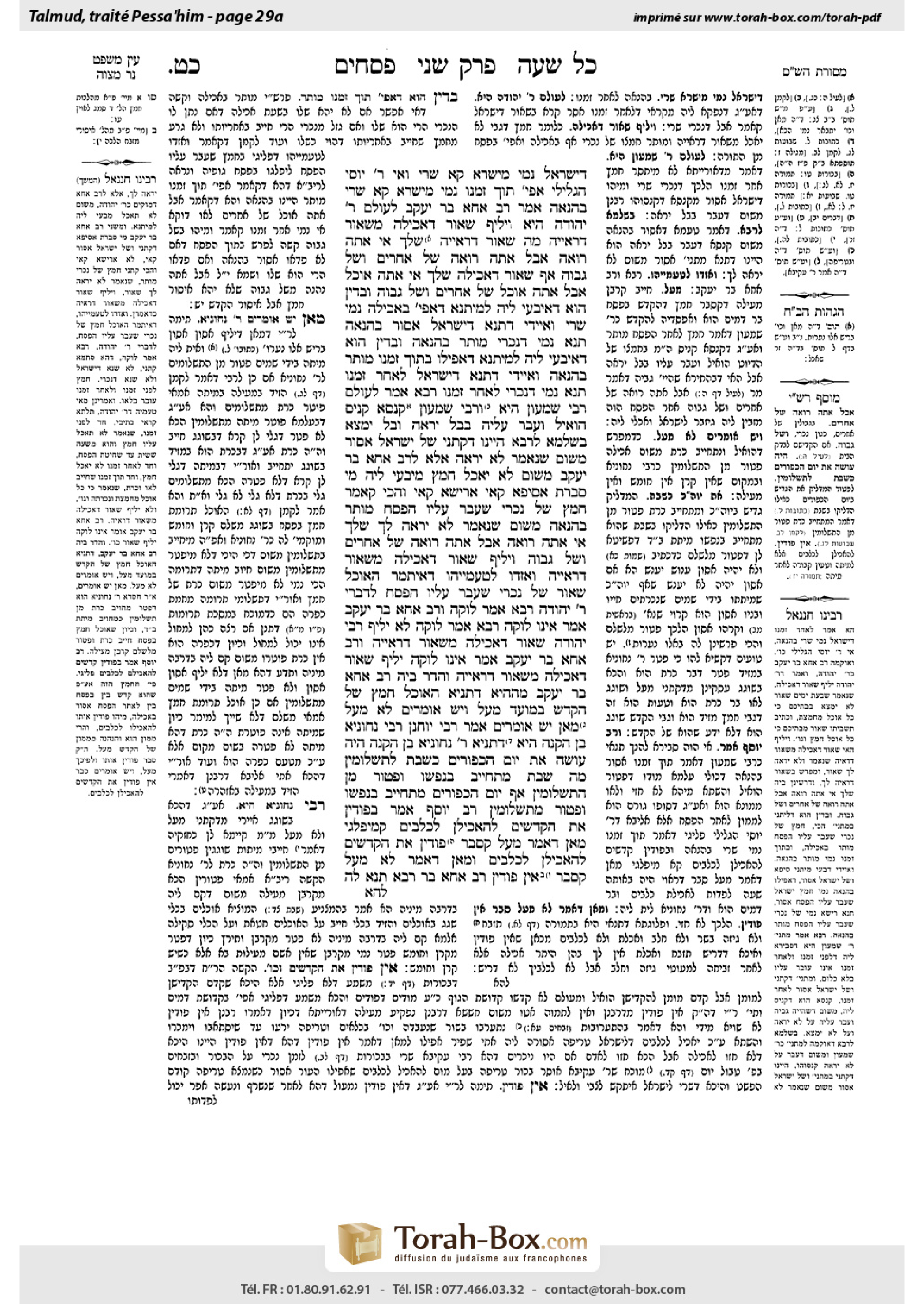
Pesachim 29a: Talmud study for Daf Yomi
Daf Yomi is the daily study of one Talmud folio. Explore 37 tractates with scans, Hebrew text, Sefaria English and AI-generated French translations where annotated.
Passage selection and English or AI-generated French translation are available where the scan has annotations. Daf Study is independent of Torah-Box and Sefaria.
Browse Pesachim · פסחים · All tractatesPesachim 29a text and translations
This page of Pesachim includes the Aramaic text, an English translation and an AI-generated French translation, alongside the scan above.
פסחים כ״ט א · Aramaic and Hebrew text
דְּיִשְׂרָאֵל נָמֵי מִישְׁרֵא קָא שָׁרֵי! וְאִי רַבִּי יוֹסֵי הַגְּלִילִי — אֲפִילּוּ תּוֹךְ זְמַנּוֹ נָמֵי מִישְׁרֵא קָא שָׁרֵי בַּהֲנָאָה.
אָמַר רַב אַחָא בַּר יַעֲקֹב: לְעוֹלָם רַבִּי יְהוּדָה הִיא, וְיָלֵיף שְׂאוֹר דַּאֲכִילָה מִשְּׂאוֹר דִּרְאִיָּיה. מָה שְׂאוֹר דִּרְאִיָּיה — שֶׁלְּךָ אִי אַתָּה רוֹאֶה, אֲבָל אַתָּה רוֹאֶה שֶׁל אֲחֵרִים וְשֶׁל גָּבוֹהַּ. אַף שְׂאוֹר דַּאֲכִילָה — שֶׁלְּךָ אִי אַתָּה אוֹכֵל, אֲבָל אַתָּה אוֹכֵל שֶׁל אֲחֵרִים וְשֶׁל גָּבוֹהַּ.
וּבְדִין הוּא דְּאִיבְּעִי לֵיהּ לְמִיתְנֵא דַּאֲפִילּוּ בַּאֲכִילָה נָמֵי שְׁרֵי, וְאַיְּידֵי דִּתְנָא דְּיִשְׂרָאֵל אָסוּר בַּהֲנָאָה — תְּנָא נָמֵי דְּגוֹי מוּתָּר בַּהֲנָאָה. וּבְדִין הוּא דְּאִיבְּעִי לֵיהּ לְמִיתְנֵא דַּאֲפִילּוּ בְּתוֹךְ זְמַנּוֹ מוּתָּר בַּהֲנָאָה, וְאַיְּידֵי דִּתְנָא דְּיִשְׂרָאֵל לְאַחַר זְמַנּוֹ — תְּנָא נָמֵי דְּגוֹי לְאַחַר זְמַנּוֹ.
רָבָא אָמַר: לְעוֹלָם רַבִּי שִׁמְעוֹן הִיא. וְרַבִּי שִׁמְעוֹן, קְנָסָא קָנֵיס, הוֹאִיל וְעָבַר עֲלֵיהּ בְּבַל יֵרָאֶה וּבַל יִמָּצֵא.
בִּשְׁלָמָא לְרָבָא, הַיְינוּ דְּקָתָנֵי: שֶׁל יִשְׂרָאֵל אָסוּר, מִשּׁוּם שֶׁנֶּאֱמַר ״לֹא יֵרָאֶה״. אֶלָּא לְרַב אַחָא בַּר יַעֲקֹב, מִשּׁוּם ״לֹא יֵאָכֵל חָמֵץ״ מִיבְּעֵי לֵיהּ!
מִי סָבְרַתְּ אַסֵּיפָא קָאֵי?! אַרֵישָׁא קָאֵי וְהָכִי קָאָמַר: חָמֵץ שֶׁל גּוֹי שֶׁעָבַר עָלָיו הַפֶּסַח מוּתָּר בַּהֲנָאָה, מִשּׁוּם שֶׁנֶּאֱמַר ״לֹא יֵרָאֶה לְךָ״ — שֶׁלְּךָ אִי אַתָּה רוֹאֶה, אֲבָל אַתָּה רוֹאֶה שֶׁל אֲחֵרִים וְשֶׁל גָּבוֹהַּ. וְיָלֵיף שְׂאוֹר דַּאֲכִילָה מִשְּׂאוֹר דִּרְאִיָּיה.
וְאָזְדוּ לְטַעְמַיְיהוּ: דְּאִיתְּמַר, הָאוֹכֵל שְׂאוֹר שֶׁל גּוֹי שֶׁעָבַר עָלָיו הַפֶּסַח, לְדִבְרֵי רַבִּי יְהוּדָה, רָבָא אָמַר: לוֹקֶה, וְרַב אַחָא בַּר יַעֲקֹב אָמַר: אֵינוֹ לוֹקֶה.
רָבָא אָמַר: לוֹקֶה, לָא יָלֵיף רַבִּי יְהוּדָה שְׂאוֹר דַּאֲכִילָה מִשְּׂאוֹר דִּרְאִיָּיה. וְרַב אַחָא בַּר יַעֲקֹב אָמַר: אֵינוֹ לוֹקֶה, יָלֵיף שְׂאוֹר דַּאֲכִילָה מִשְּׂאוֹר דִּרְאִיָּיה.
וַהֲדַר בֵּיהּ רַב אַחָא בַּר יַעֲקֹב מֵהַהִיא, דְּתַנְיָא: הָאוֹכֵל חָמֵץ שֶׁל הֶקְדֵּשׁ בַּמּוֹעֵד — מָעַל. וְיֵשׁ אוֹמְרִים: לֹא מָעַל.
מַאן יֵשׁ אוֹמְרִים? אָמַר רַבִּי יוֹחָנָן: רַבִּי נְחוּנְיָא בֶּן הַקָּנָה הִיא. דְּתַנְיָא: רַבִּי נְחוּנְיָא בֶּן הַקָּנָה הָיָה עוֹשֶׂה אֶת יוֹם הַכִּפּוּרִים כַּשַּׁבָּת לְתַשְׁלוּמִין.
מָה שַׁבָּת מִתְחַיֵּיב בְּנַפְשׁוֹ וּפָטוּר מִן הַתַּשְׁלוּמִין, אַף יוֹם הַכִּפּוּרִים מִתְחַיֵּיב בְּנַפְשׁוֹ וּפָטוּר מִתַּשְׁלוּמִין.
רַב יוֹסֵף אָמַר: בְּפוֹדִין אֶת הַקֳּדָשִׁים לְהַאֲכִילָן לִכְלָבִים קָמִיפַּלְגִי.
מַאן דְּאָמַר מָעַל, קָסָבַר: פּוֹדִין אֶת הַקֳּדָשִׁים לְהַאֲכִילָן לִכְלָבִים. וּמַאן דְּאָמַר לֹא מָעַל, קָסָבַר: אֵין פּוֹדִין.
רַב אַחָא בַּר רָבָא תְּנָא לָהּ
Pesachim 29a · English translation
Rabbi Shimon also permits one to derive benefit from leavened bread after Passover even if it was owned by a Jew. And if the mishna follows the opinion of Rabbi Yosei HaGelili, he would permit one to derive benefit from it even during Passover.
Rav Aḥa bar Ya’akov said: Actually, it is possible to explain that the mishna is in accordance with the opinion of Rabbi Yehuda, and he derives the restrictions pertaining to the eating of leaven from the restrictions relating to seeing leaven. The prohibition against seeing leaven is worded: “It shall not be seen by you.” It is understood to mean that you should not see your own or another Jew’s leaven. But you may see leaven that belongs to others, i.e., gentiles, and leaven consecrated to God. Similarly, with regard to the prohibition against eating leaven that was owned by a Jew during Passover after Passover, you may not eat your own leavened bread, but you may eat the leavened bread of others or the leaven consecrated to God after Passover.
And by right it should have taught that even the eating of leavened bread belonging to a gentile is permitted after the conclusion of Passover, but since the tanna taught that it is forbidden to derive benefit from leavened bread belonging to a Jew after Passover, he also taught that it is permitted to derive benefit from leavened bread belonging to a gentile. However, one should understand that it is permitted to eat this leavened bread as well. And similarly, by right it should have taught that even during Passover it is permitted to derive benefit from leavened bread that belongs to gentiles. But since the tanna taught about the leavened bread belonging to a Jew after Passover, he also taught about the leavened bread belonging to a gentile after Passover. Thus, one should not infer halakhot from the exact formulation of these details in the baraita, but rather understand that the mishna follows Rabbi Yehuda’s opinion.
Rava said: This is not so. Actually, our mishna is in accordance with the opinion of Rabbi Shimon. However, this is difficult, as Rabbi Shimon states that it is permitted for a Jew to derive benefit from leavened bread that had been owned by another Jew during Passover, while our mishna explicitly states that this is forbidden. This can be resolved by explaining that Rabbi Shimon argues that it is permitted only according to Torah law. However, one who intentionally commits such a transgression incurs a penalty. Since he transgressed the prohibition it shall not be seen and the prohibition it shall not be found, the Sages decreed that it is forbidden for him to derive benefit from this leavened bread.
The Gemara comments: Granted, according to the opinion of Rava, this explanation is consistent with that which was taught in the mishna: Leavened bread that belonged to a Jew is forbidden because it is stated: “It shall not be seen” (Exodus 13:7). According to this explanation, the connection between the prohibition against deriving benefit from leavened bread that was owned by a Jew during Passover and the verse prohibiting seeing leaven during Passover is clear. The prohibition against deriving benefit from this leavened bread is a rabbinically instituted fine for transgressing the Torah prohibition of “It shall not be seen.” But according to the opinion of Rav Aḥa bar Ya’akov, which states that our mishna follows the opinion of Rabbi Yehuda, and which renders forbidden by Torah law deriving benefit from leavened bread that was owned by a Jew during Passover, why is this verse cited? The mishna should have said that it is forbidden due to the verse “Leavened bread shall not be eaten” (Exodus 13:3), as that is the verse from which Rabbi Yehuda derives this prohibition.
The Gemara answers: Do you hold that this proof is referring to the latter clause of the mishna, where the prohibition against deriving benefit from leavened bread owned by a Jew is discussed? It is referring to the first clause of the mishna, which discusses permission to derive benefit from leavened bread owned by a gentile, and this is what it is saying: Leavened bread of a gentile, over which Passover has elapsed, i.e., that remains after the conclusion of Passover, it is permissible to derive benefit from it, due to the verse where it is stated: “It shall not be seen by you.” This indicates that you may not see your own leaven, but you may see leaven that belongs to others and leaven consecrated to God. And he derives the details about the prohibition of eating leaven from the prohibition of seeing leaven. The verse “It shall not be seen by you” should be understood as an explanation of what is permitted and not as an explanation of what is forbidden.
The Gemara comments that Rava and Rav Aḥa bar Ya’akov follow their line of reasoning. For it was stated that they dispute this issue: With regard to one who eats leaven of a gentile over which Passover has elapsed, i.e., that remains after the conclusion of Passover, according to the statement of Rabbi Yehuda, Rava said: He is flogged, as he has violated a Torah prohibition. And Rav Aḥa bar Ya’akov said: He is not flogged.
The Gemara explains: Rava said that according to Rabbi Yehuda, he is flogged, as Rabbi Yehuda does not derive the prohibition against eating leaven from the prohibition against seeing leaven. Instead, he derives the prohibition from a verse that does not use the words “to you,” and therefore leavened bread owned by a gentile over Passover is forbidden in all circumstances. Rav Aḥa bar Ya’akov said: He is not flogged, as Rabbi Yehuda learns the prohibition against eating leaven from the prohibition against seeing leaven, and thus it is limited to leavened bread owned by a Jew.
The Gemara notes: Rav Aḥa bar Ya’akov retracted that position on this matter. As it was taught in a baraita: One who eats consecrated leavened bread during the festival of Passover is guilty of misuse of consecrated items. If one performed this action unintentionally, then he must offer a guilt-offering to atone for using a consecrated item for non-sacred purposes. And some say: He is not guilty of misuse of consecrated items.
The Gemara asks: To whom is the phrase in the baraita: Some say, referring? Rabbi Yoḥanan said: This is Rabbi Neḥunya ben HaKana. As it was taught in a baraita: Rabbi Neḥunya ben HaKana would render the status of Yom Kippur the same as that of Shabbat with regard to payment for damage caused by a person in violation of the prohibitions of that day.
Just as one who desecrates Shabbat by intentionally causing damage to his fellow’s property, e.g., by lighting his stack of grain on fire, is liable to receive the death penalty, since one who intentionally desecrates Shabbat is punished by stoning and is therefore exempt from payment, the basis for this exemption being the principle that after committing multiple transgressions, one is punished only with the most severe punishment; so too, one who causes damage by desecrating Yom Kippur is liable to receive the death penalty, as this violation is punished with karet, i.e., spiritual death at the hand of Heaven, and is therefore exempt from payment. According to this position, one who eats leavened bread during Passover and is deserving of karet should also be exempt from other punishments, including the penalty for misuse of consecrated items. In any case, it is clear that both Sages mentioned in the baraita agree that leavened bread has monetary value. This must be due to the fact that one is permitted to derive benefit from it after Passover. Therefore, it appears that they both accept Rabbi Shimon’s position.
Rav Yosef said: The dispute mentioned in this baraita should be understood differently. Both tanna’im in the baraita accept the opinion of Rabbi Yosei HaGelili, which states that one may derive benefit from leavened bread during Passover, and thus, in principle, one should be permitted to derive benefit from this consecrated leavened bread. Yet, unlike non-sacred leavened bread, which one may sell to gentiles or feed to dogs, it is prohibited to use consecrated leavened bread in this way. Therefore, the question whether this leavened bread has any monetary value depends on the question whether one may redeem consecrated items in order to feed them to dogs, and it is about this point that the tanna’im disagree.
The one who said that he misused consecrated items by using this leavened bread during Passover holds that one may redeem consecrated items in order to feed them to dogs. Because the food may be redeemed for this purpose, the consecrated leavened bread does have some monetary value, and therefore using it is considered misuse of consecrated items. And the one who said that he did not misuse consecrated items holds that consecrated property may not be redeemed for this purpose, but only in order to provide food for a Jewish person. In this case, since it is forbidden to eat this leavened bread during Passover, the consecrated leavened bread has no value at all at this time. Therefore, one who eats such leavened bread is not guilty of misuse of consecrated items.
The Gemara comments: Rav Aḥa bar Rava taught
Pesachim 29a · Traduction française (IA)
Rabbi Shimon permet également de tirer profit du hamets après Pessa’h, même s’il appartenait à un Juif. Et si la Michna suivait l’opinion de Rabbi Yosei HaGelili, il permettrait d’en tirer profit même pendant Pessa’h.
Rav Aḥa bar Ya’akov dit : En réalité, on peut expliquer que la Michna est conforme à l’opinion de Rabbi Yehuda, et que celui-ci déduit les restrictions relatives à la consommation du hamets de celles qui concernent le fait de voir du hamets. L’interdiction de voir du hamets est formulée ainsi : « Il ne sera pas vu chez toi. » Cela signifie qu’on ne doit voir ni son propre hamets ni celui d’un autre Juif. En revanche, on peut voir le hamets appartenant à autrui, c’est-à-dire aux non-Juifs, ainsi que le hamets consacré à Dieu. De même, concernant l’interdiction de consommer, après Pessa’h, du hamets qui appartenait à un Juif pendant Pessa’h, on ne peut pas consommer son propre hamets, mais on peut consommer celui d’autrui ou le hamets consacré à Dieu.
En toute logique, il aurait fallu enseigner que la consommation du hamets appartenant à un non-Juif est également permise après la fin de Pessa’h. Mais comme le tanna a enseigné qu’il est interdit de tirer profit, après Pessa’h, du hamets appartenant à un Juif, il a également enseigné qu’il est permis de tirer profit du hamets appartenant à un non-Juif. Il faut toutefois comprendre que la consommation de ce hamets est elle aussi permise. De même, en toute logique, il aurait fallu enseigner que, même pendant Pessa’h, il est permis de tirer profit du hamets appartenant à des non-Juifs. Mais comme le tanna a enseigné ce qui concerne le hamets appartenant à un Juif après Pessa’h, il a également enseigné ce qui concerne le hamets appartenant à un non-Juif après Pessa’h. Ainsi, il ne faut pas déduire de halakhot de la formulation précise de ces détails dans la baraïta, mais plutôt comprendre que la Michna suit l’opinion de Rabbi Yehuda.
Rava dit : Ce n’est pas ainsi. En réalité, notre Michna est conforme à l’opinion de Rabbi Shimon. Toutefois, cela pose une difficulté : Rabbi Shimon affirme qu’un Juif peut tirer profit du hamets qui appartenait à un autre Juif pendant Pessa’h, tandis que notre Michna dit explicitement que cela est interdit. On peut résoudre cette difficulté en expliquant que, selon Rabbi Shimon, cela n’est permis qu’en vertu de la Torah. Cependant, celui qui commet intentionnellement une telle transgression encourt une sanction. Comme il a transgressé les interdictions « Il ne sera pas vu » et « Il ne sera pas trouvé », les Sages ont décrété qu’il lui est interdit de tirer profit de ce hamets.
La Guemara remarque : Il est vrai que, selon l’opinion de Rava, cette explication concorde avec ce qui a été enseigné dans la Michna : le hamets qui appartenait à un Juif est interdit, car il est dit : « Il ne sera pas vu » (Exode 13, 7). Selon cette explication, le lien entre l’interdiction de tirer profit du hamets qui appartenait à un Juif pendant Pessa’h et le verset interdisant de voir du hamets pendant Pessa’h est clair. L’interdiction de tirer profit de ce hamets est une sanction rabbinique pour avoir transgressé l’interdiction de la Torah : « Il ne sera pas vu. » Mais selon l’opinion de Rav Aḥa bar Ya’akov, qui affirme que notre Michna suit l’opinion de Rabbi Yehuda et que tirer profit du hamets ayant appartenu à un Juif pendant Pessa’h est interdit par la Torah, pourquoi ce verset est-il cité ? La Michna aurait dû dire que cela est interdit à cause du verset : « On ne mangera pas de hamets » (Exode 13, 3), car c’est de ce verset que Rabbi Yehuda déduit cette interdiction.
La Guemara répond : Crois-tu que cette preuve porte sur la dernière partie de la Michna, où il est question de l’interdiction de tirer profit du hamets appartenant à un Juif ? Elle porte sur la première partie de la Michna, qui traite de la permission de tirer profit du hamets appartenant à un non-Juif. Voici ce qu’elle dit : on peut tirer profit du hamets d’un non-Juif sur lequel Pessa’h est passé, c’est-à-dire qui subsiste après la fin de Pessa’h, en vertu du verset qui dit : « Il ne sera pas vu chez toi. » Cela indique qu’on ne peut pas voir son propre hamets, mais qu’on peut voir celui d’autrui et le hamets consacré à Dieu. Et il déduit les détails de l’interdiction de consommer du hamets de l’interdiction de le voir. Le verset « Il ne sera pas vu chez toi » doit être compris comme une explication de ce qui est permis, et non de ce qui est interdit.
La Guemara remarque que Rava et Rav Aḥa bar Ya’akov restent fidèles à leur raisonnement. En effet, il a été rapporté qu’ils sont en désaccord sur cette question : à propos de celui qui consomme, selon l’enseignement de Rabbi Yehuda, le hamets d’un non-Juif sur lequel Pessa’h est passé, c’est-à-dire qui subsiste après la fin de Pessa’h, Rava dit : il reçoit la flagellation, car il a transgressé une interdiction de la Torah. Rav Aḥa bar Ya’akov dit : il ne reçoit pas la flagellation.
La Guemara explique : Rava dit que, selon Rabbi Yehuda, il reçoit la flagellation, car Rabbi Yehuda ne déduit pas l’interdiction de consommer du hamets de l’interdiction de le voir. Il déduit plutôt cette interdiction d’un verset qui ne comporte pas les mots « à vous » ; le hamets appartenant à un non-Juif pendant Pessa’h est donc interdit en toutes circonstances. Rav Aḥa bar Ya’akov dit : il ne reçoit pas la flagellation, car Rabbi Yehuda déduit l’interdiction de consommer du hamets de l’interdiction de le voir ; elle est donc limitée au hamets appartenant à un Juif.
La Guemara relève que Rav Aḥa bar Ya’akov est revenu sur cette position. En effet, il a été enseigné dans une baraïta : celui qui consomme du hamets consacré pendant la fête de Pessa’h est coupable de détournement d’un bien consacré. S’il l’a fait involontairement, il doit apporter un sacrifice de culpabilité pour avoir utilisé à des fins profanes un bien consacré. Certains disent : il n’est pas coupable de détournement d’un bien consacré.
La Guemara demande : À qui renvoie l’expression « certains disent » dans la baraïta ? Rabbi Yoḥanan dit : il s’agit de Rabbi Neḥunya ben HaKana. En effet, il a été enseigné dans une baraïta que Rabbi Neḥunya ben HaKana assimilait le statut de Yom Kippour à celui du Chabbat concernant le paiement des dommages causés par une personne qui transgresse les interdictions de ce jour.
De même que celui qui profane intentionnellement le Chabbat en causant un dommage aux biens de son prochain, par exemple en mettant le feu à sa meule de grain, est passible de la peine de mort — puisque celui qui profane intentionnellement le Chabbat est puni de lapidation et est donc dispensé de payer, conformément au principe selon lequel, lorsqu’une personne commet plusieurs transgressions, elle ne reçoit que la peine la plus grave —, de même, celui qui cause un dommage en profanant Yom Kippour est passible de la peine de mort, car cette transgression est punie de karet, c’est-à-dire d’une mort spirituelle infligée par le Ciel, et il est donc dispensé de payer. Selon cette position, celui qui mange du hamets pendant Pessa’h et mérite le karet devrait lui aussi être dispensé des autres sanctions, notamment de la peine pour détournement d’un bien consacré. Quoi qu’il en soit, il est clair que les deux Sages mentionnés dans la baraïta reconnaissent que le hamets a une valeur monétaire. Cela doit s’expliquer par le fait qu’il est permis d’en tirer profit après Pessa’h. Il semble donc qu’ils acceptent tous deux la position de Rabbi Shimon.
Rav Yosef dit : Il faut comprendre autrement le désaccord mentionné dans cette baraïta. Les deux tannaïm de la baraïta acceptent l’opinion de Rabbi Yosei HaGelili, selon laquelle on peut tirer profit du hamets pendant Pessa’h ; en principe, il devrait donc être permis de tirer profit de ce hamets consacré. Toutefois, contrairement au hamets profane, que l’on peut vendre à des non-Juifs ou donner à manger aux chiens, il est interdit d’utiliser ainsi du hamets consacré. La question de savoir si ce hamets a une quelconque valeur monétaire dépend donc de la possibilité de racheter des biens consacrés pour les donner à manger aux chiens ; c’est sur ce point que les tannaïm sont en désaccord.
Celui qui affirme qu’il a détourné un bien consacré en utilisant ce hamets pendant Pessa’h considère qu’il est permis de racheter des biens consacrés pour les donner à manger aux chiens. Puisque cette nourriture peut être rachetée à cette fin, le hamets consacré a une certaine valeur monétaire ; son utilisation constitue donc un détournement d’un bien consacré. Celui qui affirme qu’il n’a pas détourné de bien consacré considère que les biens consacrés ne peuvent pas être rachetés à cette fin, mais uniquement pour fournir de la nourriture à un Juif. Dans ce cas, puisqu’il est interdit de manger ce hamets pendant Pessa’h, le hamets consacré n’a alors absolument aucune valeur. Par conséquent, celui qui mange un tel hamets n’est pas coupable de détournement d’un bien consacré.
La Guemara remarque : Rav Aḥa bar Rava enseigna
Traduction française générée par IA à partir de l’édition anglaise de Sefaria. Vérifie toujours un passage avec le texte source.
Text from Sefaria: William Davidson Edition - Vocalized Aramaic (CC BY NC); William Davidson Edition - English (CC BY NC).