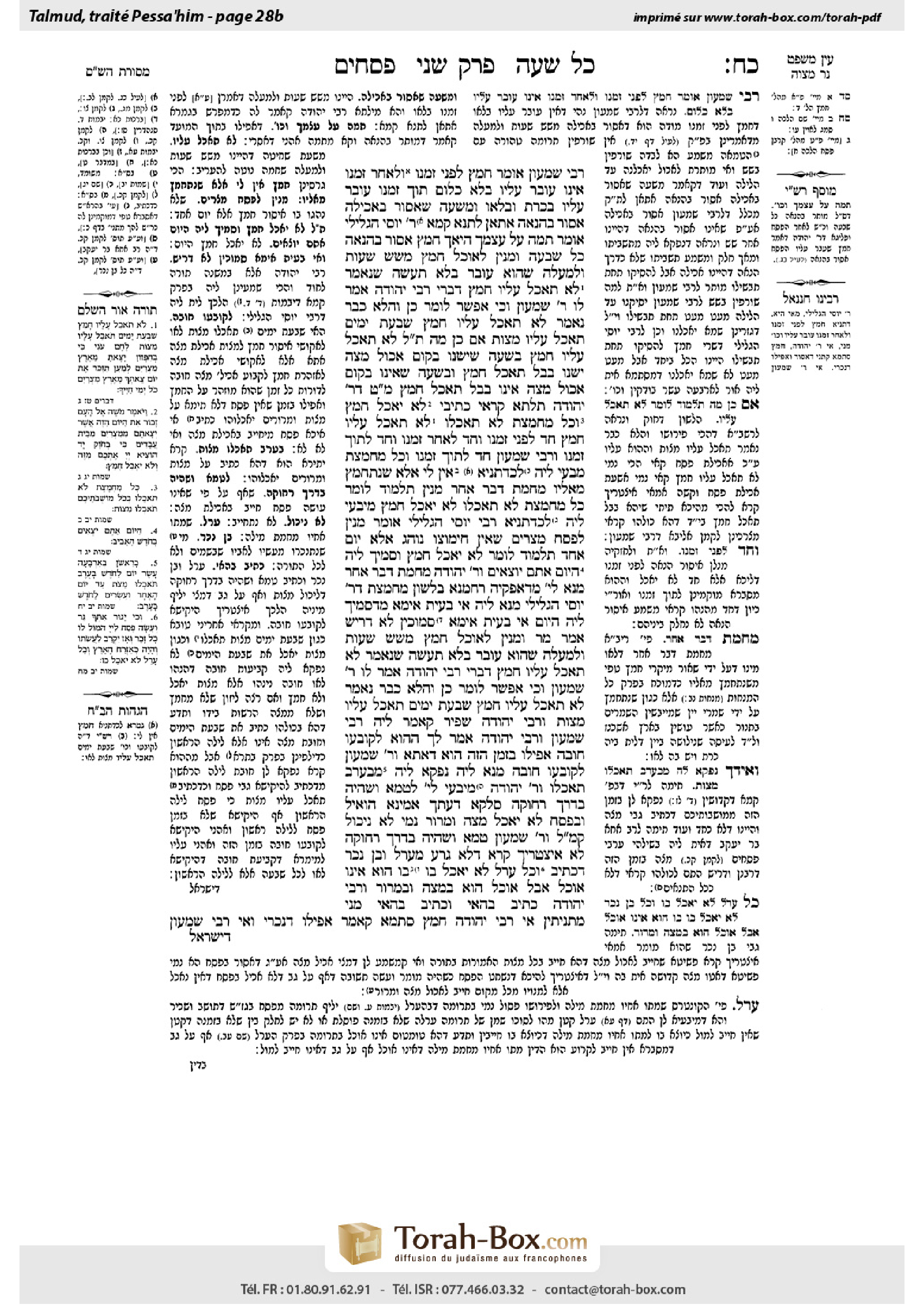
Pesachim 28b: Talmud study for Daf Yomi
Daf Yomi is the daily study of one Talmud folio. Explore 37 tractates with scans, Hebrew text, Sefaria English and AI-generated French translations where annotated.
Passage selection and English or AI-generated French translation are available where the scan has annotations. Daf Study is independent of Torah-Box and Sefaria.
Browse Pesachim · פסחים · All tractatesPesachim 28b text and translations
This page of Pesachim includes the Aramaic text, an English translation and an AI-generated French translation, alongside the scan above.
פסחים כ״ח ב · Aramaic and Hebrew text
רַבִּי שִׁמְעוֹן אוֹמֵר: חָמֵץ לִפְנֵי זְמַנּוֹ וּלְאַחַר זְמַנּוֹ — אֵינוֹ עוֹבֵר עָלָיו בְּלֹא כְּלוּם. תּוֹךְ זְמַנּוֹ — עוֹבֵר עָלָיו בְּכָרֵת וּבְלָאו. וּמִשָּׁעָה שֶׁאָסוּר בַּאֲכִילָה אָסוּר בַּהֲנָאָה, אֲתָאן לְתַנָּא קַמָּא. רַבִּי יוֹסֵי הַגְּלִילִי אוֹמֵר: תְּמַהּ עַל עַצְמְךָ, הֵיאַךְ חָמֵץ אָסוּר בַּהֲנָאָה כׇּל שִׁבְעָה!
וּמִנַּיִן לָאוֹכֵל חָמֵץ מִשֵּׁשׁ שָׁעוֹת וּלְמַעְלָה שֶׁהוּא עוֹבֵר בְּלֹא תַעֲשֶׂה — שֶׁנֶּאֱמַר: ״לֹא תֹאכַל עָלָיו חָמֵץ״, דִּבְרֵי רַבִּי יְהוּדָה.
אָמַר לוֹ רַבִּי שִׁמְעוֹן: וְכִי אֶפְשָׁר לוֹמַר כֵּן? וַהֲלֹא כְּבָר נֶאֱמַר ״לֹא תֹאכַל עָלָיו חָמֵץ שִׁבְעַת יָמִים תֹּאכַל עָלָיו מַצּוֹת״! אִם כֵּן, מָה תַּלְמוּד לוֹמַר ״לֹא תֹאכַל עָלָיו חָמֵץ״? בְּשָׁעָה שֶׁיֶּשְׁנוֹ בְּקוּם אֱכוֹל מַצָּה — יֶשְׁנוֹ בְּבַל תֹּאכַל חָמֵץ, וּבְשָׁעָה שֶׁאֵינוֹ בְּקוּם אֱכוֹל מַצָּה — אֵינוֹ בְּבַל תֹּאכַל חָמֵץ.
מַאי טַעְמָא דְּרַבִּי יְהוּדָה? תְּלָתָא קְרָאֵי כְּתִיבִי: ״לֹא יֵאָכֵל חָמֵץ״, ״וְכׇל מַחְמֶצֶת לֹא תֹאכֵלוּ״, ״לֹא תֹאכַל עָלָיו חָמֵץ״. חַד לִפְנֵי זְמַנּוֹ, וְחַד לְאַחַר זְמַנּוֹ, וְחַד לְתוֹךְ זְמַנּוֹ.
וְרַבִּי שִׁמְעוֹן: חַד לְתוֹךְ זְמַנּוֹ. ״וְכׇל מַחְמֶצֶת״ מִבְּעֵי לֵיהּ לְכִדְתַנְיָא: אֵין לִי אֶלָּא שֶׁנִּתְחַמֵּץ מֵאֵלָיו. מֵחֲמַת דָּבָר אַחֵר מִנַּיִן? תַּלְמוּד לוֹמַר: ״כׇּל מַחְמֶצֶת לֹא תֹאכֵלוּ״.
״לֹא יֵאָכֵל חָמֵץ״ מִיבְּעֵי לֵיהּ לְכִדְתַנְיָא, רַבִּי יוֹסֵי הַגְּלִילִי אוֹמֵר: מִנַּיִן לְפֶסַח מִצְרַיִם שֶׁאֵין חִימּוּצוֹ נוֹהֵג אֶלָּא יוֹם אֶחָד? תַּלְמוּד לוֹמַר: ״לֹא יֵאָכֵל חָמֵץ״, וּסְמִיךְ לֵיהּ: ״הַיּוֹם אַתֶּם יֹצְאִים״.
וְרַבִּי יְהוּדָה, מֵחֲמַת דָּבָר אַחֵר מְנָא לֵיהּ? מִדְּאַפְּקֵיהּ רַחֲמָנָא בִּלְשׁוֹן מַחְמֶצֶת.
דְּרַבִּי יוֹסֵי הַגְּלִילִי מְנָא לֵיהּ? אִי בָּעֵית אֵימָא: מִדִּסְמִיךְ לֵיהּ ״הַיּוֹם״. אִי בָּעֵית אֵימָא: סְמוּכִין לָא דָּרֵישׁ.
אָמַר מָר: וּמִנַּיִן לְאוֹכֵל חָמֵץ מִשֵּׁשׁ שָׁעוֹת וּלְמַעְלָה שֶׁהוּא עוֹבֵר בְּלֹא תַעֲשֶׂה, שֶׁנֶּאֱמַר: ״לֹא תֹאכַל עָלָיו חָמֵץ״, דִּבְרֵי רַבִּי יְהוּדָה. אָמַר לוֹ רַבִּי שִׁמְעוֹן: וְכִי אֶפְשָׁר לוֹמַר כֵּן? וַהֲלֹא כְּבָר נֶאֱמַר ״לֹא תֹאכַל עָלָיו חָמֵץ שִׁבְעַת יָמִים תֹּאכַל עָלָיו מַצּוֹת״.
וְרַבִּי יְהוּדָה, שַׁפִּיר קָאָמַר לֵיהּ רַבִּי שִׁמְעוֹן? וְרַבִּי יְהוּדָה אָמַר לָךְ: הָהוּא — לְקוֹבְעוֹ חוֹבָה אֲפִילּוּ בַּזְּמַן הַזֶּה הוּא דַּאֲתָא.
וְרַבִּי שִׁמְעוֹן, לְקוֹבְעוֹ חוֹבָה מְנָא לֵיהּ? נָפְקָא לֵיהּ מִ״בָּעֶרֶב תֹּאכְלוּ״. וְרַבִּי יְהוּדָה, מִיבְּעֵי לֵיהּ לְטָמֵא וְשֶׁהָיָה בְּדֶרֶךְ רְחוֹקָה. סָלְקָא דַּעְתָּךְ אָמֵינָא: הוֹאִיל וּבְפֶסַח לֹא יֹאכַל — מַצָּה וּמָרוֹר נָמֵי לָא נֵיכוֹל. קָא מַשְׁמַע לַן.
וְרַבִּי שִׁמְעוֹן, טָמֵא וְשֶׁהָיָה בְּדֶרֶךְ רְחוֹקָה לָא אִיצְטְרִיךְ קְרָא, דְּלָא גָּרַע מֵעָרֵל וּבֶן נֵכָר. דִּכְתִיב: ״וְכׇל עָרֵל לֹא יֹאכַל בּוֹ״ — בּוֹ הוּא אֵינוֹ אוֹכֵל, אֲבָל אוֹכֵל הוּא בְּמַצָּה וּבְמָרוֹר. וְרַבִּי יְהוּדָה: כְּתִיב בְּהַאי וּכְתִיב בְּהַאי.
מַנִּי מַתְנִיתִין? אִי רַבִּי יְהוּדָה — חָמֵץ סְתָמָא קָאָמַר, אֲפִילּוּ דְּגוֹי. וְאִי רַבִּי שִׁמְעוֹן —
Pesachim 28b · English translation
Rabbi Shimon says: One who eats or derives benefit from leavened bread, both before its time and after its time, does not transgress any prohibition. During its time one is liable to receive karet and transgresses a negative mitzva for eating or deriving benefit from leavened bread. And from the time that it is prohibited to eat leavened bread, beginning at midday on Passover eve, it is also prohibited to derive benefit from it. The Gemara comments: With this last sentence we have come to the opinion of the first tanna, as this statement appears to present Rabbi Yehuda’s opinion and not that of Rabbi Shimon. Rabbi Yosei HaGelili says: Be astounded with yourself. How can it be prohibited to derive benefit from leavened bread for all seven days? In other words, he disagrees with the premise that it is prohibited to derive benefit from leavened bread even during the seven days of Passover.
The baraita discusses a related issue: From where is it derived that one who eats leavened bread on Passover eve from the sixth hour and onward transgresses a negative mitzva? As it is stated: “And you shall sacrifice the Paschal lamb to the Lord your God, of the flock and the herd, in the place which the Lord shall choose to cause His name to dwell there. You shall eat no leavened bread with it; for seven days you shall eat matzot, the bread of affliction” (Deuteronomy 16:2–3). The juxtaposition of the Paschal lamb with the prohibition of leavened bread teaches that the prohibition to eat leavened bread begins from the time that the Paschal lamb is slaughtered, namely, the afternoon of the fourteenth of Nisan. This is the statement of Rabbi Yehuda.
Rabbi Shimon said to him: Is it possible to say this? Isn’t it already stated: “You shall eat no leavened bread with it; for seven days you shall eat matzot”? Since the verse links the prohibition of leavened bread to the mitzva of eating matza, one should also say that one must eat matza on the fourteenth of Nisan. If so, what does it mean when the verse states: “You shall eat no leavened bread with it”? The verse indicates that at a time when he is under the obligation to get up and eat matza, he is subject to the prohibition of: You shall eat no leavened bread. And at a time when he is under no obligation to get up and eat matza, he is not subject to the prohibition of: You shall eat no leavened bread.
The Gemara asks: What is the reason for the opinion of Rabbi Yehuda? The Gemara explains: There are three verses that are written with regard to this prohibition, and in Rabbi Yehuda’s opinion each one teaches that the prohibition applies at a different time. One verse states: “Leavened bread shall not be eaten” (Exodus 13:3). Another verse states: “And all that which is leavened you shall not eat; in all your habitations you shall eat matzot” (Exodus 12:20). And a third verse states: “You shall eat no leavened bread with it” (Deuteronomy 16:3). One verse indicates that there is a prohibition against eating leavened bread even before its time, on Passover eve. One verse indicates that there is a prohibition against eating leavened bread after its time as well, if a Jew owned it during Passover. And one verse indicates that the prohibition applies during Passover itself.
The Gemara asks: And how does Rabbi Shimon interpret these three verses? The Gemara explains: One verse is required to teach about the prohibition during its time. The verse: “And all that which is leavened you shall not eat” is required for another halakha, as it was taught in a baraita: I have derived that leavened bread is prohibited only if it became leavened on its own, through its own natural process. From where do I derive that if it became leavened due to another substance it is considered to be leavened bread as well? The verse states: “All that which is leavened you shall not eat.” This indicates that all leavened bread, no matter how it became so, is forbidden during Passover.
The verse “Leavened bread shall not be eaten” is also required for another halakha. As it was taught in a baraita that Rabbi Yosei HaGelili says: From where is it derived that the prohibition against eating leavened bread during the first Passover in Egypt applied for only one day? The verse states: “Leavened bread shall not be eaten,” and this is juxtaposed to the verse that states: “This day you go forth in the month of spring” (Exodus 13:4). This indicates that the prohibition against eating leavened bread during the first Passover in Egypt applied for only that one day.
The Gemara asks: And Rabbi Yehuda, from where does he derive that leavened bread that became leavened due to another substance is prohibited? The Gemara answers: He derives it from the fact that the Merciful One expresses this halakha with the general term: “That which is leavened”; no additional amplification is required.
The Gemara asks: And this teaching of Rabbi Yosei HaGelili with regard to the Passover in Egypt, from where does Rabbi Yehuda derive it? The Gemara answers: If you wish, say that he derives it from the fact that the phrase “this day” is juxtaposed to it. In Rabbi Yehuda’s opinion, the entire verse: “Leavened bread shall not be eaten” is not required to make this point; instead, this verse indicates that there is an additional time when leavened bread is prohibited. Nonetheless, the juxtaposition with the following phrase does indicate something significant, namely, that the prohibition in Egypt was limited to one day. If you wish, say instead that Rabbi Yehuda does not employ the homiletic method of juxtaposition of verses, except in limited circumstances. Accordingly, Rabbi Yehuda does not accept Rabbi Yosei HaGelili’s opinion at all and holds that the prohibition against eating leavened bread during the Passover in Egypt applied for all seven days.
The Master said in the aforementioned baraita: From where is it derived that one who eats leavened bread from the sixth hour and onward transgresses a negative mitzva? As it is stated: “You shall eat no leavened bread with it”; this is the statement of Rabbi Yehuda. Rabbi Shimon said to him: And is it possible to say this? Isn’t it already stated: “You shall eat no leavened bread with it; for seven days you shall eat matzot,” linking the time of the prohibition against eating leavened bread with the time of the mitzva to eat matza?
The Gemara asks: And indeed, Rabbi Shimon is saying well to Rabbi Yehuda, so how does Rabbi Yehuda use this verse to support his opinion? The Gemara answers that Rabbi Yehuda could have said to you: That verse comes to establish it as an obligation even nowadays. One might have assumed that after the destruction of the Temple, when the Paschal lamb can no longer be brought, the obligation to eat matza no longer applies either. Therefore, the verse links the prohibition against eating leavened bread to the obligation to eat matza in order to teach that just as it is prohibited to eat leavened bread even in the absence of the Temple, so too, there remains an obligation to eat matza as well.
The Gemara asks: And Rabbi Shimon, from where does he derive the need to establish it as an obligation even after the destruction of the Temple? The Gemara answers: He derives it from the following verse: “In the first month, on the fourteenth day of the month in the evening, you shall eat matzot, until the twenty-first day in the evening” (Exodus 12:18). This verse connects the obligation to eat matza to the date of Passover and not only to the Paschal lamb. The Gemara asks: And Rabbi Yehuda, what does he derive from this verse? The Gemara answers: He requires it to teach that there remains an obligation for one who is ritually impure or on a distant journey and cannot bring the Paschal lamb. It could enter your mind to say that since he will not eat the Paschal lamb, he is also not obligated to eat matza and bitter herbs. Therefore, the verse teaches us that he is obligated to eat them.
And Rabbi Shimon, from where does he derive this halakha? In his opinion, a verse is not necessary to teach that one who is ritually impure or on a distant journey is obligated to eat matza and bitter herbs, as he is no worse than an uncircumcised man or a resident alien. As it is written: “And no uncircumcised man shall eat of it” (Exodus 12:48). The added emphasis in “of it” indicates that only it, the Paschal lamb, he does not eat; however, he must eat matza and bitter herbs. The Gemara asks: And Rabbi Yehuda, how would he respond? The Gemara answers: Granted, the Torah did not need to add this verse. Nonetheless, it is written in this context that one who is impure or on a distant journey is obligated to eat matza and bitter herbs. And it is written in that context with regard to the uncircumcised man and the resident alien as well.
After clarifying the opinions of Rabbi Yehuda, Rabbi Shimon, and Rabbi Yosei HaGelili, the Gemara asks: In accordance with whose opinion is the mishna taught? If one suggests that it is in accordance with the opinion of Rabbi Yehuda, this cannot be, as Rabbi Yehuda said leavened bread without stipulation that the leavened bread belong to a Jew, indicating that one may not even benefit from leavened bread of a gentile over which Passover elapsed. Therefore, since this opinion contradicts the statement made in the mishna discussed here, Rabbi Yehuda can be ruled out as its author. And if it is in accordance with the opinion of Rabbi Shimon,
Pesachim 28b · Traduction française (IA)
Rabbi Shimon dit : Celui qui mange du pain levé ou en tire profit, aussi bien avant la période où il est interdit qu’après celle-ci, ne transgresse aucune interdiction. Pendant cette période, il encourt le karet et transgresse une mitsva négative s’il mange du pain levé ou en tire profit. À partir du moment où il est interdit de manger du pain levé, c’est-à-dire dès le milieu de la journée précédant Pessa’h, il est également interdit d’en tirer profit. La Guemara fait remarquer : Avec cette dernière phrase, nous en sommes venus à l’opinion du premier tanna, car cette affirmation semble présenter l’opinion de Rabbi Yehouda, et non celle de Rabbi Shimon. Rabbi Yosei HaGelili dit : Étonne-toi toi-même ! Comment peut-il être interdit de tirer profit du pain levé pendant les sept jours entiers ? Autrement dit, il conteste le principe selon lequel il est interdit de tirer profit du pain levé même pendant les sept jours de Pessa’h.
La baraïta traite d’une question connexe : D’où déduit-on que celui qui mange du pain levé la veille de Pessa’h, à partir de la sixième heure, transgresse une mitsva négative ? Car il est dit : « Tu sacrifieras à l’Éternel ton Dieu le sacrifice pascal, pris parmi le petit et le gros bétail, au lieu que l’Éternel choisira pour y faire résider Son nom. Tu ne mangeras pas de pain levé avec lui ; pendant sept jours, tu mangeras des matsot, le pain de misère » (Deutéronome 16, 2-3). Le rapprochement entre le sacrifice pascal et l’interdiction du pain levé enseigne que l’interdiction de manger du pain levé commence au moment où le sacrifice pascal est abattu, c’est-à-dire l’après-midi du quatorzième jour de Nissan. Telle est la déclaration de Rabbi Yehouda.
Rabbi Shimon lui dit : Est-il possible de dire cela ? N’est-il pas déjà dit : « Tu ne mangeras pas de pain levé avec lui ; pendant sept jours, tu mangeras des matsot » ? Puisque le verset associe l’interdiction du pain levé à la mitsva de manger de la matsa, il faudrait aussi dire qu’on doit manger de la matsa le quatorzième jour de Nissan. Dans ce cas, que signifie la formule du verset : « Tu ne mangeras pas de pain levé avec lui » ? Le verset indique qu’au moment où il est tenu de se lever et de manger de la matsa, il est soumis à l’interdiction : « Tu ne mangeras pas de pain levé. » Mais au moment où il n’est pas tenu de se lever et de manger de la matsa, il n’est pas soumis à l’interdiction : « Tu ne mangeras pas de pain levé. »
La Guemara demande : Quelle est la raison de l’opinion de Rabbi Yehouda ? La Guemara explique : Trois versets sont écrits au sujet de cette interdiction et, selon Rabbi Yehouda, chacun enseigne que l’interdiction s’applique à un moment différent. Un verset dit : « On ne mangera pas de pain levé » (Exode 13, 3). Un autre dit : « Tout ce qui est levé, vous n’en mangerez pas ; dans toutes vos demeures, vous mangerez des matsot » (Exode 12, 20). Et un troisième dit : « Tu ne mangeras pas de pain levé avec lui » (Deutéronome 16, 3). Un verset indique qu’il est interdit de manger du pain levé même avant la période où il est interdit, la veille de Pessa’h. Un autre indique qu’il est également interdit d’en manger après cette période, si un Juif en a possédé pendant Pessa’h. Et le troisième indique que l’interdiction s’applique pendant Pessa’h même.
La Guemara demande : Et comment Rabbi Shimon interprète-t-il ces trois versets ? La Guemara explique : Un verset est nécessaire pour enseigner l’interdiction pendant la période où elle s’applique. Le verset « Tout ce qui est levé, vous n’en mangerez pas » est nécessaire pour enseigner une autre halakha, comme l’enseigne une baraïta : J’ai déduit que le pain levé n’est interdit que s’il a levé de lui-même, selon un processus naturel. D’où déduis-je que s’il a levé sous l’effet d’une autre substance, il est également considéré comme du pain levé ? Le verset dit : « Tout ce qui est levé, vous n’en mangerez pas. » Cela indique que tout pain levé, quelle que soit la manière dont il a levé, est interdit pendant Pessa’h.
Le verset « On ne mangera pas de pain levé » est également nécessaire pour enseigner une autre halakha. En effet, une baraïta enseigne que Rabbi Yosei HaGelili dit : D’où déduit-on que l’interdiction de manger du pain levé pendant le premier Pessa’h en Égypte ne s’appliquait que pendant un jour ? Le verset dit : « On ne mangera pas de pain levé », et cette formule est rapprochée du verset qui dit : « Aujourd’hui, vous sortez, au mois du printemps » (Exode 13, 4). Cela indique que l’interdiction de manger du pain levé pendant le premier Pessa’h en Égypte ne s’appliquait que ce jour-là.
La Guemara demande : Et Rabbi Yehouda, d’où déduit-il que le pain levé sous l’effet d’une autre substance est interdit ? La Guemara répond : Il le déduit du fait que le Miséricordieux, c’est-à-dire la Torah, formule cette halakha par le terme général « ce qui est levé » ; aucune amplification supplémentaire n’est nécessaire.
La Guemara demande : Et cette enseignement de Rabbi Yosei HaGelili au sujet du Pessa’h en Égypte, d’où Rabbi Yehouda le déduit-il ? Si tu veux, dis qu’il le déduit du fait que l’expression « ce jour » lui est accolée. Selon Rabbi Yehouda, l’ensemble du verset « On ne mangera pas de pain levé » n’est pas nécessaire pour établir ce point ; ce verset indique plutôt qu’il existe une période supplémentaire où le pain levé est interdit. Néanmoins, le rapprochement avec l’expression qui suit indique quelque chose d’important, à savoir que l’interdiction en Égypte était limitée à un jour. Si tu veux, dis plutôt que Rabbi Yehouda n’emploie la méthode homilétique du rapprochement des versets que dans des circonstances limitées. Par conséquent, Rabbi Yehouda n’accepte pas du tout l’opinion de Rabbi Yosei HaGelili et soutient que l’interdiction de manger du pain levé pendant le Pessa’h en Égypte s’appliquait pendant les sept jours entiers.
Le Maître a dit dans la baraïta mentionnée précédemment : D’où déduit-on que celui qui mange du pain levé à partir de la sixième heure transgresse une mitsva négative ? Car il est dit : « Tu ne mangeras pas de pain levé avec lui » ; telle est la déclaration de Rabbi Yehouda. Rabbi Shimon lui dit : Est-il possible de dire cela ? N’est-il pas déjà dit : « Tu ne mangeras pas de pain levé avec lui ; pendant sept jours, tu mangeras des matsot », liant la période de l’interdiction de manger du pain levé à celle de la mitsva de manger de la matsa ?
La Guemara demande : En effet, Rabbi Shimon répond fort bien à Rabbi Yehouda ; comment Rabbi Yehouda utilise-t-il donc ce verset pour étayer son opinion ? La Guemara répond que Rabbi Yehouda aurait pu lui dire : Ce verset vient établir qu’il s’agit d’une obligation même de nos jours. On aurait pu supposer qu’après la destruction du Temple, lorsque le sacrifice pascal ne peut plus être offert, l’obligation de manger de la matsa ne s’applique plus non plus. Le verset lie donc l’interdiction de manger du pain levé à l’obligation de manger de la matsa afin d’enseigner que, de même qu’il est interdit de manger du pain levé même en l’absence du Temple, l’obligation de manger de la matsa demeure elle aussi.
La Guemara demande : Et Rabbi Shimon, d’où déduit-il qu’il faut établir qu’il s’agit d’une obligation même après la destruction du Temple ? La Guemara répond : Il le déduit du verset suivant : « Au premier mois, le quatorzième jour du mois, au soir, vous mangerez des matsot, jusqu’au vingt et unième jour du mois, au soir » (Exode 12, 18). Ce verset rattache l’obligation de manger de la matsa à la date de Pessa’h, et pas uniquement au sacrifice pascal. La Guemara demande : Et Rabbi Yehouda, que déduit-il de ce verset ? La Guemara répond : Il en a besoin pour enseigner qu’il reste une obligation pour celui qui est rituellement impur ou qui se trouve sur une route lointaine et ne peut pas offrir le sacrifice pascal. On aurait pu penser que, puisqu’il ne mangera pas le sacrifice pascal, il n’est pas non plus tenu de manger de la matsa et des herbes amères. Le verset nous enseigne donc qu’il est tenu de les manger.
Et Rabbi Shimon, d’où déduit-il cette halakha ? Selon lui, aucun verset n’est nécessaire pour enseigner que celui qui est rituellement impur ou qui se trouve sur une route lointaine est tenu de manger de la matsa et des herbes amères, car il n’est pas dans une situation pire que celle d’un incirconcis ou d’un résident étranger. En effet, il est écrit : « Aucun incirconcis n’en mangera » (Exode 12, 48). L’accent ajouté dans l’expression « n’en » indique qu’il ne mange pas uniquement le sacrifice pascal ; cependant, il doit manger de la matsa et des herbes amères. La Guemara demande : Et comment Rabbi Yehouda répondrait-il ? La Guemara répond : Certes, la Torah n’avait pas besoin d’ajouter ce verset. Néanmoins, il est écrit dans ce contexte que celui qui est impur ou qui se trouve sur une route lointaine est tenu de manger de la matsa et des herbes amères. Et il est également écrit dans ce contexte au sujet de l’incirconcis et du résident étranger.
Après avoir clarifié les opinions de Rabbi Yehouda, Rabbi Shimon et Rabbi Yosei HaGelili, la Guemara demande : Selon l’opinion de qui la Michna est-elle enseignée ? Si l’on suggère qu’elle est conforme à l’opinion de Rabbi Yehouda, cela ne peut pas être, car Rabbi Yehouda a parlé du pain levé sans préciser qu’il appartient à un Juif, ce qui indique qu’on ne peut même pas tirer profit du pain levé d’un non-Juif dont Pessa’h a passé. Par conséquent, puisque cette opinion contredit la déclaration de la Michna examinée ici, on ne peut attribuer sa rédaction à Rabbi Yehouda. Et si elle est conforme à l’opinion de Rabbi Shimon,
Traduction française générée par IA à partir de l’édition anglaise de Sefaria. Vérifie toujours un passage avec le texte source.
Text from Sefaria: William Davidson Edition - Vocalized Aramaic (CC BY NC); William Davidson Edition - English (CC BY NC).