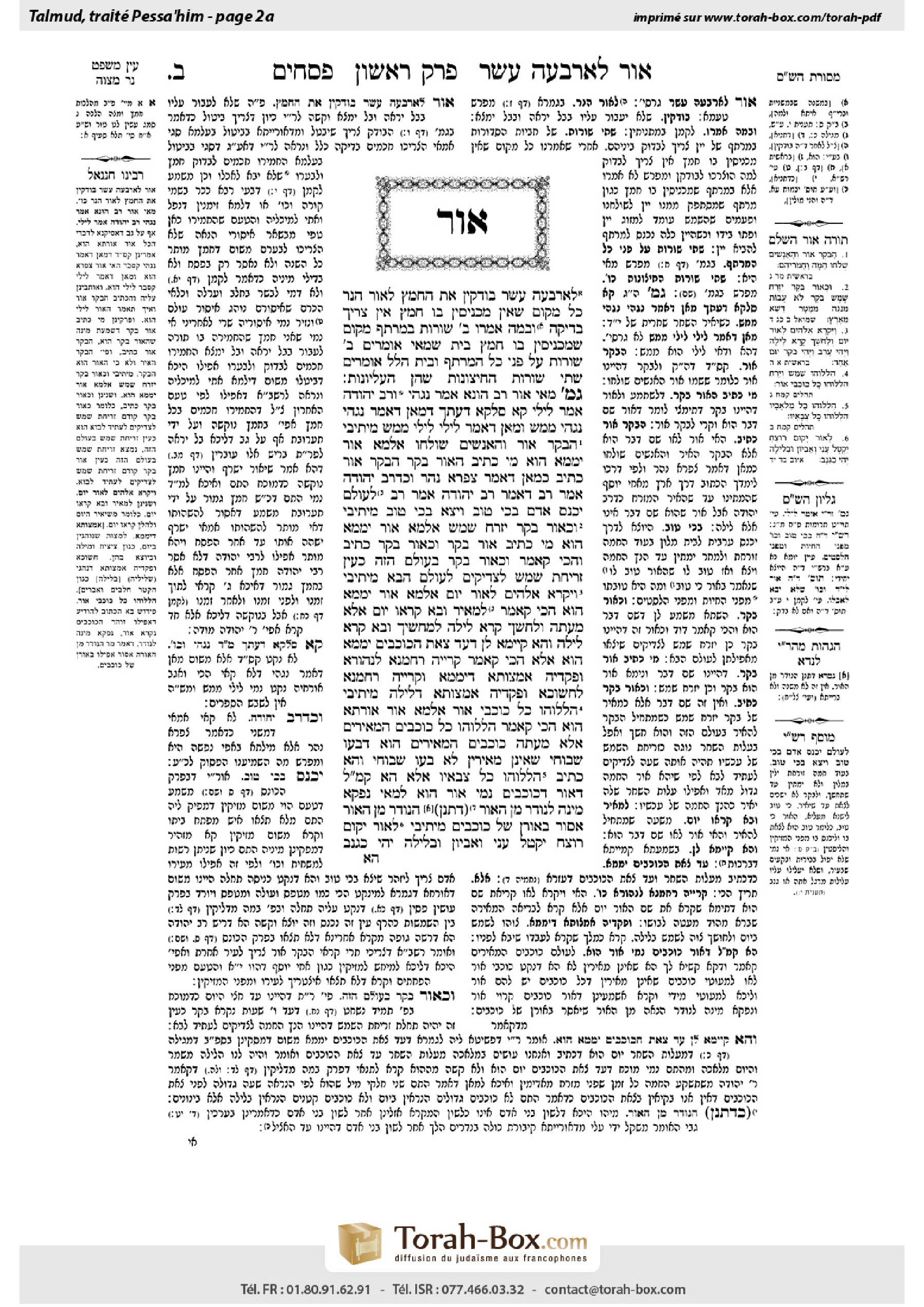
Pesachim 2a: Talmud study for Daf Yomi
Daf Yomi is the daily study of one Talmud folio. Explore 37 tractates with scans, Hebrew text, Sefaria English and AI-generated French translations where annotated.
Passage selection and English or AI-generated French translation are available where the scan has annotations. Daf Study is independent of Torah-Box and Sefaria.
Browse Pesachim · פסחים · All tractatesPesachim 2a text and translations
This page of Pesachim includes the Aramaic text, an English translation and an AI-generated French translation, alongside the scan above.
פסחים ב׳ א · Aramaic and Hebrew text
מַתְנִי׳ אוֹר לְאַרְבָּעָה עָשָׂר בּוֹדְקִין אֶת הֶחָמֵץ לְאוֹר הַנֵּר. כׇּל מָקוֹם שֶׁאֵין מַכְנִיסִין בּוֹ חָמֵץ, אֵין צָרִיךְ בְּדִיקָה. וּבַמָּה אָמְרוּ ״שְׁתֵּי שׁוּרוֹת בַּמַּרְתֵּף״ — מָקוֹם שֶׁמַּכְנִיסִין בּוֹ חָמֵץ. בֵּית שַׁמַּאי אוֹמְרִים: שְׁתֵּי שׁוּרוֹת עַל פְּנֵי כׇּל הַמַּרְתֵּף, וּבֵית הִלֵּל אוֹמְרִים: שְׁתֵּי שׁוּרוֹת הַחִיצוֹנוֹת שֶׁהֵן הָעֶלְיוֹנוֹת.
גְּמָ׳ מַאי ״אוֹר״? רַב הוּנָא אָמַר: נַגְהֵי, וְרַב יְהוּדָה אָמַר: לֵילֵי. קָא סָלְקָא דַּעְתָּךְ דְּמַאן דְּאָמַר נַגְהֵי — נַגְהֵי מַמָּשׁ, וּמַאן דְּאָמַר לֵילֵי — לֵילֵי מַמָּשׁ.
מֵיתִיבִי: ״הַבֹּקֶר אוֹר וְהָאֲנָשִׁים שֻׁלְּחוּ״ — אַלְמָא ״אוֹר״ יְמָמָא הוּא! מִי כְּתִיב ״הָאוֹר בֹּקֶר״? ״הַבֹּקֶר אוֹר״ כְּתִיב, כְּמַאן דְּאָמַר: צַפְרָא נְהַר, וְכִדְרַב יְהוּדָה אָמַר רַב. דְּאָמַר רַב יְהוּדָה אָמַר רַב: לְעוֹלָם יִכָּנֵס אָדָם בְּכִי טוֹב, וְיֵצֵא בְּכִי טוֹב.
מֵיתִיבִי: ״וּכְאוֹר בֹּקֶר יִזְרַח שָׁמֶשׁ״ — אַלְמָא ״אוֹר״ יְמָמָא הוּא! מִי כְּתִיב ״אוֹר בֹּקֶר״? ״וּכְאוֹר בֹּקֶר״ כְּתִיב, וְהָכִי קָאָמַר: וּכְאוֹר בֹּקֶר בָּעוֹלָם הַזֶּה, כְּעֵין זְרִיחַת שֶׁמֶשׁ לַצַּדִּיקִים לָעוֹלָם הַבָּא.
מֵיתִיבִי: ״וַיִּקְרָא אֱלֹהִים לָאוֹר יוֹם״ — אַלְמָא ״אוֹר״ יְמָמָא הוּא! הָכִי קָאָמַר: לַמֵּאִיר וּבָא קְרָאוֹ יוֹם. אֶלָּא מֵעַתָּה, ״וְלַחֹשֶׁךְ קָרָא לָיְלָה״ — לַמַּחְשִׁיךְ וּבָא קָרָא לַיְלָה?! וְהָא קַיְימָא לַן דְּעַד צֵאת הַכּוֹכָבִים יְמָמָא הוּא!
אֶלָּא, הָכִי קָאָמַר: קַרְיֵיהּ רַחֲמָנָא לִנְהוֹרָא וּפַקְּדֵיהּ אַמִּצְוְתָא דִימָמָא, וְקַרְיֵיהּ רַחֲמָנָא לַחֲשׁוֹכָא וּפַקְּדֵיהּ אַמִּצְוְתָא דְלֵילָה.
מֵיתִיבִי: ״הַלְלוּהוּ כׇּל כּוֹכְבֵי אוֹר״ — אַלְמָא ״אוֹר״ אוּרְתָּא הוּא. הָכִי קָאָמַר: הַלְלוּהוּ כׇּל כּוֹכָבִים הַמְּאִירִים. אֶלָּא מֵעַתָּה, כּוֹכָבִים הַמְּאִירִים הוּא דְּבָעוּ שַׁבּוֹחֵי, שֶׁאֵינָן מְאִירִין לָא בָּעוּ שַׁבּוֹחֵי?! וְהָא כְּתִיב: ״הַלְלוּהוּ כָּל צְבָאָיו״!
אֶלָּא הָא קָא מַשְׁמַע לַן — דְּאוֹר דְּכוֹכָבִים נָמֵי אוֹר הוּא. לְמַאי נָפְקָא מִינַּהּ? לְנוֹדֵר מִן הָאוֹר. (דִּתְנַן:) הַנּוֹדֵר מִן הָאוֹר — אָסוּר בְּאוֹרָן שֶׁל כּוֹכָבִים.
מֵיתִיבִי: ״לָאוֹר יָקוּם רוֹצֵחַ יִקְטׇל עָנִי וְאֶבְיוֹן וּבַלַּיְלָה יְהִי כַגַּנָּב״,
Pesachim 2a · English translation
MISHNA: On the evening [or] of the fourteenth of the month of Nisan, one searches for leavened bread in his home by candlelight. Any place into which one does not typically take leavened bread does not require a search, as it is unlikely that there is any leavened bread there. And with regard to what the Sages of previous generations meant when they said that one must search two rows of wine barrels in a cellar, i.e., a place into which one typically takes some leavened bread, the early tanna’im are in dispute. Beit Shammai say that this is referring to searching the first two rows across the entire cellar, and Beit Hillel say: There is no need to search that extensively, as it is sufficient to search the two external rows, which are the upper ones. This dispute will be explained and illustrated in the Gemara.
GEMARA: The Gemara asks: What is the meaning of the term or, translated as: The evening of? The Gemara provides two answers. Rav Huna said: It means light, and Rav Yehuda said: In this context, it means evening. At first glance, it could enter your mind to suggest that the one who said light means that one searches for leaven by the actual light of day, on the morning of the fourteenth of Nisan, and the one who said evening is referring to the actual evening of the fourteenth.
To clarify the meaning of the word or, the Gemara analyzes biblical verses and rabbinic statements. The Gemara raises an objection from a verse: “As soon as the morning was or, the men were sent away, they and their donkeys” (Genesis 44:3). Apparently, or is day. The Gemara rejects this contention. Is it written: The light was morning? “The morning was light” is written. In this context, or is a verb not a noun, as the one who said: The morning lightened. And this is in accordance with that which Rav Yehuda said that Rav said, as Rav Yehuda said that Rav said: A person should always enter an unfamiliar city with “it is good” (Genesis 1:4), i.e., before sunset, while it is light, as the Torah uses the expression “it is good” with regard to light upon its creation. This goodness is manifest in the sense of security one feels when it is light. And likewise, when one leaves a city he should leave with “it is good,” meaning after sunrise the next morning.
The Gemara raises an objection from another verse: “And as the light [or] of the morning, when the sun rises, a morning without clouds; when through clear shining after rain the tender grass springs out of the earth” (II Samuel 23:4). Apparently, or is day. The Gemara rejects this proof as well: Is it written that the light was morning? “As the light of the morning” is written, and this is what the verse is saying: And as brightly as the morning light of this world shines at its peak, so will be the rising of the sun for the righteous in the World-to-Come, as in those days the light of the sun will be seven times stronger than at present (see Isaiah 30:26).
The Gemara raises an objection: “And God called the or Day, and the darkness He called Night” (Genesis 1:5). Apparently, or is day. The Gemara rejects this proof as well. This is what the verse is saying: God called the advancing light Day. As stated previously, the word or can also be a verb; in this context, God called the beginning of that which eventually brightens, Day. The Gemara challenges this explanation: However, if that is so, the continuation of the verse, “and the darkness He called Night,” should be understood to mean: He called the advancing darkness Night, even before it is actually dark. However, this cannot be the correct interpretation of the verse, as we maintain it is day until the emergence of the stars. Since the stars emerge only after the sky begins to darken, the advancing evening cannot be defined as part of the night.
The Gemara rejects the previous explanation. Rather, this is what the verse is saying: God called the light to come and commanded it to perform the mitzva of the day, and God called the darkness and commanded it to perform the mitzva of the night. Called, in this context, does not connote the giving of a name. It means that He instructed the day and night to carry out their characteristic functions.
The Gemara raises an objection: “Praise Him, sun and moon; praise Him, all the stars of or” (Psalms 148:3). Apparently, or is the evening, as the stars of light appear at night. The Gemara rejects this contention. This is what the verse is saying: Praise Him, all the stars that radiate, as in this context or is not a noun but rather a verb that describes the activity of the stars. The Gemara challenges this explanation: However, if that is so, does the verse mean that it is the stars that radiate that are required to praise God, whereas those that do not radiate light are not required to praise Him? But isn’t it written in the previous verse: “Praise Him, all His legions,” indicating that all stars should praise God?
Rather, this phrase, the stars of light, comes to teach us that the light of stars is also considered light. The Gemara asks: What is the practical difference that emerges from the fact that the light of the stars is classified as light? The Gemara answers: It is significant with regard to one who vows that he will derive no benefit from light. It is necessary to define precisely what is included in the term light. As we learned in a mishna: For one who vows that he will derive no benefit from light, it is prohibited to benefit even from the light of the stars.
The Gemara raises an objection: “A murderer rises with the or to kill the poor and needy; and in the night he is as a thief” (Job 24:14).
Pesachim 2a · Traduction française (IA)
MICHNA : Le soir [ou] du quatorze Nissan, on recherche le hamets dans sa maison à la lumière d’une bougie. Il n’est pas nécessaire de rechercher dans les endroits où l’on n’apporte pas habituellement de hamets, car il est peu probable qu’il s’y en trouve. Quant à ce que les Sages des générations précédentes entendaient lorsqu’ils disaient qu’il faut rechercher dans deux rangées de tonneaux de vin dans une cave, c’est-à-dire un endroit où l’on apporte habituellement du hamets, les premiers tanaïm sont en désaccord. Beit Shammaï disent qu’il s’agit de rechercher dans les deux premières rangées sur toute la longueur de la cave, tandis que Beit Hillel disent : Il n’est pas nécessaire de rechercher aussi largement, car il suffit de rechercher dans les deux rangées extérieures, qui sont les rangées supérieures. Cette controverse sera expliquée et illustrée dans la Guemara.
GUEMARA : La Guemara demande : Quel est le sens du terme or, traduit par « le soir de » ? La Guemara donne deux réponses. Rav Houna dit : Il signifie « lumière », et Rav Yehouda dit : Dans ce contexte, il signifie « soir ». À première vue, on pourrait penser que celui qui dit « lumière » veut dire qu’on recherche le hamets à la lumière du jour, le matin du quatorze Nissan, tandis que celui qui dit « soir » fait référence au soir même du quatorze.
Pour préciser le sens du mot or, la Guemara analyse des versets bibliques et des propos des Sages. La Guemara soulève une objection à partir d’un verset : « Dès que le matin fut or, on les renvoya, eux et leurs ânes » (Genèse 44,3). Il semble donc que or signifie « jour ». La Guemara rejette cette affirmation : Est-il écrit : « La lumière fut le matin » ? Il est écrit : « Le matin fut lumineux ». Dans ce contexte, or est un verbe et non un nom, comme le comprend celui qui dit : « Le matin s’éclaircit ». Cela concorde avec ce que Rav Yehouda a dit au nom de Rav, car Rav Yehouda a dit au nom de Rav : Une personne devrait toujours entrer dans une ville inconnue lorsque « c’est bon » (Genèse 1,4), c’est-à-dire avant le coucher du soleil, tant qu’il fait jour, puisque la Torah emploie l’expression « c’est bon » à propos de la lumière lors de sa création. Cette bonté se manifeste par le sentiment de sécurité que l’on éprouve lorsqu’il fait jour. De même, lorsqu’on quitte une ville, on devrait partir lorsque « c’est bon », c’est-à-dire après le lever du soleil, le lendemain matin.
La Guemara soulève une objection à partir d’un autre verset : « Et comme la lumière [or] du matin, lorsque le soleil se lève, un matin sans nuages ; par son éclat limpide après la pluie, l’herbe tendre pousse hors de la terre » (II Samuel 23,4). Il semble donc que or signifie « jour ». La Guemara rejette également cette preuve : Est-il écrit que la lumière fut le matin ? Il est écrit : « Comme la lumière du matin », et voici ce que dit le verset : Aussi éclatante que soit la lumière du matin dans ce monde lorsqu’elle atteint son apogée, tel sera le lever du soleil pour les justes dans le Monde futur, car, en ces jours-là, la lumière du soleil sera sept fois plus forte qu’à présent (voir Isaïe 30,26).
La Guemara soulève une objection : « Dieu appela la lumière or, Jour, et les ténèbres, il les appela Nuit » (Genèse 1,5). Il semble donc que or signifie « jour ». La Guemara rejette également cette preuve. Voici ce que dit le verset : Dieu appela « Jour » la lumière qui s’avance. Comme indiqué précédemment, le mot or peut aussi être un verbe ; dans ce contexte, Dieu appela « Jour » le début de ce qui s’éclaircit progressivement. La Guemara conteste cette explication : toutefois, si tel est le cas, la suite du verset, « et les ténèbres, il les appela Nuit », devrait se comprendre ainsi : il appela « Nuit » les ténèbres qui s’avancent, avant même qu’il fasse réellement nuit. Or, cela ne peut être la bonne interprétation du verset, car nous considérons qu’il fait jour jusqu’à l’apparition des étoiles. Puisque les étoiles n’apparaissent qu’après que le ciel commence à s’assombrir, le soir qui s’avance ne peut être défini comme faisant partie de la nuit.
La Guemara rejette l’explication précédente. Il faut plutôt comprendre le verset ainsi : Dieu appela la lumière à venir et lui ordonna d’accomplir la mitsva du jour, et Dieu appela les ténèbres et leur ordonna d’accomplir la mitsva de la nuit. Dans ce contexte, « appela » ne signifie pas qu’il leur donna un nom. Cela signifie qu’il ordonna au jour et à la nuit de remplir leurs fonctions propres.
La Guemara soulève une objection : « Louez-le, soleil et lune ; louez-le, vous toutes, étoiles de or » (Psaumes 148,3). Il semble donc que or signifie « soir », puisque les étoiles de lumière apparaissent la nuit. La Guemara rejette cette affirmation. Voici ce que dit le verset : « Louez-le, vous toutes, étoiles qui rayonnent », car, dans ce contexte, or n’est pas un nom, mais un verbe qui décrit l’activité des étoiles. La Guemara conteste cette explication : toutefois, si tel est le cas, le verset signifie-t-il que seules les étoiles qui rayonnent doivent louer Dieu, tandis que celles qui ne rayonnent pas ne sont pas tenues de le louer ? Pourtant, le verset précédent dit : « Louez-le, toutes ses armées », ce qui indique que toutes les étoiles doivent louer Dieu.
Il faut plutôt dire que l’expression « étoiles de lumière » vient nous enseigner que la lumière des étoiles est elle aussi considérée comme de la lumière. La Guemara demande : Quelle conséquence pratique découle du fait que la lumière des étoiles soit considérée comme de la lumière ? La Guemara répond : Cela importe pour celui qui fait le vœu de ne tirer aucun profit de la lumière. Il faut définir précisément ce qui est inclus dans le terme « lumière ». Comme nous l’avons appris dans une Michna : pour celui qui fait le vœu de ne tirer aucun profit de la lumière, il est interdit de tirer profit même de la lumière des étoiles.
La Guemara soulève une objection : « Le meurtrier se lève avec le or pour tuer le pauvre et le nécessiteux ; et, dans la nuit, il est comme un voleur » (Job 24,14).
Traduction française générée par IA à partir de l’édition anglaise de Sefaria. Vérifie toujours un passage avec le texte source.
Text from Sefaria: William Davidson Edition - Vocalized Aramaic (CC BY NC); William Davidson Edition - English (CC BY NC).