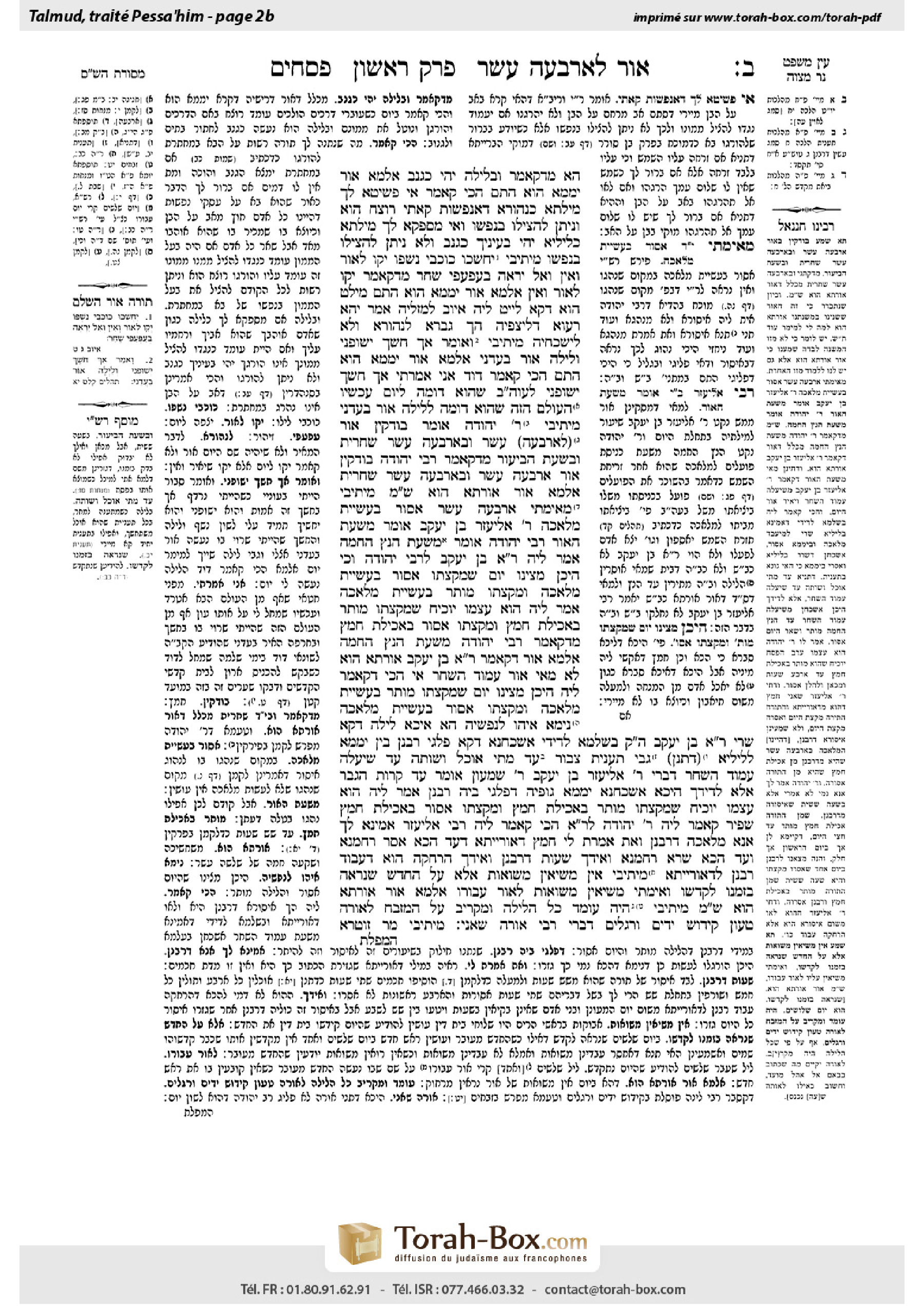
Pesachim 2b: Talmud study for Daf Yomi
Daf Yomi is the daily study of one Talmud folio. Explore 37 tractates with scans, Hebrew text, Sefaria English and AI-generated French translations where annotated.
Passage selection and English or AI-generated French translation are available where the scan has annotations. Daf Study is independent of Torah-Box and Sefaria.
Browse Pesachim · פסחים · All tractatesPesachim 2b text and translations
This page of Pesachim includes the Aramaic text, an English translation and an AI-generated French translation, alongside the scan above.
פסחים ב׳ ב · Aramaic and Hebrew text
הָא מִדְּקָאָמַר ״וּבַלַּיְלָה יְהִי כַגַּנָּב״ — אַלְמָא ״אוֹר״ יְמָמָא הוּא! הָתָם הָכִי קָאָמַר: אִי פְּשִׁיטָא לָךְ מִילְּתָא כִּנְהוֹרָא דְּאַנְּפָשׁוֹת קָאָתֵי — רוֹצֵחַ הוּא, וְנִיתָּן לְהַצִּילוֹ בְּנַפְשׁוֹ. וְאִי מְסַפְּקָא לָךְ מִילְּתָא כְּלֵילְיָא — יְהִי בְּעֵינֶיךָ כְּגַנָּב, וְלֹא נִיתָּן לְהַצִּילוֹ בְּנַפְשׁוֹ.
מֵיתִיבִי: ״יֶחְשְׁכוּ כּוֹכְבֵי נִשְׁפּוֹ יְקַו לְאוֹר וָאַיִן וְאַל יִרְאֶה בְּעַפְעַפֵּי שָׁחַר״, מִדְּקָאָמַר ״יְקַו לְאוֹר וָאַיִן״ אַלְמָא ״אוֹר״ יְמָמָא הוּא! הָתָם מֵילָט הוּא דְּקָא לָיֵיט לֵיהּ אִיּוֹב לְמַזָּלֵיהּ, אָמַר: יְהֵא רַעֲוָא דְּלִיצְפֵּיהּ הָךְ גַּבְרָא לִנְהוֹרָא, וְלָא לַישְׁכְּחֵיהּ.
מֵיתִיבִי: ״וָאוֹמַר אַךְ חֹשֶׁךְ יְשׁוּפֵנִי וְלַיְלָה אוֹר בַּעֲדֵנִי״, אַלְמָא ״אוֹר״ יְמָמָא הוּא! הָתָם, הָכִי קָאָמַר דָּוִד: אֲנִי אָמַרְתִּי אַךְ חֹשֶׁךְ יְשׁוּפֵנִי לָעוֹלָם הַבָּא שֶׁהוּא דּוֹמֶה לְיוֹם, עַכְשָׁיו, הָעוֹלָם הַזֶּה שֶׁהוּא דּוֹמֶה לְלַיְלָה — אוֹר בַּעֲדֵנִי.
מֵיתִיבִי, רַבִּי יְהוּדָה אוֹמֵר: בּוֹדְקִין אוֹר (לְאַרְבָּעָה) עָשָׂר וּבְאַרְבָּעָה עָשָׂר שַׁחֲרִית וּבִשְׁעַת הַבִּיעוּר. מִדְּקָאָמַר רַבִּי יְהוּדָה: בּוֹדְקִין אוֹר אַרְבָּעָה עָשָׂר וּבְאַרְבָּעָה עָשָׂר שַׁחֲרִית, אַלְמָא ״אוֹר״ אוּרְתָּא הוּא. שְׁמַע מִינַּהּ.
מֵיתִיבִי: מֵאֵימָתַי אַרְבָּעָה עָשָׂר אָסוּר בַּעֲשִׂיַּית מְלָאכָה? רַבִּי אֱלִיעֶזֶר בֶּן יַעֲקֹב אוֹמֵר: מִשְּׁעַת הָאוֹר, רַבִּי יְהוּדָה אוֹמֵר: מִשְּׁעַת הָנֵץ הַחַמָּה.
אֲמַר לֵיהּ רַבִּי אֱלִיעֶזֶר בֶּן יַעֲקֹב לְרַבִּי יְהוּדָה: וְכִי הֵיכָן מָצִינוּ יוֹם שֶׁמִּקְצָתוֹ אָסוּר בַּעֲשִׂיַּית מְלָאכָה וּמִקְצָתוֹ מוּתָּר בַּעֲשִׂיַּית מְלָאכָה? אֲמַר לֵיהּ: הוּא עַצְמוֹ יוֹכִיחַ, שֶׁמִּקְצָתוֹ מוּתָּר בַּאֲכִילַת חָמֵץ וּמִקְצָתוֹ אָסוּר בַּאֲכִילַת חָמֵץ.
מִדְּקָאָמַר רַבִּי יְהוּדָה מִשְּׁעַת הָנֵץ הַחַמָּה, אַלְמָא ״אוֹר״ דְּקָאָמַר רַבִּי אֱלִיעֶזֶר בֶּן יַעֲקֹב — אוּרְתָּא הוּא! לָא, מַאי ״אוֹר״ — עַמּוּד הַשַּׁחַר.
אִי הָכִי, דְּקָאָמַר לֵיהּ: הֵיכָן מָצִינוּ יוֹם שֶׁמִּקְצָתוֹ מוּתָּר בַּעֲשִׂיַּית מְלָאכָה וּמִקְצָתוֹ אָסוּר בַּעֲשִׂיַּית מְלָאכָה, נֵימָא אִיהוּ לְנַפְשֵׁיהּ: הָא אִיכָּא לַיְלָה, דְּקָא שָׁרֵי רַבִּי אֱלִיעֶזֶר בֶּן יַעֲקֹב!
הָכִי קָאָמַר: בִּשְׁלָמָא לְדִידִי, אַשְׁכַּחְנָא דְּקָא פָּלְגִי רַבָּנַן בֵּין יְמָמָא לְלֵילְיָא. (דִּתְנַן) גַּבֵּי תַּעֲנִית צִבּוּר: עַד מָתַי אוֹכֵל וְשׁוֹתֶה — עַד שֶׁיַּעֲלֶה עַמּוּד הַשַּׁחַר, דִּבְרֵי רַבִּי אֱלִיעֶזֶר בֶּן יַעֲקֹב. רַבִּי שִׁמְעוֹן אוֹמֵר: עַד קְרוֹת הַגֶּבֶר. אֶלָּא לְדִידָךְ, הֵיכָא אַשְׁכַּחְנָא יְמָמָא גּוּפֵיהּ דְּפָלְגִי בֵּיהּ רַבָּנַן!
אֲמַר לֵיהּ: הוּא עַצְמוֹ יוֹכִיחַ, שֶׁמִּקְצָתוֹ מוּתָּר בַּאֲכִילַת חָמֵץ וּמִקְצָתוֹ אָסוּר בַּאֲכִילַת חָמֵץ. שַׁפִּיר קָאָמַר לֵיהּ רַבִּי יְהוּדָה לְרַבִּי אֱלִיעֶזֶר? הָכִי קָאָמַר לֵיהּ רַבִּי אֱלִיעֶזֶר: אָמֵינָא לָךְ אֲנָא מְלָאכָה דְּרַבָּנַן וְאַתְּ אָמְרַתְּ לִי חָמֵץ דְּאוֹרָיְיתָא?! דְּעַד הָכָא אֲסַר רַחֲמָנָא, וְעַד הָכָא שְׁרָא רַחֲמָנָא.
וְאִידַּךְ? שָׁעוֹת דְּרַבָּנַן.
וְאִידַּךְ? הַרְחָקָה הוּא דַּעֲבוּד רַבָּנַן לִדְאוֹרָיְיתָא.
מֵיתִיבִי: אֵין מַשִּׂיאִין מַשּׂוּאוֹת אֶלָּא עַל הַחֹדֶשׁ שֶׁנִּרְאָה בִּזְמַנּוֹ, לְקַדְּשׁוֹ. וְאֵימָתַי מַשִּׂיאִין מַשּׂוּאוֹת — לְאוֹר עִבּוּרוֹ. אַלְמָא ״אוֹר״ אוּרְתָּא הוּא! שְׁמַע מִינַּהּ.
מֵיתִיבִי: הָיָה עוֹמֵד כׇּל הַלַּיְלָה וּמַקְרִיב עַל הַמִּזְבֵּחַ, לָאוֹרָה טָעוּן קִידּוּשׁ יָדַיִם וְרַגְלַיִם, דִּבְרֵי רַבִּי. ״אוֹרָה״ שָׁאנֵי.
מֵיתִיבִי מָר זוּטְרָא:
Pesachim 2b · English translation
From the fact that the end of the verse states: “And in the night he is as a thief,” apparently the word or at the beginning of the verse is a reference to day, as the verse contrasts between night and or. The Gemara rejects this contention. There, this is what the verse is saying: If the matter is as clear to you as light, that the thief has come into the house prepared to take a life, he is a murderer; and the owner of the house may save himself by taking the life of the intruder. In that case, one may protect himself from a thief who breaks into his house, even by killing the intruder if necessary. And if the matter is as unclear to you as the night, he should be nothing more than a thief in your eyes and not a murderer; and therefore one may not save himself by taking the life of the thief. This verse is not referring to actual day and night; rather, it uses these terms as metaphors for certainty and uncertainty.
The Gemara raises an objection to the opinion that or means evening: “Let the stars of the twilight be dark; let it look for or but have none; neither let it see the eyelids of the morning” (Job 3:9). From the fact that the verse states: “Let it look for or but have none,” apparently or is day. The Gemara rejects this contention. Actually, it is possible that or, in this context, means light in general, not specifically day. There, Job is cursing his fortune. He said: Let it be His will that this man, referring to himself, will seek light and not find it.
The Gemara raises an objection: “And I say, yet the darkness shall envelop me, and the or about me shall be night” (Psalms 139:11). Apparently, or is day. The Gemara rejects this proof. This is what David is saying there: I said after I sinned that darkness shall envelop me in the World-to-Come, which is like day. Now that I know that I have been forgiven, even this world, which is like darkness, is light for me. That being the case, it cannot be derived from here that the word or describes the day.
The Gemara raises an objection from a mishna. Rabbi Yehuda says: One searches on or of the fourteenth of Nisan, on the fourteenth in the morning, and at the time of the removal of leavened bread. The Gemara infers from Rabbi Yehuda’s teaching: From the fact that Rabbi Yehuda says that one searches on or of the fourteenth and on the fourteenth in the morning, apparently or is the evening. In the order of Rabbi Yehuda’s list, or of the fourteenth precedes the morning of the fourteenth. Therefore, or must be referring to the evening. The Gemara concludes: Indeed, learn from it that this is the case.
The Gemara raises an objection from a different source: From when on the fourteenth of Nisan is it prohibited to perform labor, for those who are accustomed not to work on Passover eve? Rabbi Eliezer ben Ya’akov says: From the time of or. Rabbi Yehuda says: From sunrise.
Rabbi Eliezer ben Ya’akov said to Rabbi Yehuda: And where have we found precedent for a day, in part of which the performance of labor is prohibited, and in another part of which the performance of labor is permitted? If, as you claim, the prohibition against performing labor takes effect only from sunrise, whereas the fourteenth of Nisan begins with the emergence of stars the previous evening, it is permitted to perform labor during the first part of the fourteenth, while during the second part of the same day labor is prohibited. He said to him: The fourteenth day itself can prove to be a precedent, as in part of it, from the beginning until the sixth hour of the day, the eating of leavened bread is permitted, and during another part of it the eating of leavened bread is prohibited.
With regard to the matter under discussion, the Gemara infers: From the fact that Rabbi Yehuda says that it is prohibited to perform labor from sunrise, apparently the word or that Rabbi Eliezer ben Ya’akov is saying, is referring to the evening. This is an additional proof that or means night. The Gemara rejects this contention: No, this is not a proof. What is meant by or? It means dawn. The dispute of the tanna’im is not whether the prohibition of labor begins at night or in the morning. Rather, they disagree as to whether labor is prohibited from dawn or only from sunrise.
The Gemara challenges this assumption: If so, consider that which Rabbi Eliezer ben Ya’akov said to Rabbi Yehuda: Where have we found precedent for a day, in part of which the performance of labor is prohibited, and in another part of which the performance of labor is permitted? Let him say to himself: Isn’t there the night, during which even Rabbi Eliezer ben Ya’akov himself permits performance of labor at night? He certainly would not raise a difficulty against the opinion of Rabbi Yehuda, which is equally difficult according to his own opinion.
The Gemara rejects this contention. This is what Rabbi Eliezer ben Ya’akov is saying: Granted, according to my opinion, I find situations in which the Sages distinguished between the day and the preceding night, as we learned in a mishna with regard to a lenient communal fast: Until when may one eat and drink before the fast? It is permitted to eat and drink until dawn; this is the statement of Rabbi Eliezer ben Ya’akov. Rabbi Shimon says: One may eat until the call of the rooster, which precedes dawn. In that case, the Sages distinguished between day and night. However, according to your opinion, where do we find a halakha with regard to which the Sages divided the day itself?
Rabbi Yehuda said to Rabbi Eliezer ben Ya’akov: The day of the fourteenth itself can prove my opinion, as during part of it, the eating of leavened bread is permitted, and during part of it the eating of leavened bread is prohibited. The Gemara comments: Rabbi Yehuda has spoken well to Rabbi Eliezer; how can Rabbi Eliezer ben Ya’akov counter this contention? The Gemara answers that this is what Rabbi Eliezer is saying to him in response: I said to you the prohibition of labor, which is by rabbinic law, and you said to me the prohibition of leavened bread, which is by Torah law. With regard to a Torah prohibition, it is possible that until this point, God prohibited doing so, and until that point, God permitted doing so, as the halakha is determined by a Torah decree. On the other hand, rabbinic prohibitions are enacted within clearly defined categories; in this case, an entire day.
The Gemara asks: And what is the response of the other Sage, Rabbi Yehuda, to this contention? The Gemara answers: Rabbi Yehuda notes that the hours when the prohibition of leaven is in effect on the morning of the fourteenth are determined by rabbinic law. Despite the fact it is prohibited by Torah law to eat leaven from midday, the distinction within the morning hours between the time when one may consume leaven and the time when one may derive benefit from leaven but not consume it is determined by the Sages. Apparently, the Sages institute ordinances that apply to part of a day.
The Gemara asks: And how can the other Sage, Rabbi Eliezer ben Ya’akov, respond to this claim? The Gemara answers: Rabbi Eliezer ben Ya’akov would say that in this case the Sages established a preventive measure for a Torah law, and decrees of this type are at times in effect for only part of the day. By contrast, when the Sages instituted independent ordinances, they invariably did so for the entire day. In any case, this source does not conclusively prove that or means evening.
The Gemara raises an objection: The court messengers kindle torches on the mountaintops as a signal that the court has sanctified and established a new month only for a month that appeared at its proper time, on the thirtieth day of the previous month, to sanctify it on that day. And when do the messengers kindle these torches? They light them on or of its additional day, at the end of the thirtieth day from the beginning of the previous month, leading into the evening of the thirty-first day. The thirtieth day is called the additional day because it is sometimes appended to the previous month, which would otherwise consist of twenty-nine days. Apparently, or is the evening, as the court messengers would certainly not light the bonfires by day. The Gemara concludes: Indeed, learn from it that this is the case.
The Gemara raises an objection: If a priest was standing all night and sacrificing the limbs of offerings on the altar, in the ora he is required to sanctify his hands and feet again, by washing them in water from the basin; this is the statement of Rabbi Yehuda HaNasi. Since a new day has begun, the priest must wash his hands and feet from the basin, a prerequisite for each day’s service. With regard to the issue under discussion, apparently or means day. The Gemara rejects this contention: This is not a conclusive proof, as ora is different, and indeed it is referring to the day. However, the word or may yet refer to the evening.
Mar Zutra raises an objection
Pesachim 2b · Traduction française (IA)
Du fait que la fin du verset dit : « Et la nuit, il est comme un voleur », il semble que le mot or, au début du verset, désigne le jour, puisque le verset oppose la nuit à or. La Guemara rejette cette affirmation. En réalité, le verset dit ceci : si la situation est claire pour toi comme le jour, c’est-à-dire si tu es certain que le voleur est entré dans la maison avec l’intention de tuer, c’est un meurtrier ; le propriétaire de la maison peut alors se sauver en tuant l’intrus. Dans ce cas, on peut se défendre contre un voleur qui s’introduit dans sa maison, quitte à le tuer si nécessaire. Mais si la situation est aussi incertaine pour toi que la nuit, tu dois le considérer comme un simple voleur, et non comme un meurtrier ; par conséquent, tu ne peux pas te sauver en tuant le voleur. Ce verset ne parle pas du jour et de la nuit au sens propre ; il emploie ces termes comme des métaphores de la certitude et de l’incertitude.
La Guemara soulève une objection contre l’opinion selon laquelle or signifie le soir : « Que les étoiles du crépuscule s’obscurcissent ; qu’il cherche or sans le trouver ; qu’il ne voie pas non plus les paupières de l’aurore » (Job 3:9). Du fait que le verset dit : « Qu’il cherche or sans le trouver », il semble que or désigne le jour. La Guemara rejette cette affirmation. En réalité, dans ce contexte, or peut désigner la lumière en général, et non le jour en particulier. Job y maudit son sort. Il dit : Que telle soit la volonté de Dieu : que cet homme, c’est-à-dire moi-même, cherche la lumière et ne la trouve pas.
La Guemara soulève une objection : « Et je dis : que les ténèbres m’enveloppent, et que la lumière autour de moi soit nuit » (Psaumes 139:11). Il semble donc que or désigne le jour. La Guemara rejette cette preuve. David dit ici : après avoir péché, j’ai dit que les ténèbres m’envelopperaient dans le Monde à venir, qui est comme le jour. Maintenant que je sais que j’ai été pardonné, même ce monde-ci, qui est comme les ténèbres, est pour moi lumière. Dès lors, on ne peut pas en déduire que le mot or désigne le jour.
La Guemara soulève une objection à partir d’une Michna. Rabbi Yehouda dit : on recherche le hamets le or du 14 nissan, le matin du 14, puis au moment où l’on élimine le hamets. La Guemara déduit de l’enseignement de Rabbi Yehouda : puisqu’il dit que l’on recherche le hamets le or du 14 et le matin du 14, il semble que or désigne le soir. Dans l’ordre de son énumération, le or du 14 précède le matin du 14. Or doit donc désigner le soir. La Guemara conclut : En effet, apprends-en que c’est bien le cas.
La Guemara soulève une objection à partir d’une autre source : à partir de quel moment, le 14 nissan, est-il interdit de travailler pour ceux qui ont coutume de ne pas travailler la veille de Pessa’h ? Rabbi Eliezer ben Yaakov dit : à partir du or. Rabbi Yehouda dit : à partir du lever du soleil.
Rabbi Eliezer ben Yaakov dit à Rabbi Yehouda : où avons-nous trouvé un précédent pour un jour dont une partie interdit le travail tandis qu’une autre partie le permet ? Si, comme tu le soutiens, l’interdiction de travailler ne prend effet qu’à partir du lever du soleil, alors que le 14 nissan commence avec l’apparition des étoiles la veille au soir, il est permis de travailler pendant la première partie du 14, tandis que le travail est interdit pendant la seconde partie de ce même jour. Il lui dit : Le 14 lui-même peut servir de précédent, car, pendant une partie de ce jour, du début jusqu’à la sixième heure, il est permis de manger du hamets, tandis que, pendant une autre partie, il est interdit d’en manger.
À propos de la question en discussion, la Guemara déduit : puisque Rabbi Yehouda dit qu’il est interdit de travailler à partir du lever du soleil, il semble que le mot or employé par Rabbi Eliezer ben Yaakov désigne le soir. Voilà une preuve supplémentaire que or signifie la nuit. La Guemara rejette cette affirmation : non, ce n’est pas une preuve. Que signifie or ? L’aube. Le désaccord entre les tannaïm ne porte pas sur la question de savoir si l’interdiction de travailler commence la nuit ou le matin. Ils sont plutôt en désaccord sur le point de savoir si le travail est interdit dès l’aube ou seulement au lever du soleil.
La Guemara conteste cette hypothèse : dans ce cas, considérons ce que Rabbi Eliezer ben Yaakov a dit à Rabbi Yehouda : où avons-nous trouvé un précédent pour un jour dont une partie interdit le travail tandis qu’une autre partie le permet ? Il aurait dû se dire : n’y a-t-il pas la nuit, durant laquelle même Rabbi Eliezer ben Yaakov lui-même permet de travailler ? Il n’aurait certainement pas soulevé une difficulté contre l’opinion de Rabbi Yehouda, alors que cette difficulté s’applique tout autant à sa propre opinion.
La Guemara rejette cette affirmation. En réalité, Rabbi Eliezer ben Yaakov dit ceci : certes, selon mon opinion, je trouve des cas où les Sages ont établi une distinction entre le jour et la nuit qui le précède, comme nous l’avons appris dans une Michna à propos d’un jeûne communautaire allégé : jusqu’à quand peut-on manger et boire avant le jeûne ? Il est permis de manger et de boire jusqu’à l’aube ; telle est l’opinion de Rabbi Eliezer ben Yaakov. Rabbi Chimon dit : on peut manger jusqu’au chant du coq, qui précède l’aube. Dans ce cas, les Sages ont établi une distinction entre le jour et la nuit. Mais selon ton opinion, où trouvons-nous une halakha pour laquelle les Sages ont divisé le jour lui-même ?
Rabbi Yehouda dit à Rabbi Eliezer ben Yaakov : le 14 lui-même peut prouver que mon opinion est juste, puisque pendant une partie de ce jour il est permis de manger du hamets, tandis que pendant une autre partie il est interdit d’en manger. La Guemara fait remarquer : Rabbi Yehouda a bien répondu à Rabbi Eliezer ; comment Rabbi Eliezer ben Yaakov peut-il réfuter cette affirmation ? La Guemara répond que Rabbi Eliezer lui dit en retour : je t’ai parlé de l’interdiction de travailler, qui relève de la loi rabbinique, et tu m’as répondu par l’interdiction du hamets, qui relève de la Torah. S’agissant d’une interdiction de la Torah, il est possible que Dieu ait interdit cette pratique jusqu’à un certain moment, puis l’ait permise à partir de ce moment, puisque la halakha est déterminée par un décret de la Torah. En revanche, les interdictions rabbiniques sont instituées dans des catégories clairement définies ; dans ce cas, elles s’appliquent à une journée entière.
La Guemara demande : quelle est la réponse de l’autre Sage, Rabbi Yehouda, à cette affirmation ? La Guemara répond : Rabbi Yehouda fait remarquer que les heures pendant lesquelles l’interdiction du hamets s’applique le matin du 14 sont déterminées par la loi rabbinique. Bien qu’il soit interdit par la Torah de manger du hamets à partir de midi, la distinction, au cours de la matinée, entre le moment où l’on peut consommer du hamets et celui où l’on peut en tirer profit sans le consommer est déterminée par les Sages. Il semble donc que les Sages instituent des ordonnances qui s’appliquent à une partie de la journée seulement.
La Guemara demande : comment l’autre Sage, Rabbi Eliezer ben Yaakov, peut-il répondre à cette affirmation ? La Guemara répond : Rabbi Eliezer ben Yaakov dirait que, dans ce cas, les Sages ont établi une mesure préventive pour une loi de la Torah, et que les décrets de ce type ne s’appliquent parfois qu’à une partie de la journée. En revanche, lorsque les Sages instituent des ordonnances indépendantes, ils le font toujours pour la journée entière. Quoi qu’il en soit, cette source ne prouve pas de manière concluante que or signifie le soir.
La Guemara soulève une objection : les émissaires du tribunal allument des torches au sommet des montagnes pour signaler que le tribunal a sanctifié et fixé le nouveau mois lorsqu’une nouvelle lune est apparue au moment prévu, le trentième jour du mois précédent, afin de sanctifier le mois ce jour-là. Et quand les émissaires allument-ils ces torches ? Ils les allument le or de son jour supplémentaire, à la fin du trentième jour à compter du début du mois précédent, à l’approche du soir du trente et unième jour. Le trentième jour est appelé le jour supplémentaire parce qu’il est parfois ajouté au mois précédent, qui compterait autrement vingt-neuf jours. Il semble donc que or désigne le soir, car les émissaires du tribunal n’allumeraient certainement pas de grands feux en plein jour. La Guemara conclut : En effet, apprends-en que c’est bien le cas.
La Guemara soulève une objection : si un prêtre est resté debout toute la nuit à offrir sur l’autel les membres des offrandes, au orah, il doit sanctifier de nouveau ses mains et ses pieds en les lavant avec l’eau du bassin ; telle est l’opinion de Rabbi Yehouda HaNassi. Puisqu’un nouveau jour a commencé, le prêtre doit se laver les mains et les pieds avec l’eau du bassin, condition préalable au service de chaque jour. Pour ce qui est de la question en discussion, il semble donc que or signifie le jour. La Guemara rejette cette affirmation : ce n’est pas une preuve concluante, car orah est différent et désigne effectivement le jour. Toutefois, le mot or peut encore désigner le soir.
Mar Zoutra soulève une objection.
Traduction française générée par IA à partir de l’édition anglaise de Sefaria. Vérifie toujours un passage avec le texte source.
Text from Sefaria: William Davidson Edition - Vocalized Aramaic (CC BY NC); William Davidson Edition - English (CC BY NC).