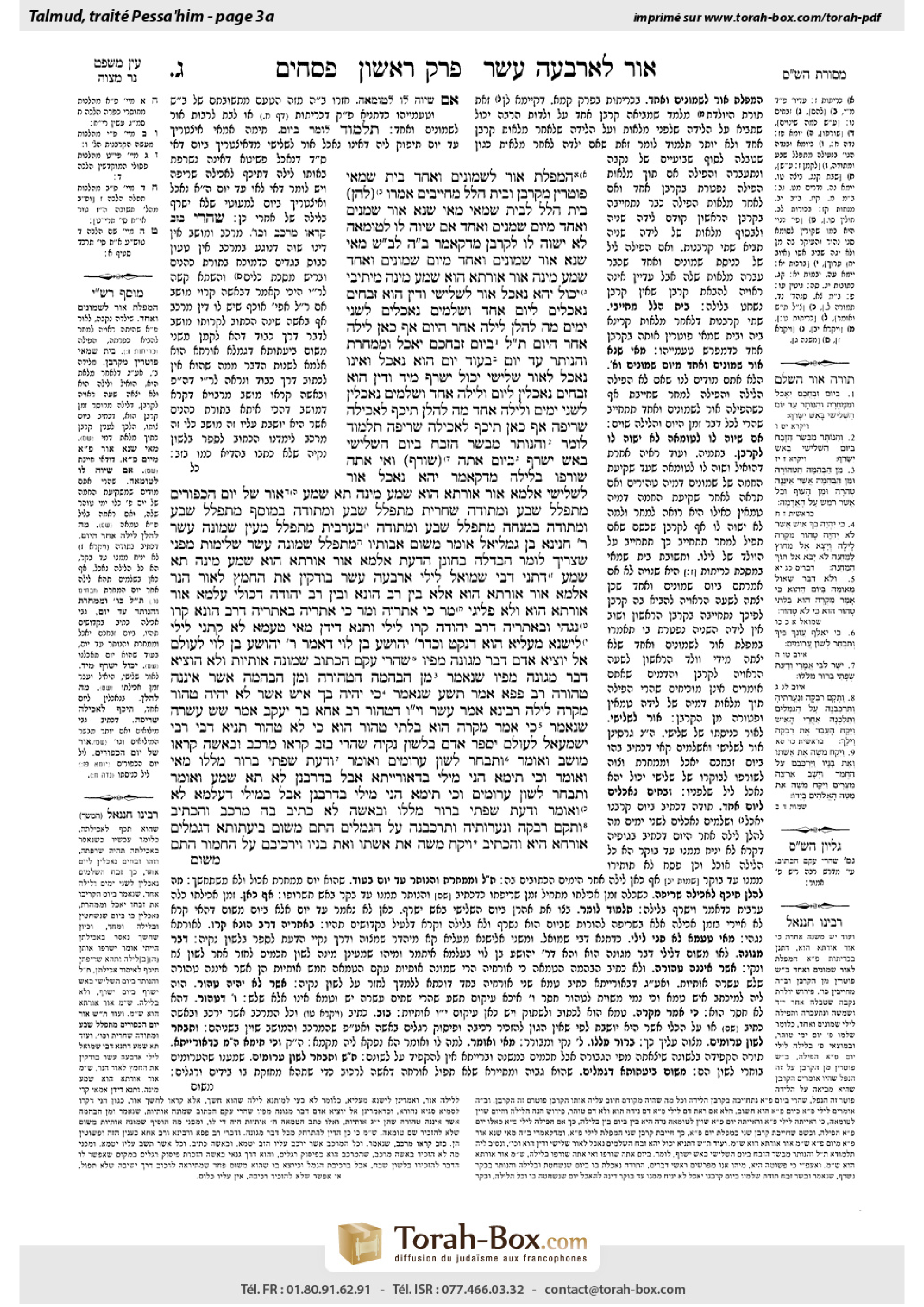
Pesachim 3a: Talmud study for Daf Yomi
Daf Yomi is the daily study of one Talmud folio. Explore 37 tractates with scans, Hebrew text, Sefaria English and AI-generated French translations where annotated.
Passage selection and English or AI-generated French translation are available where the scan has annotations. Daf Study is independent of Torah-Box and Sefaria.
Browse Pesachim · פסחים · All tractatesPesachim 3a text and translations
This page of Pesachim includes the Aramaic text, an English translation and an AI-generated French translation, alongside the scan above.
פסחים ג׳ א · Aramaic and Hebrew text
הַמַּפֶּלֶת אוֹר לִשְׁמוֹנִים וְאֶחָד, בֵּית שַׁמַּאי פּוֹטְרִין מִקׇּרְבָּן, וּבֵית הִלֵּל מְחַיְּיבִים.
אָמְרוּ (לָהֶן) בֵּית הִלֵּל לְבֵית שַׁמַּאי: מַאי שְׁנָא אוֹר שְׁמֹנִים וְאֶחָד מִיּוֹם שְׁמֹנִים וְאֶחָד? אִם שִׁיוָּה לוֹ לְטוּמְאָה — לֹא יִשְׁוֶה לוֹ לְקׇרְבָּן? מִדְּקָאָמַר בֵּית הִלֵּל לְבֵית שַׁמַּאי: מַאי שְׁנָא אוֹר שְׁמוֹנִים וְאֶחָד מִיּוֹם שְׁמוֹנִים וְאֶחָד, שְׁמַע מִינַּהּ ״אוֹר״ אוּרְתָּא הוּא! שְׁמַע מִינַּהּ.
מֵיתִיבִי: יָכוֹל יְהֵא נֶאֱכָל אוֹר לַשְּׁלִישִׁי, וְדִין הוּא: זְבָחִים נֶאֱכָלִים לְיוֹם אֶחָד, וּשְׁלָמִים נֶאֱכָלִים לִשְׁנֵי יָמִים. מָה לְהַלָּן — לַיְלָה אַחַר הַיּוֹם, אַף כָּאן — לַיְלָה אַחַר הַיּוֹם!
תַּלְמוּד לוֹמַר: ״בְּיוֹם זִבְחֲכֶם יֵאָכֵל וּמִמׇּחֳרָת וְהַנּוֹתָר עַד יוֹם״ — בְּעוֹד יוֹם הוּא נֶאֱכָל, וְאֵינוֹ נֶאֱכָל לְאוֹר שְׁלִישִׁי.
יָכוֹל יִשָּׂרֵף מִיָּד, וְדִין הוּא: זְבָחִים נֶאֱכָלִין לְיוֹם וְלַיְלָה אֶחָד, וּשְׁלָמִים נֶאֱכָלִין לִשְׁנֵי יָמִים וְלַיְלָה אֶחָד, מָה לְהַלָּן — תֵּיכֶף לַאֲכִילָה שְׂרֵיפָה, אַף כָּאן — תֵּיכֶף לַאֲכִילָה שְׂרֵיפָה.
תַּלְמוּד לוֹמַר: ״וְהַנּוֹתָר מִבְּשַׂר הַזֶּבַח בַּיּוֹם הַשְּׁלִישִׁי בָּאֵשׁ יִשָּׂרֵף״ — בַּיּוֹם אַתָּה (שׂוֹרֵף), וְאִי אַתָּה שׂוֹרְפוֹ בַּלַּיְלָה. מִדְּקָאָמַר ״יְהֵא נֶאֱכָל אוֹר לַשְּׁלִישִׁי״ — אַלְמָא ״אוֹר״ אוּרְתָּא הוּא! שְׁמַע מִינַּהּ.
תָּא שְׁמַע: אוֹר שֶׁל יוֹם הַכִּפּוּרִים, מִתְפַּלֵּל שֶׁבַע וּמִתְוַדֶּה. שַׁחֲרִית, מִתְפַּלֵּל שֶׁבַע וּמִתְוַדֶּה. בְּמוּסָף, מִתְפַּלֵּל שֶׁבַע וּמִתְוַדֶּה. בְּמִנְחָה, מִתְפַּלֵּל שֶׁבַע וּמִתְוַדֶּה. בְּעַרְבִית, מִתְפַּלֵּל מֵעֵין שְׁמוֹנָה עָשָׂר. רַבִּי חֲנִינָא בֶּן גַּמְלִיאֵל אוֹמֵר מִשּׁוּם אֲבוֹתָיו: מִתְפַּלֵּל שְׁמוֹנָה עָשָׂר שְׁלֵימוֹת, מִפְּנֵי שֶׁצָּרִיךְ לוֹמַר הַבְדָּלָה בְּחוֹנֵן הַדָּעַת. אַלְמָא ״אוֹר״ אוּרְתָּא הוּא! שְׁמַע מִינַּהּ.
תָּא שְׁמַע, דְּתָנֵי דְּבֵי שְׁמוּאֵל: לֵילֵי אַרְבָּעָה עָשָׂר בּוֹדְקִין אֶת הֶחָמֵץ לְאוֹר הַנֵּר. אַלְמָא ״אוֹר״ אוּרְתָּא הוּא.
אֶלָּא: בֵּין רַב הוּנָא וּבֵין רַב יְהוּדָה דְּכוּלֵּי עָלְמָא ״אוֹר״ אוּרְתָּא הוּא, וְלָא פְּלִיגִי, מָר כִּי אַתְרֵיהּ וּמָר כִּי אַתְרֵיהּ. בְּאַתְרֵיהּ דְּרַב הוּנָא קָרוּ ״נַגְהֵי״, וּבְאַתְרֵיהּ דְּרַב יְהוּדָה קָרוּ ״לֵילֵי״.
וְתַנָּא דִּידַן מַאי טַעְמָא לָא קָתָנֵי ״לֵילֵי״? לִישָּׁנָא מְעַלְּיָא הוּא דְּנָקֵט. וְכִדְרַבִּי יְהוֹשֻׁעַ בֶּן לֵוִי. דְּאָמַר רַבִּי יְהוֹשֻׁעַ בֶּן לֵוִי: לְעוֹלָם אַל יוֹצִיא אָדָם דָּבָר מְגוּנֶּה מִפִּיו, שֶׁהֲרֵי עִקֵּם הַכָּתוּב שְׁמוֹנֶה אוֹתִיּוֹת, וְלֹא הוֹצִיא דָּבָר מְגוּנֶּה מִפִּיו. שֶׁנֶּאֱמַר: ״מִן הַבְּהֵמָה הַטְּהוֹרָה וּמִן הַבְּהֵמָה אֲשֶׁר אֵינֶנָּה טְהֹרָה״.
רַב פָּפָּא אָמַר: תֵּשַׁע, שֶׁנֶּאֱמַר: ״כִּי יִהְיֶה בְךָ אִישׁ אֲשֶׁר לֹא יִהְיֶה טָהוֹר מִקְּרֵה לָיְלָה״. רָבִינָא אָמַר: עֶשֶׂר, וָיו דְּ״טָהוֹר״. רַב אַחָא בַּר יַעֲקֹב אָמַר: שֵׁשׁ עֶשְׂרֵה, שֶׁנֶּאֱמַר: ״כִּי אָמַר מִקְרֶה הוּא בִּלְתִּי טָהוֹר הוּא כִּי לֹא טָהוֹר״.
תַּנְיָא דְּבֵי רַבִּי יִשְׁמָעֵאל: לְעוֹלָם יְסַפֵּר אָדָם בְּלָשׁוֹן נְקִיָּה, שֶׁהֲרֵי בַּזָּב קְרָאוֹ ״מֶרְכָּב״, וּבָאִשָּׁה קְרָאוֹ ״מוֹשָׁב״. וְאוֹמֵר: ״וְתִבְחַר לְשׁוֹן עֲרוּמִים״. וְאוֹמֵר: ״וְדַעַת שְׂפָתַי בָּרוּר מִלֵּלוּ״.
מַאי ״וְאוֹמֵר״? וְכִי תֵּימָא: הָנֵי מִילֵּי בִּדְאוֹרָיְיתָא, אֲבָל בִּדְרַבָּנַן לָא — תָּא שְׁמַע: וְאוֹמֵר ״וְתִבְחַר לְשׁוֹן עֲרוּמִים״. וְכִי תֵּימָא: הָנֵי מִילֵּי בִּדְרַבָּנַן, אֲבָל בְּמִילֵּי דְעָלְמָא לָא — וְאוֹמֵר ״וְדַעַת שְׂפָתַי בָּרוּר מִלֵּלוּ״.
וּבְאִשָּׁה לָא כְּתִיב בָּהּ ״מֶרְכָּב״?! וְהָכְתִיב: ״וַתָּקׇם רִבְקָה וְנַעֲרֹתֶיהָ וַתִּרְכַּבְנָה עַל הַגְּמַלִּים״! הָתָם, מִשּׁוּם בִּיעֲתוּתָא דִגְמַלִּים — אוֹרְחָא הִיא. וְהָכְתִיב: ״וַיִּקַּח מֹשֶׁה אֶת אִשְׁתּוֹ וְאֶת בָּנָיו וַיַּרְכִּיבֵם עַל הַחֲמֹר״! הָתָם,
Pesachim 3a · English translation
from a mishna that deals with the offering of a woman who miscarries on or of the eighty-first day after her previous childbirth: The Torah obligates a woman to bring an offering after childbirth, including a miscarriage. However, one offering suffices for any births or miscarriages that occur within eighty days of the original birth, as the halakhic ramifications of that birth last eighty days (see Leviticus 12:1–6). The mishna cited addresses the borderline case of a woman who miscarries on the night of the eighty-first day following the birth. Beit Shammai exempt her from bringing another offering, as the offering she brought for the previous childbirth exempts her from bringing another for the miscarriage. And Beit Hillel obligate her to bring a second offering.
Beit Hillel said to Beit Shammai: What is different between or of the eighty-first and the day of the eighty-first? If they are equal with regard to the halakhot of ritual impurity, i.e., the blood of this woman is no longer ritually pure and all of the standard strictures of ritual impurity apply to her, will the two time periods not be equal with regard to the offering as well? In terms of the meaning of or, from the fact that Beit Hillel said to Beit Shammai: What is different between or of the eighty-first and the day of the eighty-first, learn from it that or is night. Indeed, learn from it that or means night.
The Gemara raises an objection with regard to the meaning of the word or from a baraita: One might have thought that a peace-offering, which may be eaten for two days, may also be eaten on or of the third day. And it is a logical derivation that leads to that conclusion. How so? Other offerings, e.g., sin-offerings, are eaten for one day, and peace-offerings are eaten for two days. Just as there, with regard to other offerings, the night follows the previous day, i.e., the offering may be eaten during the day and the subsequent night, so too here, with regard to peace-offerings, say that the night follows the day, and rule that they may be eaten on the night after the second day.
Therefore, the verse states: “And when you sacrifice a peace-offering to God, you shall sacrifice it of your own will. It shall be eaten the same day you sacrifice it, and on the next day; and if any remains until the third day, it shall be burnt with fire” (Leviticus 19:5–6). This verse means that it may be eaten while it is still day, i.e., during the second day, and it may not be eaten on or of the third day.
The baraita continues: If a peace-offering may not be eaten beyond the second day, one might have thought that it should be burned immediately after the conclusion of the second day, and this too is the conclusion of a logical derivation: Other offerings are eaten for one day and night, and peace-offerings are eaten for two days and one night. Just as there, the offerings are burned immediately after their permitted time for eating concludes, on the morning of the second day, so too here, with regard to peace-offerings, one could say that they must be burned immediately after their permitted time for eating concludes, at night after the second day.
Therefore, the verse states: “And if any remains of the flesh of the sacrifice on the third day, it shall be burnt with fire” (Leviticus 7:17), meaning: You must burn it during the day, and you do not burn it at night. With regard to the meaning of or, from the fact that the baraita states: One might have thought that it may be eaten on or of the third day, apparently or is evening. The Gemara concludes: Indeed, learn from it that or is evening.
Come and hear another proof: On or of Yom Kippur, one recites seven blessings in the Amida prayer and confesses his sins; in the morning prayer, one recites seven blessings and confesses; in the additional prayer, one recites seven blessings and confesses; in the afternoon prayer, one recites seven blessings and confesses; in the evening prayer, one recites an abridged version of the standard Amida prayer of eighteen blessings, as the people are weary from fasting. Rabbi Ḥanina ben Gamliel says in the name of his forefathers: One recites the eighteen complete blessings, due to the fact that he is required to recite havdala in the fourth blessing of the Amida: Who graciously grants knowledge. It cannot be inserted in the abridged version. Apparently, or is evening. The Gemara concludes: Indeed, learn from it that or means evening.
Come and hear another proof, as it was taught in the school of Shmuel: On the evening of the fourteenth of Nisan, one searches for leavened bread by candlelight. Apparently, or is evening, as this baraita replaces or with the word evening.
It is clear from these proofs that the expression or in the mishna means the evening before the day. How, then, could the amora’im dispute whether it is referring to the morning or evening? Rather, the Gemara rejects its previous assumption with regard to the dispute, as everyone, both Rav Huna and Rav Yehuda, agrees that or is evening, and they do not disagree with regard to the halakha. However, this Master stated the halakha in accordance with the expression accepted in his place, and that Master stated the halakha in accordance with the expression accepted in his place. In Rav Huna’s place, they call the evening light, and in Rav Yehuda’s place they call it night, although both terms refer to the same period.
The Gemara asks: And the tanna of our mishna, what is the reason that he didn’t explicitly teach: The night of the fourteenth, as it was taught in the school of Shmuel? The Gemara answers: He employed a euphemism. Since the tanna of our mishna did not want to mention darkness, he preferred the term or to refer to the night of the fourteenth. And this is in accordance with a statement of Rabbi Yehoshua ben Levi. As Rabbi Yehoshua ben Levi said: A person should never express a crude matter, as the formulation of a verse was distorted by the addition of eight letters rather than have it express a crude matter, as it is stated: “From the pure animals and from the animals that are not pure [asher einena tehora]” (Genesis 7:8). To avoid using the Hebrew term for impure [teme’a], which is four letters: Tet, mem, alef, heh, the verse replaced the term with the euphemism meaning “that are not pure,” which is spelled with twelve letters: Alef, shin, reish; alef, yod, nun, nun, heh; tet, heh, reish, heh.
Rav Pappa said: A different verse added nine letters, as it is stated: “If there be among you any man who is not ritually pure [asher lo yihye tahor] by reason of that which happened to him by night” (Deuteronomy 23:11). To avoid using the three-letter Hebrew word for impure, tameh, spelled tet, mem, alef, the verse employs the twelve-letter phrase “who is not ritually pure,” spelled: Alef, shin, reish; lamed, alef; yod, heh, yod, heh; tet, heh, reish. Ravina said: The verse actually adds ten letters because of the letter vav of the word tahor, as the word is spelled in its plene form. Rav Aḥa bar Ya’akov said: Yet another verse adds sixteen letters, as it is stated: “For he said, something has happened to him, he is not ritually pure; surely he is not ritually pure [bilti tahor hu ki lo tahor]” (I Samuel 20:26). To avoid using the three-letter word tameh, the verse employs the nineteen-letter phrase “he is not ritually pure; surely he is not ritually pure,” spelled: Beit, lamed, tav, yod; tet, heh, vav, reish; heh, vav, alef; kaf, yod; lamed, alef; tet, heh, vav, reish.
Likewise, a baraita was taught in the school of Rabbi Yishmael: A person should always converse euphemistically, as one finds in the following verses. The first: “And whichever saddle that the zav rides upon shall be ritually impure” (Leviticus 15:9), which discusses the impurity imparted by a zav to an object on which he sits, calls this action riding. And the verse: “And anyone who touches anything on which she sat” (Leviticus 15:22), which discusses the parallel ritual impurity of a woman, a zava, calls the action sitting. Since riding is slightly demeaning for a woman, as it involves an immodest splaying of the legs, the verse avoids the term riding and opts to convey the more modest image of sitting. And it says in another verse: “And you choose the language of the crafty” (Job 15:5), meaning that one should be clever when speaking and avoid inappropriate phrases. And it says in another verse: “My words shall utter the uprightness of my heart; and that which my lips know they shall speak sincerely” (Job 33:3).
The Gemara asks: What is the need for the proofs from the two additional verses introduced by the phrase: And it says? The baraita already proved its point from the verses with regard to zav and zava. The Gemara answers: The additional verses are necessary, lest you say: This requirement to use clean language applies only in the language written in the Torah, but in rabbinic formulations, no, there is no obligation to use clean language. To counter this argument, the tanna says, come and hear: And it says: “And you choose the language of the crafty,” which indicates that this principle extends beyond the language of the Torah. And lest you say that this requirement applies only to rabbinic language, but when it comes to ordinary speech, no, one need not speak euphemistically, the baraita adds: And it says: “And that which my lips know they shall speak sincerely,” i.e., one must speak euphemistically in every situation.
With regard to the above baraita taught in the school of Rabbi Yishmael, the Gemara asks: And with regard to a woman, is the term riding not written in the Torah? But isn’t it written: “And Rebecca and her damsels arose and they rode upon camels” (Genesis 24:61)? The Gemara answers: There, due to fear of camels, that is standard conduct. Since a camel’s back is high off the ground, a woman cannot sit on it sidesaddle; consequently, she may ride on it without being considered immodest. The Gemara cites another relevant verse. But isn’t it written: “And Moses took his wife and his children and rode them upon his donkey” (Exodus 4:20)? The Gemara answers: There, despite the fact that his wife was also on the donkey, the verse employs the language of riding
Pesachim 3a · Traduction française (IA)
D’après une Michna qui traite du sacrifice d’une femme qui fait une fausse couche le soir ou le jour du quatre-vingt-unième jour suivant son accouchement précédent : la Torah oblige une femme à apporter un sacrifice après un accouchement, y compris après une fausse couche. Toutefois, un seul sacrifice suffit pour toutes les naissances ou fausses couches survenues dans les quatre-vingts jours suivant la naissance initiale, car les conséquences halakhiques de cette naissance durent quatre-vingts jours (voir Lévitique 12:1–6). La Michna citée aborde le cas limite d’une femme qui fait une fausse couche la nuit du quatre-vingt-unième jour suivant son accouchement. Beit Shammaï l’exempte d’apporter un autre sacrifice, car celui qu’elle a apporté pour son accouchement précédent la dispense d’en apporter un autre pour la fausse couche. Beit Hillel l’oblige à apporter un second sacrifice.
Beit Hillel dit à Beit Shammaï : Quelle différence y a-t-il entre le soir du quatre-vingt-unième jour et le jour même du quatre-vingt-unième jour ? Si ces deux périodes sont équivalentes du point de vue des halakhot de l’impureté rituelle, c’est-à-dire que le sang de cette femme n’est plus rituellement pur et que toutes les règles ordinaires de l’impureté rituelle s’appliquent à elle, ne devraient-elles pas également être équivalentes en ce qui concerne le sacrifice ? Quant au sens du terme or, puisque Beit Hillel dit à Beit Shammaï : « Quelle différence y a-t-il entre le soir du quatre-vingt-unième jour et le jour même du quatre-vingt-unième jour ? », apprends-en que or signifie « nuit ». En effet, apprends-en que or signifie « nuit ».
La Guemara soulève une objection concernant le sens du mot or, à partir d’une baraïta : On aurait pu penser qu’un sacrifice de paix, qui peut être consommé pendant deux jours, peut aussi l’être le soir du troisième jour. Cette conclusion découle d’un raisonnement logique. Comment cela ? D’autres sacrifices, par exemple les sacrifices expiatoires, sont consommés pendant un jour, tandis que les sacrifices de paix le sont pendant deux jours. De même que, pour les autres sacrifices, la nuit suit le jour précédent, c’est-à-dire que le sacrifice peut être consommé pendant la journée puis durant la nuit qui suit, de même, pour les sacrifices de paix, pourrait-on dire que la nuit suit le jour et statuer qu’ils peuvent être consommés la nuit suivant le deuxième jour.
C’est pourquoi le verset énonce : « Lorsque vous offrirez à l’Éternel un sacrifice de paix, vous l’offrirez de votre plein gré. Il sera consommé le jour où vous l’offrirez, ainsi que le lendemain ; et s’il en reste jusqu’au troisième jour, il sera brûlé par le feu » (Lévitique 19:5–6). Ce verset signifie qu’il peut être consommé tant qu’il fait encore jour, c’est-à-dire pendant le deuxième jour, mais qu’il ne peut pas être consommé le soir du troisième jour.
La baraïta poursuit : Si un sacrifice de paix ne peut pas être consommé au-delà du deuxième jour, on aurait pu penser qu’il doit être brûlé immédiatement après la fin du deuxième jour ; cette conclusion découle elle aussi d’un raisonnement logique : les autres sacrifices sont consommés pendant un jour et une nuit, tandis que les sacrifices de paix le sont pendant deux jours et une nuit. De même que, dans le cas des autres sacrifices, ils sont brûlés immédiatement après la fin de la période où leur consommation est permise, le matin du deuxième jour, de même, pour les sacrifices de paix, pourrait-on dire qu’ils doivent être brûlés immédiatement après la fin de la période où leur consommation est permise, la nuit suivant le deuxième jour.
C’est pourquoi le verset énonce : « Et s’il reste de la chair du sacrifice au troisième jour, elle sera brûlée par le feu » (Lévitique 7:17), ce qui signifie : il faut la brûler pendant la journée, et on ne la brûle pas la nuit. Quant au sens du terme or, puisque la baraïta dit : « On aurait pu penser qu’il peut être consommé le soir du troisième jour », il semble que or signifie « soir ». La Guemara conclut : En effet, apprends-en que or signifie « soir ».
Viens et écoute une autre preuve : le soir de Yom Kippour, on récite sept bénédictions dans la prière de la Amida et on confesse ses péchés ; à la prière du matin, on récite sept bénédictions et on confesse ses péchés ; à la prière supplémentaire, on récite sept bénédictions et on confesse ses péchés ; à la prière de l’après-midi, on récite sept bénédictions et on confesse ses péchés ; à la prière du soir, on récite une version abrégée de la Amida habituelle de dix-huit bénédictions, car les gens sont épuisés par le jeûne. Rabbi Ḥanina ben Gamliel dit au nom de ses ancêtres : On récite les dix-huit bénédictions complètes, car on est tenu de réciter la havdala dans la quatrième bénédiction de la Amida, « Celui qui accorde généreusement la connaissance ». Elle ne peut pas être insérée dans la version abrégée. Il semble donc que or signifie « soir ». La Guemara conclut : En effet, apprends-en que or signifie « soir ».
Viens et écoute une autre preuve : il a été enseigné dans l’école de Shmuel que, le soir du quatorze Nissan, on recherche le hamets à la lumière d’une bougie. Il semble donc que or signifie « soir », puisque cette baraïta remplace or par le mot « soir ».
Ces preuves montrent clairement que, dans la Michna, le terme or désigne le soir précédant le jour. Comment les amoraïm pourraient-ils donc diverger sur la question de savoir s’il désigne le matin ou le soir ? La Guemara rejette alors l’hypothèse qu’elle avait avancée au sujet de leur désaccord : tous, Rav Houna comme Rav Yehouda, s’accordent à dire que or signifie « soir », et ils ne divergent pas sur la halakha. Cependant, l’un a formulé la halakha selon l’expression en usage dans sa région, et l’autre selon celle en usage dans la sienne. Dans la région de Rav Houna, on appelle le soir « lumière », et dans celle de Rav Yehouda, on l’appelle « nuit », bien que les deux termes désignent la même période.
La Guemara demande : Pourquoi le tanna de notre Michna n’a-t-il pas enseigné explicitement : « La nuit du quatorze », comme cela a été enseigné dans l’école de Shmuel ? La Guemara répond : Il a employé un euphémisme. Puisque le tanna de notre Michna ne voulait pas mentionner l’obscurité, il a préféré employer le terme or pour désigner la nuit du quatorze. Cela est conforme à une déclaration de Rabbi Yehoshoua ben Lévi. En effet, Rabbi Yehoshoua ben Lévi a dit : Qu’une personne ne profère jamais une parole grossière, car un verset a été allongé de huit lettres pour éviter d’exprimer une idée grossière, comme il est dit : « Des animaux purs et des animaux qui ne sont pas purs [asher einena tehora] » (Genèse 7:8). Pour éviter d’employer le terme hébreu désignant l’impureté [teme’a], qui compte quatre lettres : tet, mem, alef, hé, le verset le remplace par l’euphémisme signifiant « qui ne sont pas purs », qui s’écrit avec douze lettres : alef, shin, rech ; alef, youd, noun, noun, hé ; tet, hé, rech, hé.
Rav Pappa a dit : Un autre verset ajoute neuf lettres, comme il est dit : « S’il y a parmi vous un homme qui n’est pas rituellement pur [asher lo yihye tahor] à cause de ce qui lui est arrivé pendant la nuit » (Deutéronome 23:11). Pour éviter d’employer le mot hébreu de trois lettres désignant l’impureté, tameh, écrit tet, mem, alef, le verset utilise l’expression de douze lettres « qui n’est pas rituellement pur », écrite : alef, shin, rech ; lamed, alef ; youd, hé, youd, hé ; tet, hé, rech. Ravina a dit : En réalité, le verset ajoute dix lettres à cause du vav du mot tahor, car ce mot est écrit dans sa forme pleine. Rav Aḥa bar Ya’akov a dit : Un autre verset ajoute encore seize lettres, comme il est dit : « Car il s’est dit : quelque chose lui est arrivé, il n’est pas rituellement pur ; assurément, il n’est pas rituellement pur [bilti tahor hu ki lo tahor] » (I Samuel 20:26). Pour éviter d’employer le mot de trois lettres tameh, le verset utilise l’expression de dix-neuf lettres « il n’est pas rituellement pur ; assurément, il n’est pas rituellement pur », écrite : beit, lamed, tav, youd ; tet, hé, vav, rech ; hé, vav, alef ; kaf, youd ; lamed, alef ; tet, hé, vav, rech.
De même, une baraïta a été enseignée dans l’école de Rabbi Yishmaël : Une personne doit toujours s’exprimer par euphémismes, comme on le voit dans les versets suivants. Le premier : « Et toute selle sur laquelle le zav chevauche sera impure » (Lévitique 15:9), verset qui traite de l’impureté transmise par un zav à un objet sur lequel il s’assied et décrit cette action comme le fait de chevaucher. En revanche, le verset : « Et quiconque touchera quoi que ce soit sur lequel elle s’est assise » (Lévitique 15:22), qui traite de l’impureté rituelle analogue d’une femme, une zava, décrit l’action comme le fait de s’asseoir. Comme chevaucher est quelque peu dépréciatif pour une femme, puisque cela implique d’écarter les jambes de manière impudique, le verset évite ce terme et choisit de présenter l’image plus pudique d’une femme assise. Un autre verset dit : « Et tu choisis le langage des habiles » (Job 15:5), ce qui signifie qu’il faut parler avec finesse et éviter les expressions déplacées. Un autre verset dit : « Les paroles de ma bouche exprimeront la droiture de mon cœur, et ce que mes lèvres savent, elles le diront sincèrement » (Job 33:3).
La Guemara demande : À quoi servent les preuves tirées des deux versets supplémentaires introduits par la formule « Et il est dit » ? La baraïta a déjà établi son point au moyen des versets concernant le zav et la zava. La Guemara répond : Ces versets supplémentaires sont nécessaires, de peur que tu ne dises : cette obligation d’employer un langage châtié ne s’applique que dans la langue de la Torah écrite, mais pas dans les formulations rabbiniques. Pour réfuter cet argument, le tanna dit : Viens et écoute : « Et il est dit : “Et tu choisis le langage des habiles” », ce qui indique que ce principe s’étend au-delà de la langue de la Torah. Et de peur que tu ne dises que cette obligation ne s’applique qu’au langage rabbinique, mais que, dans la conversation ordinaire, il ne soit pas nécessaire de parler par euphémismes, la baraïta ajoute : « Et il est dit : “Ce que mes lèvres savent, elles le diront sincèrement” », c’est-à-dire qu’on doit s’exprimer par euphémismes en toute situation.
À propos de la baraïta mentionnée plus haut et enseignée dans l’école de Rabbi Yishmaël, la Guemara demande : Et, au sujet d’une femme, le terme « chevaucher » n’est-il pas écrit dans la Torah ? N’est-il pas écrit : « Rébecca et ses servantes se levèrent et montèrent sur des chameaux » (Genèse 24:61) ? La Guemara répond : Dans ce cas, par crainte des chameaux, c’est la conduite habituelle. Comme le dos d’un chameau est élevé par rapport au sol, une femme ne peut pas s’y asseoir en amazone ; par conséquent, elle peut le chevaucher sans que cela soit considéré comme impudique. La Guemara cite un autre verset pertinent. Mais n’est-il pas écrit : « Moïse prit sa femme et ses enfants et les fit monter sur son âne » (Exode 4:20) ? La Guemara répond : Dans ce cas, bien que sa femme soit également sur l’âne, le verset emploie le langage du chevauchement.
Traduction française générée par IA à partir de l’édition anglaise de Sefaria. Vérifie toujours un passage avec le texte source.
Text from Sefaria: William Davidson Edition - Vocalized Aramaic (CC BY NC); William Davidson Edition - English (CC BY NC).