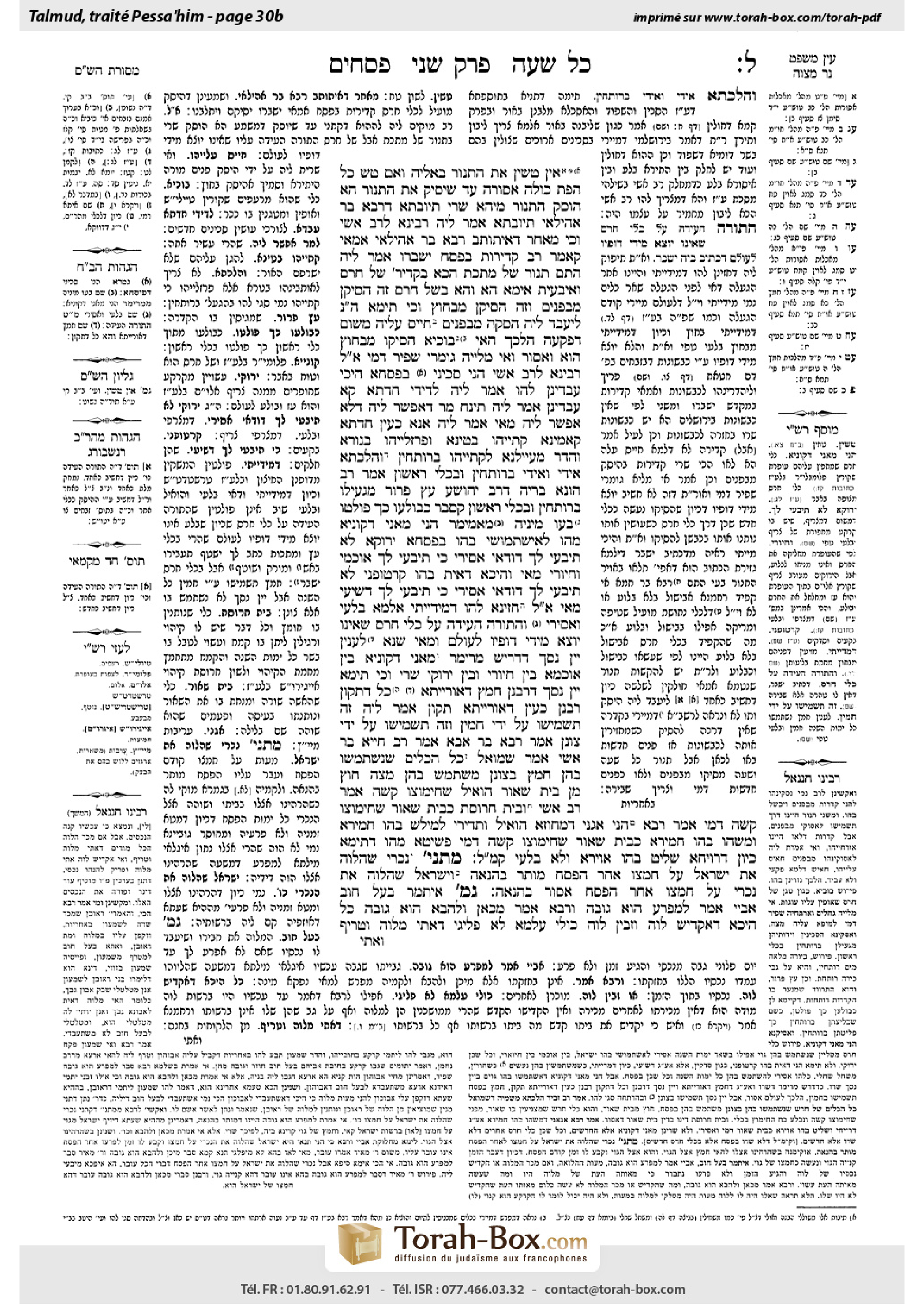
Pesachim 30b: Talmud study for Daf Yomi
Daf Yomi is the daily study of one Talmud folio. Explore 37 tractates with scans, Hebrew text, Sefaria English and AI-generated French translations where annotated.
Passage selection and English or AI-generated French translation are available where the scan has annotations. Daf Study is independent of Torah-Box and Sefaria.
Browse Pesachim · פסחים · All tractatesPesachim 30b text and translations
This page of Pesachim includes the Aramaic text, an English translation and an AI-generated French translation, alongside the scan above.
פסחים ל׳ ב · Aramaic and Hebrew text
אֵין טָשִׁין אֶת הַתַּנּוּר בְּאַלְיָה. וְאִם טָשׁ — כׇּל הַפַּת כּוּלָּהּ אֲסוּרָה, עַד שֶׁיַּסִּיק אֶת הַתַּנּוּר. הָא הוּסַּק הַתַּנּוּר — מִיהָא שְׁרֵי. תְּיוּבְתָּא דְּרָבָא בַּר אֲהִילַאי, תְּיוּבְתָּא.
אֲמַר לֵיהּ רָבִינָא לְרַב אָשֵׁי: וְכִי מֵאַחַר דְּאִיתּוֹתַב רָבָא בַּר אֲהִילַאי, אַמַּאי קָאָמַר רַב: קְדֵירוֹת בַּפֶּסַח יִשָּׁבְרוּ? אֲמַר לֵיהּ: הָתָם תַּנּוּר שֶׁל מַתֶּכֶת, הָכָא בִּקְדֵירָה שֶׁל חֶרֶס.
וְאִיבָּעֵית אֵימָא הָא וְהָא בְּשֶׁל חֶרֶס. זֶה — הֶסֵּיקָן מִבִּפְנִים, וְזֶה — הֶסֵּיקָן מִבַּחוּץ. וְכִי תֵּימָא: הָכִי נָמֵי לֶיעְבַּד לֵיהּ הַסָּקָה מִבִּפְנִים — חָיֵיס עֲלֵיהּ מִשּׁוּם דְּפָקְעָה.
הִלְכָּךְ הַאי בּוּכְיָא הֶסֵּיקוֹ מִבַּחוּץ הוּא — וְאָסוּר, וְאִי מַלְּיֵיהּ גּוּמְרֵי — שַׁפִּיר דָּמֵי.
אֲמַר לֵיהּ רָבִינָא לְרַב אָשֵׁי: הָנֵי סַכִּינֵי בְּפִסְחָא הֵיכִי עָבְדִינַן לְהוּ? אֲמַר לֵיהּ: לְדִידִי חַדְתָּא קָא עָבְדִינַן. אֲמַר לֵיהּ: תִּינַח מָר דְּאֶפְשָׁר לֵיהּ, דְּלָא אֶפְשָׁר לֵיהּ מַאי? אֲמַר לֵיהּ: אֲנָא, כְּעֵין חַדְתָּא קָאָמֵינָא: קַתַּיְיהוּ בְּטִינָא, וּפַרְזְלַיְיהוּ בְּנוּרָא, וַהֲדַר מְעַיֵּילְנָא לְקַתַּיְיהוּ בְּרוֹתְחִין. וְהִלְכְתָא: אִידֵּי וְאִידֵּי בְּרוֹתְחִין וּבִכְלִי רִאשׁוֹן.
אָמַר רַב הוּנָא בְּרֵיהּ דְּרַב יְהוֹשֻׁעַ: עֵץ פָּרוּר מַגְעִילוֹ בְּרוֹתְחִין וּבִכְלִי רִאשׁוֹן. קָסָבַר: כְּבוֹלְעוֹ כָּךְ פּוֹלְטוֹ.
בְּעוֹ מִינֵּיהּ מֵאַמֵּימָר: הָנֵי מָאנֵי דְקוּנְיָא, מַהוּ לְאִישְׁתַּמּוֹשֵׁי בְּהוּ בְּפִסְחָא? יְרוּקָּא לָא תִּיבְּעֵי לָךְ — דְּוַדַּאי אֲסִירִי. כִּי תִּיבְּעֵי לָךְ אוּכָּמֵי וְחִיוָּרֵי, מַאי? וְהֵיכָא דְּאִית בְּהוּ קַרְטוּפָנֵי, לָא תִּיבְּעֵי לָךְ, דְּוַדַּאי אֲסִירִי. כִּי תִּיבְּעֵי לָךְ דְּשִׁיעִי, מַאי?
אֲמַר לֵיהּ: חֲזֵינָא לְהוּ דְּמִידַיְּיתֵי, אַלְמָא בָּלְעִי, וַאֲסִירִי. וְהַתּוֹרָה הֵעִידָה עַל כְּלִי חֶרֶס שֶׁאֵינוֹ יוֹצֵא מִידֵי דּוֹפְיוֹ לְעוֹלָם.
וּמַאי שְׁנָא לְעִנְיַן יֵין נֶסֶךְ, דְּדָרֵישׁ מָרִימָר: מָאנֵי דְקוּנְיָא, בֵּין אוּכָּמֵא בֵּין חִיוָּרֵי וּבֵין יְרוּקֵּי — שְׁרֵי? וְכִי תֵּימָא: יֵין נֶסֶךְ — דְּרַבָּנַן, חָמֵץ — דְּאוֹרָיְיתָא, כׇּל דְּתַקּוּן רַבָּנַן — כְּעֵין דְּאוֹרָיְיתָא תַּקּוּן. אֲמַר לֵיהּ: זֶה תַּשְׁמִישׁוֹ עַל יְדֵי חַמִּין, וְזֶה תַּשְׁמִישׁוֹ עַל יְדֵי צוֹנֵן.
אָמַר רָבָא בַּר אַבָּא אָמַר רַב חִיָּיא בַּר אָשֵׁי אָמַר שְׁמוּאֵל: כׇּל הַכֵּלִים שֶׁנִּשְׁתַּמְּשׁוּ בָּהֶן חָמֵץ בְּצוֹנֵן — מִשְׁתַּמֵּשׁ בָּהֶן מַצָּה, חוּץ מִן בֵּית שְׂאוֹר, הוֹאִיל שֶׁחִימּוּצוֹ קָשֶׁה. אָמַר רַב אָשֵׁי: וּבֵית חֲרוֹסֶת — כְּבֵית שְׂאוֹר שֶׁחִימּוּצוֹ קָשֶׁה דָּמֵי.
אָמַר רָבָא: הָנֵי אַגָּנֵי דְמָחוֹזָא, הוֹאִיל וּתְדִירִי לְמֵילַשׁ בְּהוּ חֲמִירָא, וּמְשַׁהוּ בְּהוּ חֲמִירָא — כְּבֵית שְׂאוֹר שֶׁחִימּוּצוֹ קָשֶׁה דָּמֵי. פְּשִׁיטָא? מַהוּ דְּתֵימָא: כֵּיוָן דִּרְוִיחָא, שָׁלֵיט בְּהוּ אַוֵּירָא וְלָא בָּלְעִי, קָא מַשְׁמַע לַן.
מַתְנִי׳ גּוֹי שֶׁהִלְוָה אֶת יִשְׂרָאֵל עַל חֲמֵצוֹ, אַחַר הַפֶּסַח — מוּתָּר בַּהֲנָאָה. וְיִשְׂרָאֵל שֶׁהִלְוָה אֶת גּוֹי עַל חֲמֵצוֹ, אַחַר הַפֶּסַח — אָסוּר בַּהֲנָאָה.
גְּמָ׳ אִיתְּמַר: בַּעַל חוֹב, אַבָּיֵי אָמַר: לְמַפְרֵעַ הוּא גּוֹבֶה. וְרָבָא אָמַר: מִכָּאן וּלְהַבָּא הוּא גּוֹבֶה. כׇּל הֵיכָא דְּאַקְדֵּישׁ לֹוֶה וְזַבֵּין לֹוֶה — כּוּלֵּי עָלְמָא לָא פְּלִיגִי דְּאָתֵי מַלְוֶה וְטָרֵיף,
Pesachim 30b · English translation
one may not smear the inside of an oven with the fat tail [alya] of a sheep, because it is meat. And if one did smear it over the oven, then all of the bread baked in it is prohibited, lest one accidentally eat this bread with milk. However, this applies only until one kindles the oven and burns off this fat. The Gemara infers from this baraita that if the oven was kindled afterward then it is permitted in any case. This would seem to present a conclusive refutation of the statement of Rava bar Ahilai who maintains that the bread cooked in this oven is prohibited forever, even after the oven is rekindled. The Gemara concludes: Indeed, this is a conclusive refutation of his opinion.
Ravina said to Rav Ashi: Since the statement of Rava bar Ahilai was refuted, why did Rav say that pots that were used for leavened bread on Passover should be broken? Presumably, their status could be remedied in the same way as was that of this oven, by heating them on a fire until the flavor of the leavened bread absorbed in them was removed. Rav Ashi said to him: There is a distinction between these two cases. There, it is referring to a metal oven, which can be cleansed through an additional kindling, while here, it is referring to an earthenware pot, where additional kindling is insufficient, as the earthenware has the capacity to absorb more of the flavor of the leavened bread and it cannot be purged by fire.
If you wish, say instead that both this, the oven, and that, the pot, are earthenware, but that the following distinction applies. This, the oven, is kindled from the inside, and as the fire is kindled inside the oven itself, it consumes the absorbed flavor of the leavened bread. While that, the pot, is kindled from the outside, such that the flavor of the prohibited material absorbed in the pot is not purged by the fire. And if you say, so too here, in the case of the pot, he should perform the kindling procedure on the pots from the inside to remove that which has been absorbed, this is not reasonable. Presumably, the owner of the pot will be concerned lest it burst if he makes the pot too hot. Therefore, he will not use sufficient heat to ensure that the leavened bread that has been absorbed will be completely purged.
The Gemara concludes: Therefore, based on this principle, this griddle made from earthenware tiles that was used to bake bread is a type of oven where the kindling is from the outside and therefore prohibited. But if he fills it with burning coals, then it seems well and it can be used afterward. Because this vessel is often subject to a high level of heat, the owner will not be concerned that it will break when heated.
Ravina said to Rav Ashi: With regard to these knives, how do we prepare them for use during Passover? Rav Ashi said to him: For me, personally, we craft new ones. Ravina said to him: It works out well for Master, as you are able to afford new knives. However, what should one who is unable to purchase new knives do? He said to him: I was speaking of making them like new by thoroughly cleaning them in the following manner: One should cover the wooden handles in mud, so that they will not be burned, and heat the metal with fire until it is white-hot. And then I place the handles of the knives in boiling water in order to remove anything that had been absorbed into the wood. And the halakha is that with regard to both this, the blade, and that, the handle, it is sufficient to immerse them in boiling water, so long as this water is still in a primary vessel. The water must still be in the original pot in which it was boiled and not poured from another pot.
Rav Huna, son of Rav Yehoshua, said: A wooden ladle should be purged in boiling water in a primary vessel in order to remove the flavor of the forbidden food that it absorbed. The Gemara states: He holds in accordance with the principle: As it absorbs the flavor of the forbidden substance, so it emits it. The same cooking method and level of heat that caused the flavor of the forbidden substance to be absorbed in the vessel suffices to discharge the flavor of that substance from the vessel. Therefore, a ladle that absorbed flavor of leavened bread from a pot of boiling water which was over a fire will discharge the flavor of leavened bread once it is placed in the boiling water again.
They raised a dilemma before Ameimar: Concerning certain glazed [konya] earthenware vessels, what is the halakha with regard to using them during Passover? The Gemara explains: With regard to green vessels, the dilemma need not even be raised, as they are certainly prohibited as their coating does not prevent them from absorbing the flavor of leavened bread. Let the dilemma be raised with regard to black and white vessels: What is the halakha here? And furthermore, the dilemma need not be raised when they have cracks; as the leavened bread will remain stuck in these cracks, they are certainly prohibited. Let the dilemma be raised with regard to smooth vessels: What is the halakha in that case?
Ameimar said to him: I saw that some of the liquid is expelled [demidayeti]? from the outside of the vessel. Apparently they absorb and are therefore prohibited, as they cannot be prepared for use on Passover through cleansing, and the Torah testified about earthenware vessels that when they absorb the flavor of a prohibited substance, they will never leave their defective status and they remain permanently prohibited. The Torah states that a person may cleanse other vessels by scouring and rinsing them, whereas it states that earthenware vessels must be broken.
The Gemara asks: What is different about wine used for a libation, with regard to which the halakha of earthenware vessels is more lenient? As Mareimar taught: A glazed earthenware vessel is permitted whether it is black, white, or green if it was used to store wine belonging to gentiles. Any wine that came in contact with gentiles is suspected of having been poured as a libation offering to idolatry. And if you say that it is possible to distinguish between the prohibition of wine used for a libation, which is a rabbinic prohibition, and that of leavened bread, which is forbidden by Torah law, this is difficult, as all ordinances that the Sages instituted, they instituted similar to Torah law. Once they have declared that this item is prohibited, the principles applicable to Torah prohibitions apply to it as well. Ameimar said to him: The distinction between the two cases is that with regard to this vessel, which is used for cooking during Passover, its primary use is with hot foods, and therefore the flavor of the leavened bread has become absorbed within its walls. But with regard to this vessel, which is used to store wine, its primary use is with cool liquids, which are not absorbed to the same degree.
The Gemara continues discussing the ways that a vessel must be cleansed so that it can be used during Passover. Rava bar Abba said that Rav Ḥiyya bar Ashi said that Shmuel said: Any vessel that was used for leavened bread only while cool can be used for matza, because no flavor of the leavened bread was absorbed by the vessel. The exception to this rule is the leaven container where the yeast was stored, since its leavening is more potent, and it can be assumed that the flavor from the yeast has entered the walls of the vessel even without heat. Rav Ashi said: And the spice container, in which potent spices that contained flour were stored, has the same status as the leaven container whose leavening is potent.
Rava said: With regard to certain bowls of Meḥoza, since it is common to knead leavened bread in them and then store the leavened bread in them, they are considered to be like a leaven container whose leavening is potent. The Gemara asks: Why did Rava find it necessary to make this statement? Isn’t it obvious that these bowls are the same as a leaven container? The Gemara answers: Lest you say that since these bowls are spacious, the air dominates them and they do not absorb the leavened bread in the same way as does a leaven container, therefore, he teaches us that no such distinction applies.
MISHNA: If a gentile lent money to a Jew, and the Jew gave him leavened bread as collateral until after Passover, and after Passover the gentile retains this leavened bread in lieu of payment, then one is permitted to derive benefit from this leavened bread. Since the leavened bread was retained by the gentile based on the transfer that took place prior to Passover, the leavened bread is considered to have belonged to the gentile during Passover. Whereas if a Jew lent money to a gentile, and leavened bread was given as collateral during Passover in the same manner as in the previous case, then after Passover it is forbidden to derive benefit from this leavened bread. Since this leavened bread was considered to be in the Jew’s property during Passover, it is forbidden to derive benefit from it afterward.
GEMARA: It was stated that the amora’im disagree about the rights of a creditor with regard to collateral. Abaye said: He retroactively collects the property. In a case where the creditor had a lien on the property of the debtor and the debtor defaults on the loan, it is considered as if the creditor acquired rights to the collateral at the time of the loan and not at the time of collection. And Rava said: This is not the case, but rather, he acquires the collateral from that point forward, and has rights to the collateral only from the time that the loan was due. This dispute has ramifications for the status of the property, and actions undertaken with regard to it, during the intervening period. The Gemara sets several limitations on the scope of this dispute: Anywhere that the debtor consecrated or sold the field that was serving as collateral, everyone agrees that the creditor can come and seize this property and override the sale, because its status as collateral preceded its sale.
Pesachim 30b · Traduction française (IA)
On ne peut pas enduire l’intérieur d’un four avec la graisse de la queue [alya] d’un mouton, car il s’agit de viande. Si quelqu’un en a enduit le four, tout le pain qui y a été cuit est interdit, de crainte qu’on ne mange par inadvertance ce pain avec du lait. Cela ne s’applique toutefois que jusqu’à ce qu’on allume le four et qu’on brûle cette graisse. La Guemara déduit de cette baraïta que, si le four est ensuite allumé, le pain est permis en tout état de cause. Cela semble réfuter de manière concluante l’avis de Rava bar Ahilai, selon lequel le pain cuit dans ce four reste interdit à jamais, même après que le four a été rallumé. La Guemara conclut : en effet, cela réfute de manière concluante son avis.
Ravina dit à Rav Ashi : Puisque l’avis de Rava bar Ahilai a été réfuté, pourquoi Rav a-t-il dit que les marmites qui ont servi à cuire du pain levé pendant Pessa’h doivent être brisées ? Leur statut pourrait, semble-t-il, être rectifié de la même manière que celui de ce four, en les chauffant au feu jusqu’à ce que le goût du pain levé qu’elles ont absorbé disparaisse. Rav Ashi lui dit : Il y a une différence entre les deux cas. Là, il s’agit d’un four en métal, qui peut être purgé par un nouvel allumage ; ici, il s’agit d’une marmite en terre cuite, pour laquelle un nouvel allumage ne suffit pas, car la terre cuite peut absorber davantage le goût du pain levé et le feu ne peut pas l’en purger.
Si tu veux, dis plutôt que les deux récipients, le four comme la marmite, sont en terre cuite, mais qu’il faut distinguer les cas suivants : dans le cas du four, le feu est allumé à l’intérieur et, comme il brûle à l’intérieur même du four, il consume le goût absorbé du pain levé. En revanche, dans le cas de la marmite, le feu est appliqué à l’extérieur, si bien que le goût de la substance interdite absorbé par la marmite n’est pas purgé par le feu. Et si tu dis que, dans le cas de la marmite aussi, il devrait effectuer la procédure de chauffage à l’intérieur afin d’en extraire ce qui a été absorbé, ce n’est pas raisonnable. Le propriétaire de la marmite craindrait vraisemblablement qu’elle n’éclate s’il la chauffe trop. Il n’utiliserait donc pas une chaleur suffisante pour purger complètement le pain levé qui a été absorbé.
La Guemara conclut : par conséquent, selon ce principe, cette plaque de cuisson faite de tuiles en terre cuite, qui a servi à cuire du pain, est du type de four chauffé de l’extérieur et est donc interdite. Mais s’il la remplit de braises ardentes, elle pourra être utilisée ensuite. Comme ce récipient est souvent exposé à une forte chaleur, son propriétaire ne craindra pas qu’il se brise lorsqu’il sera chauffé.
Ravina dit à Rav Ashi : Que faut-il faire de ces couteaux pour pouvoir les utiliser pendant Pessa’h ? Rav Ashi lui dit : Pour moi, personnellement, nous en fabriquons de nouveaux. Ravina lui dit : Cela convient bien au Maître, qui peut se permettre d’acheter de nouveaux couteaux. Mais que doit faire celui qui ne peut pas en acheter de nouveaux ? Il lui dit : Je parlais de les rendre comme neufs en les nettoyant soigneusement de la manière suivante : on recouvre les manches en bois de boue afin qu’ils ne brûlent pas, puis on chauffe la lame au feu jusqu’à ce qu’elle soit blanche. Ensuite, je plonge les manches des couteaux dans de l’eau bouillante afin d’en retirer tout ce que le bois a absorbé. La halakha est qu’il suffit d’immerger aussi bien la lame que le manche dans de l’eau bouillante, tant que celle-ci se trouve encore dans un récipient primaire. L’eau doit toujours être dans la marmite où elle a bouilli à l’origine, et non avoir été transvasée depuis une autre marmite.
Rav Houna, fils de Rav Yehoshoua, dit : Une louche en bois doit être purgée dans de l’eau bouillante, dans un récipient primaire, afin d’en retirer le goût de l’aliment interdit qu’elle a absorbé. La Guemara précise qu’il suit le principe suivant : de même qu’un récipient absorbe le goût d’une substance interdite, il le restitue. La même méthode de cuisson et le même degré de chaleur qui ont fait absorber au récipient le goût de la substance interdite suffisent à l’en débarrasser. Ainsi, une louche qui a absorbé le goût du pain levé dans une marmite d’eau bouillante placée sur le feu restituera ce goût lorsqu’elle sera de nouveau placée dans de l’eau bouillante.
On posa à Ameimar la question suivante : quel est le statut, pour l’utilisation pendant Pessa’h, de certains récipients en terre cuite émaillée [konya] ? La Guemara explique : il n’est même pas nécessaire de poser la question au sujet des récipients verts, car ils sont certainement interdits : leur revêtement ne les empêche pas d’absorber le goût du pain levé. La question se pose au sujet des récipients noirs et blancs : quel est leur statut ? En outre, il n’est pas nécessaire de poser la question lorsqu’ils sont fissurés, car le pain levé restera collé dans les fissures et ils sont donc certainement interdits. La question se pose au sujet des récipients lisses : quel est leur statut dans ce cas ?
Ameimar lui dit : J’ai vu qu’une partie du liquide suintait [demidayeti]? de l’extérieur du récipient. Il apparaît donc qu’ils absorbent et sont par conséquent interdits, puisqu’on ne peut pas les préparer à l’usage pendant Pessa’h par nettoyage. La Torah a attesté au sujet des récipients en terre cuite que, lorsqu’ils absorbent le goût d’une substance interdite, ils ne sortent jamais de leur statut défectueux et restent interdits à jamais. La Torah dit que l’on peut nettoyer les autres récipients en les récurant et en les rinçant, tandis qu’elle prescrit de briser les récipients en terre cuite.
La Guemara demande : En quoi le vin utilisé pour une libation est-il différent, pour que la halakha concernant les récipients en terre cuite y soit plus indulgente ? Car Mareimar a enseigné : un récipient en terre cuite émaillée est permis, qu’il soit noir, blanc ou vert, s’il a servi à conserver du vin appartenant à des non-Juifs. Tout vin entré en contact avec des non-Juifs est soupçonné d’avoir été versé en libation à une idole. Et si tu dis qu’il est possible de distinguer l’interdiction du vin utilisé pour une libation, qui est d’ordre rabbinique, de celle du pain levé, interdit par la Torah, cela pose difficulté, car toutes les ordonnances instituées par les Sages l’ont été sur le modèle de la loi de la Torah. Dès lors qu’ils ont déclaré cet objet interdit, les principes applicables aux interdits de la Torah s’appliquent également à lui. Ameimar lui dit : la différence entre les deux cas est que ce récipient-ci, qui sert à cuire pendant Pessa’h, est principalement utilisé avec des aliments chauds ; le goût du pain levé a donc été absorbé dans ses parois. En revanche, cet autre récipient, qui sert à conserver du vin, est principalement utilisé avec des liquides froids, qui ne sont pas absorbés au même degré.
La Guemara poursuit son examen des méthodes permettant de nettoyer un récipient afin de pouvoir l’utiliser pendant Pessa’h. Rava bar Abba dit au nom de Rav Ḥiyya bar Ashi, qui le dit au nom de Shmouel : tout récipient qui n’a servi au pain levé qu’à froid peut servir pour la matsa, car aucun goût du pain levé n’a été absorbé par le récipient. L’exception à cette règle est le récipient à levain où l’on conservait la levure, car son pouvoir levant est plus fort et l’on peut supposer que le goût de la levure a pénétré les parois du récipient même sans chaleur. Rav Ashi dit : le récipient à épices, où l’on conservait des épices puissantes contenant de la farine, a le même statut que le récipient à levain, dont le pouvoir levant est puissant.
Rava dit : ces bols de Meḥoza, puisqu’il est courant d’y pétrir du pain levé puis de l’y conserver, sont considérés comme un récipient à levain dont le pouvoir levant est puissant. La Guemara demande : Pourquoi Rava a-t-il jugé nécessaire de faire cette déclaration ? N’est-il pas évident que ces bols sont comme un récipient à levain ? La Guemara répond : de peur que tu ne dises que, ces bols étant spacieux, l’air y domine et qu’ils n’absorbent pas le pain levé de la même manière qu’un récipient à levain, il nous enseigne qu’aucune distinction de ce genre ne s’applique.
Michna : Si un non-Juif a prêté de l’argent à un Juif et que le Juif lui a remis du pain levé en garantie jusqu’après Pessa’h, puis que, après Pessa’h, le non-Juif conserve ce pain levé à la place du remboursement, il est permis de tirer profit de ce pain levé. Puisque le non-Juif l’a conservé en vertu du transfert qui a eu lieu avant Pessa’h, ce pain levé est considéré comme lui ayant appartenu pendant Pessa’h. En revanche, si un Juif a prêté de l’argent à un non-Juif et que du pain levé a été remis en garantie pendant Pessa’h, comme dans le cas précédent, il est interdit, après Pessa’h, de tirer profit de ce pain levé. Puisque ce pain levé est considéré comme ayant été en possession du Juif pendant Pessa’h, il est interdit d’en tirer profit par la suite.
Guemara : Il a été rapporté que les amoraïm sont en désaccord au sujet des droits d’un créancier sur un gage. Abayé dit : il acquiert rétroactivement le bien. Lorsqu’un créancier détient un droit de gage sur le bien d’un débiteur et que celui-ci manque à son obligation de rembourser le prêt, c’est comme si le créancier avait acquis des droits sur le gage au moment du prêt, et non au moment de la saisie. Rava dit : ce n’est pas le cas ; il acquiert plutôt le gage à partir de ce moment-là et ne détient de droits sur celui-ci qu’à partir de la date d’échéance du prêt. Ce désaccord a des conséquences sur le statut du bien et sur les actes qui y ont été accomplis pendant la période intermédiaire. La Guemara limite la portée de ce désaccord de plusieurs façons : si le débiteur a consacré ou vendu le champ qui servait de gage, tous conviennent que le créancier peut venir saisir ce bien et faire échec à la vente, car son statut de gage est antérieur à sa vente.
Traduction française générée par IA à partir de l’édition anglaise de Sefaria. Vérifie toujours un passage avec le texte source.
Text from Sefaria: William Davidson Edition - Vocalized Aramaic (CC BY NC); William Davidson Edition - English (CC BY NC).