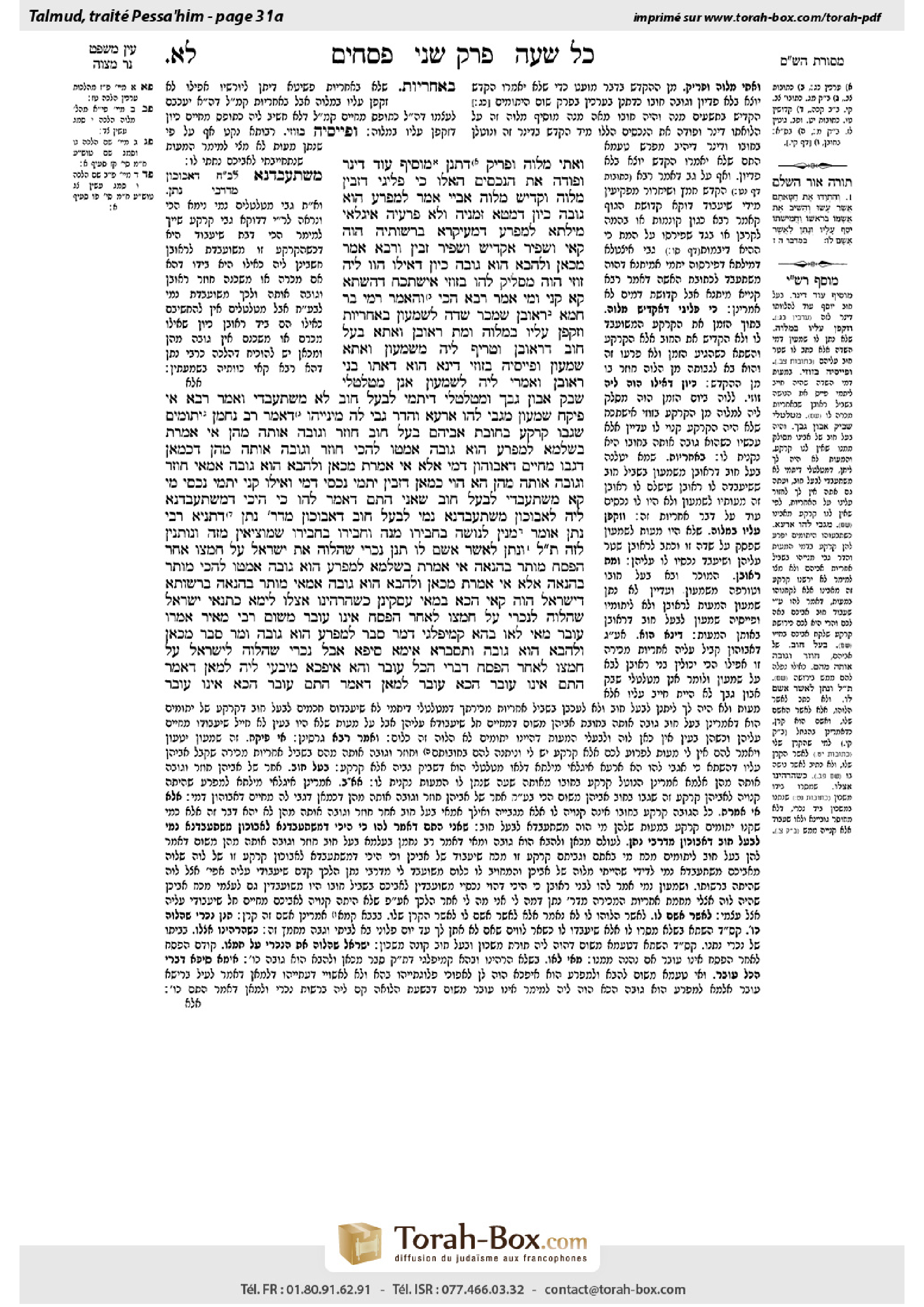
Pesachim 31a: Talmud study for Daf Yomi
Daf Yomi is the daily study of one Talmud folio. Explore 37 tractates with scans, Hebrew text, Sefaria English and AI-generated French translations where annotated.
Passage selection and English or AI-generated French translation are available where the scan has annotations. Daf Study is independent of Torah-Box and Sefaria.
Browse Pesachim · פסחים · All tractatesPesachim 31a text and translations
This page of Pesachim includes the Aramaic text, an English translation and an AI-generated French translation, alongside the scan above.
פסחים ל״א א · Aramaic and Hebrew text
וְאָתֵי מַלְוֶה וּפָרֵיק. דִּתְנַן: מוֹסִיף עוֹד דִּינָר וּפוֹדֶה אֶת הַנְּכָסִים הָאֵלּוּ. כִּי פְּלִיגִי דְּזַבֵּין מַלְוֶה, וְקַדֵּישׁ מַלְוֶה.
אַבָּיֵי אָמַר, לְמַפְרֵעַ הוּא גּוֹבֶה: כֵּיוָן דִּמְטָא זִמְנֵיהּ וְלָא פַּרְעֵיהּ, אִיגַּלַּאי מִילְּתָא לְמַפְרֵעַ דְּמֵעִיקָּרָא בִּרְשׁוּתֵיהּ הֲוָה קָאֵי, וְשַׁפִּיר אַקְדֵּישׁ, וְשַׁפִּיר זַבֵּין. וְרָבָא אָמַר, מִכָּאן וּלְהַבָּא הוּא גּוֹבֶה: כֵּיוָן דְּאִילּוּ הֲווֹ לֵיהּ זוּזֵי, הֲוָה מְסַלֵּיק לְהוּ בְּזוּזֵי — אִישְׁתְּכַח דְּהַשְׁתָּא קָא קָנֵי.
וּמִי אָמַר רָבָא הָכִי? וְהָאָמַר רָמֵי בַּר חָמָא: רְאוּבֵן שֶׁמָּכַר שָׂדֶה לְשִׁמְעוֹן בְּאַחְרָיוּת וּזְקָפָן עָלָיו בְּמִלְוֶה, וּמֵת רְאוּבֵן, וַאֲתָא בַּעַל חוֹב דִּרְאוּבֵן וְטָרֵיף לֵיהּ מִשִּׁמְעוֹן, וַאֲתָא שִׁמְעוֹן וּפַיְּיסֵיהּ בְּזוּזֵי —
דִּינָא הוּא דְּאָתוּ בְּנֵי רְאוּבֵן וְאָמְרִי לֵיהּ לְשִׁמְעוֹן: אֲנַן, מִטַּלְטְלֵי שְׁבַק אֲבוּן גַּבָּךְ, וּמִטַּלְטְלֵי דְיַתְמֵי לְבַעַל חוֹב לָא מִשְׁתַּעְבְּדִי.
וְאָמַר רָבָא: אִי פִּיקֵּחַ שִׁמְעוֹן — מַגְבֵּי לְהוּ אַרְעָא, וַהֲדַר גָּבֵי לַהּ מִינַּיְיהוּ. דְּאָמַר רַב נַחְמָן: יְתוֹמִים שֶׁגָּבוּ קַרְקַע בְּחוֹבַת אֲבִיהֶם — בַּעַל חוֹב חוֹזֵר וְגוֹבֶה אוֹתָהּ מֵהֶן.
אִי אָמְרַתְּ בִּשְׁלָמָא ״לְמַפְרֵעַ הוּא גּוֹבֶה״, אַמְּטוּ לְהָכִי חוֹזֵר וְגוֹבֶה אוֹתָהּ מֵהֶן — דִּכְמַאן דְּגָבוּ מֵחַיִּים דַּאֲבוּהוֹן דָּמֵי. אֶלָּא אִי אָמְרַתְּ ״מִכָּאן וּלְהַבָּא הוּא גּוֹבֶה״, אַמַּאי חוֹזֵר וְגוֹבֶה אוֹתָהּ מֵהֶן? הָא הָוֵי כְּמַאן דִּזְבֵין יַתְמֵי נִכְסֵי דָּמֵי, וְאִילּוּ קָנֵי יַתְמֵי נִכְסֵי, מִי קָא מִשְׁתַּעְבְּדִי לְבַעַל חוֹב?
שָׁאנֵי הָתָם, דְּאָמַר לְהוּ: כִּי הֵיכִי דְּמִשְׁתַּעְבַּדְנָא לֵיהּ לַאֲבוּכוֹן, מִשְׁתַּעְבַּדְנָא נָמֵי לְבַעַל חוֹב דַּאֲבוּכוֹן — מִדְּרַבִּי נָתָן. דְּתַנְיָא, רַבִּי נָתָן אוֹמֵר: מִנַּיִן לַנּוֹשֶׁה בַּחֲבֵירוֹ מָנֶה וַחֲבֵירוֹ בַּחֲבֵירוֹ, שֶׁמּוֹצִיאִין מִזֶּה וְנוֹתְנִין לָזֶה? תַּלְמוּד לוֹמַר: ״וְנָתַן לַאֲשֶׁר אָשַׁם לוֹ״.
תְּנַן: גּוֹי שֶׁהִלְוָה אֶת יִשְׂרָאֵל עַל חֲמֵצוֹ — אַחַר הַפֶּסַח מוּתָּר בַּהֲנָאָה. אִי אָמְרַתְּ בִּשְׁלָמָא ״לְמַפְרֵעַ הוּא גּוֹבֶה״ — אַמְּטוּ לְהָכִי מוּתָּר בַּהֲנָאָה.
אֶלָּא אִי אָמְרַתְּ ״מִכָּאן וּלְהַבָּא הוּא גּוֹבֶה״, אַמַּאי מוּתָּר בַּהֲנָאָה? בִּרְשׁוּתָא דְיִשְׂרָאֵל הֲוָה קָאֵי! הָכָא בְּמַאי עָסְקִינַן — כְּשֶׁהִרְהִינוֹ אֶצְלוֹ.
לֵימָא כְּתַנָּאֵי: יִשְׂרָאֵל שֶׁהִלְוָה לְגוֹי עַל חֲמֵצוֹ — לְאַחַר הַפֶּסַח אֵינוֹ עוֹבֵר. מִשּׁוּם רַבִּי מֵאִיר אָמְרוּ: עוֹבֵר. מַאי לָאו, בְּהָא קָמִיפַּלְגִי: דְּמָר סָבַר לְמַפְרֵעַ הוּא גּוֹבֶה, וּמָר סָבַר מִכָּאן וּלְהַבָּא הוּא גּוֹבֶה?
וְתִסְבְּרָא? אֵימָא סֵיפָא: אֲבָל גּוֹי שֶׁהִלְוָה לְיִשְׂרָאֵל עַל חֲמֵצוֹ — לְאַחַר הַפֶּסַח דִּבְרֵי הַכֹּל עוֹבֵר. וְהָא אִיפְּכָא מִיבְּעֵי לֵיהּ: לְמַאן דְּאָמַר הָתָם ״אֵינוֹ עוֹבֵר״ — הָכָא עוֹבֵר. לְמַאן דְּאָמַר הָתָם ״עוֹבֵר״ — הָכָא אֵינוֹ עוֹבֵר!
Pesachim 31a · English translation
Or if the debtor consecrated the property, the creditor can come and redeem it through a symbolic payment to the Temple. As we learned in a mishna: The creditor may add an additional dinar to the amount of the loan and redeem this property. Although strictly speaking he need not redeem it, this payment was instituted so that it would not appear as though property were removed from the consecrated Temple jurisdiction without a payment. When they disagree is in a case when the creditor sold or consecrated the property in the interim between the giving of the collateral and the time the loan was due.
Abaye said: He retroactively acquires the collateral. Since the time arrived and he did not repay his loan, it has become clear retroactively that it was in the creditor’s jurisdiction at the outset. Therefore, he did well to consecrate or sell it. However, Rava said: He collects it from that point forward, since if the borrower had money he would remove the creditor’s lien with this money and the lender would not acquire the property. It is found that the creditor acquires the property now, at the time when the loan is due, and consequently he did not have the right to consecrate or sell it before this time.
Before bringing proofs for either side of this dispute, the Gemara attempts to clarify Rava’s position. Did Rava actually say this? A statement he makes in a different context appears to contradict the one made in his name here. But didn’t Rami bar Ḥama say: Reuven sold a field to Shimon with a guarantee that if the field is repossessed, Reuven will compensate Shimon for his loss. Shimon did not pay for the purchase, and instead set up the value of the field as a loan. In the meantime, Reuven died and a creditor of Reuven’s came to collect for a loan that Reuven had taken before he sold the field, as Reuven had no other land remaining, and he seized the land from Shimon, since it was mortgaged to this loan. And Shimon went and appeased the creditor with money so the creditor would allow him to keep this field.
By right, Reuven’s sons can come and say to Shimon that he must pay them the money that he owes for the field. And they are not required to pay Shimon if he demands compensation for the repossession of his field. They can say that our father left us movable property in your hands, i.e., the money you owe us for the field, and, as a general rule, movable property that has been left to orphans is not mortgaged to a creditor. The orphans can claim that the field belongs to Shimon, and as there is no land left for the orphans, there is no way for Shimon to recover the compensation that he is owed. The money he owes Reuven is considered movable property, and therefore he cannot recover his losses from these funds.
And Rava said with regard to this case: If Shimon is clever he will pay them what he owes with real estate and not with money. Since they now have real estate received from their father’s estate, Shimon can then collect the field from them as compensation for the original field that Reuven sold to Shimon. As Rav Naḥman said: When orphans collect real estate for a debt owed to their father from one person, another creditor can come and seize this land from them in order to repay the father’s debt.
The Gemara applies this discussion to our original case. Granted, if you say that a creditor collects retroactively, and the field is considered as though it belonged to the creditor from the time of the loan, due to this reason, he can then collect the money from them, because it is considered as though he collected it during their father’s lifetime. Because the field given by Shimon to repay his debt retroactively belonged to Reuven from the time that Shimon agreed to pay for the field, therefore Shimon can now claim this land from Reuven’s heirs. However, if you say that he collects it from this point forward, why can he then collect this land from them? It is as though the orphans purchased this property. And if orphans buy property, does it become indebted to a creditor of their father? Only property that belonged to the father can be seized in order to pay back his debt, and therefore Rava’s statement in the case appears to contradict his statement with regard to the transfer of ownership of collateral.
The Gemara resolves this contradiction: It is different there, in this case, as Shimon could have said to Reuven’s children that just as I am indebted to your father, so too, I am indebted to your father’s creditor. And this principle can be learned from the statement of Rabbi Natan that one who lends to one person and borrows from another can be considered as a middleman between his creditor and his borrower. As it was taught in a baraita, Rabbi Natan says: From where is it derived that when one lends one hundred dinar [maneh] to his fellow, and that fellow lends a similar sum to a third fellow, that we take the money from this one, the second debtor, and give it to that one, the first creditor, without going through the middleman, who is both the first debtor and the second creditor? The verse states: “And he shall give it to him whom he has wronged” (Numbers 5:7), which indicates that the loan should be repaid to the creditor to whom the money is ultimately owed. Therefore, payment is made to the original creditor regardless of the issue of retroactive acquisition of the collateral.
The Gemara proceeds to bring proofs for the two sides of the question of retroactive acquisition. We learned in the mishna: If a gentile lent money to a Jew, and the Jew gave him leavened bread as collateral during Passover, and after Passover the gentile attained this leavened bread in lieu of payment, then one is permitted to derive benefit from the leavened bread. The Gemara attempts to clarify this position: Granted, if you say that he retroactively collects this property, and the leavened bread was acquired retroactively by the gentile, it is due to this that one is permitted to derive benefit from it after Passover.
But if you say that he collects it from this point forward, then why should one be permitted to derive benefit from this leavened bread? The leavened bread was in the possession of a Jew during Passover, and therefore it should be forbidden. The Gemara answers: With what are we dealing here? With a case where he deposited [hirhin] the leavened bread with the gentile in his home, and since the leavened bread was in the gentile’s possession during Passover, it is considered as if it belonged to the gentile, provided the gentile ultimately retains ownership of the leavened bread when the Jew defaults on the loan.
The Gemara suggests: Let us say that this dispute is parallel to a dispute between tanna’im. As it was taught: If a Jew lends money to a gentile and the gentile gives him leavened bread as collateral, then the Jew does not commit any transgression after Passover. They said in the name of Rabbi Meir that he commits a transgression. What, isn’t it that they disagree about this, that one Sage, Rabbi Meir, holds that the Jew transgresses by owning leavened bread because he retroactively collects the leavened bread and has therefore owned it during Passover, and one Sage, who states that the Jew does not commit a transgression, holds that he collects it from this point forward, and therefore it was not considered to be in his possession during Passover?
The Gemara rejects this explanation: And how can you understand it that way? Say the latter clause of that baraita: However, if a gentile lends money to a Jew with leavened bread as collateral, then after Passover everyone agrees that he commits a transgression. However, if the preceding explanation is correct, it needed to state the opposite of what it said in the first clause, as the case in the latter clause is the reverse of that in the first clause. Namely, according to the one who said there, in the first clause of the baraita, that he does not commit a transgression, he should say that here, in this case, he does commit a transgression. And according to the one who said there, in the first clause of the baraita, that he does commit a transgression, he should say that here, in the latter clause, he does not commit a transgression. For if the creditor retroactively acquires the collateral, then it is as though it belonged to a gentile during Passover, and therefore the Jew would not have committed a transgression by owning it.
Pesachim 31a · Traduction française (IA)
Ou bien, si le débiteur a consacré le bien, le créancier peut venir le racheter au Temple en versant une somme symbolique. Comme nous l’avons appris dans une Michna : le créancier peut ajouter un dinar au montant du prêt et racheter ce bien. Bien qu’à proprement parler il ne soit pas tenu de le racheter, ce paiement a été institué afin qu’il ne semble pas qu’un bien ait été retiré du domaine consacré au Temple sans paiement. Leur désaccord porte sur le cas où le créancier a vendu ou consacré le bien entre le moment où le gage a été remis et l’échéance du prêt.
Abayé a dit : il acquiert le gage rétroactivement. Puisque l’échéance est arrivée et qu’il n’a pas remboursé son prêt, il apparaît rétroactivement que le bien relevait dès le départ du domaine du créancier. Celui-ci a donc eu raison de le consacrer ou de le vendre. Rava, cependant, a dit : il ne l’acquiert qu’à partir de ce moment-là. En effet, si l’emprunteur avait eu de l’argent, il aurait libéré le bien du privilège du créancier grâce à cet argent, et le prêteur n’aurait pas acquis le bien. Il s’ensuit que le créancier n’acquiert le bien qu’à présent, à l’échéance du prêt ; par conséquent, il n’avait pas le droit de le consacrer ou de le vendre auparavant.
Avant d’apporter des preuves en faveur de l’un ou l’autre camp dans cette controverse, la Guemara cherche à préciser la position de Rava. Rava a-t-il réellement dit cela ? Une déclaration qu’il fait dans un autre contexte semble contredire celle qui lui est attribuée ici. Mais Rami bar Ḥama n’a-t-il pas dit : Réouven a vendu un champ à Chimon en garantissant que, si le champ était saisi, il indemniserait Chimon de sa perte ? Chimon n’a pas payé le prix d’achat ; il a plutôt considéré la valeur du champ comme un prêt. Entre-temps, Réouven est mort et un créancier de Réouven est venu recouvrer un prêt que celui-ci avait contracté avant de vendre le champ, car Réouven ne possédait plus aucun autre terrain. Le créancier a alors saisi le champ à Chimon, puisqu’il était hypothéqué en garantie de ce prêt. Chimon est allé apaiser le créancier en lui donnant de l’argent, afin que celui-ci le laisse garder le champ.
En droit, les fils de Réouven peuvent venir dire à Chimon qu’il doit leur payer l’argent qu’il leur doit pour le champ. Ils ne sont pas tenus de verser une indemnité à Chimon si celui-ci réclame compensation pour la saisie de son champ. Ils peuvent dire : « Notre père nous a laissé entre tes mains des biens mobiliers », c’est-à-dire l’argent que tu nous dois pour le champ ; or, en règle générale, les biens mobiliers laissés à des orphelins ne sont pas hypothéqués au profit d’un créancier. Les orphelins peuvent prétendre que le champ appartient à Chimon et, puisqu’il ne reste aucune terre aux orphelins, Chimon n’a aucun moyen de recouvrer l’indemnité qui lui est due. L’argent qu’il doit à Réouven est considéré comme un bien mobilier ; il ne peut donc pas se dédommager de ses pertes sur ces fonds.
Et Rava a dit au sujet de ce cas : si Chimon est avisé, il leur paiera ce qu’il leur doit en leur transférant un bien immobilier, et non en leur donnant de l’argent. Puisqu’ils posséderont alors un bien immobilier provenant de la succession de leur père, Chimon pourra leur reprendre le champ à titre d’indemnisation pour le champ que Réouven lui avait vendu à l’origine. Car Rav Naḥman a dit : lorsque des orphelins recouvrent auprès d’une personne un bien immobilier pour une dette due à leur père, un autre créancier peut venir le leur saisir afin de rembourser la dette de leur père.
La Guemara applique cette discussion à notre cas initial. Il est compréhensible que, si tu dis que le créancier acquiert le bien rétroactivement et que le champ est considéré comme lui ayant appartenu depuis le moment du prêt, il puisse pour cette raison recouvrer l’argent auprès d’eux, car c’est comme s’il l’avait recouvré du vivant de leur père. Puisque le champ que Chimon a transféré pour rembourser sa dette appartenait rétroactivement à Réouven dès le moment où Chimon avait accepté de payer le champ, Chimon peut maintenant réclamer ce bien aux héritiers de Réouven. Mais si tu dis que le créancier ne l’acquiert qu’à partir de ce moment-là, pourquoi peut-il alors leur réclamer ce bien ? C’est comme si les orphelins avaient acheté ce bien. Or, si des orphelins achètent un bien, celui-ci devient-il grevé d’une dette envers le créancier de leur père ? Seuls les biens qui appartenaient au père peuvent être saisis afin de rembourser sa dette. La déclaration de Rava dans ce cas semble donc contredire sa déclaration concernant le transfert de propriété du gage.
La Guemara résout cette contradiction : ce cas-là est différent, car Chimon aurait pu dire aux fils de Réouven : « De même que je suis débiteur envers votre père, je suis aussi débiteur envers le créancier de votre père. » Ce principe peut être déduit de la déclaration de Rabbi Natan, selon laquelle celui qui prête à une personne et emprunte à une autre peut être considéré comme un intermédiaire entre son créancier et son débiteur. Comme il a été enseigné dans une baraïta, Rabbi Natan dit : d’où déduit-on que, lorsqu’un homme prête cent dinars [maneh] à son prochain, et que celui-ci prête une somme équivalente à un troisième, on prend l’argent à celui-ci, le deuxième débiteur, pour le remettre à celui-là, le premier créancier, sans passer par l’intermédiaire, qui est à la fois le premier débiteur et le deuxième créancier ? Le verset dit : « Il le lui donnera, à celui envers qui il a commis la faute » (Nombres 5:7), ce qui indique que le prêt doit être remboursé au créancier auquel l’argent est finalement dû. Le paiement revient donc au créancier initial, indépendamment de la question de l’acquisition rétroactive du gage.
La Guemara apporte à présent des preuves en faveur des deux positions sur la question de l’acquisition rétroactive. Nous avons appris dans la Michna : si un non-Juif a prêté de l’argent à un Juif et que le Juif lui a remis du levain en gage pendant Pessa’h, puis qu’après Pessa’h le non-Juif a pris possession de ce levain en paiement, il est permis d’en tirer profit. La Guemara cherche à préciser cette position : il est compréhensible que, si tu dis que le créancier acquiert ce bien rétroactivement et que le non-Juif a acquis le levain rétroactivement, on soit pour cette raison autorisé à en tirer profit après Pessa’h.
Mais si tu dis que le créancier ne l’acquiert qu’à partir de ce moment-là, pourquoi serait-il permis de tirer profit de ce levain ? Le levain se trouvait en possession d’un Juif pendant Pessa’h et devrait donc être interdit. La Guemara répond : de quoi s’agit-il ici ? D’un cas où il a déposé [hirhin] le levain chez le non-Juif, dans la maison de celui-ci. Puisque le levain se trouvait en possession du non-Juif pendant Pessa’h, il est considéré comme lui appartenant, à condition que le non-Juif en conserve finalement la propriété lorsque le Juif ne rembourse pas le prêt.
La Guemara propose : dirons-nous que cette controverse correspond à un désaccord entre des tanaïm ? En effet, il a été enseigné : si un Juif prête de l’argent à un non-Juif et que celui-ci lui remet du levain en gage, le Juif ne commet aucune transgression après Pessa’h. Certains ont dit au nom de Rabbi Meïr qu’il commet une transgression. N’est-ce pas qu’ils sont en désaccord sur ce point : un Sage, Rabbi Meïr, estime que le Juif transgresse en possédant du levain, parce qu’il acquiert celui-ci rétroactivement et l’a donc possédé pendant Pessa’h ; tandis que l’autre Sage, qui affirme que le Juif ne commet aucune transgression, estime qu’il ne l’acquiert qu’à partir de ce moment-là, de sorte que le levain n’était pas considéré comme étant en sa possession pendant Pessa’h ?
La Guemara rejette cette explication : comment peux-tu comprendre les choses ainsi ? Considère la dernière partie de cette baraïta : cependant, si un non-Juif prête de l’argent à un Juif en prenant du levain en gage, après Pessa’h tous reconnaissent que le Juif commet une transgression. Pourtant, si l’explication précédente était correcte, il aurait fallu enseigner le contraire de ce qui est dit dans la première partie, puisque le cas de la dernière partie est l’inverse de celui de la première. Autrement dit, celui qui dit là, dans la première partie de la baraïta, que le Juif ne commet pas de transgression devrait dire ici, dans ce cas, qu’il en commet une. Et celui qui dit là, dans la première partie de la baraïta, qu’il commet une transgression devrait dire ici, dans la dernière partie, qu’il n’en commet pas. Car, si le créancier acquiert le gage rétroactivement, c’est comme si celui-ci avait appartenu à un non-Juif pendant Pessa’h ; le Juif n’aurait donc commis aucune transgression en le possédant.
Traduction française générée par IA à partir de l’édition anglaise de Sefaria. Vérifie toujours un passage avec le texte source.
Text from Sefaria: William Davidson Edition - Vocalized Aramaic (CC BY NC); William Davidson Edition - English (CC BY NC).