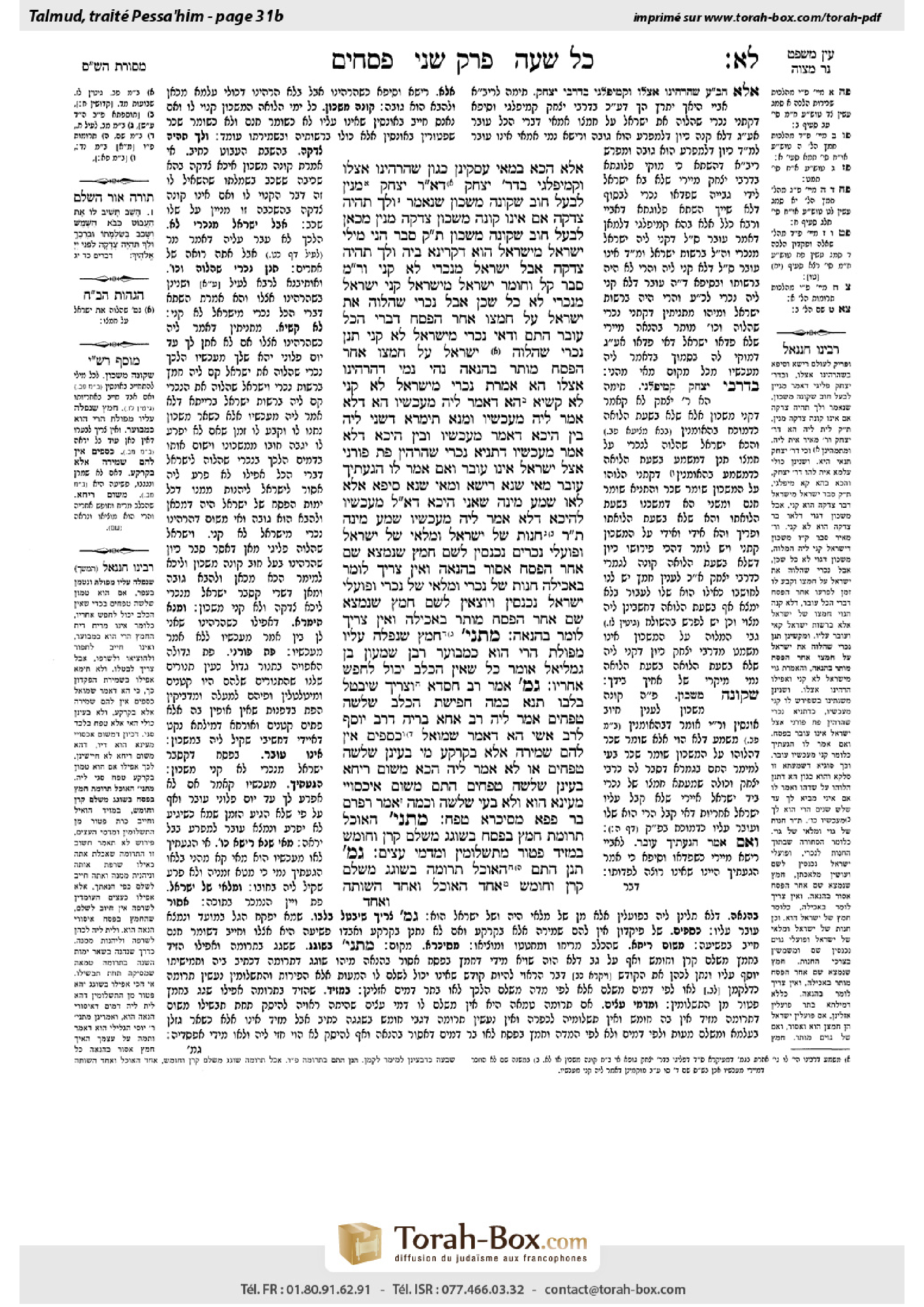
Pesachim 31b: Talmud study for Daf Yomi
Daf Yomi is the daily study of one Talmud folio. Explore 37 tractates with scans, Hebrew text, Sefaria English and AI-generated French translations where annotated.
Passage selection and English or AI-generated French translation are available where the scan has annotations. Daf Study is independent of Torah-Box and Sefaria.
Browse Pesachim · פסחים · All tractatesPesachim 31b text and translations
This page of Pesachim includes the Aramaic text, an English translation and an AI-generated French translation, alongside the scan above.
פסחים ל״א ב · Aramaic and Hebrew text
אֶלָּא הָכָא בְּמַאי עָסְקִינַן — כְּגוֹן שֶׁהִרְהִינוֹ אֶצְלוֹ, וְקָמִיפַּלְגִי בִּדְרַבִּי יִצְחָק. דְּאָמַר רַבִּי יִצְחָק: מִנַּיִן לְבַעַל חוֹב שֶׁקּוֹנֶה מַשְׁכּוֹן? שֶׁנֶּאֱמַר: ״וּלְךָ תִּהְיֶה צְדָקָה״. אִם אֵינוֹ קוֹנֶה מַשְׁכּוֹן — צְדָקָה מִנַּיִן? מִכָּאן לְבַעַל חוֹב שֶׁקּוֹנֶה מַשְׁכּוֹן.
תַּנָּא קַמָּא סָבַר: הָנֵי מִילֵּי יִשְׂרָאֵל מִיִּשְׂרָאֵל הוּא, דְּקָרֵינָא בֵּיהּ ״וּלְךָ תִּהְיֶה צְדָקָה״, אֲבָל יִשְׂרָאֵל מִגּוֹי — לָא קָנֵי.
וְרַבִּי מֵאִיר סָבַר, קַל וָחוֹמֶר: יִשְׂרָאֵל מִיִּשְׂרָאֵל קָנֵי, יִשְׂרָאֵל מִגּוֹי לֹא כׇּל שֶׁכֵּן?! אֲבָל גּוֹי שֶׁהִלְוָה אֶת יִשְׂרָאֵל עַל חֲמֵצוֹ — אַחַר הַפֶּסַח דִּבְרֵי הַכֹּל עוֹבֵר. הָתָם וַדַּאי גּוֹי מִיִּשְׂרָאֵל לָא קָנֵי.
תְּנַן: גּוֹי שֶׁהִלְוָה יִשְׂרָאֵל עַל חֲמֵצוֹ — אַחַר הַפֶּסַח מוּתָּר בַּהֲנָאָה. נְהִי נָמֵי דְּהִרְהִינוֹ אֶצְלוֹ, הָא אָמְרַתְּ גּוֹי מִיִּשְׂרָאֵל לָא קָנֵי? לָא קַשְׁיָא הָא — דְּאָמַר לֵיהּ ״מֵעַכְשָׁיו״, הָא — דְּלָא אָמַר לֵיהּ ״מֵעַכְשָׁיו״.
ומְנָא תֵּימְרָא דְּשָׁנֵי לֵיהּ בֵּין הֵיכָא דְּאָמַר ״מֵעַכְשָׁיו״ וּבֵין הֵיכָא דְּלָא אָמַר ״מֵעַכְשָׁיו״, דְּתַנְיָא: גּוֹי שֶׁהִרְהִין פַּת פּוּרְנִי אֵצֶל יִשְׂרָאֵל — אֵינוֹ עוֹבֵר, וְאִם אָמַר לוֹ ״הִגַּעְתִּיךָ״ — עוֹבֵר. מַאי שְׁנָא רֵישָׁא וּמַאי שְׁנָא סֵיפָא? אֶלָּא לָאו, שְׁמַע מִינַּהּ: שָׁאנֵי הֵיכָא דְּאָמַר לֵיהּ ״מֵעַכְשָׁיו״ לְהֵיכָא דְּלָא אָמַר לֵיהּ ״מֵעַכְשָׁיו״. שְׁמַע מִינַּהּ.
תָּנוּ רַבָּנַן: חֲנוּת שֶׁל יִשְׂרָאֵל וּמְלַאי שֶׁל יִשְׂרָאֵל, וּפוֹעֲלֵי גוֹיִם נִכְנָסִין לְשָׁם — חָמֵץ שֶׁנִּמְצָא שָׁם אַחַר הַפֶּסַח אָסוּר בַּהֲנָאָה, וְאֵין צָרִיךְ לוֹמַר בַּאֲכִילָה. חֲנוּת שֶׁל גּוֹי וּמְלַאי שֶׁל גּוֹי וּפוֹעֲלֵי יִשְׂרָאֵל נִכְנָסִין וְיוֹצְאִין לְשָׁם — חָמֵץ שֶׁנִּמְצָא שָׁם אַחַר הַפֶּסַח מוּתָּר בַּאֲכִילָה, וְאֵין צָרִיךְ לוֹמַר בַּהֲנָאָה.
מַתְנִי׳ חָמֵץ שֶׁנָּפְלָה עָלָיו מַפּוֹלֶת הֲרֵי הוּא כִּמְבוֹעָר. רַבָּן שִׁמְעוֹן בֶּן גַּמְלִיאֵל אוֹמֵר: כׇּל שֶׁאֵין הַכֶּלֶב יָכוֹל לְחַפֵּשׂ אַחֲרָיו.
גְּמָ׳ אָמַר רַב חִסְדָּא: וְצָרִיךְ שֶׁיְּבַטֵּל בְּלִבּוֹ. תָּנָא: כַּמָּה חֲפִישַׂת הַכֶּלֶב — שְׁלֹשָׁה טְפָחִים.
אֲמַר לֵיהּ רַב אַחָא בְּרֵיהּ דְּרַב יוֹסֵף לְרַב אָשֵׁי: הָא דְּאָמַר שְׁמוּאֵל כְּסָפִים אֵין לָהֶם שְׁמִירָה אֶלָּא בַּקַּרְקַע, מִי בָּעֵינַן שְׁלֹשָׁה טְפָחִים אוֹ לָא? אֲמַר לֵיהּ הָכָא מִשּׁוּם רֵיחָא בָּעֵינַן שְׁלֹשָׁה טְפָחִים. הָתָם מִשּׁוּם אִיכַּסּוֹיֵי מֵעֵינָא הוּא, וְלָא בָּעֵי שְׁלֹשָׁה. וְכַמָּה? אָמַר רַפְרָם בַּר פָּפָּא מִסִּיכְרָא: טֶפַח.
מַתְנִי׳ הָאוֹכֵל תְּרוּמַת חָמֵץ בַּפֶּסַח, בְּשׁוֹגֵג — מְשַׁלֵּם קֶרֶן וָחוֹמֶשׁ, בְּמֵזִיד — פָּטוּר מִתַּשְׁלוּמִין וּמִדְּמֵי עֵצִים.
גְּמָ׳ תְּנַן הָתָם: הָאוֹכֵל תְּרוּמָה בְּשׁוֹגֵג — מְשַׁלֵּם קֶרֶן וָחוֹמֶשׁ, אֶחָד הָאוֹכֵל וְאֶחָד הַשּׁוֹתֶה
Pesachim 31b · English translation
Rather, with what are we dealing here? With a situation where he, the gentile debtor, deposited the leavened bread that was serving as collateral with him, the Jewish creditor, and they disagree with regard to the statement of Rabbi Yitzḥak. As Rabbi Yitzḥak said: From where is it derived that a creditor acquires collateral given to him, and is considered its owner so long as the item is in his possession? As it is stated: “You shall surely return the pledge to him when the sun goes down, that he may sleep in his garment, and bless you; and it shall be a righteousness for you before the Lord your God” (Deuteronomy 24:13). Rabbi Yitzḥak infers: If the creditor does not acquire the collateral, then from where is the righteousness involved in returning it? In this case, the creditor would not be giving up anything of his own. From here it is learned that a creditor acquires the collateral.
The Gemara applies this principle to the explanation of the baraita: The first tanna holds that this applies only when a Jew takes collateral from a fellow Jew, such that I would read and apply the verse “It shall be righteousness for you” and establish that the collateral becomes the property of the lender. However, the verse does not speak about the case where a Jew takes collateral from a gentile, and therefore he does not acquire the collateral; it still belongs to the gentile. Therefore, when a Jew has leavened bread as collateral from a gentile to whom he lent money on Passover, he does not violate any prohibition, as the collateral still belongs to the gentile.
However, Rabbi Meir holds that one can derive an a fortiori inference: If a Jew acquires collateral from another Jew, all the more so is it not clear that he will he acquire collateral from a gentile? However, with regard to a gentile who lends money to a Jew with leavened bread as collateral, everyone agrees that he transgresses this prohibition after Passover. There, in that case, the gentile certainly does not acquire collateral from the Jew, and such a transaction could be completed only via the usual modes of acquisition.
We learned in the mishna: If a gentile lent money to a Jew, and the Jew gave him leavened bread as collateral until after Passover, and after Passover he retains this leavened bread in lieu of payment, then one is permitted to derive benefit from this leavened bread. Even granted that this is referring to a case where he deposited the leavened bread with him, the gentile, didn’t you say that a gentile does not acquire collateral from a Jew, and if this is the case, then why is it permissible to derive benefit from this leavened bread? According to the previously stated principle, this leavened bread remains Jewish property. The Gemara resolves this question: This is not difficult, for this case, where the gentile acquires the leavened bread and therefore it is permitted to derive benefit from it, is when the gentile said to him that if he does not repay his loan, then the collateral will be acquired from now, i.e., from the time of the loan. And that case, where it is forbidden to derive benefit from the leavened bread, is when he did not say that it would be acquired from now by the gentile.
From where do you say that he distinguishes between a case where he said that the collateral would be acquired from now and a case where he did not say that it would be acquired from now? As it was taught in a baraita: If a gentile deposited with a Jew bread baked in an oven [purni] as collateral for a loan, then he, the Jew, does not transgress the prohibition it shall not be seen and the prohibition it shall not be found. However, if he said to him: I have made them yours from now if I do not repay my loan, then it is considered as though the bread belonged to the Jew, and he transgresses this prohibition. If one assumes that there is no difference between a case where the debtor says: From now, and a case where he doesn’t say: From now, then what is different in the first clause of the baraita and what is different in the latter clause? Rather, must one not conclude from it that there is a difference between a case where he says to him that he will acquire it from now and a case where he does not say to him that he will acquire it from now? The Gemara concurs: Indeed, conclude from it that this is the case.
The Sages taught in the Tosefta: With regard to the case of a store owned by a Jew and whose contents belong to the Jew, and gentile workers would enter there periodically, then it is forbidden to derive benefit from the leavened bread that is found there after Passover, and needless to say, it is forbidden to eat this leavened bread, for it is presumed to belong to the Jewish owner. Conversely, if a store is owned by a gentile and its contents belong to the gentile, and Jewish workers enter and exit the store, then it can be presumed that the leavened bread that is found there after Passover belonged to the gentile, and therefore one is permitted to eat it after Passover. And needless to say, it is permitted to derive benefit from this leavened bread.
MISHNA: Leavened bread upon which a rockslide has fallen is considered as though it has been eliminated, and it is not necessary to dig it up in order to burn it. Rabban Shimon ben Gamliel says: Any leavened bread that has been covered to such an extent that a dog cannot search after it is considered to have been eliminated.
GEMARA: Rav Ḥisda said: Although it is not necessary to dig up the leavened bread, one is nevertheless required to nullify the leavened bread in his heart lest it become exposed during Passover. Although it may not be visible at the moment, this leavened bread may be uncovered during Passover, and he will transgress a prohibition by its being seen. It was taught in the Tosefta: How much, how deep, will a dog search? It will search three handbreadths deep.
Rav Aḥa, son of Rav Yosef, said to Rav Ashi: With regard to that which Shmuel said, that deposited money is considered to be guarded securely by an unpaid bailee, who would nonetheless not be responsible if it were stolen, only when it is buried in the ground, is it necessary to bury this deposited money three handbreadths deep, comparable to leavened bread, or not? He said to him: Here, with regard to Passover, the concern is that the dog will find the food due to its smell, and therefore three handbreadths are required. There, in the case of money, it is necessary to bury the money in order to conceal it from view. Therefore, it is not required to bury it three handbreadths deep, as animals will not search for it and people will not see it. The Gemara asks: If this is the case, then how deep is one required to bury it? Rafram bar Pappa from the city of Sikhra said: One handbreadth is sufficient for the money to be considered concealed.
MISHNA: If one unwittingly eats teruma of leavened bread on Passover, not realizing that the food was teruma, then he must pay the principal and an additional fifth. This is because one who unwittingly eats teruma must compensate the priest for the value of the teruma and add a fifth of the value, even though the teruma is considered to be valueless on Passover. If he intentionally ate the teruma then he is exempt from payment; as he is liable to receive the severe punishment of karet, he is therefore exempt from the lesser punishment of payment. If he ate impure teruma in this manner then he is not even required to pay its monetary value in wood, for one who derives benefit from impure teruma calculates its value by treating it as though it were fuel for burning. While impure teruma can be used in this manner during the rest of the year, one may not derive any benefit from leavened bread on Passover, and therefore such teruma is worthless.
GEMARA: We learned in a mishna there, in Terumot: One who unwittingly eats teruma pays the principal and an additional fifth, both one who eats it, and one who drinks it.
Pesachim 31b · Traduction française (IA)
Mais alors, de quel cas s’agit-il ici ? D’un cas où le débiteur non juif a déposé chez le créancier juif le pain levé qui servait de gage, et où ils sont en désaccord au sujet de l’enseignement de Rabbi Yitzḥak. Car Rabbi Yitzḥak a dit : D’où apprend-on qu’un créancier acquiert le gage qui lui est remis et en est considéré comme le propriétaire tant que l’objet est en sa possession ? Comme il est dit : « Tu lui rendras certainement le gage au coucher du soleil, afin qu’il dorme dans son vêtement et qu’il te bénisse ; ce sera pour toi une juste conduite devant le Seigneur ton Dieu » (Deutéronome 24:13). Rabbi Yitzḥak déduit : si le créancier n’acquiert pas le gage, en quoi consiste la juste conduite lorsqu’il le rend ? Dans ce cas, il ne renoncerait à rien qui lui appartienne. On apprend de là qu’un créancier acquiert le gage.
La Guemara applique ce principe à l’explication de la baraïta : le premier tanna estime que cela ne s’applique que lorsqu’un Juif prend un gage à un autre Juif, de sorte que je peux lire le verset « Ce sera pour toi une juste conduite » et en déduire que le gage devient la propriété du prêteur. Cependant, le verset ne traite pas du cas où un Juif prend un gage à un non-Juif ; il ne l’acquiert donc pas, et le gage appartient toujours au non-Juif. Ainsi, lorsqu’un Juif détient comme gage le pain levé d’un non-Juif à qui il a prêté de l’argent pendant Pessaḥ, il ne transgresse aucune interdiction, puisque le gage appartient toujours au non-Juif.
Rabbi Meir, cependant, estime qu’on peut tirer une déduction a fortiori : si un Juif acquiert un gage remis par un autre Juif, à plus forte raison acquiert-il un gage remis par un non-Juif. Toutefois, dans le cas d’un non-Juif qui prête de l’argent à un Juif en prenant du pain levé comme gage, tous conviennent qu’il transgresse cette interdiction après Pessaḥ. Dans ce cas-là, le non-Juif n’acquiert certainement pas le gage remis par le Juif, et une telle transaction ne pourrait être conclue que par les modes habituels d’acquisition.
Nous avons appris dans la Michna : si un non-Juif a prêté de l’argent à un Juif et que celui-ci lui a remis du pain levé comme gage jusqu’après Pessaḥ, puis que le non-Juif conserve ce pain levé après Pessaḥ en guise de paiement, il est permis d’en tirer profit. Même si l’on admet qu’il s’agit d’un cas où le pain levé a été déposé chez lui, le non-Juif, n’as-tu pas dit qu’un non-Juif n’acquiert pas le gage remis par un Juif ? Si tel est le cas, pourquoi est-il permis de tirer profit de ce pain levé ? Selon le principe énoncé précédemment, ce pain levé reste la propriété du Juif. La Guemara résout cette difficulté : il n’y a pas de contradiction, car dans ce cas, où le non-Juif acquiert le pain levé et où il est donc permis d’en tirer profit, le non-Juif a dit au Juif que, si celui-ci ne remboursait pas son prêt, le gage lui serait acquis dès à présent, c’est-à-dire à partir du moment du prêt. Le cas où il est interdit de tirer profit du pain levé est celui où le non-Juif n’a pas dit qu’il lui serait acquis dès à présent.
D’où sait-on qu’il distingue entre le cas où il a dit que le gage serait acquis dès à présent et celui où il ne l’a pas dit ? Comme il a été enseigné dans une baraïta : si un non-Juif a déposé chez un Juif du pain cuit dans un four [purni] comme gage d’un prêt, le Juif ne transgresse ni l’interdiction « il ne sera pas vu » ni l’interdiction « il ne sera pas trouvé ». Mais si le non-Juif lui a dit : « Je te les ai cédés dès à présent, si je ne rembourse pas mon prêt », alors le pain est considéré comme appartenant au Juif, et celui-ci transgresse cette interdiction. Si l’on suppose qu’il n’y a pas de différence entre le cas où le débiteur dit « dès à présent » et celui où il ne le dit pas, qu’est-ce qui distingue la première clause de la baraïta de la dernière ? Ne faut-il pas plutôt en conclure qu’il existe une différence entre le cas où il lui dit que le gage lui sera acquis dès à présent et celui où il ne le lui dit pas ? La Guemara acquiesce : en effet, il faut en conclure que tel est bien le cas.
Les Sages ont enseigné dans la Tossefta : dans le cas d’un magasin qui appartient à un Juif et dont les marchandises lui appartiennent, où des ouvriers non juifs entrent périodiquement, il est interdit de tirer profit du pain levé qui s’y trouve après Pessaḥ ; à plus forte raison, il est interdit de manger ce pain levé, car on présume qu’il appartient au propriétaire juif. À l’inverse, si un magasin appartient à un non-Juif et que ses marchandises lui appartiennent, et que des ouvriers juifs y entrent et en sortent, on peut présumer que le pain levé qui s’y trouve après Pessaḥ appartenait au non-Juif ; il est donc permis de le manger après Pessaḥ. À plus forte raison, il est permis d’en tirer profit.
Michna : Le pain levé sur lequel un éboulement est tombé est considéré comme éliminé ; il n’est pas nécessaire de le déterrer pour le brûler. Rabban Shimon ben Gamliel dit : Tout pain levé recouvert au point qu’un chien ne puisse pas le chercher est considéré comme éliminé.
Guemara : Rav Ḥisda a dit : bien qu’il ne soit pas nécessaire de déterrer le pain levé, on doit néanmoins l’annuler dans son cœur, de peur qu’il ne soit découvert pendant Pessaḥ. Bien qu’il ne soit pas visible pour le moment, ce pain levé pourrait être mis au jour pendant Pessaḥ, et son propriétaire transgresserait alors une interdiction en le laissant être vu. Il a été enseigné dans la Tossefta : jusqu’à quelle profondeur un chien cherche-t-il ? Il cherche jusqu’à trois palmes de profondeur.
Rav Aḥa, fils de Rav Yosef, dit à Rav Ashi : au sujet de ce que Shmuel a dit, à savoir que l’argent déposé n’est considéré comme gardé en sûreté par un dépositaire non rémunéré, qui ne serait toutefois pas responsable s’il était volé, que s’il est enfoui dans le sol, faut-il enfouir cet argent à trois palmes de profondeur, comme le pain levé, ou non ? Il lui répondit : ici, à Pessaḥ, la crainte est que le chien trouve la nourriture à cause de son odeur ; trois palmes sont donc nécessaires. Là, dans le cas de l’argent, il faut l’enfouir afin de le dissimuler aux regards. Il n’est donc pas nécessaire de l’enfouir à trois palmes de profondeur, puisque les animaux ne le chercheront pas et que les gens ne le verront pas. La Guemara demande : si tel est le cas, à quelle profondeur faut-il l’enfouir ? Rafram bar Pappa, de la ville de Sikhra, dit : une palme suffit pour que l’argent soit considéré comme dissimulé.
Michna : si quelqu’un mange par inadvertance de la terouma faite de pain levé pendant Pessaḥ, sans se rendre compte qu’il s’agit de terouma, il doit en payer le principal et un cinquième supplémentaire. En effet, celui qui mange de la terouma par inadvertance doit dédommager le prêtre à hauteur de sa valeur et y ajouter un cinquième, même si la terouma est considérée comme sans valeur pendant Pessaḥ. S’il a mangé la terouma intentionnellement, il est exempt de tout paiement ; puisqu’il est passible de la peine sévère de karet, il est exempt de la peine moins sévère que constitue le paiement. S’il a mangé de la terouma impure de cette manière, il n’est même pas tenu d’en payer la valeur en bois, car celui qui tire profit de la terouma impure en évalue la valeur comme s’il s’agissait de combustible. Si la terouma impure peut être utilisée de cette manière le reste de l’année, on ne peut tirer aucun profit du pain levé pendant Pessaḥ ; une telle terouma est donc sans valeur.
Guemara : nous avons appris dans une Michna, dans le traité Teroumot : celui qui mange de la terouma par inadvertance paie le principal et un cinquième supplémentaire, qu’il la mange ou qu’il la boive.
Traduction française générée par IA à partir de l’édition anglaise de Sefaria. Vérifie toujours un passage avec le texte source.
Text from Sefaria: William Davidson Edition - Vocalized Aramaic (CC BY NC); William Davidson Edition - English (CC BY NC).