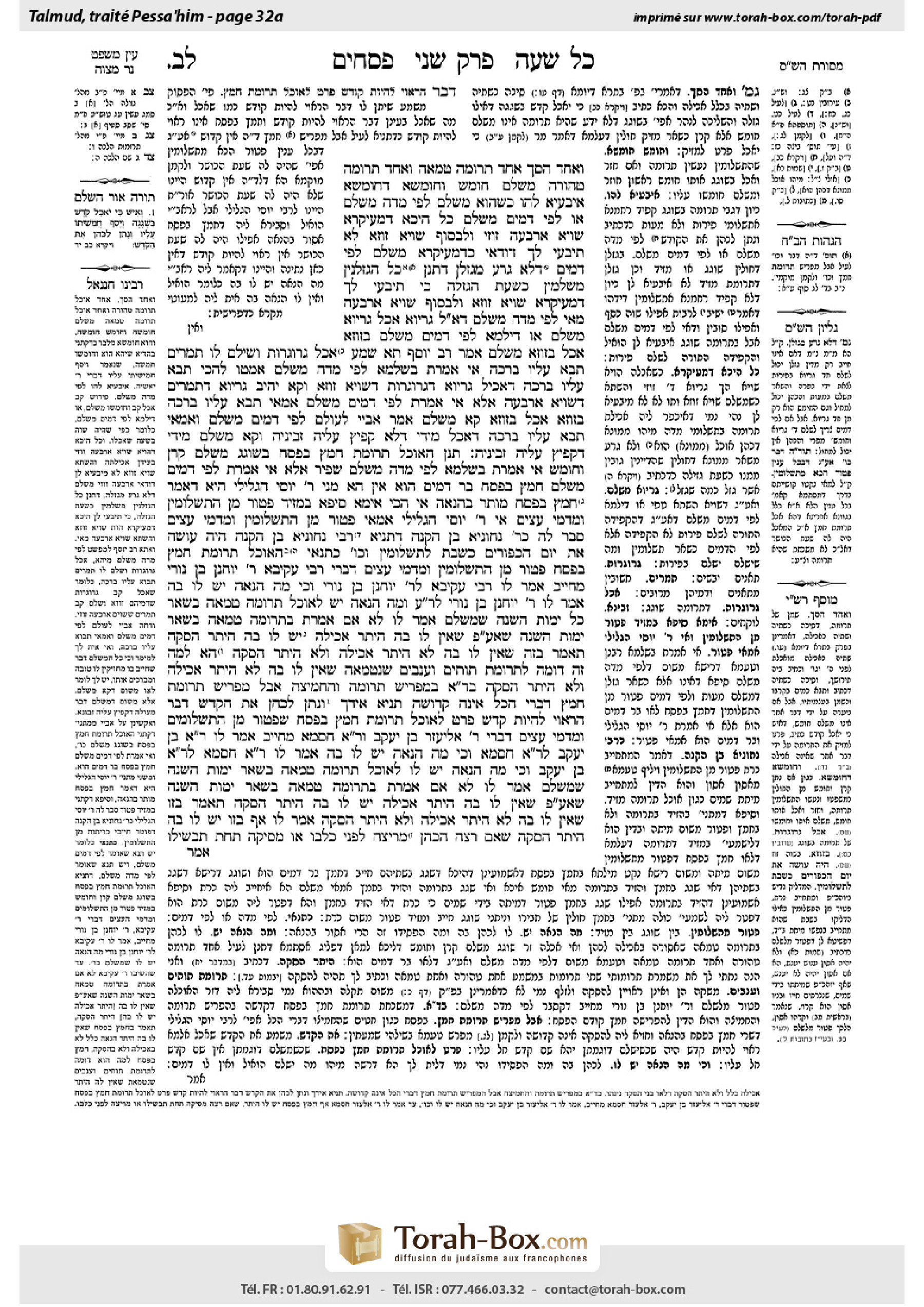
Pesachim 32a: Talmud study for Daf Yomi
Daf Yomi is the daily study of one Talmud folio. Explore 37 tractates with scans, Hebrew text, Sefaria English and AI-generated French translations where annotated.
Passage selection and English or AI-generated French translation are available where the scan has annotations. Daf Study is independent of Torah-Box and Sefaria.
Browse Pesachim · פסחים · All tractatesPesachim 32a text and translations
This page of Pesachim includes the Aramaic text, an English translation and an AI-generated French translation, alongside the scan above.
פסחים ל״ב א · Aramaic and Hebrew text
וְאֶחָד הַסָּךְ, אֶחָד תְּרוּמָה טְמֵאָה וְאֶחָד תְּרוּמָה טְהוֹרָה — מְשַׁלֵּם חוֹמֶשׁ וְחוּמְשָׁא דְחוּמְשָׁא.
אִיבַּעְיָא לְהוּ: כְּשֶׁהוּא מְשַׁלֵּם, לְפִי מִדָּה מְשַׁלֵּם אוֹ לְפִי דָמִים מְשַׁלֵּם? כׇּל הֵיכָא דְּמֵעִיקָּרָא שָׁוְיָא אַרְבְּעָה זוּזֵי וּלְבַסּוֹף שָׁוְיָא זוּזָא — לָא תִּיבְּעֵי לָךְ, דְּוַדַּאי כִּדְמֵעִיקָּרָא מְשַׁלֵּם לְפִי דָּמִים, דְּלָא גָּרַע מִגַּזְלָן. דִּתְנַן: כׇּל הַגַּזְלָנִין מְשַׁלְּמִין כִּשְׁעַת הַגְּזֵלָה,
כִּי תִּיבְּעֵי לָךְ דְּמֵעִיקָּרָא שָׁוְיָא זוּזָא וּלְבַסּוֹף שָׁוְיָא אַרְבְּעָה, מַאי? לְפִי מִדָּה מְשַׁלֵּם, דְּאָמַר לֵיהּ: גְּרִיוָא אֲכַל — גְּרִיוָא מְשַׁלֵּם. אוֹ דִילְמָא לְפִי דָמִים מְשַׁלֵּם: בְּזוּזָא אֲכַל — בְּזוּזָא מְשַׁלֵּם.
אָמַר רַב יוֹסֵף, תָּא שְׁמַע: אָכַל גְּרוֹגְרוֹת וְשִׁילֵּם לוֹ תְּמָרִים תָּבֹא עָלָיו בְּרָכָה. אִי אָמְרַתְּ בִּשְׁלָמָא לְפִי מִדָּה מְשַׁלֵּם — אַמְּטוּ לְהָכִי תָּבֹא עָלָיו בְּרָכָה, דְּאָכֵיל גְּרִיוָא דִגְרוֹגְרוֹת דְּשָׁוְיָא זוּזָא, וְקָא יָהֵיב גְּרִיוָא דִתְמָרִים דְּשָׁוְיָא אַרְבְּעָה. אֶלָּא אִי אָמְרַתְּ לְפִי דָמִים מְשַׁלֵּם — אַמַּאי תָּבֹא עָלָיו בְּרָכָה? בְּזוּזָא אֲכַל — בְּזוּזָא קָא מְשַׁלֵּם!
אָמַר אַבָּיֵי: לְעוֹלָם לְפִי דָמִים מְשַׁלֵּם, וְאַמַּאי תָּבֹא עָלָיו בְּרָכָה? דַּאֲכַל מִידֵּי דְּלָא קָפֵיץ עֲלֵיהּ זָבֹינֵיהּ, וְקָא מְשַׁלֵּם מִידֵּי דְּקָפֵיץ עֲלֵיהּ זָבֹינֵיהּ.
תְּנַן: הָאוֹכֵל תְּרוּמַת חָמֵץ בַּפֶּסַח, בְּשׁוֹגֵג מְשַׁלֵּם קֶרֶן וָחוֹמֶשׁ. אִי אָמְרַתְּ בִּשְׁלָמָא לְפִי מִדָּה מְשַׁלֵּם — שַׁפִּיר. אֶלָּא אִי אָמְרַתְּ לְפִי דָמִים מְשַׁלֵּם, חָמֵץ בַּפֶּסַח בַּר דָּמִים הוּא? אִין, הָא מַנִּי רַבִּי יוֹסֵי הַגְּלִילִי הִיא, דְּאָמַר חָמֵץ בַּפֶּסַח מוּתָּר בַּהֲנָאָה.
אִי הָכִי, אֵימָא סֵיפָא: בְּמֵזִיד פָּטוּר מִן הַתַּשְׁלוּמִין וּמִדְּמֵי עֵצִים, אִי רַבִּי יוֹסֵי הַגְּלִילִי, אַמַּאי פָּטוּר מִן הַתַּשְׁלוּמִין וּמִדְּמֵי עֵצִים?!
סָבַר לַהּ כְּרַבִּי נְחוּנְיָא בֶּן הַקָּנָה. דְּתַנְיָא: רַבִּי נְחוּנְיָא בֶּן הַקָּנָה הָיָה עוֹשֶׂה אֶת יוֹם הַכִּפּוּרִים כַּשַּׁבָּת לְתַשְׁלוּמִין וְכוּ׳.
כְּתַנָּאֵי: הָאוֹכֵל תְּרוּמַת חָמֵץ בַּפֶּסַח — פָּטוּר מִן הַתַּשְׁלוּמִין וּמִדְּמֵי עֵצִים, דִּבְרֵי רַבִּי עֲקִיבָא. רַבִּי יוֹחָנָן בֶּן נוּרִי מְחַיֵּיב. אָמַר לוֹ רַבִּי עֲקִיבָא לְרַבִּי יוֹחָנָן בֶּן נוּרִי: וְכִי מָה הֲנָאָה יֵשׁ לוֹ בָּהּ? אָמַר לוֹ רַבִּי יוֹחָנָן בֶּן נוּרִי לְרַבִּי עֲקִיבָא: וּמָה הֲנָאָה יֵשׁ לָאוֹכֵל תְּרוּמָה טְמֵאָה בִּשְׁאָר כׇּל יְמוֹת הַשָּׁנָה, שֶׁמְּשַׁלֵּם!
אָמַר לוֹ: לֹא! אִם אָמַרְתָּ בִּתְרוּמָה טְמֵאָה בִּשְׁאָר יְמוֹת הַשָּׁנָה, שֶׁאַף עַל פִּי שֶׁאֵין לוֹ בָּהּ הֶיתֵּר אֲכִילָה, יֵשׁ לוֹ בָּהּ הֶיתֵּר הַסָּקָה, תֹּאמַר בָּזֶה — שֶׁאֵין לוֹ בָּהּ לֹא הֶיתֵּר אֲכִילָה וְלֹא הֶיתֵּר הַסָּקָה! הָא לְמָה זֶה דּוֹמֶה — לִתְרוּמַת תּוּתִים וַעֲנָבִים שֶׁנִּטְמְאָה, שֶׁאֵין לוֹ בָּהּ לֹא הֶיתֵּר אֲכִילָה וְלֹא הֶיתֵּר הַסָּקָה.
בַּמֶּה דְּבָרִים אֲמוּרִים — בְּמַפְרִישׁ תְּרוּמָה וְהֶחֱמִיצָה, אֲבָל מַפְרִישׁ תְּרוּמַת חָמֵץ — דִּבְרֵי הַכֹּל אֵינָהּ קְדוֹשָׁה.
תַּנְיָא אִידַּךְ: ״וְנָתַן לַכֹּהֵן אֶת הַקֹּדֶשׁ״ — דָּבָר הָרָאוּי לִהְיוֹת קֹדֶשׁ. פְּרָט לָאוֹכֵל תְּרוּמַת חָמֵץ בַּפֶּסַח, שֶׁפָּטוּר מִן הַתַּשְׁלוּמִים וּמִדְּמֵי עֵצִים, דִּבְרֵי רַבִּי אֱלִיעֶזֶר בֶּן יַעֲקֹב. וְרַבִּי אֶלְעָזָר חַסָּמָא מְחַיֵּיב. אָמַר לוֹ רַבִּי אֱלִיעֶזֶר בֶּן יַעֲקֹב לְרַבִּי אֶלְעָזָר חַסָּמָא: וְכִי מָה הֲנָאָה יֵשׁ לוֹ בָּהּ? אָמַר לוֹ רַבִּי אֶלְעָזָר חַסָּמָא לְרַבִּי אֱלִיעֶזֶר בֶּן יַעֲקֹב: וְכִי מָה הֲנָאָה יֵשׁ לוֹ לָאוֹכֵל תְּרוּמָה טְמֵאָה בִּשְׁאָר יְמוֹת הַשָּׁנָה, שֶׁמְּשַׁלֵּם?
אָמַר לוֹ: לֹא! אִם אָמַרְתָּ בִּתְרוּמָה טְמֵאָה בִּשְׁאָר יְמוֹת הַשָּׁנָה, שֶׁאַף עַל פִּי שֶׁאֵין לוֹ בָּהּ הֶיתֵּר אֲכִילָה יֵשׁ לוֹ בָּהּ הֶיתֵּר הַסָּקָה, תֹּאמַר בָּזוֹ — שֶׁאֵין לוֹ בָּהּ לֹא הֶיתֵּר אֲכִילָה וְלֹא הֶיתֵּר הַסָּקָה! אָמַר לוֹ: אַף בְּזוֹ יֵשׁ לוֹ בָּהּ הֶיתֵּר הַסָּקָה, שֶׁאִם רָצָה הַכֹּהֵן — מְרִיצָהּ לִפְנֵי כַּלְבּוֹ, אוֹ מַסִּיקָהּ תַּחַת תַּבְשִׁילוֹ.
Pesachim 32a · English translation
And even with regard to one who anoints himself with the teruma oil, both in a case of ritually impure teruma as well as in a case of ritually pure teruma, he must pay an additional fifth if he unwittingly consumes this teruma. If he unwittingly consumes this fifth then he must pay an additional fifth of the fifth. The original fifth has a status comparable to teruma itself, and therefore one is required to pay an additional fifth for consuming it.
A dilemma was raised before the Sages with regard to the laws of teruma: When he pays for this teruma, does he pay according to the measure of the teruma or according to its monetary value? The Gemara explains the question in greater detail: Anywhere that the teruma is worth four zuz at the outset, i.e., at the time he consumed the teruma, and is worth only one zuz at the end, at the time of payment, do not raise a dilemma, for in that case he is certainly required to pay according to the monetary value at the outset. The rationale behind this ruling is that he is no worse than a thief, and therefore the law in this case is the same as if he had stolen property from another person. As we learned in a mishna: All thieves must repay what they have stolen according to the value of the stolen object at the time it was stolen, even if its value subsequently goes down.
You can raise the dilemma, however, with regard to a case where it was worth one zuz at the outset, when it was consumed, and at the end, at the time of the payment, it was worth four zuz. What is the ruling in that case? Does he pay according to the measure of teruma, as the treasurer of the consecrated property can say to him: You ate a se’a and you must pay a se’a, even if the value of the teruma has increased, or perhaps he must repay according to the monetary value, and if he ate a zuz worth of teruma then he must pay a zuz?
Rav Yosef said: Come and hear an answer to this question from what was taught in a baraita: One who ate dried figs that were teruma and paid the priest with dates, may a blessing rest upon him, as dates are worth more than dried figs. Granted, if you say that one must repay according to the measure of teruma he ate, it is due to this that a blessing should rest upon him, as he ate a se’a of dried figs that are worth one zuz and gave in return a se’a of dates worth four zuz. However, if you say that he must repay according to the monetary value of the teruma, then why should a blessing rest upon him? He ate a zuz worth of teruma and he paid a zuz worth as compensation; what is laudatory about his payment?
Abaye said: Actually, one can explain that he must repay according to the monetary value of the teruma, and why is it stated that a blessing should rest upon him? This is because he ate an item that buyers don’t jump at, i.e., it is undesirable to buyers, but paid with an item that buyers jump at. Consequently, although the produce he gives is worth no more than the produce he ate, the priest still prefers this type of payment, as he can more easily resell this produce.
The Gemara seeks proof with regard to this dispute: We learned in the mishna: One who unwittingly eats teruma of leavened bread on Passover must pay the principal and an additional fifth. Granted, if you say that he must pay according to the measure of teruma that he ate, it is well. As he ate a se’a of teruma he must also repay a se’a. However, if you say that he must pay according to the monetary value of the teruma, this is difficult, for is leavened bread on Passover of any monetary value? Certainly it is not worth anything, given that it is forbidden to benefit from this food. The Gemara answers: Yes, this leavened bread does indeed have monetary value. In accordance with whose opinion is this mishna? It is in accordance with the opinion of Rabbi Yosei HaGelili, who said that it is permissible to derive benefit from leavened bread on Passover.
The Gemara challenges this suggestion: If that is so, then say the latter clause of the mishna, where it is stated: If he consumes the teruma intentionally, then he is exempt from payment and from paying the priest for its monetary value as wood. But if this follows the opinion of Rabbi Yosei HaGelili, then why is he exempt from payment to the priest for the value of the teruma and for its monetary value in wood? Although he is exempt from paying the additional fifth as he acted intentionally, he nonetheless should be required to compensate the priest for the financial loss he caused him, as in any other case of theft.
The Gemara answers: He holds in accordance with the opinion of Rabbi Neḥunya ben HaKana, as it was taught in a baraita: Rabbi Neḥunya ben HaKana rendered the status of Yom Kippur the same as that of Shabbat with regard to payment. In his opinion, not only a person who committed a transgression punishable by a court-administered capital punishment, like one who desecrated Shabbat, is exempt from monetary payment incurred at the time of the transgression. Even one who is deserving of a divinely administered capital punishment, such as one who desecrates Yom Kippur and is punished with karet, is exempt from monetary payment for property he damaged in the course of such an act. Therefore, since one who consumes another person’s leavened bread during Passover is deserving of karet, he is exempt from monetary payment incurred by this act.
The Gemara comments: The question of whether one must repay according to the measurement or the monetary value of the teruma is like a dispute between tanna’im, as it was taught in the Tosefta: If one eats teruma of leavened bread on Passover, whether intentionally or unwittingly, then he is exempt from payment and for its monetary value in wood; this is the statement of Rabbi Akiva. Whereas Rabbi Yoḥanan ben Nuri deems him liable to pay. Rabbi Akiva said to Rabbi Yoḥanan ben Nuri: What benefit can he derive from this? What benefit could the priest have derived from this teruma as it is prohibited to benefit from this teruma and the teruma is therefore worthless? Rabbi Yoḥanan ben Nuri said to Rabbi Akiva: What benefit can one derive from eating ritually impure teruma on the rest of the days of the year, and yet nevertheless the non-priest is still obligated to pay for what he has taken. Despite the fact that a priest may not eat impure teruma, a non-priest must reimburse the priest for the principal of the teruma and add an additional fifth if he eats it.
Rabbi Akiva said to him: No, a distinction can be made between these two cases: If you say that he is obligated to pay in a case of ritually impure teruma on the rest of the days of the year, that although it is not permissible to eat it, the priest is nevertheless permitted to burn it and derive benefit from the heat generated as a result of this burning, shall you also say the same with regard to this, teruma of leavened bread during Passover, that is not permitted to be eaten or burned? Rather, to what may this be compared? It is similar to teruma of berries and grapes that became ritually impure, which is not permitted to be eaten or burned, as berries and grapes are unfit for firewood.
The Tosefta adds: In what case is this statement said, that these tanna’im disagree about the reimbursement for teruma? It was said with regard to a case where he separated teruma in a permitted manner and it became leavened during Passover. However, if he separated the teruma from leavened bread during Passover, then everyone agrees that it is not consecrated, as it is worthless.
It was taught in another baraita: With regard to the verse “And if a man eats a sacred thing in error, then he shall add a fifth part in addition to it, and shall give to the priest the sacred item” (Leviticus 22:14), the Sages expound as follows: He must give the priest an item that is fit to be consecrated, to the exclusion of one who eats teruma of leavened bread on Passover, who is exempt from payment of the teruma and even from paying its monetary value as wood; this is the statement of Rabbi Eliezer ben Ya’akov. Rabbi Elazar Ḥisma deems him liable to reimburse the priest for these items. Rabbi Eliezer ben Ya’akov said to Rabbi Elazar Ḥisma: What benefit can the priest derive from this teruma of leavened bread, as it is prohibited to benefit from it? Rabbi Elazar Ḥisma said to Rabbi Eliezer ben Ya’akov: What benefit can one derive from eating ritually impure teruma on the rest of the days of the year, and yet a non-priest who eats it must pay the priest.
Rabbi Eliezer ben Ya’akov said to him: No, a distinction can be made between these two cases: If you say he is obligated to pay in a case of ritually impure teruma on the rest of the days of year, that although it is not permissible to eat it, the priest is nonetheless permitted to burn it and derive benefit from the heat generated as a result of this burning, shall you say the same with regard to this, teruma of leavened bread during Passover, that is not permitted to be eaten or burned? Rabbi Elazar Ḥisma said to him: Even teruma of leavened bread on Passover is permitted to be burned, for if the priest wishes, he may throw it before his dog or burn it under his food, for Rabbi Elazar Ḥisma agrees with the opinion of Rabbi Yosei HaGelili that one may derive benefit from leavened bread during Passover.
Pesachim 32a · Traduction française (IA)
Et même celui qui s’enduit d’huile de terouma, qu’elle soit rituellement impure ou rituellement pure, doit payer le principal augmenté d’un cinquième s’il en consomme par inadvertance. S’il consomme ce cinquième par inadvertance, il doit payer un cinquième supplémentaire sur ce cinquième. Le cinquième initial a un statut comparable à celui de la terouma elle-même ; par conséquent, il faut payer un cinquième supplémentaire lorsqu’on le consomme.
Une question fut soulevée devant les Sages au sujet des lois de la terouma : lorsqu’il paie pour cette terouma, doit-il payer selon sa mesure ou selon sa valeur monétaire ? La Guemara précise la question : lorsque la terouma valait quatre zouz au départ, c’est-à-dire au moment où il l’a consommée, et ne vaut plus qu’un zouz à la fin, au moment du paiement, il n’y a pas lieu de s’interroger, car il doit certainement payer selon sa valeur monétaire au départ. En effet, il n’est pas dans une situation moins grave qu’un voleur, et la loi est donc la même que s’il avait volé le bien d’autrui. Comme nous l’avons appris dans une Michna : tous les voleurs doivent restituer ce qu’ils ont volé selon la valeur de l’objet au moment du vol, même si celle-ci baisse par la suite.
On peut toutefois soulever la question dans le cas où la terouma valait un zouz au départ, lorsqu’il l’a consommée, et en vaut quatre à la fin, au moment du paiement. Quelle est la règle dans ce cas ? Doit-il payer selon la mesure de la terouma, car le trésorier des biens consacrés peut lui dire : « Tu as mangé un séa et tu dois payer un séa », même si la valeur de la terouma a augmenté ; ou bien doit-il rembourser selon sa valeur monétaire, de sorte que, s’il a mangé de la terouma d’une valeur d’un zouz, il doit payer un zouz ?
Rav Yossef dit : « Viens et écoute la réponse à cette question, tirée de ce qui a été enseigné dans une baraïta : celui qui a mangé des figues sèches qui étaient de la terouma et a payé le prêtre en dattes — que la bénédiction repose sur lui —, car les dattes valent plus que les figues sèches. De fait, si tu dis qu’il doit rembourser selon la mesure de la terouma qu’il a mangée, il est juste qu’une bénédiction repose sur lui : il a mangé un séa de figues sèches valant un zouz et a donné en retour un séa de dattes valant quatre zouz. Mais si tu dis qu’il doit rembourser selon la valeur monétaire de la terouma, pourquoi une bénédiction reposerait-elle sur lui ? Il a mangé de la terouma valant un zouz et a payé une somme équivalente ; qu’y a-t-il de louable dans son paiement ? »
Abayé dit : « En réalité, on peut expliquer qu’il doit rembourser selon la valeur monétaire de la terouma. Pourquoi est-il alors dit qu’une bénédiction repose sur lui ? Parce qu’il a mangé un produit que les acheteurs ne s’arrachent pas, c’est-à-dire qui leur est peu recherché, et qu’il a payé avec un produit que les acheteurs s’arrachent. Ainsi, même si le produit qu’il donne ne vaut pas plus que celui qu’il a mangé, le prêtre préfère tout de même recevoir ce type de paiement, car il peut le revendre plus facilement. »
La Guemara cherche une preuve concernant cette controverse. Nous avons appris dans la Michna : celui qui mange par inadvertance de la terouma sous forme de pain levé à Pessa’h doit payer le principal augmenté d’un cinquième. Si tu dis qu’il doit payer selon la mesure de terouma qu’il a mangée, c’est logique : puisqu’il a mangé un séa de terouma, il doit également rendre un séa. Mais si tu dis qu’il doit payer selon la valeur monétaire de la terouma, cela pose une difficulté : le pain levé à Pessa’h a-t-il une quelconque valeur monétaire ? Il ne vaut certainement rien, puisqu’il est interdit d’en tirer profit. La Guemara répond : oui, ce pain levé a effectivement une valeur monétaire. Selon l’opinion de qui cette Michna est-elle formulée ? Selon celle de Rabbi Yossei HaGelili, qui a dit qu’il est permis de tirer profit du pain levé à Pessa’h.
La Guemara objecte à cette proposition : dans ce cas, énonce la dernière partie de la Michna, où il est dit que s’il consomme la terouma intentionnellement, il est exempt de paiement et n’a pas à verser au prêtre sa valeur monétaire comme bois. Mais si cela suit l’opinion de Rabbi Yossei HaGelili, pourquoi serait-il exempt de payer au prêtre la valeur de la terouma, c’est-à-dire sa valeur monétaire comme bois ? Bien qu’il soit exempt de payer le cinquième supplémentaire puisqu’il a agi intentionnellement, il devrait néanmoins être tenu d’indemniser le prêtre pour la perte financière qu’il lui a causée, comme dans tout autre cas de vol.
La Guemara répond : il suit l’opinion de Rabbi Neḥounya ben HaKana, comme il a été enseigné dans une baraïta : Rabbi Neḥounya ben HaKana a assimilé Yom Kippour à Chabbat en matière de paiement. Selon lui, non seulement celui qui commet une transgression passible de la peine capitale prononcée par un tribunal, comme celui qui profane Chabbat, est exempt du paiement des dommages causés au moment de la transgression, mais même celui qui mérite une peine capitale infligée par le Ciel, comme celui qui profane Yom Kippour et encourt le karet, est exempt d’indemniser autrui pour les biens qu’il a endommagés au cours d’un tel acte. Par conséquent, puisqu’une personne qui consomme le pain levé d’autrui pendant Pessa’h encourt le karet, elle est exemptée du paiement des dommages causés par cet acte.
La Guemara fait remarquer que la question de savoir s’il faut rembourser selon la mesure ou selon la valeur monétaire de la terouma correspond à une controverse entre tannaïm, comme il a été enseigné dans la Tosefta : si quelqu’un mange de la terouma sous forme de pain levé à Pessa’h, intentionnellement ou par inadvertance, il est exempt de paiement et n’a pas à payer sa valeur monétaire comme bois ; telle est la déclaration de Rabbi Akiva. Rabbi Yoḥanan ben Nouri, quant à lui, le déclare tenu de payer. Rabbi Akiva dit à Rabbi Yoḥanan ben Nouri : « Quel profit peut-il en tirer ? Quel profit le prêtre aurait-il pu tirer de cette terouma, puisqu’il est interdit d’en tirer profit et qu’elle ne vaut donc rien ? » Rabbi Yoḥanan ben Nouri dit à Rabbi Akiva : « Quel profit peut-on tirer de la consommation de terouma rituellement impure pendant le reste de l’année ? Pourtant, un non-prêtre est tout de même tenu de payer pour ce qu’il a pris. Bien qu’un prêtre ne puisse pas manger de terouma impure, un non-prêtre doit rembourser au prêtre le principal de la terouma et y ajouter un cinquième s’il la consomme. »
Rabbi Akiva lui dit : « Non, on peut établir une distinction entre ces deux cas. Si tu dis qu’il est tenu de payer dans le cas de terouma rituellement impure pendant le reste de l’année, c’est parce que, bien qu’il ne soit pas permis de la manger, le prêtre est néanmoins autorisé à la brûler et à tirer profit de la chaleur produite par cette combustion. Mais peux-tu en dire autant de cette terouma sous forme de pain levé pendant Pessa’h, qu’il n’est permis ni de manger ni de brûler ? À quoi faut-il plutôt la comparer ? À de la terouma constituée de baies et de raisins devenus rituellement impurs, qu’il n’est permis ni de manger ni de brûler, puisque les baies et les raisins ne conviennent pas comme combustible. »
La Tosefta ajoute : dans quel cas cette déclaration a-t-elle été faite, à savoir que ces tannaïm sont en désaccord au sujet du remboursement de la terouma ? Elle concerne le cas où il a séparé la terouma de manière licite, puis où celle-ci a levé pendant Pessa’h. En revanche, s’il a séparé la terouma à partir de pain levé pendant Pessa’h, tous reconnaissent qu’elle n’est pas consacrée, puisqu’elle ne vaut rien.
Une autre baraïta a été enseignée : au sujet du verset « Si un homme mange par erreur une chose sainte, il y ajoutera un cinquième et donnera au prêtre la chose sainte » (Lévitique 22, 14), les Sages interprètent ainsi : il doit donner au prêtre un bien qui peut être consacré. Cela exclut celui qui mange de la terouma sous forme de pain levé à Pessa’h, qui est exempt de payer la terouma et même sa valeur monétaire comme bois ; telle est la déclaration de Rabbi Eliezer ben Ya’akov. Rabbi Elazar Ḥisma le déclare, quant à lui, tenu d’indemniser le prêtre pour ces biens. Rabbi Eliezer ben Ya’akov dit à Rabbi Elazar Ḥisma : « Quel profit le prêtre peut-il tirer de cette terouma sous forme de pain levé, puisqu’il est interdit d’en tirer profit ? » Rabbi Elazar Ḥisma dit à Rabbi Eliezer ben Ya’akov : « Quel profit peut-on tirer de la consommation de terouma rituellement impure pendant le reste de l’année ? Pourtant, un non-prêtre qui en mange doit payer le prêtre. »
Rabbi Eliezer ben Ya’akov lui dit : « Non, on peut établir une distinction entre ces deux cas. Si tu dis qu’il est tenu de payer dans le cas de terouma rituellement impure pendant le reste de l’année, c’est parce que, bien qu’il ne soit pas permis de la manger, le prêtre est néanmoins autorisé à la brûler et à tirer profit de la chaleur produite par cette combustion. Mais peux-tu en dire autant de cette terouma sous forme de pain levé pendant Pessa’h, qu’il n’est permis ni de manger ni de brûler ? » Rabbi Elazar Ḥisma lui dit : « Même la terouma sous forme de pain levé à Pessa’h peut être brûlée, car si le prêtre le souhaite, il peut la jeter devant son chien ou la brûler sous ses aliments. Rabbi Elazar Ḥisma est en effet d’accord avec l’opinion de Rabbi Yossei HaGelili, selon laquelle on peut tirer profit du pain levé pendant Pessa’h. »
Traduction française générée par IA à partir de l’édition anglaise de Sefaria. Vérifie toujours un passage avec le texte source.
Text from Sefaria: William Davidson Edition - Vocalized Aramaic (CC BY NC); William Davidson Edition - English (CC BY NC).