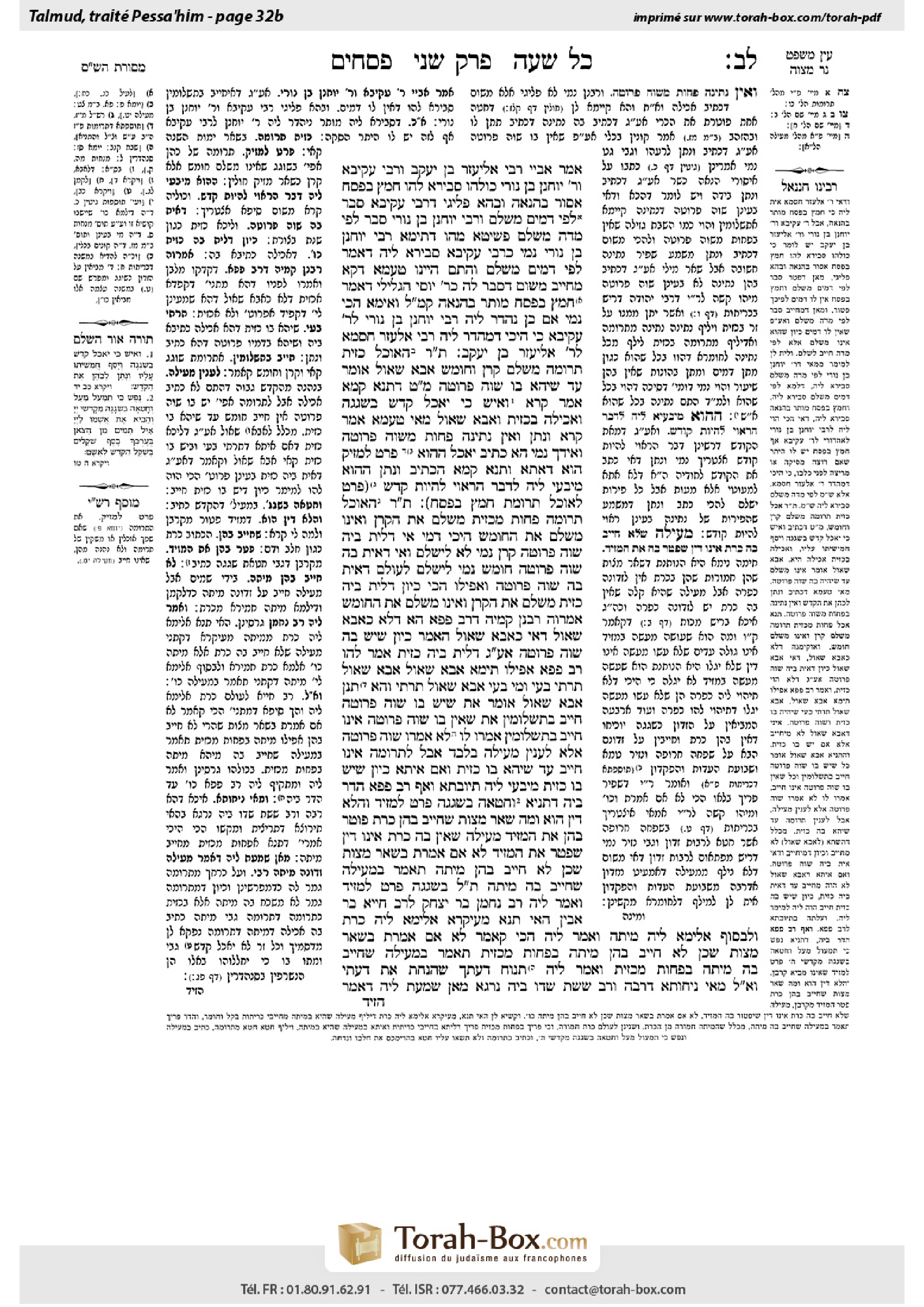
Pesachim 32b: Talmud study for Daf Yomi
Daf Yomi is the daily study of one Talmud folio. Explore 37 tractates with scans, Hebrew text, Sefaria English and AI-generated French translations where annotated.
Passage selection and English or AI-generated French translation are available where the scan has annotations. Daf Study is independent of Torah-Box and Sefaria.
Browse Pesachim · פסחים · All tractatesPesachim 32b text and translations
This page of Pesachim includes the Aramaic text, an English translation and an AI-generated French translation, alongside the scan above.
פסחים ל״ב ב · Aramaic and Hebrew text
אָמַר אַבָּיֵי: רַבִּי אֱלִיעֶזֶר בֶּן יַעֲקֹב וְרַבִּי עֲקִיבָא וְרַבִּי יוֹחָנָן בֶּן נוּרִי כּוּלְּהוּ סְבִירָא לְהוּ חָמֵץ בַּפֶּסַח אָסוּר בַּהֲנָאָה, וּבְהָא פְּלִיגִי, דְּרַבִּי עֲקִיבָא סָבַר: לְפִי דָמִים מְשַׁלֵּם, וְרַבִּי יוֹחָנָן בֶּן נוּרִי סָבַר: לְפִי מִדָּה מְשַׁלֵּם.
פְּשִׁיטָא! מַהוּ דְּתֵימָא: רַבִּי יוֹחָנָן בֶּן נוּרִי נָמֵי כְּרַבִּי עֲקִיבָא סְבִירָא לֵיהּ, דְּאָמַר לְפִי דָמִים מְשַׁלֵּם. וְהָתָם הַיְינוּ טַעְמָא דְּקָא מְחַיֵּיב — מִשּׁוּם דְּסָבַר לַהּ כְּרַבִּי יוֹסֵי הַגְּלִילִי, דְּאָמַר: חָמֵץ בַּפֶּסַח מוּתָּר בַּהֲנָאָה, קָא מַשְׁמַע לַן.
וְאֵימָא הָכִי נָמֵי? אִם כֵּן, נַהְדַּר לֵיהּ רַבִּי יוֹחָנָן בֶּן נוּרִי לְרַבִּי עֲקִיבָא כִּי הֵיכִי דְּמַהְדַּר לֵיהּ רַבִּי אֶלְעָזָר חַסָּמָא לְרַבִּי אֱלִיעֶזֶר בֶּן יַעֲקֹב.
תָּנוּ רַבָּנַן: הָאוֹכֵל כְּזַיִת תְּרוּמָה מְשַׁלֵּם קֶרֶן וָחוֹמֶשׁ, אַבָּא שָׁאוּל אוֹמֵר: עַד שֶׁיְּהֵא בּוֹ שָׁוֶה פְּרוּטָה. מַאי טַעְמָא דְּתַנָּא קַמָּא — אָמַר קְרָא: ״וְאִישׁ כִּי יֹאכַל קֹדֶשׁ בִּשְׁגָגָה״, וַאֲכִילָה בִּכְזַיִת.
וְאַבָּא שָׁאוּל, מַאי טַעְמָא? אָמַר קְרָא: ״וְנָתַן״, וְאֵין נְתִינָה פָּחוֹת מִשָּׁוֶה פְּרוּטָה. וְאִידַּךְ נָמֵי, הָא כְּתִיב ״יֹאכַל״! הָהוּא, פְּרָט לְמַזִּיק הוּא דַּאֲתָא.
וְתַנָּא קַמָּא, הָכְתִיב ״וְנָתַן״! הַהוּא מִיבְּעֵי לֵיהּ לְדָבָר הָרָאוּי לִהְיוֹת קֹדֶשׁ (פְּרָט לָאוֹכֵל תְּרוּמַת חָמֵץ בַּפֶּסַח).
תָּנוּ רַבָּנַן: הָאוֹכֵל תְּרוּמָה פָּחוֹת מִכְּזַיִת — מְשַׁלֵּם אֶת הַקֶּרֶן וְאֵינוֹ מְשַׁלֵּם אֶת הַחוֹמֶשׁ. הֵיכִי דָּמֵי? אִי דְּלֵית בֵּיהּ שָׁוֶה פְּרוּטָה — קֶרֶן נָמֵי לָא לִישַׁלֵּם, וְאִי דְּאִית בֵּהּ שָׁוֶה פְּרוּטָה — חוֹמֶשׁ נָמֵי לִישַׁלֵּם! לְעוֹלָם דְּאִית בֵּהּ שָׁוֶה פְּרוּטָה, וַאֲפִילּוּ הָכִי, כֵּיוָן דְּלֵית בֵּיהּ כְּזַיִת — מְשַׁלֵּם אֶת הַקֶּרֶן וְאֵינוֹ מְשַׁלֵּם אֶת הַחוֹמֶשׁ.
אַמְרוּהָ רַבָּנַן קַמֵּיהּ דְּרַב פָּפָּא הָא דְּלָא כְּאַבָּא שָׁאוּל, דְּאִי כְּאַבָּא שָׁאוּל, הָאָמַר: כֵּיוָן שֶׁיֵּשׁ בָּהּ שָׁוֶה פְּרוּטָה, אַף עַל גַּב דְּלֵית בֵּיהּ כְּזַיִת. אָמַר לְהוּ רַב פָּפָּא: אֲפִילּוּ תֵּימָא אַבָּא שָׁאוּל, אַבָּא שָׁאוּל תַּרְתֵּי בָּעֵי.
וּמִי בָּעֵי אַבָּא שָׁאוּל תַּרְתֵּי? וְהָא תְּנַן, אַבָּא שָׁאוּל אוֹמֵר: אֶת שֶׁיֵּשׁ בּוֹ שָׁוֶה פְּרוּטָה — חַיָּיב בְּתַשְׁלוּמִין, אֶת שֶׁאֵין בּוֹ שָׁוֶה פְּרוּטָה — אֵינוֹ חַיָּיב בְּתַשְׁלוּמִין. אָמְרוּ לוֹ: לֹא אָמְרוּ שָׁוֶה פְּרוּטָה אֶלָּא לְעִנְיַן מְעִילָה בִּלְבַד, אֲבָל לִתְרוּמָה — אֵינוֹ חַיָּיב עַד שֶׁיְּהֵא בּוֹ כְּזַיִת. וְאִם אִיתָא, ״כֵּיוָן שֶׁיֵּשׁ בּוֹ כְּזַיִת״ מִיבְּעֵי לֵיהּ. תְּיוּבְתָּא.
וְאַף רַב פָּפָּא הֲדַר בֵּיהּ, דְּתַנְיָא: ״וְחָטְאָה בִּשְׁגָגָה״ — פְּרָט לְמֵזִיד. וַהֲלֹא דִּין הוּא: וּמָה שְׁאָר מִצְוֹת שֶׁחַיָּיב בָּהֶן כָּרֵת — פּוֹטֵר בָּהֶן אֶת הַמֵּזִיד, מְעִילָה שֶׁאֵין בָּהּ כָּרֵת — אֵינוֹ דִּין שֶׁפָּטַר אֶת הַמֵּזִיד?
לֹא! אִם אָמַרְתָּ בִּשְׁאָר מִצְוֹת שֶׁכֵּן לֹא חִיֵּיב בָּהֶן מִיתָה, תֹּאמַר בִּמְעִילָה, שֶׁחִיֵּיב בָּהּ מִיתָה! תַּלְמוּד לוֹמַר: ״בִּשְׁגָגָה״ — פְּרָט לְמֵזִיד.
וַאֲמַר לֵיהּ רַב נַחְמָן בַּר יִצְחָק לְרַב חִיָּיא בַּר אָבִין: הַאי תַּנָּא מֵעִיקָּרָא אַלִּימָא לֵיהּ כָּרֵת, וּלְבַסּוֹף אַלִּימָא לֵיהּ מִיתָה!
וַאֲמַר לֵיהּ, הָכִי קָאָמַר: לֹא! אִם אָמַרְתָּ בִּשְׁאָר מִצְוֹת — שֶׁכֵּן לֹא חִיֵּיב בָּהֶן מִיתָה בְּפָחוֹת מִכְּזַיִת, תֹּאמַר בִּמְעִילָה — שֶׁחִיֵּיב בָּהּ מִיתָה בְּפָחוֹת מִכְּזַיִת. וַאֲמַר לֵיהּ: תָּנוּחַ דַּעְתְּךָ שֶׁהִנַּחְתָּ אֶת דַּעְתִּי. וַאֲמַר לֵיהּ: מַאי נִיחוּתָא, דְּרַבָּה וְרַב שֵׁשֶׁת שָׁדוּ בֵּיהּ נַרְגָּא: מַאן שָׁמְעַתְּ לֵיהּ דְּאָמַר
Pesachim 32b · English translation
Abaye said: Rabbi Eliezer ben Ya’akov, Rabbi Akiva, and Rabbi Yoḥanan ben Nuri all hold that it is forbidden to derive benefit from leavened bread during Passover. And they disagree with regard to the following issue: Rabbi Akiva holds that one pays according to the monetary value, and therefore he need not pay anything for consuming teruma of leavened bread during Passover. And Rabbi Yoḥanan ben Nuri holds that one pays according to the measure of teruma that he consumed, such that even if he ate teruma of leavened bread on Passover he must repay this amount.
The Gemara asks: Isn’t this obvious? There does not seem to be another way to explain these opinions. The Gemara rejects this question: This statement is necessary lest you say that Rabbi Yoḥanan ben Nuri also holds in accordance with the opinion of Rabbi Akiva that states that one must pay according to the monetary value of the teruma. And there, in the case of leavened bread, this is the reason that Rabbi Yoḥanan ben Nuri deems him liable to pay for the teruma because he holds in accordance with the opinion of Rabbi Yosei HaGelili, who said: It is permissible to derive benefit from leavened bread during Passover. Therefore, he teaches us that Rabbi Yoḥanan ben Nuri agrees that one may not derive benefit from leavened bread during Passover.
The Gemara suggests: And say it is indeed so, that Rabbi Yoḥanan ben Nuri accepts Rabbi Yosei HaGelili’s position. The Gemara rejects this possibility: If this was the case, then Rabbi Yoḥanan ben Nuri should have responded to Rabbi Akiva in the same way that Rabbi Elazar Ḥisma responded to Rabbi Eliezer ben Ya’akov, by saying that this leavened bread may be fed to a dog thus deriving benefit from it. Since he did not offer this answer, it is clear that he agrees that deriving benefit from leavened bread during Passover is forbidden.
After mentioning cases where a person damages teruma, the Gemara continues with a discussion of this topic. The Rabbis taught: A non-priest who eats an olive-bulk of teruma must pay the principal value of the teruma itself and an additional fifth. Abba Shaul says: He is not required to pay unless the teruma he ate is worth a peruta. The Gemara explains: What is the reason for the opinion of the first tanna? It is because the verse states: “And if a man eats a sacred item in error, then he shall add a fifth part in addition to it, and he shall give to the priest the sacred item” (Leviticus 22:14). The minimal amount that is halakhically considered eating is an olive-bulk.
And what is the reason for the opinion of Abba Shaul? The verse states: “And he shall give,” and giving less than the value of a peruta is not legally considered to be giving. The Gemara asks: And according to the other one, Abba Shaul, too, isn’t it written: “Eats,” implying that there must be at least an olive-bulk portion? The Gemara answers: That verse comes to exclude one who damages teruma without deriving benefit from it, such that he is exempt from the requirement to add an additional fifth. This is derived from the fact that the verse specifies that only one who eats is required to add a fifth.
And according to the first tanna, one can ask: Isn’t it written “And he shall give”? The Gemara answers: That phrase is necessary to teach the requirement that teruma must be an item that is fit to be consecrated, as an item cannot become teruma unless it is has some value. This is meant to exclude one who eats teruma of leavened bread on Passover, since it is worthless and therefore cannot be designated as teruma.
The Sages taught in a baraita: One who eats less than an olive-bulk of teruma must pay the principal, but is not required to pay the additional fifth. The Gemara asks: What are the circumstances of this case? If there was not the value of a peruta of teruma, then he should also not be required to pay for the principal either, because that is less than the amount for which one is obligated to pay. But if there was the value of a peruta of teruma, then he should be required to pay the additional fifth as well. The Gemara explains the case: Actually, it should be understood that there was the value of a peruta of teruma, and nonetheless, since the food was not at least an olive-bulk, he is required to pay only the principal, but he does not pay the additional fifth.
The Sages said before Rav Pappa that this halakha is not in accordance with the opinion of Abba Shaul. As, if it were in accordance with the opinion of Abba Shaul, didn’t he say: One is obligated to pay because there is the value of a peruta, even if it is not at least an olive-bulk? Rav Pappa said to them: This is no proof, as even if you say that this halakha is in accordance with the opinion of Abba Shaul, Abba Shaul requires two conditions: That the teruma be at least an olive-bulk in volume, and that it be worth at least a peruta.
The Gemara asks: Does Abba Shaul actually require two conditions? Didn’t we learn in the mishna that Abba Shaul says: For that food which is at least the value of a peruta of teruma, one is liable to pay compensation to the priest, but for that food which does not contain the value of a peruta of teruma, he is not liable to pay compensation to the priest? The Rabbis said to Abba Shaul: They said that the item must be worth a peruta only with regard to misuse of consecrated items; however, with regard to teruma, one is liable to reimburse the priest only when he eats an olive-bulk or more. And if it is so, that Abba Shaul requires both conditions, and this is a case where there is an olive-bulk, then the Rabbis should have worded their objection differently. They should have said: Since it is at least an olive-bulk, he is liable to pay, even though it is not worth a peruta. The Gemara concludes: Indeed, this is a conclusive refutation, and Rav Pappa’s position is rejected.
The Gemara notes that Rav Pappa himself also retracted this explanation. As it was taught in a baraita with regard to the verse: “If any one commits a trespass, and sins through error, in the sacred items of the Lord, then he shall bring his guilt-offering to the Lord, a ram without blemish from the flock, according to your valuation in silver shekels, after the shekel of the sanctuary, for a guilt-offering” (Leviticus 5:15), the baraita explains: The phrase “and sins through error” excludes one who sins intentionally through misuse of consecrated property. Could this not be derived through an a fortiori inference, as follows: Just as with regard to other mitzvot for which one is liable to receive karet the verse exempts one from bringing an offering when the transgression was committed intentionally, is it not right that with regard to misuse of consecrated property, which does not incur the punishment of karet, it should exempt one who acts intentionally?
The baraita rejects this claim: No, if you say that this is true with regard to the rest of the mitzvot, even those for which one is liable to receive karet, for which one is not liable to receive the death penalty if he violates them, shall you also say that this is the case with regard to misuse of consecrated items, for which one is liable to receive the death penalty, as this offense is punishable by death at the hand of Heaven? Since one cannot logically deduce this principle, the verse states “through error” to exclude one who acted intentionally.
And Rav Naḥman bar Yitzḥak said to Rav Ḥiyya bar Avin in wonderment with regard to this baraita: This tanna initially considers the punishment of karet to be stronger by assuming that misuse of consecrated property was less severe because it was not punished by karet, and subsequently he considers the punishment of death at the hand of Heaven to be stronger by stating that one cannot deduce this principle from other sins whose punishment is not death at the hand of Heaven.
And Rav Ḥiyya bar Avin said to him that it is possible to maintain the accepted position that karet is more stringent by explaining that this is what he is saying: No, these are incomparable for the following reason: If you say that one is exempt from an offering when he violates the rest of the mitzvot, for which one is not liable to receive death at the hand of Heaven if he eats less than an olive-bulk of a forbidden substance, shall you also say that this is the case with regard to misuse of consecrated property, for which one is liable to receive death at the hand of Heaven if he eats less than an olive-bulk? Rav Naḥman bar Yitzḥak said to him: May your mind be settled, as you have settled my mind and put it at ease by answering this question that was troubling me. Rav Ḥiyya bar Avin said to him: What is settling about this explanation? Rabba and Rav Sheshet threw an axe at my answer; i.e., they reject my explanation, as follows: Who did you hear that said
Pesachim 32b · Traduction française (IA)
Abaye dit : Rabbi Eliezer ben Ya’akov, Rabbi Akiva et Rabbi Yoḥanan ben Nuri sont tous d’avis qu’il est interdit de tirer profit du pain levé pendant Pessa’h. Ils sont en désaccord sur le point suivant : Rabbi Akiva estime que le paiement est calculé d’après la valeur monétaire ; il n’a donc rien à payer pour avoir consommé de la terouma constituée de pain levé pendant Pessa’h. Rabbi Yoḥanan ben Nuri estime, lui, que le paiement est calculé d’après la quantité de terouma consommée ; ainsi, même s’il a mangé de la terouma constituée de pain levé pendant Pessa’h, il doit rembourser cette quantité.
La Guemara demande : N’est-ce pas évident ? Il ne semble pas y avoir d’autre façon d’expliquer ces opinions. La Guemara rejette cette question : Cette déclaration est nécessaire, de peur que tu ne dises que Rabbi Yoḥanan ben Nuri est également d’accord avec l’opinion de Rabbi Akiva, selon laquelle le paiement doit être calculé d’après la valeur monétaire de la terouma. Dans le cas du pain levé, la raison pour laquelle Rabbi Yoḥanan ben Nuri le considère redevable du paiement de la terouma serait alors qu’il suit l’opinion de Rabbi Yosei HaGelili, qui a dit qu’il est permis de tirer profit du pain levé pendant Pessa’h. Il nous enseigne donc que Rabbi Yoḥanan ben Nuri convient qu’il est interdit de tirer profit du pain levé pendant Pessa’h.
La Guemara propose : Et si l’on disait que c’est bien le cas, et que Rabbi Yoḥanan ben Nuri accepte la position de Rabbi Yosei HaGelili ? La Guemara rejette cette possibilité : Si tel était le cas, Rabbi Yoḥanan ben Nuri aurait dû répondre à Rabbi Akiva comme Rabbi Elazar Ḥisma avait répondu à Rabbi Eliezer ben Ya’akov, en disant que ce pain levé peut être donné à un chien, ce qui permet d’en tirer profit. Puisqu’il n’a pas formulé cette réponse, il est clair qu’il convient qu’il est interdit de tirer profit du pain levé pendant Pessa’h.
Après avoir mentionné des cas où une personne cause un dommage à de la terouma, la Guemara poursuit la discussion de ce sujet. Les Sages ont enseigné : Un non-prêtre qui mange le volume d’une olive de terouma doit payer la valeur de la terouma elle-même, ainsi qu’un cinquième supplémentaire. Abba Shaul dit : Il n’est tenu de payer que si la terouma qu’il a mangée vaut au moins une perouta. La Guemara explique : Quelle est la raison de l’opinion du premier tanna ? Le verset dit : « Si un homme mange par erreur d’une chose sainte, il y ajoutera un cinquième et donnera au prêtre la chose sainte » (Lévitique 22, 14). La quantité minimale considérée par la halakha comme une consommation est le volume d’une olive.
Et quelle est la raison de l’opinion d’Abba Shaul ? Le verset dit : « Et il donnera », or donner une valeur inférieure à une perouta n’est pas juridiquement considéré comme un don. La Guemara demande : Et pour Abba Shaul, l’autre tanna, n’est-il pas également écrit « mange », ce qui implique qu’il faut au moins le volume d’une olive ? La Guemara répond : Ce verset vient exclure celui qui cause un dommage à de la terouma sans en tirer profit ; il est alors dispensé de l’obligation d’ajouter un cinquième. On le déduit du fait que le verset précise que seul celui qui mange doit ajouter un cinquième.
Et concernant le premier tanna, on peut demander : N’est-il pas écrit « Et il donnera » ? La Guemara répond : Cette expression est nécessaire pour enseigner que la terouma doit être un bien susceptible d’être consacré, car un bien ne peut devenir de la terouma que s’il a une certaine valeur. Cela exclut celui qui mange de la terouma constituée de pain levé pendant Pessa’h, puisque celle-ci n’a aucune valeur et ne peut donc être désignée comme terouma.
Les Sages ont enseigné dans une baraïta : Celui qui mange moins que le volume d’une olive de terouma doit en payer la valeur principale, mais n’est pas tenu de payer le cinquième supplémentaire. La Guemara demande : Dans quelles circonstances ? Si la terouma ne valait pas une perouta, il ne devrait pas non plus être tenu de payer la valeur principale, car cette somme est inférieure au montant à partir duquel le paiement est obligatoire. Mais si la terouma valait une perouta, il devrait également être tenu de payer le cinquième supplémentaire. La Guemara explique le cas : En réalité, il faut comprendre que la terouma valait une perouta ; néanmoins, puisque la quantité consommée n’atteignait pas le volume d’une olive, il ne doit payer que la valeur principale, et non le cinquième supplémentaire.
Les Sages dirent à Rav Pappa que cette halakha ne suit pas l’opinion d’Abba Shaul. En effet, si elle suivait son opinion, n’a-t-il pas dit qu’on est tenu de payer dès lors que la terouma vaut une perouta, même si elle n’atteint pas le volume d’une olive ? Rav Pappa leur dit : Ce n’est pas une preuve, car même si vous dites que cette halakha suit l’opinion d’Abba Shaul, celui-ci exige deux conditions : que la terouma atteigne au moins le volume d’une olive et qu’elle vaille au moins une perouta.
La Guemara demande : Abba Shaul exige-t-il réellement deux conditions ? N’avons-nous pas appris dans la Michna qu’Abba Shaul dit : Pour cette nourriture dont la terouma vaut au moins une perouta, on est tenu de dédommager le prêtre ; mais pour cette nourriture dont la terouma ne vaut pas une perouta, on n’est pas tenu de dédommager le prêtre ? Les Sages dirent à Abba Shaul : Ils ont dit que l’objet doit valoir une perouta uniquement en ce qui concerne le détournement d’objets consacrés ; en revanche, pour la terouma, on n’est tenu de rembourser le prêtre que lorsqu’on en mange le volume d’une olive ou davantage. Or, si Abba Shaul exige les deux conditions et qu’il s’agit ici d’un cas où la quantité atteint le volume d’une olive, les Sages auraient dû formuler leur objection autrement. Ils auraient dû dire : Puisque la quantité atteint au moins le volume d’une olive, il est tenu de payer, même si elle ne vaut pas une perouta. La Guemara conclut : En effet, c’est une réfutation décisive, et la position de Rav Pappa est rejetée.
La Guemara relève que Rav Pappa lui-même est également revenu sur cette explication. En effet, une baraïta a été enseignée au sujet du verset : « Si quelqu’un commet une infidélité et pèche par erreur à propos des choses saintes de l’Éternel, il apportera à l’Éternel son sacrifice de culpabilité : un bélier sans défaut du troupeau, évalué en shekels d’argent, selon le shekel du sanctuaire, comme sacrifice de culpabilité » (Lévitique 5, 15). La baraïta explique : L’expression « et pèche par erreur » exclut celui qui commet intentionnellement un détournement de biens consacrés. Ne pourrait-on pas le déduire par raisonnement a fortiori, de la manière suivante : de même que, pour les autres mitsvot dont la transgression est passible de karet, le verset dispense d’apporter un sacrifice lorsque la transgression a été commise intentionnellement, n’est-il pas d’autant plus juste que, pour le détournement de biens consacrés, qui n’entraîne pas la peine de karet, celui qui agit intentionnellement en soit dispensé ?
La baraïta rejette cette affirmation : Non. Si tu dis que cela est vrai pour les autres mitsvot, même celles dont la transgression est passible de karet mais non de la peine de mort, diras-tu aussi qu’il en est ainsi pour le détournement d’objets consacrés, qui est passible de la peine de mort, puisque cette faute est punie de mort par la main du Ciel ? Puisqu’on ne peut déduire ce principe par raisonnement, le verset dit « par erreur » pour exclure celui qui a agi intentionnellement.
Et Rav Naḥman bar Yitzḥak dit avec étonnement à Rav Ḥiyya bar Avin au sujet de cette baraïta : Au début, ce tanna considère la peine de karet comme plus grave, puisqu’il suppose que le détournement de biens consacrés est moins sévère parce qu’il n’est pas puni de karet ; puis il considère que la mort par la main du Ciel est plus grave, puisqu’il affirme qu’on ne peut déduire ce principe d’autres fautes qui ne sont pas punies de mort par la main du Ciel.
Et Rav Ḥiyya bar Avin lui répondit qu’il est possible de maintenir la position admise, selon laquelle le karet est plus sévère, en expliquant que voici ce qu’il dit : Non, ces cas ne sont pas comparables, pour la raison suivante : si tu dis qu’on est dispensé d’apporter un sacrifice lorsqu’on transgresse les autres mitsvot — pour lesquelles on n’est pas passible de mort par la main du Ciel si l’on mange moins que le volume d’une olive d’une substance interdite —, diras-tu aussi qu’il en est ainsi pour le détournement de biens consacrés, pour lequel on est passible de mort par la main du Ciel si l’on en mange moins que le volume d’une olive ? Rav Naḥman bar Yitzḥak lui dit : Que ton esprit soit apaisé, car tu as apaisé mon esprit en répondant à cette question qui me troublait. Rav Ḥiyya bar Avin lui dit : Qu’y a-t-il d’apaisant dans cette explication ? Rabba et Rav Sheshet ont lancé une hache contre ma réponse, c’est-à-dire qu’ils rejettent mon explication, comme suit : Qui as-tu entendu dire
Traduction française générée par IA à partir de l’édition anglaise de Sefaria. Vérifie toujours un passage avec le texte source.
Text from Sefaria: William Davidson Edition - Vocalized Aramaic (CC BY NC); William Davidson Edition - English (CC BY NC).