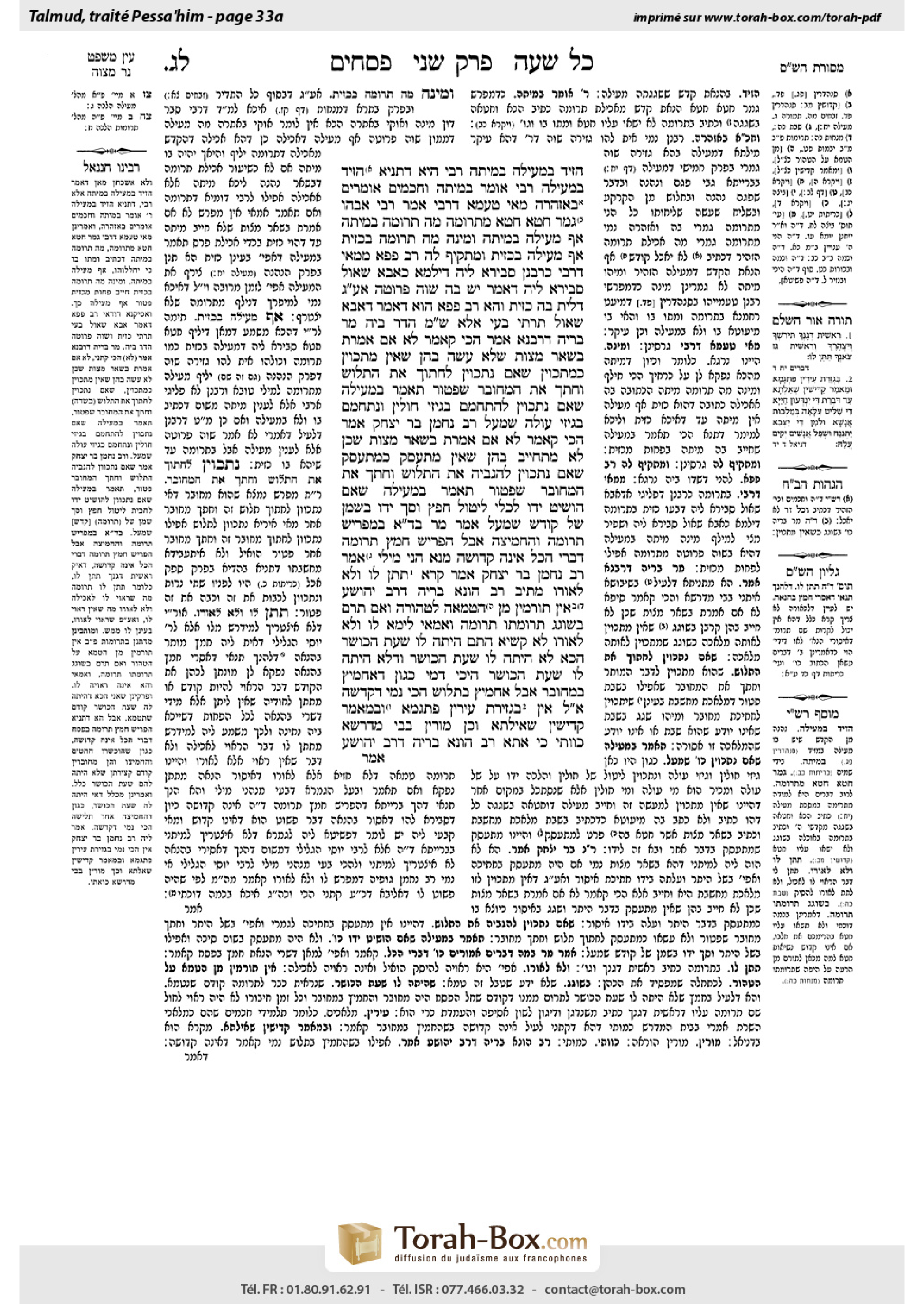
Pesachim 33a: Talmud study for Daf Yomi
Daf Yomi is the daily study of one Talmud folio. Explore 37 tractates with scans, Hebrew text, Sefaria English and AI-generated French translations where annotated.
Passage selection and English or AI-generated French translation are available where the scan has annotations. Daf Study is independent of Torah-Box and Sefaria.
Browse Pesachim · פסחים · All tractatesPesachim 33a text and translations
This page of Pesachim includes the Aramaic text, an English translation and an AI-generated French translation, alongside the scan above.
פסחים ל״ג א · Aramaic and Hebrew text
הֵזִיד בִּמְעִילָה בְּמִיתָה — רַבִּי הִיא, דְּתַנְיָא: הֵזִיד בִּמְעִילָה, רַבִּי אוֹמֵר: בְּמִיתָה, וַחֲכָמִים אוֹמְרִים: בָּאַזְהָרָה.
מַאי טַעְמָא דְּרַבִּי? אָמַר רַבִּי אֲבָהוּ: גָּמַר ״חֵטְא״ ״חֵטְא״ מִתְּרוּמָה. מָה תְּרוּמָה בְּמִיתָה — אַף מְעִילָה בְּמִיתָה.
וּמִינַּהּ: מָה תְּרוּמָה בִּכְזַיִת אַף מְעִילָה בִּכְזַיִת!
וּמַתְקִיף לַהּ רַב פָּפָּא: מִמַּאי דְּרַבִּי כְּרַבָּנַן סְבִירָא לֵיהּ? דִּילְמָא כְּאַבָּא שָׁאוּל סְבִירָא לֵיהּ, דְּאָמַר: יֵשׁ בָּהּ שָׁוֶה פְּרוּטָה — אַף עַל גַּב דְּלֵית בַּהּ כְּזַיִת.
וְהָא רַב פָּפָּא הוּא דְּאָמַר דְּאַבָּא שָׁאוּל תַּרְתֵּי בָּעֵי, אֶלָּא שְׁמַע מִינַּהּ: הֲדַר בֵּיהּ.
מָר בְּרֵיהּ דְּרַבְנָא אָמַר, הָכִי קָאָמַר: לֹא! אִם אָמַרְתָּ בִּשְׁאָר מִצְוֹת — שֶׁלֹּא עָשָׂה בָּהֶן שֶׁאֵין מִתְכַּוֵּין כְּמִתְכַּוֵּין, שֶׁאִם נִתְכַּוֵּין לַחְתּוֹךְ אֶת הַתָּלוּשׁ וְחָתַךְ אֶת הַמְחוּבָּר — שֶׁפָּטוּר, תֹּאמַר בִּמְעִילָה, שֶׁאִם נִתְכַּוֵּין לְהִתְחַמֵּם בְּגִיזֵּי חוּלִּין וְנִתְחַמֵּם בְּגִיזֵּי עוֹלָה — שֶׁמָּעַל.
רַב נַחְמָן בַּר יִצְחָק אָמַר, הָכִי קָאָמַר: לֹא! אִם אָמַרְתָּ בִּשְׁאָר מִצְוֹת, שֶׁכֵּן לֹא מִתְחַיֵּיב בָּהֶן שֶׁאֵין מִתְעַסֵּק כְּמִתְעַסֵּק, שֶׁאִם נִתְכַּוֵּין לְהַגְבִּיהַּ אֶת הַתָּלוּשׁ, וְחָתַךְ אֶת הַמְחוּבָּר — שֶׁפָּטוּר. תֹּאמַר בִּמְעִילָה, שֶׁאִם הוֹשִׁיט יָדוֹ לִכְלִי לִיטּוֹל חֵפֶץ וְסָךְ יָדוֹ בְּשֶׁמֶן שֶׁל קוֹדֶשׁ — שֶׁמָּעַל.
אָמַר מָר: בַּמֶּה דְּבָרִים אֲמוּרִים — בְּמַפְרִישׁ תְּרוּמָה וְהֶחְמִיצָה, אֲבָל הִפְרִישׁ חָמֵץ תְּרוּמָה — דִּבְרֵי הַכֹּל אֵינָהּ קְדוֹשָׁה.
מְנָא הָנֵי מִילֵּי? אָמַר רַב נַחְמָן בַּר יִצְחָק, אָמַר קְרָא: ״תִּתֵּן לוֹ״ — וְלֹא לְאוּרוֹ.
מֵתִיב רַב הוּנָא בְּרֵיהּ דְּרַב יְהוֹשֻׁעַ: אֵין תּוֹרְמִין מִן הַטְּמֵאָה לַטְּהוֹרָה, וְאִם תָּרַם בְּשׁוֹגֵג — תְּרוּמָתוֹ תְּרוּמָה. וְאַמַּאי? לֵימָא: ״לוֹ״ וְלֹא לְאוּרוֹ! לָא קַשְׁיָא: הָתָם הָיְתָה לוֹ שְׁעַת הַכּוֹשֶׁר, הָכָא לֹא הָיְתָה לוֹ שְׁעַת הַכּוֹשֶׁר.
וּדְלֹא הָיְתָה לוֹ שְׁעַת הַכּוֹשֶׁר, הֵיכִי דָּמֵי? כְּגוֹן דְּאַחְמֵיץ בִּמְחוּבָּר. אֲבָל אַחְמֵיץ בְּתָלוּשׁ — הָכִי נָמֵי דְּקָדְשָׁה? אֲמַר לֵיהּ: אִין, ״בִּגְזֵירַת עִירִין פִּתְגָמָא וּבְמֵאמַר קַדִּישִׁין שְׁאֵילְתָא״, וְכֵן מוֹרִין בְּבֵי מִדְרְשָׁא כְּווֹתִי.
כִּי אֲתָא רַב הוּנָא בְּרֵיהּ דְּרַב יְהוֹשֻׁעַ,
Pesachim 33a · English translation
that one who intentionally misuses consecrated items is liable to receive death at the hand of Heaven? It is Rabbi Yehuda HaNasi. As it was taught in a baraita: With regard to one who intentionally misuses consecrated items, Rabbi Yehuda HaNasi says that he is liable to receive death at the hand of Heaven. The Rabbis say: he violates a warning, a standard prohibition, and is flogged.
The Gemara asks: What is the reason for the opinion of Rabbi Yehuda HaNasi? From where does he derive his opinion? Rabbi Abbahu said: He derives it by means of a verbal analogy between the word sin stated with regard to misuse of consecrated items and the word sin stated with regard to teruma. With regard to misuse of consecrated items, the verse states: “If any one commits a trespass, and sins through error, in the sacred items of the Lord” (Leviticus 5:15); with regard to teruma, the verse states: “Lest they bear sin for it, and die due to it, if they profane it” (Leviticus 22:9). Rabbi Yehuda HaNasi makes the following comparison: Just as eating teruma is punishable by the death penalty, so too, misusing consecrated items is punishable by the death penalty.
From this verbal analogy, the comparison between teruma and misuse of consecrated property can be extended to other issues as well: Just as one is punished only for eating at least an olive-bulk of teruma, so too, one is punished for misusing consecrated items only if there is at least an olive-bulk of consecrated items. This indicates that the baraita cannot be explained in accordance with the opinion of Abba Shaul, who requires that the item be worth at least a peruta.
Rav Pappa strongly objects to Rav Sheshet and Rabba’s rejection of the explanation of the baraita: From where do you know that Rabbi Yehuda HaNasi holds in accordance with the opinion of the Rabbis that one is only punished after eating an olive-bulk of teruma? Perhaps he holds in accordance with the opinion of Abba Shaul, who said one is liable for eating teruma provided the food contains the value of a peruta of teruma, even if it is less than an olive-bulk. As the halakhot of misuse of consecrated items are derived from teruma, one is liable for eating both teruma and consecrated items only if the object is worth at least a peruta. As such, Rav Ḥiyya bar Avin’s explanation of the baraita should not be rejected.
With regard to the issue mentioned previously, the Gemara asks: But isn’t Rav Pappa the one who said that Abba Shaul said that it requires two conditions, that the object be worth a peruta and that it be an olive-bulk in volume? Rather, learn from this that Rav Pappa retracted his statement with regard to Abba Shaul’s opinion.
Mar, son of Rabbana, said the following to resolve the difficulty in the baraita: This is what it is saying: No, if you say that one is exempt from an offering with regard to the rest of the mitzvot, where acting without intent is not treated as though one acted with intent, i.e., if one intended to cut something that is detached from the ground on Shabbat, which is not prohibited by Torah law, and mistakenly cut something that is attached to the ground, then he is exempt because he acted without intent; shall you also say the same with regard to misuse of consecrated items, about which the halakha is stringent, such that if one intended to warm himself with non-sacred wool shearings, and owing to an error or lack of information he warmed himself with shearings from a burnt-offering, then he has misused consecrated property? Thus, misuse of consecrated property is more stringent than other commandments, in that one violates it even when acting without intent, and one cannot deduce the halakha in the case of misuse of consecrated property from the halakha in the case of the rest of the mitzvot.
Rav Naḥman bar Yitzḥak said that the baraita should be understood differently, and this is what it is saying: No, if you say this leniency with regard to rest of the mitzvot, where one who is acting unawares is not liable in the same way as one who is acting aware of his actions, such as in a case where one intended to perform a permitted act and mistakenly performed a prohibited one, i.e., if one intended to lift something that is detached from the ground, but his knife happened to cut something that is attached to the ground, in violation of the act of harvesting on Shabbat, then he is exempt; shall you also say the same with regard to misuse of consecrated items, where if one places his hand in a vessel to take an object and unknowingly places his hand in consecrated oil then he has misused consecrated items? Therefore, misuse of consecrated items is more stringent than other commandments, as one commits the sin of misusing consecrated property even if he uses the consecrated object while attempting to perform a different action and is unaware that he is performing a prohibited act.
The Master said above in the baraita: In what case is this statement said that the tanna’im disagree with regard to the obligation to pay for teruma of leavened bread? It is said with regard to a case where one separated teruma in a permitted manner and it became leavened during Passover. However, if he separated teruma from leavened bread during Passover, everyone agrees that it is not consecrated since it is worthless.
The Gemara asks: From where are these matters derived, that a worthless item cannot be designated as teruma? Rav Naḥman bar Yitzḥak said that the verse states: “The first fruits of your grain, your wine, your oil, and the first of the fleece of your sheep, shall you give to him” (Deuteronomy 18:4), and not to his fire. One must give the priest something that he can use for any purpose, and not something that the priest will be forced to burn as fuel. Even those who permit one to derive benefit from leavened bread during Passover agree that it may not be eaten, and therefore leavened bread cannot be consecrated as teruma in this case.
Rav Huna, son of Rav Yehoshua, raised an objection based on that which was taught in a mishna: One may not separate teruma from ritually impure produce for ritually pure produce, but if one unwittingly separated it in this manner then his teruma is valid teruma. And why should this be valid teruma? Let the priest say: The verse requires that the teruma be given “to him” and not to his fire, and this ritually impure teruma must be burned. In that case, why should this produce actually become teruma? The Gemara answers: This is not difficult. There, in the case of impure teruma, it had a period of fitness, and it could have been given as teruma before it became impure. Here, in the case of leavened bread, it did not ever have a period of fitness, and therefore it cannot be consecrated as teruma.
The Gemara asks: What are the circumstances in which this leavened bread did not have a period of fitness even on Passover? This could have happened only in a case where it became leavened while it was still attached to the ground and could not yet become teruma. However, if it became leavened after being detached from the ground, then can this leavened bread indeed become consecrated as teruma, even though the baraita indicates that no leavened bread can be designated as teruma during Passover? Rav Naḥman bar Yitzhak said to Rav Huna, son of Rav Yehoshua: Yes, this is indeed the case despite this puzzling limitation, and the biblical expression can be applied homiletically: “The matter is by the decree of the watchers, and the sentence by the word of the sacred ones” (Daniel 4:14). The Sages, who are compared to celestial beings, agree with my statement. And so too, in the study hall, they teach in accordance with my opinion, despite the puzzling nature of this ruling.
When Rav Huna, son of Rav Yehoshua, came,
Pesachim 33a · Traduction française (IA)
que celui qui détourne intentionnellement des biens consacrés est passible de mort par la main du Ciel ? Il s’agit de Rabbi Yehouda HaNassi. Comme il a été enseigné dans une baraïta : celui qui détourne intentionnellement des biens consacrés, dit Rabbi Yehouda HaNassi, est passible de mort par la main du Ciel. Les Sages disent : il transgresse une interdiction ordinaire et est passible de flagellation.
La Guemara demande : Quelle est la raison de l’opinion de Rabbi Yehouda HaNassi ? De quel verset la déduit-il ? Rabbi Abbahou dit : il la déduit au moyen d’une analogie verbale entre le terme « péché », employé à propos du détournement de biens consacrés, et le terme « péché », employé à propos de la terouma. À propos du détournement de biens consacrés, le verset dit : « Si quelqu’un commet une infidélité et pèche par inadvertance à l’égard des choses consacrées à l’Éternel » (Lévitique 5, 15) ; à propos de la terouma, le verset dit : « De peur qu’ils ne portent la faute qui leur vaudrait la mort, s’ils la profanaient » (Lévitique 22, 9). Rabbi Yehouda HaNassi établit la comparaison suivante : de même que manger de la terouma est passible de la peine de mort, détourner des biens consacrés est également passible de la peine de mort.
À partir de cette analogie verbale, la comparaison entre la terouma et le détournement de biens consacrés peut aussi être étendue à d’autres questions : de même qu’on n’est puni que pour avoir mangé au moins le volume d’une olive de terouma, on n’est puni pour avoir détourné des biens consacrés que si la quantité en cause atteint au moins le volume d’une olive. Cela indique que la baraïta ne peut être expliquée conformément à l’opinion d’Abba Shaoul, qui exige que l’objet vaille au moins une perouta.
Rav Pappa s’oppose vivement au rejet, par Rav Sheshet et Rabba, de l’explication de la baraïta : d’où savez-vous que Rabbi Yehouda HaNassi partage l’opinion des Sages, selon laquelle on n’est puni qu’après avoir mangé le volume d’une olive de terouma ? Peut-être partage-t-il l’opinion d’Abba Shaoul, qui dit qu’on est passible d’une peine pour avoir mangé de la terouma dès lors que l’aliment vaut une perouta de terouma, même si son volume est inférieur à celui d’une olive. Puisque les lois relatives au détournement de biens consacrés sont déduites de celles de la terouma, on n’est passible d’une peine pour avoir mangé de la terouma comme pour avoir détourné des biens consacrés que si l’objet vaut au moins une perouta. Par conséquent, il ne faut pas rejeter l’explication de la baraïta donnée par Rav Ḥiyya bar Avin.
À propos de la question évoquée précédemment, la Guemara demande : Mais n’est-ce pas Rav Pappa qui a dit qu’Abba Shaoul exige deux conditions : que l’objet vaille une perouta et qu’il ait le volume d’une olive ? Il faut donc plutôt en déduire que Rav Pappa est revenu sur sa déclaration concernant l’opinion d’Abba Shaoul.
Mar, fils de Rabbana, dit ce qui suit pour résoudre la difficulté soulevée par la baraïta : voici ce qu’elle dit : Non, si tu dis qu’on est exempté d’offrande pour les autres mitsvot, où agir sans intention n’est pas considéré comme agir avec intention — par exemple, si quelqu’un avait l’intention de couper un objet détaché du sol, ce qui n’est pas interdit par la Torah, mais qu’il a par erreur coupé un objet encore attaché au sol, il est exempt parce qu’il a agi sans intention —, diras-tu la même chose du détournement de biens consacrés, à propos duquel la halakha est stricte, au point que si quelqu’un avait l’intention de se réchauffer avec de la laine non consacrée issue de la tonte, mais que, par erreur ou par ignorance, il s’est réchauffé avec de la laine provenant d’un holocauste, il a détourné des biens consacrés ? Ainsi, le détournement de biens consacrés est plus strict que les autres commandements, car on le transgresse même en agissant sans intention ; on ne peut donc pas déduire la halakha concernant le détournement de biens consacrés de celle qui s’applique aux autres mitsvot.
Rav Naḥman bar Yitzḥak dit qu’il faut comprendre autrement la baraïta ; voici ce qu’elle dit : Non, si tu dis que cette indulgence s’applique aux autres mitsvot, où celui qui agit sans s’en rendre compte n’est pas passible de la même peine que celui qui agit en connaissance de cause, par exemple lorsqu’il a l’intention d’accomplir un acte permis, mais accomplit par erreur un acte interdit — si quelqu’un avait l’intention de soulever un objet détaché du sol, mais que son couteau a par hasard coupé un objet encore attaché au sol, transgressant ainsi l’interdit de moissonner pendant Chabbat, il est exempt —, diras-tu la même chose du détournement de biens consacrés, où, si quelqu’un met la main dans un récipient pour prendre un objet et met à son insu la main dans de l’huile consacrée, il a détourné des biens consacrés ? Le détournement de biens consacrés est donc plus strict que les autres commandements, puisqu’on commet cette faute même si l’on utilise l’objet consacré en cherchant à accomplir une autre action et sans savoir que l’on accomplit un acte interdit.
Le Maître a dit plus haut dans la baraïta : dans quel cas a-t-on dit que les tannaïm sont en désaccord au sujet de l’obligation de payer pour de la terouma constituée de pain levé ? Il s’agit du cas où quelqu’un a prélevé la terouma de manière permise et où celle-ci a levé pendant Pessaḥ. En revanche, si quelqu’un a prélevé de la terouma sur du pain levé pendant Pessaḥ, tous conviennent qu’elle n’est pas consacrée, puisqu’elle est sans valeur.
La Guemara demande : D’où déduit-on qu’un objet sans valeur ne peut pas être désigné comme terouma ? Rav Naḥman bar Yitzḥak dit que le verset enseigne : « Tu lui donneras les prémices de ton blé, de ton vin, de ton huile et de la première laine de tes moutons » (Deutéronome 18, 4), et non à son feu. Il faut donner au prêtre quelque chose dont il puisse faire ce qu’il veut, et non quelque chose qu’il sera obligé de brûler comme combustible. Même ceux qui permettent de tirer profit du pain levé pendant Pessaḥ conviennent qu’on ne peut pas le manger ; le pain levé ne peut donc pas, dans ce cas, être consacré comme terouma.
Rav Houna, fils de Rav Yehoshoua, souleva une objection fondée sur ce qui a été enseigné dans une Michna : on ne peut pas prélever de terouma sur des produits impurs au profit de produits purs ; toutefois, si quelqu’un l’a fait par inadvertance, sa terouma est valide. Pourquoi cette terouma serait-elle valide ? Que le prêtre dise : le verset exige que la terouma soit donnée « à lui », et non à son feu ; or cette terouma impure doit être brûlée. Dans ce cas, pourquoi ces produits deviendraient-ils effectivement de la terouma ? La Guemara répond : cela ne présente pas de difficulté. Dans le cas de la terouma impure, elle avait été apte à être utilisée pendant un certain temps : elle aurait pu être donnée comme terouma avant de devenir impure. Ici, dans le cas du pain levé, il n’a jamais été apte à être utilisé ; il ne peut donc pas être consacré comme terouma.
La Guemara demande : Dans quelles circonstances ce pain levé n’a-t-il jamais été apte à être utilisé, même pendant Pessaḥ ? Cela n’a pu se produire que s’il a levé alors qu’il était encore attaché au sol et ne pouvait pas encore devenir de la terouma. Mais s’il a levé après avoir été détaché du sol, ce pain levé peut-il vraiment être consacré comme terouma, alors que la baraïta indique qu’aucun pain levé ne peut être désigné comme terouma pendant Pessaḥ ? Rav Naḥman bar Yitzḥak dit à Rav Houna, fils de Rav Yehoshoua : oui, c’est bien le cas, malgré cette restriction déroutante, et l’expression biblique peut être interprétée par homilétique : « La chose est par décret des veilleurs, et la sentence par la parole des saints » (Daniel 4, 14). Les Sages, qui sont comparés à des êtres célestes, sont d’accord avec mon propos. De même, dans la maison d’étude, on enseigne conformément à mon opinion, malgré le caractère déroutant de cette décision.
Lorsque Rav Houna, fils de Rav Yehoshoua, arriva,
Traduction française générée par IA à partir de l’édition anglaise de Sefaria. Vérifie toujours un passage avec le texte source.
Text from Sefaria: William Davidson Edition - Vocalized Aramaic (CC BY NC); William Davidson Edition - English (CC BY NC).