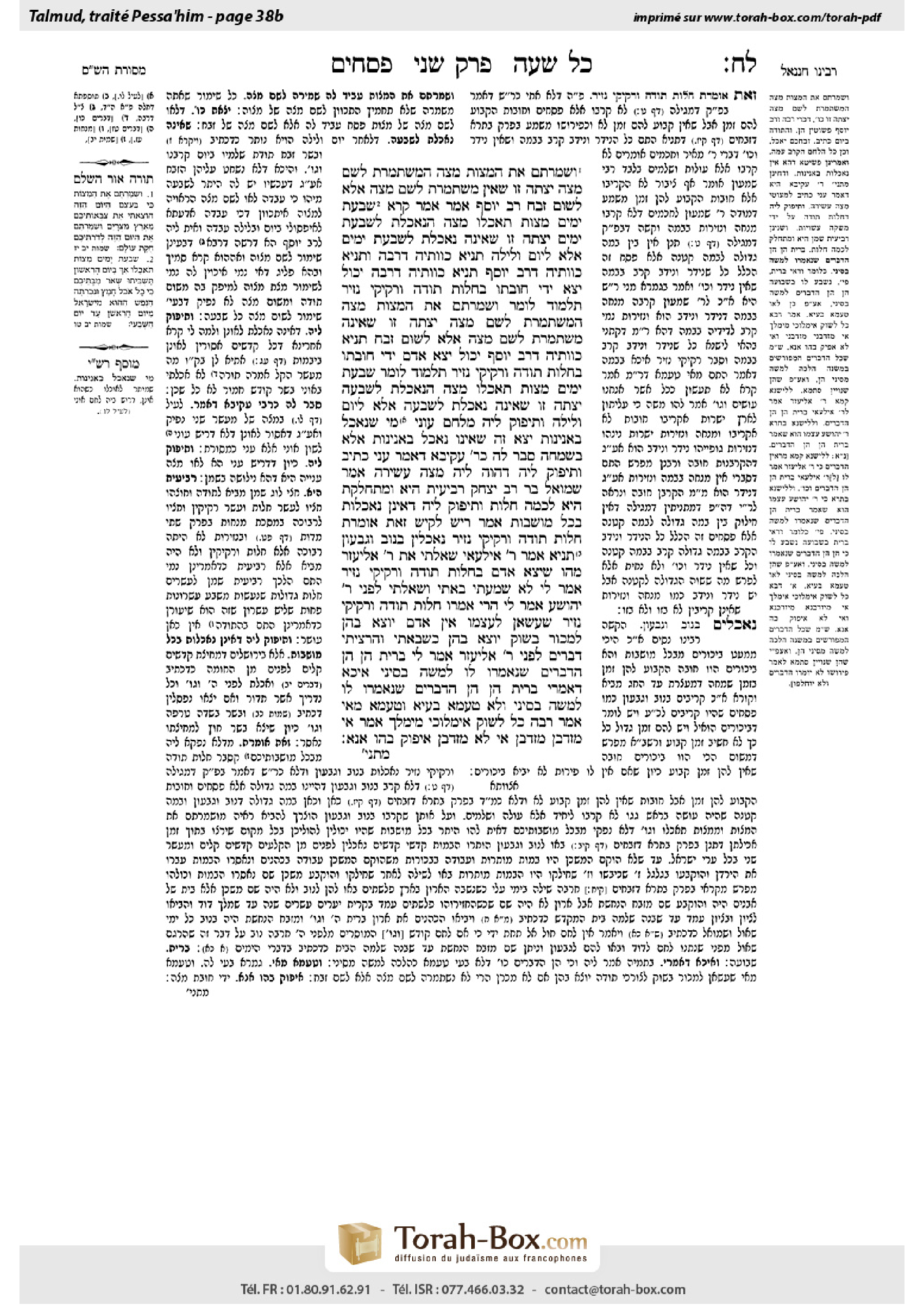
Pesachim 38b: Talmud study for Daf Yomi
Daf Yomi is the daily study of one Talmud folio. Explore 37 tractates with scans, Hebrew text, Sefaria English and AI-generated French translations where annotated.
Passage selection and English or AI-generated French translation are available where the scan has annotations. Daf Study is independent of Torah-Box and Sefaria.
Browse Pesachim · פסחים · All tractatesPesachim 38b text and translations
This page of Pesachim includes the Aramaic text, an English translation and an AI-generated French translation, alongside the scan above.
פסחים ל״ח ב · Aramaic and Hebrew text
״וּשְׁמַרְתֶּם אֶת הַמַּצּוֹת״ — מַצָּה הַמִּשְׁתַּמֶּרֶת לְשֵׁם מַצָּה. יָצְתָה זוֹ שֶׁאֵין מִשְׁתַּמֶּרֶת לְשֵׁם מַצָּה, אֶלָּא לְשׁוּם זֶבַח.
רַב יוֹסֵף אָמַר, אָמַר קְרָא: ״שִׁבְעַת יָמִים מַצּוֹת תֹּאכֵלוּ״ — מַצָּה הַנֶּאֱכֶלֶת לְשִׁבְעַת יָמִים. יָצְתָה זוֹ שֶׁאֵינָהּ נֶאֱכֶלֶת לְשִׁבְעַת יָמִים, אֶלָּא לְיוֹם וָלַיְלָה.
תַּנְיָא כְּווֹתֵיהּ דְּרַבָּה, וְתַנְיָא כְּווֹתֵיהּ דְּרַב יוֹסֵף. תַּנְיָא כְּווֹתֵיהּ דְּרַבָּה: יָכוֹל יֵצֵא יְדֵי חוֹבָתוֹ בְּחַלּוֹת תּוֹדָה וּרְקִיקֵי נָזִיר, תַּלְמוּד לוֹמַר: ״וּשְׁמַרְתֶּם אֶת הַמַּצּוֹת״ — מַצָּה הַמִּשְׁתַּמֶּרֶת לְשֵׁם מַצָּה. יָצְתָה זוֹ שֶׁאֵינָהּ מִשְׁתַּמֶּרֶת לְשֵׁם מַצָּה, אֶלָּא לְשׁוּם זֶבַח.
תַּנְיָא כְּווֹתֵיהּ דְּרַב יוֹסֵף: יָכוֹל יֵצֵא אָדָם יְדֵי חוֹבָתוֹ בְּחַלּוֹת תּוֹדָה וּרְקִיקֵי נָזִיר, תַּלְמוּד לוֹמַר: ״שִׁבְעַת יָמִים מַצּוֹת תֹּאכֵלוּ״ — מַצָּה הַנֶּאֱכֶלֶת לְשִׁבְעָה. יָצְתָה זוֹ שֶׁאֵינָהּ נֶאֱכֶלֶת לְשִׁבְעָה, אֶלָּא לְיוֹם וָלַיְלָה.
וְתִיפּוֹק לֵיהּ מִ״לֶּחֶם עֹנִי״ — מִי שֶׁנֶּאֱכָל בַּאֲנִינוּת. יָצָא זֶה שֶׁאֵינוֹ נֶאֱכָל בַּאֲנִינוּת, אֶלָּא בְּשִׂמְחָה!
סָבַר לַהּ כְּרַבִּי עֲקִיבָא, דְּאָמַר ״עָנִי״ כְּתִיב.
וְתִיפּוֹק לֵיהּ דְּהָוֵה לֵיהּ מַצָּה עֲשִׁירָה!
אָמַר שְׁמוּאֵל בַּר רַב יִצְחָק: רְבִיעִית הִיא, וּמִתְחַלֶּקֶת הִיא לְכַמָּה חַלּוֹת.
וְתִיפּוֹק לֵיהּ דְּאֵינָן נֶאֱכָלוֹת בְּכׇל מוֹשָׁבוֹת!
אָמַר רֵישׁ לָקִישׁ: זֹאת אוֹמֶרֶת חַלּוֹת תּוֹדָה וּרְקִיקֵי נָזִיר נֶאֱכָלִין בְּנוֹב וְגִבְעוֹן.
תַּנְיָא, אָמַר רַבִּי אִילְעַאי: שָׁאַלְתִּי אֶת רַבִּי אֱלִיעֶזֶר — מַהוּ שֶׁיֵּצֵא אָדָם בְּחַלּוֹת תּוֹדָה וּרְקִיקֵי נָזִיר? אָמַר לִי: לֹא שָׁמַעְתִּי. בָּאתִי וְשָׁאַלְתִּי לִפְנֵי רַבִּי יְהוֹשֻׁעַ, אָמַר לִי: הֲרֵי אָמְרוּ, חַלּוֹת תּוֹדָה וּרְקִיקֵי נָזִיר שֶׁעֲשָׂאָן לְעַצְמוֹ — אֵין אָדָם יוֹצֵא בָּהֶן, לִמְכּוֹר בַּשּׁוּק — יוֹצֵא בָּהֶן.
כְּשֶׁבָּאתִי וְהִרְצֵיתִי דְּבָרִים לִפְנֵי רַבִּי אֱלִיעֶזֶר, אָמַר לִי: בְּרִית! הֵן הֵן הַדְּבָרִים שֶׁנֶּאֶמְרוּ לוֹ לְמֹשֶׁה בְּסִינַי. אִיכָּא דְּאָמְרִי: בְּרִית, הֵן הֵן הַדְּבָרִים שֶׁנֶּאֶמְרוּ לוֹ לְמֹשֶׁה בְּסִינַי? וְלָא טַעְמָא בָּעֲיָא?!
וְטַעְמָא מַאי? אָמַר רַבָּה: כֹּל לַשּׁוּק אִימְּלוֹכֵי מִימְּלֵךְ. אָמַר: אִי מִזְדַּבַּן — מִזְדַּבַּן, אִי לָא מִזְדַּבַּן — אִיפּוֹק בְּהוּ אֲנָא.
Pesachim 38b · English translation
“And you shall guard the matzot” (Exodus 12:17). This verse teaches that one may use only matza that has been guarded from becoming leavened for the purpose of matza, i.e., with the intention of fulfilling one’s obligation of matza with it. This explanation excludes this matza, which was prepared for a nazirite or a thanks-offering and which was not guarded for the purpose of matza but for the purpose of a sacrifice.
Rav Yosef said a different reason: One may not use matza prepared for a nazirite or a thanks-offering because the verse states: “Seven days you shall eat matzot” (Exodus 12:15), which indicates that one can fulfill his obligation only with matza that can be eaten for all seven days. This requirement excludes this matza, which is of nazirite’s wafers or the loaves of a thanks-offering and which cannot be eaten for seven days, but only for one day and one night.
The Gemara comments: It was taught in a baraita in accordance with the opinion of Rabba, and it was taught in a baraita in accordance with the opinion of Rav Yosef. The Gemara elaborates: It was taught in a baraita in accordance with the opinion of Rabba: I might have thought that one can fulfill his obligation to eat matza with the loaves of a thanks-offering or a nazirite’s wafers; therefore, the verse states: “And you shall guard the matzot,” indicating that one must use matza that has been guarded from becoming leavened for the purpose of matza on Passover. This requirement excludes this matza, which was not guarded for the purpose of matza but for the purpose of a sacrifice.
It was taught in a baraita in accordance with the opinion of Rav Yosef: I might have thought that a person can fulfill his obligation to eat matza with the loaves of a thanks-offering or a nazirite’s wafers; therefore, the verse states: “Seven days you shall eat matzot,” from which it is inferred that one must fulfill this obligation with matza that can be eaten for all seven days. This requirement excludes this matza, as it cannot be eaten for seven days but only for a day and a night.
The Gemara asks a question of both opinions: And let him derive this halakha, that one cannot fulfill his obligation to eat matza with the loaves of a thanks-offering or a nazirite’s wafers, from the phrase “bread of affliction [leḥem oni]” (Deuteronomy 16:3). According to Rabbi Yosei HaGelili, this phrase means: One can fulfill his obligation to eat matza only with food that may be eaten in a state of acute mourning. This requirement excludes this matza, i.e., the loaves of the thanks-offering and the nazirite wafers, which is not eaten in a state of acute mourning but in a state of joy, as an acute mourner is prohibited from eating sacrificial foods.
The Gemara answers: Rabba and Rav Yosef both maintain in accordance with the opinion of Rabbi Akiva, who said that since oni, meaning poverty, is written, the matza must be bread of poverty. According to Rabbi Akiva, this phrase does not teach the halakha pertaining to consumption by acute mourners.
The Gemara asks another question: And let him derive this halakha, that one cannot fulfill his obligation to eat matza with the loaves of a thanks-offering or a nazirite’s wafers, from the fact that it is matza ashira, enhanced matza, as both the loaves of the thanks-offering and the nazirite’s wafers contain oil. Matza that contains ingredients besides flour and water is classified as matza ashira and cannot be used for the mitzva of eating matza on the first night of Passover.
Shmuel bar Rav Yitzḥak said: This is an incorrect definition, as the total amount of oil in these loaves or wafers is only a quarter-log, and as this small amount of oil is divided between several loaves, it is nullified in the mixture. Consequently, the loaves of the thanks-offering and the nazirite’s wafers are not matza ashira.
The Gemara again asks: And let him derive this halakha, that one cannot fulfill his obligation to eat matza with the loaves of a thanks-offering or a nazirite’s wafers from that fact that these types of bread cannot be eaten in every habitation. It was previously stated that the obligation to eat matza can be fulfilled only with food that can be eaten anywhere in Israel, whereas offerings may be eaten only in Jerusalem.
Reish Lakish said: That is to say, the loaves of the thanks-offering and the nazirite’s wafers may be eaten in Nov and Givon. In other words, the omission of this reason indicates that offerings could have been sacrificed on the communal altars during the period when improvised altars were permitted, before the Temple was built. These offerings are not among those that can be sacrificed only: “In the place that the Lord shall choose” (Deuteronomy 12:5). This means that during that period the loaves of the thanks-offering and the nazirite’s wafers could indeed have been eaten anywhere, as improvised altars were built in any place. Consequently, even after the Temple was built, the loaves of the thanks-offering and the nazirite’s wafers are still considered fit to be eaten anywhere in Israel.
It was taught in a baraita that Rabbi Ilai said: I asked Rabbi Eliezer ben Hyrcanus: What is the halakha with regard to the possibility that a person can fulfill the obligation to eat matza with the loaves of a thanks-offering or a nazirite’s wafers? He said to me: I did not hear anything about this issue. I went and asked Rabbi Yehoshua, who said to me: They said, concerning loaves for a thanks-offering or a nazirite’s wafers that one prepared for his own offering, that a person cannot fulfill his obligation with them. However, if one baked them to sell in the market, he can fulfill his obligation with them.
When I returned and recited these matters to Rabbi Eliezer, he said to me in excitement: By the covenant, these are the very matters that were stated to Moses on Mount Sinai. Rabbi Eliezer swore that this halakha had been transmitted over the generations going back to Moses on Mount Sinai. Some say he spoke in astonishment: By the covenant! Are these in fact the matters that were stated to Moses on Mount Sinai? And doesn’t this halakha require a reason? Since there is no explicit tradition in this regard, it is necessary to provide a reason for this distinction.
The Gemara asks: And indeed, what is the reason for this distinction between these loaves one prepared for himself and those he intended to sell in the market? Rabba said: With regard to anything sold in the market, the merchant may change his mind about it. He might say: If it is sold, it is sold; but if it is not sold for an offering, I will fulfill my obligation to eat matza with it. Since the merchant had in mind from the outset that these matzot might be used for the mitzva on Passover, he is permitted to use them to fulfill his obligation.
Pesachim 38b · Traduction française (IA)
« Et vous garderez les matsot » (Exode 12:17). Ce verset enseigne qu’on ne peut utiliser que des matsot gardées de manière à ne pas fermenter, en vue de la mitsva de manger de la matza, c’est-à-dire avec l’intention de s’acquitter ainsi de son obligation. Cette explication exclut ces matsot, préparées pour un nazir ou pour un sacrifice de remerciement, qui n’ont pas été gardées en vue de la mitsva de manger de la matza, mais en vue d’un sacrifice.
Rav Yossef a donné une autre raison : on ne peut pas utiliser des matsot préparées pour un nazir ou pour un sacrifice de remerciement, car le verset dit : « Pendant sept jours, vous mangerez des matsot » (Exode 12:15), ce qui indique qu’on ne peut s’acquitter de son obligation qu’avec des matsot qui peuvent être consommées pendant les sept jours. Cette exigence exclut ces matsot, à savoir les galettes du nazir ou les pains d’un sacrifice de remerciement, qui ne peuvent être consommées pendant sept jours, mais seulement pendant un jour et une nuit.
La Guemara fait remarquer qu’une baraïta a été enseignée conformément à l’opinion de Rabba, et une autre conformément à celle de Rav Yossef. La Guemara précise : une baraïta a été enseignée conformément à l’opinion de Rabba : J’aurais pu penser qu’on peut s’acquitter de son obligation de manger de la matza avec les pains d’un sacrifice de remerciement ou les galettes d’un nazir ; le verset enseigne donc : « Et vous garderez les matsot », indiquant qu’il faut utiliser des matsot gardées de manière à ne pas fermenter, en vue de la mitsva de manger de la matza à Pessa’h. Cette exigence exclut ces matsot, qui n’ont pas été gardées en vue de cette mitsva, mais en vue d’un sacrifice.
Une baraïta a été enseignée conformément à l’opinion de Rav Yossef : J’aurais pu penser qu’on peut s’acquitter de son obligation de manger de la matza avec les pains d’un sacrifice de remerciement ou les galettes d’un nazir ; le verset enseigne donc : « Pendant sept jours, vous mangerez des matsot », d’où l’on déduit qu’il faut s’acquitter de cette obligation avec des matsot qui peuvent être consommées pendant les sept jours. Cette exigence exclut ces matsot, qui ne peuvent être consommées pendant sept jours, mais seulement pendant un jour et une nuit.
La Guemara soulève une difficulté à l’encontre des deux opinions : qu’on déduise cette halakha — selon laquelle on ne peut pas s’acquitter de son obligation de manger de la matza avec les pains d’un sacrifice de remerciement ou les galettes d’un nazir — de l’expression « pain de pauvreté [leḥem oni] » (Deutéronome 16:3). Selon Rabbi Yossi HaGelili, cette expression signifie qu’on ne peut s’acquitter de son obligation de manger de la matza qu’avec un aliment qui peut être consommé en période de deuil aigu. Cette exigence exclut ces matsot, c’est-à-dire les pains du sacrifice de remerciement et les galettes du nazir, qui ne sont pas consommés en période de deuil aigu, mais dans la joie, car un endeuillé aigu ne peut pas consommer d’aliments sacrificiels.
La Guemara répond : Rabba et Rav Yossef adhèrent tous deux à l’opinion de Rabbi Akiva, qui a dit que puisque le terme oni, qui signifie pauvreté, figure dans le verset, la matza doit être un pain de pauvreté. Selon Rabbi Akiva, cette expression n’enseigne pas la halakha relative à la consommation par les endeuillés aigus.
La Guemara soulève une autre difficulté : qu’on déduise cette halakha — selon laquelle on ne peut pas s’acquitter de son obligation de manger de la matza avec les pains d’un sacrifice de remerciement ou les galettes d’un nazir — du fait qu’il s’agit de matza ashira, de la matza enrichie, puisque les pains du sacrifice de remerciement et les galettes du nazir contiennent tous deux de l’huile. Une matza qui contient des ingrédients autres que de la farine et de l’eau est classée comme matza ashira et ne peut être utilisée pour la mitsva de manger de la matza le premier soir de Pessa’h.
Shmuel bar Rav Yitzḥak a dit : Cette définition est erronée, car la quantité totale d’huile dans ces pains ou galettes n’est que d’un quart de log et, comme cette faible quantité d’huile est répartie entre plusieurs pains, elle est annulée dans le mélange. Par conséquent, les pains du sacrifice de remerciement et les galettes du nazir ne sont pas de la matza ashira.
La Guemara demande encore : qu’on déduise cette halakha — selon laquelle on ne peut pas s’acquitter de son obligation de manger de la matza avec les pains d’un sacrifice de remerciement ou les galettes d’un nazir — du fait que ces types de pain ne peuvent être consommés dans tous les lieux d’habitation. Il a été indiqué précédemment qu’on ne peut s’acquitter de l’obligation de manger de la matza qu’avec un aliment qui peut être consommé partout en Israël, tandis que les sacrifices ne peuvent être consommés qu’à Jérusalem.
Reish Lakish a dit : Cela signifie que les pains du sacrifice de remerciement et les galettes du nazir peuvent être consommés à Nov et à Givon. Autrement dit, l’omission de cette raison indique que des sacrifices pouvaient être offerts sur les autels publics durant la période où les autels privés étaient autorisés, avant la construction du Temple. Ces sacrifices ne font pas partie de ceux qui ne peuvent être offerts que « dans le lieu que l’Éternel choisira » (Deutéronome 12:5). Cela signifie que, durant cette période, les pains du sacrifice de remerciement et les galettes du nazir pouvaient effectivement être consommés partout, puisque des autels privés étaient construits en tout lieu. Par conséquent, même après la construction du Temple, les pains du sacrifice de remerciement et les galettes du nazir sont toujours considérés comme propres à être consommés partout en Israël.
Une baraïta rapporte que Rabbi Ilai a dit : J’ai demandé à Rabbi Eliezer ben Hyrcanus : Quelle est la halakha quant à la possibilité de s’acquitter de l’obligation de manger de la matza avec les pains d’un sacrifice de remerciement ou les galettes d’un nazir ? Il m’a répondu : Je n’ai rien entendu à ce sujet. Je suis allé interroger Rabbi Yehoshua, qui m’a dit : On a enseigné que, lorsqu’on a préparé pour son propre sacrifice les pains d’un sacrifice de remerciement ou les galettes d’un nazir, on ne peut pas s’acquitter de son obligation avec eux. En revanche, si on les a cuits pour les vendre au marché, on peut s’acquitter de son obligation avec eux.
À mon retour, lorsque je rapportai ces enseignements à Rabbi Eliezer, il s’exclama avec émotion : « Par l’Alliance, ce sont précisément les enseignements transmis à Moïse sur le mont Sinaï ! » Rabbi Eliezer jura que cette halakha avait été transmise de génération en génération, jusqu’à Moïse sur le mont Sinaï. Selon certains, il s’exprima avec étonnement : « Par l’Alliance ! Est-ce vraiment là ce qui a été transmis à Moïse sur le mont Sinaï ? » Cette halakha n’exige-t-elle pas une raison ? Puisqu’il n’existe pas de tradition explicite à ce sujet, il faut justifier cette distinction.
La Guemara demande : Et, en effet, quelle est la raison de cette distinction entre les pains préparés pour soi-même et ceux destinés à être vendus au marché ? Rabba a dit : Pour tout ce qui est vendu au marché, le marchand peut changer d’avis. Il peut se dire : « Si c’est vendu, tant mieux ; sinon, je m’acquitterai avec cela de mon obligation de manger de la matza. » Puisque le marchand a envisagé dès le départ que ces matsot puissent servir à la mitsva de Pessa’h, il peut les utiliser pour s’acquitter de son obligation.
Traduction française générée par IA à partir de l’édition anglaise de Sefaria. Vérifie toujours un passage avec le texte source.
Text from Sefaria: William Davidson Edition - Vocalized Aramaic (CC BY NC); William Davidson Edition - English (CC BY NC).