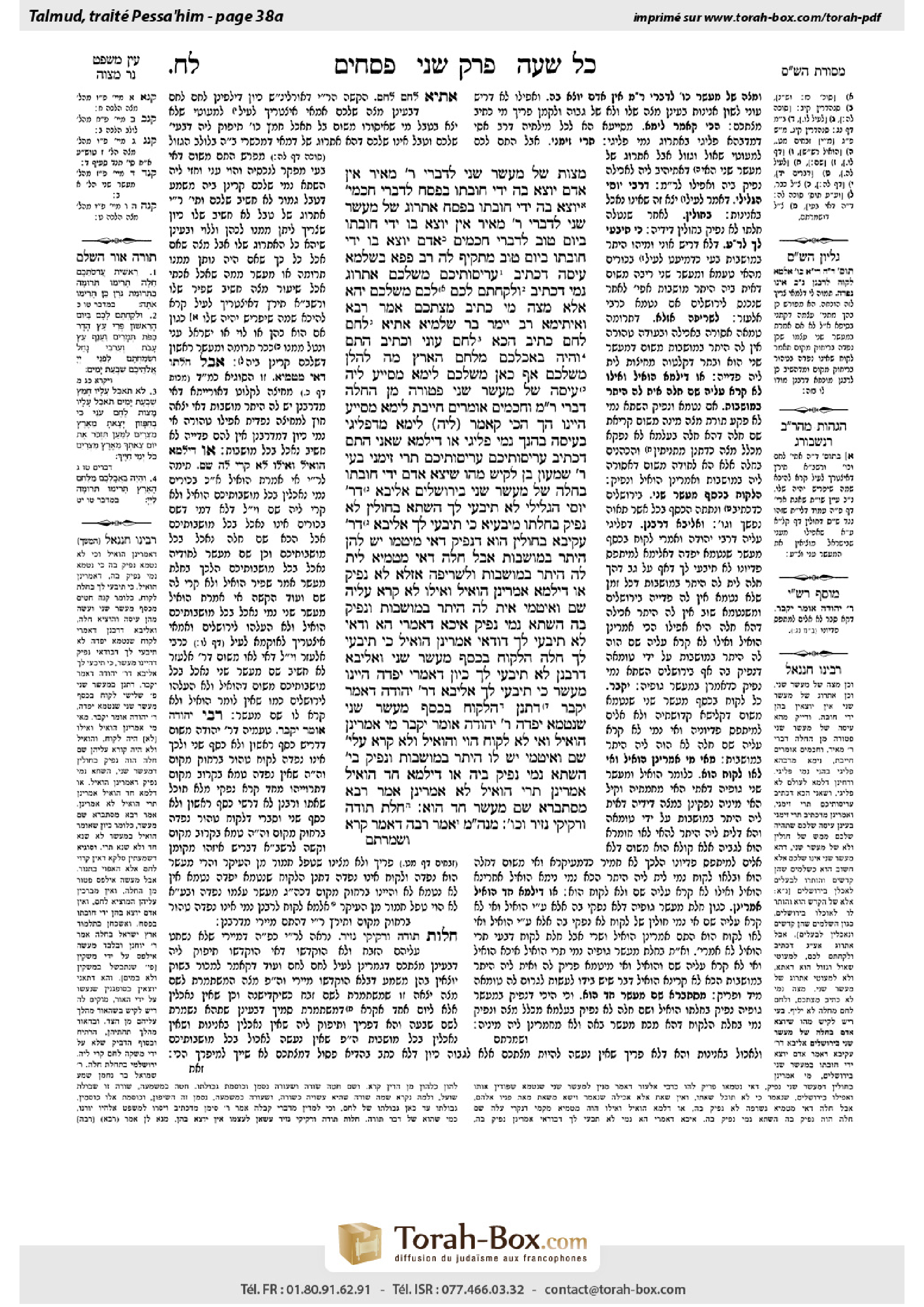
Pesachim 38a: Talmud study for Daf Yomi
Daf Yomi is the daily study of one Talmud folio. Explore 37 tractates with scans, Hebrew text, Sefaria English and AI-generated French translations where annotated.
Passage selection and English or AI-generated French translation are available where the scan has annotations. Daf Study is independent of Torah-Box and Sefaria.
Browse Pesachim · פסחים · All tractatesPesachim 38a text and translations
This page of Pesachim includes the Aramaic text, an English translation and an AI-generated French translation, alongside the scan above.
פסחים ל״ח א · Aramaic and Hebrew text
מַצּוֹת שֶׁל מַעֲשֵׂר שֵׁנִי, לְדִבְרֵי רַבִּי מֵאִיר — אֵין אָדָם יוֹצֵא בָּהּ יְדֵי חוֹבָתוֹ בַּפֶּסַח, לְדִבְרֵי חֲכָמִים — יוֹצֵא בָּהּ יְדֵי חוֹבָתוֹ בַּפֶּסַח.
אֶתְרוֹג שֶׁל מַעֲשֵׂר שֵׁנִי, לְדִבְרֵי רַבִּי מֵאִיר — אֵין יוֹצֵא בּוֹ יְדֵי חוֹבָתוֹ בְּיוֹם טוֹב, לְדִבְרֵי חֲכָמִים — אָדָם יוֹצֵא בּוֹ יְדֵי חוֹבָתוֹ בְּיוֹם טוֹב.
מַתְקֵיף לַהּ רַב פָּפָּא: בִּשְׁלָמָא עִיסָּה, דִּכְתִיב ״עֲרִיסֹתֵיכֶם״ — מִשֶּׁלָּכֶם.
אֶתְרוֹג נָמֵי, דִּכְתִיב ״וּלְקַחְתֶּם לָכֶם״, ״לָכֶם״ — מִשֶּׁלָּכֶם יְהֵא. אֶלָּא מַצָּה, מִי כְּתִיב ״מַצַּתְכֶם״?
אָמַר רָבָא, וְאִיתֵּימָא רַב יֵימַר בַּר שֶׁלֶמְיָא: אָתְיָא ״לֶחֶם״ ״לֶחֶם״. כְּתִיב הָכָא ״לֶחֶם עֹנִי״, וּכְתִיב הָתָם ״וְהָיָה בַּאֲכׇלְכֶם מִלֶּחֶם הָאָרֶץ״. מָה לְהַלָּן — מִשֶּׁלָּכֶם, אַף כָּאן — מִשֶּׁלָּכֶם.
לֵימָא מְסַיַּיע לֵיהּ: עִיסָּה שֶׁל מַעֲשֵׂר שֵׁנִי פְּטוּרָה מִן הַחַלָּה, דִּבְרֵי רַבִּי מֵאִיר. וַחֲכָמִים אוֹמְרִים: חַיֶּיבֶת. לֵימָא מְסַיַּיע?! הַיְינוּ הָךְ!
הָכִי קָאָמַר (לֵיהּ): לֵימָא מִדִּפְלִיגִי בְּעִיסָּה, בְּהָנָךְ נָמֵי פְּלִיגִי. אוֹ דִילְמָא, שָׁאנֵי הָתָם דִּכְתִיב ״עֲרִיסֹתֵיכֶם״ ״עֲרִיסֹתֵיכֶם״ תְּרֵי זִימְנֵי.
בָּעֵי רַבִּי שִׁמְעוֹן בֶּן לָקִישׁ: מַהוּ שֶׁיֵּצֵא אָדָם יְדֵי חוֹבָתוֹ בְּחַלָּה שֶׁל מַעֲשֵׂר שֵׁנִי בִּירוּשָׁלַיִם? אַלִּיבָּא דְּרַבִּי יוֹסֵי הַגְּלִילִי — לָא תִּיבְּעֵי לָךְ, הַשְׁתָּא בְּחוּלִּין לָא נָפֵיק, בְּחַלָּתוֹ מִיבַּעְיָא?! כִּי תִּיבְּעֵי לָךְ אַלִּיבָּא דְּרַבִּי עֲקִיבָא.
בְּחוּלִּין הוּא דְּנָפֵיק — דְּאִי מִיטַּמּוּ יֵשׁ לָהֶן הֶיתֵּר בְּמוֹשָׁבוֹת. אֲבָל חַלָּה, דְּאִי מִטַּמְּיָא לֵית לַהּ הֶיתֵּר בְּמוֹשָׁבוֹת, וְלִשְׂרֵיפָה אָזְלָא — לָא נָפֵיק.
אוֹ דִילְמָא: אָמְרִינַן הוֹאִיל וְאִילּוּ לֹא קָרָא עָלֶיהָ שֵׁם וְאִיטַּמַּי — אִית לָהּ הֶיתֵּר בְּמוֹשָׁבוֹת, וְנָפֵיק בָּהּ, הַשְׁתָּא נָמֵי נָפֵיק.
אִיכָּא דְאָמְרִי: הָא וַדַּאי לָא תִּיבְּעֵי לָךְ, דְּוַדַּאי אָמְרִינַן ״הוֹאִיל״. כִּי תִּיבְּעֵי לָךְ חַלָּה הַלָּקוּחַ בְּכֶסֶף מַעֲשֵׂר שֵׁנִי.
וְאַלִּיבָּא דְרַבָּנַן לָא תִּיבְּעֵי לָךְ, כֵּיוָן דְּאָמְרִי יִפָּדֶה — הַיְינוּ מַעֲשֵׂר. כִּי תִּיבְּעֵי לָךְ, אַלִּיבָּא דְּרַבִּי יְהוּדָה, דְּאָמַר — יִקָּבֵר.
דִּתְנַן: הַלָּקוּחַ בְּכֶסֶף מַעֲשֵׂר שֵׁנִי שֶׁנִּטְמָא — יִפָּדֶה. רַבִּי יְהוּדָה אוֹמֵר: יִקָּבֵר.
מִי אָמְרִינַן: הוֹאִיל וְאִי לָא לָקוּחַ הָוֵי, וְהוֹאִיל וְלֹא קָרָא עָלֶיהָ שֵׁם וְאִיטַּמַּי — יֵשׁ לוֹ הֶיתֵּר בְּמוֹשָׁבוֹת, וְנָפֵיק בֵּיהּ, הַשְׁתָּא נָמֵי נָפֵיק בֵּיהּ.
אוֹ דִילְמָא: חַד ״הוֹאִיל״ אָמְרִינַן, תְּרֵי ״הוֹאִיל״ לָא אָמְרִינַן? אָמַר רָבָא: מִסְתַּבְּרָא שֵׁם מַעֲשֵׂר חַד הוּא.
חַלַּת תּוֹדָה וּרְקִיקֵי נָזִיר וְכוּ׳. מְנָא הָנֵי מִילֵּי? אָמַר רַבָּה: דְּאָמַר קְרָא
Pesachim 38a · English translation
With regard to matzot of second-tithe produce: In accordance with the statement of Rabbi Meir, a person cannot fulfill his obligation to eat matza on the first night of Passover with this matza. Rabbi Meir considers it consecrated property, and one must eat matza that belongs to him, not consecrated property. In accordance with the statement of the Rabbis, one can fulfill his obligation with this type of matza on the first night of Passover.
The same dispute applies to a citron of second-tithe produce: In accordance with the statement of Rabbi Meir, one cannot fulfill his obligation to take the four species on the first day of the festival of Sukkot with this citron. In accordance with the statement of the Rabbis, a person can use this citron to fulfill his obligation on the first day of the festival of Sukkot.
Rav Pappa strongly objects to this statement: Granted, one must separate ḥalla from this dough, as it is written: “Of the first of your dough you shall give to the Lord a portion [ḥalla] for a gift throughout your generations” (Numbers 15:21). This verse can be read in a very precise manner, so that the expression “your dough” indicates that ḥalla is separated only from dough that belongs to you.
With regard to a citron too, a similar conclusion can be drawn, as it is written: “And you shall take for yourselves on the first day a fruit of goodly trees, branches of palm trees, and boughs of thick trees and willows of the brook” (Leviticus 23:40). Here too, the expression “for yourselves” indicates that what you take must belong to you. However, with regard to matza, is it written that you must use your own matza? Since there is no such requirement, it stands to reason that even consecrated matza is valid for this mitzva.
Rava said, and some say Rav Yeimar bar Shelamya said: This principle can be derived by means of a verbal analogy between “bread” and “bread.” It is written here, with regard to matza: “Poor man’s bread” (Deuteronomy 16:3), and it is written there, with regard to ḥalla: “And it shall be that when you eat of the bread of the land, you shall set apart a portion for a gift to the Lord” (Numbers 15:19). Just as there, in the case of ḥalla, it must be separated only from food that belongs to you, so too here, with regard to matza, it must be prepared only from produce that belongs to you.
The Gemara suggests: Let us say that the following baraita supports Rav Asi: With regard to dough of second-tithe produce, one is exempt from separating ḥalla from it; this is the statement of Rabbi Meir. And the Rabbis say: One is obligated in this mitzva. Since this is a conclusive proof, the Gemara expresses surprise at the formulation: Let us say that it supports him. This statement is identical to that one; i.e., the ruling of the baraita is identical to Rav Asi’s opinion.
The Gemara explains: This is what the statement: Let us say, is saying: Let us say from the fact that they disagree with regard to dough, so too, they disagree with regard to these other issues. Or perhaps it is different there, with regard to ḥalla, as it is written: “Your dough,” “your dough,” twice. This repetition might indicate that the mitzva of ḥalla applies only to one who maintains full ownership of the dough. Although Rabbi Meir contends that one need not separate ḥalla from second-tithe produce, he does not necessarily issue a similar ruling with regard to matza or a citron, as there is no explicit proof to this effect.
Rabbi Shimon ben Lakish raised a dilemma: What is the halakha with regard to the possibility that a person can fulfill his obligation to eat matza with ḥalla separated from second-tithe dough in Jerusalem? The Gemara clarifies this dilemma: In accordance with the opinion of Rabbi Yosei HaGelili, do not raise this dilemma. Rabbi Yosei HaGelili maintains that one can fulfill his obligation to eat matza only with food that may be eaten in a state of acute mourning. The Gemara explains why the dilemma does not arise according to the opinion of Rabbi Yosei HaGelili: Now that it has been mentioned that one cannot fulfill his obligation with the non-sacred portion of second-tithe produce, i.e., with that which was not sanctified as ḥalla, is it necessary to mention that one cannot fulfill his obligation with its ḥalla? When you raise the dilemma, it is in accordance with the opinion of Rabbi Akiva.
The Gemara explains: Unlike Rabbi Yosei, Rabbi Akiva does not interpret the phrase “poor man’s bread [leḥem oni]” as though it were written with an alef, which indicates that it is referring to the bread of acute mourning [aninut], i.e., the period of mourning on the day of the death of a close relative. Consequently, the following dilemma arises: It can be suggested that it is with the non-sacred portion of the second-tithe produce that one can fulfill his obligation, for if the produce becomes ritually impure it can be permitted to be eaten in any habitation in Israel after it has been redeemed. Rabbi Akiva agrees that any food that can be eaten in an unrestricted manner in certain circumstances can also be used for the obligation to eat matza. However, with regard to ḥalla, which, if it becomes ritually impure, cannot be permitted to be eaten in any habitation, but goes, i.e., it is slated for burning, this ḥalla cannot be used to fulfill one’s obligation.
Or perhaps we say: Since, if one had not designated the produce as ḥalla and it had become ritually impure, it could be redeemed and be permitted to be eaten in any habitation, and one could fulfill the obligation of matza with it, now too, one can fulfill his obligation with it, despite the fact that it has been designated as ḥalla. Since the sanctity is not inherent in the dough itself, it does not undermine its status as fit for matza.
Some say a different version of this analysis: With regard to this case, certainly do not raise the dilemma, as here we certainly apply the principle of: Since, as stated above. In other words, there is no doubt that ḥalla taken from second-tithe produce can be used for matza, as its sanctity is not inherent. Rather, when you raise the dilemma, it is with regard to ḥalla that was purchased with second-tithe money, as this type of food can be ritually purified if it becomes ritually impure.
And furthermore, in accordance with the opinion of the Rabbis, do not raise this dilemma, since they say that it can be redeemed for a second time; this case is identical to the case of second-tithe produce itself. In this regard, the Rabbis do not distinguish between the money with which the second tithe was redeemed and the second-tithe produce itself. Rather, when you raise the dilemma, it is in accordance with the opinion of Rabbi Yehuda, who said that an object that was purchased with second-tithe money and that became ritually impure must be buried.
As we learned in a mishna with regard to food that was purchased with second-tithe money that became ritually impure, this ritually impure food should be redeemed for money, with which one must purchase other food. Rabbi Yehuda says: It should be buried. Since this food was merely purchased with second-tithe money, it does not have the same degree of sanctity as the tithe itself. Therefore, its status as a second-tithe object cannot be transferred to yet a third object. Consequently, if it becomes impure, it cannot be redeemed for money but must be buried as an item for which there is no use.
The Gemara clarifies the aforementioned dilemma: Do we say the following: Since, if it were not purchased with second-tithe money, and furthermore, since, if one had not designated it as ḥalla and it became ritually impure, this produce would be permitted to be eaten in any habitation, one can therefore fulfill his obligation with it even after its status has changed by being purchased with second-tithe money and designated as ḥalla?
Or perhaps we say one of these logical arguments starting with: Since, but we do not say two arguments of: Since. If so, one cannot fulfill his obligation with matza of ḥalla separated from second tithe. Rava said: It stands to reason that the category of tithe is a single designation. In other words, provided that the food is included in the general framework of second tithe, it can be used for matza, and this applies even to the ḥalla separated from second tithe.
We learned in the mishna that if one prepared the loaves of a thanks-offering or a nazirite’s wafers for himself, he cannot use them to fulfill his obligation to eat matza on Passover. The Gemara asks: From where are these matters derived? Rabba said: As the verse states:
Pesachim 38a · Traduction française (IA)
Concernant les matsot faites avec des produits de la seconde dîme : selon Rabbi Meïr, on ne peut pas s’acquitter de l’obligation de manger de la matsa le premier soir de Pessa’h avec ces matsot. Rabbi Meïr les considère comme des biens consacrés, et il faut manger une matsa qui nous appartient, non un bien consacré. Selon les Rabbins, on peut s’acquitter de cette obligation le premier soir de Pessa’h avec ce type de matsa.
La même controverse s’applique à un cédrat provenant de produits de la seconde dîme : selon Rabbi Meïr, on ne peut pas s’acquitter de l’obligation de prendre les quatre espèces le premier jour de la fête de Souccot avec ce cédrat. Selon les Rabbins, on peut utiliser ce cédrat pour s’acquitter de son obligation le premier jour de la fête de Souccot.
Rav Pappa objecte vivement à cette affirmation : certes, il faut prélever la ‘hala de cette pâte, comme il est écrit : « Sur les prémices de votre pâte, vous donnerez au Seigneur une part [‘hala] comme offrande, dans toutes vos générations » (Nombres 15,21). On peut lire ce verset de façon très précise, de sorte que l’expression « votre pâte » indique que la ‘hala n’est prélevée que sur une pâte qui vous appartient.
On peut tirer une conclusion semblable au sujet du cédrat, comme il est écrit : « Vous prendrez pour vous, le premier jour, un fruit d’un bel arbre, des branches de palmier, des rameaux d’arbres touffus et des saules du torrent » (Lévitique 23,40). Ici aussi, l’expression « pour vous » indique que ce que vous prenez doit vous appartenir. Mais, concernant la matsa, est-il écrit que vous devez utiliser votre propre matsa ? Puisqu’il n’existe aucune exigence de ce genre, il est logique que même une matsa consacrée soit valable pour cette mitsva.
Rava a dit, et certains disent que c’est Rav Yeimar bar Shelamya qui l’a dit : On peut déduire ce principe au moyen d’une analogie verbale entre « pain » et « pain ». Ici, au sujet de la matsa, il est écrit : « pain de misère » (Deutéronome 16,3), et là, au sujet de la ‘hala, il est écrit : « Lorsque vous mangerez du pain du pays, vous en prélèverez une part comme offrande au Seigneur » (Nombres 15,19). De même que là, dans le cas de la ‘hala, celle-ci ne doit être prélevée que sur une nourriture qui vous appartient, de même ici, au sujet de la matsa, celle-ci ne doit être préparée qu’avec des produits qui vous appartiennent.
La Guemara propose : Disons que la baraïta suivante confirme l’avis de Rav Asi : pour une pâte faite avec des produits de la seconde dîme, on est dispensé d’en prélever la ‘hala ; telle est l’opinion de Rabbi Meïr. Les Rabbins disent : on est tenu d’accomplir cette mitsva. Puisqu’il s’agit d’une preuve concluante, la Guemara s’étonne de cette formulation : « Disons qu’elle le confirme. » Cette affirmation est identique à l’autre ; autrement dit, la décision de la baraïta est identique à l’avis de Rav Asi.
La Guemara explique : Voici ce que signifie l’affirmation « Disons » : puisque les tannaïm sont en désaccord au sujet de la pâte, disons qu’ils le sont aussi au sujet de ces autres questions. Ou peut-être le cas est-il différent là, au sujet de la ‘hala, car l’expression « votre pâte » est écrite deux fois. Cette répétition pourrait indiquer que la mitsva de la ‘hala ne s’applique qu’à celui qui conserve la pleine propriété de la pâte. Bien que Rabbi Meïr soutienne qu’il n’est pas nécessaire de prélever la ‘hala sur des produits de la seconde dîme, il ne statue pas nécessairement de la même manière au sujet de la matsa ou du cédrat, puisqu’il n’existe aucune preuve explicite en ce sens.
Rabbi Shimon ben Lakish souleva une question : quelle est la halakha quant à la possibilité de s’acquitter de l’obligation de manger de la matsa avec de la ‘hala prélevée sur une pâte faite avec des produits de la seconde dîme à Jérusalem ? Selon l’avis de Rabbi Yosei HaGelili, cette question ne se pose pas. Rabbi Yosei HaGelili soutient qu’on ne peut s’acquitter de l’obligation de manger de la matsa qu’avec un aliment qu’il est permis de consommer en état de deuil aigu. La Guemara explique pourquoi cette question ne se pose pas selon l’avis de Rabbi Yosei HaGelili : maintenant qu’il a été indiqué qu’on ne peut s’acquitter de son obligation avec la partie non consacrée des produits de la seconde dîme, c’est-à-dire ce qui n’a pas été consacré en tant que ‘hala, est-il nécessaire de préciser qu’on ne peut pas s’en acquitter avec la ‘hala elle-même ? Si l’on soulève cette question, c’est selon l’avis de Rabbi Akiva.
La Guemara explique : contrairement à Rabbi Yosei, Rabbi Akiva n’interprète pas l’expression « pain de misère [leḥem oni] » comme si elle était écrite avec un aleph, ce qui indiquerait qu’il s’agit du pain du deuil aigu [aninut], c’est-à-dire de la période de deuil qui commence le jour du décès d’un proche parent. Par conséquent, la question suivante se pose : on peut suggérer qu’on peut s’acquitter de son obligation avec la partie non consacrée des produits de la seconde dîme, car, si ces produits deviennent rituellement impurs, il est permis de les consommer dans toute habitation en Israël après les avoir rachetés. Rabbi Akiva reconnaît que tout aliment qu’il est possible de consommer sans restriction dans certaines circonstances peut également servir à s’acquitter de l’obligation de manger de la matsa. Mais, concernant la ‘hala, qui, si elle devient rituellement impure, ne peut être rendue propre à la consommation dans aucune habitation et doit donc être brûlée, on ne peut pas s’acquitter de son obligation avec elle.
Ou peut-être disons-nous : si les produits n’avaient pas été désignés comme ‘hala et étaient devenus rituellement impurs, ils auraient pu être rachetés et rendus propres à la consommation dans toute habitation, et l’on aurait pu s’acquitter avec eux de l’obligation de manger de la matsa ; de même, maintenant, on peut s’acquitter de son obligation avec eux, bien qu’ils aient été désignés comme ‘hala. Puisque la sainteté n’est pas inhérente à la pâte elle-même, elle ne compromet pas son aptitude à servir de matsa.
Certains rapportent une autre version de cette analyse : au sujet de ce cas, il ne faut certainement pas soulever la question, car ici, le principe « puisque », mentionné plus haut, s’applique assurément. Autrement dit, il ne fait aucun doute que la ‘hala prélevée sur des produits de la seconde dîme peut servir de matsa, puisque sa sainteté n’est pas inhérente. La question se pose plutôt au sujet d’une ‘hala achetée avec de l’argent de la seconde dîme, car ce type de nourriture peut être rendu rituellement pur s’il devient rituellement impur.
De plus, selon l’avis des Rabbins, cette question ne se pose pas, puisqu’ils disent qu’on peut la racheter une seconde fois ; ce cas est identique à celui des produits de la seconde dîme eux-mêmes. À cet égard, les Rabbins ne distinguent pas l’argent contre lequel la seconde dîme a été rachetée des produits de la seconde dîme eux-mêmes. La question se pose plutôt selon l’avis de Rabbi Yehuda, qui a dit qu’un objet acheté avec de l’argent de la seconde dîme et devenu rituellement impur doit être enterré.
Nous avons appris dans une Michna que, si une nourriture achetée avec de l’argent de la seconde dîme devient rituellement impure, elle doit être rachetée contre de l’argent, avec lequel on achètera une autre nourriture. Rabbi Yehuda dit : elle doit être enterrée. Puisque cette nourriture a seulement été achetée avec de l’argent de la seconde dîme, elle n’a pas le même degré de sainteté que la dîme elle-même. Son statut d’objet de la seconde dîme ne peut donc pas être transféré à un troisième objet. Par conséquent, si elle devient impure, elle ne peut pas être rachetée contre de l’argent, mais doit être enterrée, car elle ne peut être utilisée à aucune fin.
La Guemara précise la question susmentionnée : disons-nous ceci ? Si elle n’avait pas été achetée avec de l’argent de la seconde dîme et si, de plus, elle n’avait pas été désignée comme ‘hala et était devenue rituellement impure, cette nourriture aurait pu être consommée dans toute habitation ; on peut donc s’acquitter de son obligation avec elle, même après que son statut a changé du fait qu’elle a été achetée avec de l’argent de la seconde dîme et désignée comme ‘hala ?
Ou peut-être disons-nous qu’un de ces raisonnements fondés sur le principe « puisque » s’applique, mais pas deux raisonnements de ce type. Dans ce cas, on ne peut pas s’acquitter de son obligation avec de la matsa faite de ‘hala prélevée sur la seconde dîme. Rava a dit : il semble raisonnable de considérer la catégorie de la dîme comme une désignation unique. Autrement dit, dès lors que la nourriture relève du cadre général de la seconde dîme, elle peut servir de matsa, et cela s’applique même à la ‘hala prélevée sur la seconde dîme.
Nous avons appris dans la Michna que si quelqu’un a préparé pour lui-même les pains d’un sacrifice de reconnaissance ou les galettes d’un nazir, il ne peut pas les utiliser pour s’acquitter de son obligation de manger de la matsa à Pessa’h. La Guemara demande : d’où déduit-on ces règles ? Rabba a dit : comme l’indique le verset :
Traduction française générée par IA à partir de l’édition anglaise de Sefaria. Vérifie toujours un passage avec le texte source.
Text from Sefaria: William Davidson Edition - Vocalized Aramaic (CC BY NC); William Davidson Edition - English (CC BY NC).