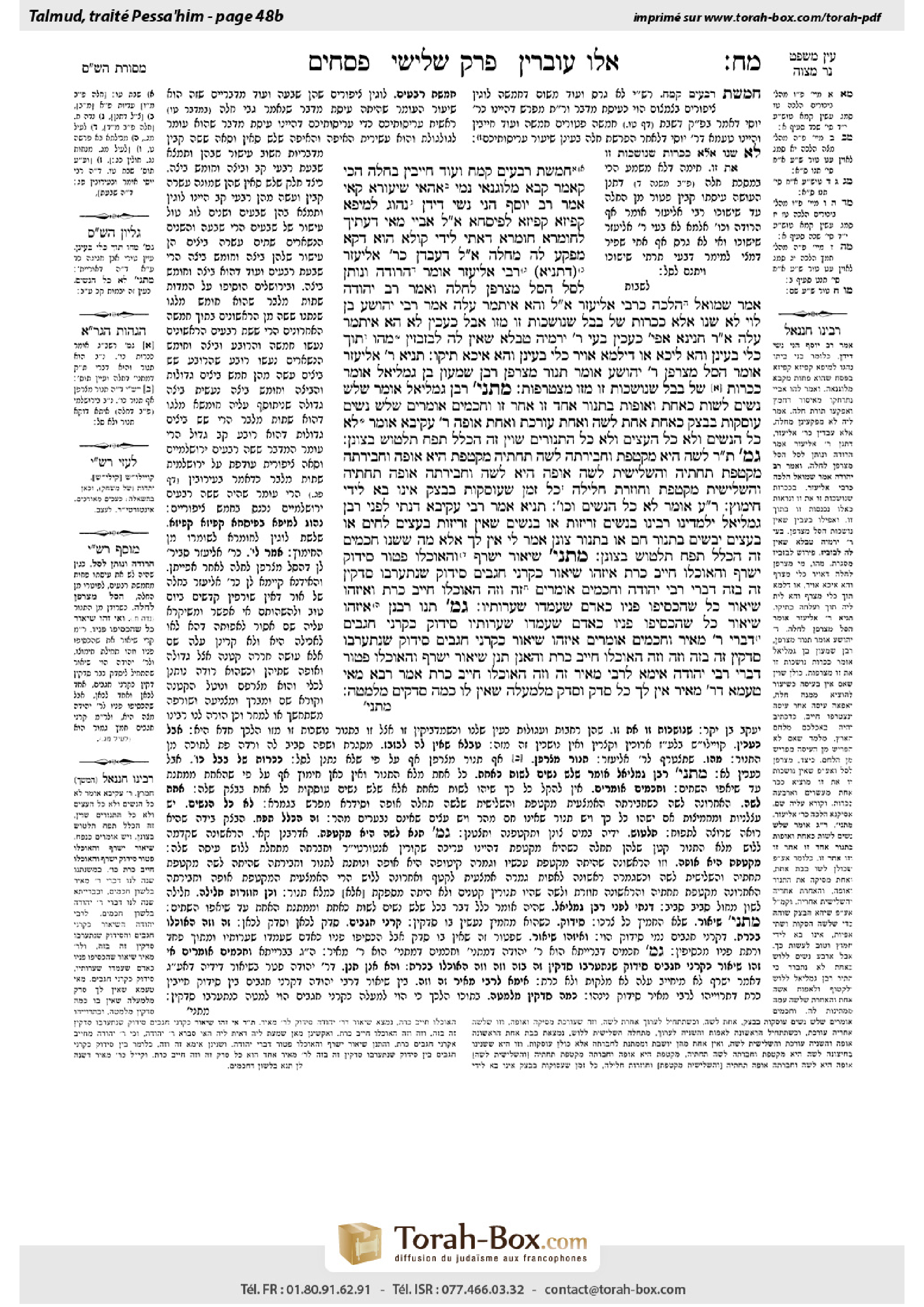
Pesachim 48b: Talmud study for Daf Yomi
Daf Yomi is the daily study of one Talmud folio. Explore 37 tractates with scans, Hebrew text, Sefaria English and AI-generated French translations where annotated.
Passage selection and English or AI-generated French translation are available where the scan has annotations. Daf Study is independent of Torah-Box and Sefaria.
Browse Pesachim · פסחים · All tractatesPesachim 48b text and translations
This page of Pesachim includes the Aramaic text, an English translation and an AI-generated French translation, alongside the scan above.
פסחים מ״ח ב · Aramaic and Hebrew text
חֲמֵשֶׁת רְבָעִים קֶמַח וְעוֹד — חַיָּיבִין בַּחַלָּה. הָכִי קָאָמַר, קַבָּא מְלוֹגְנָאֵי נָמֵי אַהַאי שִׁיעוּרָא קָאֵי.
אָמַר רַב יוֹסֵף: הָנֵי נְשֵׁי דִידַן נְהוּג לְמֵיפָא קְפִיזָא קְפִיזָא לְפִיסְחָא. אֲמַר לֵיהּ אַבָּיֵי: מַאי דַּעְתָּיךְ, לְחוּמְרָא? חוּמְרָא דְּאָתֵי לִידֵי קוּלָּא הוּא, דְּקָא מַפְקַע לַהּ מֵחַלָּה.
אֲמַר לֵיהּ: דְּעָבְדָן כְּרַבִּי אֱלִיעֶזֶר, (דְּתַנְיָא,) רַבִּי אֱלִיעֶזֶר אוֹמֵר: הָרוֹדֶה וְנוֹתֵן לַסַּל — הַסַּל מְצָרְפָן לַחַלָּה. וְאָמַר רַב יְהוּדָה אָמַר שְׁמוּאֵל: הֲלָכָה כְּרַבִּי אֱלִיעֶזֶר.
אֲמַר לֵיהּ: וְהָא אִיתְּמַר עֲלַהּ, אָמַר רַבִּי יְהוֹשֻׁעַ בֶּן לֵוִי: לֹא שָׁנוּ אֶלָּא כִּכָּרוֹת שֶׁל בָּבֶל שֶׁנּוֹשְׁכוֹת זוֹ מִזּוֹ, אֲבָל כְּעָכִין — לָא. הָא אִיתְּמַר עֲלַהּ, אָמַר רַבִּי חֲנִינָא: אֲפִילּוּ כְּעָכִין.
בָּעֵי רַבִּי יִרְמְיָה: טַבְלָא שֶׁאֵין לָהּ לְבִזְבְּזִין מַהוּ? תּוֹךְ כְּלִי בָּעֵינַן, וְהָא לֵיכָּא. אוֹ דִילְמָא — אֲוִיר כְּלִי בָּעֵינַן, וְהָא אִיכָּא. תֵּיקוּ.
תַּנְיָא, רַבִּי אֱלִיעֶזֶר אוֹמֵר: הַסַּל מְצָרְפָן. רַבִּי יְהוֹשֻׁעַ אוֹמֵר: תַּנּוּר מְצָרְפָן. רַבָּן שִׁמְעוֹן בֶּן גַּמְלִיאֵל אוֹמֵר כִּכָּרוֹת שֶׁל בָּבֶל שֶׁנּוֹשְׁכוֹת זוֹ מִזּוֹ מִצְטָרְפוֹת.
מַתְנִי׳ רַבָּן גַּמְלִיאֵל אוֹמֵר: שָׁלֹשׁ נָשִׁים לָשׁוֹת כְּאַחַת וְאוֹפוֹת בְּתַנּוּר אֶחָד, זוֹ אַחַר זוֹ.
וַחֲכָמִים אוֹמְרִים: שָׁלֹשׁ נָשִׁים עוֹסְקוֹת בְּבָצֵק כְּאַחַת, אַחַת לָשָׁה, וְאַחַת עוֹרֶכֶת, וְאַחַת אוֹפָה.
רַבִּי עֲקִיבָא אוֹמֵר: לֹא כׇּל הַנָּשִׁים וְלֹא כׇּל הָעֵצִים וְלֹא כׇּל הַתַּנּוּרִים שָׁוִין. זֶה הַכְּלָל: תָּפַח — תִּלְטוֹשׁ בְּצוֹנֵן.
גְּמָ׳ תָּנוּ רַבָּנַן. לָשָׁה, הִיא מְקַטֶּפֶת, וַחֲבֶירְתָּהּ לָשָׁה תַּחְתֶּיהָ. מְקַטֶּפֶת, הִיא אוֹפָה, וַחֲבֶירְתָּהּ מְקַטֶּפֶת תַּחְתֶּיהָ, וְהַשְּׁלִישִׁית לָשָׁה. אוֹפָה הִיא, לָשָׁה, וַחֲבֶירְתָּהּ אוֹפָה תַּחְתֶּיהָ, וְהַשְּׁלִישִׁית מְקַטֶּפֶת, וְחוֹזְרֹת חֲלִילָה. כׇּל זְמַן שֶׁעוֹסְקוֹת בַּבָּצֵק — אֵינוֹ בָּא לִידֵי חִימּוּץ.
רַבִּי עֲקִיבָא אוֹמֵר לֹא כׇּל הַנָּשִׁים וְכוּ׳. תַּנְיָא, אָמַר רַבִּי עֲקִיבָא: דַּנְתִּי לִפְנֵי רַבָּן גַּמְלִיאֵל, יְלַמְּדֵינוּ רַבֵּינוּ בְּנָשִׁים זְרִיזוֹת אוֹ בְּנָשִׁים שֶׁאֵין זְרִיזוֹת? בְּעֵצִים לַחִים אוֹ בְּעֵצִים יְבֵשִׁים? בְּתַנּוּר חַם אוֹ בְּתַנּוּר צוֹנֵן? אָמַר לִי: אֵין לְךָ אֶלָּא מַה שֶּׁשָּׁנוּ חֲכָמִים, זֶה הַכְּלָל: תָּפַח — תִּלְטוֹשׁ בְּצוֹנֵן.
מַתְנִי׳ שִׂיאוּר — יִשָּׂרֵף, וְהָאוֹכְלוֹ פָּטוּר. סִידּוּק — יִשָּׂרֵף, וְהָאוֹכְלוֹ חַיָּיב כָּרֵת.
אֵיזֶהוּ שִׂיאוּר? כְּקַרְנֵי חֲגָבִים. סִידּוּק — שֶׁנִּתְעָרְבוּ סְדָקִין זֶה בָּזֶה, דִּבְרֵי רַבִּי יְהוּדָה. וַחֲכָמִים אוֹמְרִים: זֶה וְזֶה — הָאוֹכְלוֹ חַיָּיב כָּרֵת. וְאֵיזֶהוּ שִׂיאוּר? כׇּל שֶׁהִכְסִיפוּ פָּנָיו כְּאָדָם שֶׁעָמְדוּ שַׂעֲרוֹתָיו.
גְּמָ׳ תָּנוּ רַבָּנַן: אֵיזֶהוּ שִׂיאוּר? כׇּל שֶׁהִכְסִיפוּ פָּנָיו כְּאָדָם שֶׁעָמְדוּ שַׂעֲרוֹתָיו. סִידּוּק — כְּקַרְנֵי חֲגָבִים, דִּבְרֵי רַבִּי מֵאִיר. וַחֲכָמִים אוֹמְרִים: אֵיזֶהוּ שִׂיאוּר? כְּקַרְנֵי חֲגָבִים. סִידּוּק — שֶׁנִּתְעָרְבוּ סְדָקִין זֶה בָּזֶה. וְזֶה וָזֶה — הָאוֹכְלוֹ חַיָּיב כָּרֵת.
וְהָאֲנַן תְּנַן: שִׂיאוּר יִשָּׂרֵף, וְהָאוֹכְלוֹ פָּטוּר, דִּבְרֵי רַבִּי יְהוּדָה. אֵימָא: לְרַבִּי מֵאִיר, זֶה וָזֶה הָאוֹכְלוֹ חַיָּיב כָּרֵת.
אָמַר רָבָא: מַאי טַעְמָא דְּרַבִּי מֵאִיר — אֵין לָךְ כׇּל סֶדֶק וָסֶדֶק מִלְּמַעְלָה שֶׁאֵין לוֹ כַּמָּה סְדָקִים מִלְּמַטָּה.
Pesachim 48b · English translation
Dough made from five-quarters of a log of flour and a bit more obligates one to separate ḥalla? The Gemara answers that this is what Rav is saying: A kav from Melogna is the same measure as this, as it is not a regular kav but a larger measure, identical to the amount from which one is required to separate ḥalla.
Rav Yosef said: These women of our family ordinarily bake kefiza by kefiza, i.e., three-quarters of a log at a time, on Passover, since it is easier to prevent small quantities of dough from becoming leavened. Abaye said to him: What is your opinion? Do you tell them to do this in order to be stringent? That is a stringency that leads to a leniency, as by working with small quantities one removes the dough from the obligation to separate ḥalla.
Rav Yosef said to him: They do separate ḥalla from the dough, in accordance with the opinion of Rabbi Eliezer. As it was taught in a baraita that Rabbi Eliezer says: One who removes loaves of bread from an oven and places them in a basket, the basket combines them to reach the quantity from which one is required to separate ḥalla, even if each of the loaves would not attain the necessary measure for separating ḥalla on their own. And Rav Yehuda said that Shmuel said: The halakha is in accordance with the opinion of Rabbi Eliezer. Therefore, the women of Rav Yosef’s household would put all the finished matzot into a basket and separate ḥalla from them.
Abaye said to him: But wasn’t it stated with regard to that baraita that Rabbi Yehoshua ben Levi said: They taught that a basket combines the loaves only with regard to Babylonian loaves that bite from one another. In other words, the loaves are slightly attached, and when one separates them, a bit from one loaf comes off with the other loaf. However, it does not apply to long, rod-like loaves [ke’akhin] that were baked separately. Therefore, that principle cannot be applied to the case discussed here, in which each batch of matza was baked on its own. Rav Yosef answered: Wasn’t it stated with regard to that baraita that Rabbi Ḥanina said: The halakha is in accordance with the opinion of Rabbi Eliezer even with regard to long, rod-like loaves? This indicates that Rav Yosef accepted the view of Rabbi Ḥanina.
In light of this discussion, Rabbi Yirmeya raised a dilemma: With regard to a board without a rim [levizbezin], what is the halakha? Is it considered to be a vessel that combines loaves baked separately into one unit with regard to ḥalla? Do we require the inside of the vessel in order to combine the loaves, and that is lacking, since the board is flat rather than concave? Or perhaps we require the airspace of the vessel, and that is present in this case? The Gemara concludes: Let it stand unresolved.
It was taught in a baraita that Rabbi Eliezer says: A basket combines different loaves placed in it with regard to the obligation to separate ḥalla. Rabbi Yehoshua says: An oven combines them. Rabban Shimon ben Gamliel says: Babylonian loaves that bite from one another are combined; however, if the loaves are connected to any lesser degree, e.g., if they are together in an oven or basket, they are not considered combined for the purpose of separating ḥalla.
MISHNA: Rabban Gamliel says: Three women may knead their dough as one, meaning at one time, and bake the batches of dough in one oven, one after the other, and they need not be concerned that their dough will become leavened while they are waiting to use the oven.
And the Rabbis say: Three women may be engaged in preparing dough as one, in the following manner: One kneads her dough as another one arranges her own dough so it takes the form of matza, while another one bakes her dough.
Rabbi Akiva says: Not all women, not all wood, and not all ovens are the same, and therefore no set rules should be established. Rather, this is the principle: If the dough begins to rise, she should spread cold water in which she immersed her hands, onto the dough, in order to stop the leavening process.
GEMARA: The Sages taught in a baraita: When the woman who kneads first completes her kneading, she arranges her dough and another woman kneads in her place. When the first woman finishes arranging her dough, she bakes and another woman arranges her dough in her place, and the third woman kneads her dough. When the first woman finishes baking, she kneads the dough for her next batch, and another woman bakes in her place, and the third woman arranges her dough, and they continue in turn. As long as they are engaged in handling the dough, it will not become leavened.
It was taught in the mishna that Rabbi Akiva says that not all women, not all wood, and not all ovens are the same. It was taught in a baraita that Rabbi Akiva said: I deliberated this matter before Rabban Gamliel, asking: May our master teach us if your statement, cited in the mishna, was said with regard to diligent women or women who are not diligent? Was it said with regard to an oven fueled with moist wood or dry wood? Was it said with regard to a hot oven or a cold oven? Rabban Gamliel himself said to me: You have only what the Sages taught, which is that this is the principle: If the dough begins to rise such that there is a concern that it may become leavened, she should spread cold water onto the dough to prevent it from becoming leavened.
MISHNA: Dough at the beginning of the leavening process [siur], must be burned, but one who eats it is exempt from the punishment of karet because the dough had not become fully leavened. Dough that has reached the stage of cracking must be burned, and one who eats it intentionally is liable to receive karet, as he has intentionally eaten leavened bread during Passover.
What is considered siur? Dough that has been leavened to the point that it has cracks that look like the antennae of locusts. The stage of cracking occurs later in the leavening process, when the cracks intermingle. This is the statement of Rabbi Yehuda. And the Rabbis say: One who intentionally eats either this or that, dough with cracks like locust antennae or with cracks that have become intermingled, is liable to receive karet, as once dough begins to crack it has certainly become leavened. And what is siur? It is any dough whose surface has becomes pale like the face of a person whose hair stands on end due to fear.
GEMARA: The Sages taught: What is siur? It is any dough whose surface has become pale like the face of a person whose hair stands on end due to fear. Cracking is considered to have occurred when cracks like the antennae of locusts appear. This is the statement of Rabbi Meir. And the Rabbis say: What is siur? It is when the dough forms cracks like the antennae of locusts, and cracking is when the cracks intermingle. And one who intentionally eats either this or that is liable to receive karet.
The Gemara asks: But didn’t we learn in the mishna that siur must be burned but that one who eats it is exempt from karet; this is the statement of Rabbi Yehuda. The opinion attributed to the Rabbis in the baraita appears to be the same as that which is attributed to Rabbi Yehuda in the mishna, but according to Rabbi Yehuda, one who eats siur is exempt from karet. The Gemara answers: Say that the baraita should be understood in the following manner: According to the opinion of Rabbi Meir, whose opinion was mentioned previously, one who intentionally eats either this or that is liable to receive karet, whereas according to the Rabbis he is exempt.
Rava said: What is the reason for the opinion of Rabbi Meir? It is that there is no crack above that does not have several cracks below. Therefore, even if only one small crack appears on the surface, it is a sign that the inside of the dough is filled with cracks and has become leavened.
Pesachim 48b · Traduction française (IA)
Une pâte faite avec cinq quarts de log de farine et un peu plus oblige-t-elle à prélever la ḥalla ? La Guemara répond que Rav veut dire ceci : un kav de Melogna équivaut à cette mesure, car il ne s’agit pas d’un kav ordinaire, mais d’une mesure plus grande, identique à la quantité à partir de laquelle on est tenu de prélever la ḥalla.
Rav Yosef lui dit : Les femmes de notre famille ont l’habitude, à Pessa’h, de pétrir par kefiza, c’est-à-dire trois quarts de log à la fois, car il est plus facile d’empêcher de petites quantités de pâte de devenir du hamets. Abaye lui dit : Que penses-tu ? Leur demandes-tu de procéder ainsi par mesure de rigueur ? C’est une rigueur qui entraîne un allègement, car, en travaillant de petites quantités, on soustrait la pâte à l’obligation de prélever la ḥalla.
Rav Yosef lui dit : Elles prélèvent bien la ḥalla de la pâte, conformément à l’opinion de Rabbi Eliezer. En effet, il a été enseigné dans une baraïta que Rabbi Eliezer dit : Celui qui sort des pains du four et les place dans un panier, le panier les réunit pour atteindre la quantité à partir de laquelle on est tenu de prélever la ḥalla, même si aucun des pains n’atteint à lui seul la mesure nécessaire au prélèvement de la ḥalla. Et Rav Yehuda a dit au nom de Shmuel : La halakha est conforme à l’opinion de Rabbi Eliezer. C’est pourquoi les femmes de la maison de Rav Yosef mettaient toutes les matsot cuites dans un panier et en prélevaient la ḥalla.
Abaye lui dit : Mais n’a-t-il pas été dit, à propos de cette baraïta, que Rabbi Yehoshua ben Levi a déclaré : Ils ont enseigné qu’un panier réunit les pains uniquement dans le cas des pains babyloniens qui se mordent les uns les autres ? Autrement dit, les pains sont légèrement attachés entre eux et, lorsqu’on les sépare, un morceau de l’un se détache avec l’autre. Cela ne s’applique toutefois pas aux pains longs en forme de bâton [ke’akhin], qui ont été cuits séparément. Ce principe ne peut donc pas s’appliquer au cas discuté ici, où chaque fournée de matsa a été cuite séparément. Rav Yosef répondit : N’a-t-il pas été dit, à propos de cette baraïta, que Rabbi Ḥanina a déclaré : La halakha est conforme à l’opinion de Rabbi Eliezer, même en ce qui concerne les pains longs en forme de bâton ? Cela indique que Rav Yosef acceptait l’avis de Rabbi Ḥanina.
À la lumière de cette discussion, Rabbi Yirmeya souleva un dilemme : qu’en est-il d’une planche sans rebord [levizbezin] ? Est-elle considérée comme un récipient qui réunit des pains cuits séparément en une seule unité pour ce qui est de la ḥalla ? Faut-il que l’intérieur du récipient soit présent pour réunir les pains, ce qui fait défaut ici puisque la planche est plate et non creuse ? Ou bien faut-il l’espace intérieur du récipient, qui est présent dans ce cas ? La Guemara conclut : que la question reste sans réponse.
Il a été enseigné dans une baraïta que Rabbi Eliezer dit : Un panier réunit les différents pains qu’on y place pour l’obligation de prélever la ḥalla. Rabbi Yehoshua dit : Un four les réunit. Rabban Shimon ben Gamliel dit : Les pains babyloniens qui se mordent les uns les autres sont réunis ; en revanche, si les pains sont reliés à un degré moindre, par exemple s’ils se trouvent ensemble dans un four ou dans un panier, ils ne sont pas considérés comme réunis aux fins du prélèvement de la ḥalla.
MICHNA : Rabban Gamliel dit : Trois femmes peuvent pétrir leur pâte ensemble, c’est-à-dire en même temps, et cuire leurs fournées dans un même four, l’une après l’autre, sans avoir à craindre que leur pâte ne devienne du hamets pendant qu’elles attendent d’utiliser le four.
Et les Sages disent : Trois femmes peuvent s’occuper ensemble de la préparation de la pâte de la manière suivante : l’une pétrit sa pâte pendant qu’une autre façonne la sienne en forme de matsa, tandis qu’une troisième cuit sa pâte.
Rabbi Akiva dit : Les femmes ne sont pas toutes pareilles, le bois n’est pas toujours le même, et les fours non plus ; il ne faut donc pas établir de règles fixes. Voici plutôt le principe : si la pâte commence à lever, elle doit y étaler de l’eau froide dans laquelle elle a trempé ses mains, afin d’arrêter le processus de fermentation.
La Guemara : Les Sages ont enseigné dans une baraïta : Lorsque la femme qui pétrit a terminé son pétrissage, elle façonne sa pâte et une autre femme pétrit à sa place. Lorsque la première femme a fini de façonner sa pâte, elle la cuit, une autre femme façonne la sienne à sa place, et la troisième pétrit sa pâte. Lorsque la première femme a fini la cuisson, elle pétrit la pâte de sa fournée suivante, une autre femme cuit à sa place et la troisième façonne sa pâte ; elles poursuivent ainsi à tour de rôle. Tant qu’elles s’occupent de manipuler la pâte, celle-ci ne devient pas du hamets.
La Michna rapporte que Rabbi Akiva dit que les femmes ne sont pas toutes pareilles, que le bois n’est pas toujours le même et que les fours non plus. Il a été enseigné dans une baraïta que Rabbi Akiva a dit : J’ai examiné cette question devant Rabban Gamliel et lui ai demandé : Notre maître pourrait-il nous enseigner si votre déclaration, citée dans la Michna, concernait des femmes diligentes ou des femmes qui ne le sont pas ? Concernait-elle un four chauffé avec du bois humide ou avec du bois sec ? Un four chaud ou un four froid ? Rabban Gamliel lui-même m’a dit : Tu n’as que ce que les Sages ont enseigné, à savoir le principe suivant : si la pâte commence à lever au point qu’il y a lieu de craindre qu’elle ne devienne du hamets, elle doit étaler de l’eau froide sur la pâte pour l’empêcher de devenir du hamets.
MICHNA : Une pâte au début du processus de fermentation [siur] doit être brûlée, mais celui qui en mange est exempt de la peine de karet, car la pâte n’a pas complètement fermenté. Une pâte qui a atteint le stade où des fissures apparaissent doit être brûlée, et celui qui en mange intentionnellement est passible de karet, puisqu’il a intentionnellement consommé du pain fermenté pendant Pessa’h.
Qu’appelle-t-on siur ? Une pâte qui a fermenté au point de présenter des fissures ressemblant aux antennes des sauterelles. Le stade des fissures apparaît plus tard au cours du processus de fermentation, lorsque les fissures se rejoignent. Telle est la déclaration de Rabbi Yehuda. Et les Sages disent : Celui qui mange intentionnellement l’une ou l’autre de ces pâtes, celle dont les fissures ressemblent aux antennes des sauterelles ou celle dont les fissures se sont rejointes, est passible de karet, car dès que la pâte commence à se fissurer, elle a certainement fermenté. Et qu’appelle-t-on siur ? Toute pâte dont la surface est devenue pâle comme le visage d’une personne dont les cheveux se dressent sous l’effet de la peur.
La Guemara : Les Sages ont enseigné : Qu’appelle-t-on siur ? Toute pâte dont la surface est devenue pâle comme le visage d’une personne dont les cheveux se dressent sous l’effet de la peur. Le stade des fissures est atteint lorsque des fissures semblables aux antennes des sauterelles apparaissent. Telle est la déclaration de Rabbi Meir. Et les Sages disent : Qu’appelle-t-on siur ? C’est lorsque la pâte présente des fissures semblables aux antennes des sauterelles ; le stade des fissures est atteint lorsque celles-ci se rejoignent. Celui qui mange intentionnellement l’une ou l’autre est passible de karet.
La Guemara demande : Mais n’avons-nous pas appris dans la Michna que le siur doit être brûlé, mais que celui qui en mange est exempt de karet ; telle est la déclaration de Rabbi Yehuda. L’opinion attribuée aux Sages dans la baraïta semble identique à celle qui est attribuée à Rabbi Yehuda dans la Michna ; pourtant, selon Rabbi Yehuda, celui qui mange du siur est exempt de karet. La Guemara répond : Comprends la baraïta de la manière suivante : selon l’opinion de Rabbi Meir, mentionnée précédemment, celui qui mange intentionnellement l’une ou l’autre est passible de karet, tandis que, selon les Sages, il en est exempt.
Rava dit : Quelle est la raison de l’opinion de Rabbi Meir ? C’est qu’il n’y a pas de fissure à la surface qui ne s’accompagne de plusieurs fissures en dessous. Ainsi, même si une seule petite fissure apparaît à la surface, cela indique que l’intérieur de la pâte est rempli de fissures et a fermenté.
Traduction française générée par IA à partir de l’édition anglaise de Sefaria. Vérifie toujours un passage avec le texte source.
Text from Sefaria: William Davidson Edition - Vocalized Aramaic (CC BY NC); William Davidson Edition - English (CC BY NC).