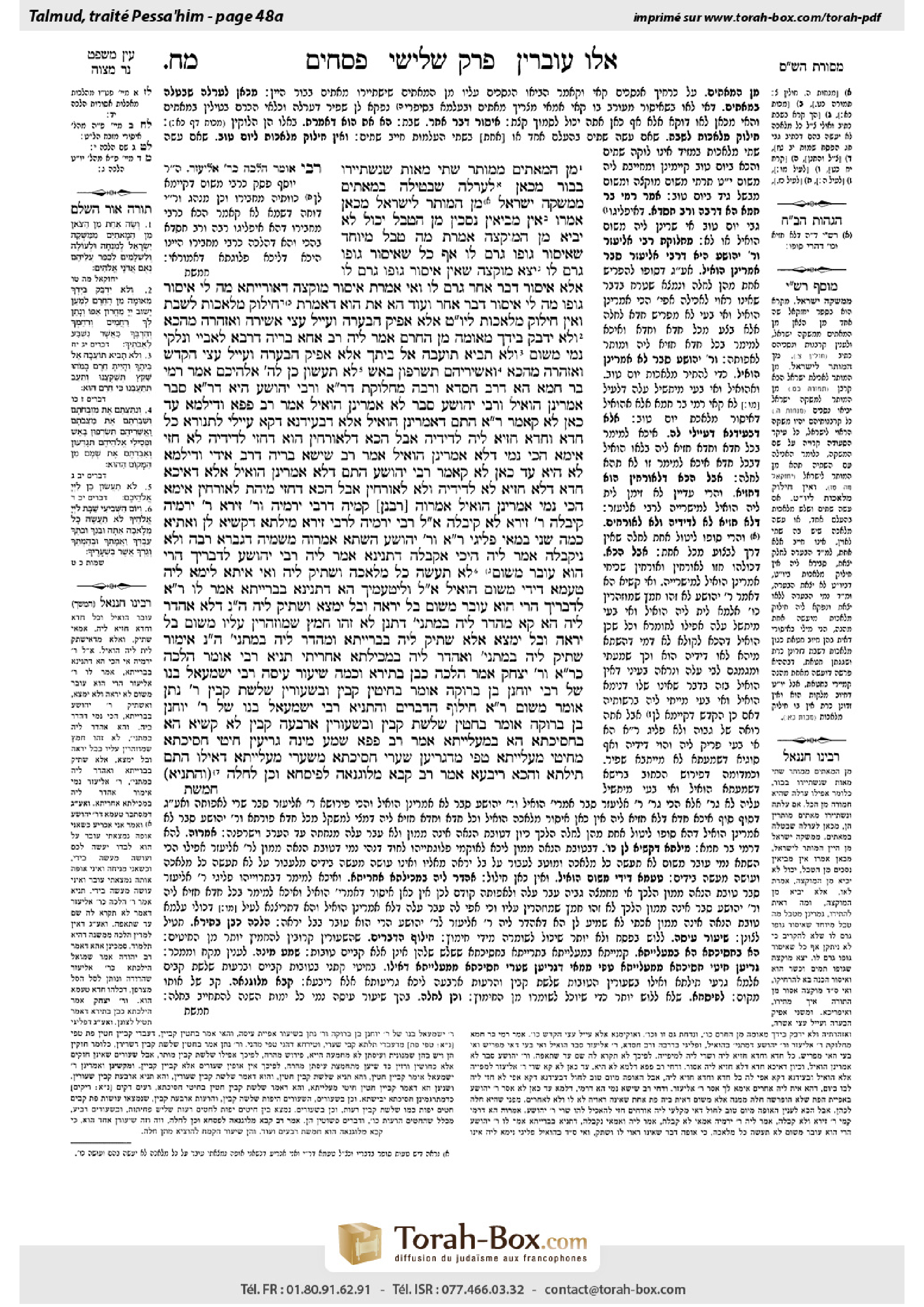
Pesachim 48a: Talmud study for Daf Yomi
Daf Yomi is the daily study of one Talmud folio. Explore 37 tractates with scans, Hebrew text, Sefaria English and AI-generated French translations where annotated.
Passage selection and English or AI-generated French translation are available where the scan has annotations. Daf Study is independent of Torah-Box and Sefaria.
Browse Pesachim · פסחים · All tractatesPesachim 48a text and translations
This page of Pesachim includes the Aramaic text, an English translation and an AI-generated French translation, alongside the scan above.
פסחים מ״ח א · Aramaic and Hebrew text
״מִן הַמָּאתַיִם״ — מִמּוֹתַר שְׁתֵּי מֵאוֹת שֶׁנִּשְׁתַּיְּירוּ בַּבּוֹר. מִכָּאן לְעׇרְלָה שֶׁבְּטֵילָה בְּמָאתַיִם.
״מִמַּשְׁקֵה יִשְׂרָאֵל״ — מִן הַמּוּתָּר לְיִשְׂרָאֵל. מִכָּאן אָמְרוּ: אֵין מְבִיאִין נְסָכִין מִן הַטֶּבֶל.
יָכוֹל לֹא יָבִיא מִן הַמּוּקְצֶה. אָמַרְתָּ: מָה טֶבֶל מְיוּחָד שֶׁאִיסּוּר גּוּפוֹ גָּרַם לוֹ — אַף כֹּל שֶׁאִיסּוּר גּוּפוֹ גָּרַם לוֹ. יָצָא מוּקְצֶה שֶׁאֵין אִיסּוּר גּוּפוֹ גָּרַם לוֹ, אֶלָּא אִיסּוּר דָּבָר אַחֵר גָּרַם לוֹ. וְאִי אָמְרַתְּ אִיסּוּר מוּקְצֶה דְּאוֹרָיְיתָא, מָה לִי אִיסּוּר גּוּפוֹ מָה לִי אִיסּוּר דָּבָר אַחֵר?
וְעוֹד, הָא אַתְּ הוּא דְּאָמְרַתְּ: חִילּוּק מְלָאכוֹת לְשַׁבָּת, וְאֵין חִילּוּק מְלָאכוֹת לְיוֹם טוֹב.
אֶלָּא אַפֵּיק הַבְעָרָה, וְעַיֵּיל עֲצֵי אֲשֵׁירָה. וְאַזְהָרָה מֵהָכָא, ״וְלֹא יִדְבַּק בְּיָדְךָ מְאוּמָה מִן הַחֵרֶם״.
אֲמַר לֵיהּ רַב אַחָא בְּרֵיהּ דְּרָבָא לְאַבָּיֵי: וְנִלְקֵי נָמֵי מִשּׁוּם ״וְלֹא תָבִיא תוֹעֵבָה אֶל בֵּיתֶךָ״.
אֶלָּא: אַפֵּיק הַבְעָרָה, וְעַיֵּיל עֲצֵי הֶקְדֵּשׁ. וְאַזְהָרָה מֵהָכָא, ״וַאֲשֵׁרֵיהֶם תִּשְׂרְפוּן בָּאֵשׁ ... לֹא תַעֲשׂוּן כֵּן לַה׳ אֱלֹהֵיכֶם״.
אָמַר רָמֵי בַּר חָמָא: הָא דְּרַב חִסְדָּא וְרַבָּה — מַחֲלוֹקֶת דְּרַבִּי אֱלִיעֶזֶר וְרַבִּי יְהוֹשֻׁעַ הִיא. דְּרַבִּי אֱלִיעֶזֶר סָבַר: אָמְרִינַן ״הוֹאִיל״. וְרַבִּי יְהוֹשֻׁעַ סָבַר: לָא אָמְרִינַן ״הוֹאִיל״.
אָמַר רַב פָּפָּא: וְדִילְמָא עַד כָּאן לָא קָאָמַר רַבִּי אֱלִיעֶזֶר הָתָם דְּאָמְרִינַן ״הוֹאִיל״, אֶלָּא דִּבְעִידָּנָא דְּקָא עָיְילִי לְתַנּוּרָא כׇּל חֲדָא וַחֲדָא חַזְיָא לֵיהּ לְדִידֵיהּ. אֲבָל הָכָא, דִּלְאוֹרְחִין הוּא דַּחֲזֵי לְדִידֵיהּ לָא חֲזֵי — אֵימָא הָכִי נָמֵי דְּלָא אָמְרִינַן ״הוֹאִיל״.
אָמַר רַב שִׁישָׁא בְּרֵיהּ דְּרַב אִידִי: וְדִילְמָא לָא הִיא, עַד כָּאן לָא קָאָמַר רַבִּי יְהוֹשֻׁעַ הָתָם דְּלָא אָמְרִינַן ״הוֹאִיל״, אֶלָּא דְּאִיכָּא חֲדָא דְּלָא חַזְיָא לָא לְדִידֵיהּ וְלָא לְאוֹרְחִין. אֲבָל הָכָא, דַּחֲזֵי מִיהַת לְאוֹרְחִין — אֵימָא הָכִי נָמֵי אָמְרִינַן ״הוֹאִיל״.
אַמְרוּהָ [רַבָּנַן] קַמֵּיהּ דְּרַבִּי יִרְמְיָה וְרַבִּי זֵירָא. רַבִּי יִרְמְיָה קַיבְּלַהּ, רַבִּי זֵירָא לָא קַיבְּלַהּ. אֲמַר לֵיהּ רַבִּי יִרְמְיָה לְרַבִּי זֵירָא: מִילְּתָא דְּקַשְׁיָא לַן וְאָתְיָא כַּמָּה שְׁנֵי בְּמַאי פְּלִיגִי רַבִּי אֱלִיעֶזֶר וְרַבִּי יְהוֹשֻׁעַ, הַשְׁתָּא אַמְרוּהָ מִשְּׁמֵיהּ דְּגַבְרָא רַבָּה, וְלָא נִיקַבְּלַהּ?
אֲמַר לֵיהּ: הֵיכִי אֲקַבְּלַהּ, דִּתְנֵינָא, אֲמַר לֵיהּ רַבִּי יְהוֹשֻׁעַ: לִדְבָרֶיךָ, הֲרֵי הוּא עוֹבֵר מִשּׁוּם ״לֹא תַעֲשֶׂה כׇל מְלָאכָה״, וּשְׁתֵיק לֵיהּ. וְאִי אִיתָא, לֵימָא לֵיהּ: טַעְמָא דִּידִי מִשּׁוּם ״הוֹאִיל״.
אֲמַר לֵיהּ: וְלִיטַעְמָיךְ, הָא דִּתְנֵינָא בְּבָרַיְיתָא, אָמַר לוֹ רַבִּי אֱלִיעֶזֶר: לִדְבָרֶיךָ, הֲרֵי הוּא עוֹבֵר מִשּׁוּם ״בַּל יֵרָאֶה וּבַל יִמָּצֵא״, וּשְׁתֵיק לֵיהּ. הָכִי נָמֵי דְּלָא אַהְדַּר לֵיהּ? הָא קָא מַהְדַּר לֵיהּ בְּמַתְנִיתִין? דִּתְנַן: לֹא זֶהוּ חָמֵץ שֶׁמּוּזְהָרִין עָלָיו מִשּׁוּם ״בַּל יֵרָאֶה וּבַל יִמָּצֵא״, אֶלָּא: שָׁתֵיק לֵיהּ בְּבָרַיְיתָא, וּמַהְדַּר לֵיהּ בְּמַתְנִיתִין. הָכִי נָמֵי, אֵימוֹר שְׁתֵיק לֵיהּ בְּמַתְנִיתִין, וְאַהְדַּר לֵיהּ בִּמְכִילְתָּא אַחֲרִיתִי.
תַּנְיָא, רַבִּי אוֹמֵר: הֲלָכָה כְּרַבִּי אֱלִיעֶזֶר, וְרַבִּי יִצְחָק אָמַר: הֲלָכָה כְּבֶן בְּתֵירָא.
וְכַמָּה שִׁיעוּר עִיסָּה? רַבִּי יִשְׁמָעֵאל בְּנוֹ שֶׁל רַבִּי יוֹחָנָן בֶּן בְּרוֹקָה אוֹמֵר: בְּחִיטִּין — קַבִּין. וּבִשְׂעוֹרִין — שְׁלֹשֶׁת קַבִּין. רַבִּי נָתָן אוֹמֵר מִשּׁוּם רַבִּי אֱלִיעֶזֶר: חִילּוּף הַדְּבָרִים.
וְהָתַנְיָא, רַבִּי יִשְׁמָעֵאל בְּנוֹ שֶׁל רַבִּי יוֹחָנָן בֶּן בְּרוֹקָה אוֹמֵר: בְּחִטִּין — שְׁלֹשֶׁת קַבִּין, וּבִשְׂעוֹרִין — אַרְבָּעָה קַבִּין! לָא קַשְׁיָא: הָא — בְּחַסִּיכָתָא, הָא — בִּמְעַלְּיָיתָא.
אָמַר רַב פָּפָּא: שְׁמַע מִינַּהּ גְּרִיעִין חִיטֵּי חַסִּיכָתָא מֵחִיטֵּי מְעַלְּיָיתָא טְפֵי מִדִּגְרִיעָן שְׂעָרֵי חַסִּיכָתָא מִשְּׂעָרֵי מְעַלְּיָיתָא. דְּאִילּוּ הָתָם תִּילְתָּא, וְהָכָא רִיבְעָא.
אָמַר רַב: קַבָּא מְלוֹגְנָאָה לְפִיסְחָא, וְכֵן לְחַלָּה. (וְהָתַנְיָא:)
Pesachim 48a · English translation
The phrase: Out of two hundred, is expounded with regard to wine brought as a libation: From the remaining two hundred portions that remain in the vat. This is referring to a case where wine prohibited as produce grown during a tree or vine’s first three years [orla] is mixed with permitted wine. The halakha is that this wine mixture may be brought as a libation only if there is two hundred times more permitted wine than prohibited wine. From here it is derived that orla is nullified in a mixture of two hundred.
The phrase: From the well-watered pastures of Israel, means that sacrifices may be offered only from that which is permitted to Israel. From here, the Sages stated: One may not offer libations from untithed produce [tevel], since Jews are prohibited from eating tevel.
I might have thought that one may not offer an animal that is set-aside on Shabbat or during a Festival; therefore, you have said: Just as tevel is unique in that its inherent prohibition caused it to be prohibited for Jews to eat, so too, anything whose inherent prohibition caused it to be prohibited for Jews to eat is invalid as an offering. This excludes an animal that has been set aside, which does not have an inherent prohibition that caused it to be prohibited for eating; rather, a different prohibition, i.e., the prohibition of utilizing set-aside objects on Shabbat, caused it to be prohibited for eating. And if you say the prohibition of utilizing set-aside material is by Torah law, what difference is there to me if a food is inherently prohibited; and what difference is there to me if it is prohibited due to a different prohibition? If there is a distinction between these prohibitions, it must be that the prohibition of utilizing set-aside material is by rabbinic law, and therefore, like many other rabbinic decrees, it does not apply in the Temple.
And furthermore, Abaye said to Rabba: It is possible to challenge your interpretation of the baraita from a different angle. Wasn’t it you who said, as cited in tractate Makkot, that there is division of labors with regard to Shabbat, and therefore one is required to bring two sin-offerings if he performed two prohibited labors of different primary categories in one lapse of awareness, or if he performed a prohibited labor twice, during separate lapses of awareness; however, there is no division of labors with regard to a Festival, and therefore one is not punished with multiple floggings for performing multiple prohibited labors? Consequently, how could one be liable for multiple floggings for the prohibition of utilizing set-aside materials and for cooking the sciatic nerve on a Festival?
Rather, in order to make this baraita consistent with Rabba’s opinion, remove the prohibition of kindling a fire and add in its place the prohibition of using the wood of a tree designated for idolatry [asheira]. And the warning, i.e., the source of the negative commandment associated with using this wood, is derived from here, a verse that relates to an idolatrous city that is burned: “Nothing from the spoil shall cling to your hand” (Deuteronomy 13:18).
Rav Aḥa, son of Rava, said to Abaye: If this case is referring to using wood from an asheira, one should also be flogged due to having transgressed the prohibition of: “You shall not bring an abominable thing into your home” (Deuteronomy 7:26). However, this would add an extra negative commandment to the list enumerated in the baraita.
Rather, remove the prohibition of kindling a fire and add in its place the prohibition of burning consecrated wood. And the warning, i.e., the source of this negative command, is from here: “And you shall burn their asheira trees with fire...you shall not do this to the Lord your God” (Deuteronomy 12:3–4). Therefore, one who burns a consecrated item in a destructive manner is punished with lashes. In conclusion, no adequate proof can be adduced from the baraita to reject Rabba’s opinion.
Rami bar Ḥama said: This dispute between Rav Ḥisda and Rabba with regard to the principle: Since, etc., is a matter of dispute between Rabbi Eliezer and Rabbi Yehoshua in the mishna. As, Rabbi Eliezer, who says that ḥalla should be separated only after the bread has been baked, holds that we say the principle: Since, etc. Since any portion of the dough could potentially be eaten if another part of the dough is designated as ḥalla, therefore, one is permitted to bake bread without separating ḥalla from it ab initio. And Rabbi Yehoshua holds: We do not say the principle: Since, etc.
Rav Pappa said that this claim can be rejected in the following manner: Perhaps Rabbi Eliezer only stated that we say the principle: Since, etc., there, in the case of the separation of ḥalla, because at the time that it was placed into the oven, each and every loaf was fit for him, and there was no indication as to which loaf he would designate as ḥalla. However, here, in a case where the bread one is baking on the Festival is fit for guests but is not fit for him, say that so too, even according to the opinion of Rabbi Eliezer we do not say the principle: Since, etc.
Rav Sheisha, son of Rav Idi, rejected Rami bar Ḥama’s statement for a different reason and said: Perhaps that is not so. Rabbi Yehoshua only stated that we do not say the principle: Since, etc., there, where there is one portion of the bread that is not fit for him or for guests, because the piece that is designated as ḥalla cannot be eaten by anyone due to the fact that it is ritually impure. However, here, in the case of one who is baking bread during the Festival so that it can be eaten on a weekday, when it is at least fit for guests, say that so too, even according to the opinion of Rabbi Yehoshua, we say the principle: Since, etc.
The Gemara recounts: The Sages said Rami bar Ḥama’s statement before Rabbi Yirmeya and Rabbi Zeira. Rabbi Yirmeya accepted it and Rabbi Zeira did not accept it. Rabbi Yirmeya said to Rabbi Zeira: The following matter has been difficult for us to explain for several years: With regard to what principle did Rabbi Eliezer and Rabbi Yehoshua disagree? Now an explanation has been stated in the name of a great man. Shall we not accept it?
He said to him: How can I accept it? We already learned in a baraita with regard to their dispute: Rabbi Yehoshua said to Rabbi Eliezer: According to your statement, one violates the prohibition: “You shall not perform any labor” (Exodus 20:9). Rabbi Eliezer could not respond to this claim and was silent. But if it is as Rami bar Ḥama explained, Rabbi Eliezer should have said to him: The reason for my opinion is due to the principle: Since, etc., on the basis of which no prohibited labor has been performed.
Rabbi Yirmeya said to him: According to your reasoning, with regard to that which we already learned in a baraita, that Rabbi Eliezer said to him: According to your statement, he transgresses the prohibitions: It shall not be seen, and: It shall not be found, and in response to this challenge Rabbi Yehoshua was silent, did he too not respond to Rabbi Eliezer? He responded to him in the mishna, as we learned in the mishna that Rabbi Yehoshua said: This is not the leavened bread about which we are warned with the prohibitions: It shall not be seen, and: It shall not be found. Rather, it must be explained in the following manner: He appeared to be silent in the baraita simply because his response was not recorded, but he responded in the mishna. So too, here it is possible to say that he appeared silent in the mishna, but he responded in a different tractate.
It was taught in a baraita that Rabbi Yehuda HaNasi says: The halakha with regard to the separation of ḥalla from impure dough during Passover is in accordance with the opinion of Rabbi Eliezer. And Rabbi Yitzḥak said: The halakha is in accordance with the opinion of ben Beteira.
The Gemara asks: How much dough may be kneaded at once on Passover without concern that the dough will become leavened in the process? Rabbi Yishmael, son of Rabbi Yoḥanan ben Beroka, says: With regard to wheat, one may use the amount of flour that comes from two kav of grain; and with regard to barley, one may use the amount of flour that comes from three kav. Rabbi Natan says in the name of Rabbi Eliezer: The matters are reversed. One may knead the flour produced from three kav of wheat or two kav of barley without concern that it will become leavened.
The Gemara asks: Wasn’t it taught in a different baraita that Rabbi Yishmael, son of Rabbi Yoḥanan ben Beroka, says: With regard to wheat, one may use the amount of flour that comes from three kav of grain, and with regard to barley, one may use the amount of flour that comes from four kav? The Gemara answers: This is not difficult, as this latter baraita is referring to low-quality grain, and that baraita is referring to high-quality grain. One can obtain a higher proportion of flour from high-quality grain than from low-quality grain, which contains a greater amount of chaff.
Rav Pappa said: Learn from this that the extent to which low-quality wheat is worse than high-quality wheat is greater than the extent to which low-quality barley is worse than high-quality barley, i.e., the discrepancy between the different levels of quality is more significant with regard to wheat, as there, in the case of wheat, they differ by one-third; and here, in the case of barley, they differ by only one-fourth.
Rav said: A kav from the place Melogna is the amount that can be used to prepare dough for Passover. And similarly, with regard to ḥalla, that is the minimum amount of dough from which ḥalla must be separated. The Gemara asks: Wasn’t it taught in a baraita:
Pesachim 48a · Traduction française (IA)
L’expression « sur deux cents » est interprétée au sujet du vin destiné à une libation : à partir des deux cents parts restantes dans la cuve. Il s’agit d’un cas où du vin interdit parce qu’il provient des trois premières années d’un arbre ou d’une vigne [orla] a été mélangé à du vin permis. La halakha est que ce mélange ne peut être offert en libation que s’il y a deux cents fois plus de vin permis que de vin interdit. On en déduit que l’orla est annulée dans un mélange de deux cents parts.
L’expression « des pâturages bien arrosés d’Israël » signifie que seuls peuvent être offerts en sacrifice les produits permis aux Juifs. Les Sages en déduisent qu’on ne peut pas offrir de libations à partir de produits non soumis à la dîme [tevel], puisque les Juifs n’ont pas le droit de manger du tevel.
J’aurais pu penser qu’on ne peut pas offrir un animal mis à l’écart le Chabbat ou pendant une fête. C’est pourquoi il est dit : de même que le tevel se distingue en ce que son interdiction intrinsèque le rend interdit à la consommation pour les Juifs, de même, tout aliment dont l’interdiction intrinsèque le rend interdit à la consommation pour les Juifs est invalide comme offrande. Cela exclut un animal mis à l’écart, car aucune interdiction intrinsèque ne le rend interdit à la consommation ; c’est une autre interdiction, à savoir celle d’utiliser des objets mis à l’écart le Chabbat, qui le rend interdit à la consommation. Et si tu dis que l’interdiction d’utiliser des objets mis à l’écart relève de la Torah, quelle différence y a-t-il entre un aliment interdit par nature et un aliment interdit en raison d’une autre interdiction ? S’il y a une distinction entre ces interdictions, c’est forcément que l’interdiction d’utiliser des objets mis à l’écart relève de la loi rabbinique et que, par conséquent, comme nombre d’autres décrets rabbiniques, elle ne s’applique pas dans le Temple.
De plus, Abaye dit à Rabba : il est possible de réfuter ton interprétation de la baraïta sous un autre angle. N’est-ce pas toi qui as dit, comme cela est rapporté dans le traité Makkot, qu’il y a division des travaux interdits le Chabbat, et que l’on doit donc apporter deux sacrifices expiatoires si l’on a accompli, au cours d’une seule période d’inadvertance, deux travaux interdits relevant de catégories principales différentes, ou si l’on a accompli deux fois un même travail interdit au cours de périodes d’inadvertance distinctes ; mais qu’il n’y a pas de division des travaux interdits pendant une fête, de sorte qu’on ne reçoit pas plusieurs séries de coups de fouet pour avoir accompli plusieurs travaux interdits ? Comment pourrait-on alors être passible de plusieurs séries de coups de fouet pour avoir enfreint l’interdiction d’utiliser des objets mis à l’écart et celle de cuire le nerf sciatique pendant une fête ?
Mais, pour rendre cette baraïta compatible avec l’opinion de Rabba, il faut supprimer l’interdiction d’allumer un feu et la remplacer par l’interdiction d’utiliser le bois d’un arbre consacré à l’idolâtrie [asheira]. Et l’avertissement, c’est-à-dire la source du commandement négatif lié à l’utilisation de ce bois, est tiré d’ici, d’un verset concernant une ville idolâtre vouée à être brûlée : « Que rien du butin ne s’attache à ta main » (Deutéronome 13,18).
Rav Aḥa, fils de Rava, dit à Abaye : si ce cas concerne l’utilisation de bois provenant d’une asheira, on devrait aussi recevoir des coups de fouet pour avoir enfreint l’interdiction suivante : « Tu ne feras pas entrer une chose abominable dans ta maison » (Deutéronome 7,26). Cela ajouterait toutefois un commandement négatif à la liste énumérée dans la baraïta.
Mais il faut supprimer l’interdiction d’allumer un feu et la remplacer par l’interdiction de brûler du bois consacré. L’avertissement, c’est-à-dire la source de ce commandement négatif, est tiré d’ici : « Vous brûlerez leurs asheiras par le feu… vous n’agirez pas ainsi envers le Seigneur votre Dieu » (Deutéronome 12,3-4). Par conséquent, celui qui brûle un objet consacré de manière destructrice est passible de coups de fouet. En conclusion, la baraïta ne permet pas d’apporter une preuve suffisante pour réfuter l’opinion de Rabba.
Rami bar Ḥama dit : cette controverse entre Rav Ḥisda et Rabba au sujet du principe « puisque, etc. » fait l’objet d’un désaccord entre Rabbi Eliezer et Rabbi Yehoshua dans la Michna. En effet, Rabbi Eliezer, qui dit que la ḥalla ne doit être prélevée qu’après la cuisson du pain, estime que l’on applique le principe « puisque, etc. ». Puisque n’importe quelle portion de la pâte pourrait être consommée si une autre portion était désignée comme ḥalla, on a donc le droit, a priori, de cuire le pain sans en avoir prélevé la ḥalla. Rabbi Yehoshua, lui, estime que l’on n’applique pas le principe « puisque, etc. ».
Rav Pappa dit que l’on peut réfuter cette affirmation de la manière suivante : peut-être Rabbi Eliezer a-t-il seulement déclaré que l’on applique le principe « puisque, etc. » dans ce cas, celui du prélèvement de la ḥalla, parce qu’au moment où la pâte a été mise au four, chaque miche, sans exception, pouvait être consommée par lui, et rien n’indiquait quelle miche il désignerait comme ḥalla. Mais ici, dans le cas où le pain qu’on cuit pendant la fête peut être consommé par des invités, mais pas par lui, il faut dire que, de même, même selon Rabbi Eliezer, on n’applique pas le principe « puisque, etc. ».
Rav Sheisha, fils de Rav Idi, réfuta la déclaration de Rami bar Ḥama pour une autre raison et dit : peut-être n’en est-il pas ainsi. Rabbi Yehoshua a seulement déclaré que l’on n’applique pas le principe « puisque, etc. » dans ce cas, où une portion du pain ne peut être consommée ni par lui ni par des invités, parce que la portion désignée comme ḥalla ne peut être consommée par personne, puisqu’elle est rituellement impure. Mais ici, dans le cas de celui qui cuit du pain pendant la fête afin qu’il puisse être consommé un jour de semaine, alors qu’il peut au moins être mangé par des invités, il faut dire que, de même, même selon Rabbi Yehoshua, on applique le principe « puisque, etc. ».
La Guemara rapporte : les Sages exposèrent la déclaration de Rami bar Ḥama devant Rabbi Yirmeya et Rabbi Zeira. Rabbi Yirmeya l’accepta, mais Rabbi Zeira ne l’accepta pas. Rabbi Yirmeya dit à Rabbi Zeira : depuis plusieurs années, nous avons du mal à expliquer sur quel principe Rabbi Eliezer et Rabbi Yehoshua étaient en désaccord. À présent, une explication a été donnée au nom d’un grand homme. Ne devrions-nous pas l’accepter ?
Il lui dit : comment pourrais-je l’accepter ? Nous avons déjà appris dans une baraïta, à propos de leur controverse, que Rabbi Yehoshua dit à Rabbi Eliezer : selon tes propos, on enfreint l’interdiction « Tu ne feras aucun travail » (Exode 20,9). Rabbi Eliezer ne put répondre à cette objection et garda le silence. Mais si l’explication de Rami bar Ḥama est correcte, Rabbi Eliezer aurait dû lui dire : mon opinion repose sur le principe « puisque, etc. », en vertu duquel aucun travail interdit n’a été accompli.
Rabbi Yirmeya lui dit : selon ton raisonnement, à propos de ce que nous avons déjà appris dans une baraïta, à savoir que Rabbi Eliezer lui dit : selon tes propos, tu enfreins les interdictions « Il ne sera pas vu » et « Il ne sera pas trouvé », et que Rabbi Yehoshua garda le silence face à cette objection, Rabbi Yehoshua n’a-t-il pas lui aussi répondu à Rabbi Eliezer ? Il lui a répondu dans la Michna, car nous avons appris dans la Michna que Rabbi Yehoshua dit : ce n’est pas de ce levain-là que nous sommes avertis par les interdictions « Il ne sera pas vu » et « Il ne sera pas trouvé ». Il faut plutôt expliquer les choses ainsi : il a semblé garder le silence dans la baraïta simplement parce que sa réponse n’y a pas été rapportée, mais il a répondu dans la Michna. De même, ici, on peut dire qu’il a semblé garder le silence dans la Michna, mais qu’il a répondu dans un autre traité.
Il a été enseigné dans une baraïta que Rabbi Yehuda HaNassi dit : la halakha concernant le prélèvement de la ḥalla d’une pâte impure pendant Pessaḥ suit l’opinion de Rabbi Eliezer. Et Rabbi Yitzḥak dit : la halakha suit l’opinion de ben Beteira.
La Guemara demande : quelle quantité de pâte peut-on pétrir à la fois pendant Pessaḥ sans craindre qu’elle ne devienne du hamets au cours de l’opération ? Rabbi Yishmael, fils de Rabbi Yoḥanan ben Beroka, dit : pour le blé, on peut utiliser la quantité de farine obtenue à partir de deux kav de grain ; pour l’orge, la quantité de farine obtenue à partir de trois kav. Rabbi Natan dit au nom de Rabbi Eliezer : c’est l’inverse. On peut pétrir la farine obtenue à partir de trois kav de blé ou de deux kav d’orge sans craindre qu’elle ne devienne du hamets.
La Guemara demande : n’a-t-on pas enseigné dans une autre baraïta que Rabbi Yishmael, fils de Rabbi Yoḥanan ben Beroka, dit : pour le blé, on peut utiliser la quantité de farine obtenue à partir de trois kav de grain, et pour l’orge, celle obtenue à partir de quatre kav ? La Guemara répond : il n’y a pas de difficulté, car cette dernière baraïta parle de grain de qualité inférieure, tandis que l’autre baraïta parle de grain de qualité supérieure. On obtient une plus grande proportion de farine à partir de grain de qualité supérieure qu’à partir de grain de qualité inférieure, qui contient davantage de balle.
Rav Pappa dit : déduis de là que la différence entre le blé de qualité inférieure et le blé de qualité supérieure est plus grande que celle entre l’orge de qualité inférieure et l’orge de qualité supérieure ; autrement dit, l’écart entre les différents niveaux de qualité est plus important pour le blé. En effet, dans le cas du blé, la différence est d’un tiers, tandis que dans le cas de l’orge, elle n’est que d’un quart.
Rav dit : un kav de la région de Melogna est la quantité qu’on peut utiliser pour préparer de la pâte pour Pessaḥ. De même, en ce qui concerne la ḥalla, c’est la quantité minimale de pâte dont il faut prélever la ḥalla. La Guemara demande : n’a-t-on pas enseigné dans une baraïta :
Traduction française générée par IA à partir de l’édition anglaise de Sefaria. Vérifie toujours un passage avec le texte source.
Text from Sefaria: William Davidson Edition - Vocalized Aramaic (CC BY NC); William Davidson Edition - English (CC BY NC).