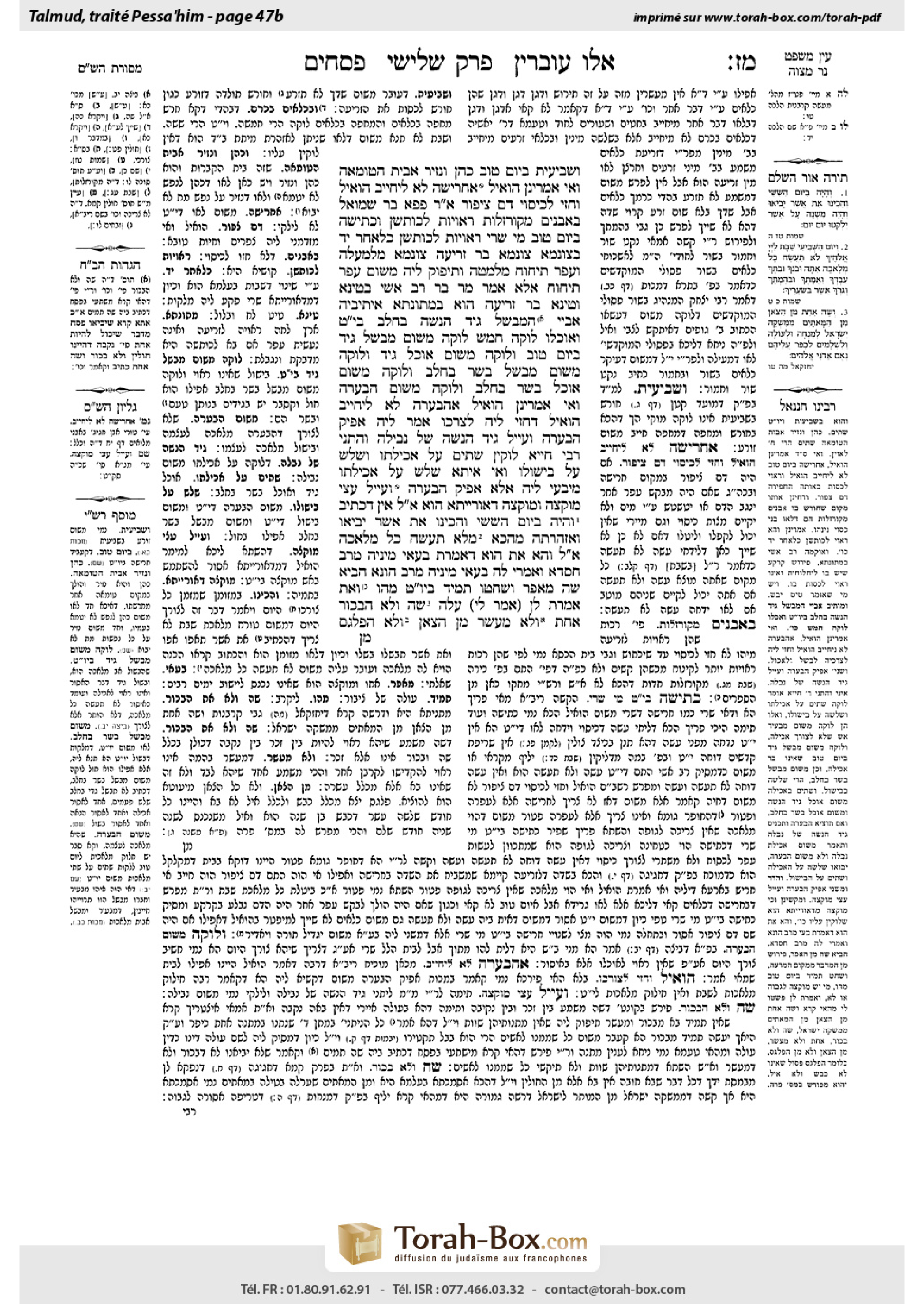
Pesachim 47b: Talmud study for Daf Yomi
Daf Yomi is the daily study of one Talmud folio. Explore 37 tractates with scans, Hebrew text, Sefaria English and AI-generated French translations where annotated.
Passage selection and English or AI-generated French translation are available where the scan has annotations. Daf Study is independent of Torah-Box and Sefaria.
Browse Pesachim · פסחים · All tractatesPesachim 47b text and translations
This page of Pesachim includes the Aramaic text, an English translation and an AI-generated French translation, alongside the scan above.
פסחים מ״ז ב · Aramaic and Hebrew text
וּשְׁבִיעִית, בְּיוֹם טוֹב, כֹּהֵן וְנָזִיר אַבֵּית הַטּוּמְאָה. וְאִי אָמְרִינַן ״הוֹאִיל״ — אַחֲרִישָׁה לָא לִיחַיַּיב, הוֹאִיל וְחָזֵי לְכִיסּוּי דַּם צִיפּוֹר.
אָמַר רַב פָּפָּא בַּר שְׁמוּאֵל: בַּאֲבָנִים מְקוּרְזָלוֹת.
רְאוּיוֹת לְכוֹתְשָׁן! וּכְתִישָׁה בְּיוֹם טוֹב מִי שְׁרֵי?! רְאוּיוֹת לְכוֹתְשָׁן כִּלְאַחַר יָד! בְּצוּנְמָא.
צוּנְמָא בַּר זְרִיעָה?! צוּנְמָא מִלְּמַעְלָה, וְעָפָר תִּיחוּחַ מִלְּמַטָּה. וְתִיפּוֹק לֵיהּ מִשּׁוּם עָפָר תִּיחוּחַ!
אֶלָּא אָמַר מָר בַּר רַב אָשֵׁי: בְּטִינָא. וְטִינָא בַּר זְרִיעָה הוּא?! בִּמְתוּנְתָּא.
אֵיתִיבֵיהּ אַבָּיֵי: הַמְבַשֵּׁל גִּיד הַנָּשֶׁה בְּחָלָב בְּיוֹם טוֹב וְאוֹכְלוֹ — לוֹקֶה חָמֵשׁ. לוֹקֶה מִשּׁוּם מְבַשֵּׁל גִּיד בְּיוֹם טוֹב, וְלוֹקֶה מִשּׁוּם אוֹכֵל גִּיד, וְלוֹקֶה מִשּׁוּם מְבַשֵּׁל בָּשָׂר בְּחָלָב, וְלוֹקֶה מִשּׁוּם אוֹכֵל בָּשָׂר בְּחָלָב, וְלוֹקֶה מִשּׁוּם הַבְעָרָה. וְאִי אָמְרִינַן ״הוֹאִיל״ — אַהַבְעָרָה לָא לִיחַיַּיב, הוֹאִיל דַּחֲזֵי לֵיהּ לְצׇרְכּוֹ!
אֲמַר לֵיהּ: אַפֵּיק הַבְעָרָה, וְעַיֵּיל גִּיד הַנָּשֶׁה שֶׁל נְבֵילָה.
וְהָתָנֵי רַבִּי חִיָּיא: לוֹקִין שְׁתַּיִם עַל אֲכִילָתוֹ, וְשָׁלֹשׁ עַל בִּישּׁוּלוֹ. וְאִי אִיתָא, שָׁלֹשׁ עַל אֲכִילָתוֹ מִיבְּעֵי לֵיהּ!
אֶלָּא: אַפֵּיק הַבְעָרָה, וְעַיֵּיל עֲצֵי מוּקְצֶה.
וּמוּקְצֶה דְּאוֹרָיְיתָא הוּא? אֲמַר לֵיהּ: אִין, דִּכְתִיב: ״וְהָיָה בַּיּוֹם הַשִּׁשִּׁי וְהֵכִינוּ אֵת אֲשֶׁר יָבִיאוּ״. וְאַזְהָרָתַהּ מֵהָכָא, מִ״לֹּא תַעֲשֶׂה כׇל מְלָאכָה״.
אֲמַר לֵיהּ, וְהָא אַתְּ הוּא דַּאֲמַרְתְּ: בְּעַאי מִינֵּיהּ מֵרַב חִסְדָּא, וְאָמְרִי לַהּ: בְּעַאי מִינֵּיהּ מֵרַב הוּנָא: הֵבִיא שֶׂה מֵאֲפָר, וּשְׁחָטוֹ תָּמִיד בְּיוֹם טוֹב, מַהוּ?
וְאַתְּ אָמְרַתְּ לַן, (אָמַר לִי) עֲלַהּ: ״שֶׂה״ — וְלֹא הַבְּכוֹר.
״אַחַת״ — וְלֹא מַעֲשֵׂר.
״מִן הַצֹּאן״ — וְלֹא הַפַּלְגָּס.
Pesachim 47b · English translation
And he is plowing during the Sabbatical year, when agricultural labor is prohibited, on a Festival. Additionally, the person plowing is a priest and a nazirite, and he is plowing a place of ritual impurity, i.e., a burial site. It is prohibited for a priest and a nazirite to become impure by walking over the burial spot of a corpse. Therefore, the one plowing commits two transgressions simply by traversing the field. And if we say the principle: Since, etc., he should not be liable for plowing on a Festival, since the dirt he loosens is fit for covering the blood of a bird. One who slaughters a bird or a non-domesticated animal is required by Torah law to cover the blood. Since it is possible that one will need to slaughter many such animals or birds and will not have enough dirt to cover their blood, his plowing may end up facilitating covering the blood. Therefore, it should not be considered a prohibited labor on the Festival.
The Gemara answers that Rav Pappa bar Shmuel said: The case is one in which a person plowed sharp stones, i.e., clods of dirt that have hardened and are unfit to be used to cover blood.
The Gemara asks: Aren’t these clods of dirt fit to be crushed and used to cover blood? The Gemara responds: Is crushing permitted on a Festival? The Gemara counters: But they are fit to be crushed in an unusual manner, which is not prohibited by Torah law. The Gemara answers: The case is one in which a person plowed hard, rocky soil, which cannot be crushed.
The Gemara asks: Is hard soil fit for planting? The case under discussion is one in which a person was preparing the ground in order to plant food crops in a vineyard. The Gemara answers: In this case, there was hard soil above and fertile, loose soil underneath, into which seeds could be planted. The Gemara rejects this answer: Derive that the act of plowing would be permitted in that case due to the loose soil, which is suitable for covering blood.
Rather, Mar bar Rav Ashi said: The case is one in which a person plowed mud, which is not fit for covering blood. The Gemara asks rhetorically: Is mud fit for planting? The Gemara answers: The case is one in which a person plowed moist earth, which is suitable for planting but which cannot be used to cover blood.
Abaye raised an objection to Rabba’s acceptance of the principle: Since, etc. One who cooks the sciatic nerve in milk on a Festival and eats it is flogged for five distinct prohibitions. How so? He is flogged due to the prohibition of cooking the sciatic nerve on a Festival, which is prohibited because the sciatic nerve is unfit for consumption; and he is flogged due to the prohibition of eating the sciatic nerve, which is explicitly prohibited by the Torah; and he is flogged due to the prohibition of cooking meat in milk; and he is flogged due to the prohibition of eating meat cooked in milk; and lastly, he is flogged due to the prohibition of kindling a fire unnecessarily on a Festival. And if we say the principle: Since, etc., he should not be liable for kindling a fire unnecessarily, since the fire is fit for use in attending to his legitimate Festival needs, e.g., cooking permitted foods.
Rabba said to him: Remove the prohibition of kindling a fire from this list and add the prohibition of eating a sciatic nerve from an animal carcass that was not properly slaughtered.
Abaye responded: Didn’t Rabbi Ḥiyya teach with regard to this mishna: He is flogged twice for his eating, as he violated the prohibitions of eating the sciatic nerve and eating meat cooked in milk, and three times for his cooking, as he violated the prohibitions of kindling a fire, cooking on a Festival, and cooking meat in milk? And if it is so, that the case is one in which the sciatic nerve was taken from an animal carcass, Rabbi Ḥiyya should have stated that he is flogged three times for his eating, as he violated the prohibitions of eating a sciatic nerve, eating meat cooked in milk, and eating an animal carcass.
Rather, Rabba said: Remove the prohibition of kindling a fire and add in its place the prohibition of using wood that has been set aside from use on the Festival.
The Gemara asks: Is the prohibition against utilizing set-aside material prohibited by Torah law, such that a person is flogged for violating this prohibition? He said to him: Yes, as it is written: “And it shall come to pass on the sixth day that they shall prepare that which they bring in” (Exodus 16:5). This verse teaches that anything that has not been prepared before the Festival is considered to be set-aside, and it is prohibited to utilize it. This verse indicates that utilizing set-aside objects is prohibited; however, it does not formulate this prohibition as a negative commandment. Therefore, the Gemara adds that the warning indicating that it is a negative commandment is from here: “You shall not perform any labor” (Exodus 20:10). This general statement pertaining to Shabbat includes utilizing objects that were not set aside for use before Shabbat.
Abaye said to him: Wasn’t it you who said: I raised a dilemma before Rav Ḥisda, and some say the correct version is: I raised a dilemma before Rav Huna: If one brought a lamb from the meadow, and the lamb is therefore set-aside because it was not designated for use before the Festival, and he slaughtered it as the daily offering on a Festival, what is the halakha? Is it permissible to offer this sacrifice?
And you said to us: He said to me about this issue that the answer can be derived from a verse in Ezekiel pertaining to communal offerings. The verse states: “And one lamb of the flock, out of two hundred, from the well-watered pastures of Israel” (Ezekiel 45:15). This verse is expounded in the following manner: The word lamb is referring to either a male or female lamb, but not to a firstborn, as that status applies only to male sheep.
The word one indicates that a sacrifice may not be brought from the animal tithe. The lamb must be one that can stand alone. An animal designated as tithe is always part of a group, as it is the tenth animal to leave the pen; therefore, it cannot be offered as a communal offering.
The expression: Of the flock indicates that only some animals of the flock may be offered, whereas one may not offer a palges, which is no longer a lamb but is not yet considered a ram.
Pesachim 47b · Traduction française (IA)
Et il laboure pendant l’année de la remise, où les travaux agricoles sont interdits, un jour de fête. De plus, celui qui laboure est un prêtre et un nazir, et il laboure un lieu rituellement impur, c’est-à-dire un lieu d’inhumation. Il est interdit à un prêtre et à un nazir de devenir impurs en passant au-dessus de la sépulture d’un mort. Ainsi, celui qui laboure commet deux transgressions rien qu’en traversant le champ. Or, si l’on applique le principe « Puisque… », il ne devrait pas être passible pour avoir labouré un jour de fête, puisque la terre qu’il ameublit convient à recouvrir le sang d’un oiseau. Celui qui égorge un oiseau ou un animal sauvage est tenu, selon la Torah, de recouvrir le sang. Comme il est possible qu’il doive égorger beaucoup de tels animaux ou oiseaux et qu’il ne dispose pas d’assez de terre pour recouvrir leur sang, son labour pourrait finalement faciliter le recouvrement du sang. Il ne devrait donc pas être considéré comme un travail interdit le jour de fête.
La Guemara répond que Rav Pappa bar Shmuel a dit : Le cas est celui d’un homme qui a labouré des mottes de terre durcies, impropres à recouvrir le sang.
La Guemara demande : Ces mottes de terre ne conviennent-elles pas à être broyées puis utilisées pour recouvrir le sang ? La Guemara répond : Le broyage est-il permis un jour de fête ? La Guemara objecte : Mais elles peuvent être broyées d’une manière inhabituelle, ce qui n’est pas interdit par la Torah. La Guemara répond : Le cas est celui d’un homme qui a labouré un sol dur et rocheux, qui ne peut pas être broyé.
La Guemara demande : Un sol dur convient-il à la plantation ? Le cas examiné est celui d’un homme qui préparait le terrain pour planter des cultures vivrières dans une vigne. La Guemara répond : Dans ce cas, le sol était dur en surface, mais fertile et meuble en dessous, de sorte que des graines pouvaient y être plantées. La Guemara rejette cette réponse : Il faut en déduire que le labour serait permis dans ce cas en raison du sol meuble, qui convient à recouvrir le sang.
Mais Mar bar Rav Ashi a dit : Le cas est celui d’un homme qui a labouré de la boue, impropre à recouvrir le sang. La Guemara demande rhétoriquement : La boue convient-elle à la plantation ? La Guemara répond : Le cas est celui d’un homme qui a labouré une terre humide, qui convient à la plantation mais ne peut servir à recouvrir le sang.
Abaye objecta à Rabba, qui acceptait le principe « Puisque… ». Celui qui cuit le nerf sciatique dans du lait un jour de fête et le mange reçoit la flagellation pour cinq interdictions distinctes. Comment cela ? Il reçoit la flagellation pour avoir cuit le nerf sciatique un jour de fête, ce qui est interdit puisque le nerf sciatique est impropre à la consommation ; pour avoir mangé le nerf sciatique, ce qui est explicitement interdit par la Torah ; pour avoir cuit de la viande dans du lait ; pour avoir mangé de la viande cuite dans du lait ; et enfin pour avoir allumé inutilement un feu un jour de fête. Or, si l’on applique le principe « Puisque… », il ne devrait pas être passible pour avoir allumé inutilement un feu, puisque celui-ci peut servir à satisfaire ses besoins légitimes pour la fête, par exemple en cuisant des aliments permis.
Rabba lui dit : Retire de cette liste l’interdiction d’allumer un feu, et ajoute l’interdiction de manger le nerf sciatique d’une carcasse qui n’a pas été abattue rituellement.
Abaye répondit : Rabbi Ḥiyya n’a-t-il pas enseigné à propos de cette Michna : Il reçoit deux fois la flagellation pour avoir mangé, car il a transgressé les interdictions de manger le nerf sciatique et de manger de la viande cuite dans du lait, et trois fois pour avoir cuit, car il a transgressé les interdictions d’allumer un feu, de cuire un jour de fête et de cuire de la viande dans du lait ? Or, si tel était le cas, à savoir que le nerf sciatique provenait d’une carcasse, Rabbi Ḥiyya aurait dû dire qu’il reçoit trois fois la flagellation pour avoir mangé, car il a transgressé les interdictions de manger le nerf sciatique, de manger de la viande cuite dans du lait et de manger une carcasse.
Rabba dit plutôt : Retire l’interdiction d’allumer un feu et remplace-la par l’interdiction d’utiliser du bois mis à l’écart pour la fête.
La Guemara demande : L’interdiction d’utiliser un objet mis à l’écart relève-t-elle de la Torah, au point qu’on reçoive la flagellation pour l’avoir transgressée ? Il lui répondit : Oui, car il est écrit : « Le sixième jour, ils prépareront ce qu’ils auront apporté » (Exode 16:5). Ce verset enseigne que tout ce qui n’a pas été préparé avant la fête est considéré comme mis à l’écart et qu’il est interdit de l’utiliser. Ce verset indique que l’utilisation d’objets mis à l’écart est interdite ; toutefois, il ne formule pas cette interdiction comme un commandement négatif. La Guemara ajoute donc que l’avertissement qui en fait un commandement négatif se trouve ici : « Tu ne feras aucun travail » (Exode 20:10). Cette formule générale relative au Chabbat inclut l’utilisation d’objets qui n’avaient pas été mis de côté en vue de leur utilisation avant le Chabbat.
Abaye lui dit : N’est-ce pas toi qui as dit : « J’ai soumis une question à Rav Ḥisda » — et, selon certains, la version exacte est : « J’ai soumis une question à Rav Huna » — : si quelqu’un amène un agneau du pâturage, de sorte que l’agneau est mis à l’écart puisqu’il n’avait pas été désigné pour être utilisé avant la fête, puis l’égorge comme offrande quotidienne un jour de fête, quelle est la halakha ? Est-il permis d’offrir ce sacrifice ?
Et tu nous as dit : À ce sujet, il m’a répondu qu’on pouvait déduire la réponse d’un verset d’Ézéchiel relatif aux offrandes communautaires. Le verset dit : « Et un agneau du troupeau, sur deux cents, pris dans les pâturages bien arrosés d’Israël » (Ézéchiel 45:15). Ce verset est interprété de la manière suivante : Le mot « agneau » désigne un agneau mâle ou femelle, mais pas un premier-né, car ce statut ne concerne que les moutons mâles.
Le mot « un » indique qu’un sacrifice ne peut pas être offert à partir de la dîme animale. L’agneau doit être un animal qui peut se tenir à part. Un animal désigné comme dîme fait toujours partie d’un groupe, puisqu’il est le dixième animal à sortir de l’enclos ; il ne peut donc pas être offert comme sacrifice communautaire.
L’expression « du troupeau » indique que seuls certains animaux du troupeau peuvent être offerts ; on ne peut pas offrir un palges, qui n’est plus un agneau, mais n’est pas encore considéré comme un bélier.
Traduction française générée par IA à partir de l’édition anglaise de Sefaria. Vérifie toujours un passage avec le texte source.
Text from Sefaria: William Davidson Edition - Vocalized Aramaic (CC BY NC); William Davidson Edition - English (CC BY NC).