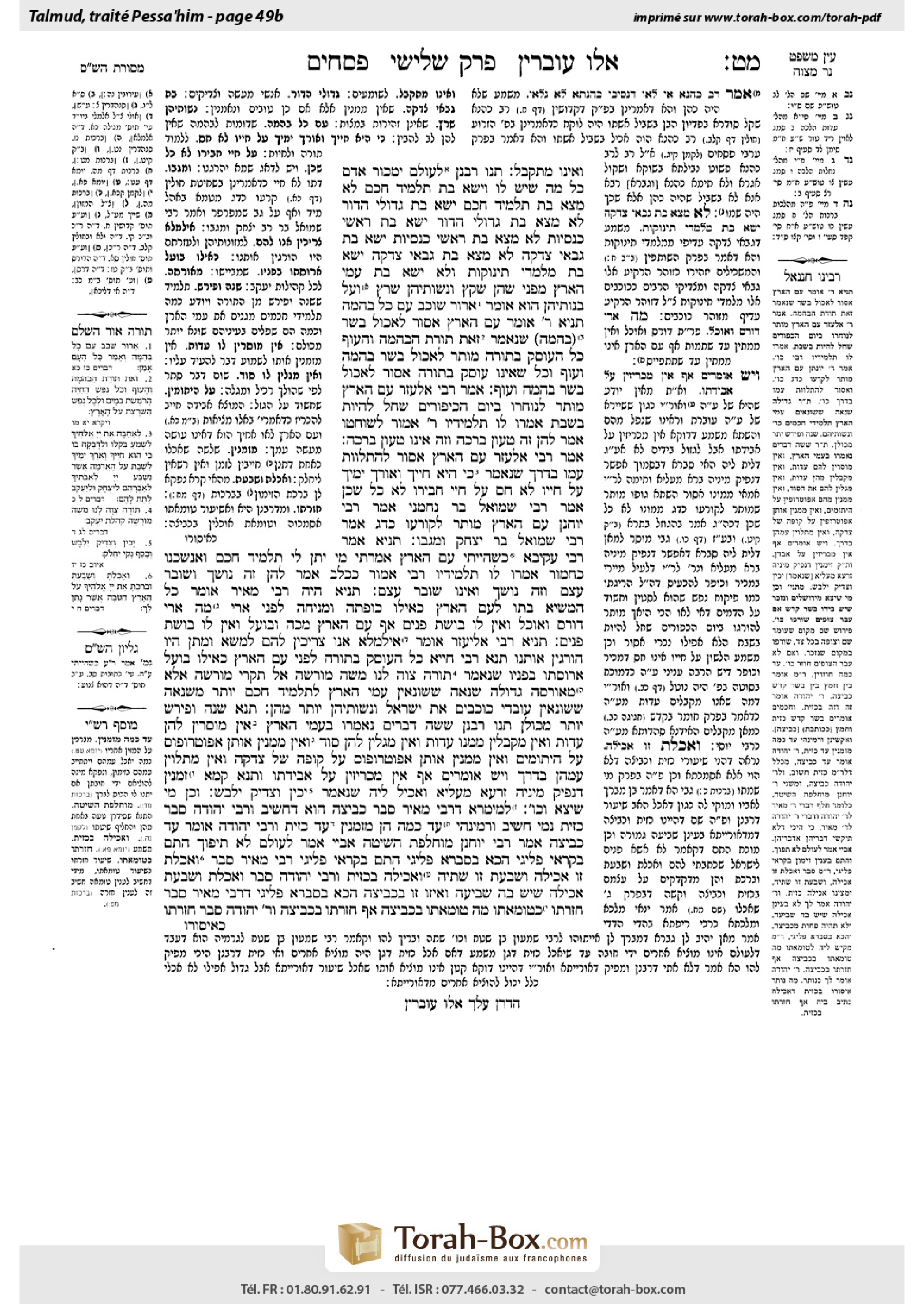
Pesachim 49b: Talmud study for Daf Yomi
Daf Yomi is the daily study of one Talmud folio. Explore 37 tractates with scans, Hebrew text, Sefaria English and AI-generated French translations where annotated.
Passage selection and English or AI-generated French translation are available where the scan has annotations. Daf Study is independent of Torah-Box and Sefaria.
Browse Pesachim · פסחים · All tractatesPesachim 49b text and translations
This page of Pesachim includes the Aramaic text, an English translation and an AI-generated French translation, alongside the scan above.
פסחים מ״ט ב · Aramaic and Hebrew text
וְאֵינוֹ מִתְקַבֵּל.
תָּנוּ רַבָּנַן: לְעוֹלָם יִמְכּוֹר אָדָם כׇּל מַה שֶׁיֵּשׁ לוֹ, וְיִשָּׂא בַּת תַּלְמִיד חָכָם. לֹא מָצָא בַּת תַּלְמִיד חָכָם — יִשָּׂא בַּת גְּדוֹלֵי הַדּוֹר. לֹא מָצָא בַּת גְּדוֹלֵי הַדּוֹר — יִשָּׂא בַּת רָאשֵׁי כְנֵסִיּוֹת. לֹא מָצָא בַּת רָאשֵׁי כְנֵסִיּוֹת — יִשָּׂא בַּת גַּבָּאֵי צְדָקָה. לֹא מָצָא בַּת גַּבָּאֵי צְדָקָה — יִשָּׂא בַּת מְלַמְּדֵי תִּינוֹקוֹת. וְלֹא יִשָּׂא בַּת עַמֵּי הָאָרֶץ, מִפְּנֵי שֶׁהֵן שֶׁקֶץ, וּנְשׁוֹתֵיהֶן שֶׁרֶץ, וְעַל בְּנוֹתֵיהֶן הוּא אוֹמֵר: ״אָרוּר שׁוֹכֵב עִם כׇּל בְּהֵמָה״.
תַּנְיָא, רַבִּי אוֹמֵר: עַם הָאָרֶץ אָסוּר לֶאֱכוֹל בְּשַׂר, (בְּהֵמָה) שֶׁנֶּאֱמַר: ״זֹאת תּוֹרַת הַבְּהֵמָה וְהָעוֹף״: כׇּל הָעוֹסֵק בַּתּוֹרָה מוּתָּר לֶאֱכוֹל בְּשַׂר בְּהֵמָה וָעוֹף, וְכֹל שֶׁאֵינוֹ עוֹסֵק בַּתּוֹרָה אָסוּר לֶאֱכוֹל בָּשָׂר בְּהֵמָה וָעוֹף.
אָמַר רַבִּי אֶלְעָזָר: עַם הָאָרֶץ מוּתָּר לְנוֹחֳרוֹ בְּיוֹם הַכִּיפּוּרִים שֶׁחָל לִהְיוֹת בְּשַׁבָּת. אָמְרוּ לוֹ תַּלְמִידָיו: רַבִּי, אֱמוֹר לְשׁוֹחְטוֹ! אָמַר לָהֶן: זֶה טָעוּן בְּרָכָה, וְזֶה אֵינוֹ טָעוּן בְּרָכָה.
אָמַר רַבִּי אֶלְעָזָר: עַם הָאָרֶץ אָסוּר לְהִתְלַוּוֹת עִמּוֹ בַּדֶּרֶךְ, שֶׁנֶּאֱמַר: ״כִּי הִיא חַיֶּיךָ וְאוֹרֶךְ יָמֶיךָ״, עַל חַיָּיו לֹא חָס, עַל חַיֵּי חֲבֵירוֹ — לֹא כׇּל שֶׁכֵּן.
אָמַר רַבִּי שְׁמוּאֵל בַּר נַחְמָנִי אָמַר רַבִּי יוֹחָנָן: עַם הָאָרֶץ מוּתָּר לְקוֹרְעוֹ כְּדָג. אָמַר רַבִּי שְׁמוּאֵל בַּר יִצְחָק: וּמִגַּבּוֹ.
תַּנְיָא, אָמַר רַבִּי עֲקִיבָא: כְּשֶׁהָיִיתִי עַם הָאָרֶץ אָמַרְתִּי: מִי יִתֵּן לִי תַּלְמִיד חָכָם וַאֲנַשְּׁכֶנּוּ כַּחֲמוֹר. אָמְרוּ לוֹ תַּלְמִידָיו: רַבִּי, אֱמוֹר כְּכֶלֶב! אָמַר לָהֶן: זֶה נוֹשֵׁךְ וְשׁוֹבֵר עֶצֶם, וְזֶה נוֹשֵׁךְ וְאֵינוֹ שׁוֹבֵר עֶצֶם.
תַּנְיָא, הָיָה רַבִּי מֵאִיר אוֹמֵר: כׇּל הַמַּשִּׂיא בִּתּוֹ לְעַם הָאָרֶץ, כְּאִילּוּ כּוֹפְתָהּ וּמַנִּיחָהּ לִפְנֵי אֲרִי. מָה אֲרִי דּוֹרֵס וְאוֹכֵל, וְאֵין לוֹ בּוֹשֶׁת פָּנִים — אַף עַם הָאָרֶץ מַכֶּה וּבוֹעֵל, וְאֵין לוֹ בּוֹשֶׁת פָּנִים.
תַּנְיָא, רַבִּי אֱלִיעֶזֶר אוֹמֵר: אִילְמָלֵא אָנוּ צְרִיכִין לָהֶם לְמַשָּׂא וּמַתָּן, הָיוּ הוֹרְגִין אוֹתָנוּ.
תָּנֵא רַבִּי חִיָּיא: כׇּל הָעוֹסֵק בַּתּוֹרָה לִפְנֵי עַם הָאָרֶץ, כְּאִילּוּ בּוֹעֵל אֲרוּסָתוֹ בְּפָנָיו, שֶׁנֶּאֱמַר: ״תּוֹרָה צִוָּה לָנוּ מֹשֶׁה מוֹרָשָׁה״. אַל תִּקְרֵי: ״מוֹרָשָׁה״, אֶלָּא: מְאוֹרָסָה.
גְּדוֹלָה שִׂנְאָה שֶׁשּׂוֹנְאִין עַמֵּי הָאָרֶץ לְתַלְמִיד חָכָם יוֹתֵר מִשִּׂנְאָה שֶׁשּׂוֹנְאִין אוּמּוֹת הָעוֹלָם אֶת יִשְׂרָאֵל, וּנְשׁוֹתֵיהֶן יוֹתֵר מֵהֶן. תָּנָא שָׁנָה וּפֵירַשׁ, יוֹתֵר מִכּוּלָּן.
תָּנוּ רַבָּנַן: שִׁשָּׁה דְּבָרִים נֶאֶמְרוּ בְּעַמֵּי הָאָרֶץ: אֵין מוֹסְרִין לָהֶן עֵדוּת. וְאֵין מְקַבְּלִין מִמֶּנּוּ עֵדוּת. וְאֵין מְגַלִּין לָהֶן סוֹד. וְאֵין מְמַנִּין אוֹתָן אַפּוֹטְרוֹפּוֹס עַל הַיְּתוֹמִים. וְאֵין מְמַנִּין אוֹתָן אַפּוֹטְרוֹפּוֹס עַל קוּפָּה שֶׁל צְדָקָה. וְאֵין מִתְלַוִּין עִמָּהֶן בַּדֶּרֶךְ. וְיֵשׁ אוֹמְרִים: אַף אֵין מַכְרִיזִין עַל אֲבֵידָתוֹ.
וְתַנָּא קַמָּא? זִמְנִין דְּנָפֵיק מִינֵּיהּ זַרְעָא מְעַלְּיָא וְאָכֵיל לֵיהּ, שֶׁנֶּאֱמַר: ״יָכִין וְצַדִּיק יִלְבַּשׁ״.
וְכֵן מִי שֶׁיָּצָא וְכוּ׳.
לְמֵימְרָא דְּרַבִּי מֵאִיר סָבַר כְּבֵיצָה הוּא דַּחֲשִׁיב, וְרַבִּי יְהוּדָה סָבַר כְּזַיִת נָמֵי חֲשִׁיב. וּרְמִינְהִי: עַד כַּמָּה הֵן מְזַמְּנִין? עַד כְּזַיִת, וְרַבִּי יְהוּדָה אוֹמֵר: עַד כְּבֵיצָה!
אָמַר רַבִּי יוֹחָנָן: מוּחְלֶפֶת הַשִּׁיטָה.
אַבָּיֵי אָמַר: לְעוֹלָם לָא תֵּיפוֹךְ. הָתָם — בִּקְרָאֵי פְּלִיגִי, הָכָא — בִּסְבָרָא פְּלִיגִי. הָתָם בִּקְרָאֵי פְּלִיגִי, רַבִּי מֵאִיר סָבַר: ״וְאָכַלְתָּ״ — זוֹ אֲכִילָה, ״וְשָׂבָעְתָּ״ — זוֹ שְׁתִיָּה, וַאֲכִילָה בִּכְזַיִת. וְרַבִּי יְהוּדָה סָבַר: ״וְאָכַלְתָּ וְשָׂבָעְתָּ״ — אֲכִילָה שֶׁיֵּשׁ בָּהּ שְׂבִיעָה, וְאֵיזוֹ זוֹ? בִּכְבֵיצָה.
הָכָא בִּסְבָרָא פְּלִיגִי, דְּרַבִּי מֵאִיר סָבַר חֲזָרָתוֹ כְּטוּמְאָתוֹ: מָה טוּמְאָתוֹ בִּכְבֵיצָה, אַף חֲזָרָתוֹ בִּכְבֵיצָה. וְרַבִּי יְהוּדָה סָבַר חֲזָרָתוֹ
Pesachim 49b · English translation
and unacceptable.
The Sages taught: A person should always be willing to sell all he has in order to marry the daughter of a Torah scholar. If he cannot find the daughter of a Torah scholar, he should marry the daughter of one of the great people of the generation, who are pious although they are not Torah scholars. If he cannot find the daughter of one of the great people of the generation, he should marry the daughter of one of the heads of the congregations. If he cannot find the daughter of one of the heads of the congregations, he should marry the daughter of one of the charity collectors. If he cannot find the daughter of one of the charity collectors, he should marry the daughter of one of the schoolteachers. However, he should not marry the daughter of an ignoramus [am ha’aretz] because they are vermin and their wives are similar to a creeping animal, as their lifestyle involves the violation of numerous prohibitions. And with regard to their daughters the verse states: “Cursed is he who lies with an animal” (Deuteronomy 27:21), as they are similar to animals in that they lack any knowledge or moral sense.
The Gemara continues its discussion with regard to an ignoramus. It was taught in a baraita that Rabbi Yehuda HaNasi says: It is prohibited for an ignoramus to eat meat, as it is stated: “This is the law [torah] of the beast and of the fowl” (Leviticus 11:46). He expounds: Anyone who engages in Torah study is permitted to eat the meat of animals and fowl, and anyone who does not engage in Torah study is prohibited to eat the meat of animals or fowl.
The Gemara proceeds to mention some sharply negative statements of the Sages in which they overstated their negative sentiments with regard to ignoramuses, although these ignoramuses were wicked in addition to being boors (ge’onim). Rabbi Elazar said: It is permitted to stab an ignoramus to death on Yom Kippur that occurs on Shabbat. His students said to him: Master, at least say that it is permitted to slaughter him. He said to them: I intentionally used the word stab, as this term, slaughtering, requires a blessing when one slaughters an animal, and that term, stabbing, does not require a blessing in any context.
Rabbi Elazar said: It is prohibited to accompany an ignoramus while traveling on the road due to concern that the ignoramus might try to harm his traveling partner, as it is stated with regard to Torah: “For it is your life and the length of your days” (Deuteronomy 30:20). An ignoramus has not studied any Torah, indicating that he is not concerned about his own life; with regard to another’s life, all the more so.
Rabbi Shmuel bar Naḥmani said that Rabbi Yoḥanan said: It is permitted to tear open an ignoramus like a fish. Rabbi Shmuel bar Yitzḥak said: And one may cut him open from his back and thereby cause his immediate death by piercing his spinal cord rather than his stomach.
It was taught in a baraita that Rabbi Akiva said: When I was an ignoramus I said: Who will give me a Torah scholar so that I will bite him like a donkey? His students said to him: Master, say that you would bite him like a dog! He said to them: I specifically used that wording, as this one, a donkey, bites and breaks bones, and that one, a dog, bites but does not break bones.
It was taught in a baraita that Rabbi Meir would say: Anyone who marries off his daughter to an ignoramus is considered as though he binds her and places her before a lion. Why is this so? Just as a lion mauls its prey and eats and has no shame, so too, an ignoramus strikes his wife and then engages in sexual relations with her without appeasing her first, and has no shame.
It was taught in a baraita that Rabbi Eliezer says: If we did not need the ignoramuses for business, they would kill us.
The Gemara shifts to a discussion of an ignoramus who has some degree of sensitivity (Me’iri). Rabbi Ḥiyya taught: Anyone who engages in Torah study in the presence of an ignoramus, causing the ignoramus embarrassment and anguish over his inability to study Torah, is considered as though he had sexual relations with the ignoramus’s betrothed bride in his presence, as it is stated: “Moses commanded us the Torah, an inheritance [morasha] for the congregation of Jacob” (Deuteronomy 33:4). Do not read it as inheritance [morasha]; rather, read it as betrothed [me’orasa]. The Torah is compared to the betrothed bride of the Jewish people until one studies it and thereby consummates his marriage with it.
Similarly, he said: The hatred which ignoramuses have for a Torah scholar is greater than the hatred that the nations of the world have for the Jewish people. And the wives of the ignoramuses hate Torah scholars more than the ignoramuses themselves. It was taught in the Tosefta that one who studied Torah and left his studies hates Torah scholars more than all of them.
The Sages taught: Six statements were made with regard to ignoramuses: One may not entrust them with testimony, i.e., one may not appoint them as witnesses to a particular event or transaction. Additionally, one may not accept testimony from them, as they are not considered trustworthy, and one should not reveal a secret to them, as they will reveal it. One may not appoint them as steward [apotropos] over an estate belonging to orphans, due to concern that they might make improper use of the orphans’ property. Likewise, one may not appoint them as guardian over a charity fund. Finally, one should not accompany them while traveling on the road, due to concern for one’s safety. And there are those who say: One does not even announce their lost items, meaning that if one finds a lost article from such a person, he is allowed to keep it without making an effort to locate the owner (Me’iri).
The Gemara asks: What is the reasoning of the first tanna, who holds that one must announce having found the lost article of an ignoramus? The Gemara explains: Sometimes upstanding offspring will come from him and will consume the property, as it is stated: “He may prepare it but the just shall put it on” (Job 27:17). It is possible for a wicked person to prepare something for himself that will later be used by a righteous person.
The Gemara returns to explaining the mishna. It was taught: And so too, one who left Jerusalem with sacrificial meat in his possession must return to Jerusalem to burn it, just as one is required to return in order to remove leaven from his possession. According to Rabbi Meir, this halakha applies with regard to an egg-bulk of sacrificial meat or leaven, whereas Rabbi Yehuda disagrees and says the minimum amount for both is an olive-bulk.
The Gemara asks: Is that to say that Rabbi Meir holds that an egg-bulk is the minimal amount that is considered significant, and Rabbi Yehuda holds that an olive-bulk is also considered significant? The Gemara raises a contradiction from a mishna in Berakhot: How much food must one eat in order to obligate those with whom he ate in a zimmun? An olive-bulk of food is sufficient according to the unattributed opinion in the mishna, which is generally that of Rabbi Meir. And Rabbi Yehuda says: An egg-bulk is the minimum measure to obligate those with whom one ate in a zimmun. This seems to contradict the opinions of Rabbi Meir and Rabbi Yehuda stated in the mishna here.
Rabbi Yoḥanan said: The opinions are reversed in one of these sources, and must be emended.
Abaye said: Actually, do not reverse the opinions. There, they disagree with regard to the interpretation of verses, while here, they disagree with regard to logical reasoning. How so? There, with regard to zimmun, they disagree with regard to the interpretation of verses. Rabbi Meir holds that the verse: “And you shall eat and be satisfied and bless the Lord your God” (Deuteronomy 8:10) should be understood as follows: “And you shall eat,” that is eating; “and be satisfied,” that is drinking. The standard halakhic principle is that eating is defined as the consumption of an olive-bulk. And Rabbi Yehuda holds: “And you shall eat and you shall be satisfied” refers to eating that includes satisfaction. And what is considered eating with satisfaction? It is consumption of an egg-bulk.
However, here, in the cases of leaven and consecrated food, they disagree not with regard to the interpretation of verses but with regard to logical reasoning, as Rabbi Meir holds: The requirement to return consecrated food is analogous to its ritual impurity. Just as its susceptibility to ritual impurity is only when it is the size of an egg-bulk, so too, the requirement to return it is only when it is the size of an egg-bulk. And Rabbi Yehuda holds: The requirement to return consecrated food
Pesachim 49b · Traduction française (IA)
et inacceptable.
Les Sages ont enseigné : Une personne doit toujours être disposée à vendre tout ce qu'elle possède afin d'épouser la fille d'un érudit en Torah. S'il ne peut pas trouver la fille d'un érudit en Torah, il doit épouser la fille d'un des grands de la génération, qui sont pieux bien qu'ils ne soient pas des érudits en Torah. S'il ne peut pas trouver la fille d'un des grands de la génération, il doit épouser la fille d'un des chefs des communautés. S'il ne peut pas trouver la fille d'un des chefs des communautés, il doit épouser la fille d'un des collecteurs de charité. S'il ne peut pas trouver la fille d'un des collecteurs de charité, il doit épouser la fille d'un des instituteurs. Cependant, il ne doit pas épouser la fille d'un ignorant [am ha’aretz], car ce sont des vermines et leurs épouses sont semblables à un animal rampant, car leur mode de vie implique la violation de nombreuses interdictions. Et concernant leurs filles, le verset déclare : « Maudit est celui qui couche avec une bête » (Deutéronome 27:21), car elles sont semblables aux animaux en ce qu'elles manquent de toute connaissance ou de sens moral.
La Guemara poursuit sa discussion concernant un ignorant. Il a été enseigné dans une baraïta que Rabbi Yehuda HaNasi dit : Il est interdit à un ignorant de manger de la viande, car il est écrit : « Voici la loi [torah] de la bête et de l'oiseau » (Lévitique 11:46). Il interprète : Quiconque s'adonne à l'étude de la Torah est autorisé à manger la viande des animaux et des oiseaux, et quiconque ne s'adonne pas à l'étude de la Torah est interdit de manger la viande des animaux ou des oiseaux.
La Guemara mentionne ensuite certaines déclarations très négatives des Sages, dans lesquelles ils ont exagéré leurs sentiments négatifs à l'égard des ignorants, bien que ces ignorants fussent méchants en plus d'être des brutes (ge’onim). Rabbi Elazar a dit : Il est permis de poignarder à mort un ignorant le jour du Yom Kippour qui tombe un Chabbat. Ses élèves lui dirent : Maître, dis au moins qu'il est permis de l'abattre. Il leur dit : J'ai intentionnellement utilisé le mot poignarder, car le terme abattre requiert une bénédiction lorsqu'on abatte un animal, tandis que le terme poignarder ne requiert aucune bénédiction dans aucun contexte.
Rabbi Elazar a dit : Il est interdit d'accompagner un ignorant en voyage sur la route, par crainte que l'ignorant ne tente de nuire à son compagnon de voyage, car il est écrit à propos de la Torah : « Car c'est ta vie et la longueur de tes jours » (Deutéronome 30:20). Un ignorant n'a pas étudié de Torah, ce qui indique qu'il ne se soucie pas de sa propre vie ; quant à la vie d'autrui, d'autant plus.
Rabbi Shmuel bar Naḥmani a dit que Rabbi Yoḥanan a dit : Il est permis d'ouvrir un ignorant comme un poisson. Rabbi Shmuel bar Yitzḥak a dit : Et on peut l'ouvrir par le dos et ainsi causer sa mort immédiate en perçant sa moelle épinière plutôt que son estomac.
Il a été enseigné dans une baraïta que Rabbi Akiva a dit : Quand j'étais un ignorant, je disais : Qui me donnera un érudit en Torah pour que je le morde comme un âne ? Ses élèves lui dirent : Maître, dis que tu le mordrais comme un chien ! Il leur répondit : J'ai spécifiquement utilisé cette formulation, car celui-ci, l'âne, mord et casse les os, tandis que celui-là, le chien, mord mais ne casse pas les os.
Il a été enseigné dans une baraïta que Rabbi Meir disait : Quiconque marie sa fille à un ignorant est considéré comme s'il la liait et la plaçait devant un lion. Pourquoi est-ce ainsi ? Tout comme un lion déchire sa proie, la mange et n'éprouve aucune honte, de même, un ignorant frappe sa femme puis a des relations sexuelles avec elle sans l'apaiser d'abord, et n'éprouve aucune honte.
Il a été enseigné dans une baraïta que Rabbi Eliezer dit : Si nous n'avions pas besoin des ignorants pour les affaires, ils nous tueraient.
La Guemara passe à une discussion concernant un ignorant qui possède un certain degré de sensibilité (Me’iri). Rabbi Ḥiyya a enseigné : Quiconque s’adonne à l’étude de la Torah en présence d’un ignorant, en causant à ce dernier une gêne et une angoisse dues à son incapacité à étudier la Torah, est considéré comme s’il avait eu des relations sexuelles avec la fiancée de cet ignorant en sa présence, car il est écrit : « Moïse nous a commandé la Torah, un héritage [morasha] pour la communauté de Jacob » (Deutéronome 33:4). Ne lisez pas héritage [morasha] ; lisez plutôt fiancée [me’orasa]. La Torah est comparée à la fiancée du peuple juif jusqu’à ce qu’on l’étudie et par là consomme son mariage avec elle.
De même, il a dit : La haine que les ignorants éprouvent pour un érudit en Torah est plus grande que la haine que les nations du monde éprouvent pour le peuple juif. Et les épouses des ignorants haïssent les érudits en Torah plus que les ignorants eux-mêmes. Il a été enseigné dans la Tosefta que celui qui a étudié la Torah et a abandonné ses études hait les érudits en Torah plus que tous les autres.
Les Sages ont enseigné : Six déclarations ont été faites à propos des ignorants : On ne peut pas leur confier un témoignage, c'est-à-dire on ne peut pas les désigner comme témoins d'un événement ou d'une transaction particulière. De plus, on ne peut pas accepter leur témoignage, car ils ne sont pas considérés comme dignes de confiance, et on ne doit pas leur révéler un secret, car ils le révéleront. On ne peut pas les désigner comme tuteur [apotropos] d'un patrimoine appartenant à des orphelins, par crainte qu'ils n'abusent de la propriété des orphelins. De même, on ne peut pas les désigner comme gardien d'un fonds de charité. Enfin, on ne doit pas les accompagner en voyage sur la route, par souci pour sa sécurité. Et il y a ceux qui disent : On n'annonce même pas leurs objets perdus, ce qui signifie que si l'on trouve un objet perdu de cette personne, il est autorisé à le garder sans faire d'effort pour localiser le propriétaire (Me’iri).
La Guemara demande : Quel est le raisonnement du premier tanna, qui soutient qu'il faut annoncer la découverte d'un objet perdu appartenant à un ignorant ? La Guemara explique : Il se peut que des descendants vertueux naissent de lui et consomment ce bien, comme il est écrit : « Il peut le préparer, mais le juste le portera » (Job 27:17). Il est possible qu'un méchant prépare quelque chose pour lui-même qui sera ensuite utilisé par un homme juste.
La Guemara revient à l'explication de la Michna. Il a été enseigné : De même, celui qui quitte Jérusalem en ayant de la viande sacrificielle en sa possession doit retourner à Jérusalem pour la brûler, de même qu'il est tenu de retourner pour se défaire du levain qu'il possède. Selon Rabbi Meïr, cette halakha s'applique à une quantité de viande sacrificielle ou de levain équivalente à un œuf, tandis que Rabbi Yéhouda est en désaccord et affirme que la quantité minimale pour les deux est équivalente à une olive.
La Guemara demande : Faut-il en conclure que Rabbi Meïr soutient qu'une quantité équivalente à un œuf est la quantité minimale considérée comme significative, et que Rabbi Yéhouda soutient qu'une quantité équivalente à une olive est également considérée comme significative ? La Guemara soulève une contradiction à partir d'une Michna dans Berakhot : Quelle quantité d'aliments faut-il manger pour obliger ceux avec qui l'on a mangé à réciter le zimmun ? Une quantité d'aliments équivalente à une olive suffit selon l'opinion non attribuée dans la Michna, qui est généralement celle de Rabbi Meïr. Et Rabbi Yéhouda dit : Une quantité équivalente à un œuf est la mesure minimale pour obliger ceux avec qui l'on a mangé à réciter le zimmun. Cela semble contredire les opinions de Rabbi Meïr et de Rabbi Yéhouda énoncées dans la Michna ici.
Rabbi Yoḥanan a dit : Les opinions sont inversées dans l'une de ces sources, et doivent être corrigées.
Abaye a dit : En réalité, n'inversez pas les opinions. Là, ils sont en désaccord quant à l'interprétation des versets, tandis qu'ici, ils sont en désaccord quant au raisonnement logique. Comment cela ? Là, en ce qui concerne le zimmun, ils sont en désaccord quant à l'interprétation des versets. Rabbi Meïr soutient que le verset : « Et vous mangerez et vous serez rassasiés, et vous bénirez l'Éternel votre Dieu » (Deutéronome 8:10) doit être compris comme suit : « Et vous mangerez », c'est-à-dire manger ; « et vous serez rassasiés », c'est-à-dire boire. Le principe halakhique standard est que manger est défini par la consommation d'une quantité équivalente à une olive. Et Rabbi Yéhouda soutient : « Et vous mangerez et vous serez rassasiés » fait référence à un repas qui inclut la satiété. Et qu'est-ce qui est considéré comme manger avec satiété ? C'est la consommation d'une quantité équivalente à un œuf.
Cependant, ici, dans les cas du levain et des aliments sacrés, ils ne sont pas en désaccord quant à l’interprétation des versets, mais quant au raisonnement logique, car Rabbi Meïr soutient : L’obligation de rapporter les aliments sacrés est analogue à leur impureté rituelle. De même que leur susceptibilité à l’impureté rituelle n’existe que lorsqu’ils sont de la taille d’un œuf, de même l’obligation de les rapporter n’existe que lorsqu’ils sont de la taille d’un œuf. Et Rabbi Yéhouda soutient : L’obligation de rapporter les aliments sacrés
Traduction française générée par IA à partir de l’édition anglaise de Sefaria. Vérifie toujours un passage avec le texte source.
Text from Sefaria: William Davidson Edition - Vocalized Aramaic (CC BY NC); William Davidson Edition - English (CC BY NC).