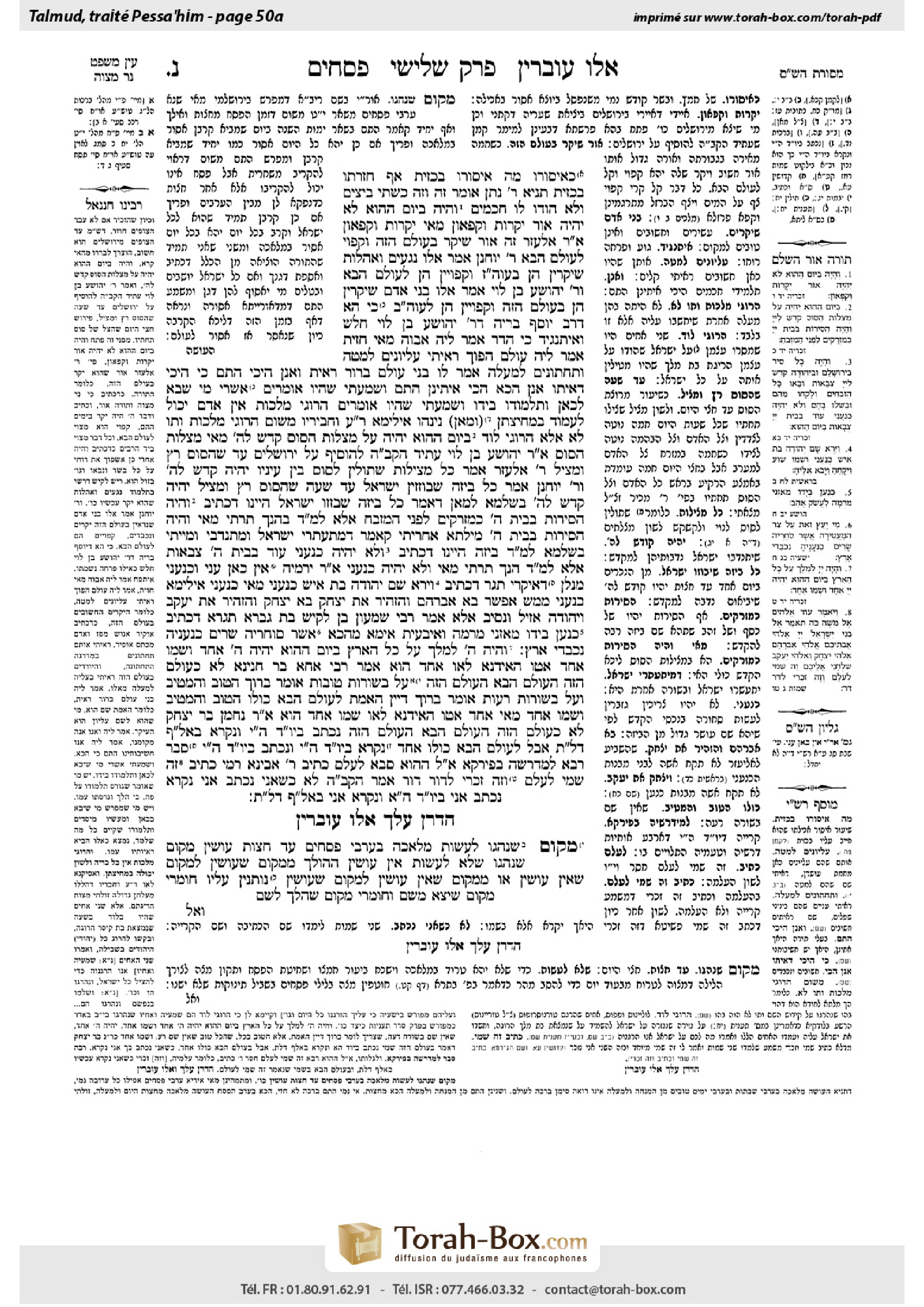
Pesachim 50a: Talmud study for Daf Yomi
Daf Yomi is the daily study of one Talmud folio. Explore 37 tractates with scans, Hebrew text, Sefaria English and AI-generated French translations where annotated.
Passage selection and English or AI-generated French translation are available where the scan has annotations. Daf Study is independent of Torah-Box and Sefaria.
Browse Pesachim · פסחים · All tractatesPesachim 50a text and translations
This page of Pesachim includes the Aramaic text, an English translation and an AI-generated French translation, alongside the scan above.
פסחים נ׳ א · Aramaic and Hebrew text
כְּאִיסּוּרוֹ: מָה אִיסּוּרוֹ בִּכְזַיִת, אַף חֲזָרָתוֹ בִּכְזַיִת.
תַּנְיָא, רַבִּי נָתָן אוֹמֵר: זֶה וְזֶה כִּשְׁתֵּי בֵיצִים, וְלֹא הוֹדוּ לוֹ חֲכָמִים.
״וְהָיָה בַּיּוֹם הַהוּא לֹא יִהְיֶה אוֹר יְקָרוֹת וְקִפָּאוֹן״. מַאי ״יְקָרוֹת וְקִפָּאוֹן״?
אָמַר רַבִּי אֶלְעָזָר: זֶה אוֹר שֶׁיָּקָר בָּעוֹלָם הַזֶּה, וְקָפוּי לָעוֹלָם הַבָּא.
רַבִּי יוֹחָנָן אָמַר: אֵלּוּ נְגָעִים וְאֹהָלוֹת, שֶׁיְּקָרִין הֵן בָּעוֹלָם הַזֶּה, וּקְפוּיִין הֵן לָעוֹלָם הַבָּא.
וְרַבִּי יְהוֹשֻׁעַ בֶּן לֵוִי אָמַר: אֵלּוּ בְּנֵי אָדָם שֶׁיְּקָרִין הֵן בָּעוֹלָם הַזֶּה, וּקְפוּיִין הֵן לָעוֹלָם הַבָּא. כִּי הָא דְּרַב יוֹסֵף בְּרֵיהּ דְּרַבִּי יְהוֹשֻׁעַ בֶּן לֵוִי חֲלַשׁ וְאִיתְנְגִיד, כִּי הֲדַר, אֲמַר לֵיהּ אֲבוּהּ: מַאי חֲזֵית? אֲמַר לֵיהּ: עוֹלָם הָפוּךְ רָאִיתִי, עֶלְיוֹנִים לְמַטָּה, וְתַחְתּוֹנִים לְמַעְלָה. אָמַר לוֹ: בְּנִי, עוֹלָם בָּרוּר רָאִיתָ. וַאֲנַן הֵיכִי הָתָם? כִּי הֵיכִי דְּאִיתוּ אֲנַן הָכָא, הָכִי אִיתִינַן הָתָם.
וְשָׁמַעְתִּי שֶׁהָיוּ אוֹמְרִים: אַשְׁרֵי מִי שֶׁבָּא לְכָאן וְתַלְמוּדוֹ בְּיָדוֹ. וְשָׁמַעְתִּי שֶׁהָיוּ אוֹמְרִים: הֲרוּגֵי מַלְכוּת אֵין אָדָם יָכוֹל לַעֲמוֹד בִּמְחִיצָתָן.
(וּמַאן) נִינְהוּ? אִילֵימָא רַבִּי עֲקִיבָא וַחֲבֵירָיו — מִשּׁוּם הֲרוּגֵי מַלְכוּת וְתוּ לָא?! אֶלָּא: הֲרוּגֵי לוֹד.
״בַּיּוֹם הַהוּא יִהְיֶה עַל מְצִלּוֹת הַסּוּס קֹדֶשׁ לַה׳״. מַאי ״מְצִלּוֹת הַסּוּס״?
אָמַר רַבִּי יְהוֹשֻׁעַ בֶּן לֵוִי: עָתִיד הַקָּדוֹשׁ בָּרוּךְ הוּא לְהוֹסִיף עַל יְרוּשָׁלַיִם עַד שֶׁהַסּוּס רָץ וּמֵצֵיל.
רַבִּי אֶלְעָזָר אָמַר: כׇּל מְצִילּוֹת שֶׁתּוֹלִין לַסּוּס בֵּין עֵינָיו — יִהְיֶה קֹדֶשׁ לַה׳.
וְרַבִּי יוֹחָנָן אָמַר: כׇּל בִּיזָּה שֶׁבּוֹזְזִין יִשְׂרָאֵל עַד שָׁעָה שֶׁהַסּוּס רָץ וּמֵצֵיל — יִהְיֶה קֹדֶשׁ לַה׳.
בִּשְׁלָמָא לְמַאן דְּאָמַר כׇּל בִּיזָּה שֶׁבָּזְזוּ יִשְׂרָאֵל, הַיְינוּ דִּכְתִיב: ״וְהָיָה הַסִּירוֹת בְּבֵית ה׳ כַּמִּזְרָקִים לִפְנֵי הַמִּזְבֵּחַ״. אֶלָּא לְמַאן דְּאָמַר בְּהָנָךְ תַּרְתֵּי, מַאי ״וְהָיָה הַסִּירוֹת בְּבֵית ה׳״? מִילְּתָא אַחֲרִיתִי קָאָמַר, דְּמִתְעַתְּרִי יִשְׂרָאֵל וּמִתְנַדְּבִי וּמַיְיתִי.
בִּשְׁלָמָא לְמַאן דְּאָמַר בִּיזָּה, הַיְינוּ דִּכְתִיב: ״וְלֹא יִהְיֶה כְנַעֲנִי עוֹד בְּבֵית ה׳ צְבָאוֹת״. אֶלָּא לְמַאן דְּאָמַר הָנָךְ תַּרְתֵּי, מַאי ״וְלֹא יִהְיֶה כְנַעֲנִי״? אָמַר רַבִּי יִרְמְיָה: אֵין כָּאן עָנִי.
וּכְנַעֲנִי מְנָלַן דְּאִיקְּרִי תַּגָּר? דִּכְתִיב: ״וַיַּרְא שָׁם יְהוּדָה בַּת אִישׁ כְּנַעֲנִי״. מַאי ״כְּנַעֲנִי״? אִילֵּימָא כְּנַעֲנִי מַמָּשׁ, אֶפְשָׁר בָּא אַבְרָהָם וְהִזְהִיר אֶת יִצְחָק, בָּא יִצְחָק וְהִזְהִיר אֶת יַעֲקֹב, וִיהוּדָה אָזֵיל וְנָסֵיב?! אֶלָּא אָמַר רַבִּי שִׁמְעוֹן בֶּן לָקִישׁ: בַּת גַּבְרָא תַּגָּרָא, דִּכְתִיב: ״כְּנַעַן בְּיָדוֹ מֹאזְנֵי מִרְמָה״. וְאִיבָּעֵית אֵימָא מֵהָכָא: ״אֲשֶׁר סוֹחֲרֶיהָ שָׂרִים כִּנְעָנֶיהָ נִכְבַּדֵּי אָרֶץ״.
״וְהָיָה ה׳ לְמֶלֶךְ עַל כׇּל הָאָרֶץ בַּיּוֹם הַהוּא יִהְיֶה ה׳ אֶחָד וּשְׁמוֹ אֶחָד״. אַטּוּ הָאִידָּנָא לָאו אֶחָד הוּא?
אָמַר רַבִּי אַחָא בַּר חֲנִינָא: לֹא כָּעוֹלָם הַזֶּה הָעוֹלָם הַבָּא. הָעוֹלָם הַזֶּה, עַל בְּשׂוֹרוֹת טוֹבוֹת אוֹמֵר: ״בָּרוּךְ הַטּוֹב וְהַמֵּטִיב״, וְעַל בְּשׂוֹרוֹת רָעוֹת אוֹמֵר: ״בָּרוּךְ דַּיַּין הָאֱמֶת״. לָעוֹלָם הַבָּא, כּוּלּוֹ ״הַטּוֹב וְהַמֵּטִיב״.
״וּשְׁמוֹ אֶחָד״. מַאי ״אֶחָד״? אַטּוּ הָאִידָּנָא לָאו שְׁמוֹ אֶחָד הוּא?
אָמַר רַב נַחְמָן בַּר יִצְחָק: לֹא כָּעוֹלָם הַזֶּה הָעוֹלָם הַבָּא. הָעוֹלָם הַזֶּה, נִכְתַּב בְּיוֹד הֵי וְנִקְרָא בְּאָלֶף דָּלֶת. אֲבָל לָעוֹלָם הַבָּא כּוּלּוֹ אֶחָד, נִקְרָא בְּיוֹד הֵי וְנִכְתַּב בְּיוֹד הֵי.
סְבַר רָבָא לְמִדְרְשַׁהּ בְּפִירְקָא, אֲמַר לֵיהּ הָהוּא סָבָא: ״לְעַלֵּם״ כְּתִיב.
רַבִּי אֲבִינָא רָמֵי: כְּתִיב ״זֶה שְּׁמִי לְעֹלָם״ — ״וְזֶה זִכְרִי לְדוֹר דּוֹר״. אָמַר הַקָּדוֹשׁ בָּרוּךְ הוּא: לֹא כְּשֶׁאֲנִי נִכְתָּב, אֲנִי נִקְרָא. נִכְתָּב אֲנִי בְּיוֹד הֵא, וְנִקְרָא אֲנִי בְּאָלֶף דָּלֶת.
הַדְרָן עֲלָךְ אֵלּוּ עוֹבְרִין
מַתְנִי׳ מָקוֹם שֶׁנָּהֲגוּ לַעֲשׂוֹת מְלָאכָה בְּעַרְבֵי פְסָחִים עַד חֲצוֹת — עוֹשִׂין. מָקוֹם שֶׁנָּהֲגוּ שֶׁלֹּא לַעֲשׂוֹת — אֵין עוֹשִׂין. הַהוֹלֵךְ מִמָּקוֹם שֶׁעוֹשִׂין לְמָקוֹם שֶׁאֵין עוֹשִׂין, אוֹ מִמָּקוֹם שֶׁאֵין עוֹשִׂין לְמָקוֹם שֶׁעוֹשִׂין — נוֹתְנִין עָלָיו חוּמְרֵי מָקוֹם שֶׁיָּצָא מִשָּׁם וְחוּמְרֵי מָקוֹם שֶׁהָלַךְ לְשָׁם.
Pesachim 50a · English translation
is analogous to its prohibition. Just as its prohibition is only when it is the size of an olive-bulk, so too, the requirement to return it is only when it is the size of an olive-bulk.
Another opinion on this issue was taught in a baraita. Rabbi Natan says: The minimum measure for both this and that, leaven and sacrificial meat, is two egg-bulks of prohibited material, but the Rabbis did not agree with him.
Incidental to the discussion of leaving Jerusalem and its surrounding area, the Gemara cites expositions of a prophetic passage, including a statement that God will eventually expand the boundaries of Jerusalem. The verse states: “And it shall come to pass on that day that there shall not be light, but heavy clouds [yekarot] and thickness [vekippaon]” (Zechariah 14:6). The Gemara asks: What is the meaning of the expression “yekarot vekippaon”?
Rabbi Elazar said: This is the light currently provided by the sun, which is significant [yakar] in this world and insignificant [kafuy] in the World-to-Come, when the moon will shine as brightly as the sun does now and the sun will be seven times brighter than it is currently.
Rabbi Yoḥanan said: This expression refers to the tractates of Nega’im and Oholot, which are weighty [yekarim] owing to their difficulty in this world, as they are among the most complex subjects, but will be easy [kefuyin] in the World-to-Come, when people will be much wiser.
And Rabbi Yehoshua ben Levi said: These are people who are considered important [yekarim] in this world and unimportant [kefuyim] in the World-to-Come. This is like the incident involving Rav Yosef, son of Rabbi Yehoshua ben Levi, who became ill and was about to expire. When he returned to good health, his father said to him: What did you see when you were about to die? He said to him: I saw an inverted world. Those above, i.e., those who are considered important in this world, were below, insignificant, while those below, i.e., those who are insignificant in this world, were above. He said to him: My son, you have seen a clear world. The world you have seen is the true world, as in that world people’s standings befit them. Rabbi Yehoshua ben Levi asked: And where are we, the Torah scholars, there? Rav Yosef responded: Just as we are regarded here, so are we regarded there.
Rav Yosef added: And I heard that they were saying in that world: Praiseworthy is the one who arrives here with his studies in hand. And I also heard that they were saying: Those executed by the government enjoy such an exalted status that no one can stand in their enclosure.
The Gemara asks: And who are these martyrs that Rav Yosef was referring to? If you say that he was referring to Rabbi Akiva and his colleagues, who were martyred, this cannot be: Is their elevated status due only to the fact that they were martyred by the Roman government and nothing more? These men were exceptional in their piety and sanctity during their lives as well. Rather, it is referring to the martyrs of Lod, Pappos and Luliyanos, who gave themselves up to be martyred for the sake of the Jewish people. They falsely admitted to killing the king’s daughter in order to prevent a harsh decree from being issued against the entire community. Although they were not known for exceptional piety before that event, they are considered to be extremely holy due to their martyrdom.
The Gemara continues to expound the section of the book of Zechariah cited above. The verse states: “On that day there shall be upon the bells of the horses [metzillot hasus]: Holy unto the Lord” (Zechariah 14:20). The Gemara asks: What is the meaning of the expression metzillot hasus?
Rabbi Yehoshua ben Levi said: In the future the Holy One, Blessed be He, will extend Jerusalem by as much as the distance that a horse can run the entire time it casts a shadow [metzeil]. Jerusalem will be so large that a horse running from one side of the city in the morning will not arrive at the other end of the city until midday, when its shadow will have disappeared.
Rabbi Elazar said: All decorative bells [metzillot] that one hangs between the eyes of a horse will be sanctified to God, i.e., they will be consecrated for the Temple treasury.
And Rabbi Yoḥanan said: All spoils that the Jewish people will take from gentiles who wage war against them, up to the time a horse runs and casts a shadow [metzeil], i.e., half a day, will be sanctified for God.
The Gemara asks: Granted, according to the one who said that this expression refers to all spoils that the Jewish people will take, this is as it is written in the continuation of the verse, which mentions additional treasure donated to the Temple: “And the pots in the Lord’s house shall be like the basins before the altar.” However, according to the ones who said these other two explanations, what is the meaning of: “And the pots in the Lord’s house”? The Gemara explains that according to these opinions the verse is saying something else: It is prophesying that in the future the Jewish people will become wealthy and bring donations to the Temple.
The Gemara goes on to ask: Granted, according to the one who said that this expression refers to spoils, this is as it is written in the next verse: “And on that day there shall no longer be a merchant [kena’ani] in the house of the Lord of hosts” (Zechariah 14:21), as he will no longer be needed. However, according to the ones who said these other two explanations, what is the meaning of the expression: “There shall no longer be a merchant”? Rabbi Yirmeya said: The word kena’ani is in fact a contraction of the phrase: There is no poor person here [ein kan ani]. In other words, there will no longer be poor people, and therefore the Jews themselves will be able to donate whatever is needed in the Temple (Maharsha).
And from where do we derive that a merchant can be called a kena’ani? As it is written: “And Judah saw there the daughter of a certain kena’ani…and he took her, and went in unto her” (Genesis 38:2). What is the meaning of the word kena’ani in this context? If you say it refers to an actual Canaanite, is it possible that Abraham warned Isaac not to marry a Canaanite woman, and Isaac warned Jacob to the same effect, and nonetheless Judah went and married a Canaanite woman? Rather, Rabbi Shimon ben Lakish said: She was the daughter of a merchant, as it is written: “As for the merchant [kena’an], the balances of deceit are in his hand. He loves to oppress” (Hosea 12:8). And if you wish, say instead that this meaning of the word can be understood from the following verse, which describes Tyre: “Whose traders are princes, whose merchants [kinaneha] are the honorable of the earth” (Isaiah 23:8).
The Gemara cites another verse from the prophecy at the end of the book of Zechariah: “And the Lord shall be King over all the earth, on that day shall the Lord be one and His name one” (Zechariah 14:9). The Gemara asks: Is that to say that now He is not one?
Rabbi Aḥa bar Ḥanina said: The World-to-Come is not like this world. In this world, upon good tidings one recites: Blessed…Who is good and does good, and over bad tidings one recites: Blessed…the true Judge. In the World-to-Come one will always recite: Blessed…Who is good and does good. There will be only one mode of blessing God for tidings.
The verse states: “On that day shall the Lord be one and His name one.” The Gemara asks: What is the meaning of the word one in this context? Is that to say that now His name is not one?
Rav Naḥman bar Yitzḥak said: The World-to-Come is not like this world. In this world, God’s name that is written with the letters yod and heh is read as Adonai, which begins with the letters alef and dalet. God’s name is not pronounced in the same way as it is written. However, in the World-to-Come it will all be one, as God’s name will be both read with the letters yod and heh and written with the letters yod and heh.
Rava thought to expound upon the correct punctuation and enunciation of the name of God during his public lecture before one of the Festivals. A certain old man said to him: The word forever is written in the verse: “This is My name forever [le’olam]” (Exodus 3:15) without the letter vav, such that it can be read le’alem, to conceal, meaning that the name should be concealed.
Rabbi Avina raised a contradiction: It is written in the verse: “This is My name forever,” implying a requirement to conceal the name of God, and in the very next phrase it states: “And this is My memorial unto all generations” (Exodus 3:15), which indicates that the name of God is to be publicized and remembered by all. Rather, the Holy One, Blessed be He, said: I, i.e., My name, is not read as I am written. I am written with the letters yod and heh, and I am read with the letters alef and dalet.
MISHNA: In a place where the people were accustomed to perform labor on Passover eve until midday, one may do so on that day. In a place where the people were accustomed not to perform labor, one may not do so. The performance of labor on the eve of Passover is not prohibited by Torah law, but is dependent on local custom. If one travels from a place where people perform labor on Passover eve to a place where people do not perform labor, or from a place where people do not perform labor on Passover eve to a place where people perform labor, the Sages impose upon him the stringencies of both the place from which he left and the stringencies of the place to which he went. In both cases, he may not perform labor.
Pesachim 50a · Traduction française (IA)
est analogue à son interdiction. De même que l’interdiction ne s’applique qu’à partir du volume d’une olive, de même, l’obligation de le restituer ne s’applique qu’à partir du volume d’une olive.
Une autre opinion sur cette question a été enseignée dans une baraïta. Rabbi Natan dit : La mesure minimale est de deux volumes d’œuf de matière interdite, tant pour le levain que pour la viande sacrificielle, mais les Sages ne furent pas d’accord avec lui.
À propos de la discussion sur le fait de quitter Jérusalem et ses environs, la Guemara cite des interprétations d’un passage prophétique, notamment une déclaration selon laquelle Dieu élargira un jour les limites de Jérusalem. Le verset dit : « En ce jour, il n’y aura pas de lumière, mais des nuées précieuses [yekarot] et épaisses [vekippaon] » (Zacharie 14:6). La Guemara demande : Que signifie l’expression « yekarot vekippaon » ?
Rabbi Elazar dit : Il s’agit de la lumière actuellement dispensée par le soleil, qui est précieuse [yakar] dans ce monde et insignifiante [kafuy] dans le Monde à venir, lorsque la lune brillera autant que le soleil brille aujourd’hui et que le soleil sera sept fois plus brillant qu’à présent.
Rabbi Yoḥanan dit : Cette expression désigne les traités de Negaïm et de Ohalot, qui sont ardus [yekarim] dans ce monde en raison de leur difficulté, car ils comptent parmi les sujets les plus complexes, mais seront faciles [kefuyin] dans le Monde à venir, lorsque les gens seront beaucoup plus sages.
Et Rabbi Yehoshua ben Levi dit : Il s’agit des personnes considérées comme importantes [yekarim] dans ce monde et insignifiantes [kefuyim] dans le Monde à venir. Cela rappelle l’histoire de Rav Yosef, fils de Rabbi Yehoshua ben Levi, qui tomba malade et était sur le point de mourir. Lorsqu’il recouvra la santé, son père lui demanda : « Qu’as-tu vu lorsque tu étais sur le point de mourir ? » Il lui répondit : « J’ai vu un monde renversé. Ceux qui étaient en haut, c’est-à-dire ceux qui sont considérés comme importants dans ce monde, étaient en bas, insignifiants, tandis que ceux qui étaient en bas, c’est-à-dire ceux qui sont insignifiants dans ce monde, étaient en haut. » Son père lui dit : « Mon fils, tu as vu un monde clair. Le monde que tu as vu est le monde véritable, car, dans ce monde-là, la position des gens leur convient. » Rabbi Yehoshua ben Levi demanda : « Et nous, les érudits de la Torah, où sommes-nous là-bas ? » Rav Yosef répondit : « Nous sommes considérés là-bas comme nous le sommes ici. »
Rav Yosef ajouta : « J’ai entendu dire que, là-bas, on disait : “Heureux celui qui arrive ici avec ses études en main.” J’ai également entendu dire : “Ceux qui ont été exécutés par le gouvernement jouissent d’un statut si élevé que nul ne peut se tenir dans leur enceinte.” »
La Guemara demande : « Et quels sont ces martyrs auxquels Rav Yosef faisait allusion ? » Si tu dis qu’il parlait de Rabbi Akiva et de ses compagnons, qui furent martyrisés, cela ne peut convenir : leur statut élevé tient-il uniquement au fait qu’ils furent martyrisés par le gouvernement romain, et à rien d’autre ? Ces hommes étaient également exceptionnels par leur piété et leur sainteté de leur vivant. Il s’agit plutôt des martyrs de Lod, Pappos et Luliyanos, qui se livrèrent eux-mêmes au martyre pour le bien du peuple juif. Ils avouèrent faussement avoir tué la fille du roi afin d’empêcher qu’un décret sévère ne soit prononcé contre toute la communauté. Bien qu’ils n’aient pas été réputés pour leur piété exceptionnelle avant cet événement, leur martyre leur vaut d’être considérés comme extrêmement saints.
La Guemara poursuit l’interprétation du passage du livre de Zacharie cité plus haut. Le verset dit : « En ce jour, il y aura sur les clochettes des chevaux [metzillot hasus] : “Saint au Seigneur” » (Zacharie 14:20). La Guemara demande : Que signifie l’expression « metzillot hasus » ?
Rabbi Yehoshua ben Levi dit : À l’avenir, le Saint, béni soit-Il, agrandira Jérusalem d’une distance égale à celle qu’un cheval peut parcourir pendant toute la durée où il projette une ombre [metzeil]. Jérusalem sera si vaste qu’un cheval qui partira d’un côté de la ville le matin n’atteindra l’autre extrémité qu’à midi, lorsque son ombre aura disparu.
Rabbi Elazar dit : Toutes les clochettes décoratives [metzillot] que l’on suspend entre les yeux d’un cheval seront consacrées à Dieu, c’est-à-dire affectées au trésor du Temple.
Et Rabbi Yoḥanan dit : Tout le butin que le peuple juif prendra aux nations qui lui feront la guerre, jusqu’à ce qu’un cheval ait couru et projeté une ombre [metzeil], c’est-à-dire pendant une demi-journée, sera consacré à Dieu.
La Guemara demande : Il est compréhensible, selon celui qui dit que cette expression désigne tout le butin que prendra le peuple juif, que la suite du verset mentionne d’autres trésors offerts au Temple : « Et les chaudrons de la maison du Seigneur seront comme les bassins devant l’autel. » Mais, selon ceux qui proposent les deux autres interprétations, que signifie : « Et les chaudrons de la maison du Seigneur » ? La Guemara explique que, selon ces avis, le verset dit autre chose : il prophétise qu’à l’avenir le peuple juif s’enrichira et apportera des dons au Temple.
La Guemara demande ensuite : Il est compréhensible, selon celui qui dit que cette expression désigne le butin, que le verset suivant dise : « Et en ce jour, il n’y aura plus de marchand [kena’ani] dans la maison du Seigneur des armées » (Zacharie 14:21), puisqu’on n’aura plus besoin de lui. Mais, selon ceux qui proposent les deux autres interprétations, que signifie l’expression : « Il n’y aura plus de marchand » ? Rabbi Yirmeya dit : Le mot kena’ani est en réalité la contraction de la phrase : « Il n’y a pas de pauvre ici » [ein kan ani]. Autrement dit, il n’y aura plus de pauvres et les Juifs eux-mêmes pourront donc donner tout ce qui est nécessaire au Temple (Maharsha).
Et d’où apprenons-nous qu’un marchand peut être appelé kena’ani ? Car il est écrit : « Juda y vit la fille d’un certain kena’ani… et il la prit et s’unit à elle » (Genèse 38:2). Que signifie le mot kena’ani dans ce contexte ? Si tu dis qu’il désigne un véritable Cananéen, est-il possible qu’Abraham ait averti Isaac de ne pas épouser une Cananéenne, qu’Isaac ait averti Jacob de même, et que Juda soit néanmoins allé épouser une Cananéenne ? Rabbi Shimon ben Lakish dit plutôt : Elle était la fille d’un marchand, comme il est écrit : « Quant au marchand [kena’an], les balances trompeuses sont dans sa main ; il aime opprimer » (Osée 12:8). Et si tu le souhaites, tu peux plutôt dire que ce sens du mot se comprend à partir du verset suivant, qui décrit Tyr : « Ses marchands sont des princes, ses commerçants [kinaneha] sont les plus honorables de la terre » (Isaïe 23:8).
La Guemara cite un autre verset de la prophétie qui conclut le livre de Zacharie : « Et le Seigneur sera roi sur toute la terre ; en ce jour, le Seigneur sera un et Son nom sera un » (Zacharie 14:9). La Guemara demande : Cela voudrait-il dire qu’à présent Il n’est pas un ?
Rabbi Aḥa bar Ḥanina dit : Le Monde à venir ne ressemble pas à ce monde. Dans ce monde, lorsqu’on reçoit une bonne nouvelle, on récite : « Béni soit Celui qui est bon et fait le bien », et, à l’annonce d’une mauvaise nouvelle, on récite : « Béni soit le Juge véritable ». Dans le Monde à venir, on récitera toujours : « Béni soit Celui qui est bon et fait le bien ». Il n’y aura qu’une seule manière de bénir Dieu à l’annonce d’une nouvelle.
Le verset dit : « En ce jour, le Seigneur sera un et Son nom sera un. » La Guemara demande : Que signifie ici le mot « un » ? Cela voudrait-il dire qu’à présent Son nom n’est pas un ?
Rav Naḥman bar Yitzḥak dit : Le Monde à venir ne ressemble pas à ce monde. Dans ce monde, le nom de Dieu, écrit avec les lettres yod et heh, se lit Adonaï, qui commence par les lettres alef et dalet. Le nom de Dieu ne se prononce pas comme il s’écrit. Mais, dans le Monde à venir, tout sera un, car le nom de Dieu se lira avec les lettres yod et heh et s’écrira avec les lettres yod et heh.
Rava s’apprêtait à exposer la vocalisation et la prononciation correctes du nom de Dieu lors de son enseignement public, avant l’une des fêtes. Un certain vieillard lui dit : Le mot « éternellement » est écrit dans le verset « Tel est Mon nom pour l’éternité [le’olam] » (Exode 3:15) sans la lettre vav, si bien qu’on peut le lire le’alem, « cacher », ce qui signifie que le nom doit être caché.
Rabbi Avina souleva une contradiction : Le verset dit « Tel est Mon nom pour l’éternité », ce qui implique qu’il faut cacher le nom de Dieu, et la phrase suivante dit pourtant : « Et tel est Mon souvenir pour toutes les générations » (Exode 3:15), ce qui indique que le nom de Dieu doit être rendu public et rappelé par tous. Le Saint, béni soit-Il, dit plutôt : « Moi, c’est-à-dire Mon nom, ne se lis pas comme Je m’écris. Je m’écris avec les lettres yod et heh, et Je me lis avec les lettres alef et dalet. »
Michna : Dans un lieu où les gens ont coutume de travailler la veille de Pessa’h jusqu’à la mi-journée, on peut travailler ce jour-là. Dans un lieu où les gens ont coutume de ne pas travailler, on ne peut pas travailler. Le travail de la veille de Pessa’h n’est pas interdit par la Torah, mais dépend de la coutume locale. Celui qui se rend d’un lieu où l’on travaille la veille de Pessa’h vers un lieu où l’on ne travaille pas, ou d’un lieu où l’on ne travaille pas la veille de Pessa’h vers un lieu où l’on travaille, les Sages lui imposent les rigueurs du lieu qu’il a quitté et celles du lieu où il est arrivé. Dans les deux cas, il ne peut pas travailler.
Traduction française générée par IA à partir de l’édition anglaise de Sefaria. Vérifie toujours un passage avec le texte source.
Text from Sefaria: William Davidson Edition - Vocalized Aramaic (CC BY NC); William Davidson Edition - English (CC BY NC).